The most important discovery in Cory Fay’s disappearance came almost ten months after searchers stopped looking for him.
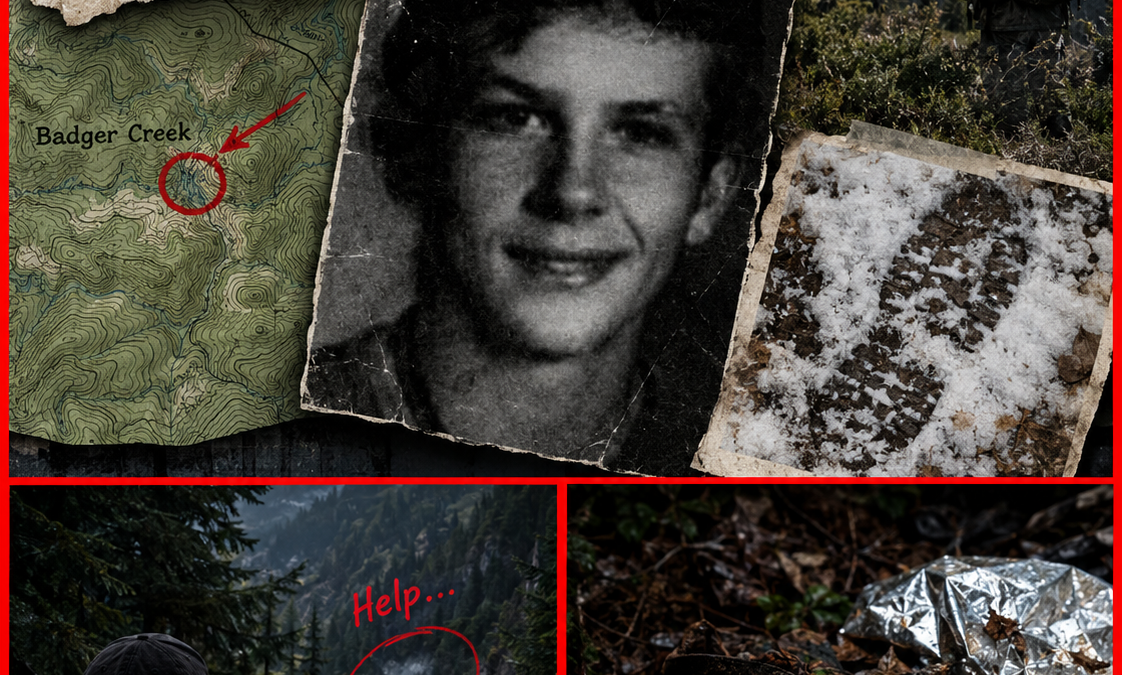
The most important discovery in Cory Fay’s disappearance came almost ten months after searchers stopped looking for him.
On September 16, 1992, a hunter exploring the northern end of Badger Creek Canyon found clothing scattered across the forest floor.
Nearby was a blue backpack.
Inside it, deputies discovered a hunting license and elk tag belonging to Cory.
Another hunter had located a rifle farther downhill, resting upright against a tree.
The belongings finally provided investigators with a definite location connected to the missing teenager.
But they also revealed something nobody had expected.
Cory had apparently traveled far beyond the area where rescuers concentrated their efforts in November 1991.
Search teams returned to the location on September 17 and 18.
They recovered additional clothing and small skeletal remains.
Among the discoveries were a tooth and part of a shoulder blade.
On September 20, a forensic dentist confirmed that the tooth belonged to Cory.
The search for a missing teenager had become an investigation into his death.
Authorities believed exposure was the most likely explanation.
However, the limited remains prevented a completely certain determination of the cause.
The Wasco County Sheriff’s Office found no evidence suggesting foul play.
Yet the location of the remains was difficult to explain.
Cory had disappeared during an elk hunting trip on November 23, 1991.
His remains were discovered eight to ten miles from his last known position and approximately 2,500 feet higher in elevation.
Reaching the location would have required traveling through steep, snowy terrain.
His grandfather was especially troubled by that detail.
Cory had been taught to follow a stream downhill if he became lost.
Instead, the evidence suggested he had moved farther into difficult country.
One theory was that Cory had pursued an elk, lost his bearings, and continued wandering as the weather deteriorated.
Hypothermia could have affected his judgment and ability to navigate.
But investigators could not reconstruct his exact route.
The original search had also produced several unexplained observations.
A tracker reported hearing someone calling for help across a canyon.
The tracker attempted to communicate with the person, but searchers could not locate the voice.
A helicopter equipped with infrared technology later registered something in the area.
A ground search the following morning found nothing.
Investigators eventually concluded that the voice did not belong to Cory, although the documentary does not establish the basis for that conclusion.
The later discovery of his remains did not resolve the uncertainty.
It remained possible that the reported voice had no connection to Cory.
It also remained possible that the searchers had heard someone who was never identified.
What investigators could establish was that Cory had died in the wilderness and that exposure was considered the likely cause.
There was no confirmed evidence of a criminal act.
For his family, the identification ended the uncertainty about whether he was still alive.
But it did not explain why he traveled so far, why his belongings were scattered, or what happened during his final days.
The wilderness had finally revealed where Cory’s journey ended.
It had not revealed every step that brought him there.