82-Year-Old Millionaire Went to a Tow Truck Auction — Then He Saw a Widow Selling Her Last Wrecker
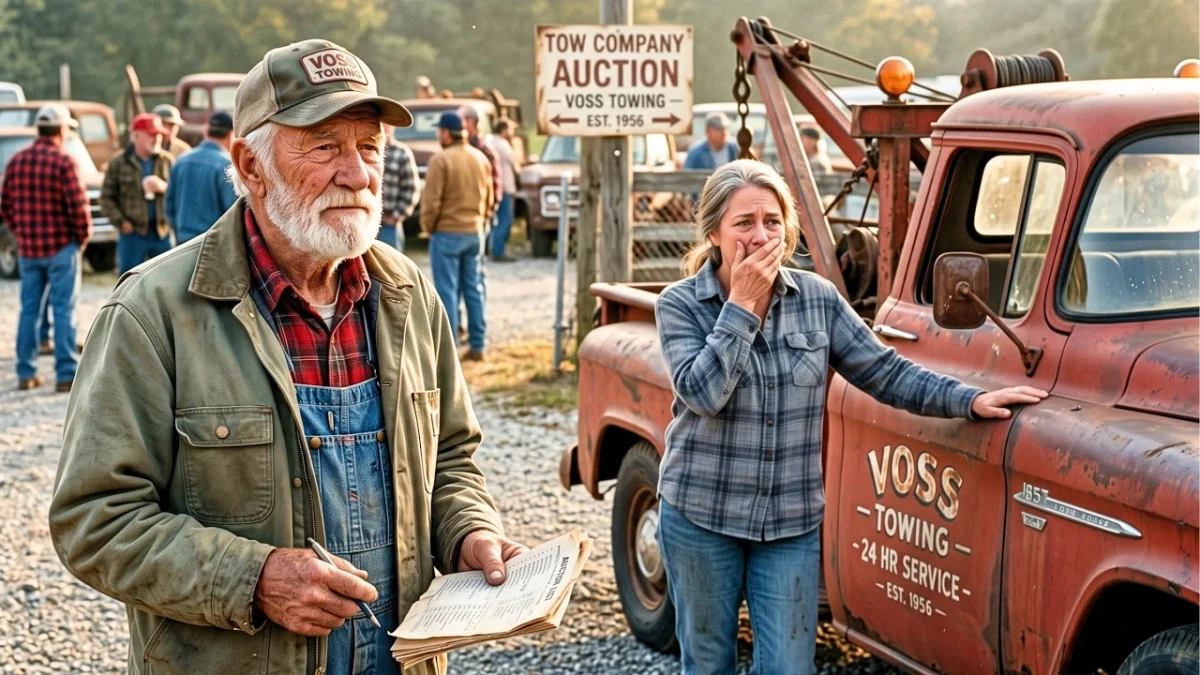
Arthur Callahan was eighty-two years old and worth nearly nineteen million dollars, though no one standing in the dust of a county road in western Missouri would have guessed it.
He drove a twenty-year-old pickup with a dashboard cracked by the summer heat.
He wore faded green work overalls, a muted flannel shirt, heavy boots with worn heels, and a baseball cap that had long since lost its original shape.
To the casual observer, he was just another retired grease-monkey holding onto the past.
In truth, Art had spent half a century building Callahan Towing and Recovery from a single rusted flatbed into a multi-state network of dispatch centers and heavy-duty recovery contracts.
He had sold his primary stake a decade ago, investing the capital into quiet, steady markets that multiplied his wealth far beyond anything a boy working out of a machine shed could have envisioned.
Yet, he still spent his Saturday mornings at liquidation auctions.
He liked the smell of spilled hydraulic fluid, the metallic clatter of snatch blocks being tossed into iron beds, and the crude, stubborn welds made by anonymous mechanics trying to keep a rig running for one more winter.
On this cold September morning, Art pulled his truck onto the gravel shoulder near a small lot on the outskirts of town.
A hand-painted sign nailed to a fence post read: *Voss Towing & Recovery Liquidation Auction — Saturday 9:00 AM*.
The lot was packed with local operators, independent mechanics, and curious neighbors.
Art stepped out of his truck, pulling his jacket tight against the biting wind.
He scanned the rows of machinery: two late-model flatbeds, a light-duty wrecker, a heavy rotator, stacks of tire chains, and wooden pallets loaded with old dispatch radios and grease guns.
Near the end of the line, sitting slightly apart from the modern fleet, was a vehicle listed on the auction paper simply as *Vintage Wrecker, Running Condition*.
Art walked over to the office trailer, where a woman in a thick wool coat stood holding a clipboard.
Her hair was silver, pulled back into a practical knot, and her eyes bore the dark, hollow weight of profound exhaustion.
She was answering questions from potential bidders with quiet dignity, refusing to let her voice shake.
Art stood near a stack of oil drums, listening to two local drivers talking nearby.
“Real shame about Walt,” the first driver said, leaning against a tire stack.
“Cancer took him fast,” the second replied, shaking his head.
“Left Linda with all these loans. He bought that new rotator right before he got sick, thinking he’d land the state highway contract. Then the new company out of Springfield came in and undercut him.”
“So she’s selling it all?”
“Has to. Bank’s holding almost fifty-eight grand in business notes and medical liens. If this auction doesn’t clear it, she loses the house and the yard.”
Art looked back at Linda Voss.
He didn’t know her, and he hadn’t known Walter Voss.
He had lived a long life, long enough to understand that the world was full of quiet tragedies, and a rich man couldn’t go around trying to throw money at every broken heart he stumbled across.
Still, something about the way she stood her ground made him stay.
At nine sharp, the auctioneer climbed onto the flatbed of a trailer and cleared his throat through a portable horn system.
“Alright, folks, settle down! We’re starting with Lot 1, the 2018 International Flatbed!”
The bidding began with loud, rhythmic chants.
Art watched from the edge of the crowd.
The prices were disappointing.
The flatbeds went for thousands below market value.
The light-duty wrecker barely cleared its own lien.
Around noon, Art saw a man in a crisp charcoal suit step up to Linda’s table.
The man held a leather folder and spoke in low, measured tones.
Art casually drifted closer, stopping behind a row of toolboxes.
“Mrs. Voss,” the banker said gently, though his eyes remained strictly professional.
“Based on the numbers so far, the primary assets aren’t reaching the projected valuations. After auction fees, you’re looking at a shortfall of nearly twenty thousand dollars on the primary note.”
Linda swallowed hard, her hand tightening around her pen.
“What does that mean for the property, Mr. Davis?”
“If the final lot doesn’t bridge that gap, the bank will have no choice but to proceed with the collateral attachment on the lot and the residential home by the end of the month.”
“I see,” Linda whispered.
“Thank you for being direct with me.”
She turned away, taking a deep breath to steady herself before looking back toward the crowd.
Art felt a heavy knot form in his chest.
He reached into his pocket, his fingers tracing the edge of his old pocketknife.
“Alright, folks!” the auctioneer hollered, gesturing toward the final machine in the line.
“Lot 14! The last piece of rolling stock today. A 1957 Diamond T vintage wrecker. Hand-painted, single owner for over forty years. Engine turns over, winch is functional. Who’ll give me ten thousand to start?”
The crowd shifted toward the old truck.
It was a brick-red monster with faded yellow lettering on the doors reading *VOSS TOWING & RECOVERY*.
The paint was peeling in long strips, one headlight lens was cracked, and the steel running boards were worn smooth by decades of boots.
Yet, when the yard mechanic stepped into the cab and pulled the starter, the engine roared to life with a deep, thunderous rhythm, settling into an remarkably clean idle.
Art walked up to the side of the truck.
He ran his palm over the heavy steel boom.
He noticed a rough, thick weld along the main iron arm—not a factory finish, but a heavy, deliberate repair made by someone who knew how to melt steel to withstand immense strain.
An older local operator standing beside Art let out a low whistle.
“Walt loved that old pig,” the operator said to Art.
“He could’ve scrapped it twenty years ago, but he kept it running.”
“Why?” Art asked softly.
“Because when a semi went into the muddy ravine off Creek Road, the modern trucks with their fancy computer sensors would cut the winches out to prevent frame torque. Walt would fire up this old Diamond T, anchor it to an oak tree, and drag the load out by brute force. It wasn’t pretty, but it never failed him.”
“Who’ll start at five thousand?” the auctioneer called out, lowering his opening bid.
“Five!” a buyer in the front shouted.
“I got five, do I hear eight?”
“Eight!” another called.
“Ten!”
“Twelve!”
The bidding moved quickly up to sixteen thousand dollars.
Art stepped closer to the center aisle.
He knew the market for vintage utility vehicles; in top restored condition, it might fetch twenty grand to a dedicated collector.
In its current state, eighteen thousand was generous.
“Eighteen thousand to the gentleman in the blue cap!” the auctioneer yelled.
“Do I hear nineteen?”
Art raised his hand calmly.
“Nineteen thousand.”
The auctioneer pointed at Art.
“Nineteen to the gentleman in overalls! Twenty?”
“Twenty!” the rival bidder called back.
Art didn’t hesitate.
“Twenty-one.”
“Twenty-two!”
“Twenty-five,” Art said, his voice dropping an octave, completely steady.
The crowd rustled.
A few men turned to look at Art, whispering among themselves.
“Twenty-five thousand for a ’57 Diamond T?” someone murmured.
“Is he crazy?”
The rival bidder glared at Art, hesitated, and then called out, “Twenty-six!”
“Thirty thousand,” Art announced cleanly.
Silence fell over the lot, broken only by the steady idle of the old diesel engine.
The auctioneer paused, blinking in surprise.
“Thirty… thirty thousand dollars to the man in the green jacket. Sir, looking for thirty-one?”
The rival bidder shook his head, holding up his hands.
“He can have it. It’s not worth half that.”
“Thirty thousand once… thirty thousand twice—”
“Thirty-five,” Art said.
The auctioneer froze.
“Sir? You’re bidding against yourself.”
“I know,” Art replied plainly.
“Make it forty thousand.”
The crowd gasped.
Linda Voss stared at Art from the office trailer steps, her eyes wide with shock.
The banker in the gray suit pulled out his notepad, hurriedly recalculating figures.
“Forty thousand dollars,” the auctioneer stammered, clearing his throat.
“Do I hear forty-one?”
No one spoke.
“Forty-two thousand,” Art said into the silence.
“Forty-five.”
He paused, looked directly at Linda, and then turned back to the auctioneer.
“Forty-six thousand dollars. Final bid.”
“Forty-six thousand dollars!” the auctioneer shouted, slamming his gavel down onto the wooden podium.
“Sold to the gentleman in the back for forty-six thousand dollars!”
The crowd broke into bewildered chatter.
Art walked slowly toward the clerk’s table to sign the bill of sale.
Linda Voss approached him, her hands trembling as she held the paperwork.
“Sir…” she began, her voice strained with emotion.
“I… I don’t understand. That truck… Walter loved it, but it isn’t worth forty-six thousand dollars. Why would you do that?”
Art pulled a worn leather wallet from his overalls, extracting his driver’s license and a bank draft card.
“It was worth it to me, ma’am,” Art said gently.
“I just wanted to make sure the truck found the right owner.”
“Are you a collector?” she asked, wiping a stray tear from her cheek.
“Something like that,” Art replied.
As Linda set the registration papers down on the folding table, her movement shifted a stack of old yellowed documents.
A small wooden picture frame slid into view.
Art’s gaze dropped to the photograph inside.
It showed a young couple standing in front of an earlier version of that same red wrecker.
The woman was clearly a youthful Linda.
The man beside her was broad-shouldered, wearing grease-stained trousers, grinning broadly at the camera.
He had dark, wavy hair, a strong jawline, and a distinct, small pale scar running vertically under the left side of his chin.
Art stopped mid-breath.
The blood seemed to freeze in his veins.
He stared at the man’s face, the scar, the slight tilt of his shoulders.
The background noise of the auctioning of spare parts faded into a low, distant hum.
“Ma’am,” Art said, his voice suddenly thick.
“What was your husband’s full name?”
Linda looked surprised by the question.
“Walter. Walter Eugene Voss.”
“Did he… did he grow up near Miller’s Creek? Over in Lafayette County?”
Linda nodded slowly, her brow furrowing.
“Yes. He lived there until we got married in ’76. How did you know that?”
Art pulled off his shapeless ball cap, holding it in both hands, his knuckles turning white.
He stared at the photograph, Fifty-two years of accumulated memories suddenly collapsing into a single, sharp point of realization.
“My name is Arthur Callahan,” he said softly.
Linda’s eyes widened slightly, a faint spark of recognition crossing her face.
“Callahan? Like… Callahan Towing?”
“Yes,” Art whispered.
“But long before there was a fleet, Mrs. Voss… there was just me, an old space heater, and a rented shed that burnt to the ground.”
Linda gasped, pressing her hand to her mouth.
“Oh… oh my lord. Walt’s mechanic.”
“He remembered me?” Art asked, his voice shaking.
“He talked about you,” Linda said, her eyes filling with fresh tears.
“Not often, but whenever he saw one of your big blue rigs on the interstate, he’d point and say, ‘That boy Art worked hard for every mile of that.'”
Art closed his eyes for a moment, letting the memory sweep over him.
It was the winter of 1974.
Art had been twenty-two years old, flat broke, and desperate.
He had scraped together every dime he earned hauling wrecked cars for an ungrateful boss to buy a single battered flatbed.
He had rented a tiny corner of an uninsulated machine shed to work on his truck at night, dreaming of starting his own operation.
Then, one freezing Tuesday in November, a cheap kerosene heater had malfunctioned.
The fire swept through the shed in minutes.
It didn’t destroy his truck, but it consumed his entire workbench, his specialized diagnostic tools, his spare parts, and left the building a charred, condemned wreck.
The landlord locked the gates.
Art had no insurance, no money to rent a proper commercial bay, and three pending repair jobs that were supposed to pay his rent.
He had sat on the bumper of his truck in the freezing snow, head in his hands, ready to sell the vehicle for scrap and give up entirely.
That was the night Walt Voss had pulled up in his red Diamond T.
Walt was only twenty-six himself back then, running a struggling one-man operation out of a half-acre lot behind his father’s barn.
Walt hadn’t said much.
He had just hopped out of his cab, looked at the burnt shed, and then looked at Art.
*”Get your tools out of the snow, kid,”* Walt had said, spitting into the slush.
*”I’ve got an empty bay in my shop. It’s got concrete floors, a stove, and electricity. You can work out of there till you get back on your feet.”*
For four months, Art had lived in that bay, sleeping on a cot beside his truck, using Walt’s air compressor and Walt’s grease gun.
When spring came, Art had saved enough money to rent his own small garage in town.
Two years later, when Art’s business began to take off, he had written Walt a check for eight hundred dollars—a sum he believed covered every kilowatt of power and every square foot of space he had borrowed.
Walt had accepted the check with a nod, shook Art’s hand, and they had gone their separate ways as their respective businesses grew in different directions.
Art had spent fifty years believing that check had settled the score.
Standing in the dust of the auction lot, looking at Linda, Art felt a profound wave of humility wash over him.
“I thought I paid him back,” Art murmured, looking at his worn boots.
“I sent him a check in 1976.”
An older man in a greasy canvas jacket, who had been listening nearby, stepped forward.
It was Jim Miller, a retired local dispatcher who had worked the county lines for forty years.
“Art,” Jim said quietly, resting a hand on the hood of a nearby tractor.
“You paid him for the electricity, son. But you didn’t know the half of what Walt did that winter.”
Art turned to look at Jim.
“What do you mean?”
“After your shed burned,” Jim explained, “nobody in the county wanted to give work to a twenty-two-year-old kid operating out of a borrowed barn. They thought you were a liability. You remember how suddenly the sheriff’s department started calling you for highway clears that December?”
Art blinked.
“Yeah. I thought… I thought word just got around that I worked fast.”
Jim shook his head, smiling sadly.
“Walt went to see Sheriff Higgins personally. He told Higgins that if your work ever fell short, or if any customer complained about a bill, Voss Towing would cover the cost out of Walt’s own pocket. Walt put his own commercial license on the line to get you on that dispatch list. He vouched for your name when your name wasn’t worth a dime on paper.”
Art felt a lump rise in his throat so sharp it made it hard to breathe.
“He… he never told me that,” Art whispered.
“Walt wasn’t the kind of man to keep a ledger on a friendship,” Jim said.
“He saw a boy about to drown, so he threw him a line. He didn’t expect you to build an empire, Art. He just wanted you to survive the winter.”
Art looked back at the red Diamond T idling smoothly in the yard.
The faded lettering on the door seemed to glow in the pale morning light.
All those years, he had believed his early success was built entirely on his own grit, his late nights, his relentless work ethic.
He had forgotten—or rather, never known—that the foundation of his entire fortune had been held together by the quiet, unearned grace of a man who asked for nothing in return.
Money could pay for kilowatt-hours and square footage.
It could never pay for trust.
It could never pay for a man putting his own reputation on the line for a broke kid with grease under his fingernails.
Linda looked at Art, tears spilling down her cheeks.
“Art… you don’t owe us anything. That was fifty years ago.”
“No, Mrs. Voss,” Art said softly, his voice full of solemn determination.
“I owe him everything. I just didn’t realize it until today.”
Art turned to look at the banker, who was standing nearby, looking slightly embarrassed by the emotional turn of events.
“Mr. Davis,” Art said sharply.
“With my bid of forty-six thousand dollars on the Diamond T, plus the proceeds from the rest of the equipment, what is the exact remaining deficit on Mrs. Voss’s obligations?”
The banker opened his ledger quickly, running a finger down the column.
“With the forty-six thousand factored in… the total remaining medical and business debt is approximately eleven thousand four hundred dollars.”
Art reached into his jacket, pulled out his personal checkbook, and tapped it against his palm.
“I’m writing a check to the bank right now for twelve thousand dollars to clear the remainder of the notes,” Art said cleanly.
“You will release all liens on Mrs. Voss’s home and this property before five o’clock today. Do you understand?”
The banker nodded rapidly.
“Yes, sir. Absolutely.”
“Wait,” Linda protested, stepping forward, her hands outstretched.
“Art, no! I can’t take your charity! That’s too much. I can’t accept that!”
Art held up a gentle hand, looking her dead in the eye.
“It isn’t charity, Linda. It’s an overdue account. It’s just taken fifty-two years to calculate the interest.”
He signed the check with a firm stroke and handed it to the banker.
Then he turned back to Linda.
“Now, about the truck.”
“I can’t take the truck back, Art,” Linda said, wiping her eyes with her sleeve.
“I don’t have a license to operate a recovery vehicle anymore. I can’t afford the commercial insurance, and I don’t have the strength to drag chains through muddy ditches. If it sits here, it’ll just rot, and that would break Walt’s heart.”
Art nodded slowly.
He had expected as much.
He turned his head toward the crowd, looking for a young man he had noticed earlier in the day—a thirty-one-year-old local driver named Caleb Ruiz, who ran a single small flatbed out of the neighboring township.
“Caleb!” Art called out.
The young man stepped forward, looking nervous, wiping his grease-stained hands on his jeans.
“Yes, Mr. Callahan?”
“You were bidding on the light-duty wrecker earlier, weren’t you?” Art asked.
“Yes, sir. But I got outbid. I’m trying to expand my route to take over the county overflow contracts, but I don’t have the capital for a second heavy rig.”
Art gestured toward the red Diamond T.
“I own this truck now,” Art said.
“Here’s the deal. I’m leasing this vehicle to you for one dollar a year.”
Caleb’s mouth dropped open.
“Sir?”
“On three conditions,” Art continued, holding up three fingers.
“First, you maintain it, keep it greased, and use it whenever you need heavy torque on the off-road recoveries that your flatbed can’t handle. Second, you leave Walter’s name painted on that door.”
Caleb looked at the truck, then at Linda, his eyes bright with reverence.
“And the third condition?” Caleb asked softly.
“Third,” Art said, leaning in, “you lease the impound lot behind this house from Mrs. Voss for a fair monthly rent, so she has a steady stream of income coming in every month.”
Caleb didn’t hesitate for a second.
He reached out and shook Art’s hand with a firm, eager grip.
“Mr. Callahan, you got yourself a deal. I’ll treat this rig like my own child, and I’ll keep the Voss name working on these roads.”
Linda stood frozen, looking between Art, Caleb, and the old red truck.
The heavy, crushing shadow of financial ruin that had hung over her for eleven months had vanished in the span of less than thirty minutes.
Her house was saved.
Her debt was gone.
Her land would provide a steady income, and her husband’s legacy would continue to rumble down the highways of Missouri every time a driver in distress needed help.
She walked over to Art, threw her arms around his neck, and wept quietly against his green canvas jacket.
Art wrapped his heavy arms around her, holding her gently, patting her back with a hand that had spent a lifetime turning wrenches.
“Thank you,” she sobbed into his shoulder.
“Thank you, Art.”
“Don’t thank me, Linda,” Art murmured, looking over her shoulder at the photograph sitting on the table.
“Thank Walt. He paid for this fifty years ago.”
By late afternoon, the auction crowd had dispersed.
The gravel lot was quiet again.
The auctioneer packed up his sound system, the banker drove away with his cleared paperwork, and Caleb was over by the Diamond T, carefully inspecting the fluid levels and listening to the steady, comforting thrum of the engine.
Art walked over to his old pickup, opening the door.
He paused, looking back one last time at the old wrecker.
He looked at the rough weld on the boom, the crack in the headlight, and the faded yellow letters of Walter Voss’s name.
He realized then that the townspeople would likely tell a very simple story about this day.
They would say an old millionaire came to town, bought a widow’s worthless truck for double its value, and gave her a fortune out of the goodness of his heart.
They would turn it into a fable about money and grand gestures.
But Art knew the real story was far quieter, far more grounded, and infinitely more profound.
Money hadn’t saved Linda Voss today; grace had.
A grace that had been set in motion in a cold, dark machine shed in 1974 by a young man who had reached out his hand to a stranger simply because it was the right thing to do.
Walt Voss had never lived to see Art become rich.
He had never asked for a reward, never kept score, and never expected his simple act of generosity to ripple across half a century.
He had just given a desperate kid enough room to survive one hard winter.
And now, fifty years later, that cold winter had finally come to an end.
Art climbed into his truck, turned the key, and listened to his own engine roar to life.
He put the truck in gear, pulled out onto the asphalt road, and headed for home, feeling lighter than he had in eighty-two years.
He knew he couldn’t repay Walt Voss.
Some debts were too large, too sacred to ever be canceled out by a financial transaction.
They weren’t meant to be paid back.
They were meant to be passed forward.








