A Dragon Egg Chose Him as Father – The Hunter’s Fire
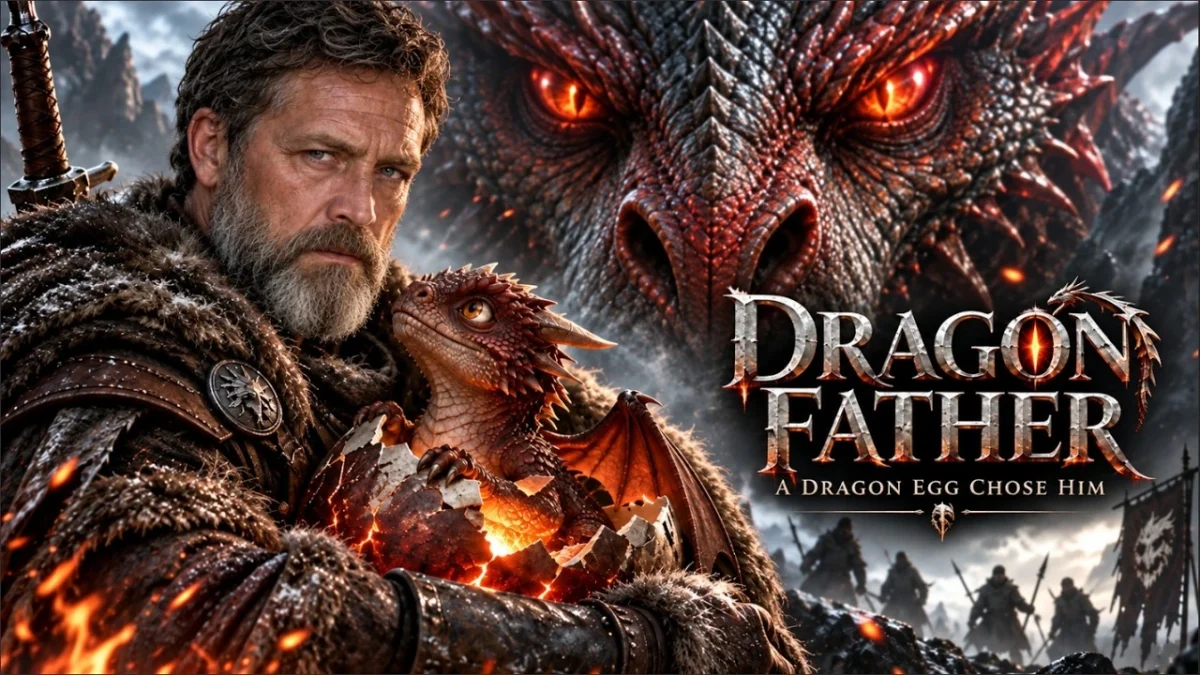
The storm had been building for three days before it broke over the Thornridge Mountains.
Rowan Ashdown did not notice the thunder.
He was too busy running for his life.
Behind him, wings the size of a barn door beat the air into submission, and a roar shook loose stones from the cliff face above him.
The dragon had been guarding this valley for longer than the oldest man in his village could remember, and for longer than that, it had been killing the sheep, the cattle, and twice now, the children who wandered too close to the ravine.
Rowan had come with six other hunters that morning.
He was the only one still standing.
“Turn and face me, little man,” the dragon hissed, her voice a rasp of smoke and gravel.
Rowan did not answer.
He had one arrow left, tipped in the black iron his father had spent a decade forging for exactly this purpose, and he would not waste breath on words the beast did not deserve.
He planted his feet at the mouth of the ravine, where the rock narrowed and her wings could not fully open.
She came anyway, jaws wide, and he loosed the arrow into the soft hollow beneath her throat.
The dragon screamed.
She fell in a heap of scale and smoke, her great body crushing the pines beneath her, and for a long moment the only sound in the valley was Rowan’s own ragged breathing.
He walked closer, half expecting her to rise again.
She did not.
It was then that he saw the nest, tucked into a hollow behind the rocks where she had fallen, lined with dry grass and the tattered remains of a cloak that was not her own.
Inside it sat a single egg, black and gold, warm to the touch even in the cold mountain rain.
Rowan stood over it for a long time.
He thought of the children who would not come home this year because of what slept inside that egg’s mother.
He thought of his own hand on the bow.
But an egg was not the same as a beast, and something in him — some old, stubborn mercy his father had beaten into him alongside the archery — would not let him lift his knife against it.
He wrapped the egg in his cloak and carried it down the mountain instead.
The egg hatched three weeks later, in the middle of the night, in the small stone house at the edge of the village where Rowan lived alone.
He woke to the sound of cracking, and by the light of a single candle he watched a small black head break through the shell, wet and trembling, its eyes gold as a coin.
The hatchling looked at him.
Rowan did not move.
Then the creature, no larger than a barn cat, crawled unsteadily across the table and pressed its head against his hand.
“I am not your mother,” Rowan said quietly.
The dragon made a small sound, something between a chirp and a growl, and curled against his palm as if it had not heard him at all, or did not care.
He named the dragon Kael, after a word in the old tongue that meant fire that does not burn its keeper.
The years that followed were not easy ones.
The village did not trust a hunter who kept a dragon the way other men kept dogs, and for a long time Rowan had to hunt further and further from home just to keep them both fed.
But Kael grew fast, faster than any creature Rowan had ever raised, and within five years he was the size of a horse, within ten the size of a house.
He learned to hunt at Rowan’s side instead of against him, diving from the clouds to drive deer toward the hunter’s waiting bow, curling around the fire at night while Rowan told him stories about the stars.
“Tell me about my mother,” Kael said one evening, when he was old enough that his voice had deepened into something low and resonant, something that made the ground hum when he spoke.
Rowan kept his eyes on the fire.
“She was a dragon of the old ridge,” he said. “Fierce. Proud. She died protecting her territory, the way any mother would.”
“Did you know her?”
“I knew of her,” Rowan said, which was true, and which was also a wall he had built brick by brick for ten years, so carefully that he almost believed it himself.
Kael seemed satisfied by this, and rested his great head against the hunter’s shoulder, and Rowan let himself breathe.
The truth came, as truths often do, from someone who had no reason to be kind about it.
His name was Halric, an old hunter who had been on the mountain that day and had never forgiven Rowan for bringing the egg home instead of destroying it.
He found Kael alone at the river’s edge, grown now to his full height, wings casting shade over half the water.
“Your father tells good stories,” Halric said, stepping out from the trees. “Did he ever tell you the true one? About the ravine, and the black arrow, and the dragon who screamed as she died?”
Kael went very still.
“What are you talking about, old man?”
“I was there,” Halric said. “Six of us went up that mountain to kill your mother. Rowan was the one who put the arrow through her throat. He didn’t save you from anyone, boy. He’s the reason you needed saving at all.”
“You’re lying.”
“Ask him yourself,” Halric said, and walked away, satisfied, into the trees.
Kael did not go home that night.
He flew instead to the ravine where he had been born, where the old bones of his mother still lay scattered and bleached among the rocks, and for the first time in his life, he understood what he was looking at.
He found the broken shaft of an arrow half-buried in the dirt beneath her ribs.
The fletching was black, the same black he had watched Rowan carve a hundred times by firelight, humming to himself as he worked.
Kael let out a sound that cracked the stone around him.
He returned to the village at dawn, and the ground shook with every step, and by the time he reached Rowan’s door the entire village had gathered at a careful distance, because they had never once seen the dragon angry, not truly, not like this.
Rowan stepped outside before Kael could tear the roof away.
“Kael—”
“Is it true?” Kael’s voice was low, and it trembled, which was somehow worse than a roar. “Did you kill my mother?”
Rowan’s silence answered before his words could.
“I did,” he said finally. “I didn’t know about the egg. I only found it after.”
“You let me call you father.” Smoke curled from Kael’s nostrils with every word. “You let me believe you saved me.”
“I did save you,” Rowan said. “That part was never a lie.”
“You murdered my mother and raised me in her ashes!”
“She had killed children, Kael. My own cousin was one of them. I went up that mountain because there was no one left who could stop her, and I have carried what I did every single day since, because it never once felt like a victory to me.”
Kael’s claws dug furrows into the earth.
“That doesn’t make it right.”
“No,” Rowan agreed. “It doesn’t. I never said it did. I only ever tried to make something good grow out of something terrible, because that was the only thing I knew how to do with the guilt.”
For a long moment neither of them spoke, and the whole village held its breath, certain the dragon would burn the house to cinders and the man along with it.
“I should kill you,” Kael said, very quietly.
“Then do it,” Rowan said, and did not step back. “I have loved you every day for eighteen years, Kael. If this is the price of the mountain, I will not run from it.”
Kael’s jaw trembled.
Smoke poured from between his teeth, and the heat of it curled Rowan’s hair, and still the hunter did not move.
“I hate you,” Kael said, and his voice broke on the words like a much younger creature’s might. “I hate you, and I don’t know how to stop loving you at the same time, and I don’t know which of those is going to win.”
“Then let’s find out together,” Rowan said. “Or let’s not. But whatever you choose, you don’t have to choose it alone. You’ve never had to be alone, not since the night you hatched in my hands.”
Kael did not kill him that morning.
Instead he flew, for three days and three nights, further than he had ever flown before, out past the ridge and the coastline and the edge of every map Rowan had ever owned, and the village whispered that the hunter’s dragon was gone for good, and that he had gotten exactly what he deserved.
Rowan did not listen to them.
He sat outside his house each evening and watched the sky, the way he had watched it the night the egg first cracked open, and he waited.
On the fourth night, the sky darkened with wings, and Kael landed hard enough to crack the stones of the yard.
“I flew to the ravine again,” Kael said. “I buried what was left of her, properly this time, the way she deserved.”
“That’s good,” Rowan said carefully. “That’s a good thing to do.”
“I’m not forgiving you,” Kael added. “Not yet. Maybe not for a long time.”
“I’m not asking you to.”
“But I don’t want to be the kind of creature who only knows how to answer blood with more blood,” Kael said, and his gold eyes, so much like the ones that had first opened in candlelight all those years ago, fixed on Rowan’s face. “She would have wanted that from me. And so, I think, would the version of you that carried an egg down a mountain instead of leaving it to die.”
Rowan felt something in his chest loosen for the first time in eighteen years.
“Then what do you want?”
“The truth,” Kael said. “Every piece of it, from now on. No more stories built to spare me.”
“Every piece,” Rowan promised. “I swear it on the fire that raised you.”
Kael lowered his great head until it rested, one final time, against the hunter’s shoulder, and though the wound between them had not closed, something had finally begun, at long last, to heal.
They rebuilt the trust slowly, the way stone walls are rebuilt after a storm, one honest conversation at a time, and in the years that followed, the people of the village stopped whispering about the hunter and his dragon, and started telling a different story instead — one about a father who chose mercy on a mountain he had every reason to leave bloody, and a son who chose forgiveness in a valley he had every reason to burn.
It was not the story either of them had expected to live.
But it was, in the end, the truest one they had.








