A Little Girl Mailed Letters to Heaven for a New Mama — The Postmistress Read One and Came
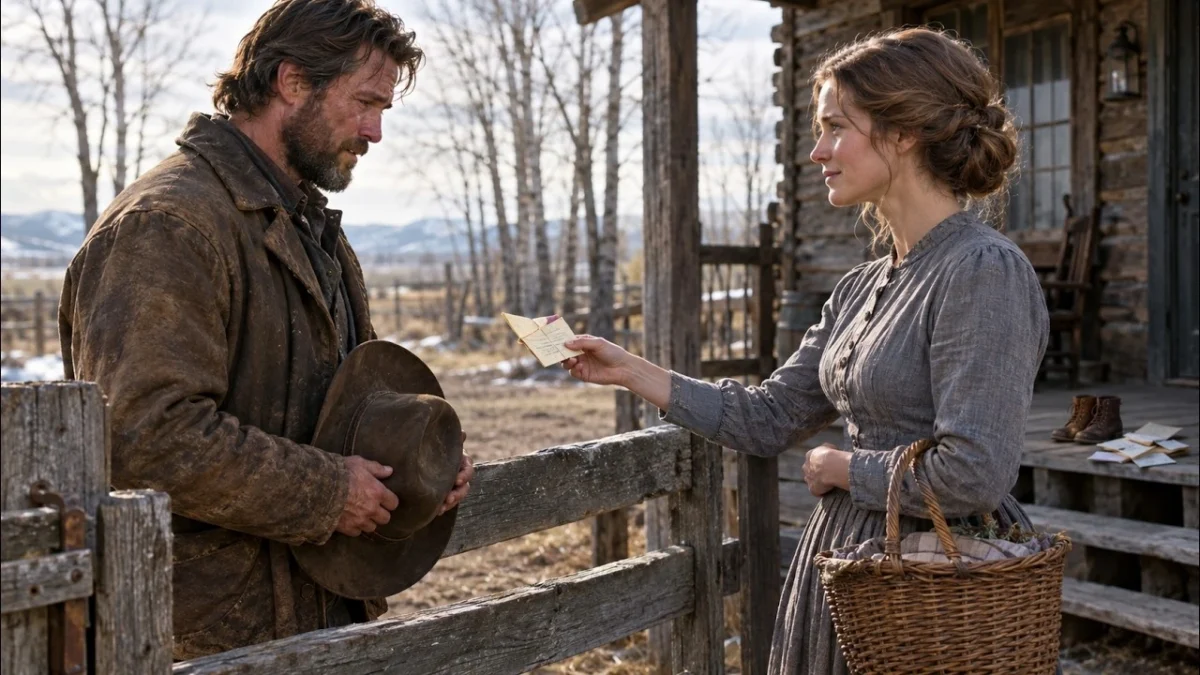
The sun hung low over the prairie town of Heartsome, casting long, pale shadows across the dusty planking of the main street. Inside the small wooden post office, Olive Rundle stood behind her brass-wire window, methodically sorting through the afternoon mail. For eleven winters, Olive had kept her station in Heartsome, maintaining a quiet, solitary life following the death of her husband. She was a woman of precise habits and careful boundaries, knowing that in a small frontier town, a postmistress held the delicate threads of everyone’s private business.
Her thumb moved steadily across envelopes addressed in ink, pencil, and charcoal. But then her fingers caught on a piece of thick, coarse paper, folded unevenly into a crooked little square.
Olive lifted it toward the amber light of the window. There was no postage stamp stuck to the corner. There was no street name, no town, and no return address. On the front, traced in the thick, trembling lines of a child’s lead pencil, were the words: *To Heaven.* Beneath that, in small, carefully printed block letters, it read: *To my mama, wherever the angels keep her.*
A faint smear of dark plum jam stained the corner of the licked flap. The little square felt light as a dried leaf in Olive’s palm, yet as she held it, a heavy stillness settled in her chest.
“You ought to leave it be, Olive,” she whispered to the empty room.
She knew the unwritten law of her trade better than anyone. A letter was sacred ground. In eleven years, she had never pried open a sealed flap or lingered over a postcard longer than was necessary to read the direction. But a letter addressed to heaven had no carrier. It could not go to the dead letter office in Chicago, nor could it be left to rot in an iron bin.
Olive reached for her brass letter opener, her hands steady, though her heart hammered against her ribs. She slid the blade under the flap and parted the paper.
Inside, the pencil lead was faint, smudged where small fingers had pressed hard against the page.
*Dear Mama,*
*I am being good. I brush my own hair now most days, even the snarls in the back. Papa burned the biscuits again this morning, but I ate them all up and did not complain because it makes his face sad when I leave food on the tin. Mama, please ask the angels to send down a new mama for Papa. Papa has gone quiet as a stone and does not laugh anymore like he used to when you were here. A little girl can keep house and wash the plates, but I cannot make a grown man’s laugh come back. I think maybe a wife could do it. I love you.*
*Your girl, Sue D.*
Olive lowered the page onto her wooden counter. The silence of the post office felt suddenly overwhelming, broken only by the dry ticking of the regulator clock on the wall. She sat down hard on her tall wooden stool, her knees feeling strangely weak.
For a long time, she did not pull the cord to open the exterior shutter for callers. She stared at the crooked signature—*Sue D.*—and thought of her own empty home, her own quiet evenings spent beside an oil lamp with only the sound of the wind rattling the glass.
The next morning, Olive walked over to the dry goods store before opening her window. Mrs. Higgins was behind the counter, weighing dried apples into paper bags.
“Morning, Olive,” Mrs. Higgins said, setting down the brass weights. “You look pale today. The chill get to your chest?”
“I am well, Sarah,” Olive replied, keeping her voice even as she rested her hands on the counter. “I only wanted to ask you a small thing. Is there a child in town—a little girl named Sue? Sue D.?”
Mrs. Higgins paused, a handful of apples hovering over the scale. “Sue D.? Oh, you must mean young Sude Pell. Orin Pell’s girl out on the wagon road, past the cottonwoods. Why do you ask?”
“I was only wondering,” Olive said quietly.
“Poor little thing,” Mrs. Higgins sighed, shaking her head. “Lost her mother, Marta, two years ago this coming harvest. Orin’s a good man, works that ranch until his hands bleed, but he’s gone hard and silent as iron since Marta passed. The child keeps his house like a woman grown, and she can’t be more than seven years old. It’d break your heart to see them on Sundays, sitting in that back pew without a word between them.”
Olive thanked her and walked back to the post office. She did not open her window that afternoon. Instead, she locked the front door, went to her living quarters in the rear, and pinned up her best gray wool dress. She placed the small, crooked letter inside a woven willow basket, took her shawl from the peg, and stepped out onto the dirt road that led away from town.
The road to the Pell place stretched long and flat across the prairie, bordered by dry grasses and the pale trunks of cottonwood trees. The wind carried the scent of woodsmoke and damp earth. Olive walked with a firm, deliberate pace, though her mind churned with doubt.
She was thirty-four years old, a widow who had built a small, untouchable sanctuary out of her routine. She had no right to go meddling in the grief of a stranger. Yet, every time she thought of turning back, she remembered the child’s words written in faint lead: *Papa has gone quiet as a stone.*
As she neared the wooden gate of the Pell ranch, she saw a man coming out from behind the barn. He was broad-shouldered and tall, dressed in a faded canvas coat and a sweat-stained hat. His face was lean, darkened by the sun, and shadowed by a thick, dark beard. He walked with a heavy, deliberate tread, his eyes fixed on the ground until he noticed the figure standing by his gate.
Orin Pell stopped, wiping his hands on an oilcloth rag. He looked at Olive with the sharp, guarded caution of a man who had long ceased to expect good news.
“Can I help you, ma’am?” Orin asked, his voice low and rasping, like heavy stones grinding together. “If you’re from the church committee, I’ve already sent my tithe with the deacon.”
Olive held her ground, her fingers tightening on the handle of her basket. “I am not from the church, Mr. Pell. I am Olive Rundle, from the post office.”
Orin frowned slightly, taking a step closer to the fence. “The post office? I don’t owe for any freight, do I?”
“No,” Olive said gently. “You owe nothing. I came because of your daughter. I came because of Sue.”
At the mention of his daughter’s name, something tightened around Orin’s eyes. His jaw set hard. “Has Sude done something wrong in town? She hasn’t been causing trouble, has she?”
“No,” Olive said. “She has done nothing wrong. But she has been sending letters.”
Olive reached into her basket, pulled out the folded square of paper, and held it across the wooden top rail of the gate.
Orin looked down at the scrap. He did not reach out to take it. “Sude gives me pennies for stamps now and then. I thought she was writing to her cousins back in Iowa. I don’t go prying into her little papers.”
“This was not addressed to Iowa, Mr. Pell,” Olive said, her voice steady despite the cool prairie breeze whipping her skirt against her ankles. “It was addressed to heaven. To her mother.”
Orin went entirely still. The air between them seemed to freeze. A dark, painful shadow crossed his face, followed quickly by a flash of rigid pride.
“If it’s a dead letter, you should have burned it,” Orin said, his voice dropping an octave, harsh and strained. “You had no business reading a child’s private thoughts, Mrs. Rundle. And you certainly had no business bringing it out here to stir up things that are settled.”
“They are not settled, Mr. Pell,” Olive replied softly, refusing to look away from his dark gaze. “There is no carrier for heaven in my office. I opened it to find out who had sent it so I might return it. But when I read what she wrote, I realized I could not simply throw it in the fire.”
“Read it then,” Orin snapped, turning his face toward the line of cottonwoods, his hands clenching into fists at his sides. “If you’re so determined to deliver it, read it to me and get it over with. My eyes aren’t much good for pencil mark on scraps.”
Olive unfolded the paper with care. Standing at the gate, with the cold wind rustling the dry weeds around their boots, she read the words aloud in a clear, unhurried voice.
She read about the snarls in the child’s hair. She read about the burned biscuits eaten in silence so as not to make Papa sad. And when she reached the line where the little girl begged her dead mother to send down a new wife so that her father might laugh again, Orin turned completely away.
He lifted one calloused, work-roughened hand and brought it up to cover his mouth. His broad shoulders, which had carried the solitary burden of his farm and his loss without bending for two years, visibly shuddered.
A long, heavy silence fell over the yard. The only sound was the distant creaking of the windmill turning in the breeze.
“She eats them,” Orin choked out, his voice barely audible. “Every morning… she sits there and eats them without a word.”
“She loves you, Mr. Pell,” Olive said gently.
Orin slowly turned back to face her, his hand dropping from his face. His eyes were red-rimmed, stripped of the distant, cold guard he had maintained since she arrived. “I thought I was keeping her safe. I thought if I worked until I couldn’t think, if I kept the stove hot and the roof tight, I was doing right by her. I didn’t know… God help me, I didn’t know she was carrying all that weight in her small hands.”
“A child sees more than we give her credit for,” Olive said. “She sees that you are drowning in your sorrow, and she does not know how to pull you out.”
“And you think a letter to heaven is going to fix that?” Orin asked, a bitter edge returning to his voice, though it lacked real force. “Marta isn’t coming back down that road, Mrs. Rundle. No matter what Sude writes on a piece of paper.”
Before Olive could answer, the heavy wooden door of the ranch house creaked open.
A small girl stepped out onto the porch. She wore a faded blue calico dress that was an inch too short at the ankles, her pale brown hair tied back in a loose, untidy braid. She hesitated on the top step, her wide, dark eyes moving cautiously from her father to the strange woman standing at the gate.
Olive did not wait for Orin to invite her. She lifted the latch of the gate, stepped into the yard, and walked slowly toward the porch.
As she reached the bottom step, Olive dropped down onto her knees directly into the dirt, bringing herself level with the child’s eyes. She did not reach out to touch her, nor did she use the high, artificial tone adults so often use with grieving children.
“Are you Sude?” Olive asked quietly.
The little girl nodded slowly, clutching the trim of her apron. “Yes, ma’am.”
Olive pulled the crooked square from her basket once more. “My name is Olive Rundle. I work at the post office in town. I am the postmistress.”
Sude’s eyes widened slightly as she looked from Olive’s face down to the paper. “Did… did the mail come back?”
“No, Sude,” Olive said, her voice warm and steady. “A letter like this cannot go through the regular post bags. There are some letters that are too important to trust to the horses and the wagons. So I brought the answer myself.”
Sude stared at her for a long, quiet moment. Her small face was serious, searching Olive’s gray eyes, looking past the plain gray dress and the silvering hair pinned neatly at her nape.
“Did Mama send you?” Sude asked in a whisper.
Orin made a faint, pained noise in his throat, stepping up toward the porch, but Olive raised a gentle hand to hold him back.
“Your mama cannot come back, Sude,” Olive said directly, looking the child straight in the eye. “But she heard you. And she knows that you and your papa need someone to help carry the load for a little while. I came out here to see if I might help with the baking… and maybe with the hair brushing, if you’ll let me.”
Sude looked at Olive’s hands, which were clean, steady, and lined with the soft calluses of a life spent handling paper and ink. Then, without saying another word, the child stepped off the wooden porch, threw her thin arms around Olive’s neck, and buried her face into the shoulder of Olive’s gray wool dress.
Olive closed her eyes and held the child close, feeling the small, rapid beat of Sude’s heart against her chest. Over the child’s shoulder, she looked up at Orin.
The rancher stood frozen, his eyes fixed on his daughter hugging a stranger in his front yard. For the first time in two years, the hard, unyielding line of his shoulders relaxed.
“I… I was about to put the kettle on for supper,” Orin said, his voice rough and uncertain as he looked down at his boots. “It isn’t much. Just salt pork and beans. But if you’ve walked all the way from town, Mrs. Rundle… you’re welcome to a plate.”
“Thank you, Mr. Pell,” Olive said, rising to her feet while keeping Sude’s small hand tucked firmly in hers. “I would be honored to stay.”
That evening, the kitchen of the Pell home felt lighter than it had in many months. Olive took over the iron cookstove without fuss or intrusion. She showed Orin how to bank the wood coals so the oven held a steady, moderate heat, preventing the bread dough from scorching on the bottom before the top could rise.
When they sat down at the scrubbed pine table, the biscuits were light and golden brown.
Sude sat between them, her legs swinging beneath her chair. With the sudden, unrestrained freedom of a child who had held her breath for too long, she began to talk. She talked about the barn cats, about the blue jay that nested in the big cottonwood, about the spellings she had practiced in her slate book, and about how hard it was to braid the back of her own hair without a mirror.
Orin sat at the head of the table, his plate half-finished, simply listening. He watched his daughter’s bright face, his eyes shifting occasionally to Olive, who listened with quiet patience, answering every question with gentle respect.
“You speak a lot tonight, Sude,” Orin said softly, though there was no scolding in his tone.
“I have a lot to say, Papa,” Sude replied, taking a large bite of golden biscuit. “Miss Olive listens real good.”
“She does,” Orin agreed, looking across the table at Olive. “She certainly does.”
When supper was finished, Olive helped Sude clear the plates and wash them in the tin basin. As the sun dipped below the horizon, painting the sky in deep streaks of purple and gold, Olive gathered her shawl and basket to leave.
Orin walked her out to the gate. The evening air was cool and crisp.
“I can hitch the wagon and drive you back to town, Mrs. Rundle,” Orin said, holding the gate open for her. “It’s too late for a woman to be walking the road alone.”
“There is no need to trouble yourself, Mr. Pell,” Olive said. “I am used to the walk.”
“It isn’t a trouble,” Orin said firmly, stepping toward the barn. “Wait here a moment.”
He hitched the bay mare to the light buggy and drove her back to the post office in town. They spoke little during the ride, but the silence between them was no longer the heavy, suffocating quiet that had filled the Pell house for two years. It was the peaceful quiet of two people who understood the weight of loss without needing to name every shadow.
In the weeks that followed, Olive’s visits to the Pell ranch became a regular occurrence.
At first, she came only on Saturday afternoons, bringing fresh yeast, a jar of plum preserves, or a ribbon for Sude’s hair. She told herself, and the curious townsfolk of Heartsome, that she was merely performing a neighborly duty—a widow lending a hand to a motherless child.
“It’s proper Christian charity, that’s what it is,” Mrs. Higgins remarked one morning at the store as Olive sorted the outgoing parcel post. “Orin Pell looks less like a ghost every time I see him in town. You’re doing a good work out there, Olive.”
Olive smiled faintly, keeping her head down over her sorting ledger. “It is no great burden, Sarah.”
“Though folks are beginning to talk,” Mrs. Higgins added, leaning closer over the counter with a shrewd glint in her eye. “A widow woman spending every weekend out at a lonely ranch. People wonder if it’s just the little girl you’re visiting.”
Olive felt a warm flush rise up her neck, but she kept her voice light and steady. “People will always find something to talk about when the mail is slow, Sarah.”
Yet, as spring bloomed across the prairie, filling the low draws with wild clover and yellow blossoms, the changes at the Pell ranch were impossible to hide.
The faded curtains in the front room were taken down, washed, and starched until they hung crisp against the glass. The heavy dust that had settled over Marta’s dried flower arrangements was carefully cleared away. Sude’s dresses were let down at the hem and mended with neat, invisible stitches.
Most of all, the gray, stony quiet that had bound Orin Pell began to fracture and dissolve.
One late afternoon in May, Olive was sitting on the front porch steps, watching Sude attempt to teach a small, clumsy calico kitten how to fetch a length of twisted twine. The kitten pounced, missed entirely, and tumbled headfirst off the edge of a wooden crate into a bucket of dry straw.
Sude let out a bright, ringing laugh, dropping to her knees to scoop up the confused animal.
From the corner of the porch, where he was oiling a leather bridle, Orin looked up. A sudden, deep sound rumbled in his chest—a sound that was rusty, strange, and entirely unfamiliar after two years of silence.
It was a laugh.
Sude froze instantly, her hands still wrapped around the kitten. She turned her head slowly, her wide eyes fixed on her father as if she had just witnessed a miracle.
Orin caught himself, looking slightly embarrassed as he rubbed the back of his neck with a oil-stained hand. “Well… the little thing looked foolish, tumbling like that.”
Sude did not care why he had laughed. She beamed like a candle lit in a dark room, looking over at Olive with a triumphant, knowing grin. Olive smiled back, her own heart swelling with a warmth that felt almost frightening in its intensity.
However, near the end of May, a shadow fell across Olive’s quiet contentment.
It happened on an evening when Orin was out in the back pasture mending a broken section of wire fence. Sude was down by the creek collecting smooth river stones, and Olive was inside the house, looking for a needle and thread to fix a tear in Orin’s work shirt.
She opened the small wooden door of a built-in cupboard off the kitchen, searching through the drawers. In the bottom compartment, tucked behind a stack of folded linens, her fingers brushed against a smooth box of polished red cedar.
Olive hesitated. She knew she should close the cupboard door, but a quiet instinct pulled her hand forward. She slid the cedar box out into the light.
The lid was slightly ajar. Inside lay a neatly folded wool shawl of soft blue, a delicate tortoise-shell hair comb, and a glass daguerreotype set in an velvet-lined case.
Olive lifted the picture case and opened the brass clasp.
The face that looked back at her was young, sweet, and remarkably beautiful. Marta Pell had soft, dark eyes and a gentle smile, her hair styled in rich coils that were pinned securely with the very tortoise-shell comb resting in the box. She looked like a woman who had been deeply loved, a woman who belonged in this home, in this kitchen, beside Orin and Sude.
Olive stood frozen over the box, a sudden, piercing coldness settling in her veins.
The reality of what she was doing hit her with terrible clarity. She was an intruder. She was stepping into another woman’s life, stirring another woman’s pots, scrubbing another woman’s table, and holding the heart of another woman’s child. She had allowed herself to forget that this warmth, this family, was built upon a foundation of deep, permanent loss.
“I have no right to be here,” Olive whispered to herself, her throat tightening with shame. “I am making free with things that do not belong to me.”
She closed the velvet case with a soft snap and placed it back into the cedar box. She was about to push the box back into the dark corner of the cupboard when she heard a small footstep behind her.
Olive turned quickly, her face pale.
Sude was standing in the doorway, holding three smooth gray river stones in her apron. Her small face was serious as her eyes moved from Olive’s distressed expression down to the open cedar box on the counter.
“I… I was looking for thread, Sude,” Olive said quickly, her voice trembling slightly. “I did not mean to go prying into your mother’s things. I am sorry.”
Sude walked into the kitchen, setting her river stones down on the wooden table. She walked over to the counter and looked into the cedar box.
“That’s Mama’s comb,” Sude said softly. She reached into the box, picked up the tortoise-shell comb, and held it up toward Olive with both hands, exactly as she had once held up her crooked letter at the post office window.
Olive drew back slightly. “Sude, no. That belongs to your mother.”
“Mama would want you to have it,” Sude said with simple, unwavering certainty. “Mama had pretty hair, and you have pretty hair, and the comb was only sitting in the dark in that box.”
“Sude…” Olive began, her eyes stinging with unshed tears. “I cannot take your mother’s place. I am only…”
“I wrote a letter,” Sude interrupted, stepping closer and pressing the comb into Olive’s hands. “I wrote plain in my letter that I wanted a new mama so Papa could laugh again. And then you came down the road with the letter in your basket. That means Mama read it, and she said yes.”
Olive knelt down on the wooden floorboards, gathering Sude into her arms, comb and all. She hid her face against the child’s small shoulder as a single tear escaped and tracked down her cheek. The lingering fear and shame that had gripped her moments before dissolved into a profound, healing peace.
A floorboard creaked near the kitchen doorway.
Olive looked up. Orin was standing there, his hat in his hand, his hair damp with sweat from his work in the pasture. He had been standing there long enough to hear everything.
He did not look angry. He did not look wounded.
Orin walked slowly across the room. He did not say a word to Olive, nor did he scold Sude. Instead, he reached out his broad, calloused hand and laid it gently on the lid of the cedar box. He held it there for a moment—a gesture of quiet respect, like a man placing a hand on the shoulder of an old friend before parting ways.
Then, Orin lifted the cedar box, walked to the tall wooden cabinet in the corner of the room, and placed it up on the top shelf. It was high enough to be safe and honored, but no longer hidden away in the dark behind old rags.
He turned back to face Olive, his dark eyes steady and clear. “Marta was a good woman, Mrs. Rundle,” he said, his voice low and solemn. “She loved this house, and she loved Sude. But she is gone. And a house cannot live on memories alone. It needs breathing, living heart.”
Olive stood up slowly, wiping her eyes with the back of her wrist. “Mr. Pell…”
“Call me Orin,” he said softly.
A few days later, on a bright Monday morning, Olive was hanging her laundry behind the post office in town. The wind was warm, blowing the white cotton sheets like sails against the blue sky.
She heard the sound of wagon wheels stopping in the alley behind her house.
Olive walked around the side of the wooden fence, a wooden clothespin still held between her fingers. Orin was standing beside his bay mare, his broad-brimmed hat held firmly in both hands. He looked nervous, his knuckles pale where he gripped the brim, though his jaw was set with quiet determination.
“Orin?” Olive asked, stepping forward. “Is something wrong with Sude?”
“No,” Orin said quickly. “Sude is fine. She’s at the store with Sarah Higgins, buying flour.”
He took a step closer to the fence line, looking at her with an intensity that made Olive’s breath catch in her throat.
“I came to speak to you, Olive,” he said, using her first name clearly, without hesitation. “I am not a man of fine words. Grief took what few words I had two years ago, and I haven’t found them all back yet. But I know how to state a plain truth when I see one.”
Olive lowered her hands, listening intently.
“My daughter wrote a letter to heaven,” Orin continued, his voice steady as a fence post anchored in solid rock. “And heaven answered by sending the truest-hearted woman in this territory up my wagon road. You came out to my ranch with a scrap of paper you had no earthly duty to deliver. You brought warmth back into a house that was freezing to death.”
He looked down at his hat, then straight back into her gray eyes.
“I was a sad man, Olive. I had settled myself into the gray, and I thought that was all I had left in this life. But the sadness lifted the day you knelt in my dirt yard and hugged my girl. I don’t want to go back to the gray. I can’t go back to it.”
Orin took a deep breath, his broad chest expanding.
“I am asking if you will stay with us. Not just for Sude’s sake—though the child adores the ground you walk on—but for mine. Because I have learned to laugh again, Olive, and I find I cannot do it unless you are in the room.”
Olive stood by the wooden fence posts, the prairie wind whipping her hair loose from its pins. She thought of her small, neat room behind the post office. She thought of the eleven years she had spent sitting behind a brass window, watching other people’s lives pass by in letters and parcels, telling herself that security and quiet were enough.
She looked at Orin’s honest, weather-worn face, at the clear devotion in his eyes, and she realized that her quiet life had never been enough. It had only been safe.
Olive set down her basket of clothespins on the grass.
“I spent eleven years reading the words people write to one another, Orin,” she said, her voice rich with emotion. “And I thought I was content to just pass them along. But when I opened that crooked little square, I knew my own lonely heart had recognized another.”
She walked around the fence line, stopping right in front of him.
“Yes,” Olive said simply, looking up into his face. “Yes, Orin. I will stay.”
They were married in the small wooden church of Heartsome at the high, green peak of summer.
The church was filled with townsfolk, from Mrs. Higgins to the local blacksmith, all gathered to witness the miracle of two quiet lives coming together out of sorrow.
Sude stood right up front between them at the altar, wearing a new white dress with a yellow sash that Olive had sewn for her. She held her head high, looking out over the congregation with absolute, unquestioning confidence. She had informed every person who entered the church doors that morning that the entire event was her doing, and no one dared to contradict her.
When the preacher pronounced them husband and wife, Orin turned to Olive, took her face gently in his large, warm hands, and kissed her before the whole town.
As they walked out of the church into the bright summer sunlight, Sude skipped ahead of them, her yellow sash fluttering in the breeze.
Olive looked up at her husband, whose hand was wrapped tightly around hers, his smile clear and unburdened in the warm light. She knew that some prayers were carried on wings, but others were carried by human hands, licked flaps, and a postmistress who could not mind her own counter. And as she looked out over the prairie road that led home, Olive knew she would never be lonely again.








