A Lonely Woman Hid in the Mountains—Until One Storm Changed Her Life
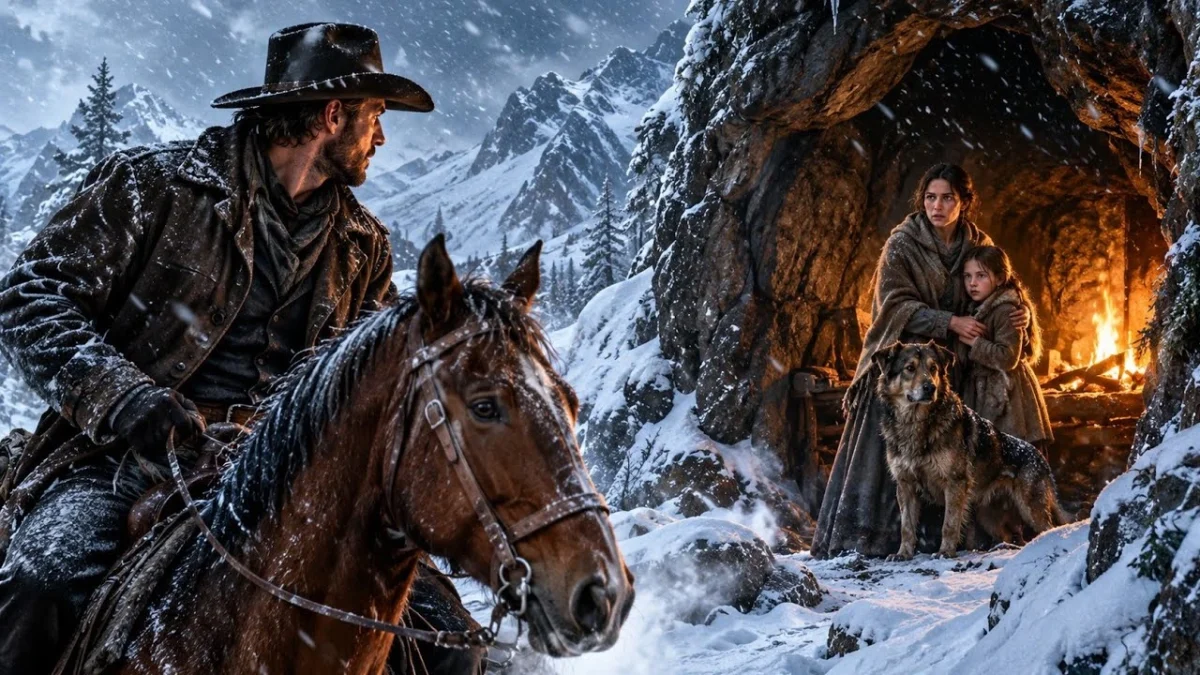
The winter of 1886 came early to the high country of the Colorado Rockies, descending not as a gentle autumn twilight but as a roaring, white-out wall of ice and stone.
By late afternoon, the narrow mountain trails that snaked through the steep timberline had been completely erased under a thick, unrelenting carpet of grey snow.
Caleb Mercer pushed his hat low over his brow, pulling his heavy wool coat tighter against a wind that bit straight through to the bone.
He was thirty-eight years old, carrying the lean, hard-muscled frame of a man who had spent his entire life working cattle and wrestling a living out of unforgiving dirt.
He was a rancher by trade, a widower by circumstance, and a man who had long since learned to keep his deepest thoughts buried far beneath the brim of his weathered black Stetson.
His horse, a dependable bay named Barnum, snorted loudly, its hot breath instantly turning to frost in the freezing air.
Caleb patted the animal’s shivering neck, feeling the fatigue deep in the horse’s shoulders.
They had been out since three hours before dawn, tracking a stray quarter-horse colt that had broken through a weak timber fence near the lower boundary of his ranch.
Caleb had found the colt, but the sudden shift in the pressure had trapped him higher up the mountain pass than he had intended to be.
“Just a little further, boy,” Caleb muttered, his own voice sounding dry and rasping against the howl of the storm.
“We’ll hit the timber line down past the gulch, and then it’s straight shot home.”
Barnum took three slow, hesitant steps forward and then suddenly locked his knees, coming to a dead halt on the narrow ledge.
“Easy,” Caleb said, tightening his grip on the leather reins.
“What is it, Barnum?”
The horse threw its head up, nostrils flaring as it scented the freezing air.
Caleb wiped a thick layer of ice from his eyelashes and squinted toward the sharp rock face towering above the trail.
At first, through the shifting, blinding curtain of white, he thought he saw a shadow move.
He blinked, reaching instinctively for the lever-action Winchester rifle resting in his saddle scabbard.
In these high passes, a shadow meant a mountain lion, a rogue bear, or a desperate timber wolf.
Then, the wind whipped the swirling snow aside for a fleeting second, and Caleb saw it.
A thin, grey line of woodsmoke was rising from a dark, jagged fissure between two colossal granite boulders.
Caleb frowned, his dark eyebrows knitting together under the ice-crusted brim of his hat.
No trappers worked this ridge anymore.
The timber camps had moved ten miles south before the first frost, and no sane rancher would build a line cabin in a rock fall three thousand feet above the valley floor.
Nobody was supposed to be living up here.
“Stay,” Caleb commanded softly, slipping his boots out of the stirrups and swinging his stiff legs down onto the slick rock.
He pulled the Winchester from its sheath, keeping the barrel pointed toward the snow, and began picking his way carefully up the icy incline toward the opening.
The closer he got, the stronger the smell of burning pine became.
It wasn’t a dry cabin stove fire; it was the damp, low-burning smoke of a hidden camp.
Then, beneath the rhythmic, mechanical roar of the gale, a sound caught Caleb’s ear that made him freeze entirely in his tracks.
It wasn’t the howl of a predator or the creak of frozen timber.
It was the high, delicate pitch of a child’s quiet voice.
Caleb lowered his chin, his hand tightening on the rifle stock as he stepped around the massive corner of the granite boulder.
The wind suddenly died down inside the sheltered cove of the rock face, leaving an uncanny, heavy silence.
A flicker of orange light danced across the dark rock wall inside the cave mouth.
A woman stepped into the entrance.
She held an iron lantern low in one hand, the yellow flame flickering wildly behind the smudged glass.
Her other hand was held out protectively behind her, pushing a small child deeper into the shadows of the cave.
Beside the child, a large, shaggy farm dog with mix-breed ears stood stiff-legged, its low, rumbling growl echoing softly off the stone walls.
The woman’s eyes were wide, dark, and filled with a stark, terrifying intensity as the lantern light caught Caleb’s face.
She looked at him as if he were a ghost, or worse, a executioner.
“Hold on,” Caleb said quickly, stepping back a pace and raising both hands high away from his rifle, showing his open palms.
“I ain’t here to hurt you.”
The woman didn’t lower the lantern.
She didn’t speak.
Her gaze didn’t rest on Caleb’s face; instead, her eyes darted frantically past his shoulder, scanning the white expanse of the mountain trail behind him.
She searched the empty storm with a desperate, frantic terror, as if she were waiting for a dozen more men to ride out of the whiteout behind him.
Caleb watched her eyes, and in that single, cold moment, a cold truth struck him.
She wasn’t hiding from the winter.
She was hiding from someone who was hunting her.
Caleb Mercer was not a man given to curiosity or charity.
Three years earlier, his world had collapsed when his wife, Mary, took sick with a sudden, violent fever during the terrible blizzard of ’83.
The snow had drifted ten feet high against the cabin door, blocking the pass for six days while he sat by her bedside, helpless, watching her breath grow slower and slower until she simply stopped breathing altogether.
After Mary died, Caleb had packed away her dresses, locked the front parlor, and cut himself off from the world.
He stopped going into town for the Saturday dances.
He stopped pulling his horse up outside the saloon to share a drink with the local cattlemen.
He stopped sitting by the fire with the hands from neighboring ranches.
He worked until his arms burned, he rode until his horse was spent, and he slept the dead, dreamless sleep of an exhausted man.
He had built a high wall around his life because remembering hurt far more than being lonely.
But as he stood in the freezing mouth of that cave, looking at the woman with the lantern, he saw something in her eyes that tore right through his self-imposed wall.
It was fear.
Not the natural fear of a person caught in a mountain storm, but the deep, hollow terror of a creature that had been hunted until it had nowhere left to run.
“My name is Caleb Mercer,” he said, speaking slowly, letting his low voice settle above the sound of the wind.
“I own a ranch down in the lower basin. Six miles south.”
The woman’s chest rose and fell in rapid, shallow breaths.
She hesitated, her knuckles white where she gripped the iron handle of the lantern.
“Eleanor,” she whispered, her voice rough from smoke and cold.
“Eleanor Hayes.”
She was perhaps thirty-two years old, though the bitter mountain life had etched faint, hard lines around her mouth and eyes.
Her dark brown hair was tied back loosely with a strip of cloth, damp with melting snow.
Behind her skirt, a small face peered out from the shadows.
“And this is Clara,” Eleanor added, her voice softening just a fraction as her hand touched the child’s hair.
The little girl looked to be no more than eight years old.
She wore an oversized wool coat that was frayed at the cuffs and pinned at the neck with a rusted nail.
She stared at Caleb with huge, solemn brown eyes, her lips pressed tightly together, refusing to make a sound.
Caleb’s eyes shifted down to Eleanor’s hands.
They were red from the biting cold, the skin rough, calloused, and scraped across the knuckles.
They were not the hands of a woman who was merely passing through or waiting out a storm.
They were the hands of someone who had chopped pine logs with a blunt axe, hauled freezing water up steep rock inclines, repaired her own shelter, and kept a child alive by sheer, stubborn force of will in a place where no human was meant to survive.
Caleb looked past them into the dark depth of the cave.
A tiny, meager fire flickered against a flat stone, producing more bitter smoke than actual heat.
A single pine log lay beside the hearth.
“You got enough wood?” Caleb asked, leaning his head toward the meager fire.
Eleanor shook her head once, a brief, bitter motion.
“Food?”
Another silent shake of her head.
Caleb turned and glanced out at the darkening sky, where the wind was whipping the pine trees into a violent, thrashing frenzy.
“This storm is turning into a real high-country blizzard,” Caleb said plainly.
“You won’t make it through tonight up here. Not with that fire.”
“We have before,” Eleanor said, her chin coming up with a flash of defensive pride.
“We survived the first freeze.”
“That was autumn,” Caleb replied, his voice dropping an octave.
“This is winter. It’s going to drop twenty below before midnight. You’ll freeze where you stand.”
Without waiting for her permission, Caleb turned around and walked back down the slippery slope toward his horse.
Eleanor watched him go, her lantern shaking slightly in her hand, as if she expected him to ride away and leave them to the mountain.
Instead, Caleb unbuckled the heavy canvas pack frame from behind Barnum’s saddle.
He carried the heavy bundle back up the rocks and stepped uninvited into the mouth of the cave, setting the sack down on a dry slab of flat limestone.
“Flour,” Caleb said, untying the leather thongs.
“Ten pounds of dried beans. A slab of salted pork, and three strips of dried beef. It was meant for my supply cabin down on the creek, but you need it more.”
Eleanor stared at the food as if it were a pile of gold coins.
She took a half-step forward, then checked herself, her eyes snapping back up to Caleb’s face, dark with intense suspicion.
“I can’t pay you,” she said, her voice laced with a sudden, sharp edge.
“I don’t have any money, Mr. Mercer. Not a single cent.”
“I didn’t ask for any,” Caleb said, his face remaining unreadable under his hat.
She took a step closer, stepping between him and her daughter.
“Then why are you giving it to us? Nobody gives away thirty pounds of winter rations in these mountains for nothing. What do you want?”
Caleb looked past Eleanor, meeting the wide, quiet eyes of the little girl standing in the shadows behind her.
“Because a child shouldn’t have to learn what it feels like to starve to death in a cave,” Caleb said softly.
Eleanor’s breath hitched in her throat.
Slowly, the defensive stiffness in her shoulders seemed to give way, her chin dropping as she lowered her eyes to the dirt floor.
For the first time since he had found them, the hard, impenetrable wall she had built around herself cracked open.
“Thank you,” she whispered, so quietly the wind almost stole the words away.
“You get that fire built up,” Caleb said, turning toward the entrance.
“I’ll be back when the trail clears.”
Caleb returned to his ranch early the next morning, but the blizzard did not abate.
For two solid days, the sky opened up, pouring foot after foot of heavy, drifting snow down upon the valley, locking the world in an icy, silent grip.
On the second evening, Caleb sat alone in his high-ceilinged kitchen, staring into the bright, roaring flames of his stone fireplace.
The house was large, built of heavy square-hewn timber, but it felt vast and hollow around him.
The silence was a physical weight pressing against his ears.
Every time he closed his eyes, he didn’t see his cattle or his empty barns.
He saw Eleanor Hayes standing in the mouth of that cold, stone cavern, holding that trembling iron lantern.
He saw the way her eyes had darted toward the trail—not with fear of the biting frost, but with the desperate terror of a creature expecting a hunter.
He remembered her hands, rough and scarred from manual labor.
He remembered the silent little girl who hadn’t made a single sound the entire time he was there.
She wasn’t afraid of the mountains, Caleb realized again, staring deep into the red coals of his fire.
She was using the mountain as a fortress because whatever was behind her was far more dangerous than freezing to death.
By the dawn of the third day, the storm finally broke, leaving behind a stark, brilliant blue sky over a world buried under three feet of blinding white powder.
Caleb didn’t wait for the sun to warm the air.
He saddled Barnum, strapped two large bundles of dry split oak firewood to a pack mule, and headed back up the mountain.
The trek was brutal, the horses sinking to their chests in the drifts, but Caleb pushed them relentlessly until he reached the high granite ledge.
When he rounded the corner, Eleanor was standing outside the cave, an iron pot in her hand, melting snow over a small bed of coals.
She froze when she saw him coming, her hand dropping to the heavy hunting knife she wore at her waist.
Then, recognizing his dark hat and the pack mule behind him, her shoulders relaxed slightly.
“You came back,” she said as he pulled his horse to a stop.
“I brought dry oak,” Caleb said, swinging down off his saddle.
“Pine smoke travels too far in clear air. Oak burns hotter and doesn’t smell as strong.”
Eleanor watched him as he began unstrapping the heavy wooden logs from the pack frame.
“You shouldn’t have done this, Mr. Mercer,” she said, though there was no real anger in her voice.
“You’ve already done more than enough.”
“Probably not,” Caleb replied, tossing a heavy log onto the dry floor inside the entrance.
“Where I come from, you don’t leave folks to freeze just because it’s inconvenient to haul wood.”
As Caleb turned to grab another bundle, his eyes caught on something resting against the inner stone wall of the cave.
It was a small, hand-forged camp axe, its wooden handle worn smooth by long use.
Carved deep into the hardwood of the handle were three initials, followed by a neatly burned surname: T. H. — Thomas Hayes.
Caleb froze, his hands resting on the wooden log, his breath catching in his throat.
He knew that name.
Every rancher, drover, and merchant in the entire valley knew that name.
Thomas Hayes had been the head foreman at the massive Red Creek Cattle Ranch, the largest operation in the territory.
Two years ago, Thomas Hayes had suddenly vanished overnight.
Rumors had flooded the valley like wildfire.
The wealthy, powerful owner of Red Creek, a ruthless land baron named Silas Boone, had publicly declared that Thomas Hayes was a thief who had stolen eight thousand dollars from the ranch safe and fled east to escape justice.
The town had accepted the story without question; Silas Boone owned the bank, paid the sheriff’s salary, and held mortgages on half the small homesteads in the county.
Caleb had been one of the few men who had harbored quiet doubts.
Thomas Hayes had been an honest, hard-working man who had once helped Caleb pull six drowned calves out of a swollen creek without asking for a dime in return.
He wasn’t a thief.
Caleb straightened up slowly, turning to look Eleanor directly in the eye.
“Thomas Hayes was your husband?” he asked softly.
The reaction was instant.
Eleanor went entirely pale, her lips parting as she took a sharp step backward, her hand flying to her knife handle.
The dog stood up beside her, its ears flattening against its head.
“Did Silas Boone send you?” she whispered, her voice trembling with a sudden, lethal desperation.
“Did he pay you to track us down?”
“No,” Caleb said firmly, keeping his hands wide and visible.
“Silas Boone doesn’t own me, Mrs. Hayes. I buy my own feed, and I pay my own taxes. I knew Thomas. He helped me pull stock out of the mud three years back. He was a good man.”
Eleanor stared at Caleb, her chest heaving as she searched his weathered face for any sign of betrayal or lie.
Slowly, very slowly, her hand slid away from the leather sheath at her waist.
“He wasn’t a thief,” she said, her voice breaking on the last word as tears finally welling up in her dark eyes.
“He never stole a single penny from that monster.”
“I know,” Caleb said quietly.
“You didn’t run up into these high rocks because you were trying to hide from the law, did you?”
Eleanor wiped her eyes with the back of her sleeve, looking out over the wide, snow-covered valley thousands of feet below them.
“No,” she said, her voice dropping to a trembling whisper.
“I came here because the man who murdered my husband wanted the only thing Thomas left behind.”
Caleb stepped closer, his voice low.
“What did Thomas have?”
Eleanor looked back into the dark recess of the cave, where Clara was sitting quietly on an old wool blanket, drawing pictures in the dirt with a burnt stick.
“Silas Boone didn’t just run cattle, Mr. Mercer,” Eleanor said, her eyes burning with a fierce, cold anger.
“He was stealing land. He was forging debt records, altering property deeds, and altering water rights claims to force small homesteaders off their ranches so he could buy them up for pennies at tax auctions. Thomas found out about it because he kept the main ranch ledger.”
She paused, taking a deep, shuddering breath.
“When Thomas confronted Silas with the ledger, Silas had two of his hired men beat him and throw him into the river. They thought nobody knew. But Thomas had taken the real ledger out of the office safe three days before and hidden it.”
“Where?” Caleb asked.
“In our cabin,” Eleanor said softly.
“Before Thomas died, he managed to crawl back to our porch. He gave me the book and told me to run. That night, Silas’s men burned our house to the ground. Clara and I barely escaped through the back woods with the clothes on our backs and that ledger.”
Caleb stood silent, processing the weight of her words.
The ledger was dynamite.
It contained the names, forged payments, fake signatures, and illegal land seizures that could destroy Silas Boone’s entire empire and put him in front of a territorial judge for murder.
“Silas has had men searching every town from here to Denver for two years,” Eleanor continued, her hands trembling as she wrapped them around her arms.
“I thought if we stayed up here in the high timber, where no one ever comes, he would eventually think we were dead and stop searching.”
“A man like Silas Boone never stops searching,” Caleb said grimly.
“He knows what that ledger means for him. He’ll keep looking until he sees your grave.”
He looked around the cold, damp rock cave.
The granite walls were dripping with melting frost, the air was bitter and damp, and the only protection they had from the wilderness was a rough pile of pine boughs and an old wool blanket.
“How long have you been living like this?” Caleb asked softly.
“Three winters,” Eleanor whispered.
“Three winters…” Caleb repeated, the words hanging heavy in the air.
A woman.
A eight-year-old child.
A dark stone cave.
Living on wild rabbits, pine bark tea, and sheer, unbreakable hope that tomorrow might be slightly safer than yesterday.
Caleb didn’t offer her empty promises.
He didn’t tell her everything was going to be alright, because he knew the world didn’t work that way.
Instead, he looked her square in the eyes and asked a question no one had asked her in three long years.
“What do you need, Eleanor?”
She looked up at him, surprised by the use of her given name, and by the lack of pity in his voice.
“Not what can I do for you,” Caleb clarified, stepping closer.
“Tell me what you need right now.”
Eleanor looked down at her daughter, then back up at the tall, quiet rancher standing before her.
“A chance,” she said simply.
“Just a real chance to stop running.”
Over the next two weeks, the icy barrier between Caleb’s lonely world and Eleanor’s hidden life began to melt away.
Caleb rode up to the cave every two or three days, bringing heavy sacks of grain, dried apples, salt, coffee, and thick wool blankets he had retrieved from his empty guest rooms down at the ranch.
Eleanor, however, refused to simply accept his charity.
Every time Caleb arrived, she had something prepared for him in return.
She took his worn, torn leather saddlebags and mended them with intricate, double-stitched leather cordage that was stronger than the original factory seams.
She walked with him along the rocky ridges, showing him wild mountain herbs, roots, and bark that could be boiled into powerful medicines to treat livestock fever and infected wounds.
She spent her afternoons sitting on a flat stone inside the cave, using a battered, coverless reader to teach Clara how to spell, write, and read arithmetic.
Gradually, without either of them consciously realizing it, the dark, damp rock cavern stopped feeling like a desperate animal’s den.
It began to feel like a home.
One late afternoon, as a light, peaceful dusting of snow began to fall outside, Caleb sat on a wooden crate near the cave fire, sipping a cup of hot black coffee Eleanor had brewed over the coals.
Eleanor was standing nearby, baking a flat pan of biscuit dough using the last of the flour Caleb had brought up.
The rich, warm scent of roasting grain filled the cavern, masking the cold smell of damp stone.
Caleb let out a long, quiet sigh, leaning his back against the granite wall.
“That’s the first decent thing I’ve smelled in three years,” Caleb said, a small, genuine smile touching the corners of his dark eyes.
Eleanor turned, holding an iron spatula, looking at him with quiet curiosity.
“Have you really lived down on that ranch all by yourself for that long?” she asked softly.
“Since Mary passed,” Caleb said.
He didn’t pull away from the memory this time.
For three years, speaking his wife’s name had felt like turning a knife in his own chest, but sitting here in the warm glow of the cave fire, the pain was softer, rounded off by time and shared hardship.
“She was a good woman,” Caleb added quietly.
“Smart. Loved the spring flowers. When she died, I just… turned the lights out inside myself, I reckon. Decided it was easier not to feel anything at all than to miss her every morning.”
Eleanor set the iron pan down near the coals and came over to sit on a rock across from him.
“I’m sorry, Caleb,” she said, her voice full of genuine empathy.
“So am I,” Caleb said, meeting her eyes.
“And I’m sorry about Thomas. He didn’t deserve what happened to him.”
“No, he didn’t,” Eleanor whispered, looking down at her hands.
“But he would be glad to know we didn’t give up.”
They sat together in comfortable, understanding silence as the fire crackled between them.
They didn’t need to fill the air with unnecessary words.
Sometimes, grief recognizes grief without requiring a single line of explanation.
Two wounded souls who had both lost everything had found a quiet sanctuary in the most unlikely place on earth.
But peace in the high Rockies is a fragile thing, and danger rarely stays buried forever.
Three days later, Caleb was unbuckling his saddle pack outside the cave entrance when Clara’s dog suddenly sprang up from its position near the hearth.
The dog’s ears went flat against its skull, a low, fierce growl vibrating deep in its chest as it dashed out into the snow, sniffing frantically at the narrow rock ledge.
“What is it, boy?” Caleb called, instantly reaching for his rifle.
The dog trotted twenty yards down the trail, snorted at a low pine branch, and grabbed something in its jaws, dragging it back toward the cave.
It dropped the object at Caleb’s feet.
Caleb knelt down, picking up the item.
It was a torn strip of heavy red flannel shirt fabric, stained with dark oil and dirt, snagged fresh on a low-hanging mountain berry bush.
The fabric wasn’t old; it hadn’t been weathered by the recent storm.
It had been torn off someone’s coat within the last few hours.
Caleb’s jaw set hard, his eyes narrowing as he looked down at the snow along the lower trail.
“Someone’s been scouting this ridge,” Caleb said, his voice dropping to a harsh whisper as Eleanor stepped out of the cave.
Eleanor’s face went dead white, her hands instantly beginning to tremble.
“Did they see the smoke?” she asked, her voice tight with panic.
“Maybe,” Caleb said, scanning the white timberline below.
“Or maybe one of Silas’s riders spotted my tracks coming up here twice a week. We can’t stay here tonight.”
That night, they did not light a fire.
They sat in complete darkness inside the cold cave, wrapped in heavy wool blankets, listening to the bitter wind howl through the rocks outside.
No one spoke.
Even little Clara sat motionless, holding her dog tightly against her chest, her big eyes wide in the dark.
Then, around midnight, above the whistle of the wind, came a sound that made Caleb’s blood run cold.
The muffled, rhythmic crunch of horse hooves walking slowly through frozen snow.
Then another set of hooves.
And a third.
Caleb quietly slid the safety off his Winchester rifle, his thumb resting lightly on the cold steel hammer.
Eleanor reached out in the dark, pulling Clara behind her back, her breath coming in ragged, terrified gasps.
Caleb leaned close to Eleanor’s ear, his warm breath brushing her cheek.
“Listen to me,” Caleb whispered, his voice steady and calm.
“When I give the word, take Clara and head straight through that narrow crease in the rock at the back of the cave.”
Eleanor stared at him in the darkness, her eyes wide with confusion.
“There is no passage back there,” she whispered back.
“It’s a dead wall.”
“There is,” Caleb insisted quietly.
“I found it four days ago while I was hauling out old brush. It’s a narrow fissure behind those two flat slabs. It leads out to the south chimney ridge. It’s too tight for horses, but you and Clara can squeeze through. It leads down to the creek trail.”
Before Eleanor could answer, a harsh, booming voice echoed off the granite cliffs outside the cave, carrying clearly through the crisp night air.
“Eleanor!”
The voice was loud, arrogant, and dripping with cruel confidence.
It was Silas Boone.
“You’ve been playing hide-and-seek up in these rocks for three long years, girl!” Silas shouted, his voice echoing off the canyon walls.
“You think I wouldn’t find you? I own these mountains! Come on out with that book, Eleanor, and maybe I’ll let you and the kid walk down to the stagecoach line!”
Inside the cave, Eleanor closed her eyes, her whole body shaking violently.
For three years, she had run from that voice.
She had lived like a feral animal, hidden in dark holes, frozen in winter storms, and starved in silence just to stay away from that man.
Caleb watched her face in the pale moonlight filtering through the entrance.
He expected her to break down.
He expected her to cry, to panic, to shrink into the shadows.
Instead, he watched something remarkable happen.
The fear in Eleanor’s eyes slowly burned away, replaced by a cold, hard, unyielding flame of pure defiance.
She opened her eyes, and the trembling in her hands stopped completely.
“No more,” she said, her voice flat, sharp, and cold as iron.
Caleb looked at her, surprised.
“You sure, Eleanor?”
She nodded once, a quick, sharp motion.
“I’ve spent three years being afraid of that monster,” she whispered, her voice absolute steel.
“I won’t spend a fourth.”
She turned, reached down into her canvas bag, and pulled out the leather-bound ledger.
She tucked it firmly inside her heavy wool coat, buttoning the thick fabric securely over her chest.
“I’m done running, Caleb.”
The plan they hatched in the dark was dangerous and desperate.
Caleb would step out into the moonlight, fire his rifle to draw Silas Boone’s three hired gunmen down toward the lower rock ledge, giving Eleanor and Clara time to slip through the rear fissure and reach the horses Caleb had hidden down in the timber.
“I’m not leaving you behind,” Eleanor said fiercely, grabbing Caleb’s coat sleeve before he could move.
“You don’t owe us your life, Caleb Mercer!”
“I ain’t planning on dying tonight, Eleanor,” Caleb said, offering her a faint, hard smile.
“I’ve got a farm to run, and a fence that needs building.”
“You don’t know the south chimney trail,” Eleanor argued, her eyes fierce.
“I do. I’ve tracked mountain goats down those rocks in pitch darkness. You draw their fire, but you follow us out through the back. We go together, or we don’t go at all.”
Caleb looked at her stubborn face, feeling a strange, powerful warmth surge through his chest despite the freezing cold.
“Fair enough,” Caleb said.
“Let’s go.”
Caleb moved to the cave mouth, raised his Winchester, and fired three rapid shots into the air above the riders’ heads.
The loud gunshots shattered the night, echoing like cannon fire off the rock walls.
“Over there!” a voice yelled from the snow below.
“He’s in the rocks! Get him!”
As muzzle flashes lit up the dark slope below, Caleb fell back into the cave, ducking as a lead bullet flattened itself with a loud smack against the stone wall.
“Now!” Caleb shouted.
Eleanor grabbed Clara’s hand, leading her quickly into the dark, narrow fissure at the rear of the cave.
Caleb squeezed in right behind them, his broad shoulders barely fitting through the tight granite crack.
They scrambled through the dark stone passage, emerging out onto a narrow, wind-swept rock shelf on the southern face of the mountain.
The wind was howling wildly, blowing freezing snow sideways across the sheer cliff.
“Hold onto the rock!” Eleanor yelled over the gale, guiding Clara step-by-step along the icy ledge.
They picked their way down the treacherous chimney, slipping, sliding, and clinging to frozen roots until they reached the thick pine timber at the base of the ridge.
Suddenly, halfway down the final slope, Clara’s boot caught on a buried pine root.
The little girl slipped with a sharp gasp, tumbling sideways into a deep snowdrift.
Eleanor lunged forward, catching her daughter by the collar of her coat, pulling her up out of the drift.
But as Eleanor fell, the front of her coat burst open.
The heavy leather ledger slipped from her grip, tumbling out into the crusty snow and sliding ten yards down the steep slope.
“The book!” Eleanor cried out.
Before she could move, a sudden, violent gust of wind whipped across the ridge, catching the loose, unfurlable pages of the old ledger.
The binding cracked, and paper began ripping free, blowing away into the swirling white blizzard like dying leaves.
Eleanor dropped to her knees in the deep snow, frantically crawling forward, her fingers clawing at the drifts as she tried to catch the flying pages.
“Eleanor, forget it! We have to move!” Caleb shouted, dropping down beside her, grabbing her arm.
“No!” she screamed against the wind.
“It’s everything! It’s all we have!”
She reached out with a desperate, frantic lunges, her fingers snapping shut around a single, crumpled piece of thick parchment just as it was about to be carried over the cliff edge.
She pulled it against her chest, weeping with exertion as she lay in the snow.
Caleb helped her to her feet, looking at the page she held.
It was the final, crucial summary page of the ledger.
At the bottom was Thomas Hayes’s bold, elegant signature, dated the day before his murder, alongside a complete list of eight local ranches, account numbers, forged bank seals, and the names of the two hired men Silas Boone had paid to commit the land thefts.
It wasn’t the whole book, but it was the head of the snake.
It was absolute, undeniable legal proof.
“You got it,” Caleb said, his hands gripping her shoulders.
“You got the proof, Eleanor. Now we run!”
Hoofbeats thundered through the trees above them.
Silas’s men had realized the cave was empty and were rounding the ridge.
Caleb led Eleanor and Clara through the dense pine grove to the hidden spot where Barnum and the pack mule were tied.
He lifted Clara up into Barnum’s saddle, then helped Eleanor swing up behind her, putting the reins into her hands.
Caleb mounted the pack mule, cutting the tie ropes with his pocket knife.
“Follow me!” Caleb shouted, turning his mount down the steep timber trail.
They rode wildly through the night, plunging through deep snowdrifts, dodging low-hanging pine branches, and trusting the horses’ instincts to keep them from tumbling down the mountain ravines.
Behind them, gunshots rang out in the timber, but the pursuers didn’t know the treacherous terrain.
One of the pursuer’s horses screamed as it lost its footing on an ice sheet, tumbling down into a rocky ravine, taking its rider with it.
Eleanor knew every turn, every hidden creek bed, and every granite shelf of that mountain.
She shouted directions to Caleb from behind, guiding them through a narrow rock canyon that bypassed the main trail entirely.
An hour later, the trees suddenly thinned out, opening up onto the wide, flat floor of the valley.
Below them, glittering like a handful of spilled diamonds in the snow, were the warm, glowing lights of the valley town.
The courthouse square.
The sheriff’s office.
Safety.
The horses came to a sliding halt at the edge of the town road, their sides heaving, steam rising from their damp coats into the cold morning air.
Caleb pulled his mule up beside Barnum, looking back toward the dark timberline behind them.
In the distance, two dark figures on horseback had stopped at the tree line, realizing they had lost their chance.
Silas Boone had reached the edge of his kingdom, and he could go no further without stepping into the light of the law.
Caleb turned to Eleanor, his face exhausted but his eyes clear.
“You take Clara and that paper straight to Sheriff Miller’s house,” Caleb said, pointing down the main street toward a neatly painted white house with smoke rising from its chimney.
“He’s an honest man. He’ll protect you.”
Eleanor looked at him, her dark eyes searching his face.
“What about you, Caleb?”
“I’ll ride back up to the ridge,” Caleb said, setting his jaw.
“I’ll make sure Silas and his man don’t decide to double back through my pasture.”
Eleanor shook her head violently, her grip tightening on Barnum’s reins.
“No,” she said firmly.
“Eleanor, listen to me—”
“No, Caleb,” she interrupted, her voice clear and strong, echoing down the empty street.
“You asked me up in that cave what I needed. Do you remember what I told you?”
Caleb looked at her, his throat suddenly dry.
“You said you needed a chance,” he replied softly.
“And you gave me one,” Eleanor said, a warm, beautiful smile breaking across her tired face.
“You gave me and my daughter our lives back. Now I’m giving you yours.”
She extended her hand toward him, holding out the back half of Barnum’s leather reins.
“We walk into town together, Caleb Mercer. No more hiding. Not for me, and not for you.”
Caleb looked at her open hand, then up at her face, feeling the last remaining stone of the high wall he had built around his heart crumble into dust.
He reached out, took her hand, and nodded once.
“Together,” he said.
By noon the next day, the small mountain town was in an uproar.
The single, blood-stained page from Thomas Hayes’s ledger had been delivered directly into the hands of Sheriff Miller and the visiting circuit judge.
By mid-afternoon, Sheriff Miller and a posse of twelve armed deputies had ridden out to the Red Creek Ranch.
By sunset, Silas Boone and his two chief enforcers were sitting behind the heavy iron bars of the county jail, facing charges of murder, grand larceny, and land fraud.
The news spread through the territory like wildfire.
The stolen land claims were invalidated, the forged debts were cleared, and the memory of Thomas Hayes was completely vindicated in the eyes of the law and the community.
The farm that had been stolen from Eleanor was officially restored to her ownership by order of the court.
The mountain woman who had spent three long years hiding in a cold stone cave walked down the wooden sidewalks of the town with her head held high, holding her daughter’s hand, feared by no one and beholden to no one.
But when spring finally arrived, washing the heavy snow off the high peaks and filling the valley creeks with rushing, crystalline water, Eleanor did not return to her old, burned-out homestead down by the river.
Nor did Caleb return to his quiet, lonely routines.
Instead, Eleanor and Clara moved into a cozy, newly built timber cabin built on the peaceful green ridge right at the boundary of Caleb’s ranch.
They didn’t rush into anything.
They didn’t make grand promises or rush to the town church.
They simply worked together.
First, Caleb and Eleanor built a sturdy split-rail wooden fence that joined their two properties into one seamless expanse of pasture.
Then, together with Clara, they turned over the rich, dark soil behind the house, planting a massive vegetable garden filled with squash, potatoes, and sweet corn.
They built a new life, brick by brick, day by day, filling the quiet mountain valley with sound, labor, and shared laughter.
One warm evening in late May, as the sun was setting behind the jagged, snow-capped peaks of the Rockies, casting a long, golden light across the green fields, Caleb stood outside the cabin porch.
He watched Clara playing in the tall grass with her shaggy dog, her bright laughter ringing out clear and free against the quiet air.
Eleanor stepped out onto the porch, wearing a simple yellow dress, carrying two mugs of hot tea.
She handed one to Caleb, leaning her shoulder gently against his arm as she looked out over the valley.
“You know,” she said softly, watching the light fade off the high granite cliffs in the distance.
“For three long years, every time the wind picked up, I thought the winter storms were going to destroy everything we had left.”
Caleb turned his head, looking down at her, seeing the warm, peaceful light reflecting in her dark eyes.
“So did I,” Caleb admitted quietly.
“I thought the cold was just how life was supposed to be.”
Eleanor looked up at him, her lips curving into a gentle, radiant smile.
“But the storm didn’t destroy us, Caleb,” she whispered.
“It brought you.”
Caleb stood quiet for a long moment, listening to the gentle breeze rustle through the pine trees around the cabin.
He set his mug down on the porch railing, turning to face her completely.
“Maybe some storms don’t come to end our lives, Eleanor,” Caleb said, his voice filled with a deep, steady certainty.
Eleanor looked up toward the towering mountain peaks that had once been her prison and her hideout.
“Maybe they come to show us where home is,” she said softly.
Caleb reached out, his big, rough hand finding hers.
This time, Eleanor didn’t hesitate.
She slid her fingers into his, closing the gap between them, holding his hand tight against her side.
And high above the green valley, the towering mountains that had once hidden Eleanor Hayes from the cruelties of the world became the very place where she finally stopped hiding.
She had entered those high, freezing rocks carrying nothing but grief, terror, and despair.
She had walked down from them carrying justice, strength, and an unbreakable hope.
Because sometimes, the terrible storms we spend our whole lives running from are the very things that tear down our walls and lead us safely home.








