A MILLIONAIRE BOUGHT BREAD FROM A SINGLE DAD WITHOUT KNOWING WHO HE WAS
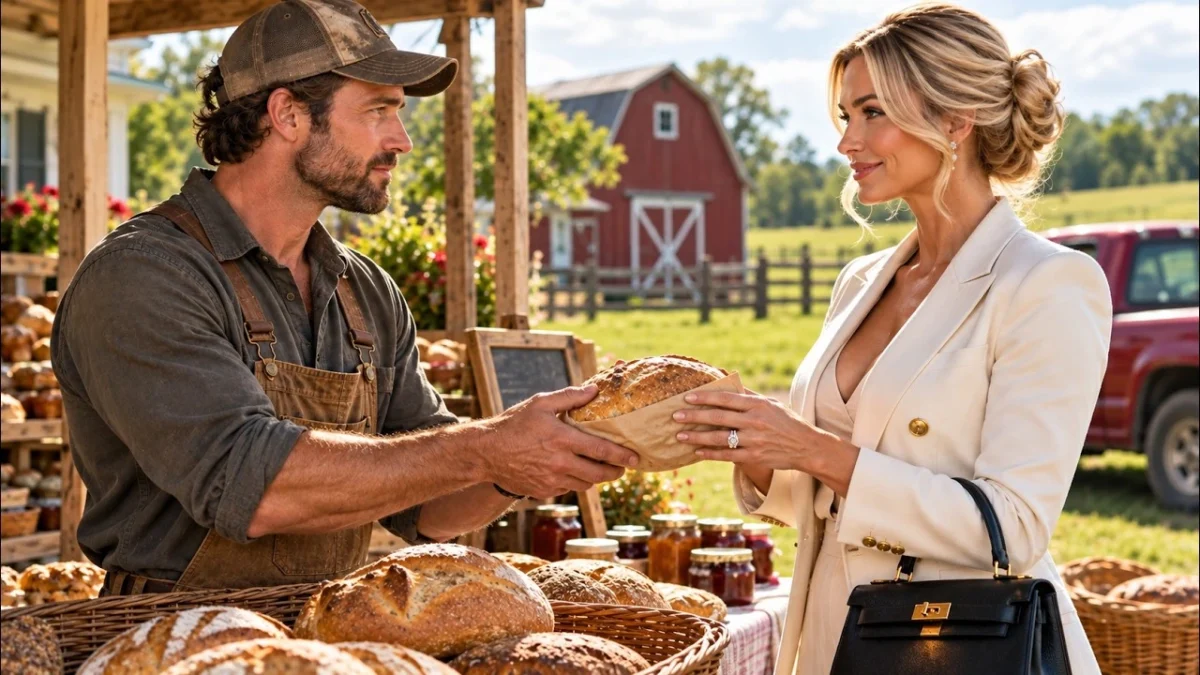
The gentle morning sun crested the rolling hills of western Montana, casting long golden shadows across the emerald pastures and illuminating the rustic wooden farm stand that sat just beyond the shoulder of the county road.
Arranged in woven wicker baskets lined with red and white checkered linen, dozens of freshly baked artisan sourdough loaves gave off a rich, comforting warmth that mingled with the sweet scent of morning clover and fresh-cut pine.
Behind the rough cedar counter stood Caleb Vance, his broad shoulders squared in quiet dignity.
He wore a faded olive drab work shirt with the sleeves cuffed to his forearms, an oil-stained leather work apron, and a sun-bleached camouflage ball cap pulled low over his forehead.
His powerful hands, dusted with coarse white flour and bearing the faint scars of years spent operating agricultural machinery, carefully wrapped a round, golden-crusted sourdough loaf in brown butcher paper, handing it forward with a calm and respectful nod.
On the other side of the counter, framed by the bright blue prairie sky, stood Evelyn Sterling.
Her tailored ivory white blazer and elegant pearl earrings contrasted sharply with the rustic setting.
A designer black leather handbag rested against her arm as she reached out with manicured hands to accept the warm parcel.
Her hazel eyes met Caleb’s steady hazel gaze, feeling a sudden, unexpected stillness wash over her racing mind.
“Thank you, Caleb,” Evelyn said softly, her voice carrying a quiet warmth that always seemed to ease the lingering tension in her shoulders.
“It smells incredible, as always.”
“You’re very welcome, Miss Sterling,” Caleb replied, his deep voice smooth and grounding.
“It was pulled from the hearth less than an hour ago.
It should stay fresh for a good few days, though I doubt it lasts that long.”
To the casual eye, it was merely a routine exchange between an affluent traveler and a humble roadside vendor.
Neither of them could fathom that this simple loaf of bread would soon dismantle a multi-million-dollar conspiracy and bind their destinies forever.
Every single loaf that rested on that roadside table was born out of a father’s fierce refusal to surrender to despair.
Long before the morning birds stirred in the branches of the ancient cottonwoods, Caleb was already awake in the darkness of his modest stone cabin, stoking the hickory embers of the brick hearth oven he had built with his own two hands.
While the rest of the county slept, his muscular forearms worked rhythmically against the heavy wooden kneading trough, blending stone-ground heirloom wheat, spring water, and a living wild yeast starter that he had carefully nurtured for seven years.
Beside the kitchen table, sleeping peacefully on a small cot beneath a patchwork quilt, lay his seven-year-old daughter, Clara.
Her bright laughter and trusting green eyes were the sole anchor of his existence.
When dawn broke, little Clara climbed out of bed, washed her face in the porcelain basin, and sat on a wooden stool by the flour bin, humming soft country melodies while helping her father tie natural jute twine around each brown paper package.
Caleb knelt down beside his daughter, gently brushing her stray blond curls behind her ears.
“Remember what we talked about, sweet pea?” Caleb asked softly, adjusting her small collar.
Clara looked up at him with a wide, bright smile.
“An honest family with clean hands and a clear conscience will never truly be poor!” she recited proudly.
Caleb smiled, kissing her forehead.
“That’s right, darling.
Never forget it.”
Yet the road that had brought Caleb Vance to that lonely country lane had been paved with an unimaginable betrayal that had once made national headlines in the financial press.
Five years earlier, Caleb had been the founder and chief executive of Heartland Grain Systems in Chicago, a revolutionary agricultural conglomerate that pioneered direct-market distribution for small family farmers across nine states.
He had poured fifteen years of his life into designing fair-trade supply chains and cooperative grain elevators, transforming Heartland into a multi-hundred-million-dollar powerhouse while maintaining an unyielding reputation for moral uprightness.
But while Caleb focused on ensuring that farmers received fair prices for their harvests, his ambitious minority partner, Nathaniel Cross, was quietly orchestrating a venomous corporate ambush behind closed boardroom doors.
Exploiting Caleb’s absolute grief following the sudden death of his wife, Rachel, from an unexpected cardiac event, Cross had systematically forged proxy authorizations, redirected offshore lines of credit into subsidiary shell accounts, and manufactured a fraudulent federal bankruptcy filing that stripped Caleb of every share, every patent, and every cent he had ever accumulated.
Rather than dragging his toddler daughter through years of corrupt litigation and mudslinging in federal courtrooms, Caleb had signed away his executive claims, packed his hand tools and family recipes into an old red pickup, and driven west until the city skyscrapers were replaced by the jagged silhouettes of the Rocky Mountains, vowing to raise his little girl far from the predatory greed that had destroyed his former life.
The modest forty-acre parcel of rocky soil he purchased at a tax auction had come with a dilapidated timber house, a sagging red barn, and an old stone smokehouse.
Through five years of brutal physical labor, Caleb had turned it into a sanctuary of peace.
He grew his own hard winter wheat, harvested organic berries from the creek bank for homemade jams, and built his roadside bread stand to pay for Clara’s school supplies and winter boots.
For months, the locals had regarded the quiet, muscular widower as a polite enigma, a man of few words who never lingered at the county tavern and never complained about the bitter winter chills.
Evelyn Sterling had discovered the stand purely by accident while driving between her family’s corporate headquarters in Billings and their sprawling cattle ranch in the High Valley.
As the sole heir and managing partner of the Sterling Agricultural Trust, Evelyn carried an exhausting burden on her slender shoulders, constantly fending off aggressive venture capital firms and unscrupulous brokers who sought to carve up her father’s hundred-thousand-acre ancestral estate into suburban subdivisions.
Exhausted by the hollow flattery of wealthy suitors and the cutthroat deceit of corporate boardrooms, she found an inexplicable solace in those five-minute stops beside Caleb’s wooden stall.
The bread he sold was undeniably extraordinary, featuring a caramelized, blistered crust and a complex, airy crumb that rivaled the finest bakeries of Europe, but it was the quiet atmosphere of the farm that truly captivated her heart.
She observed how Caleb spoke to his daughter with infinite tenderness, how he meticulously returned exact change to elderly neighbors, and how his calm, unshakable demeanor seemed to radiate a strength that had nothing to do with bank accounts or tailored suits.
Little Clara had quickly taken a liking to the elegant lady in the white blazer, often running to the edge of the grass to hand her small bouquets of purple lupines and yellow dandelions tied with yarn.
“Look what I found for you today, Miss Evelyn!” Clara exclaimed on a warm afternoon, rushing over with a freshly picked bundle of wildflowers.
Evelyn crouched down on the rough gravel, completely unconcerned about dusting the hem of her designer trousers, accepting the wild blossoms as if they were rare orchids.
“Oh, Clara, these are stunning!” Evelyn said, her eyes shining with genuine pleasure.
“You have the best eye for flowers in the whole valley.”
“Daddy helped me find the purple ones by the creek,” Clara beamed, pointing back toward the stone cabin.
“He says pretty things grow best where you take care of the soil.”
Evelyn glanced up, meeting Caleb’s warm gaze as he wiped down the wooden counter.
“Your father is a very wise man, Clara,” Evelyn remarked, feeling a soft blush touch her cheeks.
“I think he might be right about that.”
“I just tell her what the land teaches me, Miss Sterling,” Caleb said quietly, walking over to join them.
“Nature doesn’t lie, and it doesn’t give shortcuts.”
In those brief, stolen moments under the morning sun, Evelyn began to look forward to Tuesdays and Thursdays more than any other days on her executive calendar, feeling an unspoken magnetic pull toward the stoic baker whose eyes carried the wisdom and sorrow of a man who had faced the furnace of life and emerged with his soul unbroken.
The peaceful rhythm of those late summer mornings was shattered in mid-September when a catastrophic financial crisis struck the Sterling Empire.
Evelyn’s father, a proud seventy-year-old cattleman whose health had been rapidly declining, suffered a debilitating stroke just as the regional livestock market took an unprecedented downturn.
Taking advantage of the patriarch’s incapacitation, a predatory investment consortium known as Apex Horizon Capital swooped in, purchasing defaulted notes on the Sterling Feed Mills and foreclosing on three vital distribution corridors that connected the ranch to the transcontinental railway.
At the head of Apex Horizon was a familiar, venomous figure: Nathaniel Cross.
Having drained Heartland Grain of its assets and transitioned into vulture capital, Cross was now determined to force Evelyn into a predatory merger, demanding that she surrender majority voting control of the historic Sterling pasture or watch her family’s century-old business be liquidated on the county auction block before the first frost fell.
Desperate to find a way to circumvent Cross’s stranglehold on the local rail spurs, Evelyn spent sleepless nights pouring over property deeds, transportation manifests, and agricultural logistics reports.
The situation seemed hopeless.
Cross had secured exclusive regional contracts with every major commercial hauler, effectively cutting off her cattle and wheat from reaching external markets.
On a rain-swept Friday afternoon, needing fifty loaves of bread to feed the dozens of anxious ranch hands who were working overtime to secure the herds, Evelyn drove her truck up the muddy dirt lane of Caleb’s property for the very first time.
She stepped onto the covered porch of the stone cabin, knocking softly on the weathered timber door.
When Caleb opened it, wiping his hands on a clean flour sack, he immediately noted the exhaustion etched into her refined features.
“Miss Sterling,” Caleb said, stepping aside and opening the door wider.
“Please, come inside out of the downpour.”
“Thank you, Caleb,” Evelyn murmured, shaking out her wet umbrella and stepping across the threshold.
“I apologize for dropping in unannounced, but I’m in urgent need of a large order for the ranch hands.”
“It’s no trouble at all,” Caleb replied warmly.
“I have extra loaves resting in the pantry.
Let me pack them up for you.”
As Caleb stepped into the side pantry, Evelyn took a breath, taking in the immaculate order and humble dignity of the small home.
A cast-iron pot of vegetable soup simmered on the wood stove, filling the room with a rich, savory aroma.
Clara sat at the heavy oak table, carefully copying spelling words onto a slate chalkboard with neat, diligent strokes.
As Evelyn waited, her gaze wandered across the rough-hewn pine bookshelves lining the living room wall.
Alongside classic leather-bound novels and heavy agricultural science manuals, sat a simple, polished brass plaque that caught the flickering firelight.
Curiosity drawing her closer, Evelyn leaned down to read the engraved script, and her breath suddenly hitched in her throat.
The inscription read: National Agricultural Innovation Award, presented by the Department of Commerce to Caleb Vance, founder of Heartland Grain Systems, for uncompromising leadership and ethical excellence.
Evelyn stood frozen in the center of the room, her mind racing as fragments of old business journal articles and industry lore fell into place like thunderbolts.
The quiet man baking bread in this remote valley was not a lifelong peasant or a simple country vendor.
He was the legendary visionary whose radical cooperative models had terrified Wall Street commodity brokers a decade ago, the prodigy who had vanished without a trace after being ruthlessly betrayed by the very man who was now trying to destroy her family.
When Caleb returned carrying two heavy wooden crates packed with steaming loaves, he found Evelyn standing motionless by the hearth.
Her hazel eyes were glistening with unshed tears, and her voice was barely a whisper when she spoke.
“Caleb…” she began, her tone trembling slightly.
“Why is the most brilliant supply chain architect in the history of American grain selling sourdough for five dollars on a dirt road?”
Caleb stopped in his tracks, the heavy crates settling in his grip as his rugged face grew still.
The ghosts of his past had been suddenly laid bare in the warm light of his kitchen.
Quietly, he set the crates down on the floor, walked over to the stove, and poured two tin mugs of hot chicory coffee, pulling out a wooden chair for her.
“Sit down, Evelyn,” Caleb said gently, his voice devoid of anger or bitterness.
“I think you deserve an answer.”
Sitting across from her at the plain wooden table, Caleb shared the full story of his past with an unflinching honesty.
He spoke of his rapid rise in Chicago, the vision he had shared with thousands of small farmers, the profound, crippling grief after Rachel’s passing, and the systematic theft orchestrated by Nathaniel Cross.
“When Nathaniel took everything,” Caleb said, looking out the rainy window, “I had a choice.
I could spend ten years fighting him in court, letting hatred consume every thought while my daughter grew up in the shadows of lawyers and boardrooms, or I could walk away with what actually mattered.”
He looked back at Evelyn, his hazel eyes clear and filled with conviction.
“I discovered that after you lose a fortune, the only things that truly belong to a man are his honor, the work of his hands, and the love he pours into his children.
I am far happier kneading dough under the open sky than I ever was presiding over glass towers built on deceit.”
Evelyn listened, her heart breaking and swelling all at once.
She looked across the rough table at the broad-shouldered man, realizing with stunning clarity that she was not looking at a fallen giant, but at a man whose stature had only grown through suffering.
Her admiration was not for the millions he had once commanded or the power he had wielded, but for the incorruptible soul that had remained entirely intact when the gilded world was stripped away.
Setting down her mug, Evelyn placed her trembling hands over Caleb’s calloused fingers.
“Caleb,” she said, her voice thick with emotion.
“Nathaniel Cross is here in Montana.
He is trying to destroy the Sterling Trust.”
Caleb’s eyes narrowed slightly.
“Cross is behind Apex Horizon?”
“Yes,” Evelyn confirmed, a tear slipping down her cheek.
“He bought up our defaulted mill notes and foreclosed on our transit corridors.
He has secured exclusive contracts with every commercial hauler in the region.
If I can’t move our livestock and wheat to market by next week, he will force us into bankruptcy and take the land my great-grandfather built.”
She looked at him pleadingly, her grip tightening on his hand.
“I am completely out of options, Caleb.
I’m not asking you as a former CEO, but as a man of honor.
Please, help me save the livelihoods of hundreds of working families who depend on our land.”
Caleb looked into Evelyn’s eyes, seeing the same fierce, protective fire that burned within his own chest for Clara.
For five years, he had kept his strategic knowledge buried, believing his former skills had no place in his quiet life.
But seeing the same corporate predator who had ruined his family attempting to destroy an innocent woman and her ancestral soil, a deep, righteous resolve hardened inside his soul.
He glanced over at Clara, who was watching him with wide, trusting eyes, and then turned back to Evelyn, giving her a slow, decisive nod.
“We won’t fight Cross in his corrupt courtrooms, Evelyn,” Caleb stated, his voice firm and unwavering.
“We will fight him in the physical reality of the land, where real value is determined by grit, logistics, and the loyalty of working men.”
“What can we do?” Evelyn asked, a ray of hope igniting in her chest.
“Leave that to me,” Caleb said calmly.
“Be here tomorrow at dawn.”
The following morning, the kitchen table in the small cabin became a tactical command center.
Spreading out topographical county maps, abandoned railroad manifests, and regional water rights surveys, Caleb spent twenty-four hours analyzing the structural vulnerabilities of Cross’s corporate stranglehold.
Drawing upon his encyclopedic knowledge of regional infrastructure, Caleb identified a forgotten legal loophole dating back to the Homestead and Railway Acts of 1914.
“Look here,” Caleb said, pointing a calloused finger at a faded line on a county map.
“This is a decommissioned municipal rail spur.
It runs directly through the southern boundary of your pastures and connects to an independent grain corridor in North Dakota.”
Evelyn leaned in, studying the map carefully.
“That line hasn’t been used in thirty years, Caleb.
It’s overgrown and practically abandoned.”
“Abandoned, yes, but not legally closed,” Caleb explained, his mind working with crisp efficiency.
“The track bed was built on common carrier easement rights.
Under federal transit law, it remains in the public domain.
If we can clear the tracks and secure a locomotive within seventy-two hours, the Sterling Trust can legally bypass Cross’s blockades and deliver your harvest directly to deepwater ports on the Great Lakes.”
Evelyn looked up, astonished.
“That would completely nullify his foreclosure notes!”
“Exactly,” Caleb nodded.
“Cross bought the commercial haulers, but he doesn’t own the public rail easements.
We start work today.”
Working side by side with the ranch hands, Caleb rolled up his sleeves and returned to the field not as a detached consultant, but as a leader who worked harder than any man in the crew.
Wearing his worn leather apron and heavy work boots, he operated backhoes, cleared fallen timber from the old tracks, and personally recalibrated the pneumatic switches on the rail junctions with heavy iron wrenches.
Evelyn worked directly beside him, shedding her tailored blazers for heavy denim jackets and work gloves.
She carried water buckets, delivered hot meals to the laborers, and witnessed firsthand the magnetic authority of a man who commanded absolute respect without ever raising his voice.
When regional fuel suppliers, intimidated by Cross’s attorneys, refused to deliver diesel for the rail engines, Caleb reached into his vast network of independent farm cooperatives.
“Hey, Frank,” Caleb said into an old landline phone in the barn, his tone steady.
“It’s Caleb Vance.”
There was a sudden silence on the other end of the line, followed by an emotional exclamation.
“Caleb? Good lord, man, where have you been?”
“I’m in Montana, Frank,” Caleb replied.
“And I need twenty thousand gallons of biodiesel delivered to the High Valley rail junction by tomorrow morning.
We’re making a stand against Apex Horizon.”
“Say no more, Caleb,” the cooperative director responded without hesitation.
“You saved our farms a decade ago.
The fuel trucks will be there before sunrise.”
By Wednesday night, twenty thousand gallons of biodiesel had arrived, the tracks were cleared, and three leased engines stood idling on the reactivated municipal spur, hooked to four hundred cars loaded with Sterling grain and cattle.
The ultimate confrontation arrived on Thursday morning in the grand, wood-paneled ballroom of the county civic center in Billings, where the emergency general assembly of creditors and agricultural trustees was convened.
Nathaniel Cross sat at the center of the executive dais in a bespoke three-piece pinstripe suit, surrounded by high-priced corporate attorneys.
He sneered with triumphant malice as he adjusted his microphone, preparing to execute the final foreclosure protocols against the Sterling Trust.
“Ladies and gentlemen,” Cross announced smoothly, his tone dripping with arrogant condescension.
“As the Sterling Trust has failed to secure viable transportation channels to fulfill its debt obligations, Apex Horizon Capital hereby moves for the immediate liquidation of all Sterling assets.”
At that exact moment, the heavy double doors at the rear of the hall swung open.
Evelyn Sterling entered, her head held high in her tailored ivory blazer, walking down the center aisle with absolute composure.
The room grew quiet, but as she reached the presentation podium, a collective gasp swept through the assembled board members and regional ranchers as the man walking directly behind her stepped into the light.
Dressed in clean, pressed denim, a dark western-cut blazer, and carrying an antique leather ledger beneath his arm, Caleb Vance strode to the center of the room.
His towering presence and piercing gaze froze Cross in his executive chair.
The color instantly drained from Cross’s face, his arrogant smirk melting into a sickening mask of naked panic, as if he had just seen a ghost rise from an unmarked grave.
“V-Vance?” Cross stammered, grabbing his microphone with a trembling hand.
“What is the meaning of this? Security, escort this trespasser out immediately! This is a closed legal execution!”
“Sit down, Nathaniel,” Caleb said, his deep, resonant baritone cutting through the room with absolute authority.
“The execution is over, but it’s not Evelyn’s.”
Caleb stepped forward to the podium, placing the heavy leather ledger onto the table with a resounding thud that echoed through the silent chamber.
“Members of the board,” Caleb began smoothly, opening the ledger.
“I am presenting certified transit manifests proving that the Sterling Trust has already loaded and dispatched four hundred carloads of grain and livestock via the municipal rail corridor under common carrier easement rights.”
Cross slammed his hands on the table, standing up.
“That’s illegal! You don’t have the transit rights!”
“Under the Railway Act of 1914, section eight, common carrier public easements remain active as long as common stock is transported,” Caleb countered with surgical precision.
“Furthermore, these shipments are backed by emergency lines of credit issued by thirty-two regional farming cooperatives operating under the historic Heartland Trade Charter.”
A wave of astonished murmurs broke out across the audience.
The federal agricultural commissioner sitting on the board leaned forward, examining the documents Caleb handed up.
“These documents are fully valid,” the commissioner declared, looking at Cross sternly.
“The Sterling Trust is in full compliance with its debt obligations.
The foreclosure petition is denied.”
“Wait!” Cross shouted, sweat glistening on his forehead.
“This is a setup! You can’t accept backing from shell entities!”
“Speaking of shell entities, Nathaniel,” Caleb said calmly, pulling a second set of financial audits from his coat.
“I have spent the last forty-eight hours reviewing Apex Horizon’s capitalization structure.
These certified forensic bank records prove that your buyout funds were laundered through offshore accounts containing funds directly stolen from Heartland Grain Systems five years ago—funds bearing my original, unrevoked corporate signature.”
The room erupted into an uproar of outrage.
The federal trustees immediately stood, declaring all petitions filed by Apex Horizon completely null and void, ordering Cross’s corporate assets frozen on the spot.
From the back of the chamber, two United States Marshals stepped forward, their heavy boots clicking against the hardwood floor.
“Nathaniel Cross,” one of the marshals announced, pulling steel handcuffs from his belt.
“You are under arrest for interstate racketeering, commercial forgery, and federal bank fraud.”
As the armed deputies clicked the cold steel around Cross’s trembling wrists, the fallen mogul turned to Caleb, his eyes filled with venomous bewilderment.
“How?” Cross hissed, his voice cracking with desperation.
“You lost everything! You were baking bread in the dirt! How could you possibly destroy me?”
Caleb met his former partner’s gaze with calm, unshakable sorrow.
“A man who builds his life on the sand of theft will always be swept away by the river of truth, Nathaniel,” Caleb said softly.
“While an honest man standing on bedrock will never fall.”
With the Sterling legacy permanently secured and the predatory syndicate dismantled, the grand ranch house in the valley erupted into a joyous celebration for the hundreds of farmhands and neighbors who had been saved from financial ruin.
Fiddles played lively tunes, tables groaned under the weight of feast platters, and laughter filled the crisp night air.
Wealthy landowners and business executives constantly approached Caleb, offering him multi-million-dollar retainers to manage commercial logistics firms across the country.
“I appreciate the offer, gentlemen,” Caleb replied politely to each of them, shaking their hands with a firm grip.
“But my life is right here.”
He had no desire to return to the cold, hollow world of corporate glass and concrete.
While the party carried on inside, Evelyn walked out onto the porch, searching for Caleb.
She found him standing quietly near the pasture fence in the falling dusk, watching little Clara laugh as she fed sweet clover to a newborn foal.
Evelyn walked up beside him, the evening breeze fluttering the silk of her scarf.
Her eyes were shining with an emotion so deep and profound that no words could fully capture it.
She looked at his strong, dusted hands resting on the timber rail, stepping closer until her shoulder brushed his.
“When I first stopped by your roadside stand,” Evelyn confessed softly, her voice filled with tenderness, “I was just a tired, lonely woman looking for good bread.”
Caleb turned his head, looking down at her.
“And what did you find, Evelyn?”
“I found the only man I have ever known who is truly rich in all the ways that matter,” she answered, tears of affection brimming in her eyes.
She reached out, placing her warm hand over his calloused fingers.
“My family’s land is safe, Caleb, but the ranch has no future without a leader who understands that soil, sweat, and love are the only real currencies of life.”
She looked straight into his hazel eyes, her heart beating fast.
“Stay with me.
Not as an employee, and not as a consultant, but as my equal partner, my protector, and the keeper of my heart.”
Caleb looked down into her beautiful, earnest face, feeling the last cold shadows of his painful past melt away beneath the genuine warmth of her gaze.
Gently, he lifted her hand to his lips, kissing her knuckles with deep, reverent affection.
“An honest man’s greatest harvest is the love of a good woman, Evelyn,” Caleb whispered softly, his voice full of emotion.
“My boots will never walk away from where my soul has found its home.”
Just then, Clara came running across the green lawn, her bright laugh ringing out through the quiet evening.
“Daddy! Miss Evelyn!” Clara squealed happily, throwing her small arms around both of their waists.
Caleb and Evelyn laughed, wrapping their arms around each other and pulling the little girl tight between them beneath the vast, star-filled canopy of the Montana night sky.
Six months later, the morning sun broke once again over the rolling hills of the High Valley.
The old wooden roadside stand had been transformed into a charming, whitewashed stone bakery that stood proudly at the entrance of the combined Sterling-Vance Ranch.
Crates of fresh, golden sourdough loaves sat upon linen-draped tables, filling the air with that familiar, comforting warmth.
Behind the counter, beside the tall, broad-shouldered father with flour dusting his leather apron, stood Evelyn.
Her sleeves were rolled up to her elbows, her cheeks lightly smudged with white powder as she laughed brightly, handing a warm brown parcel to a smiling traveler who had driven miles just to taste the famous bread.
A few feet away, Clara skipped merrily across the green grass, chasing a golden butterfly near the flower boxes.
Caleb paused, leaning against the counter and looking across at his wife and daughter.
As he watched Evelyn smile and listened to Clara’s joyful laughter echo across the pasture, he knew with absolute, unshakable faith that sometimes a man must lose everything the world calls valuable just to discover the priceless treasures that truly endure forever.








