A Nurse Missed Her Flight to Help a Lost Little Boy — Then His Father Changed Her Life Forever
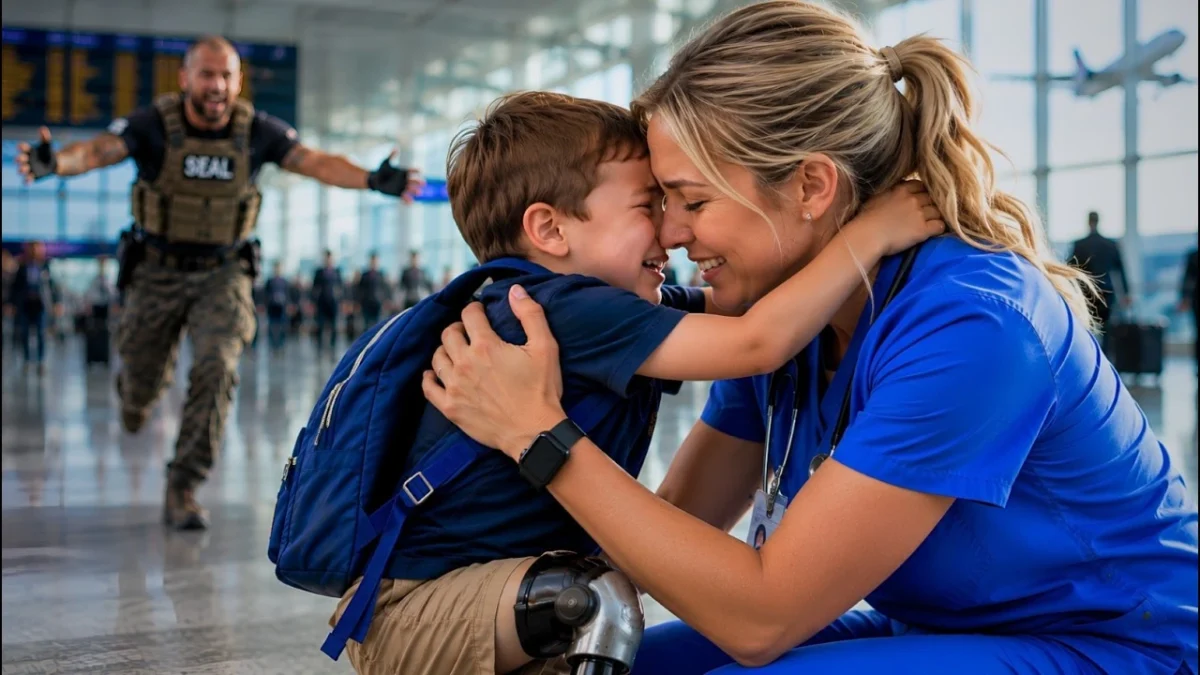
The arrivals terminal at Seattle-Tacoma International Airport buzzed with a relentless, hurried rhythm.
People surged past one another like water moving through a concrete channel, dragging heavy luggage and staring anxiously at departure boards.
Amidst the ocean of travelers, Sarah Bennett stood completely still near gate C14, her eyes fixed on the small digital screen displaying her flight’s final countdown.
She wore bright cobalt blue scrubs that marked her as a nurse, though she had spent the last two years trying very hard to blend into the civilian background and forget the life she had left behind.
Her flight to Seattle was closing in nine minutes, and somewhere past security, a boarding pass with her name on it was about to become useless paper.
A fresh start 3,000 miles away from a past she was quietly outrunning was supposed to begin today.
Then she saw the little boy.
He was standing entirely alone against a steel pillar, small and forgotten, crying softly into his hands while a couple hundred people walked right past him as if he were an unclaimed suitcase.
Sarah’s gaze dropped to his small frame, taking in the dark brown hair, the navy blue backpack with a broken zipper pull, and the khaki shorts.
Beneath the left leg of those shorts, where a small calf should have been, a matte black prosthetic curved down into a sneaker two sizes too big for a foot that had been fitted, not born.
Without a second thought, Sarah turned her back on the gate agent’s final boarding call, dropped her carry-on bag to the floor, and knelt down.
“Hey,” Sarah said softly, keeping her voice low and non-threatening. “What’s your name?”
The little boy looked up, his pupils blown wide and sweat beading on his forehead despite the air-conditioned terminal.
“Noah,” he whispered, his voice cracking on the single syllable. “I lost my grandma. I don’t feel good.”
“I know you don’t,” Sarah replied, gently resting two fingers on his wrist to check his pulse. “I’m going to help you feel better, okay? Can you tell me if you have diabetes, Noah? Do you wear a little device on your arm or your leg?”
He nodded, too dazed to be surprised she had guessed right, and lifted his shirt sleeve to reveal a small sensor patch just above his elbow.
Sarah was already digging through her carry-on bag, her fingers closing around an apple juice box she had packed for the flight out of habit more than need.
She peeled the straw free in one motion and pressed it into his hand, coaching him gently.
“Small sips, Noah. Slow.”
“Ma’am, you need to step back from the child,” a sharp voice cut through the air.
A security guard named M. Doyle hovered behind her, his tone carrying the particular brittleness of a man who had spent his morning being ignored by everyone around him.
“I need you to step away from that boy right now. We don’t know who you are.”
Sarah didn’t look up, keeping her focus entirely locked on the child whose hands were still trembling violently.
“Sir, I’m a registered nurse,” she said, her voice dropping into a register of absolute, unshakeable authority. “This boy is hypoglycemic. I need everyone to give us room.”
“You could be anyone,” Doyle argued, taking a defensive step closer. “You could have given him something.”
Sarah looked up at him then, and something in the hard, experienced coldness of her eyes made the security guard instinctively take half a step back without understanding why.
“I gave him apple juice,” she said evenly. “Watch him drink it. Then get on your radio and call it in as a level two medical, because if his hands are still shaking in ninety seconds, he needs an ambulance, not a security escort.”
Doyle’s radio crackled uselessly against his hip, but he hesitated, unnerved by the way she commanded the space around her.
Sarah turned back to Noah, her expression instantly softening into warmth.
“You’re doing great, buddy. You know what? My little sister used to get shaky like this, too. She hated it. Made her feel like the whole world was spinning.”
“It is spinning,” Noah whispered, his eyes welling with fresh tears.
“I know. It’ll stop. I promise.”
Behind them, the gate agent’s voice rang out over the intercom one final time, announcing the closing of the doors to Seattle.
Sarah didn’t even flinch.
She kept talking to the boy, asking him about his prosthetic leg, learning that he had gotten sick when he was two and that his dad was coming home today.
Within minutes, Noah’s color began to return, his breathing steadied, and the tremor in his fingers faded away.
An older woman came sprinting around the corner near the security checkpoint, her silver hair coming loose from its clip and panic written across every line of her face.
“Noah! Noah, baby!” the grandmother cried out, dropping to her knees and gathering the boy into a tight, trembling embrace, sobbing apologies about losing sight of him in the bathroom line.
Sarah stayed close, her hand resting reassuringly on the boy’s back until she was certain he was completely stable.
Just as the chaos began to settle and the gate monitor for her flight switched from boarding to departed, the heavy glass doors near the security checkpoint parted to let in a rush of fresh foot traffic.
A man strode through at a fast pace, a tactical vest slung over one shoulder, three months of deployment stubble shadowing his jaw, and his eyes scanning the crowd with the fierce intensity of a soldier searching for a threat.
It was Jack Coleman.
He had flown for twenty-two hours straight, enduring brutal layovers, running entirely on the thought of finally holding his five-year-old son again after six long months away.
When his mother had texted him twenty minutes ago saying she was at the airport with Noah, he had felt a surge of pure joy that had now curdled into ice as he spotted the crowd gathered near gate C14.
“Noah!” Jack called out, his voice cracking down the middle.
The boy’s head snapped up.
“Dad!”
Jack closed the distance at a dead sprint, dropping to his knees and wrapping his arms around his son in an overwhelming wave of relief.
For a long moment, nothing else in the terminal mattered.
When Jack finally pulled back to check his son over, Noah pointed eagerly toward Sarah, who was quietly gathering her things to leave.
“She helped me, Dad,” Noah said, his eyes wide with gratitude. “She gave me juice and stayed with me the whole time.”
Jack stood up slowly, keeping one hand on his son’s shoulder, and looked over at the nurse in cobalt blue scrubs.
“Thank you,” Jack said, his voice rougher than he intended. “Thank you for staying with him.”
“Of course,” Sarah offered a small, tired smile. “He did great. He stayed calm and stayed put.”
“Are you a nurse here at the airport?” Jack asked, his sharp eyes noticing the way she swept the surrounding crowd in slow, methodical arcs, positioning herself naturally to shield them from the curious onlookers.
“No,” she replied with a short, self-deprecating laugh. “I was supposed to be on a flight to Seattle about twenty minutes ago.”
Jack’s stomach dropped slightly. “You missed your flight for him?”
“He needed someone more than the flight needed me on it,” she answered simply, turning to walk toward the rebooking desk.
Jack watched her go, a strange, persistent itch scratching at the back of his mind.
There was a cadence to her words, a flat, disciplined precision that felt intensely familiar, though he couldn’t quite place it.
Before he could say another word, a low, mechanical groan rolled through the building from somewhere past the security checkpoint, shaking the floor beneath their feet.
A section of overhead scaffolding wrapped around gate C19, where a renovation crew had been working all morning, suddenly buckled under a weight it was never rated to carry.
Metal poles and heavy plywood decking crumpled downward with a deafening crash, raising a massive cloud of gray dust and debris that instantly choked the terminal air.
Before anyone else in the vicinity could even process what was happening, Sarah’s entire body shifted.
She didn’t flinch or shrink back; instead, her weight dropped onto the balls of her feet, oriented directly toward the danger with the undeniable muscle memory of someone who had faced catastrophic trauma before.
“Stay with your grandma,” she commanded Noah, already breaking into a hard, fast sprint toward the collapsing structure.
Jack stood frozen for one full second, watching her run toward the wreckage instead of away from it, and suddenly the itch in his mind snapped violently into focus.
He knew that run.
He had heard someone move with that exact kind of focused, fearless velocity once before—not seen it, but heard it crackling over a radio headset in a dark valley in Kunar province three years ago, when his eleven-man squad had been pinned down under murderous enemy fire and one unshakeable voice had walked a danger-close airstrike in close enough to save every single one of them.
“No way,” Jack whispered to himself, his heart hammering against his ribs as he bolted after her.
When Sarah reached the collapse, the scene was chaotic and terrifying.
Beneath a tangle of crushed aluminum poles and heavy wooden planks, a maintenance worker named Ray lay pinned from the waist down, a steel support beam crushing his lower legs against the hard tile floor.
Ray was conscious, screaming in absolute agony as shock began to creep up his face in a pale, gray sweat.
“Sir, look at me,” Sarah dropped to her knees right beside him through broken glass, her hands moving over his body in a rapid, practiced assessment. “What’s your name?”
“Ray! Oh god, my legs,” the man sobbed, hyperventilating.
“Ray, I need you to breathe with me. In through your nose,” Sarah instructed, her voice cutting cleanly through the surrounding panic.
She stripped off her stethoscope, tossing it aside, and evaluated the crush injury with cold, clinical precision.
She knew the ticking clock of crush syndrome all too well; releasing that beam without proper medical preparation would flood his bloodstream with lethal toxins and stop his heart instantly.
“Somebody call it in as a full trauma response, entrapment, crush injury!” Sarah shouted, not looking up as a small crowd gathered anxiously around the perimeter. “Tell them not to release the beam until we have intravenous access established. I need two clean shirts, a belt, anything rigid I can use as a splint, and somebody get bottled water right now!”
A businessman dropped his briefcase and instantly stripped off his leather belt, handing it to her without a single word of hesitation, while a woman nearby tore off her cardigan to use as a makeshift cushion.
Sarah looped the belt high on Ray’s thigh above the crush point, cinching it with ruthless, efficient strength to prevent the impending reperfusion injury.
“Ray, listen to me,” she said, looking straight into his terrified eyes. “When they lift that beam off you, it is going to hurt worse before it hurts better. I’m not going to let anything bad happen to you, but I need you to trust me on the timing. Can you do that?”
“Okay… yeah,” Ray panted, nodding weakly.
Just then, Jack arrived at the edge of the wreckage, pushing through the gathering onlookers just in time to watch Sarah direct a dozen terrified strangers like a seasoned military commander issuing orders in a combat zone.
She assigned one man to maintain steady pressure on a secondary laceration, told the woman with the cardigan to keep Ray talking and looking away from his legs, and calmly barked instructions at the first responders who finally pushed their way through the perimeter with emergency gear.
“Patient male, crush injury bilateral lower extremities, estimated entrapment time four minutes, belt tourniquet applied high thigh bilateral, request aggressive fluid bolus prior to release,” Sarah reported to the lead paramedic with a crisp, flawless cadence that made Jack’s breath catch in his throat.
It was the exact format, the exact rhythm drilled into every combat medic and tactical controller who had ever had to hand a casualty off under fire.
The paramedic nodded, immediately following her precise protocol as firefighters used a hydraulic jack to carefully lift the heavy steel beam off Ray’s legs.
Ray screamed out as the pressure lifted, but Sarah was right there, pressing down firmly, managing his vitals, and ensuring his heart didn’t give out under the sudden shock of reperfusion.
Within minutes, the paramedics had Ray safely secured on a backboard and wheeled toward the ambulance bay in a controlled hurry that bore Sarah’s unmistakable fingerprints.
As the commotion subsided and the dust settled, Sarah stood up slowly, wiping blood and gray dust from her scrubs, her shoulders squaring unconsciously into a posture that belonged on a parade ground rather than a hospital ward.
Jack crossed the remaining distance between them, stopping just inches away so only she could hear his words.
“Ghost Six,” he said quietly.
Sarah went entirely rigid, the paper towel in her fist crushing into a tight ball as she turned slowly to face him.
“How do you know that name?” she asked, her voice dropping into a low, guarded whisper.
“Because I’ve owed my life to it for three years, and I never knew who to thank,” Jack replied, his own voice shaking slightly with emotion. “Kunar Province. An eleven-man element pinned on a ridgeline outside a village nobody back home ever heard of. A combat controller talked danger-close air onto the enemy position ninety meters from our own men, and never once let their voice shake despite command screaming at them to pull back.”
Sarah closed her eyes, the memories crashing over her with suffocating weight.
“That call sign was Ghost Six,” Jack continued, stepping closer. “I was the squad leader on that ridge. I spent three years trying to find out who that voice belonged to so I could shake their hand and tell them that my whole squad went home because of them.”
“That mission is why I left the service,” Sarah confessed softly, opening her eyes to look at him, her defenses finally crumbling. “I sat in a tent afterward and did the math on how many people were alive because of a call I made in under ten seconds, and how many wouldn’t have been if I’d been ten seconds slower. I couldn’t carry that math forever, so I became a nurse instead. Smaller stakes, slower decisions, or so I thought.”
“There’s no such thing as smaller stakes for you,” Jack said with absolute conviction, reaching out gently to touch her arm. “I just watched you run toward a collapsing building instead of away from it. You don’t get smaller stakes; you just get better at hiding how big they still are.”
Sarah let out a long, shuddering breath that sounded remarkably like a laugh through her tears. “That obvious, huh?”
“Only to someone who does the exact same thing,” Jack smiled gently.
Before either of them could say another word, a heavy throat cleared behind them.
Security guard Doyle stood with his arms crossed over his chest, flanked by an airport operations supervisor who looked thoroughly unimpressed by the civilian heroics.
“Ma’am, I’m going to need you to come with us to fill out an incident report regarding the collapse,” Doyle announced formally.
Jack stepped forward smoothly, placing himself squarely beside Sarah in a silent display of solidarity.
“She’ll be right there, officer,” Jack said, his tone leaving no room for argument. “After all, she’s got a lot of lives to catch today.”
Sarah looked up at Jack, the lingering shadows of her past finally feeling a little lighter under the steady warmth of his gaze, realizing that sometimes missing a flight was simply the universe’s way of bringing you right where you were supposed to be.








