A quiet cowboy bought an abandoned ranch in Wyoming… Then, the cattle baron’s daughter rode up…
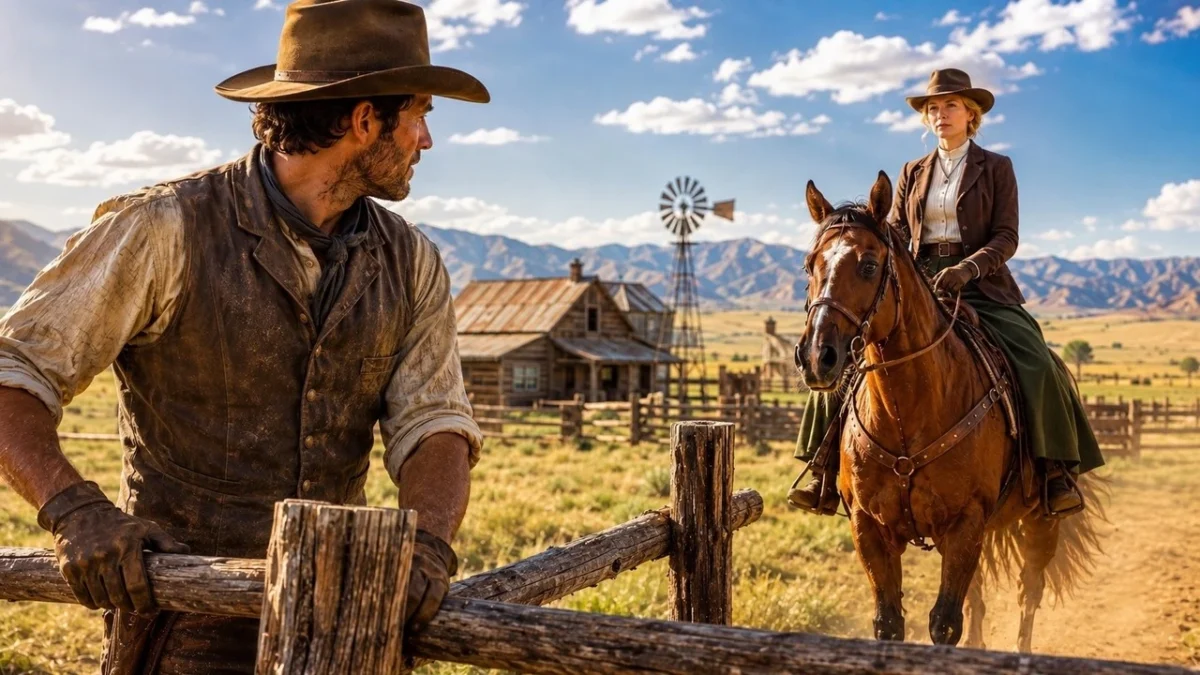
The Caldwell place had been empty for five full years when Holt Ramsay walked every inch of its perimeter on a cold Tuesday morning in April of 1891.
He was forty-seven years old, and he had been saving toward this singular moment since he was thirty-one.
Sixteen years of wages earned on other men’s ranches, stretching from Wyoming down to Colorado, into the New Mexico territory, and back up through the panhandle country.
Sixteen years of living in drafty bunkhouses, wearing boots until the leather split, and spending nothing he did not absolutely have to spend.
He had carried five hundred and ten dollars in a canvas pouch inside his saddlebag when he rode into Laramie.
It had taken sixteen years of physical break to assemble that exact sum.
The bank in Laramie had taken four hundred and ninety dollars of it for the deed and the back taxes.
He had twenty dollars remaining to his name, along with three hundred and ten acres of high-prairie land that nobody else in the county had bid on.
Standing in the center of the East Field that April morning, Holt Ramsay understood precisely why the land had gone unclaimed.
The grasshopper plague of 1886 had stripped the soil down to hardpan in the low sections, and the brutal drought of 1889 had finished what the insects began.
The Caldwell family had held on through both disasters with a stubbornness that eventually broke them.
Dewey Caldwell had died of double pneumonia in the bitter winter of 1890, and his widow had gathered their surviving children and taken the morning stage to her sister’s place in Kansas.
Nobody in the valley had blamed her for leaving.
The land had asked everything of Dewey Caldwell, and it had given him a hard, early grave at fifty-two in return.
Three prospective buyers had ridden out from town since the bank foreclosed on the parcel.
All three had surveyed the land, seen the ruin, and ridden back without making an offer.
Holt Ramsay did not ride back.
He stood alone in the East Field with the cutting April wind slicing across the open country, surveying the broken irrigation channels running along the south boundary, the collapsed timber of the corral fence near the dry water trough, and the barn roof that had lost its entire eastern quarter to a blizzard sometime in the past two winters.
He took stock of it all with the quiet arithmetic of a man who has planned for one thing for half his life and can finally see what that ambition is going to demand of him.
He walked to the house, climbed the warped wooden steps, and sat down.
He placed his hat on his knee and looked out over the acreage in the fading afternoon light.
He was forty-seven years old, and this desolate ground was the first thing in the world that had ever belonged entirely to him.
The fence first, he thought, staring at the gray post lines.
The irrigation channels after that.
Nothing else makes a lick of sense until those two things are right.
He picked up a dry stick and began drawing lines in the dirt at his feet, laying out his physical order of work, when the distant sound of rhythmic hooves caught his attention.
A rider was coming through the open front gate at a pace that proved they knew the terrain and had come with a deliberate purpose.
Holt stopped his stick and watched.
The rider was a young woman of twenty-four, a detail he could discern even from a distance, and the nature of her upbringing became immediately obvious as she pulled up at the edge of the dirt yard.
She rode a powerful blood bay stallion with the deep chest, straight back, and clean legs that only came from generations of careful, expensive breeding.
The young woman sat the saddle with the effortless stillness of someone who had been riding before she learned to read, a posture that was not stiff, but absolute ease in motion.
Her riding clothes were tailored, durable, and clean.
Her eyes, when she turned them upon him across the yard, were a steady, striking gray-green that thoroughly assessed him before she spoke a single word.
“Mr. Ramsay,” she said, her voice clear above the wind.
Holt stood up from the porch step.
He placed his hat back on his head, settling the brim low.
“Miss,” he replied softly.
She had known his name before arriving, which meant she had sought out the record at the land office, which meant this was an errand of business.
“Dena Prescott,” she said.
She paused, letting the name rest in the air, a gesture that signaled she expected the name to hold weight.
“My father is George Prescott. The Prescott operation lies directly to your north.”
“I know the Prescott mark,” Holt said.
“He asked me to ride down and speak with you,” Dena said, keeping her hand light on the reins. “My father would like to acquire this property, Mr. Ramsay. He believes the bank’s asking price severely understated its ultimate value, even in its current dilapidated condition. He has authorized me to offer you six hundred and fifty dollars for the deed.”
Holt did not blink.
“That is one hundred and sixty dollars more than you paid at the bank three days ago,” she continued, her tone measured. “You could walk away right now with a solid profit and no debt.”
Holt looked at her.
Then he looked past her, out toward the East Field, at the clogged, broken irrigation channels he had spent the last hour mentally repairing.
He looked back at Dena Prescott, twenty-four years old, sitting high on a thoroughbred bay, watching him calculate with her gray-green eyes.
“No,” Holt said.
Dena did not flinch or shift in her saddle.
“It is a fair offer, Mr. Ramsay,” she stated. “More than fair, given the state of that barn.”
“It is a fair offer,” Holt agreed. “I’m not selling.”
She turned her gaze away from him and swept it across the property.
She was doing precisely what he had done that morning, reading the soil, taking an inventory of the sheer labor required to make it produce again.
“You understand what this land needs to survive,” she said, looking back at him.
“Yes,” Holt said.
“That’s why I’m staying.”
Dena held his gaze for a long, silent moment, searching his face for hesitation and finding none.
Without another word, she reined her horse around and rode back out through the broken gate.
Holt stood in the yard, watching the dust settle behind her blood bay, before sitting back down to draw lines in the dirt.
She returned three days later, on a Friday.
She did not bring a revised offer from her father.
She came alone on the same bay horse, but she had abandoned the formal posture of her initial visit.
She rode straight out to the South Irrigation Channel, where Holt was working alone with a heavy iron spade, his shirt soaked through with sweat despite the chilly air.
She stopped her horse near the ditch and watched him dig in silence for ten full minutes before speaking.
“You’re digging it too steep,” she said.
Holt stopped his shovel mid-thrust.
He wiped his forehead with his sleeve, looked at the trench, and then looked up at her.
“The grade is wrong,” she repeated flatly.
She dismounted, looped her reins around a standing fence post, and walked through the gap where the timber was down.
She crouched directly beside the muddy trench he had been cutting since sunrise.
“The east fields in this part of the valley have a heavy clay lens about eighteen inches underground,” she said, pointing a leather-gloved finger at the exposed soil. “I can show you where it runs if you care to see it. A standard drainage grade will push the spring runoff right against that subterranean clay layer every single year. The water will pool, sour the root systems, and turn your field into a bog by May.”
Holt looked at the soil she was pointing to.
“What’s the fix?” he asked.
“You need a shallower angle,” she replied, looking up at him. “Let it sheet off toward the west side where the soil is sandy. It takes longer to channel, but it won’t trap the water.”
Holt looked down at the twenty-four-year-old woman crouching in the dirt of his newly purchased land, her expensive riding skirt resting in the dust, speaking about his soil’s hidden strata with the absolute confidence of someone who had observed this valley for a lifetime.
“You know this property,” Holt said.
“My father’s south fence line runs right along the old Caldwell boundary,” she said, standing up and dusting her knees. “I’ve ridden every square foot of this valley since I was seven years old. The Caldwells built their ditches wrong twenty years ago, and they spent every spring digging themselves out of the mud.”
“Where does the lens shift?” Holt asked.
“It shifts about forty yards east of where you’re putting your edge,” she said, stepping toward the high ground. “If you start the channel over there, you’ll have half the work and twice the drainage.”
Holt looked back at the ditch he had dug.
He had been swinging the spade into hard soil since five o’clock that morning, and his back ached from the effort.
“Show me,” he said.
She walked forty yards to the northeast and stopped, tapping the toe of her boot against the ground.
“Right here,” she said.
Holt walked over and knelt down.
She pointed out the faint, subtle shift in the color of the dry topsoil, the slight dark line running toward the ridge, showing where water had pooled and dried over decades.
He could see it clearly once she pointed it out.
“You’re right,” Holt said quietly.
“I know I am,” Dena said.
He moved his tools to the new mark and began cutting the trench at the shallower angle.
Dena stood nearby for half an hour, watching him set the line, offering short, practical corrections whenever his spade veered off the natural contour of the land.
That evening, sitting on his front porch step with his hands sore and calloused, Holt thought about the young woman who had arrived to buy him out on Tuesday and had spent her Friday afternoon teaching him how to manage his own drainage.
He was forty-seven years old, and he had worked livestock and land his entire adult life.
He realized he had no room for foolish pride.
He had not known about the clay lens, and she had saved him weeks of wasted labor.
She returned the following week, and the week after that.
She did not come every day; she had her own duties on her father’s vast ranch, managing books and overseeing cattle movements.
However, she came often enough that Holt began to listen for the sound of her bay horse coming through the gate, a habit he had not planned for and had no experience handling.
She was a remarkably skilled rancher.
This initially surprised him, then quickly stopped surprising him altogether.
She did not treat manual labor as something beneath her standing, nor did she act as though she were conferring a favor upon him by getting her hands dirty.
She worked with a quiet, efficient rhythm.
She knew where the underground spring fed the north pasture, and she knew precisely which summer months its flow would slow to a trickle.
She knew that the soil in the west parcel was rich enough to support winter wheat, but that the eastern section lacked the nitrogen to hold it through a hard freeze.
She had watched this parcel of land from her father’s territory for years, observing its shifts with an analytical eye that no county surveyor or bank assessor could ever match.
On a warm Thursday afternoon in May, while they were mending the timber along the creek bed, Dena stopped and looked up at the sky to the west.
“Look at the cloud build over the western ridge,” she said, pointing her hammer toward the peak.
Holt wiped his brow and looked. “Looks like fair-weather haze.”
“It isn’t,” she said firmly. “When the cloud gathering caps that ridge in late afternoon, it means a sudden temperature drop in the high draws. We’ll have heavy rain here in forty minutes, even if the barometer in the house hasn’t ticked down a point.”
Holt watched her scan the sky, noticing the absolute certainty in her eyes.
He had long since stopped needing to be the authority on the land; he was simply eager to absorb everything she was willing to teach him.
“We better secure the loose timber then,” Holt said, turning back to the fence.
“We better,” she agreed, picking up a box of iron nails.
They worked side by side as the wind began to shift, bringing the cool damp scent of mountain rain down into the valley.
They talked as they worked, the conversation flowing naturally in the quiet way it does between two people engaged in shared physical effort.
Bit by bit, Holt spoke about his sixteen years on the trail.
He did not deliver it as a grand speech, but rather in sparse, quiet sentences dropped between the heavy strikes of his hammer.
He told her about the endless bunkhouses in New Mexico, the dust of the Texas panhandle, and the grinding discipline of saving dollars while watching other men spend their wages in town on Saturday nights.
He shared these things with his eyes fixed on his work, giving his hands something to do while the personal history came out.
Dena listened, her movements steady as she set fence posts.
In return, she spoke of her mother, who had died of fever when Dena was fifteen years old.
She told him about the difficult years that followed, when she had forced herself to become useful to her grieving father, not merely out of filial duty, but because managing the ranch was the only constant that felt solid when everything else had been upended.
“I was nineteen when I realized it,” Dena said, resting her hand on a fence post as the first heavy rain drops began to fall.
“Realized what?” Holt asked, looking at her.
“That I had become the most capable manager on the entire Prescott operation,” she said, her voice free of boastfulness, carrying only plain fact. “And that I was the only one doing it without a wage or a title.”
“Does your father know that?” Holt asked.
“He knows I am capable,” she said, watching the rain strike the dry dirt. “Whether he has ever sat down to consider what that actually means for my life is a entirely different question.”
By late May, the cross-fencing on the lower section was complete, and the south pasture had greened up under the restored drainage.
One evening, leaning against the newly reinforced corral fence, watching Holt’s four horses graze on the thick native grass, Dena broke a long silence.
“Why this specific piece of land, Holt?” she asked, turning to face him. “There were other parcels available in the county. Places with sound houses and fences that hadn’t been picked clean by drought and bad luck.”
Holt looked out over the pasture, taking in the clean line of the ditch and the repaired timber of the barn.
“Because Dewey Caldwell loved this place,” Holt said softly. “You could see it in the way he positioned the barn to catch the morning sun, and how he set the corral away from the flood line. He cared about this dirt. It deserved someone to keep caring for it instead of letting it go back to sagebrush.”
Dena was quiet for a long time.
“My father’s land has never been abandoned,” she said slowly, her gray-green eyes reflecting the fading sunset. “It has never been unloved for a single season. But holding onto a prosperous place… that’s a very different thing than building something out of wreckage.”
Holt said nothing, but a feeling that had been quietly taking root since the morning she had corrected his drainage grade moved distinctly closer to being acknowledged.
Neither of them noticed the Prescott ranch hand sitting motionless on a horse along the high ridge to the north, watching the two of them through the gathering dusk.
The hand had been sitting there for the better part of an hour before turning his horse back toward the main house.
George Prescott arrived on Holt’s property on a cold Friday morning in early June.
He was sixty-two years old, a broad-shouldered man carrying the heavy, undisputed authority of someone who had been the prominent landholder in Sheridan County for two decades.
He rode a magnificent stallion that had cost more than Holt’s entire three hundred and ten acres, and he dismounted with deliberate, slow movements.
He walked along the new fence line, inspecting the timber like a man checking the quality of goods he intended to buy.
He looked at the mended corral, the cleared irrigation channels along the south run, and finally turned his hard gaze upon Holt, who was standing near the porch.
“You’ve made remarkable progress here, Ramsay,” Prescott said, his voice deep and raspy.
“Yes, sir,” Holt replied, staying where he was.
“My daughter has been coming down here,” Prescott stated flatly.
“She corrected my drainage grade on her second visit,” Holt said, holding the older man’s gaze. “She was right about the clay lens. I’ve asked her advice on the channel work since.”
A subtle shift occurred in George Prescott’s face, his jaw tightening slightly.
“My daughter,” Prescott said with slow emphasis, “was educated at a fine women’s academy in Denver. She reads Latin. She plays the piano well enough that she was invited to teach music at the school.”
He stepped closer to Holt, his boots crunching on the gravel.
“She is going to marry a man who can offer her an estate appropriate to who she is and where she comes from,” Prescott continued. “A man with capital, standing, and a future.”
Holt looked at the wealthy rancher, recognizing the immovable conviction of a father who had decided what was best for his daughter without ever asking her what she wanted.
“Mr. Prescott,” Holt said calmly, “I haven’t asked your daughter for anything. I’ve been working this land.”
“I know what my hands have reported to me,” Prescott snapped, “and I know where these daily visits lead. I am going to be entirely plain with you, Ramsay. My daughter is not intended for a forty-seven-year-old hired hand who sleeps under a leaking barn roof because he spent his last dollar on a worn-out property two sensible buyers walked away from.”
Prescott leaned in slightly, his eyes narrowing.
“This is not about your character,” Prescott added. “I have no specific complaint regarding your character. This is about what you cannot provide her.”
Holt met the cattle baron’s gaze without flinching.
“With respect, Mr. Prescott,” Holt said softly, “that seems like it ought to be her decision to make.”
Prescott’s eyes went cold and hard.
“Not while she carries my name,” the older man said sharply.
He turned, remounted his horse in one fluent motion, and rode north without looking back.
Holt stood in his dirt yard, watching the dust trail recede toward the horizon, thinking about Dena’s words about building something from wreckage, before picking up his shovel and returning to work.
That evening, George Prescott confronted his daughter in the dining room of the grand Prescott house.
He spoke to her plainly, with the absolute finality of a man who believed his word was law within his own household.
He informed her that her visits to the Caldwell place were finished effective immediately, and that he had made his expectations crystal clear to Holt Ramsay.
Dena sat across from her father at the heavy oak table, listening to every word without interrupting.
She did not yell or raise her voice.
She had lived with George Prescott for twenty-four years, and she understood that arguing with him directly was like striking a stone cliff with bare hands; she would only hurt herself while the stone remained unmoved.
She knew his mind shifted only when confronted with indisputable reality.
She finished her meal, went to her bedroom, and sat by the window looking out at the dark silhouette of the northern ridge.
She thought about Holt Ramsay, who had saved for sixteen long years to buy a piece of abandoned earth because he believed it was worth saving when everyone else considered it trash.
She thought about her father’s words regarding Holt’s character, realizing that her father already recognized Holt’s worth, but was too blinded by pride to accept it.
She stood up, walked down the hallway, and pushed open the door to her father’s study.
George Prescott was sitting at his grand mahogany desk, surrounded by leather-bound ledgers.
“Papa,” she said, her voice steady.
He looked up from his figures, his pen poised above the paper.
“I am not going to stop going down there,” Dena said, standing straight before his desk. “I want you to hear me say that directly, because I will not sneak behind your back. I am telling you face-to-face that I disagree with your demand.”
Prescott set his pen down with a loud click.
“Dena—”
“I am twenty-four years old,” she interrupted quietly but forcefully. “I have done every single thing this ranch has ever required of me since Mother died. I have done everything you have ever asked of me. I have never once in my life asked you to trust my judgment on something that truly mattered to me.”
She stepped closer to the desk, meeting his gray-green eyes with her own identical gray-green eyes.
“I am asking you now,” she said. “Not for your permission, Papa. For your trust that I know my own mind.”
Before he could formulate an answer, she turned and walked out of the room, closing the heavy door behind her.
George Prescott sat alone in his study for hours, staring at his open account books, unable to make the columns of figures align.
His daughter had just looked at him with the exact same unyielding expression her mother had worn whenever he was making a profound mistake, an expression he had not seen since his wife passed away.
He closed the ledger, realizing with a strange, heavy ache that he was entirely unable to focus on his work.
June arrived, bringing heat to the valley, and Holt continued his relentless restoration.
The main drainage ditches were now functioning perfectly, and the south pasture had recovered so well that it was comfortably grazing six horses.
He had repaired the damaged section of the barn roof using salvaged timber he gathered along the creek.
He knew the patch job was temporary and would not survive a second hard winter, but it kept the workspace dry while he accumulated funds for fresh shingles.
Dena continued to arrive every Tuesday and Saturday afternoon.
Her father did not attempt to physically bar her path, an omission that was not consent, but rather the quiet retreat of a man who realized his daughter would ride out regardless of his orders.
She brought her deep understanding of the land’s nuances to every project, continuing to call out Holt’s errors without hesitation.
When he prepared to plow the north section for alfalfa, she stopped him cold.
“The frost line in that specific draw holds three weeks longer than the valley average because of the ridge shadow,” she told him, leaning over the tractor frame. “If you put alfalfa in there, an early cold snap will kill the sprouts. Plant winter wheat instead. You’ll get two solid harvests before the ground freezes hard.”
Holt adjusted his plans without argument, seeding the north field in winter wheat.
He saw the small nod of satisfaction she gave when she noticed he had followed her advice, a quiet mutual respect that meant more to him than he cared to admit.
In late July, Dena stood in the yard examining his patched barn roof.
“That salvaged pine won’t hold past the November gales,” she noted, squinting at the rafters.
“I know,” Holt said, hauling a sack of feed. “It’ll hold until I can earn enough to buy proper tongue-and-groove boards.”
She watched him carry the heavy sack, appreciating the fact that he prioritized functional necessities over quick comfort.
He had accepted her corrections regarding his ditch lines after a single day of pride, and had asked for her input on every section since.
His pride was not the brittle kind that refused guidance; it was the sturdy kind that accepted a mistake, corrected it immediately, and never wasted time regretting it.
“Holt,” she called out as he set the sack down.
He turned to look at her.
“The west pasture needs cross-fencing before you bring in any more stock,” she said, pointing toward the meadow. “If you run more than eight horses in there without dividing the grazing quarters, they’ll strip the north strip bare by October, and it won’t recover until late spring.”
Holt looked at the green expanse of the west pasture.
“You’re certain about October?” he asked.
“I’ve watched that specific pasture recover every spring since I was nine years old,” she replied flatly. “I am certain.”
“All right,” Holt said. “Cross-fencing starts tomorrow.”
Neither of them noticed that the high ridge to the north had remained entirely empty for days, the Prescott hands no longer sent to watch them.
The disaster struck on a Thursday night in the second week of August.
The Sweetwater River, usually a calm trickle late in the summer, burst its banks following a massive flash flood in the western mountains.
It was the sort of sudden deluge that occurred only twice in a generation, catching the entire valley completely off guard after a dry summer.
A massive rainstorm in the peaks had channeled millions of gallons of water down the mountain draws faster than the parched creek beds could absorb it.
By midnight, the lower pastures on the northeast boundary of the Prescott ranch were completely submerged under four feet of rushing, muddy water.
Sixty-three of George Prescott’s prized breeding mares were trapped in the inundated bottomland, panicked in the pitch darkness, with two sections of their perimeter fence completely torn away by the current.
Holt smelled the sharp, muddy scent of floodwater on the night air before he heard the distant roar.
He was out of his bunk and had his horse saddled within three minutes, riding hard toward the north boundary on pure rancher instinct.
When he reached the Prescott property line, he found absolute chaos.
A dozen Prescott hands were on horseback, struggling in the deep water along the edges of the flooded field, shouting and waving ropes, trying to herd the terrified mares toward the high ground on the western slope.
They were losing the battle; the water was rising rapidly, and the horses were too frantic to respond to shouting.
Holt did not pause at the broken fence line.
He urged his horse directly through the gap into the rushing current and plunged into the middle of the flooded pasture.
He knew how to handle panicked livestock in deep water: you do not fight them head-on; you ride alongside them, match their swimming pace, and turn them gradually by degrees.
He had done it once before during a devastating flood on the South Platte River in Colorado when he was thirty-one years old, and the muscle memory returned instantly.
He worked the cold water continuously for two full hours.
The veteran Prescott foreman, a gray-bearded man named Dutch, fell in beside Holt, and together they worked the horses in small, manageable groups, guiding them steadily out of the main current toward the safety of the western ridge.
They repeated the dangerous maneuver again and again until every single mare was standing safely on the high ground, shivering but alive in the dark.
Holt sat on his exhausted horse in the receding water near the fence gap, his chest heaving as he caught his breath.
He heard George Prescott’s voice before he saw him.
The cattle baron had arrived on horseback during the second hour of the struggle, and Holt had been too focused on the rescue to notice.
Prescott was talking to Dutch, and the old foreman was pointing directly at Holt.
Prescott rode his horse slowly through the shallow water and stopped right beside Holt.
For a long minute, the wealthy man said nothing, his eyes scanning the high ridge where his valuable horses were gathered.
“All of them,” Holt said, his voice hoarse from shouting over the roaring river. “Sixty-three head.”
Prescott stopped counting.
He turned his head and looked at Holt Ramsay in the dim moonlight.
He looked at him with the expression of a man who had been cataloging a person incorrectly for months and had just been forced to completely rewrite his assessment.
“You don’t work for me, Ramsay,” Prescott said, his voice flat and quiet.
“No, sir,” Holt replied. “I don’t.”
“You don’t owe me a thing,” Prescott said. “My daughter told you I wanted you gone. I told you to stay away from her.”
“Your horses were drowning,” Holt said simply.
George Prescott sat in his saddle, letting those four words hang in the cold night air.
They left no room for the anger or arguments he had spent weeks preparing.
“Come up to the main house,” Prescott said quietly, turning his horse. “Dutch will rub down your mount.”
They sat opposite each other at the large pine table in the Prescott kitchen until nearly four o’clock in the morning.
They drank hot black coffee and talked about the valley’s water tables, the changing mountain weather, and the structural drainage of the low pastures.
As the sky began to lighten in the east, the sixty-two-year-old rancher looked across the table at the forty-seven-year-old man who had risked his life in a dark flood for no financial reward or personal gain.
George Prescott made a quiet calculation, one entirely different from any financial ledger he had ever kept.
In early September, George Prescott rode down to the Caldwell place alone.
He dismounted and spent an hour walking the south pasture, examining the newly cleared irrigation ditches, the rebuilt corral, and the sturdy cross-fencing Holt had constructed in the west field on Dena’s advice.
He walked the ground with slow, deliberate steps, reading every repair just as he read his own property.
At the south pasture fence, he stopped, reached out, and shook a heavy wooden post; it was rock-solid in the earth.
He walked down to the main drainage channel, watching the clean water sheet off toward the western sand, completely bypassing the deep clay layer underneath.
“Dena showed you this grade,” Prescott said, leaning on his walking stick as Holt walked up.
“She did,” Holt said. “On her second visit here.”
Prescott nodded slowly, staring at the running water.
“I taught her that grade when she was twelve years old,” the old man said softly. “We spent an entire rainy afternoon knee-deep in the mud of my north field, and I showed her exactly where the water went wrong.”
He fell silent for a moment, his eyes misty as he recalled the memory.
“I’ve been teaching that girl how this valley works for twelve years,” Prescott continued quietly. “I suppose… I always assumed everything I taught her was meant solely for my benefit. For my ranch. It never occurred to me that she might take those lessons somewhere else and use them to build something of her own.”
Holt remained silent, letting the older man process his thoughts.
Prescott looked out over the acreage.
“I started out in this territory with forty-five dollars in my pocket,” Prescott said. “Rented a tiny room in Cheyenne back in ’73. My wife’s father told her she was making the mistake of her life by marrying me. He died before I made my fortune, before I could prove him wrong… and that has been the one part of my success I’ve never been able to enjoy.”
He turned his head and met Holt’s eyes directly.
“I realized last night that I’ve been doing the exact same thing to my daughter that was done to me,” Prescott said, the words coming out with the difficult weight of a proud man admitting a deep error.
“That’s a hard thing to realize,” Holt said gently.
“Yes,” Prescott agreed. “It is.”
He pulled his hat down low over his eyes.
“I am not standing here giving you my blessing today, Ramsay,” Prescott said plainly. “I want to be honest with you. I’m not quite there yet.”
He gestured toward the horses grazing peacefully in the green pasture.
“What I am telling you is that I am no longer your enemy,” Prescott said. “There is a significant difference between those two things, and I want you to understand it.”
He walked to his horse and mounted up.
As he reached the front gate, he pulled his horse to a halt and looked back at the barn.
“That barn roof,” Prescott said, pointing his glove at the patched pine. “Before November sets in, I’ll have my team haul down a load of good cedar shingles and tongue-and-groove siding.”
Holt looked at him steadily.
“I will pay for the lumber, Mr. Prescott,” Holt said.
George Prescott stared at him for a long, quiet moment, and then the corners of his mouth twitched upward into something that was not quite a smile, but was undeniably related to one.
“Yes,” Prescott said softly. “I know you will.”
He turned his horse and rode north.
Holt stood by the gate, watching the old cattle baron ride away, realizing he had just witnessed a proud man do the hardest thing he had done in many years.
Holt Ramsay and Dena Prescott were married in the middle of October.
The proposal had taken place in late September on the front porch of the ranch house, a property that had once been stripped down to barren hardpan and was now recognized as the best-managed three hundred and ten acres in Sheridan County.
Holt had asked her simply and directly.
She had said yes before he could finish the sentence, telling him afterward with a laugh that she had been ready to say yes since that day in May when he had said Dewey Caldwell loved the land and that it deserved someone to keep caring for it.
The wedding took place at the small Clearfield Community Church on a morning that was crisp, cold, and clear, the sky painted in the sharp, brilliant blue unique to a Wyoming autumn.
Dena stood in the small dressing room off the church vestibule, putting the final adjustments on her simple white dress.
She wore her mother’s gold brooch pinned near her collar, the same brooch she had worn to her mother’s funeral and on every significant day of her life since.
She looked at her reflection in the small wall mirror, thinking about her father, who had promised he was no longer her enemy, but had never explicitly offered his blessing for the marriage.
She placed her hand on the brass doorknob to step into the sanctuary.
“Dena,” her friend whispered softly from across the room.
Dena turned around.
Her friend was looking past her, toward the open doors at the back of the small chapel.
Standing in the doorway, wearing his finest dark wool coat, holding his brimmed hat in both hands, stood George Prescott.
He was sixty-two years old, and he was looking at his daughter with the tender, humbled expression of a man who knows he was wrong and has finally summoned the courage to make it right.
The look was costing his immense pride everything he had, and he was paying the price willingly.
He walked slowly down the center aisle toward her, his heavy footsteps echoing on the wooden floorboards with deliberate weight.
He stopped directly in front of his daughter.
He reached out a weathered hand, gently touching the gold brooch at her collar, and then looked up into her face.
“You have your mother’s eyes, Dena,” he said softly, his voice thick with emotion.
“I know, Papa,” she whispered, her gray-green eyes swimming with tears.
George Prescott turned to look at Holt Ramsay, who was standing quietly near the altar in his best suit, waiting for his bride.
The old cattle baron took a deep breath, took his daughter’s hand, and placed it firmly into Holt’s steady palm.
“Take care of her, Holt,” Prescott said, his voice ringing clear through the small church. “And take care of that land.”
“I will, George,” Holt said, closing his hand around Dena’s. “On both counts.”
They stood together before the altar as the morning sun flooded through the tall windows, casting a warm light across the three of them, illuminating the quiet beginning of a long life built steadily from the ground up.








