A Tiny Dragon Was Left Alone in the Snow—The Toymaker Refused to Leave Her Behind
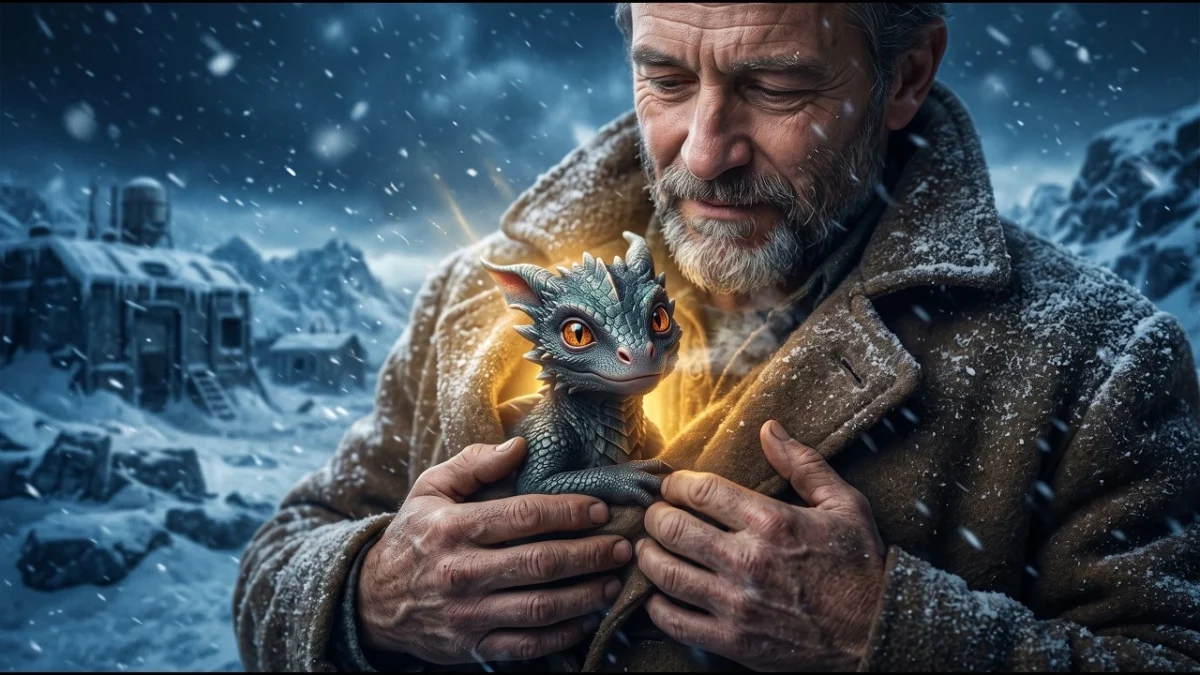
The Toymaker and the Dragon
The wind found every gap it could.
It pushed through the cracked seal around the market stall door, moved along the floor in cold fingers, lifted sawdust into small ghosts and let it fall again.
Outside, the colony of Varda’s Reach was doing what it always did in deep winter — trying to kill anything that stayed too long.
Aldric Vane did not notice the wind.
He was wrapping a wooden rocking horse in paper and twine, his thick fingers moving with the careful patience of a man who had spent real time making something matter.
The horse had taken him eleven days.
It had a carved mane, a strip of real leather for a saddle no bigger than his palm, and eyes painted a warm brown that caught the light just right.
He had made it for a girl named Dara, who had asked for it back in autumn, and he had promised it would be finished before the cold season came.
He had kept that promise.
The fact that Dara and her family had boarded an evacuation shuttle four hours ago was something Aldric was still working through.
The colony’s emergency alarm had sounded at midday.
He had heard it.
He had walked to his door and watched people running through the market corridor with bags and bundles, children dragged along by the wrist, voices overlapping in three different languages.
He had looked back at the half-wrapped rocking horse on his table.
He had gone back inside to finish it.
This was not bravery.
Aldric was not an especially brave man.
It was something more stubborn than that — a quiet refusal to leave a thing undone, the same habit that had gotten him into trouble his whole life, and would, he was beginning to suspect, get him into a great deal more trouble now.
By the time he reached the shuttle bay, rocking horse under his arm, the bay was already sealed, the last ship a white speck vanishing into the gray sky.
He stood there for a while, snow beginning to fall around him, and said several words that would have embarrassed him in company.
Then he walked back to his workshop.
Now the colony was silent in the way only truly empty places are silent — not quiet, but hollow.
The wind still made noise, and the metal walls groaned as they contracted in the cold, but there were no voices, no footsteps, no hum from the central grid, which had been shut down as part of the evacuation.
The colony of Varda’s Reach, population one thousand one hundred and forty-three that morning, now had a population of one.
Aldric took stock, because taking stock was something a craftsman always did.
He had his workshop, well insulated, with a small wood stove he had installed two winters ago because the central heating had always run too cold for his liking.
He had months of timber stored beneath the worktable, good tools, and six weeks of emergency rations most residents had forgotten in the panic to leave.
He had a generator with perhaps three weeks of fuel, if he was careful, and an offline data bank still holding maps, records, and whatever else had been cached before the network went dark.
What he did not have was a working long-range communicator.
The emergency beacon outside clicked, hummed, and displayed a steady red light — blocked, he assumed, by whatever suppression field the departing forces had left behind.
He was not surprised.
He was just a toymaker. Nobody had ever explained the politics to him, and he had never much wanted them to.
He lit the stove, moved his cot closer to it, and sat down at his worktable, because sitting and doing nothing was not something he knew how to do.
He was sanding the arm of a half-finished puppet when he heard it.
The sound came again from outside, thin and high, barely audible beneath the wind.
He might have dismissed it as metal settling if it had come only once, but it came three times, in even, deliberate bursts.
Not mechanical.
Something with lungs.
Aldric set down his sandpaper, pulled on his coat and boots, took the lantern from its hook, and went out into the snow.
The market row was long and dark, every stall sealed, drifts piling against the shutters.
He followed the sound three stalls down to an old textile vendor’s unit, where a loose shutter had fallen sideways and wedged against the frame.
In the gap beneath it, something was curled.
He crouched and held the lantern close.
It was small — barely the size of a large rabbit — with dark gray-green scales gone pale at the edges in a way that did not look healthy, small folded wings pressed flat against its sides, and a tail curled tight around its own body.
Its eyes were open, dark, and looking directly at him.
It made the sound again, thin and desperate, and Aldric felt it land somewhere in his chest.
He knew what it was.
There had been a diplomatic envoy stationed at the colony the past year — reptilian visitors he’d sold a puzzle box to once — but he had never seen one of their hatchlings before, and he had certainly never known they could be this small, or this cold.
He reached in slowly and picked her up.
She hissed, weak and frightened, and tried to pull away.
He did not tighten his grip.
He simply held her steady, tucked her against his chest, and closed his coat around her.
“Come on then,” he said, because he talked when he worked, and this, he had already decided, counted as work. “Workshop’s warmer.”
By the time they reached his door, the trembling against his chest had already begun to ease.
She bit him on the second day.
Not hard — her jaw was still weak — but she caught the meat of his thumb and held on a moment before letting go.
He pulled his hand back, looked at the two thin red marks, and looked at her.
She looked back, dark eyes steady, entirely unapologetic.
“Fair enough,” he said, and went back to trying to get her to eat.
He had started calling her Sara, after trying seven or eight names aloud the first evening and watching for a reaction.
When he said Sara, her tail had flicked sideways, twice — which, according to the colony’s old data bank, was an affirmation signal.
So, Sara it was.
He built her a nest box from spare timber and cloth offcuts, ran a loop of copper pipe from the stove behind it for steady radiant heat, and spent an entire night adjusting it until the temperature held exactly where the data bank said a hatchling needed it.
He checked it every two hours.
Food was harder.
He knew Dracari were not vegetarians, and his ration packs included dried fish strips for exactly that reason.
She turned her head away the first day.
She bit him the second.
On the third day, she ate from his hand — ungraciously, snatching the strip and retreating to her corner to eat it with her wings half-raised, watching him as though she expected him to take it back.
He did not move.
He simply went back to sanding.
Over the following days, he learned her patterns — asleep through the morning, restless and curious by afternoon, drawn to every sharp tool in the workshop until he moved them to a high shelf, which she then investigated anyway.
He talked to her constantly, not because he expected her to understand, but because the silence of the empty colony was something he preferred to fill.
He told her the names of his tools.
He told her about the rocking horse sitting finished on the corner of the table, and about Dara, and about how he hoped she was somewhere warmer than this.
Sara watched his hands whenever he worked, and he noticed she calmed whenever he was busy, as if motion itself meant safety to her.
On the fifth day, he carved her a puzzle box — a small wooden cube with panels that had to move in a specific order to reveal a hollow center, a piece of dried fish hidden inside.
She had it open in forty minutes.
He reset it, added a second step.
Twenty-three minutes.
He laughed, which startled her into flaring her wings, but she settled again quickly at the sound of it.
He was not a man who laughed often.
“Not bad,” he said. “Not bad at all.”
That night he tried reading a short list of basic Dracari words from the data bank, watching her reactions.
Warm made her tail flick.
Food sent her toward her nest box, where her rations were kept.
Good, which the data bank translated roughly as safe, settled, at rest, made her lower her crest.
She understood far more than she could say, and by the end of the second week, she had learned six standard words of her own — including his name, which came out slightly slurred as Aldrik.
He never corrected her.
He liked it better that way.
By the sixth week, Sara was the size of a medium dog, more than doubled since the night he’d found her, and eating considerably more than the ration packs were meant to provide.
He began quietly cutting his own portions, a little at a time, careful never to mention it.
She would not have understood the reasoning, and he did not want her to worry.
She noticed things anyway.
When he sat too long without moving, she would push her snout against his knee until he got up.
On the forty-second day, she sneezed fire and burned a hole clean through his hat.
She stared at the scorched wool with her mouth still open, a thin curl of smoke rising from her teeth, clearly more startled than he was.
“It’s all right,” he said, setting the hat on the shelf as evidence. “Warm in here anyway.”
She avoided looking at the hat for three days.
By the fourteenth night, she had stopped sleeping only in her nest box.
She crossed the workshop floor while he sat by the stove, too tired to carve, and curled up against his boots without a word, settling her weight there and going still.
He sat very carefully, afraid to wake her, and later wrote in his notebook: Day 14. Progress.
It was, by some distance, the most understated thing he had ever written.
On the fifty-fifth day, he saw the drone.
It moved across the pale sky in the slow, methodical grid of a survey unit, and he recognized the shape from the old evacuation notices.
He grabbed his polished tin work reflector and flashed it upward, three short bursts, a pause, three more — the pattern from the emergency instruction sheet.
The drone did not change course.
It passed over and was gone.
He was not especially discouraged.
A drone meant the area was being watched, which meant that sooner or later, someone would come back to look properly.
Sara appeared in the doorway below, drawn by the noise.
“What?” she asked — her all-purpose question.
“Visitors,” he said. “Eventually.”
She considered this, and went back inside to resume her daily inspection of the worktable, as thorough as if she had never seen it before.
The suppression field dropped on a morning he had marked, out of habit, as a Tuesday.
The beacon outside switched from a red fault light to a slow yellow pulse — trying, finally, to reach someone.
“Good,” he said, and went back inside to finish cleaning the workshop, which he had been meaning to do for some time.
The Coalition ship settled into the landing zone forty-one hours later.
Aldric was at his worktable finishing a small wooden bird with wings that flapped on a belly catch when he heard the engines, the boots on snow, the unlocked door swinging open.
Sara rose from beside the stove — considerably larger now, roughly the height of a large dog at the shoulder — and placed herself between Aldric and the door, crest raised, wings half-spread.
The man in the gray Coalition uniform took an involuntary step back.
“It’s all right,” Aldric said. “Sara. It’s all right.”
She did not fully relax, but her weight shifted back a fraction, eyes still fixed on the newcomer.
The administrator — Preet, as Aldric would soon learn — looked from Sara, to Aldric, to the stove, the nest box, the neatly stacked ration wrappers, the notebook, the half-finished wooden bird in Aldric’s hands.
“You are Aldric Vane?” he said finally. “Registered artisan, stall fourteen?”
“Yes,” Aldric said. “Is there anything to eat on your ship? I’ve been on short rations about three weeks.”
Preet lost his composure entirely.
“You’ve been on this planet since the evacuation? For three months?”
“Roughly,” Aldric said. “And the hatchling was with me for most of it. Her name is Sara. I found her under a market shutter. She was cold.”
He said it plainly, because it was, plainly, the truth.
The days that followed were complicated in the administrative sense.
The Dracari envoy stationed at the colony had lost seven hatchlings in the chaos of evacuation, all presumed dead, and the Dracari Convocation had entered formal mourning over it.
Sara was not lost.
She was here, eating dried fish from a human toymaker’s hand and burning the occasional hole in his belongings.
When Preet’s team tried to move her aboard the ship for processing, she refused — not emotionally, but with the flat, physical certainty of something that had already decided.
She crossed the room, pressed her flank against Aldric’s leg, and held the posture.
“That is a clutch bond declaration,” Preet said slowly, reading from his data pad. “Under Dracari law, it’s a formal statement of guardianship. She’s declaring that you are her nestmate. Her guardian.”
Aldric looked down at her.
“All right,” he said.
“Do you understand what that means legally?”
“Not entirely,” Aldric admitted. “Does it mean the food situation improves?”
Elder Saeth arrived two days later, ancient and silver-scaled, and found Sara mid-sentence, switching between formal Dracari and fluent standard without so much as a pause between them.
She crossed the workshop the moment she saw the elder, held a correct formal greeting posture, and said, “Elder, I am Sara, hatchling of the third clutch. I am well.” She turned slightly toward Aldric. “This is Aldric. He is my nestmate. He kept me warm.”
Saeth looked at the toymaker for a long moment.
“Why did you not leave her?” she asked.
Aldric turned his carving tool once in his fingers.
“She was cold,” he said, “and she was alone, and I wasn’t doing anything else.”
He seemed genuinely puzzled that the question needed asking at all.
Saeth was quiet for a while.
“In Dracari law,” she said finally, “when a hatchling is found without her clutch, the one who shelters her carries a formal responsibility. It cannot be transferred. It does not expire.” She set down her tea. “You are her guardian of record now. Which makes you, under Convocation law, the custodial guardian of a diplomatic ward.”
“I’m a toymaker,” Aldric said.
“You are a toymaker who kept a Dracari hatchling alive through twelve weeks of isolation with no medical support and dwindling supplies,” Saeth said, “and who, I am told, reduced his own rations to extend hers without recording a single word of complaint about it.”
Aldric said nothing to that.
“The Coalition was preparing to cite you for unauthorized use of colony property,” she added. “They will be dropping that today.”
“I thought they might,” Aldric said.
Three years later, the puzzle boxes were considerably harder.
Sara had made that necessary, solving each new version faster than he could build the next, until he started designing false catches and misleading panels just to keep her occupied.
She loved those ones best.
The new workshop stood on Caldis Station, twice the size of the old stall, with proper heating and storage for six months of timber, arranged exactly the way she had supervised him into arranging it.
She was not fully grown — Dracari adulthood was measured in decades — but she stood at shoulder height to a tall human now, with wings that folded tight along her back and a heat output that made her the warmest thing in any room she entered.
She had also, to the quiet astonishment of diplomats twice her age, become remarkably good at talking to people who were not Dracari — settling an eight-day trade impasse in three, simply by explaining, in friendly and precise standard, what the sticking phrase actually meant in her language.
Elder Saeth had written to Aldric about it.
Her letter was formal and dignified, except for its final line: She gets this from you, you know.
He kept that letter in his notebook, now on its third volume, still filled in every morning with the same small, careful details — a new wood grain, a mechanism that had taken two weeks to perfect, the particular sound Sara made when she was thinking versus when she had already solved a problem and was simply giving him time to catch up.
Above the workshop door hung a plaque he had carved himself the same day he hung the tool hooks, finished smooth with oil.
Two words in standard.
Beside them, burned into the wood in careful, controlled flame — the flame of someone who had learned, over three years, exactly how much was enough — the same two words in Dracari.
We stayed.
It did not explain anything.
It did not need to.
Every morning he walked in and saw it, and every morning it meant exactly what it had always meant — that two strangers had made a decision once, in the cold and the dark of a dying world, and had simply kept making it, every single day since.
This morning, Sara had arrived before him.
The puzzle box he’d left on the table had already been moved to her usual corner, lid open, waiting.
He hung his coat, put the kettle on, sat down at his worktable, and picked up his tools.
He began making the next one harder.








