An Old Blacksmith Asked for Water—Then He Forged Nebraska’s Strongest Homestead
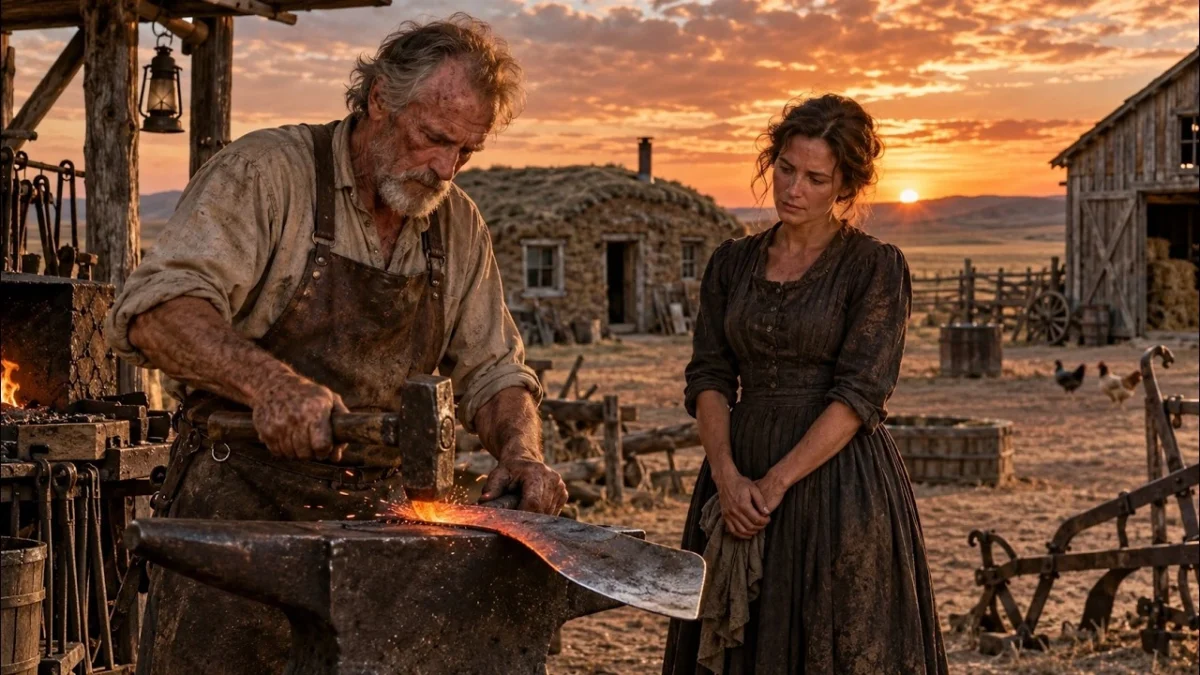
If you’ve ever been counted out before you even got started, stay with me until the very end of this story.
Hit that like button right now and drop your city in the comments so I can see just how far this story has traveled.
The dirt in Scottsbluff, Nebraska, in the late summer of 1888 did not care about a man’s life work.
It was a bleak, flat expanse where the horizon met a high, gray sky, and the topsoil was a choked mat of native bluestem and buffalo grass.
The roots ran eight inches deep, woven together like iron wire, breaking cast-iron plowshares as if they were brittle glass.
A summer in that part of the territory was not kind, but it was honest.
It did not pretend to promise ease, announcing itself in dry heat and relentless prairie winds that stripped the moisture from a man’s skin before his sweat could hit the dust.
Sixty-year-old Gideon Brooks walked down the rutted dirt track toward the Platte River Valley with a slow, mechanical rhythm.
He was a tall man bent slightly at the shoulders from forty years of leaning over open hearths and anvil blocks, his knuckles stained permanently with coal dust and machine oil.
In his right hand, he carried a canvas roll containing three farrier’s chisels and a pair of tongs, while slung over his shoulder in a burlap sack was a worn twelve-pound cross-peen forge hammer.
He had served his time as an army farrier during the War Between the States, shoeing mules in the thick mud of Virginia when he was a young man of twenty-four, and the habit of walking until the ground ran out had never quite left him.
The town of Scottsbluff had already closed its doors to him by noon.
The hardware supplier had looked at the deep lines around Gideon’s eyes and his graying beard, seen an old frame past its prime, and told him they had no use for a man who couldn’t haul sixty-pound oak timbers or drive cattle fourteen hours a day.
Gideon had not argued.
He didn’t say anything right away; something merely shifted in his jaw, not quite a smile, but a tightening of muscle that signaled he had taken the measure of the man behind the counter and found him wanting.
Arguing with a clerk about a man’s worth was like arguing with a turnip about the frost.
Gideon simply turned his back, picked up his sack, and kept walking west toward the open claims.
Two miles outside town, he stopped at the wooden gate of a quarter-section homestead.
The farm was raw, holding the kind of quiet desperation that settles over a place when the money has run out long before the work is half done.
A two-room sod house stood against the wind, its turf roof sprouting dry weeds.
Beside it sat a leaning timber barn with a roof that sagged on the eastern beam, and near the fence line stood a thin draft horse standing over a shattered John Deere plow.
A woman stood on the low porch holding a tin cup of well water.
Sarah Jennings was thirty-three years old, but her eyes had the flat, watchful look of someone who had buried a husband in the hard earth two winters ago and had been forced to learn the exact weight of a thirty-pound sack of flour by carrying it alone.
Two young children, a boy of seven and a girl of five, peeked from behind the folds of her faded calico skirt.
She wasn’t performing usefulness; she stood watching him approach the way people watch a strange dog near a chicken coop.
When you are a widow on a quarter section with two mouths to feed and a cellar down to its last two sacks of cornmeal, a stranger on the road is not a guest, but an expense.
Gideon stopped at the fence post.
He did not offer a grand greeting, nor did he launch into a long story about his troubles.
He took off his felt hat, wiping the ring of salt from his forehead with the back of his sleeve.
“The horse has a hitch in her off-hindquarter,” Gideon said, his voice low and dry as dried corn husks.
“And that cast-iron frog on your plow broke because the foundry poured the metal too cold.”
Sarah looked at him over the rim of the tin cup, her posture rigid.
“I don’t have coin for a blacksmith, mister,” Sarah said.
“And I don’t have room in the barn for a loafer.”
“I don’t want coin,” Gideon replied smoothly.
“I want a tin of water and a dry spot on your barn floor out of the night wind.”
“In trade, I’ll fix that share.”
Sarah looked down at his hands.
They were wide, the nails flat and scarred from flying scale iron, the skin on the palms hardened into yellow calluses thick as boot leather.
She didn’t say anything for a long moment, then walked down the two wooden steps, handed him the cup, and pointed a dark thumb toward the barn.
Gideon drank the water in three long, steady swallows.
He did not thank her with flowery words, simply handing the cup back, walking past her, and stepping into the shade of the barn.
The broken plowshare lay in the dust near the barn doors.
It was a standard commercial model sold by the local merchants to homesteaders who didn’t know any better.
Cast iron was cheap to pour in the eastern foundries, but it possessed no give.
When it hit the dense, ancient root network of the Nebraska prairie, it didn’t flex—it snapped like dry pine.
Gideon did not waste time looking for a proper forge.
He walked behind the barn, found a patch of dry, bare dirt shielded from the afternoon gusts, and dug a shallow trench five inches deep with the toe of his boot.
He gathered dry cow dung, bits of scrap pine from a pile of split fencing, and charcoal dust from an old brush burn.
From under Sarah’s workbench inside the barn, he hauled out a hand-operated leather bellows that had been sitting in the corner, its leather dried and stiff, but the valve still holding air.
He picked up two rusted wagon wheel hoops lying near the fence—high-carbon wrought iron forged thirty years ago when smiths still knew how to work metal properly.
He set his twelve-pound cross-peen hammer on a flat field stone he rolled into the dirt.
Sarah watched from the barn door, her hands rolled into her apron.
She didn’t ask what he was doing, and he didn’t offer an explanation.
Standing around waiting for someone to explain what they were about was a waste of sunlight.
Gideon pumped the bellows with his left hand, sending a low, steady hiss of air into the trench fire until the coals turned from dull red to a blinding, brilliant orange.
He laid the rusted wagon hoop into the heart of the heat.
When the iron reached the color of a sunrise, he drew it out with his tongs, laid it across the stone, and brought the cross-peen hammer down.
The sound was a crisp metallic ring that carried across the flat plain for a mile.
Clang, clang, clang.
His arm moved with a practiced, economical arc.
There was no wasted motion in his shoulder, no unnecessary flourish.
Each stroke flattened the thick iron hoop, drawing it out, folding the hot metal back over itself to work out the impurities, then drawing it flat again.
He took a section of scrap plate steel he found in Sarah’s junk pile, laid it over the wrought iron, dusted the joint with fine river sand to act as a flux, and shoved both pieces back into the coals.
When the fire hit welding heat—that white-hot sparkler glow where the metal begins to sweat—he pulled them out and hammered them together.
The two distinct metals fused into one continuous piece: a tough wrought-iron backing that could take the shock of hidden rocks, topped with a hard steel cutting edge that would hold a razor bevel.
He ground the edge against a river stone cooled with well water until the blade shone bright in the dying sun.
By the time the crickets began their evening hum in the tall grass, Gideon had bolted the newly shaped, self-scouring steel edge onto her wooden plow frame.
He didn’t ask Sarah if she wanted to see it; he simply walked to the pasture, caught the draft horse by its halter, led it to the harness, and hooked the single-tree to the plow.
He handed Sarah the reins.
Sarah took the wooden handles in her chapped palms.
She looked at the fresh steel edge, then out at the dark, unbroken field.
She clicked her tongue firmly.
The horse leaned into the leather collar, and the modified plow blade dropped into the dirt.
Instead of bucking or shuddering against the root mat, the self-scouring steel edge sliced straight through six inches of black sod with a soft, steady tearing sound like a sharp knife through heavy canvas.
The draft horse didn’t even drop its head.
The black soil rolled over the polished curve of the share, leaving a clean, straight furrow six inches deep.
Sarah stopped at the end of the line.
She did not shout or smile.
She stood looking down at the black earth turned up to the sky, her chest rising and falling slowly.
She looked back at Gideon, who was standing by the barn door, wiping his hammer with an oily rag.
“There’s salt pork,” Sarah said quietly, her voice flat but settled.
“And hot cornbread.”
“Get inside before the flies get to it.”
Over supper, the kitchen was quiet, except for the scrape of tin spoons against wooden bowls.
The children ate silently, their eyes darting between their mother and the thick-shouldered old man sitting at the end of the bench.
“Charles Pratt owns the mercantile in town,” Sarah said, setting a tin pot of chicory coffee on the table between them.
“He bought the paper on this quarter section from the land bank after my husband died of the lung fever two winters back.”
“He charges thirty-five dollars for a stock cast-iron plow that shatters after two acres,” she continued.
“When you break it, he won’t sell you another share on credit, but offers to buy out the claim for eight cents on the dollar.”
Gideon took a slow sip of the bitter coffee and set the tin cup down without making a sound.
“A man who sells brittle iron knows exactly when it’s going to break,” Gideon said softly.
“He set my note for the end of October,” Sarah said, her eyes fixed on the grain of the pine table.
“If I don’t have forty acres broken and planted in winter wheat by the first hard freeze, the contract says I default.”
“He takes the land, the house, and the stock, and the county sheriff signs the writ.”
“I’ve got twelve acres turned and three broken shares sitting in the dirt behind the barn.”
Gideon looked out the small glass window toward the darkness of the yard.
The wind was picking up from the north, carrying the cold scent of the high mountain plains hundreds of miles away.
It was a wind that warned of what was coming.
“The frost will be here in eight weeks,” Gideon said.
“Maybe seven if the sky turns sharp.”
“I can’t turn twenty-eight acres in seven weeks with broken cast iron,” Sarah said grimly.
Gideon reached down, picked up his leather tool roll, and set it on the floor beside his feet.
He looked at his hands, turning them over to inspect the fresh black dust ground into the deep lines of his palms.
“Cast iron is for men who sit in offices and sell things they didn’t make,” Gideon said, his voice flat and steady as an iron bar.
“We’ll need scrap metal.”
“Leaf springs from dead wagons, railroad spikes from the siding down by the creek, old machinery casing—anything steel.”
Sarah looked up from the table, her gaze meeting his for the first time without the defensive barrier of fear.
“You’re sixty years old, Gideon Brooks,” Sarah said gently.
“Why are you staying?”
Gideon didn’t answer right away.
He stretched his fingers out flat against his knees, feeling the old ache in his joints from forty years of heavy labor.
He looked at the wooden cross-peen hammer leaning against his sack in the corner of the room.
“I spent four years in the cavalry fixing shoes for horses that were going to get shot the next morning,” he said softly.
“A horse doesn’t care who owns it, and the ground doesn’t care who holds the paper.”
“The work is the work.”
“You’ve got forty acres that need turning, and I’ve got a hammer that hasn’t finished its job.”
He stood up from the bench, his knees making a dry popping sound in the quiet room.
He walked to the barn door, stepped out into the cool evening air, and looked west toward the dark outline of the hills.
The prairie stretched out before them, vast, silent, and unyielding, waiting for the cold heat of the forge to turn its soil into something that could keep a family alive.
By the middle of August, the heat over the Platte River Valley turned thick and gray, like smoke from a damp burn pile.
The prairie wind blew out of the south without a drop of rain, baking the topsoil until the clay split into deep, jagged cracks that could break a horse’s ankle.
Across the valley, the wooden handles of standard commercial tools shrank in the dry air, loosening iron heads and splintering under the hands of men who couldn’t afford to stop working.
In town, Charles Pratt raised the price of hickory tool handles to two dollars each, and his stock of forty-pound coal sacks sat locked inside his dry goods warehouse behind a heavy deadbolt.
Gideon Brooks did not go into town.
He spent three days building a permanent forge against the north wall of Sarah’s timber barn, using river mud, native stone, and sun-dried clay bricks he pressed by hand.
He fashioned a chimney pipe from an old length of rusted stove pipe he pulled out of a dry creek bed.
To feed the hearth, he and Sarah spent their mornings walking the perimeter of the abandoned wagon trails, searching the brush for anything made of forged metal.
They gathered worn-out horseshoe rims, rusted leaf springs from broken buckboards, bent railroad spikes from the spur line, and heavy iron hoops from discarded beer barrels.
Sarah worked alongside him without complaint.
She learned how to use a heavy stone to knock the scale off red-hot iron.
She learned how to tend the bellows, keeping her hand on the lever with a slow, even rhythm that kept the fire at a steady orange glow without wasting precious fuel.
She didn’t talk about her late husband, and Gideon didn’t talk about the battery horses he had shot in the mud of the Shenandoah Valley twenty-five years before.
They moved around the forge like two parts of the same machine, anticipating each other’s movements through the heat and smoke without the need for spoken instructions.
By the third week of the heatwave, two smallholders from the south section rode up to the homestead gate.
Their names were Miller and Vance, two men with hollow cheeks and sun-bleached shirts who had spent four days trying to break six acres of hard sod with cast-iron equipment bought on credit from Pratt’s Mercantile.
Both of their plowshares had shattered on the same limestone ledge that ran beneath the topsoil.
They had brought three dollars in silver and a bushel of dried apples, asking if the old man in the barn could mend their steel.
Gideon did not take their silver.
He took their broken shares, tossed the brittle cast iron into his scrap pile to use for fence post weights later, and pulled two heavy leaf springs from his salvage stack.
Over eight hours in the blistering heat, with sweat pouring down his face and soaking through his canvas shirt, he forged two custom narrow-cut steel shares with reinforced points designed to bite through limestone without snapping.
When Miller reached into his pocket to pay him, Gideon shook his head.
“Bring three loads of split oak logs for the forge hearth instead,” Gideon instructed them.
The news of his work spread quietly through the valley without a single poster being nailed to a post.
On a Tuesday night, when the moon was low and thin, Gideon took the wooden wheelbarrow and walked three miles east to the perimeter of Pratt’s Mercantile dump site.
The site was a sprawling ravine where the merchant dumped industrial trash, broken shipping crates, and condemned farm implements to keep smallholders from scavenging usable iron.
Sarah walked behind him, carrying a heavy iron pry bar and a dark lantern wrapped in a wool sack to hide the light.
They worked in silence among the piles of rusted metal and charred timber.
Gideon was looking for heavy boilerplate—dense, high-grade steel that could be cut into thick frog plates for deep subsoil plows.
Near the back of the ravine, hidden beneath a pile of rotting shipping crates that had been dumped over the edge of the bank, his pry bar struck something hard that gave off a dull, hollow thud instead of the sharp ring of iron.
He pulled away the rotting pine boards, exposing an old leather-bound trunk that had split open along the spine from moisture and earth pressure.
Inside were several stacks of original business ledgers and bundles of tied receipts tossed out when Pratt remodeled his office two years prior.
Gideon knelt in the dirt, setting his dark lantern on his knee.
He unwrapped the cloth shutter just enough to cast a thin beam of white light across the paper.
Gideon had learned his letters in a one-room schoolhouse in Ohio before he ever took up a hammer, and his years in the army quartermaster camps had taught him how a ledger was supposed to look.
He picked up a bundle of original bill-of-sale receipts tied with rotted jute twine.
The top document bore Sarah’s late husband’s name, Arthur Jennings, dated four years earlier.
It recorded the original purchase of thirty acres of timber rail and a heavy work harness.
Gideon held the paper close to his eye.
The original entry for the interest rate had been written in light blue fountain ink at six percent, the legal maximum allowed under Nebraska state usury statutes.
Over the original number, written in a darker, thicker black ink with a different nib, the figure had been altered to eighteen percent compounded annually.
Below it was a secondary entry adding a monthly storage fee for equipment that had been paid for in cash on the day of delivery.
He flipped through the rest of the bundle.
Every smallholder in the valley—Miller, Vance, the widow Henderson, and seven others—had identical altered entries on their original receipts.
Pratt had been running a double set of books, submitting the legal six percent contracts to the land office in Lincoln while enforcing the illegal eighteen percent compound rates on the farmers through his town collectors.
The overcharges on Sarah’s account alone totaled more than four hundred dollars, more than double the remaining principal on her land mortgage.
Gideon did not exclaim or raise his voice.
His jaw tightened until the muscles stood out like cords under his white stubble.
He carefully wrapped the bundles of receipts in a piece of oiled canvas from his tool roll, tucked them into his shirt, and covered the broken trunk with dirt and rotting timber.
He picked up his pry bar, loaded three sheets of thick boiler steel into the wheelbarrow, and turned back toward the homestead.
Three days later, a north wind blew in, bringing a violent dry thunderhead that rattled the tin roof of the barn.
The storm didn’t bring rain; it brought high-velocity wind gusts that caught the loose timber frame of Gideon’s forge shelter, snapping the main support post and threatening to collapse the entire roof onto the hot hearth and bellows.
Gideon was in the middle of a delicate heat, holding a glowing white weld on a subsoil plow point that would ruin if it cooled too quickly in the dirt.
Without a word, Sarah stepped into the swirling ash and smoke.
She picked up an eight-foot oak leverage beam, jammed it beneath the sagging cross-beam, and threw her entire body weight against the wood to hold the roof off the forge.
She stood there for forty-five minutes in the howling dust, her teeth gritted, her arms trembling under the immense strain, while Gideon finished the weld, hammered the point true on the anvil, and quenched the steel in a barrel of brine.
Only when the steel was dark and set did Gideon take a heavy cedar post, slide it under the beam, and hammer it into the ground with five strokes of his cross-peen hammer to secure the roof structure.
When the wind finally died at midnight, they sat together on two overturned grain boxes inside the barn.
The air smelled of burnt wool, iron scale, and hot oil.
Sarah’s hands were raw where the oak beam had chafed through her canvas gloves, and her face was streaked with black soot from the hearth pipe.
Gideon reached into his tin box, poured a cup of lukewarm water, and handed it to her.
She took the cup, her fingers brushing his calloused palm, her hand perfectly steady now.
“Did you find what you were looking for at the dump the other night?” Sarah asked softly.
Gideon reached under the workbench, pulled out the oiled canvas bundle, and set it on her lap.
He opened his small brass pocket knife, slit the jute twine, and laid the original receipts across her knees under the oil lamplight.
He pointed with his thick, dirt-stained thumb to the dark black ink written over the blue figures.
“Your husband paid for this place twice over,” Gideon said, his voice flat as an iron bar.
“Pratt’s been stealing six dollars out of every ten your family earned since the year you broke ground.”
Sarah looked down at her husband’s faded signature at the bottom of the page.
She didn’t cry; the years of carrying water, mending fences, and watching her children go without shoes had burned the tears out of her long ago.
A slow, cold stillness settled over her face—the kind of stillness that comes over a person when they realize their suffering wasn’t an act of God or the weather, but the deliberate work of a man with an ink pen.
“He has the sheriff,” Sarah said quietly.
“And he has the judge who comes down from Omaha twice a year.”
“A paper receipt found in a trash heap doesn’t mean much to a man who owns the courthouse.”
“It means everything if the man holding the hammer knows how to lay the blow,” Gideon replied calmly.
He took the bundle, walked to the anvil block, and used his pry bar to lift the heavy three-hundred-pound iron anvil off its oak base.
Beneath the timber stump was a deep, dry hollow he had carved out with his chisel weeks before.
He placed the oiled canvas package inside the hollow, lowered the iron anvil back down onto the wood, and drove four heavy iron staples into the base to lock it fast.
By the end of September, the weather broke cold.
The sky turned a hard, bright blue, and the morning grass was white with heavy frost.
Working eighteen hours a day using the high-carbon steel from the scavenged boilerplate, Gideon and Sarah had converted every broken implement on the farm into high-performance, self-scouring subsoil plows.
They hooked Sarah’s horse alongside Miller’s heavy draft stallion, which the neighbor had loaned in exchange for Gideon’s blacksmith work.
With the two horses pulling together, the heavy steel plow cut nine inches deep into the prairie beneath the tough root mat, turning over the rich, moist subsoil that had never seen the sun.
They worked from first light until the stars showed clear over the valley, turning furrow after furrow until forty full acres of deep black earth lay turned and ready for the seed.
On the last day of the month, Sarah walked the length of the north field with a heavy canvas sack slung across her shoulder, her arm rhythmically sweeping back and forth as she broadcast forty bushels of hard red winter wheat into the fresh furrows.
Gideon walked behind her with a heavy timber harrow he had studded with forged iron teeth, smoothing the soil over the seed to protect it from the prairie birds and the coming frost.
As the sun sank behind the western ridges, leaving a red smear across the cold horizon, they stood together at the edge of the quarter section.
The forty acres were finished, dark and neat against the dry gray grass of the surrounding wilderness.
A light dust cloud appeared on the road from town.
A lone rider in a dark wool coat and a high felt hat pulled his horse up to the gate.
Charles Pratt did not dismount.
He sat in his leather saddle, his gloved hands resting on the pommel, his small gray eyes scanning the freshly turned field and the neat stack of forged tools resting against the barn wall.
He looked at Gideon, taking in the old man’s soot-stained apron, his gray hair, and the heavy cross-peen hammer hanging from his leather belt loop.
Pratt’s mouth thinned into a line that had no warmth in it.
“You’ve been busy, old man,” Pratt said, his voice smooth and cold as creek ice.
“I see you managed to scrape together some iron, but iron doesn’t alter a legal note.”
He pulled a folded white paper from his coat pocket, held it out for a moment without offering it, then tucked it back into his breast pocket.
“The loan balance stands at two hundred and fourteen dollars, including interest and accrued court fees for non-payment,” Pratt said, looking over their heads at the sod house.
“The circuit judge sits in Scottsbluff on Friday morning at nine sharp.”
“If the full balance isn’t paid in gold or certified bank scrip by the time the gavel hits the block, the writ of foreclosure takes effect immediately.”
“The sheriff has already been instructed to execute the eviction by noon.”
Pratt turned his horse without waiting for an answer, his iron-shot hooves kicking up small puffs of dry dust as he galloped back toward town.
Sarah didn’t look at the dust.
She looked at Gideon, her face calm, her hands resting quietly over her apron where the dust of the winter wheat still lingered.
“We don’t have two hundred dollars in gold,” she said simply.
Gideon unhooked the cross-peen hammer from his belt and held it in his right hand.
He felt the familiar weight of the steel, the smooth, oil-darkened hickory handle that had fit his palm for thirty years.
He looked out over the black field where the seed sat deep in the earth, protected from the cold wind by nine inches of turned soil.
“We have the gold,” Gideon said softly, his jaw set like the anvil block.
“He just doesn’t know who owns it yet.”
On Friday morning at eight o’clock, the wind coming off the North Platte River carried a thin, freezing sleet that rattled against the glass windows of the Cheyenne County Courthouse.
The courtroom was a square, high-ceilinged room smelling of wet wool, tobacco smoke, and pine floor oil.
Every bench was packed with homesteaders, smallholders, and tenant farmers who had walked miles through the dark to see how their lives would be settled.
They sat in silent rows, their hats held between their knees, their hands swollen and red from the frost.
Charles Pratt sat at the long oak counsel table near the judge’s bench.
He wore a heavy wool overcoat with a velvet collar, a gold pocket watch chain stretched across his waistcoat, and a clean pair of leather riding boots.
Beside him sat two armed county deputies and a young lawyer from Omaha who was busy arranging neat stacks of legal forms and red-stamped default writs.
Judge Harrison took his seat at nine sharp.
He was an elderly man with thick gray eyebrows, a lined face, and a pair of spectacles resting on the bridge of his nose.
He was a circuit judge who had traveled these territories for twenty years, a man who knew the law was often the only thing standing between order and a firebrand.
Bound strictly by the papers laid before him, he cleared his throat, picked up his pen, and began calling the docket.
“Case forty-two,” Judge Harrison announced clearly.
“Scottsbluff Mercantile and Supply Company versus Sarah Jennings, widow.”
“Foreclosure of mortgage on quarter section fourteen, range fifty-five West.”
Pratt’s lawyer stood up immediately, smoothing his lapels with a confident air.
“Your Honor, the defendant defaulted on her principal and accrued interest as of the first of this month,” the lawyer stated.
“The plaintiff holds the original note duly signed by the late Arthur Jennings, with a total outstanding balance of two hundred and fourteen dollars.”
“We request an immediate writ of quiet title and eviction so the property may be cleared for public sale.”
Judge Harrison looked down over his spectacles at Sarah Jennings, who sat near the front of the room.
She wore her dark wool coat, her hands folded quietly in her lap, her two children sitting beside her, motionless and clean.
Before the judge could speak, the heavy double doors at the back of the courtroom creaked open.
Gideon Brooks walked down the center aisle, his heavy work boots striking the pine floorboards with a measured, echoing thud.
He carried no leather briefcase or legal folders.
In his right hand, he carried his twelve-pound cross-peen hammer, and under his left arm, he held a thick parcel wrapped in oiled canvas.
The room went completely quiet except for the rustle of wet coats as every farmer turned in their seat to watch him pass.
Gideon stopped directly beside the counsel table, set his hammer down on the polished oak wood with a heavy metallic clatter, and placed the canvas package beside it.
“State your name and business with this court,” Judge Harrison demanded, his eyebrows knitting together.
“Gideon Brooks, blacksmith,” Gideon said, his voice carrying easily to every corner of the high-ceilinged room.
“I’m here representing the estate of Arthur Jennings.”
Pratt’s lawyer scoffed, waving a hand dismissively.
“Your Honor, this man is not an attorney of record,” the lawyer argued.
“He has no standing in this proceeding, and he is bringing a weapon into a court of law.”
Judge Harrison raised a hand to quiet the lawyer, his eyes narrowing as he looked at Gideon.
“Mr. Brooks, unless you are prepared to satisfy the debt in full with legal tender, you are out of order,” the judge warned.
“I have the tender right here, Your Honor,” Gideon said calmly.
He unrolled the oiled canvas, revealing the bundle of original receipts and ledger pages he had recovered from the dump site under the anvil.
He picked up the top receipt—the original bill of sale signed by Arthur Jennings—and stepped up to the bench, handing it directly to the judge.
“That’s the original record of the transaction between Charles Pratt and Arthur Jennings,” Gideon explained.
“Look closely at the interest line under the light.”
Judge Harrison took the document, adjusting his spectacles as he held the paper toward the window light.
His eyes scanned the figures, taking in the light blue fountain ink of the original six percent rate and the thick black ink overlaid to alter the number to eighteen percent.
“What is the meaning of this?” Judge Harrison asked, his voice dropping into a dangerous, quiet tone.
“It means Charles Pratt has been altering loan contracts across this entire county,” Gideon declared, turning to face the room.
“He’s been charging eighteen percent usurious interest on six percent notes filed with the land office in Lincoln.”
“He altered Arthur Jennings’ account, charging over four hundred dollars in fraudulent interest and fake storage fees on equipment already paid for in cash.”
“If you calculate the actual debt at the legal rate, the Jennings mortgage was paid off in full fourteen months ago.”
“In fact, Mr. Pratt owes the Jennings estate over two hundred dollars in overcharges.”
Pratt jumped up from his chair, his face turning pale, then flushing a deep, mottled red.
“That’s a lie!” Pratt shouted, gesturing wildly.
“Those are forged documents stolen from a private disposal site!”
“They carry your own store mark and your own clerk’s handwriting,” Gideon fired back, his voice cutting through the noise like a cold chisel.
“And there are twenty more bundles just like it in that canvas roll—Miller, Vance, Henderson, every man sitting in these pews.”
The courtroom erupted into a chaotic roar as dozens of farmers stood up from the benches, shouting in anger as the truth swept through the crowd.
Judge Harrison brought his wooden gavel down with three thunderous cracks that echoed off the high walls.
“Order! Order in this court!” Judge Harrison roared.
The room slowly subsided into a tense, vibrating silence, every eye fixed on the bench.
Judge Harrison picked up several more pages from the bundle, comparing the signatures and the altered ink lines with meticulous care.
He leaned forward, looking down at Charles Pratt with cold, unforgiving eyes.
“Mr. Pratt,” Judge Harrison said, his voice sharp as a razor.
“You will sit down right now and keep your mouth shut until I address you.”
The merchant sank slowly back into his chair, his hands trembling as he stared at the papers on the judge’s desk.
Judge Harrison spent ten silent minutes examining the ledger entries, calculating the figures on a piece of scrap paper with his fountain pen.
Finally, he set the pen down, aligned the papers carefully, and looked out over the crowded room.
“The court finds that the mortgage note held by Scottsbluff Mercantile against the Jennings estate has been fraudulently altered in violation of territorial usury laws,” Judge Harrison declared firmly.
“The debt is hereby declared null and void.”
“Furthermore, the court orders an immediate freeze on all assets and accounts of the Scottsbluff Mercantile and Supply Company pending a full federal audit of all active land contracts in Cheyenne County.”
“The county sheriff is instructed to take custody of Mr. Pratt’s business ledgers immediately.”
A low, rumbling cheer started in the back row of the courtroom and quickly swelled into a deafening roar that shook the glass windows.
Farmers slapped each other on the back, women wiped away tears, and Miller and Vance shook their fists in triumphant relief.
Sarah Jennings sat motionless on her bench, her hand pressed against her mouth as a single tear finally cut a clean line through the pale dust on her cheek.
Gideon Brooks did not join in the cheering.
He picked up his canvas roll, wrapped it around his farrier’s tools, and picked up his twelve-pound cross-peen hammer.
He turned his back on the commotion, walking steadily back down the center aisle toward the double doors.
Sarah caught up with him on the wooden steps outside the courthouse, where the freezing sleet had turned into a soft, steady snowfall that dusted the town in white.
“Gideon,” Sarah called out, her breath forming a cloud in the cold air.
He stopped on the steps, turning to look at her, his hammer resting lightly against his thigh.
“The land is clear,” Sarah said, her voice shaking with emotion.
“The home is clear.”
“We have forty acres of winter wheat sitting in the ground, and a forge built against the barn wall.”
“There’s work to be done for every family in this valley.”
“You don’t have to keep walking until the ground runs out.”
Gideon looked down at the hammer in his hand, then out at the wide, snow-covered expanse of the Platte River Valley stretching west toward the mountains.
The cold wind blew against his face, but he didn’t feel the chill.
He looked at Sarah’s steady eyes and the two young children standing beside her in the fresh snow.
For the first time in forty years, something loosened in Gideon Brooks’ shoulders.
“The ground hasn’t run out,” Gideon said softly, his voice low and warm.
“It’s just getting started.”
He slung his tool sack over his shoulder, stepped off the wooden stairs, and walked back down the road toward the homestead—not as a stranger passing through, but as a man who had finally forged his home.








