At 20, She Bought a Farm With an Abandoned Canal — Then Learned Where Its Water Came From
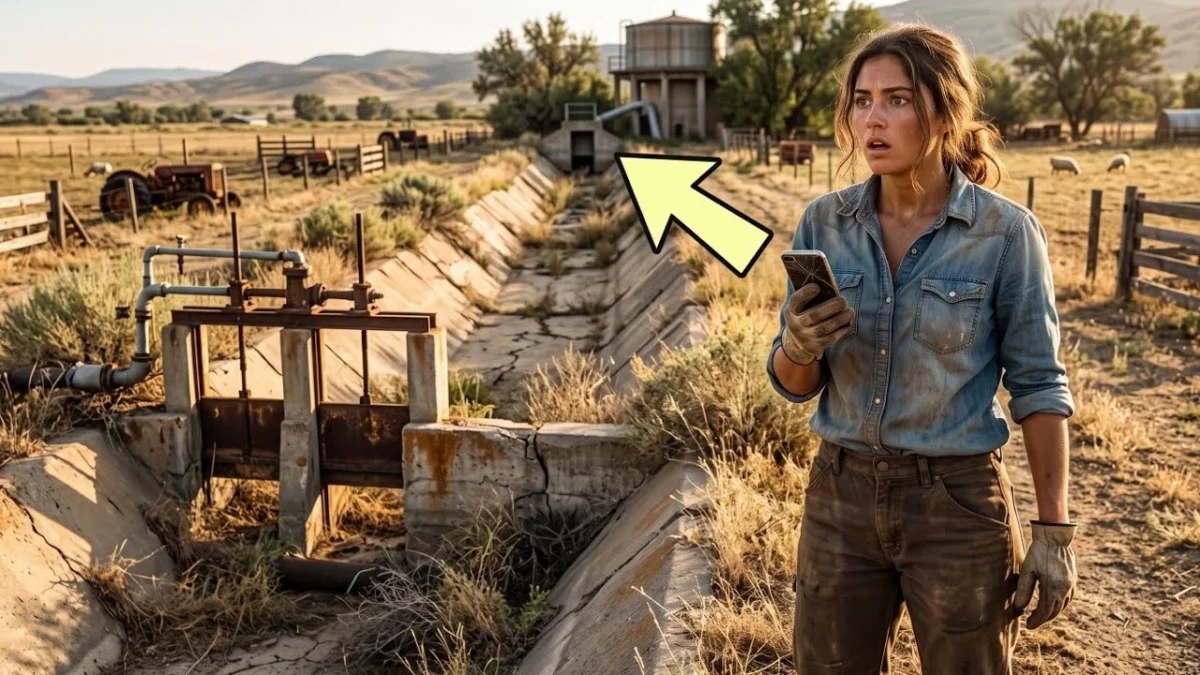
The truck’s idling engine rattled the loose dashboard trim as Mara Voss pulled up to the weather-worn gate of the thirty-eight-acre parcel.
Behind her, the dust from the county road hung thick in the dry morning air, suspended like a pale curtain against the bruised blue of the eastern sky.
Beside her, her father, Thomas Voss, sat with his hands resting heavily on his knees, his knuckles scarred and permanently stained with grease and oil from forty years of running a small livestock operation two counties south.
He didn’t look at the rusted wire gate or the sprawling patch of sagebrush and cheatgrass stretching toward the horizon; he looked straight ahead through the bug-splattered windshield, his jaw set in the familiar, stubborn line Mara had known her entire life.
“I just think you ought to wait,” Thomas said, his voice low, gravelly, and carrying the unyielding weight of a man who had seen too many dry years devour too many good intentions.
“Build up your savings a little more. Get a couple of seasons under your belt working for someone else before you take all this on alone.”
Mara shifted the truck into neutral and pulled the handbrake, the ratchet clicking sharply in the quiet cab.
She was twenty years old, her hands calloused from four years of hauling fifty-pound feed sacks on weekend shifts, her bank account drained down to the last dollar to cover the down payment on the land she had spent months searching for.
“I don’t want a farm I can only run with someone checking in on me every week, Dad,” she replied, her voice calm, measured, and stripped of anger.
“I want one I have to figure out myself. Mistakes included.”
Thomas turned his head slowly, his grey eyes searching her face, looking for any sign of hesitation or doubt, but finding only the quiet, quiet resolve he had unwittingly raised her to possess.
“That canal alone could be more than you bargain for,” he said, gesturing with a thick hand toward the long, straight earthwork visible beyond the boundary fence.
“It’s a hazard, Mara. It’s a liability sitting on concrete that’s older than your grandfather.”
“Then I guess I’ll figure it out,” Mara said, reaching for the door handle.
She stepped out into the crisp, dry air, the smell of sun-baked dirt and wild sage filling her lungs as her boots hit the ground.
She unhooked the chain on the gate and swung it open, leaving her father sitting in the idling truck, forced to follow her onto the land she now owned.
The property was thirty-eight acres of sun-bleached slope, a single-story homestead house with peeling white paint, and a well that worked most days if you didn’t pump it too hard.
And then there was the canal.
It ran the entire length of the eastern boundary, a dead-straight concrete channel cut deeply into the earth decades before Mara was born.
The concrete was fractured in a dozen places, split wide open by decades of freezing winters and boiling summers, with dense tufts of sagebrush and tumbleweed pushing through the seams like green teeth.
The realtor who had sold her the place had passed over it quickly during their walk-through, using the dismissive, airy tone people use when they hope an obvious flaw won’t ruin a sale.
“That hasn’t carried water in years,” the realtor had told her, waving a manicured hand toward the dry trench.
“County says it’s not part of any active irrigation district anymore. You can fill it in if you ever want the land back.”
Mara hadn’t filled it in.
She didn’t have a tractor with a front loader, she didn’t have a backhoe, and she certainly didn’t have the three thousand dollars a local contractor wanted just to haul in fill dirt to bury it.
So the canal sat there through her first spring, empty, broken, and useless in the exact way an old, neglected fence line is useless once no one keeps livestock in the pasture it used to enclose.
Spring turned into summer, and summer on that particular stretch of high plain was brutal.
By July, the rain had stopped completely, replaced by a relentless, blazing sun that baked the topsoil until it cracked into hard, brittle plates you could lift with your bare fingers.
Mara spent her days mending the exterior fences, clearing dead brush from the perimeter, and hand-watering a small vegetable patch behind the house with water hauled from the kitchen sink when the well pump began to sputter and spit sandy water into the lines.
Her life had contracted into a simple, exhausting routine of physical labor, frugal meals, and early nights spent staring at handwritten ledgers at her kitchen table.
It was the middle of August when the routine broke.
A heavy wind event had blown through three days prior, knocking down two spans of barbed wire along the northern fence line where her land met the property of Dale Pretty.
Dale was a man in his late sixties who had farmed the section to the north for more than thirty years, a man whose skin looked like oiled saddle leather and whose opinions on farming were as set as concrete.
Mara walked the perimeter with a bucket of staples, a fence tool, and a coil of wire slung over her shoulder, her head down against the glare of the noon sun.
As she stepped over the lip of the concrete canal near the northeastern bend—where the channel curved slightly before disappearing into a thick stand of wild cottonwood trees—she stopped.
The heat radiating off the ground was intense enough to make the distant horizon shimmer, but the soles of her work boots felt something different.
She paused, looking down.
The concrete under her feet had gone dark.
It wasn’t wet in the sense of standing water or a flowing stream, but it was cool—damply, distinctly cool to the touch in a way nothing else on the thirty-eight dry acres was cool in the middle of August.
Mara dropped her bucket of wire and knelt down on the sun-warmed concrete.
She pressed the flat of her bare palm against the dark stain.
The stone was cold against her skin, holding a deep, subterranean chill that defied the ninety-five-degree heat beating down on her back.
She stood up and walked thirty feet to the south; the concrete returned to a pale, bone-dry gray, hot enough to burn if she sat on it.
She walked thirty feet to the north, toward the shade of the cottonwoods; the concrete remained pale and dry until it reached the exact same sixty-foot bend.
She retraced her steps three times, measuring the damp section with her paces, her brow furrowed under the brim of her work hat.
A sixty-foot stretch of a canal that everyone insisted had been abandoned for half a century was holding moisture in the dead middle of a drought.
Two days later, Mara met Dale Pretty at the boundary fence while he was out idling on his antique tractor, grease-stained cap pulled low over his eyes.
“Noticed you walking that old ditch pretty hard the last couple days,” Dale said, leaning out of his seat and spitting a dark stream of tobacco juice into the dust.
“You looking to haul it off for scrap concrete?”
“No,” Mara said, leaning her forearm against the top wire of the fence.
“Dale, that bend up by the cottonwoods—the concrete’s cold. It’s damp.”
Dale let out a dry, hacking chuckle and shook his head, pushing his cap back with a greasy thumb.
“Probably just shade holding on to some morning dew longer than the open sections, girl. Those cottonwoods throw a heavy shadow right there till nearly noon.”
“I was out there at three in the afternoon, Dale,” Mara said, her tone level and unhurried.
“The sun hits that bend directly from one o’clock on. The shade was gone, but the dampness wasn’t.”
Dale shrugged, pulling a rag from his back pocket to wipe his hands.
“Land plays tricks in August, Mara. That canal used to feed off a diesel pump station three miles south. County pulled the engines out back in the mid-seventies when fuel got too steep to justify the run. Whole system went bone dry after that. There ain’t no water in that ditch, because there ain’t no water to get into it. You’re just seeing ground sweating under old stone.”
“Water doesn’t sweat up out of nowhere,” Mara said quietly.
“Well, it sure as hell don’t run uphill,” Dale replied, reaching for his gear shift.
“Don’t go wasting your time digging around in a dead ditch, Mara. You got weeds to pull and a well to watch. Leave the ghost water alone.”
He shifted the tractor into gear and drove off, the blue exhaust cloud hanging in the still air long after he had crossed the ridge.
Mara watched him go, but she didn’t move from the fence line.
She had grown up around men like Dale, men who survived on regional consensus and traditional wisdom that worked ninety percent of the time.
But she had also grown up watching her father calculate head-feet of water, soil saturation rates, and slope gradients on yellow legal pads at night.
One fundamental truth had been hammered into her head from the time she was ten years old: water is not mysterious, and it does not lie.
It obeys gravity, it moves along lines of least resistance, and it only shows up where a pathway allows it to go.
If a piece of concrete was cold and damp in August, something was supplying energy and moisture to keep it that way.
Every three days throughout late August and into early September, Mara walked the northern bend of the canal.
She brought a wooden ruler and a notebook, recording the ambient temperature, the time of day, and the exact dimensions of the dark stain on the concrete.
By the middle of September, while the surrounding prairie grasses withered into brittle yellow wire and the regional water authorities issued drought warnings to the commercial farms in the valley, the damp patch on Mara’s canal had not shrunk.
It had grown.
Where a hairline crack ran along the base of the western channel wall, a dark, narrow line had crept outward like an ink stain spreading on a blotter.
It wasn’t a flow; it was a seep, a slow, continuous exhalation of moisture from behind the wall.
On a cool Saturday afternoon, after finishing her morning chores, Mara returned to the bend with a flat-head shovel, a mattock, and a five-gallon bucket.
She dropped into the bed of the canal, knelt by the hairline crack, and began to clear away the thick layer of accumulated silt, decomposed leaves, and matted weed roots that had filled the bottom of the channel over fifty years of neglect.
She swung the mattock with steady, rhythmic strikes, breaking through the dense root mass.
Eighteen inches down, beneath a thick layer of dry, grey silt, her shovel blade struck something that gave way with a soft, wet crunch.
She set the shovel aside, dropped to her knees, and scooped out the loosened debris with her gloved hands.
Underneath the dirt lay a bed of coarse, rounded river gravel.
She pulled off her glove and plunged her bare fingers into the gravel.
It was cold, slick, and thoroughly saturated with fresh, odorless water.
When she squeezed a handful of the coarse stone together, the trapped water trickled between her fingers, dripping onto the concrete base of the canal.
Mara sat back on her heels, wiping a smudge of dirt from her forehead with her forearm.
Her heart was beating fast against her ribs.
The project was no longer a passing curiosity or a way to pass an idle hour after work.
It had become an obsession.
The following morning, before the sun had cleared the eastern hills, Mara set out to walk the entire length of the canal system, starting from the southern property line where the old county pump station had once stood, all the way to the northern boundary where the channel disappeared into the dense growth of the cottonwood grove.
The southern mile of the canal confirmed everything Dale Pretty and the realtor had told her.
It was a monument to dead infrastructure.
The concrete walls were broken into jagged chunks, flipped sideways by tree roots, and completely choked with blown soil and dead Russian thistle.
It was dry as a bone, holding nothing but heat and dust.
But as she walked north, past her house and toward the cottonwood stand, the character of the earthwork changed.
The vegetation growing out of the concrete cracks grew noticeably denser and greener.
Tough pasture grass gave way to thick patches of sedge and wild mint.
When she knelt at three different points along the final two hundred yards before the property line, pressing her hand against the bottom of the channel, the concrete was consistently cool.
She reached the boundary fence where the canal crossed onto county land under a clump of old-growth trees.
Here, the concrete channel ended abruptly, tapering off into a dry-laid stone culvert that looked far older than the manufactured concrete of the main ditch.
The stone culvert vanished into the side of a steep, terraced hillside that rose toward the upper bench of the valley.
Mara stood in the shadow of the cottonwoods, listening to the wind rustling the dry leaves above her head.
The landscape was trying to tell her a story, but the pieces she had been given by her neighbors were out of order.
On Monday morning, Mara drove into town and walked into the county extension office, a dusty, low-slung brick building smelled of blueprint paper and old coffee.
She skipped the front desk intern and walked straight to the back room where the historical plat maps and land-use records were kept in tall, green metal filing cabinets.
A clerk named Arthur, a gray-haired man who had worked for the county since the Nixon administration, looked up from his desk over his half-moon spectacles.
“Back again, Miss Voss?” Arthur asked, leaning back in his swivel chair.
“Well still running sandy?”
“The well’s fine, Arthur,” Mara said, leaning over his counter.
“I need to see the original construction permits and water rights filings for the eastern boundary canal on my parcel. Not the 1970s pump district records. I want the original plat maps from before the valley was electrified.”
Arthur grunted, pushed himself up from his chair, and shuffled back into the archives.
It took him twenty minutes to return, carrying a flat, leather-bound folio that left a trail of yellow dust on the wooden counter as he laid it open.
“Here it is,” Arthur said, tracing a yellowed map with a blunt finger.
“Parcel 402. That’s your place. Now, the main regional district ran that diesel pump system up from the river in 1952. That’s what most folks remember.”
“Look further back,” Mara urged, leaning closer to the map.
“Look at the northern section. By the cottonwoods.”
Arthur adjusted his glasses, squinting at the fine, handwritten copperplate ink script running along the margin of the 1912 land survey.
He stopped, his finger pausing over a tiny, hand-drawn symbol—a small circle with three blue lines radiating outward.
“Well, look at that,” Arthur murmured, his voice dropping an octave.
“The northern ditch wasn’t built by the irrigation district at all. It was dug in 1908 by an old homestead outfit—the Miller family.”
“What was it feeding from?” Mara asked, her breath catching in her throat.
“Says here… ‘Gravity drop channel from hillside contact line,'” Arthur read slowly.
“They tapped a natural spring line at the base of the gravel bench. No pumps. No electricity. They just laid stone and poured early cement to catch the runoff and float it down to their orchards.”
“Why did people stop using it?”
Arthur turned a page, scanning the clerk’s handwritten notes from sixty years ago.
“When the county built the big diesel pump system in the fifties, they routed the new canal right over the old Miller ditch. It was easier to use the existing earthwork than cut a new channel. When the diesel station was shut down in the seventies, everybody assumed the whole ditch went dry because the pump stopped running. Nobody remembered that the top end was sitting on an active spring line that predated the pump by forty years.”
Mara stared at the yellowed map, the blue ink lines clear and distinct under the fluorescent lights of the office.
“The spring never stopped,” she whispered.
“Guess not,” Arthur said, closing the heavy folio with a dull thud.
“Springs don’t care about county permits or fuel prices, Miss Voss. They just run until the ground runs out of water.”
Armed with the historical records, Mara spent the next two months working the northern section of the canal by hand.
Every evening after finishing her farm work, she put on heavy rubber boots, grabbed her shovel, mattock, and a wheelbarrow, and walked up to the cottonwood bend.
She cleared away sixty years of accumulated mud, rotting vegetation, and collapsed bank soil inch by painstaking inch.
She worked until her forearms ached and her hands were raw inside her leather gloves, peeling back the thick blanket of earth that had choked the old channel.
Dale Pretty often watched her from his side of the fence, leaning against his truck fender or sitting on his idling tractor, his head shaking in slow, solemn disbelief.
“You’re gonna break your back digging out a ditch that’s gonna freeze solid in November and dry up completely come spring, Mara!” he shouted across the wire one evening as the autumn chill began to set into the air.
“You’re chasing ghost water! You ought to be spending your time getting winter feed laid in!”
Mara didn’t stop digging.
She turned her head, wiped her brow, and called back, “Come take a look in three weeks, Dale!”
“I don’t need to look at mud!” Dale grumbled, but he stayed by the fence for another ten minutes, watching the steady, rhythmic rise and fall of her shovel.
What Dale didn’t understand—and what Mara had confirmed by reaching out to a retired hydrologist named Dr. Howard, a friend of her father’s who agreed to walk the property in mid-October—was the fundamental nature of contact springs.
Dr. Howard had arrived on a crisp, clear afternoon, carrying a collapsible soil probe and a handheld conductivity meter.
He was a tall, lean man with white hair and a quiet, methodical manner that Mara instantly respected.
They walked together up the cleared length of the channel, the fallen cottonwood leaves crunching beneath their boots.
“Look here, Mara,” Dr. Howard said, stopping near a exposed section of the channel wall and thrusting his soil probe deep into the bank above the concrete.
He pulled the metal rod out and inspected the core sample sticking to the tip.
“See this upper layer?” he asked, pointing to a loose, coarse band of tan sediment.
“That’s high-permeability glacial gravel. Rain and snowmelt hit the upper plateau three miles west of here, soak right through this gravel, and move downward fast.”
He pointed to the lower band of the soil core, which was dark, dense, and sticky.
“That’s dense lacustrine clay. It’s virtually impermeable. Water moving down through the gravel hits that clay layer and can’t go any deeper. It has nowhere left to go except sideways, following the slope of the clay until it intersects the surface right here at the base of this hill.”
“So it’s not dependent on recent rain?” Mara asked.
“Not at all,” Dr. Howard replied, looking down into the channel where a faint, clear sheen of water was now visible over the cleared concrete.
“Groundwater moving through a deep gravel layer moves at a speed measured in feet per week, not miles per hour. The water coming out of this hill right now might have fallen as rain two or three years ago. It operates on a massive time lag. That’s why it was damp in August. While the surface soil was baking, the deep groundwater was arriving right on schedule.”
Dr. Howard walked over to the dry-laid stone culvert near the boundary fence, examining the original masonry work of the Miller family.
“Whoever built this in 1908 knew exactly what they were doing,” Dr. Howard said, a smile pulling at the corners of his mouth.
“They didn’t just dig a ditch. They set this channel right at the contact line where the gravel meets the clay. They let gravity do one hundred percent of the work. No engines, no electricity, no maintenance other than keeping the channel clear of mud.”
He turned to look at Mara, his eyes bright with professional appreciation.
“Most modern farmers think about water in terms of horse-power and pipe diameter,” he said.
“They want a pump they can turn on with a switch. When the switch stops working, they think the water is gone. You looked for the physics instead of the machinery.”
By the first week of November, Mara had cleared nearly four hundred feet of the northern channel.
The dark stain that had started as a sixty-foot damp patch in August was now a clear, continuous, visible trickle of fresh water running silently over the restored concrete.
It wasn’t a raging river—it was barely a quarter of an inch deep, moving at a slow, leisurely walking pace—but it was pure, unmetered, cold water, moving steadily through the dry landscape without a pump, without a electric bill, and without a drop of rain falling from the sky.
Word of what the twenty-year-old girl was doing on the old Miller place began to spread among the neighboring farms with the quiet speed peculiar to rural communities.
On a cold Saturday morning in mid-November, two trucks pulled up to Mara’s gate.
Silas Miller, a grand-nephew of the original homesteaders who farmed two sections over, and another local farmer named Tom Briggs stepped out and walked down the lane where Mara was working on her fence.
“Morning, Mara,” Silas said, pulling his hat down against the biting wind.
“Dale says you uncovered the old Miller spring.”
“It was always there, Silas,” Mara said, leaning on her fence pliers.
“Just buried under fifty years of dirt.”
Tom Briggs looked down into the cleared channel, watching the thin sheet of water glisten in the pale autumn sun.
“We heard a rumor down at the feed store you pulled a line off the county irrigation main,” Tom said, his eyes narrow but curious.
“You can walk the whole line to the county road if you want, Tom,” Mara replied calmly.
“No pipes, no pumps. Just the old stone culvert off the hill. The county extension office confirmed the 1908 water rights on the plat map.”
Silas Miller stood silent for a long moment, looking at the water moving over the concrete his own family had poured long before he was born.
“My grandfather used to talk about that water,” Silas said softly, almost to himself.
“Said it was the sweetest spring in the county. We all thought it dried up when they put the big diesel pumps in back in the fifties.”
“It didn’t dry up,” Mara said.
“People just stopped looking for it once they had a switch to flip.”
In December, the first hard frost hit the valley, freezing the top inch of soil solid and turning the prairie grass into silver wire.
Dale Pretty drove his truck down the boundary lane, stopping near the northern bend where Mara was standing, wrapped in a heavy canvas coat, watching the channel.
Dale stepped out of his cab, his breath pluming white in the freezing air.
He didn’t say anything at first; he just walked to the edge of the ditch and looked down.
The slow-moving water was still flowing, cutting a dark, unfrozen ribbon through the frost-rimed concrete.
Because the spring water came from deep underground, it emerged at a constant fifty-two degrees Fahrenheit, resisting the surface freeze that had locked up every stock tank and shallow pond in the township.
Dale stared at the flowing water for a long, quiet minute, his hands shoved deep into his coat pockets.
“I’ll be damned,” Dale said quietly.
“It’s still moving.”
“It’s been moving the whole time, Dale,” Mara said, her voice steady in the crisp air.
Dale pulled his hand from his pocket, rubbed his chin, and looked at her.
“I took you for a stubborn kid with more debt than sense, Mara,” he said, the words coming hard and slow, but stripped entirely of his previous condescension.
“I was wrong. You saw something the rest of us were too blind to look for.”
“It wasn’t magic, Dale,” Mara said, looking out over her thirty-eight acres.
“It was just paying attention.”
When spring arrived the following year, bringing with it a regional water crisis—as the county irrigation district announced a thirty percent reduction in pump allocations due to low winter snowpack—Mara Voss was ready.
Instead of extending the canal further to try to clear every foot of the concrete, she made a deliberate choice that shocked her father and neighbors alike: she left the southern third of the canal completely untouched, choked with brush and natural sediment.
When her father came to visit in May, standing beside the shallow catchment basin she had dug near her eastern pasture to hold the spring flow, he stared at the overgrown section of the ditch in confusion.
“Why leave a hundred yards of it choked up, Mara?” Thomas asked, looking at his daughter.
“If you cleared the rest, you could double your flow into the basin.”
“Because of what Dr. Howard showed me,” Mara explained, pointing to the lush, dark green belt of natural forage that had sprouted along the uncleared section.
“The overgrown parts slow the water down. They force part of it to soak laterally into the surrounding soil, recharging the shallow water table along my whole eastern pasture. If I clear it into a perfect, smooth concrete highway, all the water races straight into the basin and evaporates, and the soil along the banks dries out.”
Thomas looked at the lush green pasture, then at his daughter’s confident, relaxed posture.
He stayed silent for a long time, the wind rustling the paper of the notebook he held in his hand.
“You really didn’t want anyone checking in on you, did you?” he said softly, a slow, proud smile finally breaking across his weathered face.
“I didn’t need checking on, Dad,” Mara said, catching his eye.
“I just needed to listen to the land before I started telling it what to do.”
By her second summer, the shallow catchment basin was holding enough cold, clean groundwater to fully irrigate her ten-acre vegetable plot and keep her livestock tanks full throughout the hottest months of the year, without her well pump having to run more than twenty minutes a day.
Her farm was green, productive, and financially stable at a time when larger, more modern operations nearby were hauling in expensive trucked water and cutting back their planted acreage.
Dale Pretty walked over to the fence line late one afternoon in August, watching Mara haul a crate of freshly harvested squash toward her truck.
“Mara,” Dale called out, resting his arms on the top wire.
“Yeah, Dale?”
“You think… you think there might be another one of those old spring lines further up the bench on my side of the line?” he asked, his tone slightly sheepish, his eyes fixed on the green pasture behind her.
“I got an old low spot near my timber line that stays soft in June. Always thought it was just bad drainage.”
Mara set her crate down, wiped her hands on her jeans, and walked over to the fence.
“It might be bad drainage, Dale,” she said with a small, knowing smile.
“Or it might be a contact line that’s been waiting for somebody to stop stepping over it.”
“Would you… take a look at it with me sometime?” the sixty-eight-year-old farmer asked, looking down at his boots.
“If you got an hour to spare?”
“I’ll bring my shovel on Saturday,” Mara said.
The story of the twenty-year-old girl and her dead canal didn’t make the front page of state newspapers, and no regional farming magazines sent reporters out to photograph her catchment basin.
The county extension office simply added a single line to parcel record 402, noting the reactivation of a historic 1908 gravity spring, and filed it away in the metal cabinets.
But across that quiet stretch of the high plains, something subtle and permanent shifted in the years that followed.
Neighbors who had driven past ruined concrete, strange angled fence lines, and marshy hollows for thirty years began stopping their trucks, stepping out into the dust, and taking a second look at the land they thought they knew.
They began asking questions about what lay beneath the weeds and broken stone, realizing that progress didn’t always mean buying bigger diesel engines or digging deeper wells.
Sometimes, it simply meant having the patience to read the old records written into the earth by people who had understood the land long before electricity arrived to make everyone forget.
Mara still walks the northern bend of her canal every Sunday morning, carrying her wooden ruler and her notebook.
She checks the temperature of the water, clears away fallen leaves from the stone culvert, and watches the steady, quiet trickle moving across the concrete.
Further up the hillside, buried under sixty years of pine needles, brush, and heavy silt, lies another two hundred feet of the original 1908 stone channel that she hasn’t touched yet.
She thinks about it sometimes as the sun sets over the western ridges, casting long, dark shadows across her green fields.
She isn’t in a rush to dig it out.
She knows it’s up there, running quietly in the dark under the earth, keeping its own time, waiting for whenever she decides it’s time to continue the conversation.








