At 22, He Bought a Ranch With an Abandoned Well — Then Discovered Where Its Water Came From
Walt Hendry didn’t look up from his tailgate when the truck pulled in.
He was winding baling twine around his elbow with slow, deliberate movements.
It was the way a man moved when he had already decided how the conversation was going to end before the engine was even turned off.
“You bought the place with the dead well, kid,” Walt said, his tone flat and unbothered.
Jesse Talbett stepped out of his Ford, letting the door slam with a heavy metallic clack.
“It came with the property,” Jesse said, leaning his arms against the dusty bed of Walt’s pickup.
“So did the barn roof. That’s coming down next week.”
Walt tossed the neat coil of twine into the back of his truck and finally raised his eyes.
He wasn’t being mean, just tired in the way older ranchers got when they had watched too many young men throw their life savings into bad soil and dry grass.
“That well’s been dry since before you could walk, son,” Walt said, wiping his grease-stained hands on a rag.
“Has anybody actually looked down it lately?” Jesse asked.
Walt shook his head, a faint, dry smile touching his mouth.
“Nobody looks down a dead well, Jesse. That’s what makes it dead.”
Jesse didn’t argue.
“Thanks for the advice, Walt,” he said, turning back toward his truck.
“I appreciate you coming by.”
He drove back up the washboard gravel road toward his six hundred and forty acres of sun-bleached pasture.
He didn’t tell Walt what he had done the evening before.
He hadn’t told anyone.
Standing behind the rotted wooden frame of the old barn as the sun dipped behind the limestone ridge, Jesse had pulled a smooth stone from his pocket and dropped it straight down the center of that forgotten stone shaft.
He had braced himself for the sharp, dry click of stone striking stone.
Instead, after a long silence, he had heard a soft, unmistakable splash.
Jesse was twenty-two years old.
He possessed a USDA beginning-farmer loan that he had barely qualified for, an old F-150 with a hundred and ninety thousand miles on the odometer, and a piece of central Wyoming ranch land that every experienced operator in the county considered a financial disaster.
It hadn’t rained in seven weeks.
The range grass was brittle and the exact color of old hemp rope.
Yet forty feet down a hand-dug shaft that the valley had written off fifty years ago, something was holding cold water.
Jesse hadn’t drifted into ranching because he was a dreamer.
He had been forced out of it once before, and the scar from that loss ran deep.
When he was fifteen years old, a brutal multi-year drought had settled over his grandfather’s place in western South Dakota.
Month by month, the stock ponds had shrunk until they were nothing more than cracked plates of dry mud.
He remembered standing by the chute as the cattle were loaded onto commercial stock trailers, bound for the auction barn one truckload at a time.
Then came the day the bank took the land itself.
Jesse never forgot the image of his grandfather sitting in the cab of his farm truck at the end of the lane, the engine turned off, staring silently across a dry dirt dam.
The old man had said only one thing before turning the key and driving away forever.
“Water tells you the truth if you’re quiet enough to listen, Jesse.”
At fifteen, Jesse hadn’t understood what that meant.
He had spent the years after high school trying to scrape together a life.
He managed one semester at an agricultural college before his funds completely evaporated.
After that, he took whatever work paid in cash: setting fence posts in frozen ground, working twelve-hour shifts at a commercial feedlot, and driving a propane delivery truck through the dead of winter.
He saved every single dollar, lived out of an old camper shell, and ate cheap canned soup.
When he turned twenty-two, he took his meager savings, combined them with a low-interest government loan, and bought the low-priced ranch on the flank of the ridge.
The listing agent had looked at his shoes when Jesse signed the paperwork.
The agent knew why the price was so low, and so did every neighbor in the valley.
The ranch had only one functional water source: a drilled well three hundred and eighty feet deep that produced a thin, sluggish stream of mineral-heavy water.
It was barely enough to fill the kitchen sink and keep two stock troughs full for a small herd.
Anything beyond that had to be hauled in tank trailers from the municipal fill station twelve miles down the highway.
In dry country, land without water isn’t a ranch; it’s just expensive scenery.
Jesse felt the weight of that reality every time he spoke to the local cattlemen.
Whenever he asked about pasture management or stocking rates, the older ranchers would offer advice, stop, and leave a heavy pause at the end of their sentences.
In that quiet pause, one unspoken word always hung in the air: kid.
The property itself was rugged and worn down.
It featured a small house with a sagging front porch, cattle corrals made of rotting gray cedar posts, a rusted windmill tower whose blades had blown off during a winter gale decades ago, and a dry wash that cut across the lower pasture like a faded scar.
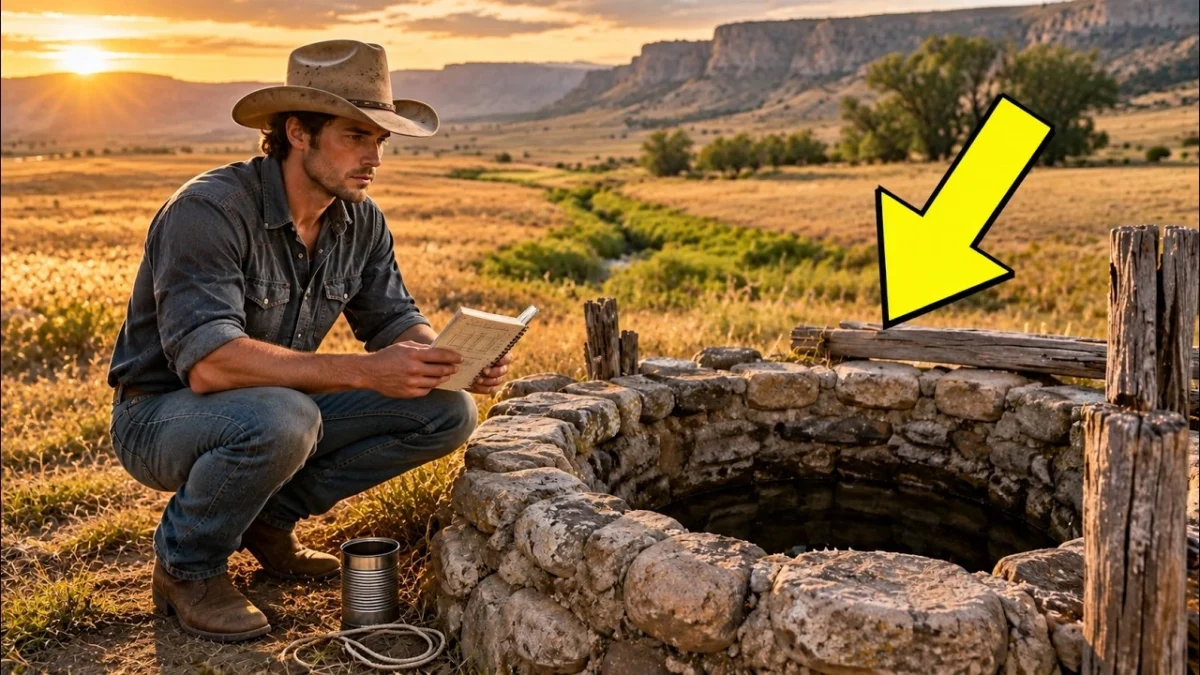
Behind the main barn, sitting on a gentle rise, was the well everybody talked about.
It was surrounded by a knee-high ring of fitted fieldstones, stacked neatly without a single drop of mortar.
Two rotted oak planks were thrown across the top to keep stray calves from falling in.
Beside the stone ring stood an old cast-iron hand pump, seized solid with deep, dark rust the color of dried blood.
When Jesse examined the structure closely, he noticed that many of the stones forming the ring were oddly round and smooth, looking almost like loaves of bread.
He had assumed the homesteaders had gathered decorative river rocks from somewhere down in the valley to make the well look nice.
The real estate agent had strongly advised him to backhoe the entire thing full of dirt to avoid liability.
“Every family that owned this place had a story about why that well died,” the agent had told him.
“Some say it went dry back in the seventies. Some say the casing collapsed. Some say the underground vein simply vanished when the regional water table dropped. Save yourself a headache and fill it in.”
Walt’s version was simply the shortest and most confident, but that dropped pebble had made a splash.
The following Saturday, Walt stopped his pickup at the fence line while Jesse was hammering staple nails into a stretch of downed wire.
Walt leaned against his driver’s side door, squinting through the heat shimmer.
“Still thinking about that stone hole behind the barn, Jesse?” Walt called out.
Jesse drove a staple home with his fencing pliers before looking back.
“It’s holding water, Walt.”
Walt shrugged, picking a sliver of wood out of his thumb with a pocketknife blade.
“Old hand-dug wells hold a little seepage after a rain. Nothing to build a herd on.”
“It hasn’t rained here since May,” Jesse noted quietly.
Walt didn’t miss a beat.
“Then it’s a perched pocket. Bit of trapped surface runoff sitting on an underground clay shelf. It’ll be bone dry by September, mark my words.”
Both of Walt’s explanations were sensible and grounded in decades of practical experience.
They came from a man who had ranched this exact soil for over fifty years.
Jesse didn’t argue or try to convince him otherwise.
Instead, he went into his workshop, found an old steel bolt, and tied it securely to a long spool of nylon masonry string.
Using a tape measure and a black permanent marker, he tied a tight knot in the string every six inches.
Every morning at six o’clock, before the heat of the sun hit the valley, Jesse walked up the slope behind the barn.
He pulled back the rotted planks, lowered the weighted string down into the dark opening, and waited for the tension to slacken when the bolt hit bottom.
Then he pulled the string back up, noted where the moisture line stopped, and recorded the exact measurement in a small, paper-bound feed store notebook.
He began noticing details that had escaped him at first glance.
When he bent over the mouth of the well, the air rising out of the stone shaft was crisp and cold, feeling like a refrigerator door had been swung open on a ninety-degree afternoon.
He rigged a heavy tin coffee can to a rope, lowered it down, and hauled up a gallon of water.
The liquid was crystal clear and chilled to the touch.
When he took a sip, it tasted soft and clean, completely free of the harsh, sulfurous mineral tang that ruined the taste of the water coming from his domestic drilled well.
His house tap water was so hard it left a thick white crust inside his coffee pot within a week.
This water left nothing.
On the twelfth morning of taking measurements, Jesse lowered the string, pulled it back up, and blinked in disbelief.
He checked the knots once, then checked them again against his ruler.
The water level hadn’t fallen despite twelve days of blistering heat and zero rainfall.
It had risen four inches.
A static, trapped pocket of water resting on a bed of subterranean clay does not refill itself in the dead of August.
Something was actively feeding the shaft from underneath.
Jesse set out to find the source.
He assumed the most logical answer was a leaking buried pipe somewhere on the property line.
Looking down toward his lower pasture, he spotted a patch of wild clover and tall grass that stood out as a bright green speck in a sea of brown, dried-out turf.
“Water’s surfacing right there,” Jesse muttered to himself.
“It’s got to be leaking out from an old stock line.”
He drove to town, spent five hundred and twenty dollars—money he could ill afford to waste—to rent a small tracked mini-excavator for twenty-four hours, and trailered it back to the ranch.
He spent four hours digging a deep trench straight through the center of the green patch, diesel exhaust filling the hot air.
At four feet down, his excavator bucket clipped an old, rusted iron pipe fitting.
Water began to seep slowly out of the joint, bubbling up through the fresh clay.
It was a broken stock line from thirty years ago, weeping a tiny trickle of house-well water into the dirt.
It was a localized leak, not an underground source.
Jesse shut off the machine, climbed out of the operator’s seat, and sat on the edge of the dirt mound, his face covered in gray dust and sweat.
While he sat there in defeat, Walt’s pickup truck slowed to a crawl on the county road fifty yards away.
Walt looked through his open window at the trench, looked at Jesse sitting covered in mud, gave a single slow nod of understanding, and drove away without stopping.
The silence of that gesture felt heavier than any insult Walt could have shouted.
Yet, as Jesse sat in the dirt, the failed excavation taught him something vital about how water moved through his soil.
A pipe leak created a blotch—a messy, localized, muddy circle that stayed right where the fitting had rusted through.
It didn’t create structural plant growth or clean currents.
That evening, determined to clear his head, Jesse hiked up to the high limestone ridge that bordered the northern edge of his property.
He sat on a flat ledge of rock, wiped his forehead, and looked down at his six hundred and forty acres spread out like a map below him.
In the long, golden light of the late afternoon sun, the topography revealed details that were invisible from the ground.
Tracing the land with his eyes, Jesse caught his breath.
He saw a thin, continuous ribbon of dark green vegetation winding its way across the pale, dried-out grass of his pastures.
It wasn’t an irregular blotch like the pipe leak.
It was a narrow, deliberate line.
It originated up near the base of the limestone ridge, ran downhill, passed directly through the stone ring of the hand-dug well behind the barn, curved smoothly through the dry wash, and continued across the lower pasture toward the valley floor.
Growing thick along this invisible track were deep-rooted shrubs—rabbitbrush, wild sedges, and scattered stands of dwarf willow.
They were thriving, green and vibrant, while the shallow-rooted range grasses surrounding them had gone completely dormant.
Jesse remembered a term from a textbook during his short semester at agricultural college: phreatophytes.
The word was derived from Greek roots meaning “well-plants.”
They were species whose root systems didn’t rely on summer rain showers; instead, they drove their roots down tens of feet into the earth to drink directly from the permanent underground water table.
The green line passed through his old well like a highway passing through a small town.
The upper end of that highway pointed straight toward a deep rock cut on the public ridge land above his boundary fence.
Jesse decided he needed historical facts before he started digging up any more of his pasture.
The following Monday, he drove to the county courthouse and asked to see the historical land survey records.
The clerk led him down into a basement record room that smelled strongly of moldy paper and dried leather glue.
After an hour of searching through metal drawers, the clerk wheeled out an oversized canvas binder containing original homestead plats.
Jesse flipped through the fragile, yellowed pages until he found the survey map for his township, dated September 1911.
It had been surveyed and signed by an original homesteader named Ezra Pruit.
There, drawn in fine black ink, was the outline of Jesse’s ranch, the limestone ridge, and the dry creek bed.
Near the location of the present-day barn, Ezra Pruit had drawn a tiny black “X”.
Beside the mark, written in precise calligraphy, were the words: Well No. 1. Dug 41 ft. Water struck at 38 ft. Yield strong.
Extending from the “X” toward the base of the ridge was a fine dashed line.
Along that line, Pruit had noted two words in faded ink: Gravel, water-bearing.
Jesse stared at the document, his heart beating fast against his ribs.
He took a photograph with his phone, then walked over to the State Engineer’s Water Rights Office on the second floor.
He asked the records officer to pull the historic surface and groundwater filings for his parcel.
The clerk brought up a thick manila folder.
Inside was an unextinguished stock-water claim filed by Ezra Pruit in May 1912, guaranteeing the property the right to draw water from the shallow hand-dug well for livestock use.
Tucked behind it was a secondary filing from 1974 submitted by a subsequent owner named Callahan.
The 1974 document showed that Callahan had drilled the deep three-hundred-and-eighty-foot well simply to get pressurized water piped directly into his modern kitchen and bathroom without needing an electric lift pump on the old shallow system.
Nobody had ever abandoned the old stone well because it went dry.
They had stopped using it simply because a modern drilled well was more convenient.
Over fifty years, the old pump had rusted shut, the wooden cover had rotted, the original owners had moved away, and the local story had gradually solidified into a absolute truth: the well is dead.
A well could die purely by reputation.
Jesse leaned against the wooden counter, holding the papers.
That discovery answered why the well still held water, but it created an even bigger mystery.
In 1911, equipped with nothing more than a shovel, a pickax, and a team of horses, how had Ezra Pruit known exactly where to dig down forty feet through hard clay to hit an invisible underground water vein?
To find out, Jesse visited the small county historical society office located in the basement of the local library.
The volunteer on duty helped him search through digital archives of early twentieth-century homestead photos.
They found a single black-and-white photograph taken in the summer of 1922 titled The Pruit Farmstead.
The photo showed a wooden barn, a horse team, and running across the flat pasture behind the building, a thick, dark belt of wild willows.
It was the exact same line Jesse had spotted from the limestone ledge seventy years later.
Realizing he needed professional insight, Jesse contacted the regional county extension office and asked for help.
The agent referred him to Dr. Ruth Callaway, a retired hydrogeologist who had spent over forty years mapping aquifers and drilling agricultural wells across Wyoming, Montana, and Colorado.
When Jesse reached her by phone, she agreed to drive out to the ranch on one condition.
“Don’t call me an expert, young man,” she said sternly.
“The earth makes fools out of experts every single day. Just have a fresh pot of coffee ready.”
She arrived two days later in a beat-up station wagon filled with soil sampling augers, geological maps, and rock hammers.
She walked up the slope behind the barn without saying a word, her heavy leather work boots crunching on the dry grass.
She knelt at the edge of the stone well ring, pulled back the plank, and peered down into the darkness.
She rigged a small sampling beaker to a line, dropped it down, and pulled up a fresh water sample.
She poured a small amount into her palm, tasted it, and sat in complete silence for a full minute, swirling the liquid around her mouth.
Then, she reached out and ran her hand over the fieldstones forming the top of the well wall.
She grabbed one of the smooth, round rocks and examined it closely.
“Where did these come from, Jesse?” she asked, looking up at him.
“I thought Pruit collected them from a riverbed down in the valley for decoration,” Jesse replied.
“These aren’t decorative,” Ruth said, tapping the stone with her knuckle.
“These are stream-worn river cobbles. Look how rounded and smooth the edges are. High-energy flowing water did that over thousands of years.”
She stood up, brushing dirt off her knees, and looked down into the open shaft.
“Whoever dug this shaft didn’t haul these stones up from the main river five miles away,” she said.
“They pulled these stones right out of this hole while they were digging. They were digging down into an ancient, buried riverbed.”
She sat down on an overturned wooden crate and drew a diagram in the dirt with a small twig.
“Thousands of years ago, during the glacial retreat, a powerful creek ran right across this bench,” Ruth explained.
“It laid down a thick, heavy layer of clean, coarse gravel and smooth cobbles. Later on, as the climate dried out, windblown silt and heavy clay covered that gravel channel, sealing it underground.”
She tapped the twig against the soil.
“Gravel has huge open spaces between the stones,” she continued.
“Water moves through those gravel spaces as easily as it moves through an open pipe. The heavy clay on both sides acts like solid walls, keeping the water locked inside the channel.”
“It’s an underground pipe,” Jesse said, staring at the ground.
“Precisely,” Ruth nodded.
“Your hand-dug well isn’t just a hole in the ground that collects rain. It’s an open vertical window sitting right on top of a buried river.”
Jesse leaned forward, his hands on his knees.
“Then why did the water level rise four inches in the middle of an August drought?”
Ruth smiled faintly.
“Because an aquifer doesn’t only respond to the rain falling directly over your head,” she said, pointing her thumb toward the towering limestone peaks visible fifteen miles to the west.
“It listens to where the water begins. The deep mountain snowpack melts in late June. That water sinks into the limestone, enters this buried gravel vein, and trickles slowly downhill.”
She looked at him intently.
“It takes weeks for that hydrostatic pressure wave to travel a mile underground. That snowmelt from June is reaching your well right now in mid-August. It’s like a letter arriving late in the mail.”
“And how did Pruit know where to dig in 1911?” Jesse asked.
Ruth pointed out toward the slope, where the subtle belt of green rabbitbrush and sedges ran through the dry landscape.
“Old-timers were observers out of necessity,” she said gently.
“Pruit didn’t need satellite imagery or drilling equipment. He simply stood on that ridge, looked down at the valley, and followed the plants. He dug where the willows told him to dig.”
Jesse looked out over his parched pastures, processing everything she had said.
“Why didn’t the great droughts kill this stream?” he asked softly, thinking of his grandfather’s dried-out stock ponds in South Dakota.
“Surface ponds evaporate in a matter of weeks because they’re exposed to the sun and wind,” Ruth explained.
“Groundwater stored in deep gravel channels is insulated. It moves slowly and drains even slower. It’s heavily buffered.”
She stood up and looked around the horizon.
“A single dry year won’t empty a system like this. It takes four or five consecutive years of severe drought to dry it out, and even then, it doesn’t just switch off like a tap. It fades gradually.”
Jesse stood in silence, feeling a heavy weight lift from his chest.
Ruth turned to him and asked the question that would dictate his next move.
“Now, Jesse, do you know where this underground channel actually begins?”
Before leaving, Ruth handed Jesse a small, pocket-sized electronic tool.
It was a digital total dissolved solids (TDS) meter, worth about forty dollars.
“This measures dissolved mineral content in parts per million,” she said.
“Use it to trace the water signature.”
That afternoon, Jesse calibrated the meter and tested his domestic drilled well first.
The digital screen read 910 PPM—a very high concentration showing heavy mineral saturation from deep bedrock.
Then he lowered his bucket into the old stone well, drew a fresh sample, and dipped the sensor into the cold water.
The screen read 74 PPM.
He called Ruth on her cell phone immediately to report the number.
“Seventy-four is pure snowmelt or recent rain,” Ruth confirmed over the crackling line.
“It hasn’t spent years dissolving deep limestone or gypsum. Your home well and your old stone well are drinking from two completely different sources, Jesse.”
Equipped with the meter and a backpack filled with water bottles, Jesse spent the next morning tracking the subterranean channel on foot.
He followed the faint ribbon of green shrubs as it wound its way uphill across his north pasture.
The vegetation line grew steadily fainter as the soil thinned, finally dissolving into a broad, fan-shaped apron of rounded cobbles at the foot of the limestone ridge on public BLM land.
Directly above this gravel fan sat a steep notch cut into the solid limestone wall.
Jesse knew that notch.
It was the exit point for Alder Creek—a mountain stream that roared with cold, muddy water every April during the spring runoff, but reduced to a trickling thread by July.
Every rancher in the valley knew about Alder Creek.
Walt had mentioned it to Jesse during his first week on the property.
“Alder Creek quits every summer, kid,” Walt had said at the time.
“The ground just drinks it right up.”
Everyone in the county knew the creek disappeared into the ground at the base of the ridge.
Yet, for fifty years, not a single person had ever stopped to ask where that water went after it sank out of sight.
Jesse walked up to the exact spot where the last surface thread of Alder Creek vanished beneath a pile of rounded river cobbles.
He crouched down, picked up a stone, and turned it over in his fingers.
It was smooth, heavy, and perfectly rounded—identical to the stones Ezra Pruit had pulled out of the well forty-one feet below ground.
He remembered Ruth’s warning that nature was unpredictable and that gravel veins could pinch shut or dead-end against impermeable clay walls.
A theory that made perfect sense could still be wrong.
He needed absolute proof before he spent a single dollar on infrastructure.
The following morning, Jesse made a phone call to the Bureau of Land Management office to obtain a temporary tracer permit.
Once approved, he purchased a small bottle of non-toxic, eco-friendly fluorescein dye—the concentrated bright-green compound used by plumbers to trace sewer leaks and by cave explorers to track underground rivers.
He mixed a single tablespoon of the vibrant yellow-green powder into a bucket of water.
Walking up to the limestone notch on the public ridge, he poured the bright fluorescent liquid directly into the flowing thread of Alder Creek right where it slid beneath the gravel fan.
Then, the long wait began.
Every morning at first light, Jesse walked up to the old well behind his barn, dropped his tin coffee can down into the dark water, and hauled it up to inspect the contents against the early daylight.
For nine consecutive days, the water in the can came up completely clear, cold, and unchanged.
Jesse began to doubt his theory, wondering if he had wasted his time and bought into a foolish fantasy.
On the tenth morning, September second, Jesse lowered the tin can, pulled it up hand over hand, and held it up to the rising sun.
Running straight through the clear water in the tin vessel was a faint, luminous green thread—like a drop of green ink floating through a glass of liquid.
Jesse sat down right on the fieldstone ring, the tin can held tight in his hands, and let out a long breath.
The water vanishing at the high limestone ridge was the exact water standing beneath his feet.
Every spring, mountain snow melted, rushed down the limestone notch, and poured directly into the subterranean gravel fan.
From there, it entered the ancient buried stream bed, traveled a mile and a half silently beneath his dry pastures, and arrived at Ezra Pruit’s hand-dug stone well weeks later.
It was cold, soft, and constantly renewed.
It wasn’t a temporary leak, a stagnant pocket, or a lucky fluke.
It was an underground river running silently beneath his boots, recharged every single year by the snowpack on the distant mountain peaks he could see from his front porch.
The clues had been there for half a century: the ice-cold air in the shaft, the soft taste of the water, the rounded river cobbles in the well wall, the late-summer rise in water levels, the line of green shrubs visible from the ridge, the dashed markings on the 1911 homestead plat, and the thick stands of willows captured in the 1922 photograph.
Every piece of evidence had been pointing in the exact same direction.
The land had been telling its secret all along.
Nobody had simply taken the time to listen.
When Jesse called Dr. Ruth Callaway to share the news of the dye test, she was pleased, but she quickly reminded him to stay grounded.
“Don’t get greedy, Jesse,” she cautioned him over the phone.
“Think of that buried channel as a natural savings account. The mountains make a deposit into that gravel bed every spring. If you try to pump out more than the mountain deposits, you’ll drain it dry and break the system.”
Jesse took her advice to heart.
He didn’t attempt to drill a massive commercial irrigation well or try to turn his dry range into alfalfa fields.
Instead, he hired a local contractor to carefully clean out the debris at the bottom of the old forty-one-foot stone shaft.
He installed a heavy, modern sanitary cap over the top of the fieldstone ring to protect it from surface contamination.
Inside the well, he lowered a small, highly efficient solar-powered submersible pump connected to two solar panels mounted on the south side of the old barn.
He ran a two-inch poly pipe from the well up to a three-thousand-gallon insulated storage tank set high on the rise.
From the base of that storage tank, he laid simple gravity-feed water lines down into his pastures, connecting them to three heavy-duty steel stock troughs.
Two of those troughs were situated in lower pastures that hadn’t supported a single head of cattle since the mid-1970s, simply because previous owners had no way to get water to them without hauling trucks.
Jesse kept his feed store notebook beside the storage tank, logging the water levels and recovery rates every Sunday afternoon.
He visited the State Engineer’s Office one last time, submitting the official paperwork to reactivate and register his active use of the historic 1912 water right.
To protect his water source at its origin, Jesse spent a week building a sturdy four-strand barbed-wire fence around the gravel recharge fan at the foot of the ridge, ensuring his stock wouldn’t overgraze or trample the delicate intake zone.
Late that August, an intense heat wave hit central Wyoming.
Temperatures topped ninety-five degrees for two straight weeks, and neighboring ranchers were forced to hook up tractor trailers to haul water tanks back and forth from town at immense expense.
Jesse’s primary deep-drilled home well saw its production drop by half.
The shallow stone well, fed by the deep gravel river, barely fluctuated.
Jesse didn’t become an overnight millionaire.
He was still a young guy with an old pickup truck, working eighteen-hour days to pay off his farm loan.
However, he completely eliminated his water-hauling expenses and brought two hundred acres of dormant, high-quality grazing land back into full rotational production.
One afternoon in mid-September, as the air was beginning to turn crisp, Walt Hendry’s pickup truck turned off the county road and rolled slowly up the dirt track into Jesse’s lower pasture.
Jesse was standing by one of the new steel troughs, watching twenty head of Black Angus cattle drink peacefully from the clear, cold water flowing out of the gravity pipe.
Walt put his truck in park, stepped out slowly, and walked over with his hands jammed deep into his canvas coat pockets.
He stood silently by the trough for a long time, watching the water ripple in the breeze.
He looked at the gravity pipe, looked up the hill at the solar storage tank, and finally looked over at the cattle.
“Where did you put that green dye in, Jesse?” Walt asked quietly, his eyes fixed on the water.
Jesse pointed up toward the northern horizon.
“Right up in the limestone notch, where Alder Creek sinks into the cobble fan.”
Walt turned his head and stared toward the limestone ridge for a long, silent minute.
“For sixty-one years, I’ve lived in this valley and watched that creek disappear into the rocks every July,” Walt said softly, rubbing his jaw.
“Never once in my whole life did I stop and ask myself where that water went.”
He cleared his throat and looked directly at Jesse, the old dismissiveness completely gone from his eyes.
“Could you show me how you mapped it out, son?” Walt asked.
“Bring a tin coffee can,” Jesse said with a quiet smile.
“And a piece of string with some knots in it.”
Later that evening, after Walt had driven home and the cattle had settled down to graze in the lower pasture, Jesse walked up the gentle rise behind the barn alone.
The sun was dropping low behind the mountains, casting a warm, honey-colored light across the vast Wyoming prairie.
He walked up to the stone well, resting his palm on the cool surface of the fieldstone wall.
His fingers touched one of the smooth, rounded cobbles—the stone he had once assumed was placed there for simple decoration.
A hard-working homesteader in 1911 had pulled that exact stone out of the dark earth with his bare hands.
Ezra Pruit had observed the wild willows, read the signs of the terrain, dug where nature told him to dig, and constructed something designed to endure.
For over fifty years, every experienced person in the valley had passed by this exact spot, looked at the stone ring, and seen nothing more than an abandoned, useless ruin.
Jesse recalled a quote by the conservationist Aldo Leopold that he had read back in college:
Land then is not merely soil. It is a fountain of energy flowing through a circuit of soils, plants, and animals.
Jesse finally understood what those words meant in his bones.
The water flowing beneath his ranch wasn’t an isolated pocket or a lucky accident.
It was part of an interconnected living system—bound to the high mountain snows, the limestone cliffs, the buried gravel channels, the deep-rooted shrubs, and the cattle grazing in his fields.
It was all one continuous circuit, and the old stone well was simply the place where a person could reach down and touch it.
He hadn’t just found a way to water his herd.
He had learned how to read the landscape.
His advantage over the older ranchers had never been years of practical experience.
Walt had far more experience than he did.
Dr. Ruth Callaway possessed decades of scientific training.
The real estate agent who had wanted to fill the hole with dirt had spent an entire career buying and selling rural properties.
Jesse’s advantage was something much simpler and far more valuable: he had been willing to question an assumption that everyone else had accepted as absolute truth.
If he had listened to the sensible, well-meaning advice of the experienced men around him, he would have capped the stone ring, drilled his primary well deeper, and spent thousands of dollars he didn’t have.
Instead, he had chosen to observe, take measurements, follow the subtle clues, and understand the land before making a single change.
His grandfather’s words, spoken years ago beside a dry stock dam in South Dakota, came back to him in the quiet evening air.
Water tells you the truth if you’re quiet enough to listen.
Looking down from the rise, Jesse could see the narrow ribbon of dark green vegetation curving gracefully across the shadowed pasture, running exactly where it had been for thousands of years.
Sometimes, the most valuable treasure resting on a piece of land isn’t something hidden underground, but the patience it takes to slow down, look closely, and truly understand what has been there all along.








