Banished at 19, I Opened My Dad’s Forgotten Safe House—The Attic Treasure Saved Me
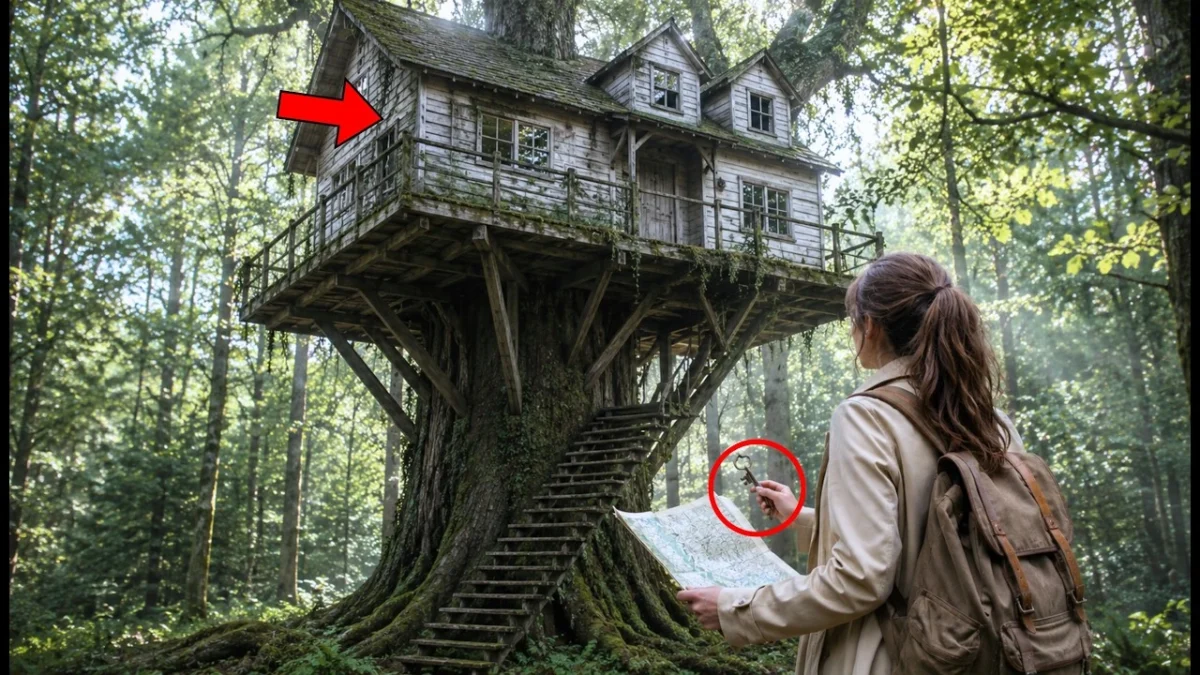
Nineteen years of extraordinary privilege vanished for Cindy Howard in the span of a single rainy afternoon. The massive iron gates of the Howard estate in Chicago clicked shut behind her with a brutal, echoing finality, leaving her standing on the wet pavement with nothing more than a canvas duffel bag and a rusty, pitted iron key. Her uncle Gregory had orchestrated the coup with ruthless precision, framing her for embezzlement and evicting her from the only home she had ever known after the tragic death of her father, Adam Howard.
Gregory stood on the grand staircase, looking down at her with a chilling, triumphant smirk. “You’re a thief, Cindy,” he had told her, his voice dripping with false sorrow that failed to mask his malice. “The board has seen the evidence. You are disinherited.”
Now, shivering in a cheap diner booth three miles away, Cindy stared down at the small velvet pouch hidden inside her jacket. Inside lay the key her father had pressed into her hand on her sixteenth birthday, accompanied by a cryptic warning about wolves and a forgotten thinking place in upstate New York. She had no money, no phone, and no allies. But as she gripped the heavy metal key, a cold, hard resolve began to take root in her chest. She realized her father had known the danger long before the tragedy on Lake Michigan.
The journey to Asiggo, New York, was an agonizing trial of endurance. After a grueling twenty-four-hour Greyhound bus ride fueled by stale air and a gnawing ache in her stomach, Cindy stepped off into the biting autumn air with exactly twelve dollars to her name. Asiggo was a historic, weather-beaten port city resting on the southern shore of Lake Ontario. Guided only by fragmented childhood bedtime stories, she began the grueling four-hour trek along the highway shoulder, diving into roadside ditches every time a semi-truck roared past.
When she finally found the overgrown dirt logging road, it was choked with aggressive brambles and fallen pine branches. The thorns tore fiercely at her jeans and scratched her exposed arms as she forced her way through the dense foliage, the thick canopy plunging the trail into a gloomy, premature twilight.
Finally, the safe house came into view, and Cindy’s heart sank into her stomach. It was a dilapidated, single-story timber cabin featuring a sagging roof, moss-covered walls, and windows clouded with decades of grime. The front porch looked as though it would collapse under the weight of a stray cat. She climbed the rickety stairs, carefully avoiding the visibly rotten planks, and approached the heavy-duty padlock that stood in stark contrast to the eighty-year-old shack.
With trembling hands, she pulled the rusty iron key from her pocket and inserted it into the lock. It yielded with a heavy, satisfying click. Pushing the door open, she was greeted by the stale scent of pine needles, dust, and old paper. The interior was sparse, housing only a small wood stove, a sturdy oak table, a military-grade sleeping bag, and several heavy wooden crates stacked tightly in the corner. Using a rusted crowbar she found discarded near the stove, she pried open one of the crates to reveal rows of canned goods, bottled water, matches, and a well-stocked first aid kit. Her father had indeed prepared this place for survival, but Cindy knew a simple shelter wasn’t the ultimate answer. Adam Howard was a master strategist; there had to be more.
On her third night in the cabin, the wolves finally caught up with her.
Cindy was reading a paperback by the dim, flickering light of a kerosene lamp when she heard the unmistakable, bone-chilling crunch of heavy tires on gravel outside. Her blood instantly turned to ice. The logging road was entirely hidden; no one stumbled upon it by accident. Reacting on pure instinct, she blew out the lamp, plunging the cabin into pitch blackness, and crept toward the clouded window.
Through a small scratch in the grime, she watched as a massive black SUV parked fifty yards away, its headlights cutting jagged paths through the dense fog. Two men stepped out, clad in dark tactical gear and moving with a predatory, professional grace.
“You sure this is the grid coordinate?” one asked, his voice carrying clearly through the crisp night air.
“Positive,” the other replied, holding up a glowing tablet. “Boss traced Adam’s old property records through a shell LLC. Gregory said the ledger has to be here. Adam wouldn’t trust a bank with it.”
“What about the girl?”
“If she’s here, make it look like a tragic exposure incident. The boss doesn’t care. He just wants the hard drives.”
Cindy stopped breathing. They were here to assassinate her, and they were hunting for the exact proof that could dismantle Gregory’s entire criminal empire. As the men approached the porch, the heavy floorboards groaned beneath their boots. They rattled the front door, finding it firmly secured by the deadbolt she had thrown.
“Doors bolted,” one muttered. “Break a window. Let’s sweep it fast.”
Just as a heavy flashlight smashed against the side window, shattering the glass inward, nature intervened with a deafening crash. A massive tree, weakened by a recent storm and battered by relentless winds, suddenly gave way, plunging directly onto the hood of their SUV. The vehicle’s alarm instantly began to blare, a piercing siren that tore through the quiet forest.
“Damn it, the radiator is smashed!” one of the men yelled over the blaring siren. “We need to go before the locals hear this and call the cops. We’ll come back in the morning with a crew.”
They retreated from the porch, sprinting back toward the ruined vehicle. The engine ground and hissed before they managed to reverse down the overgrown path, leaving Cindy shaking violently in the dark, clutching the heavy crowbar. She had less than eight hours before dawn brought a larger, deadlier team back to the cabin.
The moment the taillights vanished, Cindy sprang into action, relighting the kerosene lamp and tearing the cabin apart. She moved the cot, ripped up the thin center rug, and tapped every single timber along the interior walls, listening intently for a hollow sound. Three hours passed in a blur of exhaustion. The cabin appeared to be nothing more than a simple wooden box.
Frustration boiled over into desperate tears until she looked up.
She had checked the walls and the floor, but the cabin featured a pitched roof, meaning a triangular space existed right above the flat interior ceiling. Placing a chair in the narrow hallway connecting the main room to the tiny bathroom, she climbed up and ran her hands along the tongue-and-groove pine boards. Near the bathroom door, her fingers brushed against a tiny, perfectly circular indentation, barely the size of a dime.
Grabbing a flathead screwdriver from her tool kit, she climbed back up and pried at the spot. A small wooden plug popped out, revealing a recessed keyhole. Scrambling down, she retrieved the rusty iron key from the table and rushed back. She inserted the key into the ceiling lock, turning it smoothly to activate a hidden counterweighted spring mechanism with a soft pneumatic hiss. A two-by-four-foot section of the ceiling dropped an inch. Pushing it open, a set of sleek, modern aluminum stairs unfolded—completely contradicting the rustic aesthetic of the cabin.
Cindy climbed the stairs and pushed her head through the opening, expecting cobwebs and rat droppings. Instead, motion sensors clicked, and a row of bright LED strip lights flickered to life.
She gasped. The attic was a marvel of covert engineering. Thick soundproof server racks lined the walls, humming quietly in a climate-controlled environment powered by a hidden solar array on the roof. In the center of the room sat a massive vintage Diebold bank safe bolted directly into the reinforced floor joists, accompanied by a heavy steel desk holding a single laptop and a leather-bound journal.
Cindy climbed the rest of the way up, her boots echoing on the reinforced steel grating. She went straight to the desk and opened the journal, recognizing her father’s sharp handwriting on the first page.
*”Cindy, if you are reading this, the worst has happened and Gregory has made his move,”* the entry began. *”I wanted to protect you from the rot inside our family, but I see now that keeping you in the dark was my greatest failure. Gregory is not just a greedy man. He is a monster. For the last five years, he has been using a network of shell companies, primarily one named Apex Logistics, to launder hundreds of millions of dollars for a cartel operating out of Sinaloa. I found out three months ago and have been quietly gathering evidence to turn him over to the feds, but Gregory has spies everywhere.”*
Tears pricked her eyes. Her father hadn’t died in a simple mechanical accident; Gregory had him murdered to protect his money-laundering operations. The initial grief was instantly incinerated by a white-hot rage.
She continued reading. *”The servers in this room contain every transaction, every forged manifest, and every wire transfer Gregory ever authorized. But digital files can be corrupted or denied by high-priced defense attorneys. That is why you need to open the safe.”*
The journal provided the combination: the day Cindy broke her arm falling off a horse at the estate, setting the bone herself while waiting for an ambulance without shedding a single tear. August 14, 2018.
Walking over to the massive Diebold safe, Cindy grasped the heavy brass dial and spun it precisely to the numbers indicated. She pulled the heavy handle down. Heavy locking bolts retracted with a loud metallic clank, and the thick steel door swung open. Inside lay physical bearer bonds—untraceable liquid assets worth millions of dollars—alongside three thick manila envelopes sealed with red wax containing physical handwritten ledgers, photographs, and audio transcripts.
*”This money is yours,”* the journal concluded. *”Use it to disappear if you must. But if I know you, you won’t run. Find Liam Dempsey. He was my oldest friend, forced out by Gregory years ago. He knows what to do.”*
As the first slivers of pale dawn light began to peek through the ventilation grates, Cindy packed the bearer bonds, the physical ledgers, and the external backup drives into her canvas duffel bag. She grabbed a thick stack of emergency hundred-dollar bills from near the safe’s hinges, tucked her father’s journal into her jacket, and climbed down the aluminum stairs. She wasn’t just going to survive; she was going to take everything back.
The heavy rumble of multiple engines echoed through the trees just as she finished packing. Through the shattered side window, she saw three black SUVs rolling down the overgrown logging road, their suspensions bouncing violently over the ruts. A dozen men in tactical gear poured out before the vehicles even came to a complete stop, carrying assault rifles and heavy breaching tools.
Cindy sprinted toward the back of the cabin, shoved the tiny bathroom window open, threw her duffel bag into the thick ferns outside, and squeezed her body through the narrow frame just as the front door splintered under the force of a battering ram. Hitting the damp earth, she grabbed her bag and scrambled into the dense underbrush, running with a reckless, frantic energy.
Behind her, a furious yell echoed through the trees as they discovered the open attic and the empty safe. Pushing deeper into the woods, Cindy navigated by the position of the rising sun, heading east toward the highway until her lungs burned and her legs felt like lead.
When she finally reached the asphalt shoulder of the state route, she flagged down a passing logger’s truck, offering the bewildered driver a crisp hundred-dollar bill for a ride to the transport hub in Syracuse. Once in the city, she used the emergency cash to buy a cheap burner phone, a dark hoodie, sunglasses, and a bus ticket heading northeast to Portland, Maine.
The journey took another grueling day and a half. The biting coastal wind whipped off the Atlantic as she walked down the docks of a working-class marina in Portland, finding Dempsey Marine Services tucked between a rusted trawler and a bait shop. Pushing the heavy door open, she smelled motor oil, salt, and stale coffee.
A man in his late fifties, bearing a thick beard streaked with gray and forearms corded with muscle, was bent over a dismantled outboard motor. He wiped his hands on a greasy rag and grunted without looking up, “Shop’s closed.”
“I have a boat that needs fixing,” Cindy said, her voice trembling slightly. “My father said you were the best architect he ever knew, even if you just build engines now.”
The man froze. The rag slipped from his hands. Slowly looking up, his piercing blue eyes locked onto hers, reading the unmistakable truth in her features.
“Cindy,” he whispered, his voice cracking with emotion as he stepped forward. “Good God, you have Adam’s eyes.”
The adrenaline that had sustained her for the past four days evaporated instantly, and her knees buckled. Liam caught her before she hit the floor, guiding her to a battered leather armchair in the corner of his office. He locked the shop doors, pulled the tight blinds, and handed her a cup of scalding black coffee.
Once she steadied herself, Cindy unzipped the duffel bag and handed her father’s leather-bound journal to him. Liam read the first page, his jaw tightening and the veins in his neck bulging as a quiet, lethal rage settled over his features. He spent the next hour pouring over the red-waxed ledgers and booting up the encrypted hard drives on a secure, air-gapped laptop retrieved from his own hidden floor safe.
“Your father suspected Gregory was dirty,” Liam said, his voice a low, dangerous rumble, “but we never imagined it was this deep. Gregory has been using Apex Logistics as a massive washing machine for Sinaloa cartel cash. But he’s overextended. The cartel wants clean real estate assets they can use as legitimate collateral, and Gregory is planning to merge Apex entirely into the Howard portfolio to give them a permanent foothold in the US commercial market.”
“Can we take this to the police?” Cindy asked.
Liam shook his head grimly. “Gregory owns the local police, and half the district attorneys in Chicago are in his pocket. If we hand this over through standard channels, the evidence will disappear in an evidence locker fire, and you will be found floating in Lake Michigan. If we are going to kill a snake this big, we have to cut the head off in front of the whole world.”
He turned to his wall calendar. “Tomorrow night is the annual Howard Foundation charity gala at the Drake Hotel. Gregory is scheduled to give a keynote address announcing the Apex Logistics merger to the board and the press. The cartel’s top fixers will be in the VIP boxes ensuring the deal goes through.”
Cindy looked at the mountain of undeniable evidence sitting on the desk. “We crash the gala.”
“We don’t just crash it,” Liam said, a fierce, predatory grin breaking through his gray beard. “We hijack it. We expose him to the board, the press, and the federal agents I’m going to invite.”
The Drake Hotel Ballroom was a dazzling sea of black tuxedos, glittering diamonds, and the delicate clinking of crystal champagne flutes—the absolute pinnacle of Chicago high society. Forty-eight hours prior, Cindy would have been wearing a custom designer gown, greeting senators and tech moguls as the undisputed heir to the empire. Tonight, she wore a sleek, tailored black suit bought with bearer bond cash, wearing an earpiece and slipping through the hotel’s service corridors like a ghost.
Liam had spent the last two days pulling every favor from his military past, contacting a specialized federal task force that bypassed the corrupted local Chicago field office entirely. The feds were currently staging in the underground parking garage, waiting for Liam’s signal.
“I’m at the service elevator heading to the AV control room,” Cindy whispered into her collar mic.
“Copy that, Cindy,” Liam’s voice crackled softly in her ear from his monitoring van three blocks away. “Gregory’s security team is heavy on the ballroom floor, but they left the tech booth lightly guarded. Two men. You know what to do.”
Cindy stepped out of the service elevator on the mezzanine level overlooking the massive ballroom. Through the glass, she could see Gregory standing proudly at the podium on the grand stage, basking in the spotlight like a king surveying his conquered domain. She approached the heavy door of the audio-visual booth. Two men in dark suits stood outside—the exact same thugs who had thrown her out of her home days ago.
Taking a deep breath, Cindy pulled a small canister of military-grade pepper spray from her pocket and stepped smoothly around the corner. “Hey, excuse me,” she said, pitching her voice high and panicked. “There’s a fire in the kitchen. You need to—”
The men turned instinctively, reaching for their earpieces, but Cindy didn’t hesitate. She raised her hand and delivered a continuous, blinding stream directly across both of their faces. They bellowed in sudden agony, their hands flying to their eyes as they collapsed heavily to their knees.
Stepping past them without a backward glance, Cindy swiped the access card from one of their belts, unlocked the heavy door of the AV booth, and locked it securely behind her. The technician inside spun around in shock, but before he could shout, Cindy disabled him with a swift, calculated strike learned from Liam’s hurried crash course.
She plugged her father’s encrypted hard drive directly into the master broadcast switcher, overriding the hotel’s primary media server. On the massive projector screens above the ballroom, Gregory’s smiling face was instantly replaced by high-resolution financial wire transfer logs, scanned handwritten cartel ledgers, and audio transcripts detailing the Apex Logistics conspiracy.
In the ballroom below, the murmurs of high society abruptly died away into a stunned, deathly silence. Gregory stopped mid-sentence, staring up at the screen in absolute horror as his crimes played out in agonizing detail.
Cindy pressed the earpiece communicator, her voice steady and ringing with absolute authority. “Go, Liam. Send in the feds.”
Heavy boots echoed up the stairwells as federal agents flooded the ballroom doors, securing every exit. Looking down through the glass at her uncle’s pale, crumbling expression, Cindy adjusted her jacket collar. The frightened girl left in the rain was gone. The true heir to the Howard empire had returned to claim her birthright.








