Blind woman Was Left at a Bus Stop — A Single Dad Changed Her Life Forever
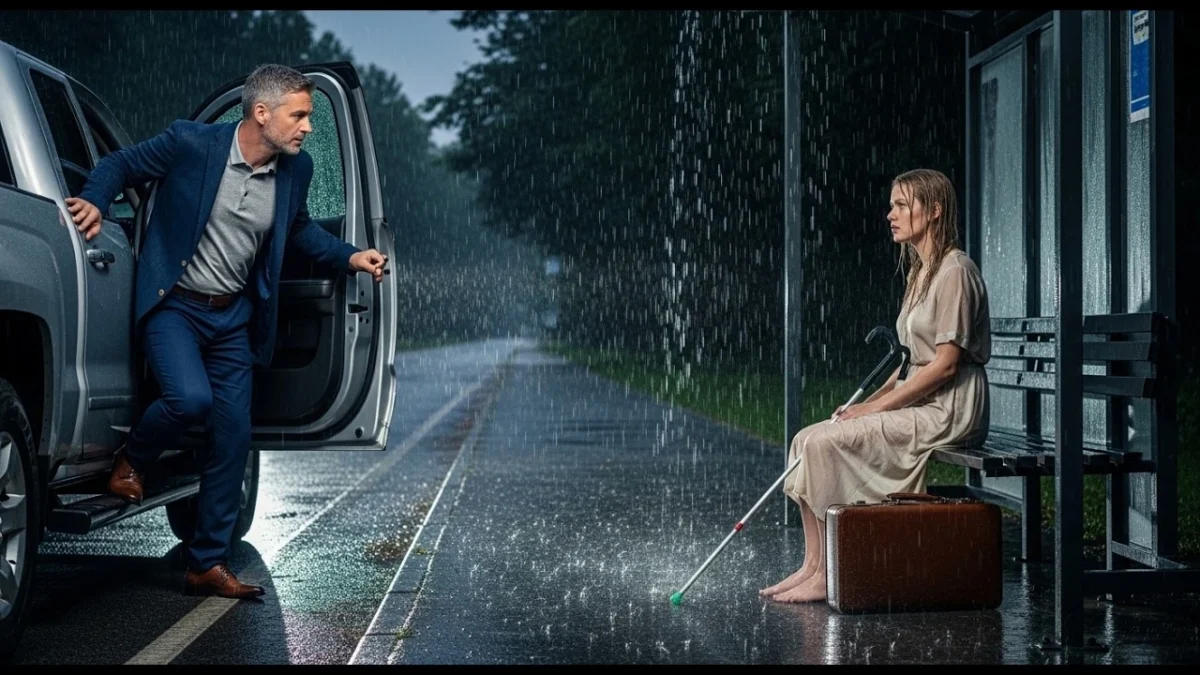
The rain fell without warning, turning the quiet night into a wall of gray downpour.
One moment the air was dry and still, the kind of stillness that settles over small towns after 10:00 when the local diners dim their lights and the traffic thins to a trickle on Route 9.
The next moment, the sky opened up over Western Pennsylvania with sudden, indifferent violence.
Marcus Hale noticed the downpour with the quiet, practiced economy of attention that belonged to a single parent.
His hands rested firmly on the steering wheel of his old pickup truck as his mind ticked through a relentless mental list.
He had to make sure he signed his nine-year-old daughter Lily’s permission slip before 7:00 a.m., double-check the inventory counts from the hardware store, and figure out if there was anything left in the refrigerator worth calling dinner.
He had stayed late at Clearwater Hardware for the third time that month, recounting heavy boxes of galvanized nails and plumbing fixtures until his fingers felt stiff.
As his windshield wipers slapped rhythmically against the glass, his headlights swept across the bus stop at the corner of Route 9 and Clearwater Road.
He almost drove past.
He would think about that moment for years to come, how close he had been to simply keeping his eyes on the road, wrapped up in his own fatigue.
Yet a flash of pale fabric against the dark metal bench made him touch the brakes.
He pulled off onto the gravel shoulder and stared through the rain-streaked side window.
A young woman was sitting on the bench.
She wore a thin linen dress completely unsuited for late September, already soaked through and clinging to her shoulders.
She had no umbrella, no raincoat, and no shoes on her feet.
Beside her sat a scuffed brown leather suitcase, and leaning against her knee was a white and green folding cane.
Marcus put the truck in park, turned on the hazard lights, and stepped out into the rain.
The cold water instantly soaked through his jacket as he crossed the wet pavement.
He stopped a few feet away so he wouldn’t startle her over the sound of the falling water.
“Hey,” Marcus said, raising his voice just enough to be heard. “Are you waiting for someone?”
The young woman turned her head toward him with a deliberate, precise movement.
Her pale gray eyes were open, staring slightly past his left shoulder.
“No,” she said, her voice unexpectedly steady. “I’m not waiting for anyone.”
“The last bus on this route ran at 9:00,” Marcus said, wiping rain from his eyes.
“I know,” she replied softly.
Marcus stood in the downpour, observing the quiet stillness of her posture.
“Do you have somewhere to go?” he asked.
A brief pause hung in the air between them, long enough for him to understand the situation before she even spoke.
“Not at the moment,” she said.
Marcus looked back toward his idling truck, then down at her shivering frame.
“My name is Marcus Hale,” he said gently. “I run the hardware store down the road. I have a guest room at my house. It has a lock on the door, and my daughter is upstairs asleep. You don’t have to come, but you can’t stay out here in this storm.”
She remained still for a second, processing his tone and the space around her.
“You don’t know me,” she said.
“No,” Marcus answered, “but you’re sitting at a dead bus stop in a rainstorm. We can figure out the rest later.”
The faint shadow of a smile touched the corner of her lips.
“Okay,” she said.
Marcus reached down and picked up her leather suitcase.
Without needing to be guided, she reached out and rested her hand light as a feather on his forearm.
Her grip was practiced and confident, navigating the curb and pavement alongside him without a single stumble.
They climbed into the warm cab of the truck, where Marcus immediately turned the heater to high.
“My name is Sophie,” she said as the hot air began to blow through the vents. “Sophie Callahan.”
“Good to meet you, Sophie,” Marcus said, pulling the truck back onto the dark highway. “Where were you trying to get to tonight?”
“Nowhere specific,” Sophie replied, pulling her knees slightly toward her chest to catch the heat. “I had an apartment on Birchwood, but the landlord decided he needed the unit back and gave me two weeks’ notice.”
“Two weeks?” Marcus frowned, keeping his eyes on the road. “That doesn’t sound legal.”
“It probably isn’t,” Sophie said quietly. “But fighting a legal battle requires energy and money, and I didn’t have much of either left.”
Marcus adjusted the rearview mirror, glancing at her profile.
“How long have you been blind?” he asked gently, carefully measuring his words.
“Since I was nineteen,” Sophie answered, her tone entirely matter-of-fact. “A degenerative retinal condition. It took my sight over the course of about six months.”
She reached down, touching the white cane resting across her lap.
“It’s an AmbuTech folding model,” she added with a slight smile. “I noticed you picked up my suitcase like it was made of thin glass.”
“First time handling one,” Marcus admitted with a faint chuckle.
“It’s sturdier than it looks,” she said, leaning her head back against the seat rest. “Thank you for stopping, Marcus.”
They drove the rest of the way in silence, the rhythm of the rain providing a steady backdrop to the quiet warmth of the truck.
When they arrived at the modest two-story house on the edge of town, Marcus led her inside, keeping his steps slow and deliberate.
He showed her to the small guest room on the ground floor, pointing out the layout by placing her hand on the edge of the bed frame, the dresser, and the door handle.
“The bathroom is right across the hall,” Marcus said in a low voice. “I left some clean towels on the counter and a pair of dry sweatpants on the chair. The door locks from the inside.”
“Thank you, Marcus,” Sophie said, her fingers lingering on the brass door lock. “For everything.”
“Get some sleep, Sophie. We’ll talk in the morning.”
Marcus walked upstairs, his heart beating with a strange, quiet weight.
He checked on Lily, softly closing her bedroom door, before sitting on the edge of his own bed.
He spent the next hour staring at the ceiling, wondering if he had made a reckless decision, but knowing in his gut that leaving her on that bench would have haunted him forever.
The morning light broke through the clouds around six o’clock, painting the kitchen in pale yellow hues.
Marcus was already at the stove, brewing a fresh pot of coffee, when he heard soft footsteps coming down the stairs.
Lily stepped into the kitchen, wearing her favorite flannel pajamas with her dark hair standing up in a messy morning tumble.
She paused near the doorway, her wide eyes fixing instantly on the guest room door, which stood wide open.
Sophie was already awake, sitting quietly at the wooden kitchen table.
She wore an oversized gray sweatshirt that Marcus had left out for her, her hands wrapped neatly around a steaming ceramic mug.
Lily walked closer, stopping two feet from the table with the unabashed curiosity only a child could manage.
“Who are you?” Lily asked directly.
Sophie turned her face toward the sound of the young voice, a soft, warm expression relaxing her features.
“I’m Sophie,” she said gently. “Who are you?”
“I’m Lily,” the girl replied, taking another step forward. “Why are you sleeping in our house?”
“It was raining very hard last night,” Sophie explained, setting her mug down carefully. “And your dad was kind enough to give me a ride and a dry place to stay.”
Lily tilted her head, noticing the white cane leaning against the table leg.
“What’s that stick for?” Lily asked.
“Lily, sweetie, let Sophie drink her coffee,” Marcus interrupted, stepping away from the stove with a plate of toast.
“It’s alright, Marcus,” Sophie said with a gentle laugh. “It’s my cane, Lily. It helps me feel where I’m walking because my eyes don’t work.”
Lily walked right up to the chair, inspecting the cane with deep concentration.
“So you can’t see anything?” Lily asked softly.
“Not very much,” Sophie answered. “Just broad shapes and darkness.”
Lily thought about this for a moment, her young mind processing the concept with absolute seriousness.
“Do you want me to tell you what the kitchen looks like?” Lily offered generously.
Sophie smiled, a true, bright smile that seemed to warm her entire face.
“I would love that, Lily,” Sophie said.
Over the next two days, the quiet rhythm of the house adjusted to Sophie’s presence in a way that felt surprisingly natural.
Marcus learned more about her background in small, unhurried pieces over morning coffee and evening meals.
Eight months prior, the non-profit organization where she worked in Pittsburgh—a group that produced accessible audio materials for visually impaired students—had lost its federal grant funding and closed down without warning.
Sophie had used her modest savings to pay rent while searching frantically for new employment.
“I submitted thirty-seven applications,” Sophie told Marcus on the second evening as they sat on the back porch while Lily did her homework inside. “I got four interviews.”
“And none of them worked out?” Marcus asked, leaning against the wooden railing.
“People don’t know how to interact with a blind candidate,” she said without bitterness, though a shadow of fatigue touched her voice. “They ask illegal questions, or they get so nervous about saying the wrong thing that they barely talk at all. Or they take one look at my cane and decide I’m a liability before I even sit down.”
“What was your job at the non-profit?” Marcus asked.
“Audio editing and accessibility compliance,” she replied, her chin lifting slightly. “I checked educational audiobooks to make sure the descriptions were clear and the formatting was precise. I was very good at it.”
“I believe you,” Marcus said simply.
In those short forty-eight hours, Marcus had watched her navigate his home with a methodical, silent grace that humbled him.
She never stumbled, using her hands and subtle touch to map out the kitchen counters, the placement of the chairs, and the distance to the front door.
On her second morning, Lily had brought her plastic alarm clock to the kitchen table.
“Can you feel what time it is?” Lily had asked, holding out the clock.
Sophie had taken the device, tracing her slender fingertips lightly across the raised numbers and the position of the hands on the glass surface.
“It is exactly seven fourteen,” Sophie had announced.
“Woah,” Lily had gasped, her eyes wide with admiration. “That’s like a superpower.”
From that moment on, Lily was completely captivated.
She spent hours asking Sophie about braille, how guide dogs were trained, and how blind people knew when a street light had changed.
Sophie answered every single question with patience and genuine delight, treating Lily’s boundless curiosity with solemn respect.
Standing in the kitchen door, watching the two of them laugh together over a book about sea turtles, Marcus felt a deep, forgotten ache loosen in his chest.
It was a quiet area of his heart that had remained firmly closed off ever since his wife had walked out on them five years ago, unable to handle the routine demands of small-town family life.
Marcus had learned to rely entirely on himself, building a wall of daily tasks and hard work to protect his daughter and himself from further disappointment.
Watching Sophie interact with Lily made him realize how lonely that wall had kept them.
On the third afternoon, Marcus was sitting in the small back office of Clearwater Hardware, reviewing stacks of paper invoices from his tool suppliers.
The desk was littered with receipts, yellow notepads, and half-empty coffee cups.
His desk phone rang, echoing loudly off the metal filing cabinets.
He picked up the receiver on the second ring. “Clearwater Hardware, this is Marcus.”
“Hello, Mr. Hale,” a woman’s professional voice came through the line. “My name is Dr. Patricia Wren. I’m calling from the Wren-Castillo Visual Neurology Institute in Pittsburgh.”
Marcus shifted in his chair, setting his pen down. “Dr. Wren? How did you get my number?”
“I’m calling regarding Sophie Callahan,” Dr. Wren explained. “I have been trying to reach her for nearly three weeks, but her cell phone line was disconnected. I finally pulled her file and saw that she listed Marcus Hale and Clearwater Hardware as a secondary emergency contact when she enrolled in our trial eighteen months ago.”
Marcus sat up straight, his hand tightening around the receiver. “An emergency contact? She put my name down?”
“Yes,” Dr. Wren said, a hint of confusion in her voice. “Eighteen months ago, when she signed the consent forms for our Phase Two gene therapy trial. She listed your business address and phone number.”
Marcus remembered then—Sophie had mentioned growing up in a neighboring county years ago, before her sight failed completely.
She must have remembered the name of the local hardware store when filling out the form, having no family members left to list as a contact person.
“Mr. Hale, are you still there?” Dr. Wren asked.
“Yes, I’m here,” Marcus said quickly. “Sophie is staying at my house right now. She lost her apartment a few days ago.”
There was a sudden, distinct shift in Dr. Wren’s voice, a tight edge of excitement breaking through her clinical demeanor.
“She is with you right now?” Dr. Wren asked.
“Yes. What is this about, Doctor?”
Dr. Wren took a quiet breath over the line. “Sophie was part of a five-person cohort receiving a specialized viral vector injection designed to repair damaged retinal cells. We lost contact with her just as we began analyzing the mid-term data.”
“What did the data show?” Marcus asked, his heart beginning to thump heavily against his ribs.
“Three of the five patients in her group have shown measurable restoration of functional vision,” Dr. Wren said, speaking slowly and deliberately. “Two of them have regained significant clarity over the last four months. And Sophie’s last set of retinal scans before she missed her appointment showed structural changes identical to the positive responders.”
Marcus leaned forward, resting his elbows on his desk, completely motionless. “What are you saying?”
“I’m saying that Sophie may be regaining her vision, Mr. Hale,” Dr. Wren said. “We need her to come into the clinic immediately for a complete neurological and visual evaluation. Can you bring her to Pittsburgh tomorrow morning?”
Marcus closed his eyes, overwhelmed by the sudden magnitude of the news. “Yes,” he said, his voice thick with emotion. “I’ll bring her in.”
He hung up the phone, sat quietly in his office for five minutes to gather his thoughts, and then immediately locked up the hardware store early.
He drove home through the bright afternoon sunlight, his hands gripping the steering wheel tight as his mind raced.
When he walked through his front door, he found Sophie sitting on the living room rug beside Lily.
Lily was reading aloud from an illustrated book about blue whales, pronouncing the long scientific words with extreme care.
Sophie was listening intently, nodding along and making quiet comments that caused Lily to beam with pride.
Marcus stood in the hallway, watching the quiet warmth of the scene before stepping into the room.
“Sophie,” Marcus said softly.
Sophie turned her face toward his footsteps. “You’re home early, Marcus. Is everything alright at the store?”
Marcus walked over and sat on the wooden coffee table across from her.
“I just got a phone call,” he said gently. “From Dr. Patricia Wren.”
The moment the name left his lips, Sophie went entirely still.
It was not her usual calm stillness; it was the tense, frozen posture of a person bracing for impact.
“She’s been trying to reach you for weeks,” Marcus continued, keeping his tone calm and steady. “Your phone was disconnected, so she used the emergency contact number you wrote down on your intake form eighteen months ago.”
Sophie lowered her head, her fingers tightening around the fabric of her pants. “I didn’t have anyone else to write down,” she whispered. “I just remembered the name of your shop from when my father used to buy lumber there. I never thought anyone would actually call it.”
“Well, she called,” Marcus said softly. “Sophie, she told me about the clinical trial. She told me about the results.”
“Please,” Sophie whispered, her voice trembling slightly. “Please don’t say anything if you’re not entirely sure, Marcus. I can’t… I can’t hope for that again.”
“She said your last retinal scans showed the exact same progress as the patients who responded to the treatment,” Marcus said, leaning closer so she could hear every word clearly. “She wants you in Pittsburgh tomorrow morning for a full evaluation.”
Sophie did not move.
She sat perfectly still on the carpet, processing the words as tears slowly welled up in her pale gray eyes and spilled down her cheeks.
She reached out with both hands, pressing her palms flat against the hardwood floor as if to keep the room from spinning around her.
“Okay,” she breathed out, her voice breaking. “Okay.”
Lily looked between the two of them, sensing the immense emotional weight in the room.
Without saying a word, the nine-year-old reached out her small hand and placed it gently over Sophie’s trembling fingers.
Sophie turned her head toward the girl, feeling the small, warm hand beneath hers, and let out a sob, her guarded composure completely giving way to relief.
The next morning, Marcus drove his truck into the heart of Pittsburgh.
He dropped Lily off at her elementary school early, explaining to her teacher that they had an urgent medical appointment in the city.
He left his store in the hands of his trusted assistant manager, who had taken one look at Marcus’s intense expression and simply said, “Take all the time you need.”
Dr. Wren’s clinic was located on the fourteenth floor of a modern glass building overlooking the Allegheny River.
Marcus sat in the quiet waiting room for nearly three hours while Sophie was taken through a series of dark exam rooms, high-tech eye scans, and neurological tests.
He paced the carpeted floor, staring out the massive glass windows at the river below, feeling more nervous than he had in years.
Finally, the heavy double doors opened, and Sophie stepped out into the waiting room, accompanied by a tall woman in a white lab coat.
Marcus walked forward immediately, his eyes searching Sophie’s face.
Her expression was entirely transformed.
The cautious, guarded look she had carried for years was gone, replaced by a radiant, wide-eyed sense of wonder that made her look years younger.
“Mr. Hale,” Dr. Wren said, extending a hand to Marcus with a genuine, warm smile. “I’m so glad you brought her in.”
“How is she?” Marcus asked, looking directly at Sophie.
“The gene therapy has successfully halted the retinal degeneration,” Dr. Wren announced proudly. “More than that, it has stimulated significant cellular regeneration. Sophie is already experiencing partial light reception and spatial outline detection.”
“I can see the light coming through those windows,” Sophie said, her voice shaking with joy as she pointed toward the river view. “I can see the shape of the frame, Marcus. I can see where the light meets the wall.”
Marcus looked at her, finding himself completely unable to speak as a lump formed in his throat.
“She will need several months of structured vision rehabilitation to help her brain process the visual data again,” Dr. Wren added. “It’s a long process, but her prognosis for regaining functional independence is exceptional.”
“Thank you, Doctor,” Marcus said, shaking Dr. Wren’s hand warmly.
Dr. Wren smiled and walked back toward her office, leaving them alone in the quiet hallway.
Sophie took a step toward Marcus, her eyes looking directly into his face—not past his shoulder, but right at his eyes.
“Marcus,” she said softly. “When I filled out those papers eighteen months ago, I was completely alone. I wrote down Clearwater Hardware because it was a place from my childhood that felt safe, even though I knew no one there would remember me.”
“I’m glad you wrote it down,” Marcus said, his voice rough with emotion.
“You saved my life at that bus stop,” she said, taking a step closer. “Not just because you got me out of the rain, but because you reminded me that there are still good people in the world worth trusting.”
Marcus smiled, offering her his arm just as he had done on that dark, rainy night on Route 9.
“Lily is going to be waiting at the front door demanding a complete report the second we get back,” Marcus said with a soft laugh.
Sophie reached out and took his arm, wrapping her hand securely around his coat sleeve.
“Then let’s not keep her waiting,” Sophie said softly, a bright, beautiful laugh bubbling up from her chest.
Together, they walked down the long corridor toward the elevators and stepped out into the bright afternoon sunlight.








