CEO Banned a Single Dad at Christmas Dinner—Then Her Helicopter Crashed and He Returned to Save Her!
The heavy oak doors of the Carrington Mountain Lodge ballroom had barely swung shut behind Caleb Danner before the suffocating weight of the silence inside settled back over the room.
Outside, the storm was no longer just a backdrop for the holiday festivities; it was a living, breathing monster consuming the 7,000-foot ridge.
Inside, the string quartet resumed playing a sprightly piece in 3/4 time, the gentle friction of horsehair against violin strings doing its best to erase the lingering awkwardness of a dismissed safety officer.
Helena Carrington remained seated at the head of the long mahogany table, her dark green silk dress catching the amber glow of the crystal chandeliers.
She did not touch her wine.
Instead, she picked up her phone, her thumb flicking across the screen as if the brief interruption by a man in an old work coat had been nothing more than a speck of dust on her sleeve.
Preston Whitlock, the executive vice president, hovered nearby like a well-dressed shadow.
His silver-streaked temples caught the light as he leaned down, flashing a reassuring, patrician smile that seemed designed to soothe the frayed nerves of the surrounding regional directors.
“An absolute non-event, Helena,” Preston murmured, his voice rich and smooth as aged whiskey.
“The man has always been prone to dramatics. A classic case of operational over-identification. He treats a standard winter front like an extinction-level event because it gives him a reason to feel important.”
Helena didn’t look up immediately, but the corner of her mouth tightened.
“He refused to sign the concurrence, Preston,” she said, her voice low enough that only those immediately adjacent could hear.
“It’s not about his dramatics; it’s about the paper trail. If the board sees an unsigned safety form in the audit…”
“There won’t be an unsigned form,” Preston interrupted smoothly, pulling his own phone from his pocket.
“I already have the release from the maintenance contractor right here. Fully compliant, fully certified, fully legal. The aircraft is airworthy. Ethan is ready on the pad. If we don’t lift off in the next twenty minutes, you’ll miss the investor breakfast in Denver tomorrow morning, and six months of lobbying goes up in smoke.”
Helena stared at the screen Preston held out.
The words *serviceable* and *approved* glowed in sharp blue light against the dark glass.
To a woman who measured her entire existence in quarters, deliverables, and margins, paperwork was reality.
A handwritten warning from a regional supervisor holding a weather printout felt like fiction by comparison.
“Let’s go, then,” Helena said, standing up with a fluid, practiced grace that commanded immediate attention from the room.
“Ethan is waiting. Preston, wrap things up here. I want the morning brief waiting on my tablet when I touch down.”
—
A few miles down the mountain, tucked beneath the timberline at the base of the access road, Caleb Danner sat in the pre-fabricated operations yard with a cup of coffee that tasted uncomfortably like a filing cabinet.
The sodium light above the fuel island buzzed faintly, casting long, warped shadows across the drifts of snow piling against the north fence.
He had just finished hanging up the phone with his nineteen-year-old daughter, Marin.
The conversation had been short, echoing with the familiar, quiet ache of a single father who had spent four consecutive Christmas Eves staring at duty logs while his daughter slept in a dorm room or drove across state lines to find a family to sit with.
“Be careful, Dad,” she had said.
“The passes are supposed to be terrible.”
“I will,” he had replied.
Now, sitting at the metal desk with the glow of the monitor illuminating his weathered face, Caleb heard it.
It wasn’t the wind, and it wasn’t the steady hum of the yard’s generator.
It was the unmistakable, deep-throated turbine spool of an AgustaWestland helicopter winding up on the pad behind the lodge far above.
Caleb froze.
He didn’t move for several seconds, his hand resting beside the printed weather advisory—the very same red-alert advisory he had dropped on the white tablecloth in front of the chief executive less than an hour ago.
Slowly, deliberately, he stood up, pulled his heavy work coat back on, and walked out into the biting cold.
Through the swirling sheets of white, high up against the dark ridge line, he caught the flash of a red anti-collision light.
It blinked once, twice, and then steadied as the aircraft climbed into the lower layer of the cloud deck.
Then it was swallowed whole.
Caleb stood by his truck for a long moment, the wind tearing at the collar of his coat.
He did not feel vindicated.
He did not feel a dark sense of satisfaction.
He felt a cold, hollow knot form in the pit of his stomach.
“I hope I’m wrong,” he whispered into the empty yard, his voice instantly shredded by the gale.
“God, I hope I’m wrong.”
—
Twenty-two minutes later, the automated alert tone shattered the quiet of the yard.
It was a sound Caleb had heard only twice in eleven years as a safety supervisor.
His phone buzzed violently against the dashboard of his truck.
He looked down at the screen.
*Aircraft telemetry interrupted.*
He slammed the truck into gear, the tires spinning wildly in the unplowed slush before grabbing purchase as he tore out of the yard and pointed the hood back up the steep, winding access road toward the lodge.
His fingers were steady, a grim muscle memory kicking in from his years as a flight medic in the Air National Guard.
He pulled up the tracking software.
The position symbol was there, frozen in time.
One minute stale.
Then three minutes.
Then, for four agonizing seconds, a single transponder ping flickered back to life—four hundred feet lower than the previous altitude, drifting off-course toward the jagged granite walls of Harrow Ridge, before winking out for good.
Caleb didn’t hesitate.
He dialed the county search and rescue dispatcher directly.
“Dispatcher, this is Caleb Danner, Carrington Operations,” he said, his voice flat, controlled, and entirely devoid of panic.
“I have an overdue company transport heading southeast out of the lodge. Transponder dropped off the ridge. I need the emergency frequency activated immediately.”
“Copy that, Danner,” the dispatcher’s voice came back instantly, sharp and professional.
“We’re tracking the loss of signal now. What’s your position?”
“I’m on the lower access road, heading up,” Caleb replied, his eyes locked on the blinding wall of white ahead of his high-beams.
“Listen to me carefully. The official flight plan has them following the primary corridor, but given the icing layer moving in from the west and standard pilot behavior under these specific wind conditions, Ethan didn’t stay on the corridor. He would have broken left down the drainage toward Harrow Ridge to find lower ground. The last known position isn’t where he crashed. It’s where he disappeared from radar.”
There was a brief pause on the line as the dispatcher processed the tactical assessment.
“The rescue choppers are grounded, Danner,” she warned him.
“Zero visibility at the pass, severe icing. Ground teams are nearly two hours out from the far side of the divide. You’re completely on your own up there.”
“I know,” Caleb said, his truck chewing through a drift that threatened to swallow the bumper.
“Put me through to Doug Farall.”
A moment later, the gruff, gravelly voice of the county incident commander cut through the static.
“Danner? The dispatcher says you have a vector.”
“Doug, it’s Caleb,” he said firmly.
“Pilot is Ethan Row. Passenger is Helena Carrington. They’re down in the drainage below the old logging bench. The trees are dense, but there’s a flat shelf about four hundred yards down the fall line from the ridgeline break. If Ethan managed an autorotation, that’s where he’d put her down.”
“Can you get up there?” Farall asked, cutting straight to the point.
“The road’s drifted over, and we’ve got a downed lodgepole blocking the second switchback.”
“I’m taking the tracked utility vehicle from the fleet shed,” Caleb answered, his foot pressing harder on the accelerator.
“I’ll clear the timber or go around on foot with snowshoes. Get your ground team moving. Use the old logging trail as an approach vector. I’m going in now.”
“Copy that, Danner,” Farall said, his tone softening just a fraction.
“Do not go down anything you cannot come back up. Keep your radio open. Report every fifteen minutes.”
“Understood.”
—
Up in the wreckage, tucked into the freezing, wind-whipped pocket of the draw beneath Harrow Ridge, the world was a study in violent chaos.
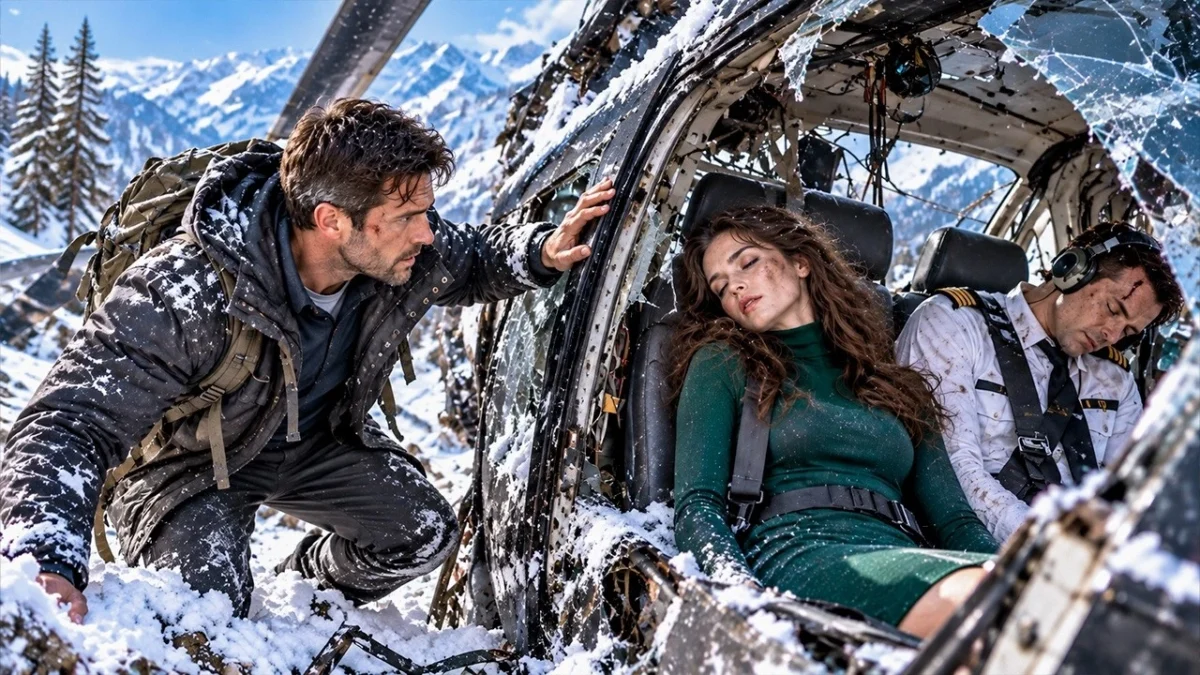
The AgustaWestland lay on its right side, its nose jammed deep into a towering drift of fresh powder.
The tailrotor was entirely sheared off, resting fifty feet up in the broken limbs of a shattered pine.
Inside the crushed cabin, the air tasted sharply of atomized jet fuel, warm electronics, and smoldering insulation.
Helena Carrington coughed violently, her body shaking with a bone-deep chill that no amount of adrenaline could suppress.
Blood trickled sluggishly from a laceration on her scalp, matting her dark hair against her forehead.
Her expensive green silk dress was torn, coated in frost and stained with hydraulic fluid.
Her left arm hung awkwardly at her side, the shoulder dislocated or broken, while the mangled aluminum frame of the cabin seat pinned her thighs like a vise.
“Ethan?” she whispered, her voice cracked and small, stripped of all executive authority.
“Ethan, can you hear me?”
In the left seat, trapped upside down and sideways against the shattered instrument console, Ethan Row groaned.
His right shin was pinned beneath a heavy steel structural member, his breath coming in shallow, ragged gasps.
“I’m here, boss,” Ethan wheezed, his lips pale.
“Still breathing. Just… trying to turn off the fuel master, but I can’t reach the switch.”
“Don’t move,” Helena commanded, though her own voice trembled uncontrollably.
“Someone… someone is coming. They have to be coming.”
“In this weather?” Ethan chuckled weakly, a dry, painful sound.
“Ground teams are hours away, Helena. We’re too far off the flight path.”
Before Helena could answer, a sound cut through the howling wind outside.
It wasn’t the roar of another engine, and it wasn’t the whistle of the gale.
It was a steady, rhythmic shouting from the ridge above them—a deep, resonant voice calling out numbers and coordinates, testing the firmness of the snowpack.
*“Carrington Operations! Coming down the fall line! Ethan, Helena, make some noise if you can hear me!”*
Helena blinked, her blurred vision straining against the dim interior of the wreck.
A beam of bright white light cut through the shattered windscreen, dancing across the frosted dashboard and illuminating the swirling cloud of snow dust inside the cabin.
Then, a face appeared in the gaping hole where the window used to be.
It was Caleb Danner.
He wore the exact same heavy work coat he had worn into the ballroom earlier that evening, the shoulders dusted thick with fresh snow, his headlamp casting a harsh, uncompromising glare across the interior.
Helena stared at him, her mind momentarily failing to bridge the impossible gap between the man she had dismissively banished from her table and the man standing outside a crushed helicopter in the dead of a freezing mountain night.
“You…” Helena breathed, her eyes wide with disbelief.
“What are you… how did you find us?”
Caleb didn’t smile, and he didn’t offer any vindicating remarks.
His face was completely neutral, carved from the same hard granite as the mountains surrounding them.
“I told you the advisory was red, Ms. Carrington,” Caleb said, his voice entirely calm as he braced his boots against a solid pine root to anchor himself on the treacherous forty-degree slope.
“Now, stop talking and listen to me. Is anyone else on board?”
“Just the two of us,” Ethan called out from the left seat, his voice strained.
“Danner… man, am I glad to see you.”
“Save the breath, Ethan,” Caleb instructed, immediately assessing the structural integrity of the airframe with a practiced, sweeping glance.
“The airframe is resting on a shifting drift. We don’t have a lot of time before the whole thing settles further down the draw. Ethan, the console is holding your leg. Helena, the seat frame has your lap locked. We’re going to work on you first, Ms. Carrington, because you’re closest to the break and you can still move your upper body.”
“I don’t need—” Helena started to protest out of sheer, ingrained habit, but a sharp spasm of pain from her shoulder cut her off.
“Save the executive orders for the boardroom, Ms. Carrington,” Caleb interrupted without a trace of hesitation, his tone firm, authoritative, and utterly unshakable.
“Right now, you’re just a patient in a very bad place, and I’m the only thing between you and hypothermia. Can you feel your toes?”
Helena swallowed hard, blinking away the cold sweat stinging her eyes.
“Yes. I can move them.”
“Good. Grab onto my forearm when I count to three.”
Caleb reached into his heavy pack, pulling out a compact hydraulic rescue ram.
With expert precision, he wedged the tool into the narrow gap between the deformed floor track and the crushed seat frame.
His muscles corded beneath his coat as he pumped the handle.
Metal groaned in protest, screaming against the immense pressure of the collapsed cabin.
A shower of fine ice crystals rained down on them from the roof.
“One… two… three—pull!” Caleb grunted.
Helena grabbed his thick forearm with her right hand, throwing her weight backward with a sharp cry of agony as the metal gave way with a loud *snap*.
Her right leg slid free from the trap.
Without pausing, Caleb reached in further, guiding her carefully through the jagged frame of the broken window, lifting her clear of the wreckage with a smooth, powerful motion born of a thousand similar extractions.
He carried her forty feet up the steep slope, placing her securely against the thick trunk of a sheltered spruce tree.
He wrapped an emergency thermal blanket tightly around her shivering shoulders, cracking two chemical heat packs and pressing them firmly into her hands.
“Hold these against your chest,” he ordered, his breath pluming white in the freezing air.
“Do not let go of them. The ground team is twenty minutes out. Stay awake, Helena. If you stop answering me, I’m going to be very annoyed with you.”
A faint, breathless sound escaped Helena’s lips—half a gasp, half a dry, disbelieving laugh.
It was the first genuine, unscripted sound Caleb had ever heard her make.
“You… you came back,” she whispered, her eyes fixed on his weathered face.
“Of course I came back,” Caleb said simply, already turning around to head back down toward the wreck.
“You’re still an employee of Carrington Meridian, Ms. Carrington. Even if I’m just part of the furniture.”
—
Back at the crushed fuselage, the situation had deteriorated rapidly.
A sharp, acrid smell of burning insulation and leaking fuel filled the air.
Ethan was struggling to stay conscious, his head slumped against the overhead console.
“Danner,” Ethan muttered, his voice fading.
“The fuel… it’s pooling near the battery bus.”
“I see it, Ethan,” Caleb said, dropping back down into the unstable trench beside the aircraft.
“We’re getting you out right now.”
The console was wedged heavily across Ethan’s shin, carrying the dead weight of the crumpled nose section.
Caleb wedged a sturdy length of timber beneath the frame, using the shattered door pillar as a fulcrum.
His back screamed in protest, forty-eight years of hard labor and old injuries flaring up all at once, but he locked his core, gritted his teeth, and pushed with every ounce of strength in his body.
The metal lifted three inches.
“Now, Ethan! Pull your leg out!”
Ethan gave a desperate heave, his boot tearing free from the wreckage with a sickening crunch.
Caleb grabbed him by the heavy straps of his flight jacket, dragging him backward through the window frame and up the snowy slope just as a low, ominous groan echoed from beneath the tail.
The slope gave way.
With a long, grinding sigh of torn aluminum and shifting earth, the eleven-million-dollar AgustaWestland broke loose from its icy anchor.
It slid silently down the draw into the absolute blackness of the canyon, disappearing beneath a massive wall of cascading snow that closed over the site within seconds.
Caleb and Ethan collapsed into the snow a safe distance up the slope, their chests heaving, their lungs burning with every freezing breath.
Above them, huddled against the spruce tree, Helena watched the empty space where the helicopter had been.
She stared into the dark abyss for a long time, the terrifying reality of how close she had come to vanishing into the mountain finally settling over her with the weight of an avalanche.
She turned her head slowly, looking past the falling snow at Caleb, who was already on his radio giving clear, concise coordinates to the approaching rescue team.
The arrogance, the corporate detachment, the polished armor she had worn like a second skin for six years—all of it had been stripped away by the freezing wind, leaving behind a woman who realized, with terrifying clarity, that paper, titles, and legal deferrals meant nothing when the mountain decided to collect its due.
Minutes later, the distant whine of tracked snowcats and the sweeping beams of headlamps pierced the upper ridge line.
Doug Farall and his mountain rescue team crested the rise, moving with swift, practiced efficiency.
As medics rushed forward with trauma sleds and blankets, Helena watched as Caleb quietly stepped back, shouldering his heavy pack and checking his radio log.
She struggled to push herself up against the trunk of the tree, ignoring the searing pain in her shoulder, and called out across the wind.
“Caleb!”
Caleb paused, turning back slowly to look at her.
Helena looked at him—really looked at him—for the first time since she had taken the CEO’s chair.
She saw the lines etched around his eyes, the simple work coat stained with grease and snow, and the quiet dignity of a man who didn’t need flattery, titles, or applause to know who he was.
“Thank you,” she said, her voice steady, clear, and stripped of every trace of corporate coldness.
“You saved our lives.”
Caleb tipped his head slightly, a faint, weary ghost of a smile touching the corners of his mouth.
“Just doing my job, Ms. Carrington,” he said softly, turning back toward the trail to guide the rescue team down the mountain.
“See you at the office after the holidays.”








