CEO Made Her Nephew Lead Mechanic Over a Single Dad—Then the Whole Crew Walked Out
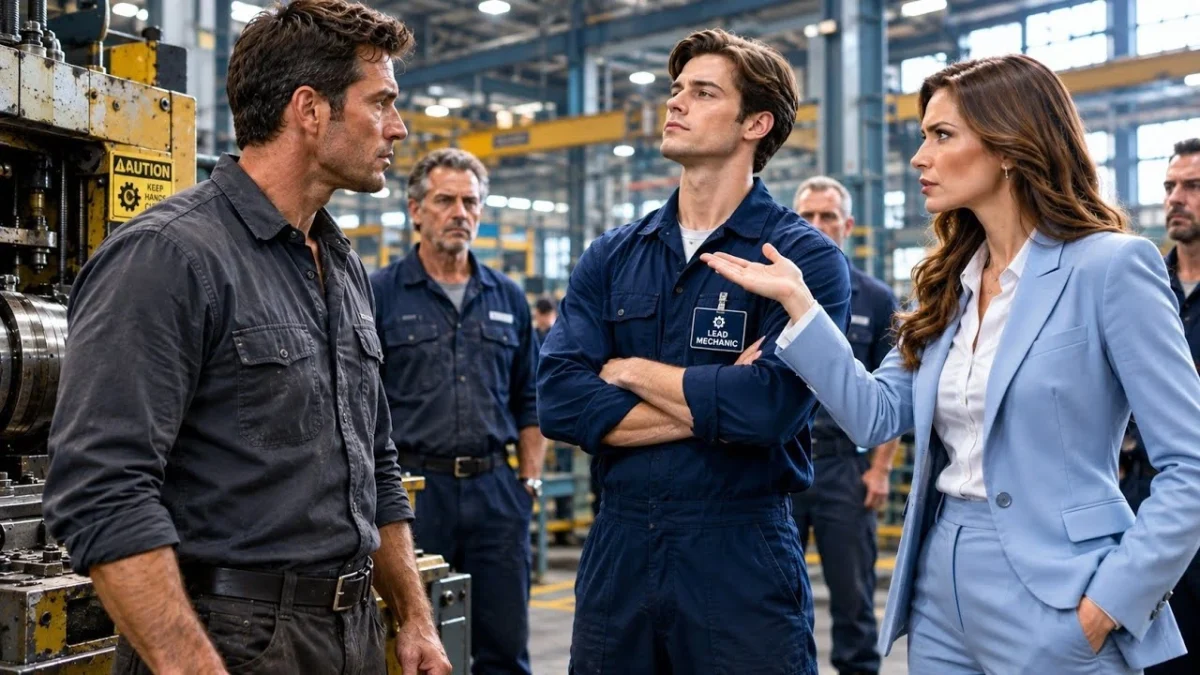
The morning air inside the sprawling assembly hall of Ridgeway Industrial Systems was thick with the scent of hot hydraulic oil, ozone, and metal shavings.
Outside, a brisk October wind swept across the industrial parks of Dayton, Ohio, rattling the corrugated steel panels of the facility.
Inside, the usual deafening roar of heavy manufacturing had grindingly slowed to a low, uneasy hum as forty shift workers gathered in a ragged semicircle around the central maintenance platform.
At forty-one years old, Caleb Morgan stood toward the back of the group, his broad shoulders squared beneath a faded blue work shirt that bore the faint, permanent dark stains of machine grease.
His rough, calloused hands hung loosely at his sides, his fingernails permanently lined with the black residue of industrial lubricants that no soap could ever fully wash away.
For fourteen relentless years, Caleb had been the quiet heartbeat of the Ridgeway plant.
He was the man who arrived twenty minutes before the whistle blew and stayed thirty minutes after the graveyard shift ended, meticulously inspecting the pressure seals on the massive five-hundred-ton stamping presses.
Since the sudden passing of his wife, Hannah, six years ago from a sudden illness, Caleb had built his entire existence around two sacred pillars: his eight-year-old daughter, Grace, and the machinery that kept food on her table.
Beside Caleb stood Marcus Reed, a veteran mechanic who had shared a workbench with him for over a decade, along with young Joshua Bennett, a promising twenty-three-year-old apprentice whose forehead was smeared with soot.
“Don’t worry about a thing, Caleb,” Marcus whispered in a low raspy voice, nudging Caleb’s elbow with his forearm.
“Old man Henderson retired last Friday, and there isn’t a soul in this building who doesn’t know you’ve been running the maintenance department for the last five years anyway.”
“That’s right,” Joshua added softly, nodding with eager conviction.
“When the CEO pins that lead mechanic badge on you today, Caleb, you’re looking at a raise that’s long overdue. Grace is gonna get that new bicycle she’s been asking for.”
Caleb offered his friends a small, tired smile, though his humble nature kept him from echoing their confidence.
“We’ll see, boys,” Caleb replied quietly, his deep voice grounded and measured.
“The front office operates on its own timeline. Let’s just hope whoever takes the lead position keeps safety as the top priority.”
The murmuring among the workers abruptly died down as high-heeled shoes clicked sharply against the concrete floor.
Victoria Whitmore, the chief executive officer of Ridgeway Industrial Systems, stepped onto the platform.
She was a sharp-featured, meticulously groomed woman in her mid-fives, wearing an immaculate light blue designer suit that stood out in stark, absurd contrast against the grimy, industrial backdrop of the factory.
Behind her walked a tall, clean-shaven twenty-six-year-old man wearing a pristine, brand-new hard hat and high-end work boots that had clearly never stepped in a drop of motor oil.
It was Ethan Whitmore, Victoria’s nephew.
Victoria adjusted the micro-lapel microphone attached to her blazer, her icy blue eyes scanning the crowd of tired, oil-stained men with cool distance.
“Good morning, everyone,” Victoria began, her voice broadcasting clearly through the overhead public address speakers.
“As you all know, the retirement of Arthur Henderson left a crucial leadership vacuum in our primary maintenance division. At Ridgeway, we are committed to modernizing our operational workflow, increasing quarterly throughput, and bringing fresh, educated perspectives to our technical management team.”
She gestured with a polished hand toward the young man standing beside her.
“Therefore, it gives me great pleasure to announce our new lead mechanic and plant maintenance supervisor—Ethan Whitmore.”
A suffocating, heavy silence instantly enveloped the factory floor.
It was not a silence born of respect or surprise, but a dense, suffocating hush—the sound of twelve seasoned tradesmen realizing in a single second that loyalty, sweat, and fourteen years of flawless sacrifice meant absolutely nothing when set against nepotism.
Victoria reached into a velvet box, retrieved a polished brass badge labeled *Lead Supervisor*, and pinned it directly onto her nephew’s pristine vest.
Ethan puffed out his chest, stepping forward to address the silent crowd.
“I look forward to optimizing your daily routines, gentlemen,” Ethan said, his voice brimming with arrogant confidence.
“We are going to eliminate outdated habits and ensure maximum machine uptime.”
Marcus stared at the concrete floor, his fists clenched so tightly his knuckles turned white.
Joshua looked wide-eyed at Caleb, his mouth slightly open in utter disbelief.
Thomas Keller, a fifty-eight-year-old machinist nearing his pension, slowly pulled off his safety glasses and began wiping them with a rag, shaking his head in quiet disgust.
Caleb did not flinch, nor did his expression change, but a profound, cold stillness washed over his chest.
Victoria turned her sharp eyes directly toward Caleb, stepping to the edge of the platform.
“Caleb Morgan,” Victoria called out aloud, her voice devoid of any warmth or apology.
“As our most senior line mechanic, I expect you to work closely beneath Ethan. You will assist him in mastering the facility’s specific technical layout and support his new administrative directives.”
She paused for a second, as if waiting for Caleb to express gratitude for remaining employed.
Caleb looked at the CEO, then at the young man holding the title he had earned a hundred times over.
“Understood, Ms. Whitmore,” Caleb said softly, nodding once.
Without another word, Caleb turned around and walked back to his workbench.
The morning shift proceeded in an eerie, tense atmosphere.
While Ethan spent hours in the air-conditioned second-floor office attempting to reorganize the digital maintenance logs, the actual work on the floor remained firmly on Caleb’s shoulders.
At eleven o’clock, Marcus slammed a heavy wrench onto the steel table beside Caleb, his face flushed with anger.
“It’s an absolute disgrace, Caleb!” Marcus spat out, glaring up toward the glass office.
“The kid has a business degree and two years managing a dry distribution warehouse! He doesn’t know the difference between a pneumatic valve and a hydraulic cylinder! You saved Line 3 from a catastrophic meltdown during the blizzard three winters ago by staying on this floor for thirty-six straight hours!”
“Keep your voice down, Marcus,” Caleb said calmly, continuing to carefully calibrate the threading on a replacement drive bolt.
“Shouting won’t change the corporate structure. The machines don’t care who wears the badge; they still need to run safely.”
“How can you be so damn calm?” Joshua asked, stepping over with a grease-stained clipboard.
“They spat right in your face, Caleb.”
Caleb paused, setting his tools down on the rag, and turned his tired eyes toward his younger co-worker.
“Because my daughter needs a roof over her head, Joshua,” Caleb replied softly.
“Anger doesn’t pay the rent, and it certainly doesn’t buy Grace’s school supplies. We do our job, we keep each other safe, and we go home to the people who actually care about us.”
That evening, Caleb drove his old pickup truck back to his modest frame house on the outskirts of Dayton.
When he opened the front door, the sweet scent of simmering tomato sauce greeted him.
His eight-year-old daughter, Grace, was sitting at the kitchen table, her school books spread out around her.
Her dark hair was tied in a slightly lopsided braid—a remnant of Caleb’s rushed morning routine before the sunrise shift.
“Daddy!” Grace exclaimed, springing up from her chair and throwing her arms around his waist.
Caleb dropped his heavy canvas lunchbox and squeezed her tightly against his chest, closing his eyes as the humiliation of the factory floor washed away in the warmth of her embrace.
“Hey, kiddo,” Caleb murmured, kissing the top of her head.
“How was school today?”
Grace pulled back, her sharp green eyes—so strikingly similar to her late mother’s—instantly studying his weary face.
“Did something happen at work, Daddy?” she asked softly, her young voice full of intuitive concern.
“You look sad.”
Caleb managed a gentle smile, walking over to the stove to check the pot of sauce.
“Just a long day with the machines, sweetheart. Nothing your old man can’t handle.”
Grace walked back to the table, picked up a piece of drawing paper, and proudly handed it to him.
“Look what I drew in art class,” she said excitedly.
Caleb took the paper.
In bright crayon colors, Grace had drawn a massive steel building with smoke coming out of the chimney.
In front of the building stood a tall figure wearing blue overalls, holding a giant wrench, with a bright gold star drawn over his chest.
At the bottom, in neat, childish handwriting, she had written: *My Dad, the Best Chief in the World.*
Caleb stared at the paper, his throat tightening so painfully he couldn’t speak for several seconds.
He carefully folded the drawing and tucked it inside his shirt pocket, directly over his heart.
“It’s beautiful, Grace,” Caleb whispered, his voice thick with emotion.
“It’s the best thing I’ve seen all day.”
By the middle of the following week, Ethan Whitmore’s complete lack of practical mechanical knowledge began to wreak havoc on the factory’s operational stability.
Eager to impress his aunt and show a dramatic increase in production numbers, Ethan issued a sweeping directive bypassing mandatory preventative maintenance checks.
On Thursday morning, Ethan walked down to the maintenance bay holding a digital tablet, his face flushed with unearned authority.
“Morgan!” Ethan called out loudly, pointing at the massive, thirty-foot hydraulic stamping press that anchored the center of Assembly Line 1.
“Why is Press Four shut down right now? It’s been idle for forty-five minutes, costing us nearly twelve thousand dollars in hourly quota.”
Caleb stepped out from beneath the machine’s primary framework, wiping his hands on a rag.
“Press Four has a severe fluid leak in the main secondary pressure seal, Mr. Whitmore,” Caleb explained plainly.
“The internal pressure sensors are reading erratic spikes. If we run it without replacing that seal, the main line could rupture.”
Ethan scoffed, looking at his tablet screen.
“The digital system log shows the pressure seal was replaced eight months ago. It has at least another four months of operational life according to the manufacturer’s average life-cycle chart.”
“The manufacturer’s chart assumes ideal operating temperatures,” Caleb replied patiently, keeping his tone firm yet respectful.
“This line has been running double shifts all summer. The rubber on that seal is degraded. It needs four hours of maintenance right now, or it becomes a safety hazard.”
Ethan stepped closer, his voice dropping into a condescending register.
“We have a forty-ton shipment due to the Midwest Logistics group by five o’clock today, Morgan,” Ethan said coldly.
“I am not explaining a production delay to Ms. Whitmore because you want to perform unnecessary preventative tweaking. Override the safety sensor, lock the bypass valve, and fire the press back up immediately.”
Caleb stood his ground, looking straight into the eyes of the CEO’s nephew.
“I strongly advise against that, sir,” Caleb said firmly.
“If that valve fails under full pressure, someone standing near the feed line could get seriously hurt.”
“I didn’t ask for a lecture on safety, Morgan,” Ethan snapped loudly, loud enough for the surrounding workers to hear.
“I gave you an operational order as your supervisor. Override the system and restart the press, or I will write you up for insubordination right now.”
Caleb took a slow, heavy breath, looking over at Marcus and Joshua, who were watching the exchange with tense, fearful expressions.
Knowing that refusing outright would result in his immediate termination—leaving Grace without health insurance—Caleb made a compromise.
“I’ll bypass the digital sensor,” Caleb said quietly, “but I am placing a reinforced steel blast shield around the external manifold.”
“Do whatever you want with the shield, just get the line moving,” Ethan ordered dismissively before turning on his heel and walking back toward the administrative stairs.
Two hours later, the horrifying reality of Caleb’s warning unfolded with terrifying swiftness.
At 2:15 PM, a sharp, metallic screech echoed across the factory floor, followed instantly by a violent, explosive rupture.
The degraded secondary seal on Press Four failed under hyper-pressurized hydraulic force.
A high-pressure stream of hot oil blasted outward, shattering the primary housing unit with the force of a small grenade.
The heavy steel blast shield that Caleb had installed absorbed eighty percent of the explosive shrapnel, preventing a fatal tragedy, but a piece of flying metal clipped young Joshua Bennett along the side of his head, sending him tumbling hard onto the concrete floor.
“Shut it down! Main breaker! Shut it down!” Marcus screamed out in terror.
Caleb rushed forward through the cloud of hot steam and atomized hydraulic fluid, throwing his heavy weight against the manual emergency kill switch.
The massive machinery groaned to a complete halt as alarm sirens began to wail across the facility.
Caleb dropped to his knees beside Joshua, ripping off his own shirt to press it firmly against the deep gash streaming blood along the young man’s hairline.
“Hold still, Josh, hold still,” Caleb urged calmly, applying firm pressure.
“You’re okay, son. You’re gonna be just fine.”
Within minutes, Victoria Whitmore rushed down the glass staircase, followed by Ethan, who looked pale, terrified, and utterly out of his depth.
“What happened here?!” Victoria demanded hysterically, looking at the pool of oil and the flashing red emergency lights.
“The whole plant has ground to a halt!”
Ethan immediately pointed a trembling finger at Caleb, who was kneeling on the floor covered in blood and black oil while paramedics arrived through the side doors.
“It was a sudden structural failure in the primary manifold, Aunt Victoria!” Ethan lied rapidly, his voice cracking with panic.
“I told Morgan to inspect the line thoroughly this morning, but he must have miscalibrated the bypass pressure!”
Marcus took a furious step forward, his fists raised.
“You lying little coward!” Marcus roared.
“Caleb explicitly told you that seal was blown! You ordered him to bypass the safety controls!”
“That is completely untrue!” Ethan yelled back, backing up behind his aunt.
“I relied on the maintenance reports provided by the crew!”
Victoria raised her hand sharply, silencing the shouting.
Her face was cold, calculating, and focused entirely on the immediate legal liability facing the corporation.
“Enough!” Victoria declared, her voice cut like glass.
“This facility is losing forty thousand dollars for every hour this primary press is offline. I want this line repaired and operational by tomorrow morning, or heads will roll.”
She turned her eyes toward Caleb, who was slowly standing up after handing Joshua over to the medical team.
“Caleb Morgan,” Victoria said, her tone laced with severe hostility.
“Since this failure occurred under your direct technical supervision, you will stay here tonight and rebuild that manifold assembly. If it is not running by six AM, your employment with Ridgeway is terminated.”
Caleb stared at her.
He didn’t yell.
He didn’t curse.
He simply looked at the woman who saw human beings as nothing more than lines on an expense sheet.
“I’ll fix the machine,” Caleb said softly, his voice devoid of all emotion.
For the next fourteen grueling hours, while the rest of the factory went home for the night, Caleb worked alone in the cold, silent facility.
Covered in grease, his arms aching, his knuckles bruised and bleeding where a steel wrench had slipped, he meticulously rebuilt the entire hydraulic manifold from scratch.
He replaced the ruined seal, recalibrated the internal pressure valves, and hand-polished the feed pistons to ensure total mechanical safety.
At five-thirty in the morning, as the pale gray light of dawn began to creep through the high factory windows, Caleb tightened the final bolt and wiped the sweat from his eyes.
He pulled the main power breaker.
The massive press hummed to life, running smoothly, quietly, and perfectly.
At seven o’clock, the day shift workers began arriving, their faces sullen as they walked through the front turnstiles.
Victoria Whitmore arrived shortly after, stepping onto the floor alongside Ethan to inspect the line.
She observed the press running at full capacity, then walked over to the maintenance bay where Caleb stood beside his toolbox, exhausted beyond measure.
“The line is running,” Victoria noted coolly, without a single word of appreciation for the fourteen-hour miracle he had just performed.
“However, given the safety breach yesterday, I am issuing a formal written reprimand in your permanent file, Caleb. And starting today, Ethan will be auditing all of your daily repair logs before any work is authorized.”
Caleb looked at Victoria, then turned his head to look at the eleven men who had gathered behind him.
Marcus was there.
Thomas was there.
Even young Joshua, wearing a thick white bandage around his head, stood quietly near the tool rack.
They were all staring at Caleb, waiting to see how much humiliation one good man was expected to bear.
Caleb reached down to his pocket, pulled out the folded paper drawing his daughter had made for him, and looked at the little yellow star drawn over the cardboard mechanic’s chest.
He realized then that his dignity was not something Victoria Whitmore could give him, nor was it something she possessed the power to take away.
Slowly, deliberately, Caleb unclipped his heavy leather tool belt.
He laid it down gently on the steel workbench.
He reached into his chest pocket, took out his brass company identification badge, and set it down neatly beside his wrenches.
“Caleb?” Marcus asked, his voice trembling slightly.
Caleb turned to Victoria, looking her straight in the eye with a calm, unshakeable dignity that made the CEO visibly uncomfortable.
“I’ve given fourteen years of my life to this factory, Ms. Whitmore,” Caleb said softly, his deep voice carrying clearly across the quiet floor.
“I worked through freezing winters, I skipped holidays, and I bled on this concrete floor to keep your machines running. But I will not allow my hard work to be blamed for your nephew’s arrogance, and I will not risk the lives of the men standing behind me.”
Victoria scoffed, crossing her arms defensively.
“If you walk out that door right now, Morgan, you are fired,” Victoria warned coldly.
“You will be blacklisted from every manufacturing plant in the county. You have an eight-year-old daughter to feed. Don’t ruin your life over pride.”
Caleb offered a small, quiet smile.
“My daughter deserves a father who respects himself,” Caleb replied gently.
He turned around, picked up his personal lunchbox, and began walking toward the main exit doors.
“Caleb, wait!” Marcus called out.
Victoria turned toward the remaining workers, her voice sharp and commanding.
“Back to your stations, everyone! The line is running! Get to work!”
Marcus looked at Victoria, then looked at the brass badge lying on Caleb’s bench.
Without saying a single word, Marcus unclipped his own safety gloves.
He tossed them onto the table beside Caleb’s tools.
Then, Marcus stepped out of the maintenance line and began walking behind Caleb.
Victoria’s eyes widened in shock.
“Marcus! What do you think you are doing?!” she shouted.
Joshua Bennett was next.
He took off his work apron, laid it on the bench, and fell into step directly beside Marcus.
“Joshua! You get back here this instant!” Ethan yelled, his voice cracking with sudden panic.
Then came Thomas Keller.
The fifty-eight-year-old veteran machinist slowly unbuttoned his work vest, draped it over a vice grip, and walked toward the exit.
One by one, without a single shout, without a single curse, without a single threat, all twelve mechanics on the maintenance crew stripped off their safety gear, laid their tools down on the benches, and turned their backs on the CEO.
“Are you all out of your minds?!” Victoria shrieked, her composed facade completely shattering into sheer panic as she realized what was happening.
“You are throwing away your careers! You are breaking your employment contracts! I will sue every single one of you!”
Thomas stopped at the doorway, turned around, and looked at Victoria with a expression of cold pity.
“You can buy all the expensive machines you want, Ms. Whitmore,” Thomas said quietly.
“But you can’t buy the men who know how to keep them alive. Good luck running this plant.”
The heavy glass doors swung open, and the entire maintenance crew walked out into the bright morning sunshine, leaving the massive steel factory utterly silent behind them.
Outside in the parking lot, Caleb turned around, stunned as he saw eleven men standing behind him in the cool autumn air.
“What… what are you guys doing?” Caleb asked, his voice shaking with sudden emotion.
“You didn’t have to quit your jobs for me.”
Marcus walked up, placing a heavy hand on Caleb’s shoulder.
“We didn’t quit for you, Caleb,” Marcus said firmly.
“We quit for ourselves. We’re men, not replaceable cogwheels. If they can treat a man like you like trash after fourteen years, none of us ever stood a chance.”
“That’s right,” Joshua added, smiling through the bandage on his forehead.
“Where you go, we go, boss.”
Tears finally welled in Caleb’s eyes, blurring the sight of his brothers in arms standing shoulder to shoulder beside him.
The fallout at Ridgeway Industrial Systems was immediate, catastrophic, and brutal.
Within forty-eight hours, without a single qualified mechanic on site to handle routine adjustments, the complex automated assembly lines began to fail one after another.
Press Two overheated, seizing its main drive shaft.
The secondary conveyor belt snapped, causing a massive pile-up of raw steel components that completely paralyzed the distribution floor.
Ethan Whitmore, completely overwhelmed and frantic, tried to hire temporary contract mechanics, but none of them understood the custom, decades-old hydraulic systems that Caleb had spent fourteen years mastering.
Major construction clients, facing massive delays on their structural orders, began canceling their contracts in droves.
Within two weeks, Ridgeway Industrial Systems was hemorrhaging hundreds of thousands of dollars a day.
Meanwhile, word of the massive walkout spread quickly through the tight-knit industrial community of Dayton.
Three weeks after the walkout, Samuel Carter, the founder and owner of Carter Heavy Equipment—a massive, highly respected manufacturing firm located just five miles down the road—called Caleb for a private meeting.
Samuel was a self-made man in his late sixties, with snowy white hair, rough hands, and an unshakeable belief in honest labor.
Sitting in his spacious wooden office overlooking a spotless, thriving factory floor, Samuel slid a cup of black coffee across the desk to Caleb.
“I heard what happened over at Ridgeway, Caleb,” Samuel said, leaning back in his leather chair.
“Victoria Whitmore is a corporate suits player who inherited her father’s company and thinks a balance sheet tells the whole story. I’ve been watching your work for years. You’re the man who kept that old plant running on a shoestring budget.”
“I did my best, sir,” Caleb replied humbly.
Samuel smiled, setting his coffee down.
“I’m expanding my primary production plant, Caleb. I need a Director of Plant Maintenance. Someone who answers directly to me, someone who sets the safety standards, builds the teams, and runs the floor with full authority. The salary is ninety-five thousand a year, full health benefits, and a guaranteed pension.”
Caleb blinked, stunned by the incredible offer.
The salary was nearly double what he had been making at Ridgeway.
“Mr. Carter… that is an incredible offer,” Caleb said, his voice quiet.
“But I have one absolute condition.”
Samuel raised an eyebrow, curious.
“Name it.”
“I have eleven men standing out in the cold right now,” Caleb stated with absolute conviction.
“Mechanics, machinists, and apprentices who walked out of that plant because they believed in doing what was right. I won’t take this job unless every single one of them gets hired alongside me at full competitive union wages.”
Samuel stared at Caleb for a long, silent moment.
Then, a broad, warm smile spread across the old man’s face, and he slapped his heavy hand against the desk.
“God damn, Morgan,” Samuel chuckled warmly, reaching across the desk with an outstretched hand.
“That wasn’t a condition; that was a guarantee. I was hoping you’d say that. Bring your crew in on Monday morning.”
Two months later, the transformation was complete.
The eleven mechanics were fully integrated into Carter Heavy Equipment, working under Caleb’s leadership in an environment where safety, respect, and skill were celebrated every single day.
Caleb instituted a comprehensive apprenticeship program, placing young Joshua under his direct mentorship.
Marcus was appointed senior line supervisor, and Thomas was given a flexible part-time role guiding new hires, allowing him to transition comfortably toward his retirement.
Because of the fair hours and civilized shift schedules, Caleb was finally able to eat dinner with Grace every single night, coach her youth soccer team, and attend every school assembly.
One crisp afternoon in early December, a luxury sedan pulled into the parking lot of Carter Heavy Equipment.
Victoria Whitmore stepped out of the vehicle.
She looked pale, worn out, and visibly defeated.
Her company had lost three major municipal contracts, Ethan had resigned in disgrace after causing a quarter-million dollars in machinery damage, and the board of directors was threatening to remove her as CEO.
She walked into the main maintenance hangar, where the sound of rhythmic, efficient machinery filled the air.
She found Caleb standing near a brand-new CNC milling center, patiently explaining a complex technical tolerance to three young apprentices.
Caleb looked up, noticing her presence.
He excused himself from the young men and walked over, his expression calm and neutral.
“Ms. Whitmore,” Caleb said politely.
Victoria looked around at the clean, organized facility, seeing Marcus, Thomas, and Joshua working happily in the distance.
She swallowed her immense pride, her eyes brimming with genuine, painful regret.
“Caleb,” Victoria said, her voice dropping into a quiet, trembling tone.
“I came here… to apologize.”
Caleb listened quietly, crossing his arms.
“I made a terrible mistake,” Victoria confessed, her eyes fixed on the concrete floor.
“I let family pride override competence. I treated you—and your crew—like you were easily replaceable parts on an assembly line. I ruined my father’s company because I was too arrogant to see what you were truly worth.”
She looked up at him, her eyes pleading.
“I am prepared to offer you the Lead Supervisor position at Ridgeway, Caleb. Double your old salary. Full operational autonomy. Please… come back. Bring your crew back. We won’t survive the winter without you.”
Caleb looked at the woman who had once tried to crush his spirit.
He felt no hatred toward her, no desire for vengeance, and no bitterness.
“I accept your apology, Ms. Whitmore,” Caleb said softly and sincerely.
“I truly do. But I won’t be coming back.”
Victoria’s face fell.
“Why? Is it the money? I can pay more—”
“It was never about the money,” Caleb interrupted gently.
“It was about respect. The man standing here today isn’t the same man you tried to humiliate. Mr. Carter gave us a home where our character matters more than our last name. I wish you and Ridgeway the best, but my place is here.”
Victoria stared at him for a long moment, realizing with absolute clarity that no amount of corporate wealth could ever buy back what her arrogance had destroyed.
She nodded slowly, turned around, and walked out of the building alone.
That evening, Caleb drove home under a sky filled with bright winter stars.
When he walked through his front door, Grace ran down the hallway, holding a brand-new science project she had built for the regional school fair.
It was a small, working model of a mechanical factory, meticulously crafted out of cardboard, small wooden dowels, and rubber bands.
Right at the center of the model stood a tiny figure cut out of cardboard, wearing blue overalls with a little brass star pinned to its chest.
“Look, Daddy!” Grace cheered proudly, setting the model on the dining table.
“My teacher gave me an A-plus! She asked me who built the model, and I told her my dad taught me everything about how machines work!”
Caleb knelt on the hardwood floor beside his daughter, looking at the tiny cardboard mechanic standing tall at the center of her world.
He pulled Grace into his arms, burying his face in her hair, and finally allowed tears of pure, overwhelming joy and gratitude to stream down his face.
He had lost a badge, but he had gained his freedom.
He had lost a job, but he had found his brotherhood.
And as he held his daughter tight, Caleb Morgan knew that he was, and always would be, the richest man in the world.








