“Did you kiss me while I slept?” asked the Apache woman — The cowboy smiled: “I’ll come tonight.”
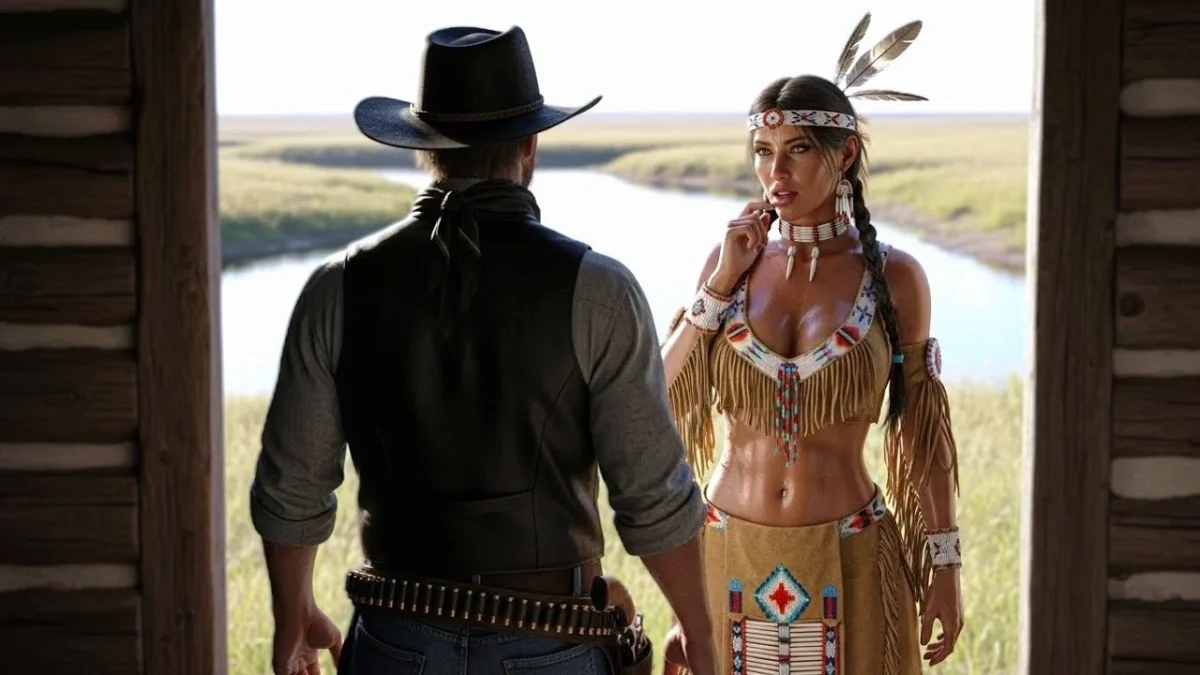
PART 1: THE BLOOD IN THE SNOW
The wind coming off the northern ridges did not merely blow; it bit through leather, wool, and bone alike.
Snow gathered in thin, icy lines along the rough pine window frame of the small frontier cabin.
It fell softly enough to muffle the howling gale, yet heavy enough to remind anyone caught outside that night travel in the valley was a death sentence.
Inside, a low fire burned in the belly of a heavy iron stove, throwing a steady orange glow across the log walls.
The cabin was modest, built for survival rather than comfort.
A rough-hewn oak table sat near the center.
A few wooden crates served as storage and seating.
A battered repeating rifle leaned quietly against the far corner, its blued steel catching the flickering firelight.
On a narrow cot tucked against the warmest wall, an Apache woman named Aayoka lay motionless, her deep side wounds wrapped tightly in clean white cloth.
Elias Ward knelt beside her on the cold floorboards.
He was tightening a fresh bandage around her ribs with slow, agonizingly careful movements.
He worked as if he were deeply afraid of causing her pain—not because he was inexperienced with trauma, but because he was a man who respected pain more than most.
His weathered face was calm, framed by dark hair and a shadow of beard, but there was an unmistakable tension in his broad shoulders.
It was the posture of a man holding back memories he never spoke of, keeping guard over a life he had sworn to leave behind.
Neither of them belonged in this lonely stretch of territory, yet there they were, bound by blood and winter.
Aayoka had fled her settlement three nights earlier after a ruthless band of armed mercs and land-grabbers raided the outskirts.
She had been struck by a grazing bullet and a sharp piece of shrapnel while escaping into the brush.
Though her horse had outrun the pursuers before collapsing, exhaustion and severe blood loss had eventually forced her onto foot, dragging her body through the freezing valley.
Elias had found her collapsed near the treeline, half-conscious, her skin as cold as the frost clinging to her tunic.
Elias himself had come to this isolated valley months ago for reasons he kept buried deep within his chest.
A former rancher from the New Mexico territory, he had lost his young wife and younger brother to a sudden, violent outbreak of fever that had swept through the territory like wildfire.
It had left no time for goodbyes, only time for digging graves in the rocky soil.
After burying his world, Elias had abandoned his home, sold his livestock, and ridden north with a single, unyielding goal: to live completely alone until his own time came.
The valley offered quiet.
It offered miles of distance from human cruelty and human tragedy.
He had not planned on ever helping another soul.
He had sworn off the burden of caring.
Yet, when he had stepped out onto his porch three mornings ago to haul firewood and saw a human shape crumpled in the crimson-stained snow, he proved to himself that he was not a monster.
He was not the kind of man who could watch a stranger die in the cold.
Now, their shared purpose was reduced to the most fundamental human drive: basic survival.
Aayoka needed a sanctuary from the relentless men tracking her across the territory.
Elias needed to decide whether he would remain hidden in his self-imposed shell or step back into deadly conflict for a woman whose name he had only learned hours ago.
As Elias tied off the knot on the bandage, Aayoka lay still, watching him carefully through heavy eyelids.
Her breathing was steady, though fatigue pulled sharply at her dark eyes.
She was not afraid of him in the way she feared the men riding with carbines across the snow.
Yet, there was an ingrained caution in her expression, a silent readiness to defend her life if her trust proved misplaced.
She studied his large, calloused hands.
She saw the precision, the restraint, and the unexpected gentleness in every movement.
He did not touch her carelessly.
He did not treat her as a helpless creature or a prize.
Every adjustment of the cloth was measured and respectful.
Elias finished the knot, leaned back onto his heels, and checked her temperature by hovering his palm just above her brow.
“You’ll be able to walk in a day or two,” he said softly, his voice low and raspy from disuse.
Aayoka nodded faintly against the canvas pillow, though her thoughts were far less optimistic.
“Walking is not the same as running, cowboy,” she whispered, her voice rough.
“I don’t expect you to run,” Elias replied, gathering the soiled rags into a wooden bucket.
“I expect you to heal.”
“You don’t know the men behind me,” she said, searching his eyes.
“They don’t stop because the wind turns cold. They don’t stop because a trail goes faint. They have money riding on my head.”
“Let them ride,” Elias said, rising to his full height.
“The snow is filling the pass tonight. Nobody moves fast in this.”
Silence pressed heavily between them once more, dense with unspoken history, yet no longer hostile.
Aayoka’s mind drifted back to the moment she had awakened earlier that morning, suspended between feverish delirium and reality.
She remembered feeling a warm, firm presence beside her in the dim light.
He had been wiping the cold sweat from her throat, his thumb brushing near her lips to clear a drop of water he had offered her.
In her dazed state, the closeness had startled her heart into a panic.
She had tried to read his face then, but the shadows had hidden his eyes.
Now, as the orange firelight softened the hard, unforgiving lines of his jaw, she felt that same knot of uncertainty tightening against her ribs.
Elias walked over to the corner, picked up a tin cup, and poured fresh water from a kettle sitting on the stove.
He returned to the bedside and handed it to her without a word.
When she reached up to take the cup, her warm fingers brushed against his cold knuckles.
Elias did not pull his hand away abruptly, but he did not linger either.
The contact was grounded, real, and devoid of any hidden intent.
Still, Aayoka felt her pulse quicken against her collarbone.
“Elias,” she said softly.
He stopped mid-turn, looking down at her.
“What is it?” he asked.
She hesitated, her thumb tracing the rim of the tin cup.
She wondered if asking the thought aloud would break the delicate truce they had built inside this warm cabin.
Her voice came out smaller than she intended, yet pointed and direct.
“Did you kiss me while I slept?”
The question hung in the air, heavy and sudden, cutting straight through the crackle of the wood stove.
For the first time since he had dragged her out of the storm, Elias looked visibly unsettled.
He blinked once, his dark eyes lowering to the floorboards as if he were rapidly replaying every second of the feverish night in his mind.
He had checked her temperature dozens of times.
He had wiped the sweat from her pale forehead.
He had held her shoulders steady when she thrashed in the grip of nightmares, making sure her open wounds did not tear.
But he had not crossed the sacred line between savior and trespasser.
His thoughts turned inward, sharp and defensive.
She’s terrified, he reminded himself silently. She’s been hunted by men who take whatever they want. Don’t give her a reason to fear you too.
He lifted his gaze, meeting her intense, dark eyes directly.
A faint, almost unreadable smile touched the corner of his mouth—not a smile of mockery or flirtation, but an honest, weary expression of understanding.
“No,” Elias said softly.
He paused, holding her gaze until he was certain she believed him.
“But I’ll come tonight.”
He did not mean the words as a provocative offer or a romantic threat.
He meant that he would return to her side when the dark set in, that he would sit on the hard floor beside her cot to fight off her fever, and that he would keep watch if the terror of her past caught up to her dreams.
Yet, the plain, direct nature of his answer made something shift inside her chest.
Aayoka swallowed hard, feeling a sudden flare of heat that had nothing to do with her fever.
She could not tell if the sensation rising in her throat was lingering apprehension or a strange, overwhelming relief.
Elias watched her reaction closely, trying to gauge if his blunt frontier tone had frightened her.
He felt a sudden, dangerous pull toward her—a protective instinct that went far beyond basic Christian charity or rancher manners.
He wanted to shield her, not just from the cold, but from the brutal world that had driven her into his valley.
Part of him wanted to step back, to re-establish the cold wall of isolation he had spent months building around his broken heart.
But as he looked at her pale face and the quiet strength shining in her eyes, he knew he couldn’t hide behind silence any longer.
He walked over to the corner, grabbed a sturdy wooden chair, and dragged it across the room.
He set it down firmly near the iron stove, at an angle where he could clearly see both the cabin’s heavy front door and her cot.
“You’re safe here, Aayoka,” Elias said, his voice flat and steady. “That’s all you need to know.”
Aayoka did not reply in words.
Instead, she sank back into the blanket, her tight shoulders loosening by a fraction of an inch.
Her racing heartbeat began to settle.
The small cabin no longer felt like a trap or an unfamiliar prison.
Outside, the mountain wind continued to hurl fresh snow against the wooden logs, but inside, the fire crackled warmly, and the tension between two wounded strangers settled into a quiet, tentative truce.
PART 2: TRACKS IN THE VALLEY
By the time morning light broke over the eastern ridge, the snow had ceased its relentless fall.
The sky above the valley turned a pale, icy blue, illuminating a landscape wrapped in pristine, untouched white.
Elias stood from his wooden chair, his joints popping softly after a night of fitful, half-awake vigilance.
He had not slept properly, keeping one ear attuned to the storm outside and the other to the rhythm of Aayoka’s breathing.
The cabin was silent except for the low hiss of embers in the stove and the faint rustle of blankets as Aayoka shifted on the narrow bed.
She opened her eyes fully, cleared of the heavy fog of fever for the first time since her arrival.
The sharp, intelligent alertness in her gaze told Elias that her mind was fully returned, and with it, a demand to understand her reality.
Slowly, testing her body’s limits, Aayoka pushed herself up onto her elbows.
She winced as her side pulled, but she forced herself to sit upright on the edge of the cot.
She took a slow, controlled breath, bracing her ribs with one hand before looking up at Elias.
Without a word, Elias walked to the stove, poured fresh warm water into the tin cup, and brought it over.
He extended it to her, his movements deliberate and unhurried.
He stayed far enough back to ensure she did not feel cornered, silently signaling that she was in complete control of her own space.
Aayoka took the cup, her fingers steady as she held it.
“Why did you help me?” she asked suddenly, her voice clearer now, ringing with natural authority.
“You don’t know who I am. You don’t know what trouble follows me.”
Elias leaned his back against the edge of the sturdy oak table, crossing his arms over his broad chest as he considered the question.
He was not a man given to long speeches or emotional confessions, but he recognized that she deserved absolute honesty.
“You were bleeding out in the snow,” Elias said plainly. “And you were alone. Leaving a human being to freeze into an ice block isn’t something I can live with. It’s that simple.”
Aayoka searched his face for a long, silent moment, looking for hidden motives, deceit, or hesitation.
She found none.
His eyes were clear, carrying neither self-righteous pride nor expectation.
“In my experience, cowboy,” she said, taking a small sip of the warm water, “nothing in this territory is ever that simple.”
“Maybe not,” Elias replied. “But out here, I make my own rules.”
Aayoka swung her legs carefully over the side of the bed.
Instantly, Elias took a step backward, creating even more physical distance between them.
She noted the movement immediately—the deliberate respect he showed for her boundaries, his careful avoidance of sudden gestures, and the way he kept his posture relaxed despite his height.
“What will you do when the snow clears?” she asked, her dark eyes tracking his face.
Elias’s jaw tightened slightly.
He had been calculating the math of their situation since the moment he brought her through the door.
“The snow stopped hours ago,” Elias said, pointing toward the shuttered window. “Which means the valley is isolated, but it’s not invisible. A horse leaves a deep trench in fresh powder. If the men tracking you know how to read a winter landscape, they’ll find this cabin.”
“They won’t just look for tracks,” Aayoka said grimly. “They know I was heading north toward the pass. They know this is the only shelter within twenty miles.”
“Then we stay cautious,” Elias said. “We watch the tree line. If someone enters the valley, we’ll see them long before they reach the porch.”
Hearing him use the word we brought a subtle wash of relief over her.
He was not planning to turn her out into the cold, nor was he ignoring the deadly reality she had brought to his doorstep.
Determined to test her own strength, Aayoka pushed against the mattress and attempted to stand.
Her legs wobbled beneath her weight, and her breath hitched as a sharp knife of pain stabbed through her stitched side.
She swayed, her hand shooting out to catch the edge of the heavy oak table to keep from collapsing.
She let out a frustrated hiss through her teeth, angry at her body’s failure.
Elias watched her closely, his hands hovering slightly near his sides, but he did not rush forward to grab her.
He allowed her the dignity of finding her own balance before speaking.
“Push too hard,” he warned quietly, “and you’ll tear those stitches wide open. Then we’re right back where we started.”
Aayoka gave a single, reluctant nod, allowing herself to sink slowly back into the chair beside the table.
“I hate feeling like prey,” she muttered, staring at the floorboards.
“Nobody likes being hunted,” Elias said. “It turns your blood sour.”
Aayoka looked around the room, her eyes taking in the details of his sparse existence: the single rifle, the worn leather saddle sitting on a crate, the lonely pair of boots by the door, and the absence of any female belongings or decorative touches.
“You live out here all by yourself,” she noted. “No family. No ranch hands. Why?”
Elias turned his head toward the window, his expression darkening as memory pulled at him.
“It’s quieter this way,” he said softly. “I came to this valley to get away from things I couldn’t fix. I didn’t come looking for a fight.”
“Yet a fight found you anyway,” she observed.
“It usually does,” Elias replied.
Aayoka stood up again, much slower this time, holding her hand firmly against her bandage.
She walked with measured steps toward the small glass window near the front door and peered through the frost-rimmed pane.
Outside, the bright morning sun bounced blindingly off the white ground.
She could clearly see the deep, jagged path Elias had carved through the snow three days ago when he had carried her unconscious body to the cabin.
Beyond that, the valley stretched out in pristine, silent beauty.
No smoke, no movement, no rider.
For a brief second, her tense shoulders relaxed.
“They don’t give up, Elias,” she said, her voice dropping an octave as she turned back to face him. “The men behind me… they aren’t common bandits. They are men who buy land with blood.”
“How many?” Elias asked, his tone shifting instantly into that of a soldier evaluating an coming engagement.
“Four, maybe five,” she answered without hesitation. “Led by a man named Vance. He carries a brass-framed Winchester and doesn’t care who dies as long as he gets what he’s paid for.”
Elias nodded once, digesting the news.
“Four or five,” he repeated thoughtfully. “In an open field, those are bad odds. In a timber valley with narrow passes, it’s a different story.”
He walked over to the corner, picked up his repeating rifle, and worked the lever with a crisp, practiced clack-clack.
He checked the chamber, verified the brass cartridge sitting inside, and set the weapon down on the oak table within arm’s reach.
Aayoka watched the fluid, effortless way he handled the firearm.
“You’ve shot at men before,” she said. It was a statement, not a question.
Elias looked at her, his eyes cold and distant.
“More than I ever wanted to,” he said simply.
He walked over to the cabin’s heavy wooden shutters, pulling them close and securing them with thick iron hooks.
The interior of the cabin dimmed immediately, illuminated only by the firelight and the thin rays of sun piercing the cracks in the logs.
Aayoka watched him secure the space with methodical precision.
There was no panic in his movements, only a deep, practiced preparation.
She stepped closer to the table, her hand resting near the rifle.
“Show me what I can do,” she demanded. “I won’t hide in a corner while men shoot at you on my account.”
Elias looked down at her injuries, assessing her physical state with a critical eye.
“You aren’t ready for a gun battle, Aayoka. If you recoil from a heavy rifle, it’ll tear your side wide open.”
“I am ready enough,” she insisted, her jaw set firm. “I survived three days in a blizzard with a bullet in my ribs. I am not a helpless child.”
Elias studied her face.
He saw no foolish bravado in her eyes, only fierce self-respect and an absolute refusal to be a victim.
He reached into a wooden drawer beneath the table, pulled out a thick hunting knife in a worn leather sheath, and handed it to her.
“Keep this close,” Elias said. “If the door gives way, stay positioned behind the iron stove. The angle forces anyone coming through the frame to turn their back to you. Use that advantage.”
Aayoka wrapped her fingers firmly around the stag-horn handle of the blade.
She pulled it an inch from the sheath, checking the edge before sliding it back into place.
Elias watched her grip—it was practiced, steady, and devoid of tremor.
“You know how to use it,” he noted.
“My father taught me that a knife never runs out of lead,” she replied quietly.
Elias returned to the window, placing his eye against a thin gap between the heavy wooden shutter and the log frame.
The valley outside looked tranquil, almost magical under the winter sun, but Elias knew better.
The silence was too heavy, too complete.
Even the winter birds had stopped singing in the high pines.
Suddenly, Elias’s body went rigid.
“What is it?” Aayoka whispered, instantly stepping up behind him, her hand gripping the hunting knife.
At the edge of the far treeline, roughly three hundred yards away, a dark shape had emerged from the shadow of the pines.
Then another.
And another.
Five mounted men, wrapped in heavy wool coats and fur caps, were walking their horses slowly through the deep snow, their carbines held across their saddles.
“They found the valley,” Elias said, his voice dropping to a harsh whisper. “They’re following the tree line.”
PART 3: THE BATTLE FOR THE VALLEY
Aayoka leaned forward, her eyes narrowing as she caught sight of the lead rider through the narrow slit in the shutter.
“That’s Vance,” she whispered, her breath hitching slightly. “The man on the dun horse.”
“They’re taking their time,” Elias observed, his voice devoid of panic. “They know the valley is a dead end. They think they’ve got us trapped in a wooden box.”
“What do we do?” Aayoka asked, turning her face toward his. “If they set fire to the cabin, we’ll burn or be picked off as we run.”
“I built this cabin out of green oak and thick stone,” Elias said calmly. “It doesn’t burn easy, and bullets won’t penetrate these logs. But staying inside forever just lets them pick their moment.”
He stepped away from the window and grabbed his heavy sheepskin coat from the peg by the door.
“There’s a rock shelter half a mile up the northern ridge,” Elias said, pointing toward the rear of the cabin. “It’s hidden behind a thick stand of fir trees and overlooks the entire path. If we get you up there, you’ll be invisible, and I can hold the narrow pass alone.”
“You want me to run again?” Aayoka countered, her eyes flashing with sudden anger.
“I want you to move,” Elias corrected, his tone firm and unyielding. “Running is what you do when you’re panicked. Moving is what you do when you want to win. We don’t have time to argue about your pride, Aayoka.”
She stared at him, her dark eyes fierce, before giving a single, sharp nod.
“Fine. But if they press you, you fall back to the rocks with me.”
“Agreed,” Elias said.
He opened a small wooden crate near the stove, grabbed a thick leather pouch of extra ammunition, and stuffed it into his coat pocket.
Then, taking a wool blanket from the cot, he wrapped it securely around Aayoka’s shoulders, pulling the heavy hood low over her head to keep her warm and obscure her dark hair.
His touch was swift, efficient, and filled with an undeniable protective intensity.
BANG!
A heavy, deliberate blow struck the front door of the cabin, shaking the iron hinges and rattling the wooden latch.
Aayoka froze, her hand flying to the hilt of the hunting knife at her waist.
“Ward!” a rough, gravelly voice shouted from the porch outside. “We know she’s in there! We tracked her horse to the valley mouth! Throw the Apache girl out, and we’ll leave you your skin!”
Elias didn’t answer. He didn’t even look toward the front door.
He leaned close to Aayoka’s ear, his breath warm against her cold skin.
“Out the back door,” he whispered intensely. “Stay low. Follow my steps in the snow.”
He unlatched the small rear door of the cabin—a narrow escape hatch he had built for timber hauls—and pushed it open quietly.
A rush of freezing air swept into the room.
Aayoka slipped through the opening first, her boots sinking deep into the white powder.
Elias stepped out right behind her, his repeating rifle held ready, his eyes scanning the dense timber behind the house.
CRASH!
Behind them, the front door gave way under a heavy shoulder or boot, splintering against the iron lock.
“Search the room!” Vance’s voice echoed from inside the cabin. “Check the bed! The stove is still hot!”
“Move,” Elias growled softly, placing a large hand gently against the small of Aayoka’s back to urge her forward into the dense brush.
They scrambled up the steep, snow-covered slope, using the massive trunks of ancient pine trees as cover.
Aayoka’s side burned like liquid fire with every step she took, the sharp incline straining her wounded abdominal muscles to their absolute limit.
She gritted her teeth, refusing to let a single groan escape her lips.
Behind them, shouting erupted from the cabin porch as the men discovered the open rear door.
“They went up the ridge!” a man yelled. “Tracks are fresh! They’re on foot!”
“Don’t shoot the girl!” Vance shouted back. “Bring her back conscious! Shoot the cowboy!”
Elias paused behind a massive granite boulder, pulling Aayoka behind him into the shadows.
“You hear that?” Elias whispered, a grim, dark smile touching his lips. “They think I’m just a cowboy.”
He raised his repeating rifle, rested the heavy barrel against the edge of the granite boulder, and took a slow, deep breath.
Through the trees below, two of Vance’s men were charging up the slope, their boots kicking up clouds of white powder, their rifles held at the hip.
Elias aligned his front sight with the chest of the lead tracker.
He squeezed the trigger.
CRACK!
The sharp report of the rifle shattered the winter silence, echoing loudly off the canyon walls.
The lead tracker was thrown backward as if struck by a invisible sledgehammer, his rifle flying into the air before his body tumbled down the snowy incline.
The second man dropped instantly, diving behind a fallen log for cover.
“Take cover! He’s got a long-gun!” the man screamed into the trees.
“Keep moving up to the shelter, Aayoka!” Elias ordered, racking his rifle’s lever to chamber another round with a sharp metallic clatter. “Don’t look back!”
“I’m not leaving you!” she called out, reaching the mouth of the rock shelter twenty yards above him.
The shelter was a shallow granite cave, dry and shielded from the wind by dense fir trees.
From her elevated position, Aayoka had a clear view of the entire slope below.
She pulled her hunting knife, but then her eyes caught sight of a heavy, sharp-edged rock resting near the cave mouth.
Aayoka picked up the jagged stone, her hands steady despite the agonizing pain in her side.
Below, the second tracker peeked around his log, aiming his carbine directly at Elias’s position behind the boulder.
Before the gunman could pull his trigger, Aayoka leaned over the rock ledge above him and hurled the heavy stone down with all the strength left in her body.
The heavy rock crashed through the pine branches and struck the gunman squarely on the shoulder, knocking him off balance and causing his shot to wild fire into the sky.
BANG!
Taking immediate advantage of the distraction, Elias stepped out from behind his boulder, aimed down, and fired a single round.
CRACK!
The gunman collapsed into the snow and did not move again.
Silence descended upon the slope once more, heavy, suffocating, and absolute.
Gunsmoke drifted lazily through the cold pine needles, smelling sharply of sulfur.
Down near the cabin, Vance and his remaining two men froze in their tracks, realizing that two of their party were down in less than two minutes.
“Ward!” Vance called out from behind the corner of the cabin log wall, his voice shaking with a mix of fury and newfound caution. “You’re fighting for a woman you don’t even know! She’s an Apache runaway! She ain’t worth your blood, man!”
Elias stood near the mouth of the rock shelter, stepping up beside Aayoka.
He looked down at the cabin, his face hard as granite, his eyes burning with a fierce, absolute resolve that had been dead inside him for years.
“She’s human!” Elias shouted back, his voice booming through the quiet valley like thunder. “And she’s under my roof! That makes her worth everything I’ve got left!”
Vance stared up at the ridge for a long moment, measuring the deadly accuracy of the man above him and the unforgiving terrain of the valley.
He knew when a job had gone sour.
Without another word, Vance signaled his remaining men, mounted his horse, and turned back toward the valley entrance, fleeing into the deep timber before the mountain claimed the rest of them.
Elias watched them ride until their figures shrank to tiny black specks against the white expanse and vanished over the horizon.
He slowly lowered his rifle, the tension draining from his massive frame, leaving him exhausted in the cold air.
He turned to look at Aayoka.
She was standing near the cave entrance, clutching her side, her face pale from exertion, but her eyes were fixed on him with an intensity that made his breath catch.
“You came for me,” she said softly, her voice trembling slightly in the freezing wind.
“I told you I would,” Elias replied, stepping closer and wrapping his arm gently around her waist to support her weight as they prepared to head back down to the cabin.
Aayoka looked up into his weathered face, seeing the man who had lost everything, yet had risked his life to keep her safe.
She leaned her head lightly against his shoulder as they began their slow walk back down the snow-covered slope toward the warm stove.
“Did you kiss me while I slept, cowboy?” she asked again, a faint, genuine smile touching her lips for the very first time.
Elias looked down at her, his dark eyes softening as he pulled the heavy wool blanket tighter around her shoulders.
“No,” Elias whispered gently as they reached the cabin porch. “But I’m not sleeping tonight either.”








