Do You Remember Me Mountain Man – The Beautiful Bride Was His Childhood Neighbor
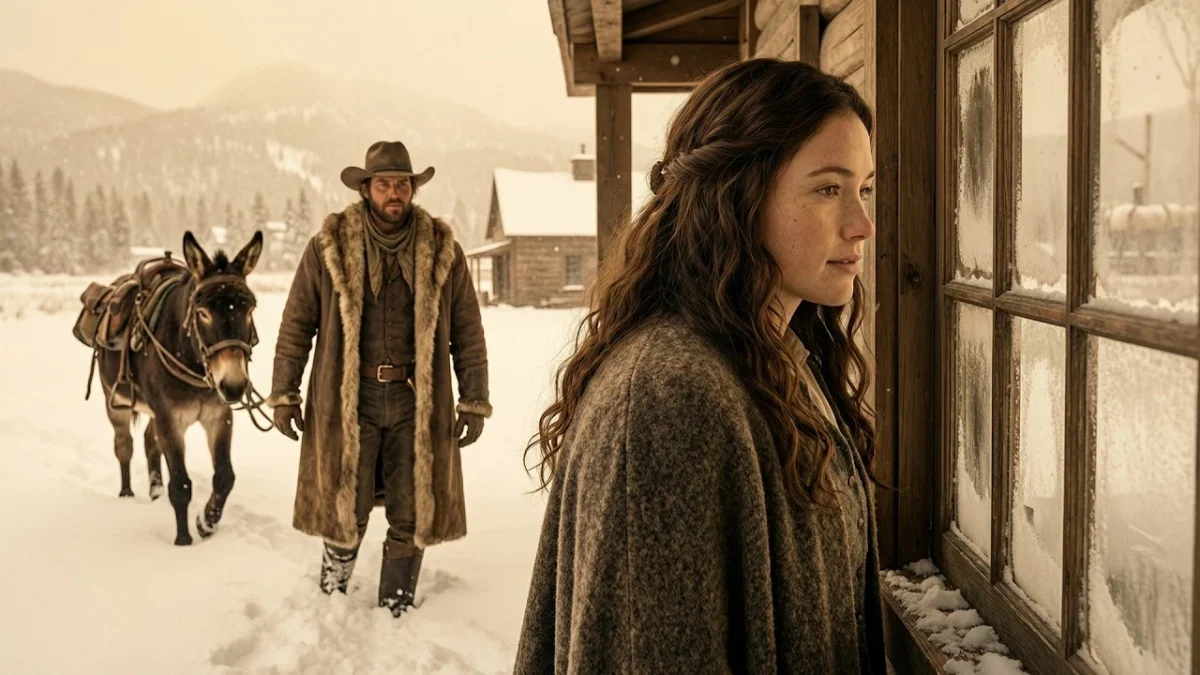
The wind howled through the high pines like a wounded beast, driving a blinding curtain of snow across the narrow trail. Samuel Hawkins pulled his heavy buffalo coat tighter around his neck and squinted into the gray fury of the Colorado Rockies. His mountain mustang, Buck, picked his way down the treacherous slope with deliberate care, his hooves crunching against the ice hidden beneath the fresh snow. For twelve long years, Samuel had called these wilderness peaks his home. At thirty-two, he had spent over a third of his life far away from the towns of his youth, choosing the isolation of the mountains over the noise, hypocrisy, and deceit of settled society.
His hands were scarred, calloused, and weathered from years of setting steel traps, skinning game, and surviving bitter high-altitude winters. He held the reins with a calm, practiced grip. Packed tightly in the leather saddlebags behind his seat were weeks of labor: prime beaver pelts and thick wolf hides. Traded at the right post, they would yield enough salt, lead, black powder, and flour to keep him fed until the spring thaw.
Samuel had not intended to stop at Pine Ridge. His destination was Clear Creek, a larger trading outpost another day’s ride north. But Buck was favoring his left front leg, limping slightly whenever the trail turned steep, and the sky had turned a bruising shade of purple that heralded a killer blizzard.
Pine Ridge materialized out of the swirling white like a ghost town. It was a cluster of rough-hewn log buildings huddled against the base of the mountain, smoke tearing away from chimney tops the moment it hit the gale.
He guided his horse onto the main street, passing a dark blacksmith shop, a general store with frost-etched windows, and a saloon where golden lamplight spilled out onto the snow-covered boardwalk. The town was eerily quiet for late afternoon. Then, riding the wind, came the faint sound of a fiddle playing a merry tune.
At the far end of the street, the small wooden church was ablaze with light. Wagons and saddled horses were tied outside, their coats dusted with snow as they stomped their feet against the cold.
Samuel frowned under his wolf-skin cap.
A wedding, he thought. In weather that could freeze a man’s blood in minutes, folks were either hopelessly in love or rushing to settle a matter before the winter locked them in.
He dismounted outside the livery stable, his heavy boots crunching deeply into the drift. A young stable boy, no more than fourteen, ran out from the barn, wrapping his arms around his thin coat and shivering violently.
“Afternoon, mister!” the boy yelled over the howling wind. “That’s quite a storm blowing in from the pass!”
“That it is,” Samuel replied, his voice raspy and deep from days of silence. “My horse needs a dry stall and a thorough check. His left front hoof might be carrying a stone.”
The boy took the reins, his eyes wide as he looked up at Samuel’s towering frame, his tangled brown beard, and the heavy Sharps rifle slung across his back. Mountain trappers were becoming a rare breed, even in frontier towns like Pine Ridge.
“I’ll rub him down right away, sir,” the boy said, eager to earn his coin. “Everyone’s over at the chapel right now. Mr. Morrison’s marrying that lady from back east. Pretty as a picture, they say.”
Samuel grunted softly. Gossip held no value for him.
“Just feed the horse,” Samuel said. “I’m looking for a warm room until the weather clears.”
Across the street stood the Frontier Inn. Samuel trudged through the snow, pushed open the heavy oak door, and stepped inside. The wall of heat from the massive stone fireplace hit him instantly. The common room was completely deserted except for the innkeeper behind the counter, a thin man wearing wire-rimmed spectacles who was engrossed in a week-old newspaper.
“Need a room for the night,” Samuel said, dropping a silver dollar onto the polished wood.
The clerk looked up, adjusting his glasses to inspect the rough visitor.
“Welcome to the Frontier Inn, sir,” the clerk said, handing over an iron key. “Room four at the top of the stairs. Though you might find it hard to sleep early on. The whole town is celebrating across the street. Mr. James Morrison is our most prominent merchant, you see.”
“I’m not here to celebrate,” Samuel said quietly, taking the key. “I just need a bed.”
Before he could take a step toward the staircase, the heavy doors of the church across the street burst open. Laughter, cheering, and the lively scraping of the fiddle spilled out into the snowy twilight as the wedding party began to pour into the street.
Samuel paused by the front window of the inn, watching the scene out of habit.
The groom emerged first. He was a heavy-set man in his mid-forties, wearing a fine tailored black suit that strained against his wide chest and stomach. His face was flush red, his jaw thick, and his small, calculating eyes swept over the gathering with obvious satisfaction. He held the arm of his new bride with a grip that seemed less like affection and more like ownership.
Then Samuel’s gaze shifted to the bride, and the air left his lungs.
She stepped out into the falling snow like an apparition. She wore a simple white cotton gown, modest and elegant, lacking the elaborate frills of high-society dresses but worn with natural grace. Her dark hair was styled neatly beneath a light veil. As she paused on the wooden steps, she lifted her face slightly to the sky, catching the falling snowflakes.
Samuel’s heart hammered against his ribs. Even across the street, through the dim light and swirling snow, every line of her profile was instantly recognizable. The soft curve of her jaw, the straight posture, the subtle tilt of her head—they were etched into his memory from a life he thought he had buried forever.
As if feeling the weight of his stare, the woman turned her head and looked directly across the snow-filled street toward the inn window.
Her green eyes, flecked with tiny spots of gold, widened in complete shock. Her lips parted, and the small bouquet of dried winter flowers in her hand slipped slightly in her grasp.
For several seconds, the noise of the cheering crowd, the fiddle music, and the roar of the wind seemed to mute entirely. Time froze between them.
Without a word to her husband or the guests surrounding her, she pulled her arm free from Morrison’s grasp and began walking straight down the snow-covered street toward the inn door. The hem of her white wedding dress dragged through the fresh snow, gathering dirt and moisture, but she did not seem to notice or care. Her eyes remained locked on Samuel.
Samuel moved on instinct, pushing the front door of the inn open and stepping out onto the porch just as she reached the bottom step.
Up close, the years fell away, even as he saw the changes in her. She was no longer the young girl he had run through the woods with in Missouri. She had grown into a strikingly beautiful woman, but her eyes held a profound, quiet exhaustion—the kind that comes from carrying heavy burdens alone for far too long.
She stopped at the foot of the wooden steps, her breath misting white in the freezing air.
“Do you recognize me, mountain man?” she asked, her voice trembling slightly against the wind. “I was your childhood neighbor.”
The sound of her voice made Samuel’s chest ache with a sudden, sharp grief for the lost years.
“Elizabeth,” he whispered, stepping down onto the snow. “Libby Turner.”
A faint, bittersweet smile touched her lips.
“No one has called me Libby in a very long time,” she said softly. “It’s Elizabeth now. Elizabeth Morrison, as of about ten minutes ago.”
Before Samuel could speak, a harsh, commanding voice shattered the moment.
“Elizabeth! What in blazes are you doing out here in the snow?”
James Morrison marched down the church steps, his boots thudding heavily against the timber. His face was dark with immediate anger as he saw his new bride standing next to a wild, bearded trapper.
Elizabeth flinched slightly at his tone, her posture stiffening, but she did not look away from Samuel. She reached out with a gloved hand and gently touched the rough leather of Samuel’s sleeve. Her fingers were shaking.
“I’m glad I got to see you again, Samuel,” she whispered rapidly, her voice barely audible over the wind. “I’m glad to know you survived.”
Morrison arrived, shoving himself between them and grabbing Elizabeth’s upper arm with a force that made her gasp softly. He glared up at Samuel with cold, territorial eyes.
“You’ll excuse my wife, stranger,” Morrison said, his tone dripping with condescension and warning. “She’s overwhelmed by the day’s events and clearly not thinking straight. Come inside, Elizabeth.”
Samuel stood his ground, his hand resting instinctively near the heavy hunting knife at his belt. He wanted nothing more than to tear Morrison’s hand away from her arm, but the harsh reality of the frontier stayed his movement. She was legally another man’s wife now. In the eyes of the law and the town, he was merely an intruder.
Elizabeth looked back over her shoulder as Morrison dragged her toward the waiting carriage. Her eyes met Samuel’s one last time, filled with a silent desperation that chilled him far more than the mountain storm.
Samuel remained on the porch long after the carriage rolled away and the church lights were extinguished. He stood in the bitter cold, staring at the tracks left in the snow, his mind racing through a maze of painful memories and sudden, terrible realizations.
Libby Turner was alive. The girl who had lived on the farm next to his in Missouri, the girl who had promised to wait for him before a devastating fire and family ruin had torn their lives apart, was here in Pine Ridge.
And she had just married a man whose cruel grip left no doubt about the misery that awaited her.
That night, Samuel did not sleep. He sat in his small room at the inn, listening to the blizzard assault the wooden shutters. He stared at the weak yellow flame of the oil lamp, remembering the summer they were sixteen, the promises made under the oak trees, and the sudden disappearance that had driven him into the solitude of the Rockies.
When morning finally broke, the storm had cleared, leaving Pine Ridge buried under two feet of pristine, dazzling snow. The sky was a pale, clear blue, and the morning air carried a brittle stillness.
Samuel walked down to the common room, where the innkeeper, Josiah Pritchard, was pouring black coffee for a couple of local trappers.
“Morning, Mr. Hawkins,” Pritchard said, setting down a heavy mug. “That was one hell of a blizzard last night.”
“It was,” Samuel agreed, taking a seat at the counter. “Is there any news from the Morrison place?”
Pritchard paused, raising an eyebrow as he wiped the counter with a rag.
“You know Mr. Morrison?” Pritchard asked.
“I used to know his wife’s family,” Samuel replied carefully. “A long time ago.”
Pritchard leaned in slightly, lowering his voice.
“Well, if you’re an old friend of her family, you might be sorry to hear the town talk this morning,” the innkeeper said. “Mrs. Dobbs, the woman who goes up there to do the morning cooking and cleaning, came back down to the general store an hour ago. She said there was terrible shouting inside that house before dawn. Sounds of glass breaking, chairs throwing around. The new bride locked herself in the guest bedroom and refused to come out for breakfast.”
Samuel’s hand tightened around his coffee mug until his knuckles turned white.
“Did anyone check on her?” Samuel asked, his voice dangerously low. “Did the town doctor go up there?”
“Dr. Whitman offered,” Pritchard said, shaking his head. “But Morrison met him at the front gate with a shotgun. Told the doctor to mind his own business, said his wife was just having hysterical fits and needed to learn her duty. Nobody crosses Morrison in this town, Hawkins. He owns the timber mill, the freight line, and half the land along the creek.”
Samuel finished his coffee in one long swallow, stood up, and walked out into the cold morning air without another word.
He walked down the street toward the livery stable to check on Buck. The horse was resting comfortably in a dry stall, its leg already showing signs of improvement after the stone had been removed.
The freckled stable boy was shoveling snow from the barn doorway.
“Morning, mister!” the boy called out. “Looks like Mr. Morrison’s big freight shipment went out right on schedule this morning, despite the snow. Three wagons full of mining supplies heading south to the camps.”
“Did you see Mrs. Morrison today?” Samuel asked.
The boy stopped shoveling and looked around cautiously before leaning closer to Samuel.
“I walked past the main house when I was fetching water from the well,” the boy whispered. “I saw her standing at the second-story window. She was looking out at the mountains. She had a dark shadow across her cheek, mister. Looked like a fresh bruise to me.”
Samuel’s jaw clenched so hard his teeth ached.
He left the stable and walked to the outer edge of town, where Morrison’s grand two-story house sat on a raised knoll. It was a imposing structure built of thick timbers and stone, surrounded by a high wooden fence and iron gates. It looked less like a home and more like a fortress designed to keep the world out—or keep someone in.
Samuel stood near the tree line, watching the guards Morrison kept posted near the barn. Every instinct honed by twelve years of wilderness survival told him that direct violence right now would only get him killed or thrown in jail, leaving Elizabeth completely helpless. He needed patience, strategy, and proof.
By late afternoon, Samuel entered the local saloon. The room was packed with miners, teamsters, and Morrison’s hired men, all drinking away the post-storm cold.
Morrison sat at a large circular table near the back fireplace, holding a glass of whiskey in one hand and a thick cigar in the other. He was surrounded by his closest associates, laughing loudly as he boasted about his wealth and influence.
“A round of drinks for my men!” Morrison shouted to the bartender. “To a prosperous winter and a well-ordered home!”
One of his rough-looking hand hands grinned, raising his glass.
“To Mr. Morrison!” the man hollered. “May your new eastern bride yield you a house full of sons by next autumn!”
“And may she learn to obey a bit faster!” another man added, prompting crude laughter around the table.
Morrison leaned back, blowing a thick cloud of blue cigar smoke toward the ceiling.
“She’ll learn,” Morrison said with a smug, cold grin. “Eastern women are delicate and spoiled, but a few weeks of frontier reality will break her temper. I’ll make a proper, obedient wife out of her soon enough.”
Samuel sat in a dark corner of the room, his fingers gripping his whiskey glass so tightly that a hair-line crack appeared in the thick glass. He forced himself to remain still, absorbing every word, watching every movement.
Unable to stomach any more of Morrison’s boasting, Samuel left a silver coin on his table and slipped out the side door into the freezing night air.
The town was quiet now, the temperature plummeting once again. As Samuel walked past the small church, he noticed a faint yellow light flickering through the stained-glass window near the side entrance.
He stepped up to the wooden door, pushed it open quietly, and stepped inside.
The sanctuary was cold and silent, lit only by a few votive candles flickering near the altar. Kneeling on the cold wooden floor near the front pew was Elizabeth. Her head was bowed, her hands clasped tightly together, and her shoulders were trembling with silent sobs.
“Elizabeth,” Samuel said softly, his heavy boots making almost no sound on the center aisle.
She gasped and turned around quickly, her hand flying to her throat. When she recognized him in the dim light, the panic left her face, replaced by a deep, heartbreaking exhaustion. Her eyes were red from crying, and even in the dim candlelight, Samuel could see the faint purplish shadow marking her left cheekbone.
“Samuel,” she breathed, wiping her eyes hastily with her sleeve. “You shouldn’t be here. If James finds out you followed me…”
“I don’t care about James Morrison,” Samuel said, stepping closer and kneeling in the pew beside her, keeping a respectful distance. “Are you hurt, Libby?”
She gave a small, bitter laugh that ended in a shaky breath.
“Nothing I didn’t expect,” she murmured, looking down at her bruised hands. “He was drinking heavily after the wedding party left. When I refused to unlock the door, he broke it down. He likes to remind people that he owns everything in this town—including me.”
“Why did you marry him, Libby?” Samuel asked gently. “Why come all the way to Colorado to marry a man like that?”
Elizabeth looked up at the stained-glass window, her eyes distant as she remembered her past.
“After the fire destroyed our farm in Missouri, my father died trying to pay off the debts,” she said softly. “Mother and I were left with nothing. Absolutely nothing, Samuel. No money, no home, no food. My mother’s cousin, Theodore Ashford, sent for us from Philadelphia, but mother’s mind was broken by grief. She made us change our last name, paranoid that father’s creditors would track us down and throw us into the poorhouse.”
She turned back to look at Samuel, her green eyes shimmering with tears.
“I looked for you before we left,” she whispered. “I waited by the creek for three days, hoping you would come back from your hunting trip.”
“I rode all the way to Independence that winter looking for you,” Samuel said, his voice thick with emotion. “I asked every trader, every blacksmith, every wagon master. Nobody had ever heard of a family named Turner leaving the territory.”
“Because we were using my mother’s maiden name,” Elizabeth said, tears finally spilling over her lashes. “We vanished. Then mother died two years ago in Philadelphia. I was left working as a seamstress for pennies a day, facing eviction. Mr. Morrison came east on business. He was wealthy, respected, and he offered me a home, security, and a respectable life out west. I thought… I thought anything was better than starving in a city tenement.”
“And now?” Samuel asked softly.
“Now I realize I traded one kind of prison for a far worse one,” she said, her voice dropping to a harsh whisper. “Do you ever think about that last summer, Samuel? Before everything burned?”
“Every single day,” Samuel replied without hesitation. “I spent twelve years in these mountains trying to forget the sound of your voice, Libby. I never managed it.”
Elizabeth reached across the wooden bench and touched his hand. Her fingers were ice cold, but her touch sent a surge of warmth through his chest.
“I thought you were dead,” she whispered. “When I stepped out of that church yesterday and saw you standing in the snow, I thought I was seeing a ghost.”
“I’m alive,” Samuel said, wrapping his large, warm hand around her trembling fingers. “And I’m not going anywhere.”
“You have to leave, Samuel,” she said suddenly, panic returning to her voice. “James is a dangerous man. He has men who will kill for him for twenty dollars. You can’t fight him.”
“I’ve survived grizzly bears, mountain blizzards, and hostile raiders for twelve years, Libby,” Samuel said firmly. “I’m not running away from a bully in a black suit. If you need help—if you want to leave—tell me right now, and I will get you out of this town tonight.”
Elizabeth stared at him, her heart tearing between the desperate urge to escape and the terrifying knowledge of what Morrison would do if they were caught.
“He would hunt us down,” she said softly. “He has the law in his pocket, Samuel. A wife who runs away with a mountain trapper has no legal rights on the frontier. They would call you a kidnapper and hang you.”
She pulled her hand back gently and stood up.
“I have to go back before he notices I’m gone,” she said, looking toward the side door. “Please, Samuel… just leave Pine Ridge. Go back to your mountains where you’re safe.”
“I asked you a question yesterday,” Samuel said, standing up to face her. “Did you choose this life, or did circumstances choose for you?”
Elizabeth paused at the door, her hand resting on the iron latch. She turned her head slightly, her shadow long against the church wall.
“Circumstances chose,” she whispered. “They always have.”
“Then let me give you a choice now,” Samuel said quietly. “How long will you stay in town?”
“As long as it takes to keep you safe,” she replied, and then she slipped out into the freezing night, leaving him alone with the flickering candles.
The next morning, Pine Ridge exploded with shocking news.
Morrison’s heavy freight wagon, carrying thousands of dollars worth of mining equipment and gold coins meant for payroll, had been ambushed five miles south in Devil’s Canyon. The driver had been shot dead, the guards scattered, and the entire cargo looted.
Morrison spent the morning riding through the center of town on his black stallion, screaming at the sheriff and offering a massive reward for the bandits. He blamed the attack on rogue raiders or desperate local miners.
Samuel watched the chaos from the porch of the general store, his tracker’s mind sifting through the details.
The storm had ended less than twenty-four hours ago. The snow in Devil’s Canyon would have been knee-deep, making a surprise ambush by outside raiders nearly impossible to pull off without leaving obvious tracks leading from miles away. Yet the sheriff reported that the tracks at the crime scene simply vanished near Morrison’s own timber mill.
It was an inside job. Samuel had served as a scout for the army in his younger years, and he knew the signs of stage-managed destruction.
Later that afternoon, Samuel sought out Clarence Headley, Morrison’s nervous, middle-aged bookkeeper, who was huddled inside the town’s small assay office, shivering despite the stove.
Samuel sat down across from the clerk, placing his large hands flat on the wooden table.
“Mr. Headley,” Samuel said in a low, measured voice. “You look like a man who hasn’t slept in three days.”
“I’m… I’m just tired from the winter cold, Mr. Hawkins,” Headley stammered, adjusting his thick spectacles with trembling fingers.
“A man only gets that kind of twitch in his eye when he knows a storm is about to collapse his roof,” Samuel said smoothly. “Morrison’s freight line isn’t making money, is it? He’s broke. He’s been borrowing money from eastern banks to keep up his grand image, and those loans are due this month.”
Headley went pale, looking around the empty office in sheer terror.
“If James Morrison finds out I spoke to anyone—” Headley began.
“If Morrison goes down for fraud and murder, his accomplices will hang right alongside him,” Samuel interrupted sternly. “Or do you think he’ll protect you when the territorial marshals arrive to investigate that ‘robbery’?”
Headley buried his face in his hands, his breath coming in ragged gasps.
“It’s all fake,” Headley confessed in a rushing whisper. “The ledgers… there are two sets of books. Morrison staged the robbery himself to collect the insurance money from the Philadelphia syndicate! The cargo in those wagons wasn’t mining equipment—it was crates of rocks and old iron! He had his own men shoot the driver because the driver refused to lie about it!”
Samuel stood up, his eyes cold and dark.
“Where are those real ledgers, Headley?”
“In the iron safe at the timber mill office,” Headley wept. “I have the duplicate key. Just… just don’t let him kill me, Hawkins!”
“Keep your mouth shut and stay in this room,” Samuel commanded. “The law will be handling Morrison by tomorrow.”
That night, thick black smoke began billowing into the night sky from the direction of Morrison’s estate.
Shouts echoed through the streets of Pine Ridge as the church bell began to ring wildly. Samuel ran toward the northern edge of town, joining dozens of townsfolk carrying leather buckets.
The large carriage barn beside Morrison’s house was completely engulfed in flames, the fire roaring against the dark winter sky. Through the heat, the smoke, and the chaotic shouting of the crowd, Samuel heard a terrified woman’s scream coming from a second-story window of the main house.
“Elizabeth!” Samuel roared.
He ignored the shouts of the townsfolk warning him back and sprinted up the porch steps, throwing his shoulder against the front door. The lock gave way with a loud crack, and he burst into the house.
The interior was filling rapidly with thick, suffocating smoke from the adjoining structure. Samuel pulled his wet neckerchief over his mouth and bounded up the wooden staircase two steps at a time.
He reached the upper hallway, coughing violently as heat radiant from the walls. He found Elizabeth’s bedroom door at the end of the hall, but when he threw his weight against it, the door refused to budge. It was secured from the outside with a heavy iron latch bar.
“Samuel! Samuel, I’m in here!” Elizabeth cried out from inside, pounding on the heavy wood. “The room is filling with smoke!”
“Stand back from the door, Libby!” Samuel yelled over the roar of the fire.
He looked around, grabbed a heavy ornamental bronze statuette from a hallway table, and smashed it with all his strength against the iron latch bar. On the third strike, the wood splintered, the iron bar twisted, and the door swung wide open.
Elizabeth stumbled out into his arms, coughing hysterically, her nightdress singed at the hem by floating embers.
“He locked me in,” she gasped, clinging to Samuel’s leather coat for dear life. “He set fire to the barn to destroy his financial records, and he locked me in this room so I couldn’t escape!”
“I’ve got you,” Samuel said, lifting her effortlessly into his arms. “You’re safe now.”
He carried her down the smoke-filled staircase and burst out into the crisp, freezing night air.
Townswomen immediately rushed forward with heavy wool blankets, wrapping Elizabeth securely and guiding her toward a bench.
A moment later, James Morrison emerged from behind the burning barn, surrounded by three of his armed henchmen. His clothes were covered in soot, his eyes wild and bloodshot. His face hardened into a violent mask when he saw Samuel standing guard in front of Elizabeth.
“Thank God you were there to help, mountain man!” Morrison shouted, his voice artificially loud as he tried to address the surrounding crowd. “The lock on her door must have jammed from the heat warping the frame!”
“The lock didn’t jam, Morrison!” Samuel replied, his voice ringing out across the snow-covered yard like a thunderclap. “It was secured with an iron latch bar from the outside hallway! I had to smash it open myself, and twenty men here can go upstairs right now and look at the broken wood!”
Murmurs of shock and outrage immediately rippled through the gathered townsfolk. People began backing away from Morrison and his men.
Before Morrison could offer another lie, Dr. Whitman pushed his way through the crowd, carrying his medical bag. He knelt beside Elizabeth, inspecting her smoke-inhalation symptoms, but as he pulled the blanket around her shoulders to check her pulse, her sleeves rolled back, exposing dark, terrible bruises lining her wrists and forearm.
Dr. Whitman’s face turned grim and hard. He stood up, turning to face Morrison and the gathering crowd.
“These injuries aren’t from any house fire!” Dr. Whitman declared loudly, pointing a stern finger at Morrison. “These bruises are days old, some fresh, some fading! This woman has been systematically beaten and restrained!”
The crowd fell completely silent. The respect and fear Morrison had commanded in Pine Ridge evaporated in an instant, replaced by disgust.
“This is outrageous!” Morrison bellowed, reaching for his sidearm. “You dare accuse me in front of my own town—”
“The sheriff has your bookkeeper, Morrison!” Samuel interrupted, stepping forward, his hand resting on his rifle stock. “Clarence Headley handed over the duplicate key to your safe at the mill an hour ago. The territorial marshals already have your real ledgers showing insurance fraud, and now you’re facing attempted murder.”
Judge Carlton, the town’s chief magistrate who had been standing among the onlookers, stepped forward with a hard expression.
“Sheriff, arrest James Morrison and his men immediately,” Judge Carlton ordered.
Morrison’s face went pale. Realizing the web had closed around him, he backed away toward his horse, but the sheriff and four armed deputies drew their weapons, surrounding him before he could mount.
“You’ll pay for this, Hawkins!” Morrison spat, screaming over his shoulder as the deputies forced his arms behind his back and slammed iron handcuffs onto his wrists. “You haven’t seen the last of me!”
For the next week, a sense of quiet peace returned to Pine Ridge.
James Morrison was held in the county jail, his vast fortune frozen by the territorial court as evidence of fraud mounted daily. Elizabeth stayed at the home of Dr. Whitman and his wife, recovering her strength under their dedicated care.
Samuel visited her every afternoon. With each passing day, the color returned to her cheeks, the haunted look in her eyes softened, and the bright, spirited laugh he remembered from their childhood began to surface once again.
However, Morrison’s political connections and vast sums of hidden cash allowed him to accomplish the unthinkable. Eight days after his arrest, a corrupt circuit judge from the county seat granted Morrison temporary bail pending trial.
Morrison walked out of the jailhouse angrier and more desperate than ever. He had lost his business, his reputation, and his control over the town. Having nothing left to lose, his rage focused entirely on the man who had destroyed him.
He rode through the center of town on his black stallion, screaming threats at the sky.
“You turned my wife against me, mountain man!” Morrison roared toward the Frontier Inn. “You stole what belonged to me! You’ll pay for this with your life!”
That evening, the sheriff visited Samuel at the inn.
“Morrison is dangerous, Samuel,” the sheriff warned, placing a heavy hand on the table. “He’s holed up at the saloon with two hired guns he brought in from Denver. A man with no future is the most lethal thing on the frontier. You should take your horse and leave town tonight.”
Samuel looked the sheriff straight in the eye, his face expressionless.
“I’ve stopped running from my problems twelve years ago, Sheriff,” Samuel said quietly. “Let him come.”
The following morning, a messenger delivered a letter to Dr. Whitman’s house. It was postmarked from Philadelphia, written by Elizabeth’s mother’s cousin, Theodore Ashford.
Having finally learned of Elizabeth’s plight through news reports of the fraud scandal, Theodore offered her a safe haven in Pennsylvania, a position as a governess for his young children, and the funds for immediate stagecoach passage east.
Elizabeth sat by the fireplace, holding the letter in her lap as Samuel entered the parlor.
“It’s a genuine chance for a new life, Libby,” Samuel said softly, leaning against the mantlepiece. “A quiet life in a city where nobody knows what happened here.”
Elizabeth looked up at him, her green eyes filled with a deep, searching sorrow.
“And what about you, Samuel?” she asked, her voice trembling slightly. “What happens to you?”
“I’ll manage,” Samuel said with a faint, sad smile. “I always do. The mountains will still be there.”
“You could come with me,” she said suddenly, standing up and taking a step toward him. “We could leave this place together. Start over in Philadelphia.”
Samuel shook his head slowly, looking down at his worn, calloused hands.
“I’m a mountain trapper, Libby,” he said softly. “I belong under the open sky. I wouldn’t fit in your cousin’s drawing rooms in Philadelphia. I’d be like a caged wolf.”
“Then I’m not going,” Elizabeth declared fiercely, tears shining in her eyes. “I spent twelve years trapped in choices made for me by other people. I won’t leave you behind to face Morrison alone. We face him together, or I stay right here.”
Samuel looked at her, his heart swelling with an emotion so powerful it made his chest ache. He stepped forward and placed his hands gently on her shoulders.
“No, Libby,” Samuel said firmly but tenderly. “You go. You get on that stagecoach and build a life filled with peace and safety. That’s all I’ve ever wanted for you.”
She did not answer, but the tears flowing down her face spoke louder than any words.
At dawn the next morning, Morrison’s final vengeance arrived.
A sheet of parchment was nailed to the front door of Dr. Whitman’s house with a heavy hunting knife. Written in thick, jagged ink were six words:
*NOON. MAIN STREET. COME ALONE OR SHE DIES ANYWAY.*
The sheriff tried to block Samuel as he stepped off the porch of the inn at eleven-fifty-five.
“Don’t do this, Hawkins,” the sheriff pleaded, holding out a hand. “We can surround the saloon with a posse. We can starve him out.”
“This doesn’t end with a posse, Sheriff,” Samuel said calmly, checking the action of the Colt revolver at his hip. “Morrison won’t stop until one of us is in the ground. If I don’t face him, he’ll hunt Libby for the rest of her life. This ends today.”
At precisely twelve o’clock, the entire town of Pine Ridge held its collective breath.
The main street was completely deserted. The shopkeepers had bolted their doors, the windows were lined with terrified onlookers, and even the mountain wind seemed to die down to a hushed whisper.
Samuel walked out into the middle of the snow-dusted street, wearing his worn leather coat and wide-brimmed hat. He stopped thirty paces from the saloon entrance.
The double doors of the saloon swung open, and James Morrison stepped out onto the boardwalk. He wore his black suit, his face contorted into a mask of pure, unadulterated hatred. His hand rested hovering inches above the iron butt of his revolver.
“You ruined me, mountain man,” Morrison spat, his voice echoing off the wooden storefronts. “You took my wealth, my reputation, and my wife.”
“You ruined yourself, Morrison,” Samuel replied, his voice calm, steady, and cold as mountain ice. “You built a life on fraud, cruelty, and fear. It was bound to collapse.”
The sheriff called out from behind the corner of the general store, his rifle raised.
“Drop your weapon, Morrison! It’s over! Lay down your gun!”
“There’s no law out here!” Morrison snarled, ignoring the sheriff completely, his bloodshot eyes fixed entirely on Samuel. “There are only men who win and men who die!”
A sudden gust of wind stirred the white snow between them, swirling in tiny eddies across the dirt road.
Morrison’s hand twitched downward.
Both men drew in a single, fluid blur.
The thunderous cracks of two gunshot blasts shattered the silence of Pine Ridge almost simultaneously.
Morrison staggered backward three steps, his eyes wide in disbelief as a dark red stain blossomed across his shoulder and chest. He dropped his gun, stumbled over the edge of the boardwalk, and collapsed face down into the snow.
Samuel remained standing for a long second, his revolver still pointed forward, smoke curling from the barrel. Then his knees gave way, and he dropped heavily to one knee, his left hand pressing hard against his side where blood was rapidly spreading through his wool shirt.
The sheriff and townsfolk rushed out into the street.
A high-pitched cry pierced the air as Elizabeth broke free from Dr. Whitman’s grasp on the porch and sprinted down the street, throwing herself into the snow beside Samuel.
“You fool!” she sobbed frantically, pressing her hands over his wound to stop the bleeding. “You absolute fool! You said you could survive anything in these mountains!”
Samuel looked up into her tear-streaked face, managing a weak, lopsided smile despite the searing pain in his ribcage.
“Guess I… guess I had to prove it to you, Libby,” he whispered.
His vision began to darken around the edges, the sounds of the crowd fading into a distant buzz as he drifted out of consciousness, his fingers locked tightly around Elizabeth’s hand.
When Samuel finally opened his eyes, the harsh glare of the sun was filtering through a clean lace curtain. He was lying in a soft bed inside Dr. Whitman’s home, heavy linen bandages wrapped tightly around his chest.
The side of his ribs throbbed with a dull, steady ache, but he was alive.
Sitting in a wooden rocking chair right beside his bed was Elizabeth. Her eyes were rimmed with red from hours of weeping, but as she saw him shift and look at her, a brilliant, radiant smile lit up her face.
“Morrison?” Samuel rasped, his throat dry.
“He’s dead, Samuel,” Elizabeth said softly, leaning over to gently touch his forehead. “The bullet passed through his shoulder and hit his heart. It’s over. Truly over.”
Samuel let out a long, shuddering sigh of relief, sinking back into the pillows. Then he looked around the room, noticing her packed leather travel bag resting near the door.
“You missed your stagecoach east,” he noted quietly.
“There will be another stagecoach tomorrow,” Elizabeth said, sitting on the edge of the mattress and taking his hand in hers. “And another one next week.”
“Then why isn’t your bag at the depot?”
“Because I’m not taking it,” she whispered, tears of joy filling her eyes. “I told Cousin Theodore in a telegram this morning that I won’t be coming to Philadelphia.”
Samuel stared at her in utter disbelief.
“Libby… you have a safe, comfortable life waiting for you back east,” he said. “You don’t have to stay in these wild mountains.”
“I don’t want a comfortable cage in Philadelphia, Samuel,” she said firmly, leaning down until her face was inches from his. “I want freedom. I want honesty. And most of all… I want you.”
She leaned down and pressed her lips softly against his. The kiss was gentle, lingering, and filled with twelve years of unspoken love and longing.
“No more running,” she whispered against his cheek. “No more cages. We build our own life now.”
Six weeks later, when the spring sun had begun to melt the high snowdrifts and Samuel’s wound had fully healed, they prepared to leave Pine Ridge for good.
The entire town gathered along the main street to see them off. Josiah Pritchard, Dr. Whitman, and even the freckled stable boy stood on the boardwalk, waving and shouting warm wishes for their journey.
Elizabeth wore sturdy leather riding boots, a thick wool cloak, and a wide-brimmed trail hat. Her dark hair floated loose in the crisp mountain breeze, and her face held a vibrant, healthy glow that no one in Pine Ridge had ever seen before.
She mounted her own bay mare, riding side by side with Samuel as they turned their horses north toward the high wilderness, leaving the town, the court battles, and the painful memories behind them forever.
Late on the second day of riding, they reached Samuel’s hidden cabin nestled deep within a high valley of blue spruce and ponderosa pines. A crystal-clear mountain stream rushed past the front porch, reflecting the towering snow-capped peaks above.
Samuel dismounted and walked over to Elizabeth’s horse, placing his hands on her waist to help her down.
She stepped off the stirrup, landing lightly in his arms, her eyes taking in the breathtaking expanse of the untouched wilderness stretching as far as the eye could see.
“It’s not much, Libby,” Samuel said quietly, looking at the simple log cabin he had built with his own two hands. “It’s small, it’s isolated… but it’s honest.”
Elizabeth wrapped her arms around his neck, resting her head against his chest as she listened to the steady, strong beat of his heart.
“It’s not small at all, Samuel,” she replied softly, looking up into his eyes. “It’s everything. It’s home.”
That winter, as the first gentle snow began to blanket the valley, they were married in a small, quiet ceremony on the cabin porch. Their only witnesses were Dr. Whitman, who had ridden up from town to deliver supplies, the endless mountain peaks, and the quiet whisper of the wind through the pines.
Elizabeth happily traded her lace dresses and silk ribbons for warm wool trousers, leather jackets, and practical boots. She learned to tend the mountain garden, preserve wild berries, and track game alongside Samuel. Her smile grew brighter with every passing season, untamed and free.
As the years drifted peacefully by, the small cabin expanded. Samuel built a timber barn, a larger kitchen, and a stone fireplace that warmed the entire house.
Before long, the quiet valley was filled with the joyful sounds of three bright-eyed children playing in the summer meadows, splashing in the clear mountain stream, and listening to their father’s tall tales of the high wilderness.
And every now and then, on quiet autumn evenings when the sun dipped low behind the jagged peaks, painting the Colorado sky in breathtaking shades of gold, crimson, and violet, Elizabeth would walk out onto the porch where Samuel sat carving wood.
She would lean against his chair, wrap her arms around his shoulders, and whisper softly in his ear:
“Do you recognize me, mountain man? I was your childhood neighbor.”
And Samuel would put down his carving knife, turn his head, and pull her tightly into his lap, kissing her with the same fierce devotion that had kept him alive through every storm.
“I recognize you, Libby Turner,” Samuel would answer with a deep, happy smile. “You’re my heart, my home, and my forever.”








