“Don’t Leave Me Here,” the Apache Woman Whispered — The Lonely Cowboy Never Expected What She Did
The wind never stopped talking in the high country above the Chiricahua Range, and Jonas Hale had long since decided that was the only company he needed.
For three long, solitary years, he had worked the Sweetwater spread as a line rider.
It was a job that suited a man who preferred silence to conversation and the steady presence of horses to the unpredictable nature of people.
His line shack sat a full two days’ ride from the main ranch house, tucked away in a narrow timbered draw where the pines rustled under the mountain gusts.
The shack was a single room built of raw pine boards, holding little more than a cast-iron stove, a narrow cot, and a single wooden shelf loaded with dog-eared books.
He had read those books so many times that their paper spines had cracked white.
Jonas kept his own hours, mended miles of drift fence, and buried his past in the quiet hills.
Four winters back, in the red-dirt country of Missouri, he had laid to rest his young wife, Emily, and a tiny baby daughter who had never lived long enough to receive a middle name.
After that terrible winter, vast distance had become the only medicine that dulled the ache in his chest.
At thirty-four years old, Jonas was broad through the shoulders from a decade of heavy rope work and chopping wood.
His face had been tanned by the desert sun to the rich color of well-oiled saddle leather, and his grey eyes had gone quiet in the way a homestead goes quiet after everyone has packed up and left.
The hands down at the home ranch called him Steady whenever he rode in for supplies.
His foreman called him the finest rider on the payroll and the loneliest man he had ever encountered, though he never said either to Jonas’s face.
That autumn, a subtle, uneasy shift had settled over the territory.
Jonas felt it in his bones long before he understood its source.
There were thin plumes of dark smoke rising along the far horizon where no ranches belonged, and the range cattle were spooked, turning skittish for no reason he could easily track.
Tension rode through the high mountain passes like a fever searching for a place to break.
He did not know yet that the fever would break directly upon his own doorstep.
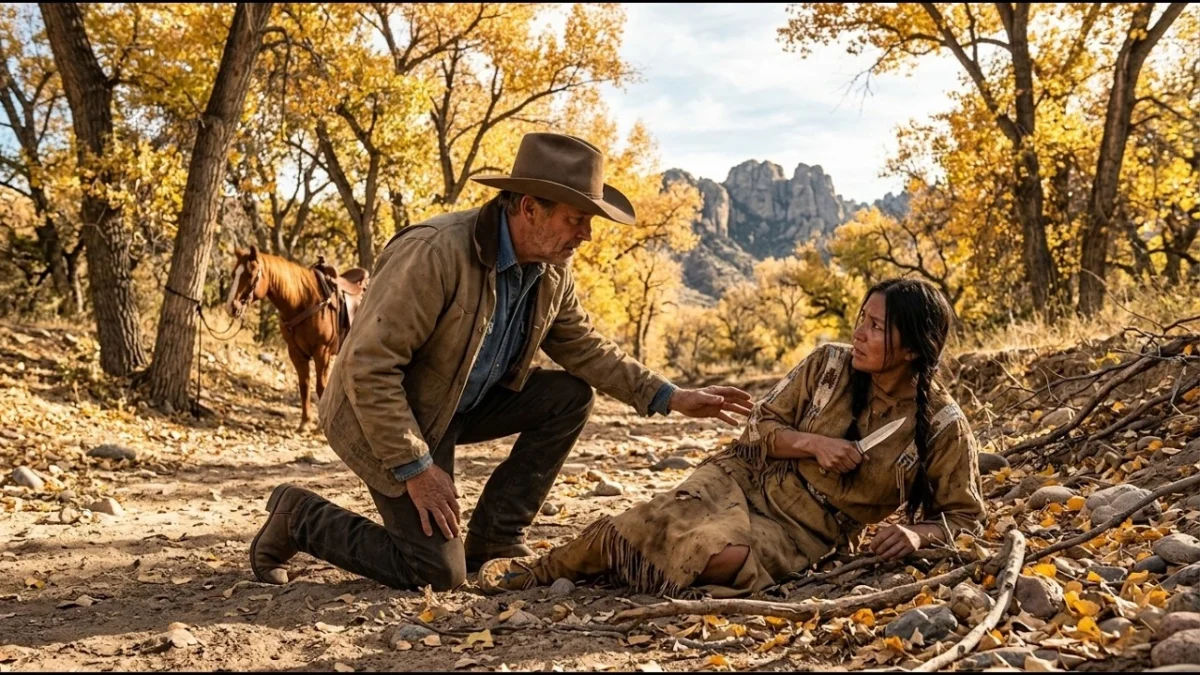
He found her on a crisp Tuesday afternoon, three miles south of his cabin.
She lay in a dry, sandy wash where the fading autumn light filtered down thin and golden through the yellow leaves of the cottonwoods.
At first glance, Jonas truly believed she was dead.
She lay half-concealed beneath a tangle of wild brush, one arm bent unnaturally beneath her torso.
A jagged gash along her hairline had crusted dark with dried blood, and her traditional deerskin dress was torn and heavily stained with trail dust and blood that clearly belonged to more than just her.
It was only the faint, shallow rise and fall of her ribs that stopped him from riding past.
He reined in his horse, moved by the instinctive urge to stop for anything still breathing in a world that had otherwise grown cold and still.
She was young, certainly younger than him, though not by many years.
Her thick black hair was matted with dirt against her left temple.
Her face, even dark with bruises, held a fierce, unyielding composure, as if she had resolved long before passing out that she would give no enemy the satisfaction of seeing her spirit broken.
Jonas had lived in the territory long enough to recognize its quiet, brutal realities.
He could guess the terrible shape of what had happened even before he turned his horse to examine the physical tracks in the dirt.
Shod horses—many of them—had ridden fast away from a makeshift camp situated further up the draw.
He could smell the sour, heavy stench of burnt canvas and scorched wood drifting on the breeze.
He chose not to ride up to the ruined camp to look closer.
He had witnessed that exact brand of war-torn destruction once before in Missouri, and he possessed no desire to carry those haunting images twice in one lifetime.
Instead, Jonas dismounted and knelt beside the fallen woman in the sand.
Her eyelids fluttered open, dark and unfocused at first.
Then, in an instant, her gaze sharpened with sudden, terrifying clarity.
Her good hand flashed beneath the folds of her skirt, her fingers closing around the bone handle of a hidden knife faster than his eyes could follow.
Jonas did not reach for his colt revolver.
He simply raised both of his large hands, palms facing outward, keeping his posture calm and unthreatening.
“I’m not one of them,” Jonas said softly, his deep voice steady in the quiet wash.
“Whoever did this to you and your camp, I’m not one of them.”
She said nothing, her breathing ragged and shallow.
Yet, she did not strike with the knife.
She held her position, her dark eyes searching his face for any sign of deceit.
That, he would realize much later, was the very first gift she ever gave him.
It was not complete trust—not yet—but it was the deliberate choice not to kill him, which in that wild country amounted to the exact same rare kindness.
Jonas set to work quickly, knowing the light was fading and the air was turning bitter cold.
He cut two sturdy lodgepole pines and strung his heavy canvas bedroll between them to construct a temporary travois behind his pack horse.
Gently, he lifted her onto the canvas, ignoring the sharp intake of breath she took when her broken wrist shifted.
He led his horses back toward the line shack at a slow, deliberate walk, his eyes constantly scanning the surrounding timberline for any sign of pursuers.
She did not utter a single word for two full days.
Inside the warmth of the cabin, Jonas set her broken wrist as carefully as his rough hands knew how.
He splinted the bone using a shaved axe handle and strips of clean cotton cloth.
He cleansed the deep laceration along her scalp using boiled well water and the remainder of his prized whiskey.
She endured the burning pain without making a sound, though her jaw remained clenched tight enough to turn her skin pale beneath the bronze.
Jonas willingly surrendered his comfortable cot to her.
He wrapped himself in his thick wool blankets and slept on the hard floor near the woodstove, keeping his Winchester rifle resting within easy arm’s reach.
He told himself he kept the rifle close not out of fear of her, but out of fear for the men who had left her to die in that sandy wash.
On the third morning, as the sun began to paint the pine tops outside, she finally broke her silence.
“Water,” she said, her voice rough from dehydration, but her English was startlingly clear.
Jonas was leaning over the stove, and he nearly dropped the heavy tin coffee pot in sheer surprise.
He quickly poured a cup of fresh water from the bucket and brought it to the bedside, helping her lift her head to drink.
“You speak English,” Jonas remarked, stepping back to give her space.
“Mission school,” she replied quietly, setting the empty cup down.
“Long ago.”
Her dark eyes, still deeply guarded, studied his features the way a seasoned traveler studies the sky, trying to read what kind of storm was approaching.
“You are not going to sell me to the army,” she stated, it being more of a test than a question.
“No,” Jonas answered directly.
“Or to Vance,” she added, her voice dropping an octave.
It was the very first time Jonas heard the name that would come to dominate his entire world in the dark weeks ahead.
“Who is Vance?” Jonas asked, frowning slightly.
She did not answer his question right away.
Instead, she tilted her head slightly and posed a question of her own.
“Why did you not leave me in the wash?”
Jonas considered offering a simple, convenient answer about Christian charity or the basic duty of a neighbor on the trail.
Instead, he looked her square in the eye and spoke the unvarnished truth.
He knew intuitively that telling a lie to a woman with eyes like hers would be taken as a direct insult.
“Didn’t seem right, leaving something breathing to stop breathing when I had the power to help it,” Jonas said, leaning his broad back against the heavy wooden table.
“Guess I’ve had my fill of things stopping breathing long before their time.”
Something subtle shifted behind her dark eyes as he spoke those words.
It was still not complete trust, but it was a quiet, solemn recognition.
It was the silent understanding of two deeply grieving people measuring one another across a small, quiet room.
“My name is Naya,” she said at last, her voice steadying.
“Of the Chiricahua.”
“Jonas Hale,” he replied gently.
She nodded once, as if carefully recording his name in her memory for future use, and turned her face toward the rough pine wall.
That night, for the very first time since he had brought her into the cabin, Naya fell asleep without her hand curled tightly around the handle of her knife.
Naya healed slowly over the passing weeks, her strength returning in small, incremental measures.
As her broken bones mended, something else began to take shape between them—a quiet, unhurried connection between two souls who had both long since forgotten how to expect gentleness from the world.
She began to tell him her story, revealing it in small pieces over the long autumn evenings.
She spoke of Silas Vance, the wealthy cattle baron whose vast herds already grazed over half the valley.
Vance coveted the rich, permanent water rights that flowed directly through her family’s ancestral winter camp.
Those same water rights happened to run straight through the homestead land where Jonas’s line shack was built.
Vance had hired a band of ruthless mercenaries to drive her people off the land under the false pretense of an official government relocation order that did not actually exist.
When her father, a deeply respected healer among the Chiricahua, refused to abandon the land and the sacred graves of his ancestors, Vance’s hired guns had descended upon the camp.
They burned every lodge that could burn and scattered the people into the wilderness.
In the sheer terror and chaos of the raid, Naya had been struck down and left for dead, believing she was the sole survivor of her clan.
She recounted these horrors without shedding a single tear, speaking in short, measured sentences.
Jonas realized that her absolute calm cost her far more strength than weeping ever would have.
In return for her honesty, Jonas opened up about his own buried past.
He told her about Emily, about the harsh Missouri winter, and about the tiny daughter he had never had the chance to name properly.
He spoke of the hollow silence he had built like a fortress around his heart ever since.
Naya listened to his words without once interrupting.
When he finally went quiet, looking down at his large, rough hands, she spoke with startling wisdom.
“Grief makes good company for one person,” she said softly from the cot.
“It makes terrible company for two. You have let it sit in the best chair in your house for far too long, Jonas Hale.”
Jonas looked up, caught completely off guard, and let out a genuine, booming laugh.
It was the first real laugh he had produced in more years than he cared to count.
As the sound echoed off the rafters, the lingering heavy tension inside the small cabin seemed to ease completely.
Over the days that followed, the dynamic inside the line shack transformed.
Naya began teaching him words in her native language, patiently correcting his clumsy, thick-tongued pronunciation.
A subtle, hidden smile often hovered just beneath her calm exterior whenever he stumbled over a phrase.
She showed him how to read the surrounding landscape through her father’s eyes.
She pointed out which wild roots could draw severe infection from a wound, which animal tracks signaled impending danger, and which merely belonged to passing deer.
She taught him how to walk through dense dry brush without making a single sound, moving like a shadow across the mountain slopes.
In return, Jonas showed her how to read the complex brand marks burned into the hides of Vance’s cattle.
He explained the legal boundaries of the territory and taught her how the white men used papers and deeds to claim ownership of the earth.
Together, without ever voicing the thought out loud, they began to build a strange, quiet life that neither of them had ever expected to want again.
Yet, the dark smoke riding on the horizon had not truly vanished.
It was merely waiting for the right moment to return.
It was Naya who first spotted the trouble coming.
She was standing near the cabin’s small glass window when she froze, her gaze fixed on the high ridge overlooking the draw.
“Riders,” she said, her voice dropping to a low, intense whisper.
“Three of them on the high ridge. They are not approaching. They are watching us, Jonas. The way wolves watch a stray calf before deciding if it is worth the fight.”
Jonas stepped up behind her, looking out through the glass.
He recognized the heavy, high-pommeled saddles and the lever-action rifles carried by the men on the skyline.
“Vance’s men,” Jonas said, a cold, familiar calculation settling over his mind.
It was the same cold, tactical focus he had learned years ago during the dark days of the war in Missouri.
“They are counting how many of us are inside,” Naya noted, her posture rigid.
“They are checking to see how many rifles we have.”
Jonas turned to look at her, his face grim.
“If it’s me and this land they’re after, I ought to pack you up on my best horse and send you down toward the Sweetwater home ranch,” Jonas said firmly.
“The foreman there is an honest man. You’d be safe behind their walls.”
Naya turned away from the window to face him directly.
For the very first time since he had pulled her from the wash, Jonas saw unadorned fear written across her face.
It was not a fear of Vance’s hired killers or their rifles, he suddenly realized.
It was the deep, terrifying fear of being abandoned once again—of having someone she had finally grown to trust simply ride away and never return.
“Don’t leave me here,” she whispered, her voice trembling slightly.
The simple words hit Jonas harder than any physical blow or thunderous shout ever could.
He closed the short distance between them and reached out, taking her uninjured hand into his own broad, calloused palm.
For a long, heavy moment, neither of them said a word as the wind howled outside the timber walls.
“I wasn’t asking you to hide because I wanted to get rid of you, Naya,” Jonas said gently, his thumb tracing the back of her hand.
“I was trying to figure out how to keep you breathing. There’s a difference between running away and surviving, and I mean to learn it from you if you’ll teach me. You know this country far better than I ever will.”
Naya searched his face for a long, quiet moment, reading the complete sincerity in his grey eyes.
Slowly, the visible fear on her face folded back down into a sharp, unyielding resolve.
“Then we do not run,” Naya declared, her voice growing firm.
“We prepare this house. My father taught me far more than just healing herbs, Jonas Hale. He taught me how his people held this entire valley against their enemies for a hundred years before Vance’s kind ever set foot in it.”
What Naya orchestrated over the course of the next forty-eight hours would ultimately save both of their lives.
Neither of them knew yet just how far the consequences of her actions would reach across the territory.
She set to work with a ferocious, tireless focus that left Jonas standing in absolute awe.
Using strips of tough, uncurried rawhide, she showed Jonas exactly where to string hidden trip lines across the two narrow rock approaches leading up to the cabin.
They rigged the lines to heavy, unstable rock slides on the steep slopes above the trail, ensuring that any horse galloping up the path would trigger a cascading avalanche of loose shale.
At her direction, Jonas led their horses down into a concealed, heavily timbered draw half a mile away, completely removing the animals from the potential line of fire.
Despite the painful splint still binding her wrist, Naya packed a leather satchel full of clean cotton dressings and the pungent dried herbs her father had used to stop arterial bleeding.
She climbed up to a high, natural rock outcrop directly above the cabin’s roof, where she had a clear, unobstructed view of the entire valley approach.
On the second night, as darkness settled thick over the mountains, Naya climbed to the highest point of the ridge and lit three small, distinct fires in a precise triangular pattern.
Jonas watched the flames flicker against the black sky, growing uneasy.
“Those fires will draw Vance right to us,” Jonas warned as she climbed back down.
“They are not for Vance,” Naya admitted quietly, sitting by the hearth.
“There are others, Jonas. Some of my father’s people scattered into the high, hidden canyons when the raid took place. I did not know if any had survived until two nights ago, when I saw a faint answering signal fire deep in the mountains.”
She looked down at her hands, her voice dropping.
“I told you nothing because I was afraid I might be wrong. Hope is a terrible thing to lose twice in one lifetime.”
Silas Vance’s men arrived at the break of dawn.
Six heavily armed riders came galloping up the narrow approach, carrying repeating rifles and displaying the arrogant confidence of men who had never once been made to answer for their crimes.
They never reached the cabin door.
Naya’s hidden trip lines executed their purpose with brutal efficiency.
As the lead two horses struck the rawhide cords, the hillside above them gave way with a deafening roar, burying the lead riders in a massive slide of shale and timber that instantly took the fight clean out of them.
From behind an overturned wooden wagon bed in the yard, Jonas opened fire with his Winchester.
He fired with methodical, unhurried precision, placing his shots so close to the remaining riders that he pinned them securely behind a stand of boulders.
Every time a hired gun attempted to advance toward the cabin, a round from Jonas’s rifle kicked up dirt at his boots, forcing him back.
Yet, it was Naya’s signaling fires that ultimately decided the fate of the valley.
As the morning dragged on and the gunfight threatened to turn into a prolonged siege, a thunderous chorus of hooves echoed down from the high canyon trail behind Vance’s men.
Sweeping down the mountain came a dozen armed riders—the fierce survivors of Naya’s dispersed camp, led by an uncle she had believed was dead.
They were heavily armed, furious, and utterly unwilling to watch their homeland be stolen a second time.
Caught in a deadly crossfire between Jonas’s rifle in the yard and the Chiricahua warriors on the ridge, Vance’s remaining mercenaries completely broke rank.
They abandoned their positions and fled down the valley in terror.
Silas Vance himself was left standing near the tree line, his face pale as ash.
For the very first time in his life, the wealthy cattle baron realized that the land he had intended to steal was defended by people who would not simply vanish when threatened.
Before Vance could mount his horse to escape, a troop of federal marshals came riding hard up the trail.
They had been summoned days earlier by a neighboring rancher’s wife who had grown suspicious of Vance’s heavily armed riders.
The marshals immediately took Silas Vance into heavy iron custody, placing him under arrest on charges of land fraud, arson, and attempted murder.
Those charges would, in due time, completely dismantle his cattle empire and strip him of his power in the territory forever.
In the quiet, heavy stillness that followed the battle, Naya stood in the center of the ridge where her family’s camp had once stood.
Surrounded by the uncles, aunts, and cousins she had thought the fire had taken from her forever, she buried her face in her hands and wept openly.
They were not tears of grief alone, but tears born of a strange, aching relief—the overwhelming weight of a tragedy proven wrong.
Jonas kept his distance throughout the evening.
He stood far back near the tree line, understanding intuitively that some reunions required a sacred space he had no right to occupy.
He watched her surrounded by her people, feeling a familiar, cold ache returning to his chest, believing his time in her life had naturally come to an end.
Late that night, after the campfires had burned down to glowing embers and her family had settled into a quiet, watchful rest, Naya walked away from the group.
She found Jonas sitting alone on a fallen log near his horses, staring into the dark timber.
She walked up quietly and sat down directly beside him on the log.
“You could go with them now, Naya,” Jonas said carefully, keeping his eyes fixed on the distant hills.
“You can help them rebuild your village. You don’t owe a lonely line rider anything. You never did.”
Naya turned her head to look at him, her dark eyes reflecting the faint starlight above.
“I did not do what I did over these past weeks to pay off a debt, Jonas Hale,” she said softly but firmly.
“I did it because you were the very first person since the fire who did not ask me to be smaller than I am.”
She turned her gaze toward the vast valley stretching out below them, its tall summer grasses gleaming silver beneath the moon.
“My people will rebuild our home here on this land, using the water that is rightfully ours again,” Naya continued, reaching out to touch his sleeve.
“And I find that I have no desire to live far away from this valley. Or far away from you.”
Jonas looked at her, the long-standing wall around his heart finally crumbling away completely.
He took her hand, folding his fingers securely around hers, and for the first time in four years, the overwhelming silence in his chest felt completely filled.
By the time the following spring rolled around, the small line shack had been substantially transformed.
Jonas and the cowboys from the Sweetwater spread had built a sturdy second room onto the side of the cabin, expanding its timber frame.
Beside the front door, Naya maintained a flourishing garden plot.
She planted it with corn, beans, and squash using the ancient methods of her people—the three sacred sisters growing twined tightly together, exactly as her father had taught her.
They were officially married late that spring in a unique ceremony that beautifully blended both of their traditions.
A circle of elders from her tribe stood alongside a gathering of rough-sawn ranch hands from the Sweetwater spread.
None of the cowboys had ever witnessed a wedding quite like it before, but every single one of them agreed afterward that they had never seen Steady Jonas Hale smile so broadly in all the years they had known him.
Decades later, when their own grown children would sit by the hearth and ask how their parents had first met in the wilderness, Jonas would always tell the story plainly.
He would tell them how he had discovered a badly injured woman near death in a dry wash and brought her home on a travois, truly believing he was the noble one doing the saving.
It was always Naya who stepped in to finish the tale.
“He truly thought he saved my life that day,” she would say, looking across the warm firelight to smile at her husband.
“But it was the other way around, right from the very first whisper in that cabin. I only asked him not to leave me behind. Everything that happened after that, I did myself, and so did he, once he finally stopped being afraid to stay.”
And down in the rich, green valley below the Chiricahua Range, where Naya’s people still drew sweet water from a clear mountain stream that was, at long last, truly theirs forever, that was the story the mountain wind carried the longest.
It was not merely the tale of a lonely cowboy who rescued a stranger in the woods, but the enduring story of two broken people who, by simply refusing to leave one another, found the strength to save themselves.








