Duke Proposed to Her as a Joke — ‘I Thought You’d Never Ask,’ She Said; He Had Never Been More in…
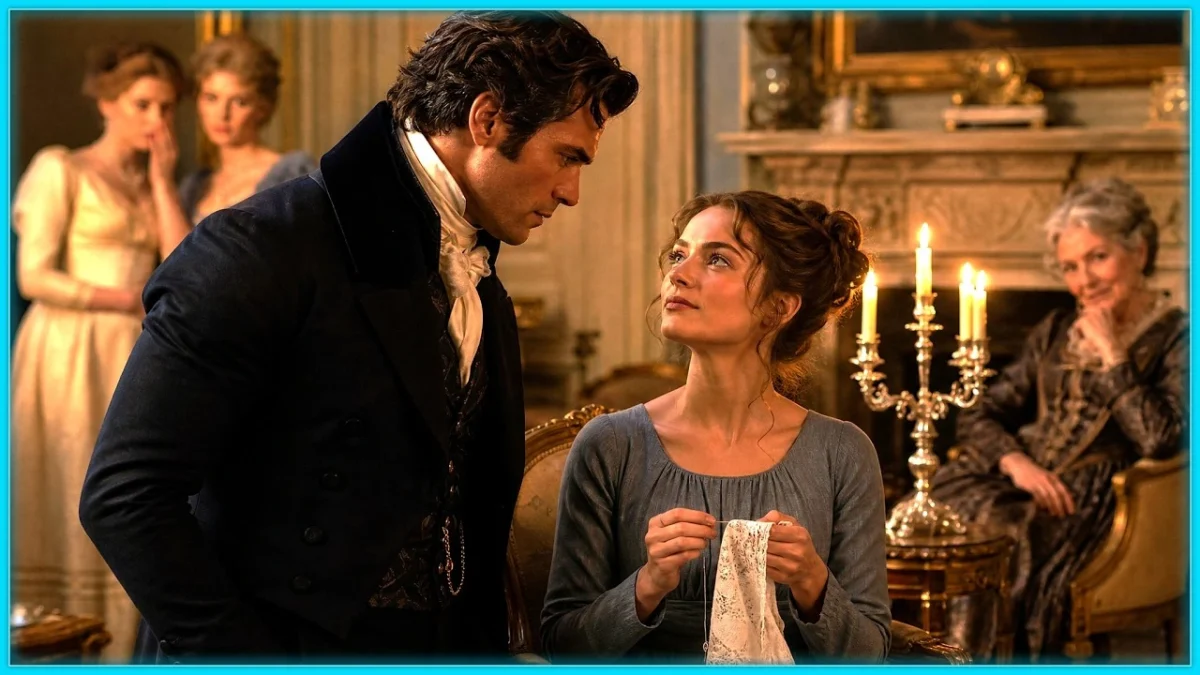
Under the flickering crystal chandeliers of the grand drawing room at Denimore House, the evening had dissolved into a haze of laughter, music, and lighthearted folly.
A long game of forfeits had just concluded, ending with the radiant Mrs. Fairfax pretending to refuse a heart as a playful joke, sending ripples of polite amusement through the assembled gentry.
Julian Ashford, the sixth Duke of Denimore, stood near the center of the room, holding a glass of wine and wearing his usual glittering, effortless smile.
At thirty, Julian was a man who possessed every advantage fortune could bestow: an ancient title, vast estates, striking good looks, and a charm so magnetic that no one had ever thought to demand anything deeper from him.
He was customary to being the most captivating figure in any room he entered, treating life as a pleasant, trivial dance where nothing was ever allowed to touch him too closely.
“Well, Miss Hartwell, since not one of these charming young ladies will have me, and I am plainly doomed to die a bachelor, perhaps I had better marry you,” Julian said, throwing the words laughing over his shoulder to the room at large.
“What do you say?”
“Will you take pity on a poor rejected duke?”
It was a careless, glittering thing, flung out to amuse the drawing room after the game.
He said it to Prudence Hartwell simply because she happened to be the nearest convenient person, sitting quietly in a far corner under the shadow of a high window.
She was the paid companion to his grandmother, old Lady Denimore.
At twenty-seven, Prudence was a quiet woman whom nobody ever looked at twice.
She was plain of dress, pale of countenance, and sat always a little apart with her mending or her books, an invisible fixture in a house filled with aristocratic brilliance.
In the three months she had lived under his grandmother’s roof, Julian, if he were honest, had scarcely looked at her once.
He expected her to blush, stammer, and drop her gaze in flustered silence, as overlooked women invariably did when a great nobleman made them the butt of a casual jest.
Having already dismissed the joke, Julian began to turn back toward the giggling Fairfax sisters, the words barely out of his mouth and the easy laugh still resting on his lips.
“I thought you’d never ask,” Prudence Hartwell said.
She spoke quietly, yet the words pierced the air with uncanny clarity, for a crowded room always hears the one thing it is least prepared to receive.
Julian froze mid-turn.
The easy laughter died instantly throughout the room.
The Fairfax girls exchanged startled, uncomprehending glances, their fans freezing mid-flutter.
Over by the hearth, old Lady Denimore went completely still, a sudden, sharp light moving behind her shrewd eyes that Julian, had he been paying attention, might have found deeply alarming.
Prudence had paused her needle in the cloth.
She looked up from her mending, her plain face lifted directly to his.
She was not blushing.
She was not stammering.
She was not the least bit flustered.
Her gray eyes met the Duke’s with an expression he could not decipher—a look so perfectly composed, so steady, that it seemed as though she had been waiting for the question for a very long time and was merely relieved that it had finally arrived.
Julian Ashford stood anchored to the fine Turkish carpet in the middle of his grandmother’s drawing room with a joke curdling on his lips, suddenly discovering that he did not know what to say.
“I…” he began, his famed eloquence vanishing into thin air.
“You asked me to marry you,” Prudence said, calmly setting down her mending upon the small mahogany table beside her chair.
“Before all these witnesses, I have accepted.”
“I am aware, Your Grace, that you meant it as a jest.”
“You meant it as you mean most things—lightly, to amuse the room.”
“And I am aware that the honorable course now is for me to laugh it off, let you off the hook, and spare you the awkwardness of having proposed to your grandmother’s companion by accident.”
She stood up smoothly, her hands smoothing the folds of her plain wool skirt.
“But I find I do not wish to.”
“I have spent seven-and-twenty years being the person who laughs things off to spare gentlemen their awkwardness, and I have decided quite recently, and quite firmly, that I have done it for the last time.”
“So, you have asked me, and I have said yes.”
“I shall hold you to it, or you shall have to be the one to cry off and be known throughout the county as the Duke who jilted his grandmother’s companion.”
“I leave the choice entirely to you.”
“Good evening.”
She offered a low, flawless curtsy to the room—to the astonished Fairfax girls, to the frozen Duke, and to Lady Denimore, whose withered face had cracked into something suspiciously resembling a triumphant smile.
Then, gathering her mending under her arm, Prudence Hartwell walked out of the drawing room with her head held high.
She left behind a silence so absolute that Julian could clearly hear the embers in the grate shift and settle.
“Well,” Lady Denimore said into the heavy quiet, her voice rich with enormous satisfaction.
“That is the most interesting thing that has happened in this drawing room in forty years.”
She turned her sharp gaze upon her grandson.
“Julian, do close your mouth.”
“You look remarkably like a landed trout.”
Julian closed his mouth, though his senses remained entirely stunned.
The Fairfax sisters and their mother, sensing that the evening’s entertainment had taken a turn far beyond their social competence, hurriedly made their excuses and fled into the night.
They departed with enough scandal in their bonnets to ensure the story would be whispered in every parlor across three counties before breakfast.
Soon, Julian was left alone with his grandmother, who sat regarding him over her spectacles with the particular relish of an old woman watching a young man reap a harvest he had carelessly sown.
“You will have to marry her, you know,” Lady Denimore observed, taking a delicate sip of her tea.
“Grandmother, it was a jest,” Julian said, finally finding his voice, though it sounded strange to his own ears as he paced the rug.
“The whole room knows it was a jest!”
“The whole room knows you proposed to a gentlewoman in public company, and she accepted you,” the old lady corrected mildly.
“That is what the whole room knows.”
“That is what the whole room will say.”
“By Thursday, it will be stated in every drawing room from here to London that the Duke of Denimore is engaged to his grandmother’s companion.”
“You may, of course, deny it.”
“You may announce to the world that you were merely amusing yourself at the expense of a poor woman with no fortune and no family.”
“You may say that you never meant a word of it, that the whole thing was a foolish joke, and that she was a fool to take it seriously.”
Her tone was gentle, yet utterly merciless.
“That is entirely within your power.”
“It will ruin her, of course.”
“A woman jilted so publicly does not easily find another situation.”
“Who would engage a companion whom the Duke of Denimore was heard to trifle with?”
“But that need not trouble you.”
“It was only a jest.”
Julian sat down rather heavily in an armchair opposite her.
“You are enjoying this.”
“I am enjoying it enormously,” Lady Denimore admitted without a trace of shame.
“I have been trying to get you to look at that girl for three months, and you never once did, simply because she does not giggle, she has no fortune, and she does not throw herself at your head like the young ladies you find so amusing.”
She set her teacup down with a sharp clatter.
“Now sit there and listen to an old woman, Julian, because I shall not live forever, and you had much better hear this while I am still here to say it.”
“You have spent your whole life being amused.”
“You are charming, clever, and rich, and everyone has laughed at your jokes since you were in leading strings.”
“You have never in your life had to be in earnest about anything, because charm has always been enough to carry you through.”
“That girl who just walked out of this room has been in earnest every single day of her life because she has had to be.”
“She has no fortune to be careless with, no name to trade upon, and nothing to rely on but her own steadiness.”
“And tonight, she has just done the bravest thing I have seen a woman do in years.”
“She called your bluff publicly, at enormous risk to herself, because she is tired of being invisible.”
“She decided, quite rightly, that she would rather be ruined standing up than stay safe on her knees.”
Lady Denimore leaned forward, her dark eyes piercing him.
“You may destroy her, or you may deserve her.”
“I am curious to see which you choose.”
Julian did not sleep that night.
He lay awake in his massive ducal bed, turning the events of the evening over and over in his mind.
What kept him from rest was not the fear of social awkwardness, nor the threat of county gossip, nor even his grandmother’s sharp scolding.
It was the memory of the look on Prudence Hartwell’s face when she had said, “I thought you’d never ask.”
It was that composed, waiting, unflustered look—the expression of a woman who had thought about this long before the moment arrived.
A woman who had perhaps watched him for three months across a quiet room, forming opinions she had never once been asked to share.
She had taken a careless joke, turned it into a door, and walked straight through it because she had decided her life was worth the gamble.
He had never once wondered what Prudence Hartwell thought about anything.
He had never wondered if she thought at all.
And now, he found he could think of nothing else.
It was a novel and profoundly uncomfortable sensation for a man who had spent thirty years believing he was the most interesting person in every room he inhabited to realize that the most compelling soul had been sitting in the corner with her mending the entire time, unregarded and waiting.
The next morning, Julian sought her out.
He found her in the small parlor, bathed in the pale morning light, sitting at a desk and quietly writing letters.
She looked up when the door opened and he walked in.
Her face gave away nothing.
Looking at her calm posture, Julian realized with a jolt that she had spent the entire night not knowing whether she had secured her future or completely destroyed her life.
Yet here she sat, writing her letters regardless, simply because that was the kind of woman she was.
“You have come to cry off,” Prudence said.
It was a statement, not a question.
“I quite understand.”
“I gambled, and I have lost.”
“You need only say the word, Your Grace, and I shall release you and be gone by evening.”
“You may tell the county whatever story pleases you best.”
“I ask only that you let me keep my character with your grandmother, who has been exceptionally kind to me, so that I may find another situation.”
“That is all.”
Julian stood near the center of the small room, looking at her.
“I have not come to cry off,” he said.
He was surprised to hear the words leave his mouth, and even more surprised to realize they were entirely true.
“I have come to… well, I hardly know.”
“To find out who you are.”
“I think I proposed to you last night without the faintest idea of what I was doing, and it appears I am now engaged to a stranger.”
“It seems only prudent to become acquainted with the woman I am to marry.”
Prudence set down her quill.
Something flickered across her plain, controlled features—not hope, for she was far too guarded to harbor hope so easily, but a careful, weary attention.
“You cannot mean to go through with it,” she said softly.
“I do not know what I mean,” Julian admitted, stepping closer.
“That is the difficulty.”
“I am not accustomed to not knowing what I mean.”
“I have always known.”
“The knowing has always been easy and cheap, and it has never cost me a single thing.”
“And last night, for the first time in my life, I said a thing and could not tell whether I meant it.”
“I have not been able to think of anything else since.”
He pulled out a chair and sat down across from her uninvited, a breeching of formality that was entirely contrary to his usual polished manners.
“So, Miss Hartwell, tell me who you are.”
“Not the companion, but the person.”
“My grandmother says I have never once looked at you.”
“She is right, and I am deeply ashamed of it.”
“I should like to begin now.”
And so, over the course of that morning, and many mornings that followed, she told him.
Julian began finding reasons to seek her out every day, pursuing her company in a way he had never pursued anyone before.
He learned that she was the daughter of a country clergyman—well-born, but left utterly impoverished when her father died when she was twenty.
She had been left with nothing but a solid education and a small trunk of books.
For seven years, she had worked as a governess and then as a companion, passed from one wealthy household to another.
She had been useful and invisible, watching gentle families live their gentle, comfortable lives from the very edges of drawing rooms, never truly belonging to any of them.
He discovered that she was clever—far cleverer than anyone in his social circle had ever suspected.
She possessed a dry, sharp wit that took him entirely by surprise, so much so that Julian repeatedly found himself laughing at her humor instead of his own, an occurrence that had never happened in his entire life.
She read voraciously.
She held clear, well-reasoned opinions on literature, politics, and human nature, though she had learned through harsh experience to keep them hidden.
A companion with strong opinions, as she dryly noted, rarely kept her employment for long.
Julian, taking delight in drawing those opinions out one by one, found each thought sharper, truer, and more refreshing than the last.
He had proposed to her as a joke because she was the nearest overlooked woman to hand.
Week by week, he discovered that she was not overlooked because she lacked depth.
She was overlooked simply because no one had ever taken the trouble to look—and that failure to look had been the world’s loss, and very nearly his own.
“You watched me for three months,” he said to her one sunny afternoon as they strolled through the terrace gardens.
Walking together had quietly become their daily habit.
“Before the joke, my grandmother said you had formed definite opinions of me.”
“I should like to hear them.”
“I warn you, I have braced myself for the worst.”
Prudence stopped beside a bed of blooming roses and considered him thoughtfully.
“Do you truly wish to hear the truth?”
“I find I wish the truth from you more than I have ever wished it from anyone,” Julian replied, stopping beside her.
“It is a most inconvenient feeling.”
“Very well,” Prudence said, resting her hands lightly over her dress.
“When I first arrived at Denimore House, I thought you were exactly what you appeared to be.”
“Charming, idle, and thoroughly pleased with yourself.”
“A man to whom nothing had ever been difficult, and who had never in his life spoken a truly serious word.”
“I thought you would break the Fairfax girls’ hearts one by one without even noticing you were doing it.”
“And I disliked you rather for being so careless with people, though of course I said nothing, because companions do not speak.”
She paused, looking out over the manicured lawns.
“Then I watched longer, because I had nothing else to do in that drawing room but watch.”
“And I began to see the other thing.”
Julian tilted his head.
“The other thing?”
“I saw you sit for an hour with your grandmother when she was feeling low and crippled with pain,” Prudence said quietly.
“You made her laugh, and you never told a soul you had done it.”
“I saw you notice that the young footman’s hand was bandaged, and you quietly arranged for him to rest without taking it out of his wages.”
“I saw that under all that glittering charm, there was a man who was inherently kind when he thought no one was looking.”
“A man who had simply never been asked to be anything more than charming.”
“And I thought…” She trailed off.
“You thought what?” Julian asked gently.
“I thought it was a great waste,” Prudence said, meeting his eyes directly.
“I thought: there is a good man in there who has never had to become himself because no one has ever required it of him.”
“And no one ever will, because society allows a duke to remain a boy forever.”
She took a breath, the quiet evening breeze stirring her hair.
“And then, that night, you made your careless joke.”
“And I thought, quite suddenly and quite recklessly—and I still cannot entirely account for why I did it—I thought: I shall require it of him.”
“I shall call his bluff and see whether the good man comes out.”
“It was a terrible risk and a dreadful presumption, and I fully expected to be ruined for it.”
She looked up at him, her usually guarded face entirely open and vulnerable.
“But you did not cry off.”
“You came to the parlor the next morning to find out who I was.”
“So perhaps I was not entirely wrong about the good man after all.”
The engagement, having begun as a reckless gamble born of a joke, now had to be lived through in the awkward, exhilarating daylight of a public courtship.
The county fully believed the Duke of Denimore was engaged, and there could be no undoing it without total ruin to Prudence’s reputation.
Thus, the two of them were thrown together day after day in the peculiar position of a betrothed couple who had never actually chosen each other in the traditional sense, learning in public the deep truths most couples learn in private.
Julian found it the strangest, most transformative education of his life.
He had been engaged once before, briefly, at twenty-three, to a famous society beauty who had eventually thrown him over for a wealthy marquis.
At the time, he had minded chiefly the dent to his vanity.
He had spent the subsequent decade flirting his way through countless social seasons, never once being in earnest, because earnestness was for men who could not command charm, and Julian could always command charm.
And now, here he was, walking in the garden every afternoon with a plain, penniless companion who refused to be charmed.
She saw straight through his polished polish as if it were clear glass, told him so without hesitation, and liked him far better for the man underneath than for the glitter on top.
“You do that when you are uncomfortable,” she observed one rainy afternoon.
They were standing in the long gallery of Denimore House, listening to the rain beat against the tall diamond windows.
Julian had just turned a deep, personal question of hers aside with a clever witticism, as was his lifelong habit.
“You make a joke,” she continued calmly.
“Whenever a subject comes too near, you reach for something clever and hold it up in front of you like a fan.”
“I have watched you do it a hundred times.”
“You did it just now.”
Julian stopped his pacing and looked at her.
“Did I?”
“You did,” she said softly.
“I asked whether you were happy—truly happy as a man, not as a duke.”
“And you told me a very amusing story about your London tailor.”
“It was very funny, but it was also a fan, and I saw straight through it, as I generally do.”
She stepped closer to him, her gaze gentle.
“You need not do that with me, Julian.”
“I am not one of the ladies in the drawing room.”
“I do not require to be amused.”
“You may simply answer the question, or tell me you would rather not answer it, and either will do fine.”
“But the fan is unnecessary.”
“I have already seen what is behind it, and it is a great deal better than the shield you carry.”
Julian stood motionless for a long moment.
The rain ran down the glass, and the painted portraits of dead Dukes of Denimore looked down from the walls.
None of them, Julian suspected, had ever been asked if they were happy either.
“No,” Julian said at last, his voice dropping into a quiet register he rarely used.
“I am not happy.”
“I have not been happy in a very long time, and I did not even know it, because no one ever asks a duke whether he is happy.”
“They only ask whether he is amused.”
“I am always amused, and I mistook the one for the other for nearly ten years.”
He ran a hand through his hair, feeling his way through the words, unpracticed at speaking pure truth without his protective charm.
“I have everything a man is supposed to want, and I have been bored to the very bone by all of it.”
“I have hidden that boredom behind being charming, and everyone was so pleased with the charm that no one noticed the man behind it was slowly turning to glass.”
He looked at her with deep wonder.
“You noticed it from a quiet corner with your mending in three months.”
“You noticed a thing my own grandmother took forty years to see.”
“That is why I did not cry off the next morning, Prudence.”
“Not merely to spare your reputation, but to spare myself.”
“Because when I woke up after that joke, I realized that for the first time in a decade, I was not bored.”
“And I was not going to give that up for the sake of a little awkwardness with the county.”
Prudence stood very still, her breathing soft.
“That is the truest thing you have ever said to me,” she whispered.
“It is the truest thing I have ever said to anyone,” Julian replied.
“You have a way of drawing the truth out of me.”
“It is most disconcerting.”
“I begin to think I shall spend my whole life telling you true things, and I find, to my great surprise, that I should like nothing better.”
Prudence turned away toward the window, and Julian saw her hand rise briefly to her eyes.
He understood, for he was learning to read her as she had long since learned to read him, that she was deeply moved and needed a moment to regain her composure.
He gave it to her quietly.
He had learned that courtesy from watching her protect the dignity of others.
He stepped over to the nearest portrait and remarked aloud upon its remarkable ugliness until she had mastered her feelings again.
When she turned back, her eyes were clear, and a silent, profound understanding passed between them.
Yet a heavy shadow soon fell across those bright weeks, coming, as such troubles do, from the world outside.
The news of the engagement had spread, exactly as Lady Denimore had predicted, to every drawing room across the region.
The Duke of Denimore was engaged to his grandmother’s companion—a penniless nobody, a woman of no family.
The county, which loved nothing so much as a grand match unless it was the scandal of a ruined one, began to talk viciously.
Whispers began to circulate that Miss Hartwell had cunningly trapped the young Duke.
They claimed she had turned a careless party joke into a binding betrothal through sheer effrontery, that a companion who would execute such a scheme was no better than a scheming adventuress, and that the Duke was a grand fool for falling into her snare.
The rumors inevitably reached Prudence.
She was too observant not to hear them and too proud to complain.
Julian, who might have ignored such social gossip in his former days, noticed immediately now because he had learned to watch her.
He saw the whispers land like blows, saw her bear them in resolute silence, and found that he could not endure the insult to her honor.
“They are saying I trapped you,” she told him finally one evening in the library when he pressed her on her quietness.
“They say I am an adventuress and that you are a fool.”
“I do not mind it for myself—I have been spoken of harshly before, and worse.”
“But I mind it for you, Julian.”
“You have an honored name, and I am the cause of it being dragged through the mud.”
“That I mind very much.”
Julian was quiet for a long moment.
Then a smile spread across his face—not his old, glittering, careless grin, but something far harder, warmer, and entirely new.
“Then we had better give the county something else to talk about,” he said firmly.
“Leave it to me, Prudence.”
“I have spent thirty years learning how to command a room.”
“It is nearly the only useful thing I know how to do, and I have never once had a reason worth doing it for.”
“I have one now.”
He gave the county something else to talk about, though not in the manner anyone anticipated.
A grand dinner was scheduled at Denimore House the following week—the first formal gathering Julian had hosted in years.
The entire neighborhood accepted the invitations, half of them coming out of base curiosity to inspect the calculating companion who had snared a duke, and the other half simply to dine well at ducal expense.
They arrived prepared to be cold, distant, and vastly superior.
They found themselves, over the course of a single evening, comprehensively outmaneuvered.
It was accomplished not by any grand, dramatic speech from Julian, but by the quiet, deadly competence of Prudence Hartwell—a woman who had spent seven-and-twenty years observing high society from its margins and knew its every vulnerability far better than it knew itself.
Seated at the foot of the long dining table as the mistress of the house, Prudence was magnificent in the only way that truly mattered in such a room.
She showed genuine interest in everyone, remembered every family history, and possessed the rare, exquisite gift of making each person she conversed with feel briefly like the cleverest soul in England.
The formidable dowager who had arrived intending to sneer found herself charmed into sharing long stories of her own youth that no one had asked to hear in thirty years.
The stiff-necked local squire, who had openly labeled Prudence an adventuress at his own breakfast table, discovered to his shock that she had read his favorite treatise on agricultural drainage and held remarkably shrewd insights upon it.
He returned home that night her most devoted advocate.
Julian, watching from the head of the table, saw the entire room shift course by course from hostility to grudging respect, and finally to open delight.
He realized then that his own cleverest move had simply been to put Prudence Hartwell in the mistress’s chair and let the county discover for itself what he had found in the garden: that she was, without trying, the most compelling person any of them had ever encountered.
“You did not need my help to command the room after all,” Julian murmured to her late that night, after the last carriages had rolled away and the candles were burning low in the quiet hall.
“You did it entirely yourself, without ever raising your voice.”
“Half of them will be quoting your remarks by Sunday.”
He smiled down at her.
“I am beginning to think, Prudence, that I have gotten vastly the better end of this bargain.”
“The county, which pities me for marrying a nobody, has the matter precisely upside down.”
“They will come round,” Prudence said with a soft, tired, yet wonderfully unguarded smile.
“They always come round in time to whatever the Duke does.”
“It is the one genuine advantage of your rank, and I intend to make thorough use of it.”
“You are going to be a formidable duchess,” Julian noted softly.
“I am going to be a very formidable duchess,” she agreed.
“You have been warned.”
“It is far too late to cry off now.”
“I would not cry off for the whole of England,” Julian said, his voice ringing with absolute conviction.
The next afternoon, Julian stood among the blooming bushes in his grandmother’s rose garden, looking at Prudence.
He understood that somewhere in the weeks since a careless joke had been uttered, without his marking the exact day, the thing he had said without meaning had become the thing he meant more than anything else in the world.
” You were not wrong about the good man,” he said slowly, stepping closer to her.
“Though I think you give me far too much credit.”
“The good man had been fast asleep for a very long time, and it took a companion with a needle, a piece of mending, and a great deal of nerve to wake him.”
He paused, looking into her gray eyes.
“Prudence… may I call you Prudence?”
“I have been calling you that in my head for a fortnight, and it seems absurd to go on with ‘Miss Hartwell.'”
“I owe you a confession, and it is not an easy one for a man who has never in his life had to be in earnest.”
“So you must be patient with me while I make it badly.”
Prudence looked up from her work, a faint smile playing on her lips.
“I have watched you make eloquent speeches to entire drawing rooms without a single stumble,” she said.
“This should be nothing to you.”
“That is precisely the trouble,” Julian said softly.
“Those speeches cost me nothing.”
“This one costs me a great deal, which is how I know it is real.”
He took a deep breath, letting the steady air fill him.
“I proposed to you as a joke.”
“You know that, and the whole room knew it.”
“It was thoughtless, unkind, and exactly the sort of careless thing my grandmother says I have done all my life.”
“And then you said, ‘I thought you’d never ask.'”
“Something changed inside me in that instant, Prudence.”
“I have been trying for two weeks to name it, and the nearest I can come is this:”
“It was as though I had been playing cards my whole life for worthless counters, just for the light amusement of the table.”
“And then, quite by accident, I put down a real gold coin, looked up, and discovered that this time the game was real.”
“I did not know it was real until you made it real.”
His voice wavered slightly, a sudden lack of control that astonished him.
Nothing had ever made his voice unsteady before.
“And now, I find that I do not want to be let off the hook.”
“I have spent the last fortnight dreading that you would grow tired of my company and release me.”
“I have discovered that I would rather be held to a joke with you than be free with anyone else in England.”
He stepped even closer, his gaze locked onto hers.
“That is not a jest, Prudence.”
“I have never meant anything less as a jest in my whole life.”
Prudence Hartwell stood entirely motionless among the roses.
The weary guardedness that had armored her spirit for seven-and-twenty years finally wavered and broke.
Beneath it, Julian saw for the very first time how much her brave gamble had truly cost her.
He saw how frightened she had been every single day under her calm composure, how she had steeled herself every morning for the inevitable rejection that would ruin her, and how she had gone on writing her letters anyway.
“You had better be quite sure, Your Grace,” she said, her own voice trembling now.
“Because I called your bluff once at a terrible risk, and I would not survive doing it a second time.”
“If you are only being kind… if this is only charm wearing the clothes of earnestness to spare us both the awkwardness…”
“Then cry off now, and let me go.”
“Be careless with someone who can afford the loss.”
“But do not tell me you are in earnest unless you truly are.”
“Because I believed a man once before, long ago, and I told you I have laughed things off to spare gentlemen their feelings for the last time.”
“I meant that, too.”
“I am not being kind,” Julian said firmly.
“Ask my grandmother.”
“She will tell you I have never been kind at any real cost to myself until these past weeks.”
“She will tell you the change in me is entirely your doing, though she takes full credit for throwing us together.”
“She does not deserve that credit, for she only threw us into the same room.”
“You did the rest with a needle, a piece of mending, and more courage than I have shown in thirty years.”
Then, right there in the damp path of his grandmother’s rose garden, the Duke of Denimore went down on one knee.
He knelt in the dirt before his grandmother’s companion, with no audience to perform for and no joke to hide behind.
“Prudence Hartwell, I asked you once as a jest, and you were brave enough to take it seriously,” he said, taking her hand in his.
“Let me ask you now as the most serious thing I have ever done in my life.”
“Will you marry me?”
“Not to save your character, and not to spare me the tongues of the county.”
“But because I have fallen deeply in love with the person no one ever took the trouble to look at.”
“I intend to spend the rest of my life making certain she is looked at, treasured, and never invisible again for as long as I live.”
He looked up at her with complete openness.
“I have never been more in earnest.”
“I did not know until I met you that I could be.”
For a long, suspended moment, Prudence did not answer.
Two clear tears slipped down her plain, composed face, and she made no move to wipe them away.
Julian understood that they were not tears of grief, but the sudden release of a hope held down so tightly for so long that its expression could only come as weeping.
“You foolish, careless, charming man,” she said, her voice rich with emotion, echoing the very tone his grandmother often used.
“I said yes a fortnight ago before witnesses, and I have been terrified every single day since that I should have to unsay it.”
She smiled through her tears, reaching down to press his hand.
“Of course I will marry you.”
“Though I thought you’d never ask properly—I mean this time.”








