Everyone Said the Old Rancher Had No Heart — Until a Little Girl Knocked at His Door
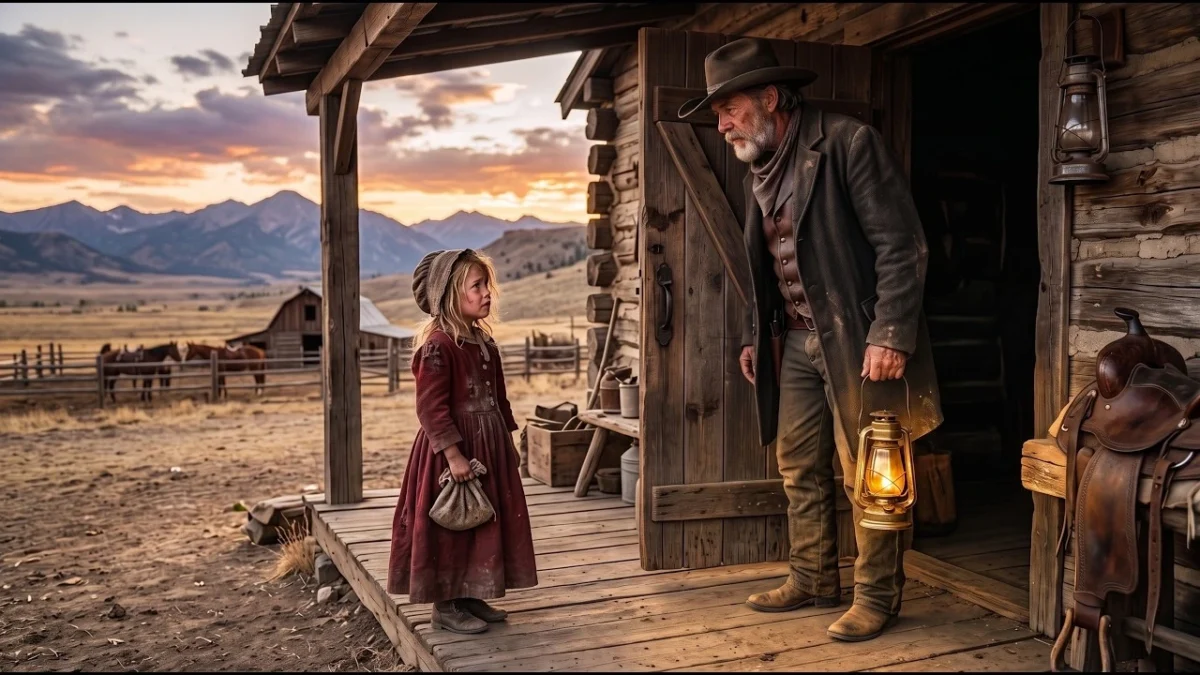
By the autumn of 1889, everyone in Dunmore Gap, Wyoming, had already made up their minds about Amos Whitaker.
They said the old rancher had no heart, and they said it with the quiet certainty of folks repeating a story so old that nobody remembered who had told it first.
At sixty-eight years old, Amos lived entirely alone at the far western end of the valley, occupying a weathered double-log house that had not welcomed a single guest in eleven years.
His property was set back behind a split-rail fence he mended himself with heavy wire and a gate he kept chained and bolted against the world.
Twice a month, his rusted farm wagon clattered down the washboard trail into town.
He stopped at the dry goods store once for flour, salt, lard, and black tea, and once more at the blacksmith’s for horseshoe nails or iron straps.
He spoke to no one unless coin had to change hands, answering direct questions with brief, rumbling grunts that discouraged further conversation.
The valley children dared each other to run past his perimeter fence at dusk, shivering as they pointed at his dark porch.
The grown townsfolk simply looked the other way when his wagon passed, offering brief nods that were never returned.
What nobody in Dunmore Gap understood was how a human heart can go completely quiet without actually going cold.
On a bitter, gray evening near the end of October, something arrived at Amos Whitaker’s front door that the entire valley would have declared impossible, and it arrived in the smallest imaginable shape.
It began with a knock.
Amos was sitting near the cast-iron kitchen stove, the way he sat every night after the chores were finished.
His black coffee had gone lukewarm and skinned over in his tin cup, and the autumn wind was working its slow, whistling complaint against the wooden eaves.
The knock came so soft that he thought at first it was merely a dried cottonwood branch scraping against the siding.
Then it came again, three distinct, light taps, striking low on the heavy oak door, no higher than a man’s knee.
Amos set his cup down on the bare pine table with a dull clatter.
He did not own a watchdog anymore, having buried his old hound eight winters back, and no neighbor had any reason to ride five miles out from town after dark.
He crossed the kitchen slowly, the thick floorboards groaning beneath his heavy work boots.
He slid the iron latch back and pulled the heavy door inward against the biting draft.
There was no one standing at eye level.
He lowered his gaze past the porch railing, his bushy gray eyebrows knitting together in deep confusion.
A little girl was standing on his top step, no more than six or seven years old.
She wore a faded wool coat at least two sizes too large, its sleeves rolled back in bulky cuffs over her small wrists, and a pair of scuffed button boots caked gray with alkaline trail dust.
Her light brown hair had come half loose from its single, messy braid, whipped around her face by the mountain wind.
She was hugging a small cloth bundle wrapped in a flour sack tightly against her chest with both arms, holding it the way a desperate person holds the absolute last thing they possess.
She looked up at him with large, pale gray eyes that were tired far past the point of crying.
She did not flinch, nor did she run away, though every other child in the valley would have sprinted for the timber at the sight of his towering, scowling frame.
“Mister,” she said, her voice thin and raspy from cold air and long miles. “Is this the house at the end of the road? A lady told me the house at the end of the road would have a light on.”
For a long, heavy moment, Amos Whitaker, whom everyone in the valley swore had a stone in his chest, could not find a single word to offer her.
He stared at her dusty boots, then at her pale face, before finally finding his voice.
“Who sent you up here, child?” he asked, his voice rough from hours of silence.
“A lady back at the stage post,” the girl replied, shifting her bundle slightly. “She said if I kept walking west along the wheel ruts, the last house before the pass belonged to an old man who kept a lamp in his window. She said I was to look for the yellow light.”
Amos looked past her shoulder into the gathering dusk.
The valley behind her was empty, stretched out in vast, silent reaches of sagebrush and gray shadows under a bruising purple sky.
“Where are your folks?” he asked.
“My grandmother went to sleep two days ago in the cabin near the creek,” she said plainly, without any tears. “The woman there said Gram wasn’t going to wake up anymore. She said Gram had let out a long breath and just didn’t draw it back.”
Amos felt a cold chill that had nothing to do with the Wyoming wind settle into his bones.
“And the wagon?” he pressed softly.
“They put me on a freight wagon going to my uncle’s place in Sweetwater County,” she explained, her small legs trembling slightly inside her thin stockings. “But the driver stopped at the timber fork to haul a broken axle out of the ditch. He told me to sit on a crate and wait. Another wagon came by and a man said my uncle’s ranch was up this trail. So I started walking. But the road kept going and the trees got tall and the sun went down.”
“How long have you been walking on those feet?” Amos asked.
“Since the sun was over the high peak,” she said.
Amos looked down at the child’s dusty, paper-thin boots, then stepped backward into the warmth of the room, throwing the door wide open.
“Come in out of that wind,” he said gruffly. “Before you let every bit of my heat out into the yard.”
He had not lit a second oil lamp in that house in over eleven years, but he reached for a brass lantern on the sideboard now, struck a sulfur match against his thumbnail, and set the flame to the wick.
The golden glow flared up, driving the deep shadows out of the corners of the kitchen.
He ushered the girl toward the high-backed wooden armchair near the stove, which was his own accustomed seat, though she did not know it.
“Sit down there,” he commanded gently. “Take off those boots.”
She obeyed without a word, setting her wrapped bundle carefully on her lap before unbuttoning the dusty leather straps with stiff, red fingers.
Amos walked over to the pantry cupboard, pulling out a loaf of coarse lard bread he had baked three days prior and a pitcher of sweet milk that was sitting in the cold stone cellar box.
He poured a full cup and sliced a thick slab of bread, spreading a layer of plum preserve across it before setting both on a small stool beside her chair.
“Eat that,” he said.
The girl looked up at the bread, then at him, her eyes searching his lined, weathered face.
“Thank you, mister,” she whispered.
She ate the way the truly famished eat, taking quick, ravenous bites at first, before suddenly slowing down, as if remembering her manners and feeling a sudden wave of embarrassment.
Amos sat across from her on a low three-legged milking stool, resting his broad hands on his knees as he watched her in total silence.
He did not know what to say to a small child, so he said nothing at all, and somehow the silence between them was neither cold nor awkward.
What he could not have explained to her, what he had never explained to a single living soul in Dunmore Gap, was that another small chair had once sat right beside the hearth.
Eleven years ago, Amos had buried his young wife, Eliza, after a bitter winter fever had taken her slow and steady over the course of three painful weeks.
She had passed away in their timber bed with her slender hand clasped tightly in his, her very last words being a quiet joke about the homemade gingham curtains she had never finished hemming.
Amos had carried that quiet, devastating grief with him through every single day that followed.
They had never been blessed with children of their own, though he had built this four-room log house with his own hands, intending it for a large family that had never arrived to fill its silent spaces.
After Eliza was gone, Amos had simply stopped trying to be part of the living world.
It had proven far easier to accept the reputation the town invented for him—the mean, heartless hermit at the end of the gap—than to be the grieving man who missed his wife in a kitchen that was far too large for one set of boots.
He had allowed the legend of his bitterness to grow around him like the thick thistles along his boundary fence, because thistles kept people at a distance and asked nothing of his weary heart.
Now, a small, lost child was sitting in Eliza’s chair, her small cloth bundle tucked securely beside her hip, her eyelids growing heavy as the heat from the iron stove thawed her small frame.
Amos looked at her small, dust-smudged face and felt something ancient and deeply buried shift inside his chest, like a heavy stone turning over in wet soil after a spring rain.
When her head finally nodded forward and her breathing went slow and rhythmic, Amos stood up softly.
He lifted her gently in his broad arms, amazed by how light she felt, and carried her into the spare bedroom that had served as a dry storage space for a decade.
He cleared a stack of folded horse blankets off the narrow cot, laid her down, and pulled a clean woolen quilt up to her chin.
The next morning, before the mountain sun had cleared the eastern rimrock, Amos hitched his pair of bay draft horses to the farm wagon.
He bundled the girl, whose name he had learned was Sadie, in his own heavy sheepskin coat and set her on the wooden seat beside him.
He drove the five miles into Dunmore Gap without speaking much, the steel wagon tires crunching loudly over the frozen mud ruts.
He pulled up directly in front of the town marshal’s office, tying the reins to the hitching rack.
Marshal Holt Bishop, a fair-minded man with graying temples, looked up from his desk in sheer astonishment as the old hermit walked into the office with a small child trailing quietly behind his boots.
“Amos?” the marshal asked, standing up and setting his coffee cup aside. “What’s happened out at your place?”
Amos laid his heavy hand on Sadie’s shoulder.
“Found her on my porch last night,” Amos said plainly. “She walked up from the timber fork alone. Her grandmother died back at the stage cabin two days ago. She was supposed to be on a wagon heading for relatives in Sweetwater County, but she got left behind at the crossroads.”
Marshal Bishop listened intently, taking off his Stetson hat and rubbing his forehead as Amos detailed the child’s story.
“Sweetwater is a long piece east,” Bishop said, leaning against his desk. “I can send a rider out to the telegraph line at the railhead to inquire about her kinfolk. But that’s going to take time, Amos. A week, maybe three. Letters move slow out here, and people move even slower.”
The marshal stepped over to the window, looking out at the wagon seat before turning back to the old rancher.
“The real question is,” Bishop continued softly, “where is the little girl going to stay while we sort this business out?”
By mid-morning, word of the situation had spread through Dunmore Gap like dry grass catching fire in an August wind.
The general store, the blacksmith shop, and the local livery emptied as townsfolk gathered near the marshal’s porch to see the spectacle.
They looked at the quiet, small girl sitting on the bench inside the office, and then they looked at Amos Whitaker standing tall on the boardwalk.
Amos saw the familiar expressions written across their faces—the cold certainty, the easy judgment, the firm belief that he was a man entirely devoid of human sympathy.
He stood quietly, waiting for one of them to step forward and offer a solution.
He waited for a family with a comfortable home, a farmer with a spare bed, or one of the church women with kind hands to offer the child a proper place to stay.
Not a single person stepped forward.
They simply stood in small groups, whispering behind their gloves, waiting to see what the heartless old man would do with a burden he clearly wouldn’t want.
They waited the way folks wait for a heavy rock to prove it cannot float on water.
Amos looked down at Sadie, who was looking up at him through the office window with wide, uncertain eyes.
He turned back to the crowd, his face completely unreadable, and reached for his leather reins.
“She’ll stay out at my place,” Amos announced, his voice carrying clearly across the quiet dirt street. “Till her people are found.”
A collective, sharp breath went through the gathered crowd, but no one uttered a word of protest.
It was the marshal’s mother who intervened on the second afternoon, though Amos would never have asked for her help and she certainly would not have offered it as a favor.
Clara Bishop was a widow of fifty-two years with a spine as straight as a oak fence rail and a firm opinion on every matter under the sun.
She had buried a husband, raised three headstrong sons in the territory, and was not in the slightest bit intimidated by an old rancher’s dark reputation.
She arrived at the Whitaker place in her light, one-horse buggy, unannounced and uninvited.
She carried a wicker basket filled with clean cotton dresses cut down from her granddaughter’s outgrown clothes.
She unlatched the front gate that no neighbor had touched in eleven years, marched up the stone walkway, and stepped right through the front door without knocking.
“A man can keep a child fed on salted beef and bread,” Clara announced loudly, setting her heavy basket on the pine table with a thud. “He can’t braid a young girl’s hair worth a curse. Where is she?”
Amos stared at her from the kitchen stove, a iron poker held in his hand, but he did not tell her to leave.
And that was how, against every prediction the valley of Dunmore Gap had ever made, the quiet house at the end of the road began to return to life.
The change did not happen all at once, for true grace rarely operates with sudden speed, but it happened steadily day by day.
Clara Bishop came out to the ranch every other afternoon, bringing sewing supplies, fresh bread, and an endless stream of advice that Amos pretended to ignore while secretly listening to every word.
She taught Sadie how to mend her stockings and neatened her loose brown hair into tight, orderly braids.
Sadie, for her part, was a naturally quiet child who grew remarkably less guarded with every passing day.
Like a banked fire finding its flame again once someone remembers to feed it wood, her true personality began to emerge.
She began following Amos out to the timber barn during the freezing morning hours, her small boots crunching in his large footsteps through the mud.
She insisted on naming every animal on the property, whether Amos approved of the practice or not.
A red-spotted cow became Buttercup, an old plow horse became Barnaby, and a stray gray hen that frequented the porch was grandly named Duchess.
She quickly discovered that the old rancher, who had not laughed where another human could hear him in over eleven years, made a specific grumbling noise deep in his throat whenever she said something utterly ridiculous.
She learned that if she pestered that grumbling sound long enough with her childish chatter, it would eventually break apart into a low, quiet chuckle.
Early in the second week, Amos woke long before dawn, as old men accustomed to hard labor usually do.
He walked into the dark kitchen and found Sadie already standing by the window in her oversized wool coat, looking out at the gray light breaking slowly over the eastern ridges.
She did not hear his boots on the floorboards.
She was speaking in a soft, low whisper to the empty air, telling her dead grandmother all about the farm.
She spoke about the gray hen named Duchess, the cold mornings in the barn, and the big old man who kept the lamp lit at the end of the valley road.
She was telling her grandmother that she was safe, that her belly was full, and that she was no longer afraid of the dark.
Amos stood motionless in the shadow of the doorway, listening to a six-year-old child make her own quiet peace with a loss far too massive for her small arms to bear.
He did not interrupt her, nor did he step into the room to draw attention to himself.
He understood that grief, if handled with gentleness and patience, must find its own slow path through the human heart.
When Sadie finally turned around and noticed him standing near the pantry, she did not look startled or guilty.
“I was just telling Gram about Duchess,” she said softly, clutching her coat collar tight against her throat.
Amos cleared his throat, adjusting the suspenders over his broad shoulders.
“That seems like a fine thing to do,” he replied gently. “She’d likely want to know the hen is being looked after.”
He walked over to the stove, opened the iron draft, and shook the ashes down into the pan before reaching for the iron skillet.
“Let’s get some salt pork fried up,” he added. “The work won’t wait for the sun.”
They cooked breakfast together in the dim morning light, neither of them mentioning her grandmother again, but an unspoken bond settled firmly between them that neither possessed the words to describe.
Later that same evening, as the fire crackled steadily in the iron grate, Sadie sat on the braided rug near his boots, peeling a small red apple with a blunt butter knife.
She looked up at him with the direct, unvarnished curiosity that only young children possess.
“Mister Amos,” she asked, “why do you live out here all by yourself without any people?”
Amos sat still for a long time, his hand resting motionless on the armrest of his wooden chair.
The ticking of the tall brass clock on the shelf seemed to grow louder in the quiet room.
At last, he leaned back and looked into the yellow flames behind the stove door.
“There used to be a woman here,” Amos said softly, speaking the words with great care. “My wife, Eliza. She helped me build this house when we were young. She made every room in it worth being in.”
“Where did she go?” Sadie asked, holding her half-peeled apple in her lap.
“She took sick one winter,” Amos said, his voice dropping an octave. “A long time ago. And when she passed on, I couldn’t find much reason to keep the rooms lit or talk to folks in town. It just felt easier to let the house go quiet.”
He had never said that much about his grief to any living person in eleven years.
He said it now to a six-year-old girl sitting on a braided rug, and somehow she was precisely the right person to hear it.
Sadie considered his words with great seriousness, turning the apple over in her small hands.
“I think,” Sadie said thoughtfully, “she’d be real glad to see somebody sitting in her chair again.”
Amos Whitaker, whom everyone in Dunmore Gap swore had a heart made of cold granite, stood up abruptly from his chair.
He walked over to the stove, took up the iron poker, and began vigorously stoking a fire that needed no tending whatsoever, keeping his back turned so the child would not see the moisture gathering in the corners of his eyes.
By the middle of the third week, the marshal’s rider returned from the railhead bearing a letter from Sweetwater County.
The rider had located the cousin and his wife, but the news was not what the town had anticipated.
The relatives had not seen Sadie’s grandmother in over four years and had never been informed that the child was being brought to their doorstep.
The letter was not cruel, but it was written with the extreme caution of poor homesteaders who calculated the cost of another mouth before they calculated the warmth of their hearth.
They already had four young children of their own, the cousin wrote, and the dry season had destroyed their oat crop.
Times were exceptionally lean across the county.
They would take the girl if the law strictly required them to do so, but if any other arrangement could be made locally, no one would think ill of the authorities for keeping her in Dunmore Gap.
Marshal Bishop rode out to the Whitaker place himself that afternoon, holding the yellowed paper in his leather-gloved hands.
He read the letter aloud to Amos as they sat together on the front porch steps, watching Sadie chase the gray hen across the frost-dusted yard with absolute, single-minded devotion.
“It’s no real home they’re offering her, Amos,” Bishop said quietly, folding the paper along its creased lines. “She’d just be one mouth too many at a table that’s already bare.”
“I can read between the lines,” Amos said, his hands resting heavily on his knees.
“There’s the county orphan home up near Cheyenne,” the marshal added, looking out over the timber rail fence. “They’d take her in. The matron there is decent enough, I suppose.”
Amos did not answer immediately.
He watched Sadie jump over a low log, her oversized coat flapping around her knees as she let out a bright, ringing laugh that echoed off the dry limestone cliffs behind the barn.
“Amos! Amos! Look!” she called out, holding her arms wide as the hen fluttered away into the tall grass. “Duchess almost let me pick her up!”
The sound of his own name shouted in that clear, joyful voice pierced straight through the eleven years of frozen silence that had enclosed his chest.
Amos realized then that he had spent over a decade believing the townsfolk were right about him because believing them was far easier than feeling the pain of his own empty house.
A man does not discover what is truly inside his heart by the speeches he makes while sitting alone in a dark room.
He discovers it by what his hands reach for when something fragile, helpless, and unasked-for stands outside his door in the freezing dark.
Amos knew, as he watched the girl turn and wave at the porch, that he had already made his choice on the very first night, the exact moment he had stepped back and held the heavy door open against the wind.
Everything that had happened since was merely his mind catching up to what his heart had already decided.
“She’s not one mouth too many,” Amos said, his voice firm and steady as mountain stone. “Not out here. Out here, there’s been one chair too empty for far too long.”
Marshal Bishop looked at the old rancher for a long moment, a slow, genuine smile spreading across his weathered face.
He pulled his Stetson down tight over his eyes and stood up from the wooden step.
“I’ll inform the county judge to draw up the formal guardianship papers,” Bishop said. “I reckon nobody in the valley is going to object.”
Word of Amos Whitaker’s decision swept through Dunmore Gap faster than the news of the child’s arrival had three weeks prior.
This time, however, the tone of the talk was entirely different.
The town that had been so utterly certain of its harsh verdict found itself standing quietly corrected by an old hermit and a lost child.
When Amos brought Sadie into town on his weekly supply runs, the very same people who had looked the other way for eleven years now found endless excuses to cross the dirt street.
The storekeeper offered Sadie a long peppermint stick from his glass display jar.
The seamstress gave her a scrap of bright blue silk ribbon for her hair.
They were small, humble offerings laid at the feet of a miracle they had not believed possible in their dry valley.
A few of the older townsfolk, the honest ones who felt the weight of their past judgments, walked right up to Amos on the boardwalk outside the post office and admitted openly that they had been completely wrong about his character.
Amos accepted their apologies the same way he accepted most things in life—with a brief nod of his head and very few words.
He held no grudge against them for their old opinions.
He had carried enough cold, heavy bitterness in his own life to know better than to pick up a fresh load of resentment.
That was the part of the story the people of Dunmore Gap would retell for decades around their winter fires.
They did not merely tell how the heartless old rancher had taken in a lost orphan girl from the trail.
They spoke of how he had never once thrown their past unkindness back into their faces when he had every legal and moral right to do so.
He had simply chosen the higher road.
Grace was what his Eliza would have called it, and she would have meant it as the highest compliment a human soul could earn.
By the middle of November, the legal documents arrived from the territorial court in Cheyenne, bearing the official seal of the magistrate.
Marshal Bishop brought them out to the ranch, setting the inkwell on the kitchen table so Amos could sign his name in slow, deliberate cursive at the bottom of the page.
The papers formally declared the child to be Sadie Whittaker, legally recognized as his daughter before the law and the territory.
The old man held the official parchment in his thick, calloused hands for a long time, staring at the fresh ink before carefully placing it inside the family Bible that had sat untouched in his drawer since Eliza’s passing.
Winter came exceptionally hard to Dunmore Gap that year, as it always did in the high country, bringing feet of heavy snow that drifted against the timber fences and locked the valley in ice.
Yet the log house at the end of the road was no longer the dark, silent place it had been for over a decade.
There were two oil lamps lit brightly in the main room every single evening, casting a warm yellow light across the snowdrifts outside the kitchen window.
There was light brown hair to be combed and braided every morning after breakfast.
There was a gray hen named Duchess that had successfully established her roosting spot inside a padded crate in the warm back pantry.
Most importantly, there was a bright, small voice that filled every single room that had stood vacant and silent for eleven long years.
Clara Bishop continued to ride her buggy out to the ranch every few days, bringing jars of preserved cherries or fresh butter, constantly pretending that she was coming purely for the child’s instruction.
Amos never corrected her, allowing her to keep her proud excuse while enjoying the company and the fresh food she left on his table.
On the longest, coldest night of that December, with the snow piled high against the log walls and the iron stove glowing dark red in the corner, Sadie fell fast asleep with her head rested lightly against Amos’s heavy arm.
He had been reading aloud to her from the only storybook in the house, moving his large finger slowly beneath each printed word as he stumbled over the difficult sentences.
He sat motionless in the armchair for nearly two hours after she had gone to sleep, refusing to shift his position lest he disturb her peaceful rest.
Outside the thick glass panes, the mountain wind worked its ancient, howling complaint against the wooden eaves, exactly as it had done every winter before.
However, the man sitting by the warm stove listening to the storm was no longer the bitter hermit the town had buried under eleven years of cruel, lazy rumors.
He thought of his beloved Eliza, he thought of the empty chair that was now filled, and he thought of the strange, ordinary mercy of a soft knock at his door on a gray October evening.
He had been so entirely convinced that his life was completely finished, believing that the absolute best of his years lay buried beneath the cemetery sod alongside his wife.
He had been entirely wrong.
The best part of his remaining life had walked for miles in the wrong direction down a dusty trail, wearing boots three sizes too large and clutching everything she owned in a small cloth bundle, searching desperately for the only house in the valley that still kept a light burning in its window.
“A lady told me the house at the end of the road would have a light on,” she had said to him on that dark night.
It did, Amos thought to himself as he adjusted the quilt around the sleeping girl’s shoulders, by God, it did.
He realized then that he had simply forgotten why a man keeps a lamp lit in the wilderness in the first place.
Everyone in Dunmore Gap had spent eleven years saying the old rancher had no heart.
The truth was simply that none of them had ever thought to walk up to his porch and knock on his door.
And the little girl who finally did, the tiny orphan whom the rest of the world had left standing in the freezing dark for an old man to take in or turn away, grew up in that very house at the end of the trail.
She learned to braid her own hair as the years passed, kept her own warm lamp burning bright in the kitchen window on gray autumn evenings, and told anyone who cared to listen the absolute truth about the gruff old man who had taken her in and raised her.
She told them that the whole town had been completely wrong about Amos Whittaker all along.
She taught the valley that a human heart does not stop beating simply because it goes quiet for a while.
She proved to everyone in Wyoming that sometimes all a closed-up house ever needs is one small knock, struck low on the timber door, no higher than a child’s knee, and an old man who still remembers how to open it.








