He Braced for a Pampered City Bride — She’d Driven Freight 6 Years and Fixed His Axle Before Supper
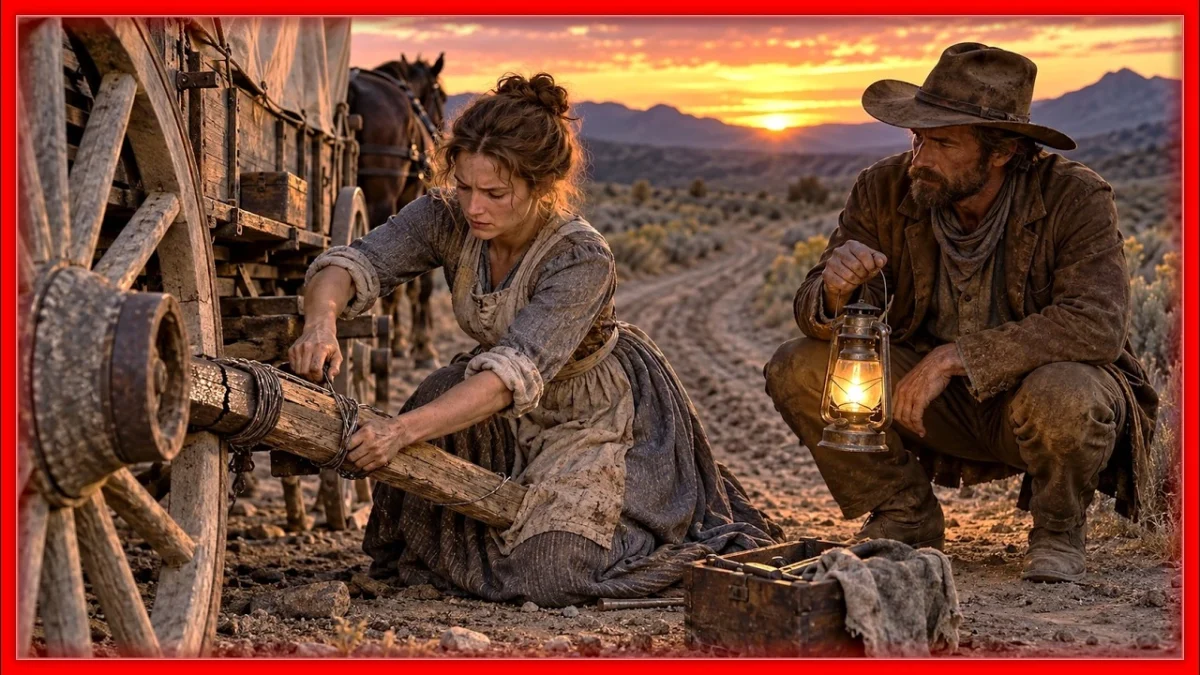
The axle went with a crack like a rifle shot on the lonely stretch of dirt road three miles west of the depot.
The heavy wooden wagon lurched violence to the right, burying its rim deep into the soft ditch grass before Micah Todd had time to curse.
He caught himself against the seat rail, pulled the team to a shivering halt, and stared out at the empty expanse of dust and sagebrush.
“No,” he said to the quiet air, to the tilted wagon bed, and to the vast blue sky.
“Not today.
Not this day of all days.”
He hauled his pocket watch out of his waistcoat with a hand that was already trembling slightly from frustration.
The tin face showed twenty minutes past one.
He was an hour behind schedule, and the depot at Lone Tree was still two hours off even with a wagon that had four whole wheels under it.
Somewhere down the iron rails to the east, a steam locomotive was huffing toward a wooden platform where he was supposed to be standing.
He was supposed to be there in his best wool coat, hat in hand, looking like a man who had his life in order.
Instead, he was going to arrive caked in ditch mud, leading a lame team, looking like a fool whose world fell apart on the way to fetch his own mail-order bride.
He climbed down from the seat, his boots sinking into the damp earth, and knelt to examine the ruin.
The rear oak axle had sheared clean near the hub, leaving splintered white wood jutting out like broken bone.
It was an old break, grayed with dry rot at the core that he should have noticed three months ago when he greased the spindles.
Micah sat back on his heels, took off his hat, and wiped the sweat from his forehead with the back of his sleeve.
“Honest,” he muttered to himself, staring at the splintered wood.
“At least it’s honest.”
He had been plain enough in his letters to the agency back in Saint Louis, plainer than any man looking for a wife had a right to be.
He had not sent a photograph of someone else’s house, nor had he bragged about the size of his herd.
“It is hard country,” he had written with a blunt nib on cheap paper.
“It is a hard, quiet house.
I am not a wealthy man, nor a smooth one, and I will not pretend otherwise to get a woman out here under false colors.
There is a hired hand named Ezekiel who speaks when he pleases, a leaking roof over the kitchen, and more wild cattle than good sense.
If that suits you, write back.
If it does not, I will think none the worse of you for saying so.”
He had expected a delicate city woman who would read those lines, shudder at the thought of wind and dust, and toss the paper into the stove.
Or perhaps some desperate widow who needed a roof so badly she would accept any terms, no matter how grim.
Instead, three weeks later, he had received a short, neat reply written in a stiff, slanted hand.
“I am not afraid of hard, Mr. Todd,” the letter had said.
“I have had little else.”
It was signed Lena Bauer, followed by a date and the number of her train.
Now, that date had arrived, and Micah was kneeling in a ditch three miles from town, trying to wedge a rotten fence rail under an iron-bound wheel that weighed more than he did.
After twenty minutes of straining until his eyes went dark, the rail snapped in half with a dull pop, leaving him flat on his back in the mud.
He lay there for a moment, looking up at the passing clouds, listening to the gentle cropping sound of his horses eating ditch grass.
“Well,” he told the sky.
“Walking it is.”
He unhitched the team, tied the reins together, and began the long, dusty walk toward Lone Tree, leading the two horses behind him.
His boots felt heavier with every mile, the mud drying into a hard, gray crust around his ankles.
By the time the low wooden roof of the Lone Tree depot came into view, the sun was dropping toward the western ridges, throwing long, dark shadows across the tracks.
The platform was completely deserted except for one figure.
She was standing beside a single leather-bound trunk near the freight office, her hands folded neatly over her skirt, watching him approach.
She did not pace.
She did not peer down the road with an anxious hand over her eyes.
She simply stood there, perfectly still, watching him with the calm, flat assessment of a buyer examining a horse at an auction.
She had been waiting on that wooden platform for nearly three hours, and by the look of her boots, she had not sat down once.
Micah stopped ten paces off, pulling his hat from his head, feeling the full length of the speech he had prepared on the road completely evaporate from his mind.
“Miss Bauer?” he asked, his voice rough from dust.
“Mr. Todd,” she said.
Her voice had a low, round German weight to it, unhurried and clear.
“You are late.”
“I am,” Micah said, looking down at his muddy boots and then up at her face.
She was not small, nor was she delicate.
She had broad shoulders under a dark traveling dress that had seen better days, and her dark hair was pinned back in a sensible, tight coil.
Her face was square-jawed, her gray eyes sharp and clear under straight brows.
“My axle broke two miles back,” he offered, feeling small.
“The rear oak sheared at the hub.
I had to walk the team in.
I’m sorry, Miss Bauer.
It is a poor start for a man who wrote you a whole letter about being dependable.”
Lena Bauer looked at his mud-caked trousers, looked at the two tired horses behind him, and then looked down the empty road leading back into the hills.
“Show me,” she said.
Micah blinked.
“Show you?”
“The wagon,” she said, reaching down to pick up her heavy leather trunk by its iron handle without waiting for him to offer.
“It is on the road, yes?
Then show me.”
“Miss Bauer, it’s two miles back,” Micah said, taking a step toward her to reach for the trunk.
“You’ve been standing here for hours.
We can go to the boarding house in town.
I can get a rig from the livery tomorrow—”
“The boarding house costs money you do not need to spend,” she interrupted, shifting the trunk to her other hand before he could touch it.
“And a wagon left in the ditch overnight loses its harness to the first traveler who comes by with a light finger.
Lead the horses, Mr. Todd.”
She set off down the dirt road before he could gather his thoughts, her stride long and sure despite the heavy skirts of her traveling dress.
Micah stood for a second with his hat in his hand, then turned his horses around and trotted to keep pace with her.
They walked in silence for the first mile, the only sound being the soft thud of horse hooves and the rustle of dry grass in the evening breeze.
Every few minutes, Micah would glance over at her, expecting to see her falter, or complain about the dust, or ask to rest on the trunk.
She did none of those things.
She walked with her head up, her eyes scanning the countryside, taking in the dry ridges, the sparse timber, and the distant, dark line of the mountains.
When they finally reached the spot where the wagon sat tipped like a drunkard in the ditch, Lena did not hesitate.
She walked straight into the tall grass, set her trunk down on a dry rock, and circled the tilted wagon once.
She gathered her skirts, crouched down in the dirt without a word of concern for her dress, and put her bare hand flat against the broken axle.
She felt the splintered wood, traced the dark circle of rot near the iron hub, and let out a short, soft sound through her nose—a small “tch” sound that Micah would later learn meant she had already identified the problem, solved it, and was merely annoyed at the negligence that caused it.
“Dry rot,” she said, standing up and wiping her dusty palm against her skirt.
“It has been split for six months.
A blind man could have felt the play in the wheel.”
Micah flushed, the heat rising under his collar.
“I’ve been busy with the cattle—”
“Fence rail,” she cut in, turning her back on him to look at the cedar fence running along the road edge.
“And wire.
Do you have heavy fence wire in the box?”
“I have wire,” Micah said, holding his ground.
“But Miss Bauer, you don’t need to be messin’ with this in the dark.
I can walk back to the ranch, get Ezekiel, and bring the heavy sled—”
“I drove freight for six years, Mr. Todd,” she said, her voice entirely devoid of pride or anger, stating it merely as an unassailable fact.
“From Salt Lake north into the mining camps and back again.
In winter.
With six mules and a trail wagon behind me.
I have broken axles in places where there was no fence, no wire, and no man standing by with his hands in his pockets.
Give me the wire.”
Micah stared at her for three seconds, his mouth slightly open.
Then he turned, climbed into the tilted bed of the wagon, and hauled out the heavy roll of galvanized wire and a pair of iron pincers.
When he climbed back down, she was already standing there with a thick oak fence rail she had somehow pried loose from the post with her bare hands and a heavy stone.
“Hold this end,” she commanded.
He held the end.
For the next twenty minutes, under the darkening canopy of the twilight sky, Micah Todd watched his mail-order bride work.
She pushed her sleeves up past her elbows, ignoring the smudge of black grease that marked her forearm.
Her pins slipped from her hair, letting dark strands fall around her face, but she didn’t bother to brush them back.
She set the oak rail along the underside of the broken axle, notched it with his hatchet with clean, powerful strikes, and began wrapping the heavy wire around both timbers.
She used a stout wooden peg to twist the wire tight, levering it with a mechanical efficiency that made the iron wire bite deep into the wood until the joint was as rigid as solid iron.
“There,” she said, kicking the iron rim with her boot.
The wheel didn’t budge.
“It will get us to the house.
Tomorrow, you will tear it off and put in hickory.”
She walked over to the dry rock, picked up her leather trunk, and tossed it into the back of the wagon bed with a heavy thud.
Then she turned and held out her hand to him.
“The lantern,” she said.
Micah looked down at his own hand.
Without even realizing it, he had lit the tin lantern from the wagon box and was holding it up like a dutiful boy illuminating a workbench for his master.
He handed it to her without a word.
She hung it from the front seat iron, climbed up into the driver’s seat with a single smooth movement, picked up the reins, and looked down at him.
“Are you coming, Mr. Todd?
Or are you walking behind?”
Micah climbed up beside her, taking the reins back only because his pride demanded he drive his own team onto his own land.
As the wagon rattled down the dark, rutted trail toward his house, the splinted axle holding steady with every jolt, Micah looked sideways at her profile against the starlight.
He had written a letter asking for a woman who could endure a hard life.
He realized now, with a sudden, dizzying lurch in his chest, that he had ordered a wife the way a man orders timber—sight unseen—and had received something far larger, heavier, and more unyielding than he knew how to carry.
They reached the ranch house after nine.
The house was dark, save for a single lantern burning in the bunkhouse fifty yards away where Ezekiel was likely sleeping.
Micah brought her into the kitchen, lit the oil lamp on the pine table, and motioned toward the bench.
“It isn’t much,” he said, suddenly acutely aware of the dust on the floorboards, the unwashed coffee pot on the stove, and the rough timber walls.
“I can fry some salt pork.”
“Cold biscuits are fine,” she said, setting her bonnet on the table.
“And water.”
They sat across from each other at the small table, eating cold, heavy biscuits with grease-stained fingers in a heavy silence.
Micah watched her eat.
She did not nibble.
She ate with the same steady, economical movement she had used to wrap the wire around the axle—no wasted motion, no pretense.
“I don’t know what I asked for in that letter, Miss Bauer,” Micah said softly, breaking the silence as he set his tin cup down.
“But I don’t believe I asked for this.”
Lena stopped with a piece of biscuit halfway to her mouth.
Her gray eyes met his, cold and steady in the lamplight.
“Are you disappointed, Mr. Todd?”
Micah looked at her hands—broad, short-nailed, with a fresh red wire-scrape across the back of the thumb.
Then he looked at her eyes, which showed no fear of him, no fear of the dark house, and no fear of the empty country outside.
“I don’t know,” he said honestly.
“I don’t know if it’s disappointment or something closer to being terrified.”
A tiny muscle at the corner of her mouth twitched, but she did not smile.
“Rest,” she said, standing up and clearing her plate.
“Tomorrow there is work.”
The wedding took place three days later in the small, drafty frame church at the crossroads.
Pastor Reeves, a man whose black coat was faded to gray at the elbows, stood behind the pulpit and read the service from a thumb-worn book.
Micah stood beside Lena, wearing his one good suit, feeling less like a groom taking a wife and more like a small shareholder being admitted into a large, serious enterprise.
When the pastor asked Lena for her vows, she answered in a clear, flat voice that didn’t hesitate for a fraction of a second.
“I do,” she said, looking Micah straight in the eyes, her gaze so direct it made his neck hot.
When it came his turn, Micah’s voice cracked slightly on the word *honor*.
From the second pew, Ezekiel—his long, thin frame folded into a clean cotton shirt—let out a quiet, wheezing snort that sounded suspiciously like a man trying not to laugh aloud.
Outside on the church steps, after the pastor had shaken their hands, Ezekiel ambled up, leaning against the wooden railing with a twig between his teeth.
“Half the county’s sayin’ you married up, boss,” Ezekiel said, grinning until his yellow teeth showed.
“The other half’s sayin’ she married down.
I ain’t decided which way the money ought to go, but I know which way I’m bettin’ if anybody asks.”
“Neither have I decided,” Micah said under his breath, watching Lena.
She was currently shaking Pastor Reeves’s hand with a grip that caused the old clergyman to bow his head slightly and laugh in surprise.
“She’s a fine woman, Micah,” the pastor said, coming over to tap Micah’s shoulder.
“A bit… solid, perhaps.
But solid holds the roof up when the wind comes.”
“Yes, sir,” Micah said.
“Solid.”
The weeks that followed did not soften her.
If anything, the homestead seemed to bend itself to her will rather than the other way around.
On her fourth morning, before the sun had cleared the eastern ridge, Micah walked out to the horse corral to find her already inside the fence with a three-year-old green colt he had been putting off breaking for two months.
The colt was snorting, its ears back, eyes rolling white.
Lena stood in the center of the dirt ring, holding a long lead rope, speaking to the animal in low, rhythmic German phrases that sounded like smooth stones rolling in a stream.
She did not use a whip.
She did not yell.
She simply moved with the colt, stepping inside its space when it yielded, backing off when it panicked, until within an hour, the horse was standing beside her, trembling, its lathered neck resting against her shoulder while she gently scratched behind its ears.
“It was on the list,” she said casually when Micah leaned over the fence rail, his mouth open.
“He is a good horse.
He just has a stupid mouth because you pull too hard on the left rein.”
“I don’t pull hard on the left,” Micah protested.
“You do,” she said, opening the gate and walking past him toward the barn.
“The left rein is shorter by two inches.
I measured it.”
By the second week, she had reorganized the tool shed.
For five years, Micah had kept his axes, chains, and iron wedges in a pile in the corner where he could usually find them by kicking around in the dark.
Lena spent an afternoon driving iron spikes into the cedar posts, hanging every scythe, saw, and bridle according to its size and purpose.
When Ezekiel went to fetch a double-bitted axe that evening, he stopped at the shed door, looked inside at the immaculate walls, and slowly pulled his hat off.
“Boss,” Ezekiel whispered to Micah later while they were greasing the harness by the pump.
“I’d sooner step barefoot on a prairie rattler than put a shovel back in the wrong spot in that shed.
I mean that true.”
“So would I, Ezekiel,” Micah admitted softly, looking back toward the house where smoke was rising straight from the chimney.
“So would I.”
Yet, as the farm began to run with the smooth, relentless precision of a clockwork engine, Micah felt an odd, heavy lump growing in his chest.
He had spent his whole life believing that a man’s value lay in his ability to protect, to provide, to carry the heavy end of the log so the woman wouldn’t have to.
He had brought Lena out here expecting to build a shield around her against the harshness of the West.
Instead, he found himself standing in his own yard night after night feeling like an extra wheel on a small cart—a spare part nobody had ordered and nobody knew where to store.
One late afternoon, he found her in the barn, her skirt pinned up around her knees, holding a heavy iron hammer over a anvil, preparing to reshoe the draft mare.
He had explicitly told her that morning he would take the horse into town to the blacksmith on Friday.
“Lena,” he said, his voice coming out sharper than he intended.
“Drop the hammer.”
She paused, the iron tool held mid-air, and turned her gray eyes on him.
“The shoe is loose,” she said calmly.
“If she walks to town on it, she splits the wall.”
“I said drop it,” Micah repeated, taking two long steps into the dim light of the barn.
“You don’t have to do every single thing on this place yourself.
I told you I’d handle the shoeing.”
Lena looked at him for a long, quiet moment.
She slowly set the heavy hammer down on the face of the anvil with a dull clink, but she did not step back.
“Would you rather I did less?” she asked.
Her voice was not angry, but for the first time since he had met her at the depot, there was a flicker of uncertainty in her expression—a faint crease between her brows.
“I do not know how to sit with my hands in my mouth, Micah.
My father had four daughters and no sons on a farm near Stettin.
We worked, or we did not eat.
In the freight camps, if you do not fix your own wheel, you freeze in the pass.
I only know how to do.”
“I know,” Micah said, rubbing his neck, feeling the frustration deflate out of him, leaving only a hollow ache.
“I know you do.
And you do it better than me.
You mend fence straight, you break colts in an hour, and you don’t waste a penny.
But I’m the man who brought you here, Lena.
I’m supposed to be taking care of things.
And every time I turn around, you’ve already done the job, done it faster, and pointed out where I was doing it wrong.
It leaves me wondering what I’m here for.”
Lena stood beside the anvil, her hands resting on the cold iron.
“Ah,” she said softly.
She did not offer a quick answer.
She picked up the shoeing hammer again, turned it over in her hands, and then went back to work, the rhythmic *clink-clink-clink* of iron fillling the barn.
For three days after that, she was quieter than usual.
She did her work, but she spoke only when spoken to, and Micah worried he had driven a wedge between them that could never be pulled out.
The breakthrough came on a rainy Tuesday evening in late May.
The wind was howling off the high plains, driving a cold, sheeted rain against the glass of the kitchen window.
They had finished supper, and Micah was sitting near the stove, oiling his leather boots by the light of a single kerosene lamp.
Across the table, Lena was sitting with an open paper booklet in front of her—a seed catalog that had arrived in the morning mail from Omaha.
She was leaning low over the page, her face inches from the print.
Her lips were moving slow and hard, working over silent syllables, her thick forefinger tracking across the line like a child who had just learned her alphabet weeks ago.
She stayed on a single page for ten minutes, her brow furrowed, a tiny drop of sweat forming at her temple despite the chill in the room.
When she came to a long word, she let out a sharp, frustrated breath through her teeth and made to close the book.
Micah set his boot down quiet.
“What is it?” he asked gently.
Lena froze, her hand flat on the paper cover.
A dark, red flush crept up from the collar of her dress, staining her throat and cheeks—an embarrassment so deep and raw he had never seen anything like it on her face before.
Not when she was knee-deep in ditch mud, not when she was handling wild horses.
“It is nothing,” she said stiffly, her English suddenly sounding thicker, more wooden.
“Just pictures.”
“Lena,” Micah said, rising from his chair and walking over to the table.
He stood behind her, looking over her shoulder at the fine print under an engraving of a hybrid corn variety.
“Can you read the descriptions?”
She kept her eyes fixed on the table, her jaw set so tight her cheek muscles quivered.
“My English is for talking,” she said, her voice dropping very low.
“It is for freight manifests with numbers.
It is for orders: *two sacks flour, five kegs nails*.
My father taught us the farm, the cattle, the mules, the weather.
He had no time for books.
The school in the valley was closed when the snow came.
In the freight office, the clerks did not care if I could read the stories, so long as I signed my mark to the delivery book.”
She pulled her hand back from the page, hiding it in her lap.
“I can read the numbers,” she added, a sudden edge of defensive pride returning to her voice.
“I know what a dollar is.
I know what a bushel weighs.”
Micah looked down at the top of her head—at the straight, clean part in her dark hair, at the small, sturdy shoulders that had carried six years of freight through mountain passes.
And for the first time in two months, the knot in his chest loosened entirely.
“I can teach you,” he said.
The words came out of him simple and easy, without a trace of hesitation or pride.
Lena did not look up immediately.
“I am twenty-eight years old,” she said to the oilcloth tabletop.
“It is stupid for a grown woman to sound out words like a calf learning to walk.”
“It isn’t stupid at all,” Micah said, taking the chair beside her.
He reached out, took the catalog, and turned it back to the page she had been staring at.
He pointed a calloused finger at the long word that had stopped her.
“That word there is *unfavorable*,” he said softly.
“It means bad weather, or poor ground.
*Un-fa-vor-a-ble*.”
Lena looked at his finger, then at the black type.
Her lips moved.
“Un-fa-vor-a-ble,” she repeated, her German accent softening the middle vowels.
“That’s it,” Micah said, smiling for what felt like the first time in weeks.
“We can do it every night.
After supper, when the chores are down and Ezekiel is in the bunkhouse.
We’ll take the paper, or the Bible, or the farm reports.
Half an hour.
That’s all.”
Lena turned her head slowly to look at him.
Her gray eyes searched his face, reading the lines around his mouth, looking for any trace of pity or mockery.
She found none—only a quiet, steady patience that mirrored her own.
“You would do that?” she asked softly.
“I would,” Micah said.
“I’d like to.”
“It is a deal, then,” she said, though she did not shake his hand this time.
She simply left the book open between them.
That night marked the beginning of a new rhythm in the house.
Every evening, after the greasy dishes were washed and the stove was stoked for the night, the lamp was brought to the center of the pine table.
Micah would sit with his shoulder nearly touching hers, his long finger moving across the columns of newspapers, catalogs, and old books he dug out of a trunk in the attic.
Lena was an intense, impatient student.
When she mispronounced a word, she would hiss at herself, slam her hand on the table, and make Micah repeat it three times until her tongue mastered the sharp English consonants.
She learned with the same fierce, terrifying speed she applied to everything else.
Within three weeks, she was reading full paragraphs without stopping.
Within a month, she was reading the weekly county paper aloud to him while he mended harness leather by the lamp.
And Micah found that those quiet, yellow-lit hours at the kitchen table became the anchor of his life.
He no longer felt like an unnecessary accessory on his own ranch.
He was the man who had given her the keys to a house she had been locked out of her whole life, and every time she successfully sounded out a complex sentence, the look of quiet triumph on her face was worth more to him than every fence post he had ever set.
In late spring, the rains came with a fury that turned the dry coulees into roaring brown torrents.
A mudslide came down off the northern bluffs, taking out forty yards of the main canyon road—the only road connecting the valley ranchers to the railhead at Lone Tree.
It happened two days before Micah’s contract delivery of thirty head of prime steers was due at the stockyards.
On Wednesday morning, four local ranchers rode into Micah’s yard, their horses dripping wet, their faces dark with gloom.
“We’re stuck, Todd,” said Silas Vance, the eldest of the group, leaning over his saddle horn.
“Road’s buried six feet deep under timber and clay.
Won’t be cleared for a week.
Buyer at the depot says if the cattle aren’t in the pens by Friday afternoon, the contract is void and he’s buying from the south valley instead.”
“A week?” Micah said, looking out at the pouring rain.
“Can’t we work around through the lower creek?”
“Creek’s five feet over its banks,” Vance spat.
“You’d drown half the herd trying to swim ’em.
We’re out forty head’s worth of profit, every last one of us.
Nothing to do but wait for the sun and take the loss.”
The men sat on their horses for a few minutes, cursing the weather, before turning back down the lane.
Lena had been standing on the porch, a wool shawl pulled over her shoulders, listening to every word.
She watched the riders vanish into the gray sheets of rain, then walked inside without saying a word to Micah.
When Micah entered the kitchen ten minutes later, he found her pulling on her heavy oiled coat and tying a leather cap tightly over her ears.
“Where are you going?” he asked, startled.
“To hitch the team,” she said, snapping her brass buckles shut.
“The cattle can go over the high ridge trail.”
Micah stared at her.
“The high ridge?
Lena, nobody’s used that trail since the timber company abandoned it ten years ago.
It’s narrow, it’s steep, and with this rain, it’s a grease-track.”
“It is a road,” she said firmly, pulling her heavy gloves on.
“It has a rock base underneath the leaf mold because the timber wagons packed it down for twenty years.
The canyon road is clay; that is why it slid.
The ridge is granite.
It will hold.”
“It’s too dangerous for a full wagon, let alone driving stock—”
“I have driven four tons of dynamite up a trail narrower than your arm span in the Wasatch mountains, Micah Todd,” she said, turning to look him dead in the eye.
“With mud up to the hubs and lightning hitting the pines above me.
We are not losing thirty head of beef because four old men are afraid of a little mud.”
She didn’t wait for his permission.
She walked out into the pouring rain, and after standing indecisively in the kitchen for five seconds, Micah grabbed his coat and ran out after her.
What followed was twenty-four hours of grueling, bone-chilling hell.
They gathered the thirty steers with Ezekiel’s help, pushing the reluctant animals up the steep, winding spur trail that led to the top of the granite ridge.
Lena rode the lead horse, her face set like carved stone against the driving wind, picking out the trail through the thick brush where the path had overgrown.
Where the trail narrowed to a ledge barely six feet wide with a hundred-foot drop into the ravine below, Micah’s heart lodged firmly in his throat.
His horse slipped once, back legs sliding into the mud before recovering, but Lena rode ahead without a tremor, her voice ringing out clear over the storm, calling to the lead steer, guiding the herd with a calm, terrifying authority.
They reached the Lone Tree stockyards at two o’clock on Friday afternoon—two full hours before the buyer’s deadline.
The steers were muddy, wet, and tired, but every single one of the thirty head was alive and standing on four feet.
The stockyard agent, a fat man in a dry wool coat who had spent the morning assuming no cattle would arrive from the north, stared at the mud-drenched trio in utter disbelief as he signed the receipt voucher.
“How in the name of God did you get thirty steers over the ridge in a gale?” the agent asked, staring at Lena, who was calmly wiping rain from her horse’s saddle with a rag.
“We walked,” Lena said simply.
She took the signed voucher from the man’s hand, checked the dollar figure twice with her sharp gray eyes, and handed it to Micah.
As they sat in the small town cafe an hour later, drinking scalding black coffee while their clothes steamed near the potbellied stove, Micah looked across the table at his wife.
Her face was smeared with black ridge dirt, her hands were raw from the leather reins, and she looked utterly, completely unbothered.
“You could have been killed on that ledge, Lena,” Micah said softly, holding his coffee mug in both hands to stop the shaking.
“I have driven worse roads in worse years for men who did not care if I lived or died so long as the freight arrived,” she said, setting her cup down with a small clatter.
Then she looked up, her gray eyes locking onto his with an intensity that made his breath hitch.
“I was not going to let a little mud beat me on my own husband’s contract.”
The words *my own husband’s* hung in the air between them, heavy and sweet, vibrating like a plucked wire.
Micah felt something shift inside his chest—a sudden, deep settling of foundation stones that had been loose for years.
The news of the ridge crossing spread through the county like prairie fire.
Within three days, every rancher from Lone Tree to the river knew that Micah Todd’s new German wife had brought a herd over a dead trail in a gale to save a contract.
It was that news that brought the visitor to their door a week later.
A two-horse buggy drove up the lane on a sunny afternoon, carrying a heavy-set man in a fine wool suit with a thick gold watch chain across his waistcoat.
Micah was on the porch cleaning a bridle when the man stepped down, unlit cigar clamped between his teeth.
“Todd?” the man asked, lifting his hat half an inch.
“I’m Dunmore.
Dunmore Freight & Line.”
Micah stood up, recognized the name immediately.
It was the largest freighting outfit in the territory—the very company that operated out of Salt Lake and the northern camps.
“Mr. Dunmore,” Micah said cautiously.
“What can I do for you?”
“I’m here to see Lena Bauer,” the man said, looking past Micah toward the house.
“Or Mrs. Todd, as I hear she is now.”
Lena appeared at the screen door a second later, her sleeves rolled to her elbows, flour dusting her forearms from baking.
She looked at Dunmore, her face instantly hardening into a mask of cold recognition.
“Dunmore,” she said.
“Mrs. Todd,” Dunmore said, stepping up to the porch railing, pulling a folded paper from his pocket.
“Word gets around.
I heard about the ridge trail delivery last week.
I remembered your name from the Utah runs three years ago.
You were the best driver on the northern route until… well, until we had that restructuring.”
“Until you gave my team to your nephew,” Lena said without a trace of heat, her tone purely factual.
“Who rolled the wagon into the Snake River two months later.”
Dunmore winced slightly, but pressed on.
“A mistake,” he admitted, waving a hand.
“A management error.
Which is why I am here in person.
The northern line is short on drivers who actually know how to keep a rig on the road in bad weather.
I am expanding the mountain route from here to the iron mines.”
He set the folded paper on the porch railing between them.
“I’m offering you the lead driver position for the northern division.
Double your old wage.
Eighty dollars a month.
Your own team, your choice of wagons, and three drivers under your direct order.
A six-month contract starting June first.”
Micah felt as if the air had been suddenly sucked out of his lungs.
Eighty dollars a month was more cash than his entire farm brought in after taxes and feed bills in a good year.
In six months, she would earn nearly five hundred dollars—a fortune in the valley.
He looked at the white paper on the rail, then at Lena’s face.
She wasn’t looking at Dunmore.
She was looking at the paper, her fingers twitching slightly against her apron.
“That is a great deal of money,” she said quietly.
“It is,” Dunmore agreed, sensing an opening.
“It’s what you’re worth, Lena.
You’re the best driver in three territories, and it was a mistake to let you go.
Sign the paper, and we’ll have you in Lone Tree by Monday.”
Micah stepped back toward the doorframe, his throat dry, his stomach dropping into a dark, cold pit.
He looked down at his own dusty boots, feeling the familiar, bitter weight of his own limitations returning to crush him.
“Take it, Lena,” Micah said.
His voice sounded thin, hollowed out by the effort it took to speak.
Lena turned her head sharply to look at him.
“What?”
“Take it,” Micah repeated, forcing himself to look her in the eyes, though it felt like tearing skin.
“I knew what I was when I wrote that letter to the agency in St. Louis.
I told you plain I wasn’t a wealthy man, nor a smooth one.
I’m just a guy with three hundred acres of dry grass, a leaky roof, and a broken axle in every ditch.
I can’t give you eighty dollars a month.
I can’t give you a fleet of wagons or people to command.
I was never going to be able to offer you enough to make staying here worth more than what a company like that can pay you.
Go on and take it.
I won’t hold it against you.
A man ought to know his own ceiling, and I’ve always known mine.”
The porch went dead silent.
The wind rustled the dry leaves of the cottonwood tree in the yard.
Dunmore smiled slightly, taking a silver lighter from his pocket to light his cigar, believing the matter was concluded.
Lena did not look at Dunmore.
She did not look at the contract on the rail.
She walked slowly toward Micah until she was standing two feet from him, her gray eyes burning with a dark, furious fire he had never seen in her before.
“You are a foolish man, Micah Todd,” she said.
Her English came out slow, deliberate, each word placed like a heavy square stone laid into a wall.
“You gave me the words,” she said, her voice trembling slightly with a suppressed emotion.
“Now I am using them to say no.”
Micah blinked, stunned.
“Lena—”
“Shut your mouth,” she snapped, turning her back on him to face Dunmore.
She picked up the folded paper from the rail, didn’t even bother to open it, and handed it straight back to the freight boss’s chest.
“I did not marry this man for a wage, Mr. Dunmore,” she said, her voice ringing out across the quiet yard.
“I have had wages.
I have had money in my hand at the end of a long, cold week, and I have sat in a drafty boarding house with no one waiting for me at the end of the road to ask how my day went.
I will not trade a partnership for a fortune, however large your numbers are.”
Dunmore’s jaw went slack, the unlit cigar hanging precariously from his lip.
“Mrs. Todd, be sensible—eighty dollars—”
“I am sensible,” she cut him off, stepping down off the porch onto the dirt drive, forcing the heavy man to step back a pace.
“Wait here.”
She walked into the house, her boots heavy on the floorboards, and returned five seconds later carrying the big leather-bound ranch ledger—the same ledger she had spent three weeks reorganizing from Micah’s messy box of paper receipts.
She flipped the heavy book open on the porch rail, her thick forefinger pointing directly to the final column of neat ink numbers she had written herself by lamplight.
“Look,” she commanded Dunmore.
“Read.”
Dunmore blinked, leaning over to look at the ledger.
“This is our property,” Lena said, her voice dropping into a steady, rhythmic cadence.
“This is what the ranch earned last year when my husband worked it alone.
This is what it earned this spring since my hands took hold of the reins.
Here is the forty dollars saved by fixing our own equipment.
Here is the hundred and twenty dollars from the ridge contract that you thought was impossible.
Here is the projection for the autumn calf sale.”
She looked up from the page, her gray eyes boring into Dunmore’s face.
“My husband offered me a life,” she said, her English precise and flawless.
“And then he sat with me every night by the lamp and taught me the letters and words so I could read the ledger that proves what we have built together.
You are offering me hours and dollars that end when I am too old to hold the reins.
He offered me a home that stays when the snow comes.
I have done the arithmetic both ways, Mr. Dunmore.
I know which is worth more, and it is not close.”
She slammed the ledger shut with a soft, final thud that sounded like a door closing forever on the freight company.
“Tell your company I am not for hire,” she said.
“And do not come back to this yard.”
Dunmore stood on the gravel drive for ten seconds, looking at the solid, fierce woman standing on the porch, then at Micah, who was standing in the doorway looking like a man who had just seen the heavens open up.
The freight boss opened his mouth to say something, realized there was not a single word in the English language that would change her mind, stuffed his paper back into his pocket, and climbed into his buggy without lighting his cigar.
He turned the horses around and drove down the lane at a trot, the dust rising behind him.
Micah stood on the porch, watching the buggy vanish down the road until the dust settled back into the grass.
He didn’t say a word.
He couldn’t.
“What?” Lena asked, turning to him, brushing her dusty skirt down with her palms, her cheeks still slightly pink from her outburst.
“Why are you looking at me like that?”
Micah looked at her—really looked at her—in the bright afternoon sun.
“I have never in my life seen a man leave a negotiation looking so thoroughly beaten by arithmetic,” he said softly.
A tiny, rare smile tugged at the corner of Lena’s mouth—the small, private smile she reserved for when she was proudest of a job well done.
“Numbers do not lie, Micah,” she said, turning to walk back inside the kitchen.
“Only people do.
I have always trusted the numbers more.”
That evening, long after the sun had gone down and the cold wind had returned to rattle the windowpanes, Micah sat at the kitchen table with a fresh sheet of white paper and a bottle of black ink.
Lena was sitting beside him, a mug of warm tea between her hands, watching him write.
“What are you writing?” she asked.
“A letter,” Micah said, dipping his steel pen into the ink.
“To the agency in Saint Louis.
The one that sent you out here.”
“Why?” she asked, her eyes narrowing slightly.
“They need an update,” Micah said, his mouth twitching with a hidden smile.
“They keep records on how these marriages turn out.”
He drew the lamp closer, smoothed the paper, and wrote three short sentences in his clear, looping hand:
*Wife arrived.*
*Is stronger than me.*
*Do not send help.*
He stopped, leaned back, and turned the paper toward her.
“Read it,” he said gently.
Lena leaned over the table, her face close to the page in the yellow light.
Her lips moved slowly, sounding out the letters she had learned over the long winter evenings.
“Wife… arrived,” she read out loud, her German accent lingering on the consonants.
“Is… stron-ger… than… me.
Do… not… send… help.”
She stopped.
She looked at the short text, then looked up at Micah, her gray eyes warm and bright in the lamplight.
Then, for the first time since he had met her on that windy depot platform three months ago, Lena Bauer laughed.
It was a real laugh—rich, warm, and startled out of her chest, filling the quiet kitchen with a sound that seemed to chase away every cold draft in the room.
She reached out, took the steel pen from his hand, dipped it into the black ink, and brought the point down onto the paper directly beneath his signature.
Carefully, deliberately, with clean, sure letters that no longer trembled or hesitated, she signed her name:
*Lena Todd*
She set the pen down, looked at her name written beside his, and then reached across the pine table to place her hand flat over his calloused fingers.
Micah closed his hand around hers, feeling the rough wire-scrape on her thumb, the broad, strong palm, and the solid weight of a woman who had finally reached the end of her road, and had no intention of ever leaving it.








