He Burned 40 Years of Brush Behind the Barn — Then Stone Steps Appeared in the Ash
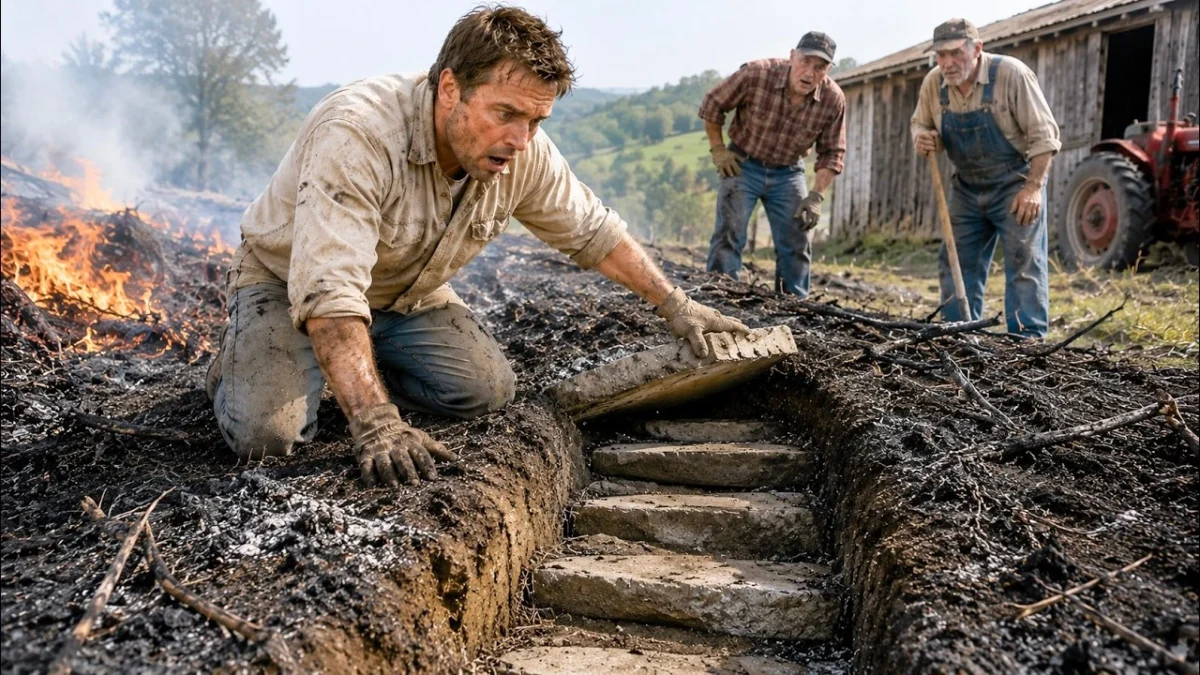
The air above the brush was thick with the scent of dry cedar leaf, sumac, and old dust when Tom Hale struck the match against the striking strip of a wooden box.
The flame flared small and yellow in the pale noon light, then caught the curled dry fringe of grass he had scraped into a pile at the edge of the northwestern ditch.
He stepped back, resting his hands on the wooden handle of his brush hook, watching the fire crawl sideways along the scraped dirt.
It moved with a steady, quiet hiss, finding the dry grapevines first, then climbing into the lower, dead branches of the young cedar trees.
Behind him, the old barn stood dark and weathered, its oak boards greyed by decades of rain, its tin roof reflecting the glare of the late September sun.
Beyond the barn, six acres of hillside sloped upward into the Ozark sky, completely overgrown with forty years of thicket, wild cane, and dense cedar stands.
Tom had returned to Howell County, Missouri, in the spring, right after his uncle Amos had been buried in the churchyard down near the creek.
For fifteen years, Tom had worked in a town garage three counties over, wiping grease from his knuckles and turning wrenches on tractors, trucks, and grain haulers.
Before that, he had been a young man working as a hand on the neighboring farms, learning the lean economics of Ozark soil.
He knew what hay was selling for, he knew what cattle cost to feed through a hard January, and he knew that six acres of overgrown hillside were six acres he was paying county taxes on while the cedar trees used it for nothing.
By late afternoon, the wind from the northwest had done its work, pushing the fire down through the dense brush until the entire slope was a black, smoking field.
The heat had been fierce enough in the cedar thickets to scorch the topsoil down to bare earth, leaving thin white trails of ash where heavy branches had fallen.
Tom stood on the barn floor that evening, watching the last wisps of blue smoke drift up toward the ridge before he went inside to sleep.
Sunday morning came cold and quiet, long before the dew had a chance to lift from the unburned pasture above the fire line.
Tom walked up the slope carrying a thermos of black coffee, his heavy work boots sinking shallowly into the soft, grey ash.
He was looking for cedar stumps, estimating how many days he would need to spend with a chain and the tractor before the ground could be disked and seeded down.
He was not looking for anything else.
Near the middle of the slope, where a cluster of heavy cedars had burned down to smoking, jagged collars, his boot struck something hard that did not yield like limestone float.
He stopped, taking a swallow of coffee, and pushed the toe of his boot into the deep ash around his feet.
A flat, rectangular edge of limestone appeared, grey and sharp, set at an angle that natural rock never assumed in those hills.
He leaned down, brushing the grey dust away with his gloved hand.
The slab was roughly four inches thick, clean-cut, and square on three sides, while its upper edge disappeared beneath the charred root mass of an old cedar stump.
Tom set his thermos down on a nearby rock, hooked his fingers under the scorched stump, and pulled with all his weight.
The roots gave way with a sharp dry crack, tearing loose from the earth and exposing another slab set directly below the first one.
It was dropped seven inches down the slope, set back into the earth with deliberate, geometric precision.
Tom walked back down to his pickup truck, reached into the bed, and pulled out his short-handled spade.
He walked back up the hill and began to dig, scooping away the wet ash and black soil from the front of the second step.
A third slab appeared beneath it, then a fourth, each one identical in depth, face, and thick, hand-chiseled edge.
“You find a ledge up there, Tom?” a voice called out from the upper fence line.
Tom stopped his spade and looked up through the thin drift of smoke.
Roy Tanner was standing near the corner post of the pasture, his arms resting on the top strand of barbed wire, wearing his grease-stained felt hat.
“Not a ledge, Roy,” Tom said, wiping his brow with the back of his forearm.
Roy climbed over the wire, his boots crunching on the charred ground as he walked down to where Tom was standing.
He stopped beside the exposed stone and stared down at the four clean steps descending into the unburned ash.
“Those aren’t rocks,” Roy said, taking his hat off and rubbing his forehead.
“No,” Tom said. “They’re not.”
“Where do they go?” Roy asked, leaning over to peer into the brush further down the slope.
“I don’t know,” Tom replied, leaning his weight on the spade handle. “I lived on this place until I was twenty, and I never knew they were here.”
“Amos never said nothing about steps?”
“Not a word,” Tom said. “Not once.”
Roy spat into the ash and shook his head, looking down at the flat stone.
“Well,” Roy said, “if you’re going to dig ’em out, you better watch for copperheads. Smoke brings ’em out of the deep rock this time of year.”
“I’ll watch,” Tom said.
Tom did not bring the tractor up the hill the next morning, nor did he use a team or a heavy iron pry bar.
A strange, quiet care had taken hold of him, the kind of stillness that comes over a man when he realizes he has stepped onto ground that was shaped by hands he used to know.
He worked with the short spade, a small hand trowel, and a brush hook, clearing the packed earth and burned root fibers inch by inch.
By the end of Monday afternoon, he had cleared eleven steps, each one forty-two inches wide, perfectly level, and dropped at the exact same interval.
On Tuesday evening, the counter stood at nineteen steps, leading down toward a deep drop in the hillside beneath the old barn line.
On Wednesday morning, near the middle of the stairs, Tom’s trowel scraped against something hard and metallic embedded in the vertical face of a riser stone.
He dropped to his knees, scraping away the red dirt with his fingers until a square-cut recess in the limestone was exposed.
Inside the recess sat a heavy, corroded iron socket, held firmly in place with lead poured around its edges.
A broken stump of solid iron rail remained seated inside the socket, rusted down to a rough, pitted stub.
Tom sat down on the stone step below it, resting his elbows on his knees, staring at the old iron fitting.
A man did not set iron handrail sockets into hand-cut limestone if he was just building a path to a trash pit.
A handrail meant people walked here in the dark, or in the ice, carrying burdens heavy enough that they needed a free hand to steady themselves on the way down.
“Find something else?” a voice came from above.
Tom looked up to see Roy standing at the top of the stairs, carrying a pair of fencing pliers.
“An iron socket,” Tom said, pointing to the step. “For a rail.”
Roy walked down the steps, counting them under his breath as he descended, his heavy boots making a hollow sound against the stone.
“Nineteen, twenty, twenty-one…” Roy stopped on the step above Tom and looked down at the socket. “That’s leaded in. That took a forge to melt that lead.”
“It took a lot more than a forge,” Tom said. “Look at the cut on these risers. That’s cold-chiseled limestone.”
“Your uncle Amos didn’t do this,” Roy said flatly. “Amos couldn’t cut a straight post with a crosscut saw, let alone chisel stone like that.”
“No,” Tom agreed. “Amos didn’t build this.”
“How far down do they go?”
“Two more steps, looks like,” Tom said, driving his trowel into the dirt at his feet. “Then we hit whatever’s down there.”
By Wednesday afternoon, Tom reached the twenty-third step, nine feet below the grade of the pasture floor.
The bottom step did not lead to a cellar door, a wooden frame, or an open pit.
It ended abruptly against a solid vertical wall built of massive limestone blocks, fitted together so tightly that barely a blade of grass had grown between them over forty years.
The wall had been laid with grey lime mortar, thick and hand-troweled, sealing off whatever lay behind it from the light of the hill.
Roy came back down the steps that evening, holding a flashlight he had taken from his truck.
“It’s just a root cellar,” Roy said, shining the yellow beam along the face of the sealed wall. “Old man Hail probably had an earth cellar down here, roof caved in, and he capped it off so the cows wouldn’t fall in.”
“Maybe,” Tom said, sitting down on the bottom step and leaning his back against the cool stone wall.
As he rested, he felt a strange draft on the back of his neck, cold and steady against his sweat-dampened shirt.
He turned around, placing his hand against the mortar joint on the right side of the wall.
He reached into his pocket, pulled out a box of kitchen matches, struck one, and held the flame close to the narrow joint between two blocks.
The flame leaned inward, pulled toward the dark seam by a steady, invisible draft.
He moved the match six inches to the left, and the flame pulled inward again, fluttering softly in the draw.
“That’s not dead air, Roy,” Tom said softly. “A caved-in root cellar doesn’t breathe like that.”
“The ground settles,” Roy said, though he leaned in closer to watch the flame. “Cracks open up.”
Tom touched the stone with his bare palm; it felt icy cold, far colder than the dry September soil on the hill above them.
He reached into his pocket, pulled out an old metal dial thermometer he used for checking tractor radiators, and pressed the probe flat against the stone block.
The needle drifted down slowly, past seventy, past sixty-five, stopping firm at sixty-three degrees.
Tom stood up, walked up the twenty-three stone steps into the open sunlight, and held the thermometer out in the afternoon air.
The needle swung quickly up to ninety-one degrees.
“Twenty-eight degrees difference,” Tom said, looking down at Roy. “That wall is holding back a lot of cold air.”
The following morning, Tom brought a three-foot steel rod and a hand sledge up from his workshop.
He did not strike the stone blocks; instead, he set the tip of the rod against the soft lime mortar on the right side of the wall and tapped it gently with the hammer.
The mortar crumbled easily, turning to white dust under the steel point, and after four inches of resistance, the rod suddenly punched through into empty space.
Tom pushed the rod further in, sliding it inward until nearly two feet of steel disappeared into the dark void behind the stone.
He moved the rod sideways, probing along the horizontal seam for six feet until he hit solid stone once more on the far side.
“It’s an eighteen-inch wall,” Tom said to himself in the quiet of the morning. “And whatever is behind it is open.”
Two days later, Tom walked past the top of the stairs, heading straight up the hill toward the thick timber line that had escaped the burn.
He walked slowly, his eyes fixed on the ground, looking for anything that did not belong in an Ozark pasture.
Seventy feet uphill from the buried stairs, in a shallow depression shaded by a stand of scrub oak, he found the first pipe.
It was a four-inch terracotta pipe, flared at the collar, emerging from the dirt at a steep angle.
Cedar roots had wrapped around it over the decades, cracking the clay collar, but the opening remained clear of soil.
Tom knelt beside the pipe and placed his palm over the dark hole.
A stream of cool air was rising out of the ground, flowing steadily into the hot morning heat, cool enough to feel like cold water against his skin.
Twenty feet further up the ridge, he found a second pipe, identical to the first, laid along the exact same line.
He stood between the two pipes and looked back down the slope toward the sealed stone wall beneath the barn.
Someone had designed a natural air system into the hill, using the elevation difference to draw cold air up through the earth and vent it out the top.
The chamber below was not a simple pit; it was a engineered underground structure built to maintain a permanent draft.
That afternoon, Tom drove his truck down the county road to the home of Harold Kirby.
Harold was sixty-nine years old, retired, with thick, mason’s hands and white hair that sat low over his brow.
He had spent forty years laying stone for county culverts, barn foundations, and stone houses across three Missouri counties.
When they reached the stairs, Harold walked down slowly, touching the edge of each limestone step with the toe of his boot.
He stood at the bottom for a long time, looking closely at the mortar between the stone blocks.
“Look here, Tom,” Harold said, tapping a section in the middle of the wall with his knuckles. “See that course?”
“What about it?” Tom asked.
“This middle part—about six feet wide and four feet tall—was put in long after the rest,” Harold said, pointing to the mortar line. “The mortar on the outer walls is dark grey, made with river sand and local lime. This stuff in the middle is lighter, portlan’ cement mixed in. Somebody knocked a hole in this wall, and then somebody else closed it up later.”
“Can we take the middle out without bringing the hill down?” Tom asked.
“We can,” Harold said, reaching into his pocket for a cold chisel. “If we take our time and don’t get wild with a sledge.”
They worked together through the afternoon, setting each stone block carefully on the bottom step rather than letting them smash into the dirt.
By four o’clock, the light from the setting sun reached through the open gap, illuminating a dark, narrow passage beyond the wall.
The opening was not a small room; it was a stone corridor, five feet wide and over six feet tall, extending straight into the dark interior of the hillside.
The floor was made of flags of local limestone, sloping gently downward, with a shallow drainage channel carved into the right side.
Tom reached into his coat, pulled out a heavy aluminum flashlight, and stepped through the gap.
“Watch your head,” Harold called from behind. “The ceiling looks solid, but don’t go jumping around.”
The corridor ran sixty feet into the rock before opening into a vast, rectangular chamber.
Tom swept the flashlight beam around the room, the yellow light catching rows of massive stone shelves built directly into three of the walls.
Each shelf was eight feet long, built of heavy slab stone supported by stone piers, with decayed wooden dividers still standing between some of the sections.
In the center of the ceiling, two terracotta shafts opened to the surface, letting in a faint, distant circular glow of day.
The floor was clean, dry, and cool, with a small drain hole cut into the lowest corner.
Tom checked the thermometer he had brought in his pocket; inside the chamber, the air stood at fifty-eight degrees, while the heat outside remained in the upper eighties.
Rusted iron hooks were driven into the stone mortar at regular intervals along the ceiling beams.
Scattered across the stone floor were pieces of broken salt-glaze stoneware, grey and cobalt blue, along with the disintegrated splinters of old wooden crates.
Tom walked along the left wall, holding his flashlight close to the stone shelf facings.
On the front edge of the first shelf section, someone had cut a single capital letter into the limestone with a stone chisel: **H**.
He moved to the next section; the stone face was carved with a sharp, bold **M**.
The third section bore a **C**.
The fourth section had a **B**.
The fifth section was marked with a **D**.
“H, M, C, B, D,” Tom murmured aloud, his voice echoing softly against the corbeled stone ceiling.
He stood in the dark chamber for several minutes, looking at the carved letters, trying to make them fit some system of agricultural grading or crop rotation.
On Friday morning, Tom drove into town and parked in front of the Howell County Courthouse.
He walked into the county recorder’s office, asking the clerk for the historical plat maps of his section from the early 1930s.
The clerk brought out a heavy leather-bound volume, its pages yellowed and dry along the edges, and laid it out on the long oak table.
Tom turned the pages until he found his uncle’s section from 1932.
The map showed his farm, marked under the name of his grandfather, Hail, surrounded by four adjacent properties.
To the north lay the Miller place.
To the east was the Carter farm.
To the south was the Brooks land.
To the west was the Dawson holding.
Hail, Miller, Carter, Brooks, Dawson.
**H – M – C – B – D.**
Tom sat back in his chair, staring at the old black-ink lines on the map.
The underground room was not a private cellar built by his family; it was a shared storage facility, built by five neighboring farms during the height of the Great Depression.
Each family had its own assigned section, marked with its initial carved directly into the stone shelf.
He walked down the hall to the county historical room, where an elderly volunteer helped him search through old agricultural extension bulletins from the 1930s.
In a thin, stapled pamphlet from 1935 titled *Community Food Preservation in the Ozark District*, they found a single line of text:
*Hail Hill Storage Association – Howell County – Co-operative root and fruit vault.*
There was no drawing, no map, and no further detail.
Later that week, Tom went through a box of old farm papers he had found in the attic of his uncle Amos’s house.
In a worn manila folder labeled *Barn & Fencing – 1948–1952*, he found a yellowed receipt written in pencil on cheap ledger paper.
The receipt was dated October 12, 1951.
*Received of Amos Hail – $12.40 for stone, lime, and hauling – Hail Hill entrance repair and closure.*
At the bottom of the slip was his uncle’s signature, written in dark, shaky blue ink.
Amos had not discovered the chamber by accident; he had helped put the final mortar into the wall that closed it away.
The following Tuesday, Tom drove down a gravel road three miles east to visit Lena Barrett.
She was eighty-three years old, sitting on her front porch in a green rocker, her hands folded in her apron.
“I remember the Hill Room,” Lena said, her voice clear and light when Tom asked her about the structure. “My mother used to send me up there with baskets in September after the apple harvest was picked. We’d take green beans in stoneware crocks, wrapped in damp straw, and carry ’em up those steps.”
“What did it smell like down there, Mrs. Barrett?” Tom asked softly.
“It smelled like damp limestone, cold soil, and sweet apples,” she said, looking off toward the timber line. “It was always cold, even when the heat was so thick in August you couldn’t breathe in the kitchen. We stopped going up there around fifty-one or fifty-two, I think. Electricity came through the valley, and daddy bought an International Harvester refrigerator for the porch. We didn’t need to haul baskets up the hill anymore.”
“Did you know it was sealed?”
“I thought it caved in,” she said, turning her head back to look at him. “Things get left behind when people don’t need ’em no more, Tom. You stop walking a path, and the brush takes it back in five years.”
By October, Tom had contacted descendants of the other families named on the old map.
On a cold, clear Saturday afternoon, four people stood together at the bottom of the twenty-three stone steps.
Calvin Brooks, seventy-one years old, stood near the entrance holding a small oil lantern, looking at the letter **B** carved into the shelf facing.
“My granddad used that same mark on his timber axes,” Calvin said, touching the letter with a thumb. “He cut that ‘B’ with his own hands.”
A woman named Martha, whose family had owned the Miller place before moving to town in the sixties, stood silently in front of the section marked **M**.
She reached out and touched the cold limestone, her fingers tracing the sharp, chiseled groove of the letter.
Nobody spoke for a long time; the only sound in the cool chamber was the slow, steady drip of water falling into the stone sump at the end of the corridor.
In November, a structural engineer from the county office walked the length of the corridor with Tom.
He tested the stone corbeling with a small hammer, inspected the terracotta ventilation shafts, and examined the repaired entrance wall.
“The main chamber is rock-solid,” the engineer said, stepping back into the light at the base of the stairs. “That corbeled stone roof will last another hundred years if you keep the drainage clear. The far passage—past the main room—has some loose rock from a small roof fall, so I’d keep that fenced off unless you want to spend two thousand dollars on timber shoring.”
“I don’t need the far passage,” Tom said. “The main room is enough.”
“What are you going to do with it?” the engineer asked. “Register it as a historic site?”
“No,” Tom said, looking down at the heavy limestone steps. “It’s not a museum. It’s a root cellar.”
Over the next three weeks, Tom worked alone on the hillside behind the old barn.
He rebuilt the timber entrance frame at the bottom of the steps using heavy white oak timbers he had sawed at the local mill.
He cleaned out the shallow stone drainage channel along the floor, clearing away forty years of accumulated silt until the water flowed freely into the sump again.
He replaced the rotten wooden shelf dividers with new planks of treated lumber, sliding them into the ancient stone slots cut by five men in 1933.
He cleared the upper ends of the terracotta ventilation pipes on the ridge, fitting them with iron wire mesh to keep out leaves and small animals.
In late August of the following year, when the heat outside sat at ninety-four degrees in the shade, Tom walked down the stone steps with a wooden crate of early potatoes.
He set the thermometer on the shelf marked **H**; the mercury settled at fifty-eight degrees.
He laid out three bushels of white potatoes on the stone shelf, then brought down six baskets of Jonathan apples from the small orchard near the creek.
By December, the ground above was frozen hard under a light skin of winter ice.
Tom walked down the clean stone steps, unlocked the oak door at the bottom, and stepped into the dim, cool air of the chamber.
The potatoes were as firm and clean as the day he had dug them from the garden soil.
The apples were crisp, cold, and sweet, holding their flavor far better than anything he had ever stored in the barn loft or the back porch cabinet.
The chamber was doing what five men had built it to do during a hard year when nobody had money for metal or coal.
One afternoon in late winter, Tom was standing by the road talking to Lawrence Combs, an old neighbor who had lived in the valley since the Second World War.
Lawrence leaned against the side of Tom’s pickup truck, looking up at the clean hillside behind the barn where the brush had been cleared away.
“You know, Tom,” Lawrence said, taking a pocketknife out to whittle a small twig, “when your uncle Amos closed that wall back in fifty-one, I asked him why he was taking the time to haul all that stone down the hill.”
“What did Amos tell you?” Tom asked.
“Amos said it was dangerous to leave it open with the roof leaking in the back,” Lawrence said. “But he said something else, too. He said your generation sees history when you look at old stuff like that. His generation just saw something they were glad they didn’t need to rely on no more. They’d spent twenty years hauling baskets up and down that hill in the cold, and when the electric wire came down the road, they felt like they’d been let out of prison.”
Tom looked up the hill toward the spot where the steps were cut into the earth.
Amos hadn’t buried a secret or tried to hide the past from the people who came after him.
He had simply closed a door on a hard time that everyone in the valley was eager to leave behind.
Electric refrigerators had come, the roads had been paved with gravel, and the market in town stayed open year-round.
The five families had moved on to things that required less labor, letting the wild cane, the grapevines, and the eastern red cedar take over the slope until the path was completely gone from sight.
By late spring of the next year, the six acres were ready for the pasture drill.
Tom drove his tractor up the slope, pulling a disc to break the remaining roots and level the soil where the burn had been thickest.
He sowed a mix of orchard grass and clover, rolling the ground flat behind the drill.
From the road below, or from the porch of the old house, you could look up at the hillside behind the barn and see only a smooth green slope rising toward the timber line.
If you did not know the stone steps were there, buried nine feet deep into the limestone grade of the Ozark hill, you would never guess they existed at all.
The entrance timber framed a dark shadow against the green grass, completely invisible until a man stood right at the edge of the first step.
Tom walked up the hill on a clear evening after the grass had taken root, stopping at the top step to look down at the dark opening below.
He had not found what he was looking for when he lit the dry brush on that Saturday in September.
He had been looking for pasture for a few cows, a way to make six acres of neglected land pay its fair share of the taxes.
The fire had cleared the land, but under the ash, it had handed him something that had sat waiting in the earth long before he was born.
The cold limestone slabs had not moved.
The carved letters **H – M – C – B – D** had not faded from the rock.
The ventilation draft still pulled the cold air through the terracotta pipes on the ridge, moving it continuously down through the dark space beneath the grass.
The stone had stayed where it was placed, waiting silently for the brush to be cleared away once more.








