He Called Her the Unwanted Bride… Until She Revealed Her Deadly Secret
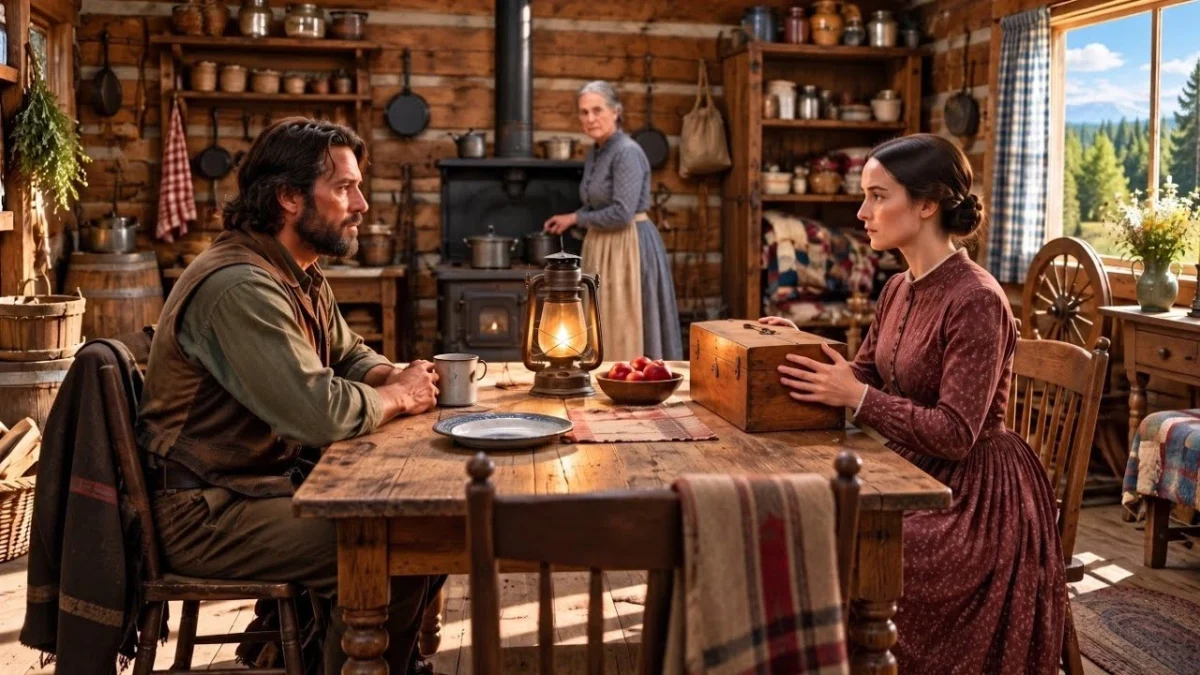
The trunk hit the porch boards with the dull, heavy clank of iron long before the woman climbed down from the wagon seat.
Caleb Whitfield stood by the wheel and thought that was strange, because most mail-order brides brought hope chests made of cedar, not something that landed like an anvil.
She had not spoken a single word since the preacher pronounced them married an hour before in the dim little church at Cold Water Creek.
Caleb had not tried to force speech from her either, mostly because he did not know what a man was supposed to say to a woman he had ordered through a letter and an old photograph.
She was a stranger who had crossed four hundred miles of flat prairie to marry a man she had never seen, simply because her own kin back in Missouri had no more room at their table for her.
Her name was Ruth Ann Callaway.
The letter that had brought her west described her as capable, quiet, and willing.
Caleb now understood that was the sort of description a desperate family used when they could not honestly say handsome, clever, or beloved.
He looked at her in the burnt-orange light of the Wyoming evening as she stood thin and straight beside his wagon.
Her gray traveling dress was soft with road dust, and her dark hair was pinned tight enough to look like punishment.
He felt the same cold disappointment he had felt when she stepped off the stagecoach that morning in town.
The photograph she had sent must have been taken years ago, because the girl in the picture had round cheeks and easy eyes, while this woman had neither.
“She looks like a fence rail in a dress,” his mother, Louisa, muttered under her breath from the porch steps, not bothering to lower her voice.
Louisa was seventy years old, half-blind in her left eye from a mule kick decades ago, and had run Caleb’s household since his wife died of the winter fever.
“We sent for a woman to cook and sew, Caleb, and they sent us a scarecrow instead,” Louisa added, leaning heavily on her cane.
Caleb did not answer his mother.
There were six people under his roof who needed tending besides himself.
There was Louisa, whose failing eyes could no longer manage the cooking or the mending.
There were his three children—Thomas, Abigail, and little Peter—who had been running wild as jackrabbits since their mother died.
There were also two hired hands, Wesley and a young boy named Silas, who slept in the bunkhouse and expected three hot meals a day and their shirts mended without complaint.
Caleb had written east for a bride the way a man writes for a replacement plow horse, out of raw necessity.
The ranch was drowning in unwashed linens, burnt suppers, and children who cried themselves to sleep in dirty clothes.
He needed a woman’s hands in that house before the spring roundup, or he was going to lose the entire operation to chaos.
Ruth Ann stood near the porch rail, her hands clasped loosely in front of her gray skirt.
The three children peered out from behind the cottonwood post like small, suspicious wild animals.
Caleb stepped closer to her, his jaw set hard, having no patience left for gentleness or polite courtships.
“Can you sew for a whole household?” Caleb asked her plain and hard, his voice flat in the quiet evening air.
“Can you mend a dozen work shirts, let out a growing boy’s trousers, and keep three children in decent clothes?”
Ruth Ann did not flinch or look away from his gaze.
“I can cook for two hired men who work from can’t-see to can’t-see, if that’s what you’re asking,” Caleb continued, crossing his arms over his chest.
“Because that is what I need here, Mrs. Whitfield, much more than I need a wife who reads poetry or plays a piano I don’t own.”
Ruth Ann looked at him for a long moment, her dark eyes steady and unblinking.
Something subtle moved behind her eyes, something Caleb mistook in his ignorance for fear or shame.
“I have sewn nothing for a household in eleven years,” Ruth Ann said, her voice quieter than the wind moving through the cottonwood leaves, but steadier than anything Caleb had heard from a woman in two years.
“Eleven years is a long time to forget how to hem a skirt,” Caleb said, his brow furrowing with rising frustration.
“I did not say I forgot,” Ruth Ann replied smoothly.
“I said I have not sewn for a household,” she said.
“For eleven years, I have been sewing for the United States Army,” she added.
Caleb paused, staring at her.
“The Army?” he repeated.
“First as a girl learning beside my mother in a garrison town in Kansas,” Ruth Ann explained, her gaze remaining on his face.
“Later on my own, stitching heavy canvas tents, wool uniforms, and once, during a terrible winter at Fort Led, the burial shrouds for eighteen soldiers lost to influenza.”
She stepped closer to the heavy iron-bound trunk sitting on the porch.
“I was the only woman left standing at that fort who could hold a needle without her hands shaking,” she said softly.
“I can cut a pattern from a man’s old wool coat and make three children’s coats from it, with enough cloth left over for mittens,” she added.
“And if there is no doctor near, I can sew a deep wound shut so it heals clean,” she said.
“My father was a company surgeon at the garrison, and he trained my hands alongside his own before he died.”
Caleb Whitfield stood in his own dirt yard and found he had nothing left to say.
Behind him on the porch, his mother had gone very still, her mouth slightly open.
The weeks that followed proved every word Ruth Ann had spoken to be true, and more besides.
Ruth Ann rose every morning an hour before dawn, long before the sky over the eastern ridges began to lighten.
By the time Caleb pulled his heavy work boots on and stepped into the kitchen, the iron stove was roaring with a bright fire.
The three children were already washed, their hair combed neat, and bowls of warm cornmeal porridge set out on the scrubbed oak table.
In the evenings, after the supper dishes were washed and the hired hands had retreated to the bunkhouse, Ruth Ann sat by the kerosene lamp with a mountain of mending in her lap.
She worked until her eyes burned from the dim light, humming something low and sad that Caleb eventually recognized as an old military hymn.
“Where did you get this cloth?” Caleb asked one night, picking up a heavy dark wool coat she had just finished making for young Thomas.
“It was an old saddle blanket from the barn that you were going to throw out,” Ruth Ann said without looking up from her needlework.
“I washed it in lye three times, boiled it down, and recut the shoulders,” she explained.
Thomas wore the coat everywhere, proud because it fit him better than anything bought from the mercantile store in town.
Ruth Ann also sat with little Abigail in the afternoons, teaching the girl how to hold a bone needle.
“Keep your thumb straight, Abigail,” Ruth Ann said softly, guiding the child’s small fingers over a strip of plain linen.
“A uneven stitch tears easy when the wind catches it,” Ruth Ann told her.
“Will my stitches be as pretty as yours one day?” Abigail asked, looking up with wide, eager eyes.
“If you practice every day, they will be better,” Ruth Ann promised, touching the girl’s hair with a rare, gentle hand.
Abigail, starved for a mother’s affection, began following Ruth Ann around the house and yard like a quiet shadow.
Even Louisa, who had sworn she would never warm to a mail-order scarecrow, began sitting beside Ruth Ann in the rocking chairs.
“Ruth Ann, bring your thread over here,” Louisa would say, holding up a needle with trembling, spotted hands.
“My good eye is clouded over today, and I can’t find the eye of this iron needle,” the old woman grumbled.
Ruth Ann would immediately set her own work down, take the needle, and thread it without a word of complaint.
She never made the old woman feel useless, and Louisa gradually stopped making sharp remarks about her thin frame.
Yet despite her endless hard work, there remained a cold, distant stillness in Ruth Ann that never eased.
Whenever a heavy supply wagon passed too fast along the dirt road outside, her body would freeze completely.
Her shoulders would go rigid, and her hand would drop to her lap until the sound of the iron-rimmed wheels faded into the distance.
When raised voices or rough laughter carried up from the bunkhouse after dark, she would stop speaking mid-sentence, staring quietly at the dark glass of the window.
Caleb noticed these habits the way an experienced rancher notices a horse that startles at shadows for no obvious reason.
He filed the observations away in his mind as things to ask her about later, when there was time.
However, there was never any time on a Wyoming cattle ranch.
The land and the stock demanded every single hour God gave, from sunrise to starlight.
It was not until a freezing night in late March that Caleb finally understood what kind of woman he had brought into his home.
The winter snows were melting, leaving the main trail thick and heavy with black mud.
Just after dark, three mounted men came riding down off the ridge road, their horses lathered and blowing steam in the cold night air.
They were hard-faced men who had robbed the Bozeman stagecoach two days prior, leaving the driver dead in a muddy ditch.
They needed fresh horses and a place to hide until the sheriff’s posse from Cold Water Creek lost their trail.
Caleb was out in the main barn, holding a lantern over a brooding mare that was close to foaling, when he heard Wesley yell from the yard.
“Get your hands up, old man!” a harsh voice shouted through the dark.
Caleb grabbed his Winchester rifle from where it leaned against the stall door and sprinted out into the mud.
By the time he cleared the barn doors, one of the outlaws had already grabbed six-year-old Peter by the collar of his nightshirt.
The man held a heavy Colt revolver directly against the boy’s head, using the crying child as a human shield.
“Drop that rifle, farmer, or I’ll blow this boy’s head clean off!” the man snarled, his face shadowed under a wet felt hat.
Caleb’s whole body went icy cold and useless.
He raised his rifle, but his hands trembled violently because there was no clean shot he could take without risking his youngest son’s life.
“Put the gun down, Caleb,” a steady voice called out from the porch steps.
Caleb turned his head slightly and saw Ruth Ann walking down the wooden steps into the yard.
Her hands were raised level with her shoulders, her apron flapping slightly in the cold wind.
Her voice was as flat and calm as if she were discussing the market price of flour with the local grocer.
“You’re making a mistake, friend,” Ruth Ann said, walking slowly toward the rider who held Peter.
“Step back, woman, or you’ll get the same!” the outlaw shouted, tightening his grip on the screaming boy.
“The sheriff’s posse is less than forty minutes behind you,” Ruth Ann said, not stopping her slow, deliberate advance.
“I was sitting by the kitchen window with the sash open,” she continued smoothly, her dark eyes locked onto the outlaw’s face.
“I heard your horses coming off the ridge, and I heard six riders behind you on the lower trail,” she lied without a single tremor in her voice.
“They are moving fast, six men with rifles, and they know you’re heading for the main road,” she added.
The outlaw holding Peter hesitated, his eyes darting nervously toward the dark tree line along the creek.
“If you stay here in this yard trying to steal barn horses, they will have you cornered in twenty minutes,” Ruth Ann said.
“Your only chance of getting away clean is to take the trail through the north pasture,” she said, pointing a finger toward the dark hills behind the house.
“The north pasture opens onto the old Shoshone trail,” she explained.
“No posse from Cold Water Creek knows that trail, and it cuts straight through the rocks to the border,” she said.
She stopped just five feet away from the barrel of the man’s pistol.
“Leave the child here,” she said quietly.
“The horses in the north pasture are already saddled for the night herd,” she lied again.
“Take them and ride now, or stay here and die in this mud when the posse arrives,” she said.
The outlaw stared at her face, searching for any sign of fear, panic, or deceit.
Her absolute calm unsettled him far more than screams or tears would have.
After a tense, unbearable moment of silence, the outlaw cursed loudly and shoved little Peter hard into the mud toward Caleb.
“Get to the horses!” the outlaw yelled to his two companions.
The three men wheeled their mounts around, dug their spurs in, and rode hard toward the dark opening of the north pasture.
Caleb dropped his rifle into the dirt, scooped Peter up into his arms, and held the trembling boy tight against his chest.
Ruth Ann walked over, picked up Caleb’s dropped rifle, worked the lever to clear the chamber, and handed it back to him.
“You should clean the mud off this barrel before it rusts,” she said softly, her voice still completely steady.
Caleb did not sleep a single wink that night.
He sat in the big wooden chair by the parlor stove, holding Peter until the boy finally cried himself to sleep.
Across the room, Ruth Ann sat on the small settee with Abigail curled up tightly in her lap.
Neither of the adults spoke for hours, because the sheer terror of what had almost happened left no room for plain words.
Two days later, the sheriff and a posse of eight armed men rode up into the ranch yard.
They brought news that the three stagecoach robbers had been trapped and captured in a rocky canyon along the old Shoshone trail, exactly where Ruth Ann had directed them.
The sheriff, a gray-haired veteran named Miller, climbed down off his horse and walked over to the porch where Caleb and Ruth Ann were standing.
Sheriff Miller stopped in his tracks, staring intently at Ruth Ann’s face.
“Well, I’ll be damned,” Sheriff Miller said, taking off his broad-brimmed hat.
“Are you Doc Callaway’s girl from Fort Led?” the sheriff asked, his eyes wide with recognition and respect.
Ruth Ann went quiet, her fingers tightening slightly against the apron at her waist.
“I was,” she said quietly.
“I thought I recognized that look,” Sheriff Miller said, turning to Caleb with an astonished grin.
“Caleb, do you know who you’ve got living under your roof?” the sheriff asked, slapping his leg with his hat.
“They used to call her the Iron Nurse of Fort Led back in ’72,” Miller said to the surrounding men.
“We had a band of hostile raiders hit the eastern perimeter of the fort during a snowstorm,” the sheriff explained, turning back to Caleb.
“Half the green recruits broke ranks and ran for the barracks, terrified out of their minds,” Miller said.
“This girl here stood right in the open firing line beside her father’s field tent,” he said.
“She dragged wounded soldiers out of the dirt, holdin’ blood vessels shut with her bare fingers while lead was flying through the canvas,” Miller added, shaking his head in wonder.
“She held that whole garrison together when grown men were falling apart,” Miller said.
Ruth Ann looked down at the porch boards, her face pale.
“That was a very long time ago, Sheriff,” Ruth Ann said, her voice dropping low.
“It’s just an old story from a bad winter,” she added quickly.
“Your coat sleeve is torn at the elbow, Sheriff,” she noted, pointing at his jacket to change the subject.
“If you sit on the bench for ten minutes, I can mend that seam so it holds against the wind,” she offered.
“I’d be honored, ma’am,” Sheriff Miller said, stepping up onto the porch and handing her his dusty coat.
That night, after the children were tucked into their beds and Louisa had retired to her small bedroom, the house went completely quiet.
Caleb walked out onto the front porch and found Ruth Ann sitting on the top wooden step.
The spring night air was sharp and cold, and the sky above the dark mountain peaks was clear, filled with millions of bright, icy stars.
Caleb walked over and sat down beside her on the step, leaving a few inches of space between them.
He pulled his wool coat tighter around his shoulders and looked out over his dark, silent land.
“Why didn’t you ever tell me?” Caleb asked gently, his tone entirely different from the harsh demand he had made on her first night.
“Tell you what, Caleb?” she asked softly, watching the stars.
“Why did a woman who faced down raiders and sewed shut wounded men by lantern light let me treat her like an unwanted chore?” he asked.
“Why did you let me believe you were just a spare, ordinary bride sent west because your family had no place for you?” he pressed.
Ruth Ann was quiet for a long time, her hands resting quietly in her lap.
The cold wind moved through the dry grass in the yard, making a soft, whispering sound against the fence posts.
“Because after Fort Led, I was tired,” Ruth Ann said, her voice breaking slightly for the very first time.
“After everything I saw, everything I touched, and every young man I helped bury in that frozen ground, I was so tired,” she said.
“All I wanted in this world was to be ordinary,” she whispered, looking at her hands.
“I wanted to be a simple woman who sewed basic shirts, washed dishes, and minded children,” she said.
“I never wanted to be the only steady hand in a room full of men who were falling apart ever again,” she confessed.
She turned her head to look at Caleb in the dim moonlight.
“When I saw your advertisement in the paper back in Missouri, I chose it over three others,” she revealed.
“Why mine?” Caleb asked, surprised.
“Because your letter asked for nothing but a capable, willing wife to run a plain household,” Ruth Ann said.
“There was no mention of glory, no mention of danger, and no grand promises,” she said.
“I prayed every night on the train coming west that this place would be exactly as quiet and plain as your letter sounded,” she added softly.
Caleb looked at her in the dim light of the porch.
He saw the faint lines of fatigue around her eyes and the pale, thin set of her mouth.
He remembered how he had judged her in a single, unfeeling glance when she stepped down from the wagon in her dusty gray dress.
He remembered calling her a scarecrow in his heart, valuing her only for what her hands could produce for his ranch.
A deep, painful wave of shame washed over him, settling heavy in the pit of his stomach.
“I am ashamed of myself, Ruth Ann,” Caleb said, his voice raw and honest in the dark.
“I looked at you and saw only a set of hands to mend my clothes and cook for my men,” he admitted.
“I didn’t care about who you were, where you had been, or what you had suffered to get here,” he said.
He leaned closer to her on the wooden step, his eyes steady on hers.
“I married you for your hands because I was desperate,” Caleb said plainly.
“And without knowing it, I got the bravest heart I have ever stood beside in my entire life,” he said.
“Caleb…” she started, her voice faint.
“No, listen to me,” Caleb interrupted gently.
“From this night forward, I intend to know the whole of you,” he declared.
“Not just the parts that are useful around this ranch, and not just the work you can do for this family,” he promised.
“I want to know the woman who sat by that window and dreamed of a quiet life,” he said softly.
Ruth Ann turned her body toward him on the step.
For the first time since she had stepped off the stagecoach in Wyoming, a small, genuine smile touched her lips.
It softened the sharp lines of her face and brought a warm, gentle light to her dark eyes.
“Well, Caleb Whitfield,” Ruth Ann said quietly, her voice lighter than he had ever heard it.
“I suppose a ranch household can always use a woman who is handy with more than just a sewing needle,” she said.
“Provided her husband is finally willing to sit down and ask the right questions,” she added, her smile widening just a fraction.
Caleb reached out his broad, calloused hand and wrapped his fingers gently around her slender ones.
Her hand was warm against the cold night air, resting steady and firm in his grip.
They sat together on the wooden porch steps under the hard, bright Wyoming sky, listening to the quiet breathing of the sleeping house behind them.
Caleb looked out over the vast dark pastures of his ranch and held her hand tighter.
He understood with absolute certainty that he had not brought home an unwanted, unwanted bride at all.
He had brought home the single most precious thing on that entire land, the one strength he could never afford to lose.








