He Dug Up the Fence Post His Father Said Never to Touch — Then the Cattle Refused to Cross
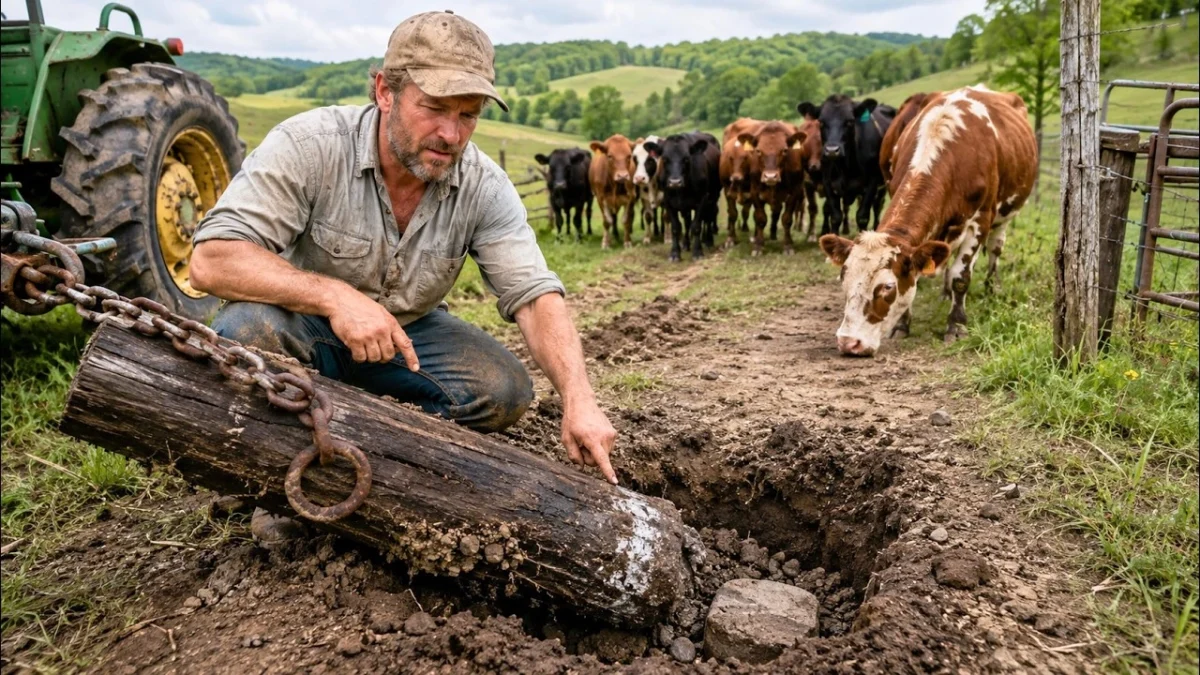
The heavy iron chain slapped against the dark heartwood of the old locust post with a dull, metallic thud.
Ray Mercer leaned over, wrapping the cold links twice around the base, right where the grey timber vanished into the damp spring soil.
He hooked the metal back onto itself, secured the clevis, and wiped his soil-stained palms against his canvas work trousers.
Behind him, the old John Deere tractor idled with a rhythmic, heavy thrum that vibrated through the damp earth of the pasture.
Wes Dalton stood a few paces off to one side, his hands shoved deep into his denim jacket pockets, his boots splattered with yellow mud.
“Your dad still wouldn’t let you pull that thing if he were standing here, Ray,” Wes said, squinting through the morning exhaust.
Ray didn’t look back as he climbed onto the metal tractor seat.
“Dad isn’t moving cows anymore, Wes,” Ray said quietly, his voice dry and flat against the rumble of the engine.
He pulled the throttle lever down, put the transmission into low gear, and slowly let the clutch out.
The heavy steel chain drew tight with a sharp screech.
The old locust post, greyed by sixty years of Missouri weather, groaned once deep in its socket.
Ray gave the engine a little more fuel, the rear tires bite deep into the green sod, and the post tore free all at once.
It came out with a wet, heavy suction sound that echoed across the quiet pasture, far deeper than Ray had expected.
The timber had gone down nearly four feet into the earth, far deeper than any standard wooden fence post had a right to be set.
Ray cut the tractor engine, letting the sudden silence of the morning settle over the hillside.
He climbed down from the seat and walked over to where the long, dark log lay tangled in the grass.
The bottom foot of the post wasn’t rotten; black locust held up against the damp earth better than iron.
Packed tightly around the buried base was a thick layer of crushed river gravel, cemented together by decades of pressure.
A crust of chalky white mineral had stained the wood pale near the very tip.
Halfway down the buried length, an old iron ring was set directly into the wood, half-choked with red rust.
Beneath where the post had stood, sitting loose in the bottom of the open hole, lay a flat, smooth slab of hand-cut limestone.
Ray stared down into the hole, his boots resting on the freshly churned earth.
He hadn’t expected gravel, he hadn’t expected iron rings, and he certainly hadn’t expected cut stone four feet underground.
“That’s a lot of work for an old gate post,” Wes observed, stepping up to the edge of the pit and peering in.
“It’s just an old marker,” Ray said, shaking his head. “Old man probably built it with whatever he had in the wagon.”
He unhooked the chain, kicked the heavy post off into the tall weeds along the fence line, and picked up his spade.
He had twenty-eight acres of fresh spring pasture sitting on the other side of that gap, and he wasn’t going to waste daylight thinking about a piece of buried wood.
Ray was forty-two years old that spring, working eighty-three acres of hard, rocky Missouri hill country.
It was the same land his father, Harold Mercer, had worked until his heart finally gave out the winter before.
Harold had died in his heavy wool coat out by the stock tank, checking on three-week-old calves in weather too bitter for a man of seventy-four to be out in.
Ray had worked side by side with his father for nearly twenty years, but Harold had never been a man given to long explanations.
He kept careful, brief notes in small leather books, changed as little as he could get away with, and held to habits that seemed like stubbornness to everyone else.
The single locust post had been one of those habits.
The old wire fence that once attached to it had rotted away decades ago, cleared out when Ray was still a boy.
Yet the lone post had remained, standing completely isolated in the middle of a wide, open stretch of grass.
It sat directly in the path where Ray needed to expand the main gate to get his heavy machinery and the herd into the north pasture.
Ray had asked his father about that post more than once over the years.
“Leave that one be, Ray,” Harold would always say, barely looking up from whatever strap of harness he was mending.
“Why?” Ray had asked him more than once. “It’s right in the middle of the turn. It makes no sense.”
“You’ll know if you ever need to,” Harold had replied, his tone closing the matter completely.
It had frustrated Ray every time.
After Harold died, the phrase started to feel less like wisdom and more like a sentence that meant nothing at all.
It felt like just another piece of farm stubbornness his father had carried to the churchyard without bothering to explain.
That spring, Ray needed the north pasture more than he ever had.
Hay prices had skyrocketed through the dry winter, grain costs were rising every month, and his main pasture was showing the heavy wear of too many hooves on too little grass.
If he couldn’t get his thirty-four cows and twenty-one spring calves onto the fresh clover in the north twenty-eight acres, he was going to be forced to buy expensive feed through July.
That meant selling his calves early and light, right when the main note at the county bank came due in the fall.
The old post wasn’t just an annoyance; it was standing between him and a decision that affected the farm’s survival.
So he had hooked the chain to the John Deere, pulled the post, and cleared the gap.
The following morning, the sun rose clear and warm, burning the light mist off the green bottom land.
Ray drove the herd up from the lower barn, waving his hat and calling out to the lead cows as they moved up the dirt lane.
The gate stood open wider than it ever had in the history of the farm, fifty feet of clear, unobstructed grass stretching between the new corner posts.
There was nothing left in the dirt to mark where the old locust post had stood.
The lead cow, a heavy-barrelled black Angus cross, walked steadily toward the open gap.
Ten feet from the line where the post used to stand, she stopped dead in her tracks.
Her ears came forward, her head dropped low, and her nostrils flared as she blew a hard, warm puff of air against the grass.
The second cow stopped right beside her shoulder, her flank pressing against the lead animal.
Within three minutes, the entire herd—thirty-four cows and twenty-one spring calves—had bunched up into a tight, nervous line.
They formed a perfect, straight row along a boundary line that no longer existed anywhere on the farm.
Ray walked past them, stepping through the open gap to stand ten feet inside the north pasture.
He pulled a small wooden bucket of sweet feed from the back of the utility vehicle and shook it hard.
“Come on, Bess,” Ray called out, pointing to an old cow near the front. “Come on through. It’s open.”
The old cow took two slow, cautious steps forward into the gap.
She stopped, lowered her nose to the small patch of bare dirt where the post had been pulled, and licked the soil.
She sniffed at the raw earth the way a dog works an old scent trail, her tail flicking nervously against her hocks.
Then she turned around, walked two paces backward, and rejoined the herd.
“There is nothing there,” Ray said, his voice rising in frustration as he looked down at the empty ground.
Wes, who had walked up the lane carrying a wooden staff, leaned against the new fence wire and chuckled softly.
“They seem to disagree with you, Ray,” Wes said.
“The fence is gone, Wes,” Ray insisted, stomping his boot down on the flat sod. “There’s no wire, no post, no timber, nothing.”
“The fence is gone,” Wes agreed, taking off his hat and scratching his grey hair. “But the cattle still know where it was.”
Ray wasn’t interested in stories about strange animal senses or old memories passed down through bloodlines.
These were practical cattle, raised by his father, moved along the same lanes year after year until their habits were as fixed as the stone ledges under the topsoil.
Calves followed their mothers, moving where they were taught to move.
Herd behavior held onto patterns long after the original reason for the pattern had vanished from the farm.
That realization didn’t solve his problem, but it sharpened the question sitting right in front of him.
Why had his father spent thirty years stopping the herd at that exact spot?
Why had he repeated that routine so consistently that the stopping point was buried deep in the bones of every animal on the place?
Ray walked over to the weeds where he had thrown the old locust post the morning before.
He knelt down, rolling the heavy timber onto its side to examine it in the bright morning light.
There were no staple marks along its length, no signs that barbed wire or smooth fence line had ever been nailed to its face.
On one side, the iron ring was worn completely smooth, shiny as polished silver on the inner curve where a heavy rope or iron hook had rubbed against it thousands of times.
The base carried that same thick, white mineral crust, hard as dried plaster.
Ray pulled his pocketknife out, opened the small blade, and scraped away the red mud near the middle of the post.
Carved deep into the dense wood were two block letters, faint but legible to anyone looking for them: **N G**.
Wes walked over, leaning down to look over Ray’s shoulder at the faint carving.
“N G,” Wes said, squinting. “Must be old Nathan Green’s initials. He owned the land west of here back in the twenties.”
“Nathan Green’s place was two miles south,” Ray said, running his thumb over the carved grooves. “This isn’t a man’s initials.”
On the third morning, Ray didn’t try to force the herd straight through the wide gap with his hat and bucket.
He sat on the fender of the tractor at the edge of the field, letting the cattle stand at the line and work it out for themselves.
The cows shuffled their feet, tossing their heads and lowing softly into the cool air.
After ten minutes of waiting, old Bess turned her head fifteen feet to the right, away from the wide opening Ray had cleared.
She began to walk slowly along a narrow, obscure strip of ground that ran at an angle to the main fence line.
It was a path Ray had passed a thousand times without ever paying it a single second of attention.
The second cow fell in directly behind Bess’s tail, and within two minutes, the entire herd was moving in a quiet, single-file line.
They bypassed the wide, open gap entirely, walking along the subtle curve of the slope before crossing into the north pasture fifty yards further up.
Ray waited until the last calf had passed through before he walked over to inspect the strip of ground they had chosen.
From a distance, it looked like regular pasture grass, green and unworked.
Standing directly on it, however, Ray noticed that the grass along this narrow band grew shorter and thinner than the dense turf on either side.
When he slammed his heel down, the earth felt remarkably solid under his heavy boots, offering no give at all.
The strip didn’t run straight; it curved in a shallow, deliberate arc about eight feet wide from edge to edge.
The old locust post hadn’t been set there to mark where the cattle were supposed to stop.
It had been set to mark where they were supposed to turn.
On Saturday morning, Ray came back out to the slope carrying a sharp spade and an iron pry bar.
He knelt at the beginning of the curved path the herd had taken and drove the spade deep into the sod.
Four inches down, the steel blade struck something hard with a sharp, metallic *clink*.
Ray cleared away a rectangle of sod, peeling back the green grass like a strip of carpet.
Lined up in a neat, continuous row was a path of flat limestone slabs, laid edge to edge along the length of the arc.
He dug along the sides of the stone path, finding smaller river rocks and gravel packed tightly into the seams between the larger slabs.
It was careful, heavy work—the kind of construction that required hours of manual labor, horses, and wagons.
Someone had built a solid, stone-packed cattle lane right through the middle of the hillside.
Then they had allowed the pasture grass to grow over it until the road vanished from sight, remembered by nothing on the farm except the feet of the herd.
Wes walked up the slope carrying his lunch bucket, stopping at the edge of the freshly dug trench.
He stood with his arms crossed, staring down at the exposed limestone roadway.
“So your old man kept a post standing for a road everybody forgot thirty years ago,” Wes said, shaking his head. “Seems like a lot of trouble to keep an old memory alive.”
Ray rested his hands on the spade handle, looking down the length of the stone curve.
“Dad didn’t care about memories, Wes,” Ray said quietly. “He didn’t save things just because they were old.”
“Then why keep the post?”
“I don’t know yet,” Ray said. “But I’m going to follow this road and find out.”
Ray spent the afternoon digging small test holes every twenty feet along the line of hidden stone.
The paved lane curved gently downhill, staying entirely clear of the low, straight path Ray had originally planned to clear for his gate.
Two hundred yards down the slope, at the edge of the lower meadow, the stone path ended at a shallow depression in the ground.
Hidden beneath decades of rotted leaves, brush, and fallen oak limbs lay the remains of a small, rectangular stone foundation.
Two heavy iron eyebolts were set directly into the remaining corner blocks, thick with flake rust.
Scattered inside the perimeter were broken chunks of old concrete and heavy deposits of that same white mineral crust Ray had found on the bottom of the post.
Ray picked up a piece of the white crust, rubbing it between his thumb and forefinger until it turned to a fine, salty dust.
He smelled his fingers, recognizing the faint, sharp tang instantly.
It was salt residue—the remains of an old mineral and salt feeding station.
Decades ago, his grandfather or his father had used this site to hold cattle, using salt blocks to draw the herd down off the high pastures.
They would gather the animals here, count them, check their hooves, and supplement their diet before letting them into the lower meadows.
That evening, after the farm was quiet and the cattle were settled, Ray went into his father’s small office behind the kitchen.
The room smelled of old paper, pipe tobacco, and motor oil.
On the wooden desk sat a stack of small, black leather notebooks Harold had kept over fifty years of farming.
Ray pulled down the volume marked *1958–1964*, opening the yellowed pages under the glow of the desk lamp.
He flipped past the pages of grain receipts, vaccine purchases, and rainfall records until he came to a section titled *Pasture Rotations*.
Written in Harold’s tight, economic hand was a entry dated May 14, 1961:
*Moved 22 head through North Saltgate. Replaced ring on main post. Gravel holding fine.*
Ray stared at the words on the page.
The letters **N G** carved into the old locust post hadn’t been a man’s initials at all.
**N G** stood for **North Gate**—or **North Saltgate**.
According to his father’s detailed notes, the cattle had once been trained to stop at the lone post, receive their salt ration, turn onto the paved stone lane, and move down to the holding station.
It was a smart, efficient system for managing livestock without extra hired hands.
Yet as Ray read through the notebook, he realized that history alone didn’t explain why his father had forbidden anyone from pulling the post forty years after the salt station had been abandoned.
Ray turned the page to an entry written three years later, in the dry summer of 1964.
The handwriting was heavier here, written with a dark pencil:
*Never open path straight north after rain. Ground soft below topsoil. Use stone lane always. Saltgate post marks dry crossing.*
*Dry crossing.*
Ray read those two words three times in the quiet room.
He set the small leather notebook down on the desk, walked to the back door, and looked out into the dark pasture.
The ground directly in front of where the old post had stood looked like solid, green turf on the surface.
It appeared no different from any other square foot of grass on the eighty-three-acre farm.
The next morning at sunrise, Ray walked out to the pasture carrying his post-hole digger.
He stopped at the exact spot where he had intended to put his new wide gate—the straight path he had cleared with the tractor.
He drove the blades of the tool deep into the sod, pulling up a core of earth.
The top six inches were firm, dry, and packed tightly with roots.
Below eight inches, however, the blades sank into dark, grey clay that was heavy, cold, and saturated with water.
Ray pulled the digger up and pushed his spade straight down into the hole.
The tool slid into the subsoil with almost no resistance, sinking to the handle in a thick, unstable slurry of hidden mud.
It was a deep, natural seep—a subterranean spring that stayed wet beneath the surface even during dry weather.
The old stone lane had been built in a wide, careful arc for one specific reason: to bypass that invisible patch of treacherous ground.
His father hadn’t kept that lone locust post standing out of stubbornness or nostalgia.
He had kept it there as a permanent, physical warning flag.
It was a marker to remind anyone working the farm that this was the one place on the property where cattle must never be driven straight across.
The real proof of his father’s wisdom came three days later.
A heavy spring storm system moved over southern Missouri, dumping nearly four inches of rain on the valley over seventy-two hours.
The pastures turned to standing water, and the creeks rose to the top of their banks.
When the rain finally stopped on Thursday morning, Ray drove his tractor out to check the fence line near the north pasture.
Curious, he drove the front wheels of the John Deere onto the straight path he had originally cleared for the gate.
The heavy front tires sank four inches into the sod, then six, then eight, the engine groaning as the rubber spun uselessly in the hidden mud beneath the grass.
Ray quickly shifted into reverse, differential lock engaged, and backed the machine out before it settled to the axles.
He cut the engine, stepped off the tractor, and stood looking at the deep, water-filled ruts his tires had left in the earth.
If he had driven thirty-four heavy cows and twenty-one spring calves straight across that ground after a heavy rain, the results would have been disastrous.
The heavy animals would have broken through the thin sod crust, sinking knee-deep into the soft, treacherous clay below.
Calves would have been bogged down, injured, or trampled in the panic, and he would have spent days hauling struggling livestock out of the mud with chains and ropes.
Ray walked twenty yards to his right, stepping onto the ancient stone lane he had uncovered the week before.
He stomped his heavy boots down on the limestone slabs.
The water had drained completely through the packed river gravel between the stones, leaving the surface firm, hard, and entirely dry.
His father hadn’t marked an old fence line.
He had marked the last safe place for the herd to turn.
Ray sat down on the wet grass at the edge of the stone road, looking back toward the empty hole where the post had stood.
He remembered dozens of spring mornings from his youth, watching his father stand by that post in his old oilskin coat.
Harold would wave his hat, shouting at the lead cows, gently nudging them off to the right without ever saying a word to Ray about why they were turning.
Ray remembered how impatient he had been as a young man, wondering why his father insisted on taking the long, curved way around instead of just clearing the pasture and driving the cattle straight through.
Harold likely couldn’t have explained the underground soil hydrology or the geological formation of the subsoil seep if Ray had asked him.
What he did have was forty years of hard-earned experience.
He knew what happened when a heavy cow stepped onto that soft ground after a three-day rain.
He knew the exhaustion of pulling a stuck calf out of freezing mud while the mother bellowed in the dark.
Rather than trying to explain decades of trial and error to a young son who might not listen, Harold had condensed all that hard experience into a single, unbreakable rule:
*Don’t move that post.*
Ray had spent twenty years resenting that rule for its silence.
Standing there in the damp pasture, looking at the firm stone lane beneath his boots, he saw it clearly for the first time.
His father had taken a lesson that could cost a man a season’s profit and boiled it down into a single physical object that could outlive him.
He had left a guardrail on the farm so his son wouldn’t have to learn the same hard lesson the hard way.
Ray didn’t put the pasture back the way it was before he brought the tractor up.
He spent the next two weeks working the north gate area with his spade and a wagon load of rock.
He cleared the brush and thick sod along the entire length of the old stone lane, exposing the limestone road his grandfather had laid.
He hauled in three loads of crushed rock from the local quarry, packing it into the low spots to reinforce the turns.
He set two heavy new white-oak posts at the top of the stone path, hanging a wide, proper steel gate that swung smoothly in an arc.
He built a sturdy wire fence around the treacherous subsoil seep, sealing off the soft ground completely so no animal or tractor could ever wander onto it by mistake.
He set a new mineral trough near the old stone foundation at the bottom of the hill, stocking it with fresh salt blocks for the herd.
All told, the improvements cost him a little over eight hundred dollars and three weeks of hard manual labor.
It was a fraction of what he would have spent buying extra hay through the dry summer months.
The expanded lane opened up nearly a month of extra grazing on land he had owned outright his entire life.
The old locust post hadn’t made him money directly; it had kept him from destroying the land he already had.
A month later, after the first cutting of hay was safely in the barn, Wes Dalton drove his pickup up the driveway.
He walked up the lane to where Ray was finishing the paint on the new steel gate.
Wes looked at the wide, gravel-packed turn, then looked over at the fenced-off patch of green grass where the tractor ruts had dried into deep scars.
“You putting that old post back in the ground, Ray?” Wes asked, resting his elbows on the top rail of the gate.
“Not there,” Ray said, wiping a spot of black paint from his thumb.
“I thought your old man said never to move it,” Wes said with a slight grin.
“Dad needed us to remember where the turn was,” Ray replied, looking out over the green expanse of the north pasture. “I can mark it a little better now that I know why it’s there.”
That afternoon, Ray walked over to the tall weeds near the fence line where the old locust timber had been lying since the morning he pulled it.
He picked up the heavy log, carried it down the lane, and laid it across the wooden rafters inside the main barn.
He placed it high up near the peak of the roof, out of the weather and off the damp floor.
The old post was worn smooth around its rusted iron ring, white with mineral crust at its base, and marked with the faint initials **N G**.
Ray didn’t keep it out of superstition or sentiment.
He kept it because the wood had done its job for sixty years, protecting the farm and the man who worked it.
It was nearly a year after Harold Mercer had been laid in the earth before his son finally understood the only instruction his father had never bothered to explain.
*Don’t move that post.*
Ray had thought it was just an old, forgotten boundary marker.
The cattle had known it as the place to stop and turn.
The stone slabs buried beneath the sod had known it as the start of a road.
His father’s black notebook had called it the North Saltgate.
Three days of heavy spring rain had shown plainly what all of them had been trying to say the entire time.
The post had never marked where the farm ended.
It had marked where the safe ground did.
Ray had widened the gate, he had improved the lane, and he had given the herd a better route than his father had ever built.
The old locust post stayed in the barn rafters—not because anyone was forbidden to touch it anymore, but because Ray finally understood what it meant.








