He Lost 6 Estate Managers… The 7th Told Him He Was Wrong
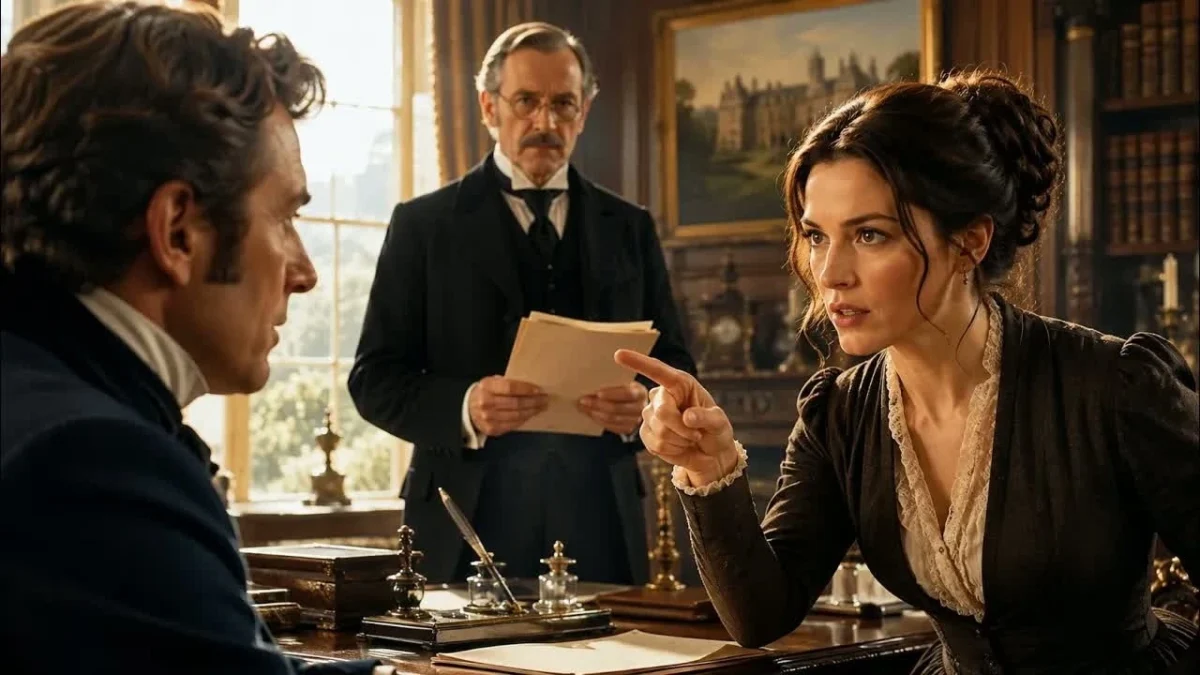
The problem, and it is best to understand this from the very beginning, was not the estate managers.
Lord Emory Kravath, fifth Viscount of Dunhollow, would spend two full years and six failed appointments arriving at this understanding.
He had not yet arrived at it, but on a cold, gray Tuesday morning in October, he was approximately forty seconds away from doing so.
Six stewards in twenty-four months—that was the figure he kept repeating to himself as he adjusted his cuffs beside the heavy mahogany desk.
Six capable, well-referenced, thoroughly interviewed men had taken the position at Dunhollow House, and each in turn had departed it.
Three had been dismissed for what Emory considered grievous errors in judgment.
Two had resigned with the particular, unyielding stiffness of men who had decided it was far safer not to say what they actually thought.
The sixth had sent a letter written in language so extraordinarily careful it felt architectural, stating that the position as currently structured was not one he felt capable of continuing in.
Emory had read that final letter twice before setting it down beside his brass inkwell.
He had said nothing to Mr. Hawes, his personal secretary.
Mr. Hawes, a compact and terribly precise man who had served the Kravath family for twenty-two years, had stopped offering commentary after the fourth departure.
It was not because Mr. Hawes lacked opinions—he possessed two decades of accumulated observations—but because he recognized the specific variety of obstruction in his employer.
He knew that commentary was simply not the instrument required to break through Emory’s stubbornness.
Instead, Hawes had quietly arranged for a seventh candidate.
The application had arrived via a professional placement agency in Halifax, accompanied by a small slip of paper bearing Hawes’s economical handwriting: *I believe this one will do.*
Hawes had never written such a note before.
Emory sat in his high-backed leather chair, preparing himself with the measured optimism of a man who had been disappointed six times in succession.
At precisely ten o’clock, the door to the study opened.
Miss Sylvia Corbett stepped into the room.
Her punctuality was immediately noted; of the previous six, one had arrived early, which Emory had considered presumptuous, and two had arrived late, which had been instantly disqualifying.
Miss Corbett arrived at the exact second appointed, as though time itself had been consulted and had readily agreed to the terms.
She was perhaps thirty years old, brown-haired, and thoroughly contained in manner.
She was dressed neatly without excess, looking very much like someone for whom the work mattered far more than the visual performance of attending to it.
“Miss Corbett,” Emory said, rising briefly to indicate the leather armchair across from his desk.
“Lord Kravath,” she replied, her voice steady and clear.
She sat down, folded her hands neatly in her lap, and waited.
Emory began the interview speech he had delivered six times before.
Through sheer repetition, the presentation had become impeccably polished.
It was a thorough account of the estate, the scope of Dunhollow, the tenant accounts, the farm ledgers, the precise relationship between the estate manager and the household, and the rigorous expectations placed upon the role.
He had refined the speech after every failure, adding clarity where he believed understanding had lacked.
By this seventh iteration, it was air-tight and comprehensive.
He was approximately forty seconds into his monologue when Miss Corbett spoke up.
“That is not why they left.”
The heavy silence of the study seemed to collapse in an instant.
The room at Dunhollow was built for quiet—thick stone floors, heavy velvet curtains, and the kind of stillness that accumulates over generations of unquestioned aristocracy.
Emory froze mid-sentence, his lips slightly parted, his hands resting flat upon his blotter.
Most men in his position would have reacted in one of two ways: they would have grown furious at the sheer insolence, or they would have shut down completely.
Emory, to his credit, went very quiet and paid strict attention.
He stared at her across the width of the desk.
Miss Corbett met his gaze without a flicker of hesitation, displaying the composed calmness of someone who had uttered an absolute truth and was not in the least surprised by the silence it produced.
“I beg your pardon?” Emory said, his tone voice carefully neutral.
“The stewards who left,” Miss Corbett said, speaking with the patient precision of someone presenting a factual case rather than registering a personal complaint.
“That is not why they left. You have described the position very thoroughly, my lord, but the position itself is not the problem. The problem is what happens after someone is actually hired into it.”
Emory leaned back against his chair, taking a slow, deep breath.
“Go on,” he said softly.
Miss Corbett tilted her head slightly, the tiny movement of a person deciding how direct to be, and promptly deciding on total candor.
“You have just described a position that carries genuine authority over the estate accounts, the leases, and the tenant affairs. But the stewards you dismissed—why were they dismissed?”
“They made errors in judgment,” Emory said, his jaw tightening. “Errors that caused actual financial and structural damage to the property.”
“Errors that you had not anticipated or explicitly cleared beforehand,” she corrected gently.
Emory said nothing to refute her.
“And the ones who resigned,” Miss Corbett continued, unabated.
“The letter from the most recent gentleman—I had the opportunity to read Mr. Hawes’s written summary of his exit interview. The steward used the exact phrase: *the position as currently structured*. He was not leaving because the workload was too great, Lord Kravath. He was leaving because the work is entirely undoable as defined.”
Emory’s expression did not alter; he had spent thirty-eight years learning how to keep his face completely inscrutable.
“You read Hawes’s summary?”
“I prepare before I attend interviews,” she said simply.
“My lord, what you are asking for is an estate manager who operates with genuine authority, but who also never acts without your prior, explicit approval. Those are not two attributes of the same position. They are, in fact, diametrically opposed positions. Until you understand which of the two you are actually offering, you will continue to hire perfectly capable people and continuously find them wanting.”
In the fireplace behind him, a log shifted, making a small, sensible popping sound.
Outside, the October grayness of Nova Scotia moved past the tall windows with complete indifference to the conversation occurring inside.
Emory looked at the woman sitting across from him and thought, with the sudden clarity of a man encountering something entirely unexpected: *No one has ever said that to me before.*
Six interviews, six men, six position descriptions accepted without a word of challenge, and not one of them had possessed the courage or the clarity to tell him the description was inherently flawed.
“What would you suggest then?” Emory asked slowly, crossing his arms.
“What am I actually offering?”
Miss Corbett met his gaze steadily.
“A choice. Either you want someone who manages Dunhollow as their own direct responsibility—someone who makes the decisions that need making, and informs you afterward with enough clarity that you understand precisely what occurred and why—or you want an assistant who merely executes your personal decisions more efficiently than you can execute them yourself. Both are entirely legitimate positions. However, they require entirely different people, and they cannot be combined. You have spent two years trying to force them together. That is why they left.”
Emory sat motionless for a long moment, letting her words sink into his mind.
“And which position, Miss Corbett,” he asked, the weight of his question hanging heavily in the room, “would you accept?”
She did not hesitate for even a fraction of a second.
“The first. I manage Dunhollow as my responsibility. I inform you clearly, regularly, and completely. You will know everything that happens on this land. But you approve nothing in advance, because the approval was already granted when you chose to hire me. If a decision I make is demonstrably wrong, you address it with me directly. If it is right, you let it stand without requiring that it had been your idea first.”
She paused, taking a light breath.
“And if you find that arrangement uncomfortable, then I am not the right person for Dunhollow, and you should know that before we waste any more of each other’s time.”
Emory studied her face, taking in the calm determination in her dark eyes.
“Why did you say all of this?” he asked, genuinely curious.
“You could have agreed with my description, taken the salary, and behaved however you intended to behave once you were safely inside the house. Most people would have.”
Something shifted in her expression—not quite a smile, but the subtle architecture of one forming beneath the surface.
“I have been in positions where I agreed to descriptions that desperately needed correcting,” she said softly.
“I spent three years doing precisely that in my previous post. I decided, before I walked into your study today, that I was never going to do it again. The cost of speaking plainly is the potential loss of the position, a cost I calculated I could easily bear. The cost of *not* speaking plainly is considerably higher, and I have already paid it once.”
Emory leaned back, his mind flashing to the sixth resignation letter he had set aside weeks ago.
He looked at Miss Corbett, feeling a sudden, profound respect that he had not anticipated.
“Can you start on Monday?” he asked quietly.
A brief wave of relief passed over her features—so swift and carefully managed that if Emory had not been watching her closely, he would have missed it entirely.
“Monday suits me very well, my lord,” she replied.
Miss Corbett proved to be, as her initial references had promised, thoroughly exceptional.
Her references had described someone diligent, practical, and precise, and she possessed all of those qualities in abundance.
What Emory had not anticipated was the specific, transformative quality of her competence.
It was not the mechanical competence of an employee following orders down to the letter; it was the intelligence of someone who understood the entirety of a system and worked outward from that deep understanding.
Dunhollow had been running for two years with a constant, grating low-level friction.
Small decisions were left unmade, minor maintenance issues were ignored, and the estate suffered from the ambient inefficiency of a vast property without anyone at its center who felt genuinely responsible for its health.
Under Miss Corbett, that friction simply ceased.
By the second week, the house and surrounding grounds were noticeably quieter.
By the third week, the tension had evaporated entirely.
She submitted her reports every Wednesday afternoon without fail.
They were crisp, three-page documents organized strictly by significance: decisions made and the explicit reasoning behind them, followed by items flagged as problems that had not yet arrived, but were inevitably approaching.
Emory read each report with complete attention, finding every time that her conclusions were undeniably correct.
He wrote concise replies, which she noted and acted upon immediately.
After six weeks of this effortless rhythm, Emory realized he was no longer carrying a persistent weight of administrative anxiety.
The estate was finally being managed.
This realization left him with an unexpected byproduct: an abundance of free time, and the disorienting feeling of a man who suddenly had nothing urgent to fix.
He began to notice things around the house he had previously overlooked.
He noticed that the correspondence room on the second floor had been completely reorganized, replacing a chaotic filing system that had defied basic logic for fifteen years with one that was self-evident.
He noticed that a long-standing boundary dispute with a tenant in the Eastfield Quarter, which had simmered unresolved for six months, had been settled quietly on terms that satisfied both parties.
Then, on a crisp Friday afternoon, he walked into the map room and saw a newly annotated survey of the Dunhollow property lines hanging on the drafting table.
It corrected four major boundary discrepancies that had been overlooked for decades.
Miss Corbett was standing by the high window, marking a secondary register with a fine ink pen.
“Miss Corbett,” Emory said as he stepped inside.
“My lord,” she said, looking up from her work.
“The Eastfield Quarter dispute,” Emory said, gesturing toward the map.
“The shared drainage agreement you negotiated—I would not have thought of that approach.”
“It was not particularly complicated,” she said calmly.
“It merely required looking at both properties simultaneously rather than treating each one in total isolation. The previous stewards failed to do that because they did not have the authority to discuss boundary adjustments without your prior written consent.”
Emory absorbed the gentle rebuke with a small nod.
“I see,” he said.
“Was there something else you required, my lord?”
“The 1841 survey,” Emory said, walking closer to examine the delicate parchment on the table.
“You found it?”
“I did. It was in an unmarked wooden crate in the east cellar, tucked behind a broken armchair.”
Emory stared at the map in disbelief.
“I have been searching for that original survey for four years.”
“I cannot imagine why no one thought to look in the cellar,” she said smoothly.
There was something in her tone—a very dry, carefully placed thread of humor—that Emory was beginning to recognize.
“You are amused, Miss Corbett,” he said, turning to look at her.
“I am entirely professional, my lord,” she replied without cracking a smile.
Emory almost smiled himself, catching the briefest shift in her expression before she turned back to her papers.
By the eighth week, Emory found himself sitting at his desk on a Wednesday evening, reading her weekly report for the second time.
He had already absorbed the operational facts on his first reading.
He was reading it again simply because he enjoyed the rhythm of her prose in the third paragraph.
He sat with the document in his hands for five full minutes before admitting the truth to himself: he was far more interested in the Wednesday reports than was strictly warranted by the estate business alone.
He was interested because of the person writing them.
He was well aware of how it appeared—the Viscount of Dunhollow taking a personal shine to his female estate manager.
It sounded like the plot of a cheap parlor novel, and he had no desire to play a role in that kind of story.
Yet he was also unwilling to lie to himself and pretend the interest did not exist.
On Friday afternoon, he tracked her down in the East Library.
The room was small, filled with dark oak shelves, and her presence in it made the space feel curiously intimate.
She was sorting through his father’s messy geological survey collection, reordering the leather-bound volumes.
“Miss Corbett,” he said from the doorway.
“My lord,” she said, pausing with a book in her hands.
“You moved the third volume of the Laurentian series,” he noted, stepping inside.
“It was misplaced behind the continental atlases,” she said.
“It belongs with the proper chronological sequence. I should have asked before reorganizing your father’s collection.”
“Do not apologize. It was misplaced, and you corrected it.” Emory paused, leaning against the edge of a tall bookcase.
“Do you read them?”
Miss Corbett looked up, meeting his eyes.
“Yes.”
“What do you read?”
The question hung between them in the quiet air of the library.
“History, mostly,” she said after a brief assessment.
“Natural history, some philosophy, and the occasional novel if it has earned its place. The third Laurentian volume is well worth reading twice, by the way. The arguments presented in the fourth chapter have never been properly answered.”
Emory felt a quiet jolt of surprise.
“I know,” he said softly.
Miss Corbett held his gaze for a moment, her eyes reflecting the soft amber light of the desk lamp.
“I know you know,” she said quietly.
Three days later, on a chilly Monday afternoon in November, Emory walked into the East Library where she was updating the estate ledgers.
“Miss Corbett,” Emory began, stepping directly into the room.
“I want to say something that falls entirely outside the professional register of our conversations.”
Miss Corbett set her pen down cleanly.
“You have said several things outside it already, my lord.”
“I am aware,” Emory said, turning to look out the window at the bleak landscape.
“I have been far more interested in the Wednesday reports than is warranted by the numbers alone. Not because of the accounts, but because of the person who writes them. I have been attempting not to say that for approximately three weeks, and the effort of keeping quiet has begun to seem like an exceptionally poor use of my energy.”
The library was utterly motionless.
“I understand what I am saying and what it implies,” Emory continued, turning back to face her.
“I am not saying it to create a difficulty for you. I am saying it because I have spent two months watching someone manage a property that frustrated six other men, and I have gradually realized that the part of all this I find most compelling is not the property at all.”
Miss Corbett remained entirely still, her hands resting flat on the mahogany desk.
“You may tell me,” Emory added carefully, “that this is unwelcome, inappropriate, or that you prefer our arrangement to remain strictly professional. I will accept any of those answers without the slightest resentment.”
Miss Corbett looked down at the neatly aligned Laurentian volumes, then out at the gray November light filtering through the window, and finally back at him.
“It does not create a difficulty,” she said, her voice completely steady.
“It creates a question.”
“Which question?”
“What do you intend to do about it?”
Emory considered this with absolute seriousness.
“I intend to behave exactly as I have behaved. Read the Wednesday reports. Visit the map room on Tuesdays. Note when the correspondence files have been reorganized. And perhaps stop forcing myself to pretend I have no reason for any of it beyond the estate’s balance sheet.”
“That is very restrained,” she noted softly.
“I am working within obvious constraints.”
Miss Corbett looked at the third volume of the geological series, a faint, thoughtful expression touching her lips.
“I’ll tell you something, Lord Kravath.”
“I am listening.”
“I corrected you in our initial interview,” she said carefully, “because I had made a firm decision about what I was no longer willing to manage into silence. That decision was about the job description. But the same principle applies to other areas of life as well.”
Emory stepped closer to the desk, his eyes locked onto hers.
“What other areas?”
“The fact,” she said, her voice carrying that same unmistakable, direct clarity, “that I have been at Dunhollow for eight weeks, and I have not once wished to be anywhere else. And the reason for that is not merely the satisfaction of managing the property.”
Outside, a light wind rattled the glass panes.
Emory stared at her, the silence between them rich and heavy with unspoken understanding.
“There is a formal dining room in this house,” Emory said quietly.
“It has been set for a single person for the better part of two years. Would you join me for dinner tonight? Not as my estate manager, but as the woman who found the 1841 survey behind a broken chair in the cellar.”
Miss Corbett was quiet for a long moment, assessing him one last time.
“Yes,” she said.
“What time?”
“Seven o’clock.”
“Seven o’clock suits me,” she agreed.
When Emory left the library, he calculated that seven o’clock was five hours away—the shortest five hours he felt he had ever had to wait.
Dinner at seven quickly evolved into a permanent arrangement for Tuesdays and Fridays.
It was never formally announced; it simply became the natural shape of their lives, the way good arrangements establish themselves through comfortable repetition.
They spoke endlessly about the estate—the complicated, unvarnished truth of it, the tenants, the long-term farm leases, and the structural repairs needed before winter set in.
Her mind was remarkably sharp; her insights regarding the north-boundary leases proved far superior to those of his legal solicitors in town.
“Your logic is considerably better than my lawyer’s,” Emory told her over dinner one Tuesday evening.
“I am well aware,” Miss Corbett replied mildly, taking a sip of wine.
“You know, the grace to pretend modesty is generally considered a virtue,” Emory teased.
“I save my modesty for matters I am actually uncertain about,” she countered smoothly.
Emory leaned across the table, looking at her with genuine curiosity.
“Are you ever uncertain?”
She considered the question with her usual seriousness.
“Rarely. I verify facts before I draw conclusions. Though I admit I am far more careful when drawing conclusions about people. People are considerably more complicated than property surveys.”
“And what are you uncertain about regarding me?”
Miss Corbett looked directly into his eyes.
“At present? Absolutely nothing.”
Emory held her gaze, a deep sense of warmth blooming in his chest.
“Good,” he said softly.
She smiled—a full, radiant smile that completely transformed her face.
Emory noted it with the intense focus of a man who realized such moments were exceedingly rare and worth preserving at all costs.
In mid-December, as the late-night darkness pressed hard against the dining room windows, Emory set his linen napkin beside his plate.
“I want to discuss the position,” he said quietly.
Miss Corbett went very still.
“Not to alter your authority,” Emory added quickly.
“I want to talk about whether the terms, as they currently stand, adequately describe what this position actually is.”
She tilted her head, her dark eyes searching his face.
“The management of Dunhollow is working exceptionally well, my lord.”
“Yes,” Emory agreed. “The estate is running better than it has in decades.”
“Then what is wrong with the terms?”
Emory looked at the long mahogany table, the fine porcelain plates, and the two places set neatly side by side.
“Nothing is wrong with them,” he said softly. “I simply wish to add to them. These bi-weekly dinners are not professional dinners, Sylvia.”
“No,” she agreed, her voice dropping an octave. “They are not.”
“They are not the dinners of a viscount and his estate manager,” Emory continued, searching for the right words.
“I do not possess the precise vocabulary for what we have become. I only know that whatever it is, it is no longer described by *employer* and *employee*. That inadequacy has been building for weeks, and I would far prefer to address it plainly than allow it to linger.”
Sylvia looked down at the flickering candles between them, her expression deeply thoughtful.
“I corrected you in our interview,” she said quietly, “because I refused to manage myself into a role that was convenient for someone else. And I came to dinner the first time because that same principle applied.”
She paused, tracing the rim of her wine glass with a delicate finger.
“Twelve dinners later, I realize I have not been in a room where I could simply exist as myself without constant management in a very long time. I would like to keep being in this room.”
Emory leaned forward, his voice steady.
“Then stay.”
“I told you on day one,” she said, a faint smile touching her lips, “not as your estate manager.”
“Not as the manager,” Emory agreed, holding her gaze.
“As the person who is undeniably right about the Laurentian volumes. As the person who corrects me mid-sentence, who found a lost survey that four years of searching could not locate, and who tells me the plain truth. Stay in this house with me.”
Sylvia looked at him across the table.
Outside, the first snow of the Canadian winter was beginning to fall softly against the glass.
“You are asking me to marry you eventually,” she stated plainly.
“First, I am asking you to stay,” Emory corrected gently.
“The rest naturally follows the staying. Though staying and marrying seem intimately connected in my mind.”
“They are connected,” she agreed softly.
“I want to be completely honest about what I am asking of you,” Emory said.
Sylvia looked at the candles, then at the place setting opposite her own, which had been empty for far too long before her arrival.
“I interrupted your speech forty seconds in,” she reminded him with a soft laugh.
“And I hired you for it,” Emory replied without a second’s hesitation.
“Because it was the truest thing anyone had said to me in two years.”
He held out his hand across the table.
Sylvia looked at his open palm, then reached out and placed her fingers softly in his.
“Yes,” she said.
Emory let out a long breath he felt he had been holding for months.
“The formal position description will need revising,” Sylvia added, her eyes sparkling with dry humor.
“Mr. Hawes can handle the drafting,” Emory said with a grin.
“Mr. Hawes has been listening from the adjacent corridor since October,” Sylvia noted dryly. “He will be entirely insufferable.”
“He is already insufferable,” Emory replied. “It will not materially alter his demeanor.”
Sylvia smiled her full, radiant smile, and Emory felt an overwhelming certainty settle over him.
*I am going to spend the rest of my life bringing that smile to her face,* he thought, *and that is a magnificent way to spend a life.*
On Wednesday morning, Mr. Hawes entered the study with his usual unflappable composure.
He set a freshly inked document upon Emory’s desk without a word.
Emory picked up the sheet and read the neat, copperplate script written in Hawes’s unmistakable hand:
*Position of Viscountess of Dunhollow. Primary responsibilities to include: overall estate oversight, historical property archiving, mandatory Tuesday and Friday dinners, and the direct correction of the Viscount mid-conversation as required.*
Emory looked up from the page.
Mr. Hawes stood at attention, his face an absolute mask of neutral professionalism perfected over twenty-two years of service.
“Not a single word, Hawes,” Emory warned, though his eyes were gleaming.
“Of course not, my lord,” Hawes replied cleanly.
He allowed a silence of precisely two seconds to pass between them.
“Shall I file it in the official family archives?” Hawes asked.
“File it,” Emory commanded.
Hawes picked up the document, bowed crisply, and turned toward the door.
If the old secretary was smiling to himself as he walked out into the hallway, there was no one present in the study to confirm it, though Emory chose to believe he was.
Dunhollow House ran in the months that followed as it had not run in generations.
The estate accounts balanced to the penny, the tenant farmers were thoroughly content, and the geological surveys in the East Library were maintained in immaculate order.
Every evening, two chairs sat side by side near the library fire, neither remaining empty for long.
The 1841 property survey hung proudly in a gilded frame inside the map room, fully annotated and corrected.
And Lord Emory Kravath, fifth Viscount of Dunhollow, never sat alone in his study again.








