He Only Came to Fix a Fence… Then Heard Her Pray: “God, Please Don’t Take Him Too”
The fence had been down for three weeks before anyone in Larksburgh Hollow thought to send for Ezra Coloulton.
It was not a large stretch of fence, merely sixty yards of split rail running along the low ridge that separated the Puit land from the section nobody quite claimed anymore.
But it had been down long enough that two of Otis Puit’s steers had wandered clear into the county road.
And it had been down long enough that Otis, who was seventy-one and carried a bad hip from an old fall off a barn roof, had finally admitted he could not mend it himself.
“Ezra is the one,” Otis told his wife over breakfast, leaning his heavy hands on the table.
“Man does honest work, doesn’t charge double for his time, and doesn’t talk your ear off while he does it.”
So on a gray Tuesday morning in the spring of 1879, Ezra rode out from his own place with a wagon loaded with cedar rails, a maul, and a heavy coil of wire.
He was expecting a half day’s work under a overcast sky and nothing more.
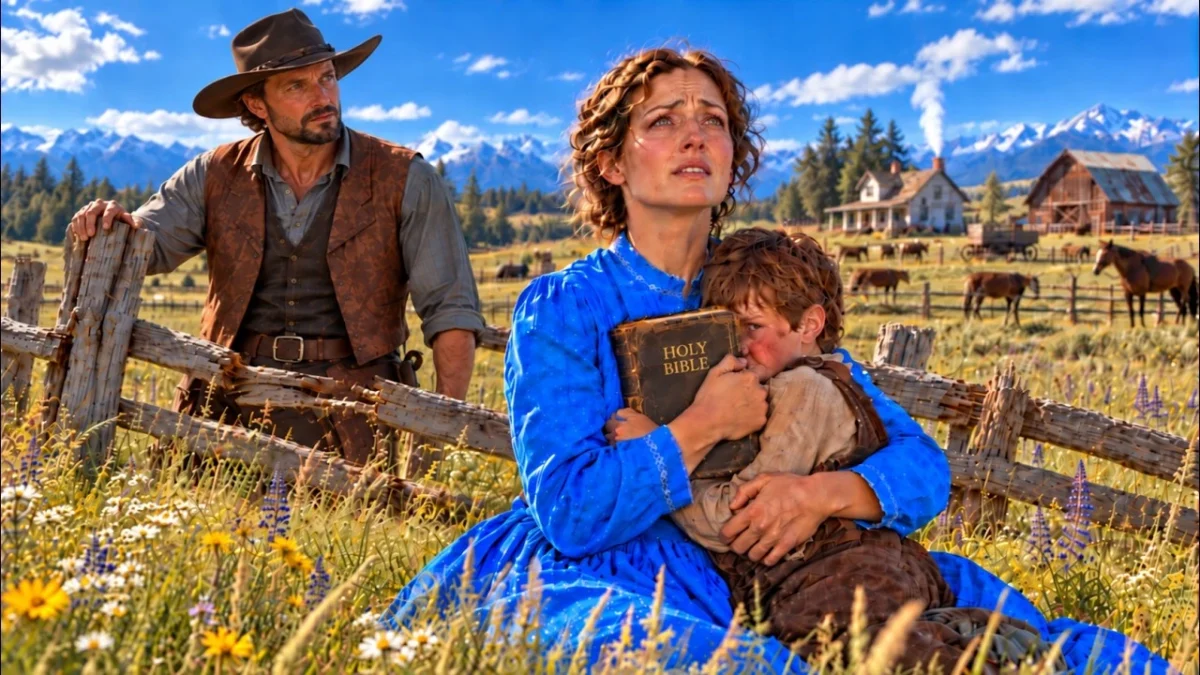
He did not expect to find a woman kneeling in the tall, unkept grass on the far side of that broken fence line.
She was crouching low, her hand pressed flat over a small boy’s mouth, both of them remaining as still as fence posts.
The moment his horse’s hooves crunched on the gravelly dirt, Ezra pulled up short on the reins.
He did not call out right away.
A man learned in that quiet country that a woman hiding in the brush with a child was either running from something dangerous or hiding something she couldn’t afford to lose.
Either way, shouting at her from horseback was the wrong way to start.
He swung down slowly from the saddle, deliberately letting his boots make heavy, distinct noises in the dirt so they would hear him coming and know he hadn’t crept up on purpose.
He stood at a respectful distance, taking off his hat and holding it against his thigh.
“Ma’am,” Ezra said, keeping his voice low and steady.
“I’m not here for you. I’m here for the fence.”
The woman didn’t move for a long, agonizing moment.
She was perhaps thirty, dressed in a plain, faded blue calico dress, her dark hair coming loose from its wooden pins.
There was a look on her face that Ezra recognized from older, harder years in his own life.
It was not a fear of him personally, but a heavy fear that had been living inside her so long it had settled permanently into her posture.
She looked like a person with a shoulder that had been hurt too many times to ever fully lower again.
The little boy peaked out from behind her arm, his face pale and marked with faint smudges of dust.
He had solemn brown eyes and looked to be seven or eight years old.
He didn’t say a word, holding his breath as he stared at Ezra’s boots.
“There anybody after you two?” Ezra asked, stepping over a fallen post.
“No,” the woman said, her voice sharp and too quick.
Then she softened her tone, as if she had caught herself in a lie and lacked the stamina to keep telling it.
“Not yet, maybe.”
Ezra nodded slowly, as though that were a perfectly reasonable answer to hear on an open ridge.
He set down his heavy wooden maul and reached for a post.
“I’ve got fence to mend,” he said simply.
“Takes me the better part of the day to set these rails right. You’re welcome to sit where you’re sitting. I won’t ask you your business unless you want to give it.”
She studied his face, looking for the catch that usually came with a stranger’s offer.
Whatever she saw in Ezra’s quiet, weathered features seemed to loosen something in her back, just a fraction.
“Miriam,” she said finally, her voice raspy from lack of water.
“Miriam Hail. And this is my son, Toby.”
“Ezra Coloulton,” he replied, balancing a rail against his knee.
Toby spoke up then, in the abrupt, bursting way of children who have been forced to be quiet too long and have run out of patience for it.
“Are you going to tell on us?” the boy asked, staring hard at Ezra’s wire clippers.
“Tell who?” Ezra asked.
“Uncle Garrett?”
Ezra picked up the rail and set it firmly into the notch where the old timber had rotted through.
“Don’t know your Uncle Garrett,” Ezra said, driving a wooden wedge into place.
“Don’t know where he lives, and don’t care to ask.”
It was not much of a promise, but it was enough that morning to get Miriam Hail to sit down properly in the prairie grass instead of crouching like a frightened rabbit ready to bolt.
She allowed her son to lean against her side while they watched the stranger drive posts into the hard Kansas dirt, as if the world outside that broken fence line had mercifully gone quiet for an hour.
Ezra worked steadily through the morning without asking another question.
Miriam watched him, and in the way that quietness sometimes loosens a guarded tongue better than direct interrogation, she began to talk without being asked.
She told him she and Toby had been staying for two nights in the old line shack a mile east.
It was a rickety structure that belonged to no one in particular, an old hut ranch hands used during autumn blizzards and everyone else forgot existed.
She told him she had walked all the way from Coyle’s Crossing, eleven miles down the dirt road.
“I didn’t trust the stage line,” she explained, pulling a loose thread on her sleeve.
“Not with Garrett Hail’s money likely in half the drivers’ pockets by now. Or so I believed.”
She did not tell him why she was fleeing Garrett Hail, not at first.
Ezra didn’t press her.
He had learned from working the land, handling cattle, and watching other men’s troubles for the better part of twenty years that a person’s trial showed its full shape eventually on its own.
Pulling at a story too soon only tore it before it was ready to be told whole.
By midday, when the sun reached its peak, Ezra stopped his work to eat the thick slices of coarse bread and salt pork he had brought wrapped in a cloth.
Without saying a word, he divided the food into three equal portions and handed two of them across the dirt.
Miriam hesitated before accepting it, but Toby took his piece eagerly.
As they ate, Miriam began to lay out the rest of her burden.
She spoke in short, deliberate bursts, pausing to check on Toby after every few sentences, as if making sure each piece of her story was safe to set down before letting go of it completely.
“My husband, Thomas Hail, is in the Kansas State Penitentiary at Lansing,” she said, looking straight at the horizon.
“Eight months now. He was convicted of stealing cattle from a drive he’d been hired onto.”
She turned her gaze to Ezra, her eyes fierce.
“Cattle he never touched. I swear it flat and certain.”
Ezra chewed his bread slowly and listened.
“He signed on with the Kesler outfit for the spring drive,” Miriam continued, her fingers tightening around her apron.
“We needed the wages desperately. We’d had a hard winter, lost two horses to the rot, and the garden failed. Halfway through the drive, thirty head went missing in one single night. When the count came up short, it was Thomas who’d had the last watch. Nobody else’s word counted for anything after that. It didn’t matter that he was a good father. Didn’t matter that he’d never so much as taken a penny that wasn’t his in the eleven years I knew him. They just took him away in chains.”
“He didn’t do it,” Ezra said.
It wasn’t phrased as a question, but as a plain statement of her belief.
“I know my husband,” Miriam said, and there was a hard layer of iron beneath the heavy grief in her voice.
“I don’t say that because a wife is supposed to say it in front of strangers. I say it because I know the difference between a man who is guilty and ashamed, and a man who is innocent and furious that nobody will listen to him.”
She rested her hand on Toby’s hair.
“Thomas was the second kind. Still is, far as his letters tell me.”
Toby, who was chewing his salt pork with the single-minded focus of a hungry child, looked up from the grass.
“Papa didn’t steal the cows,” Toby declared firmly.
“He was asleep for one hour because Mr. Kesler made him do double watch three nights running. That’s when the bad men took them.”
Ezra looked at the young boy for a long, quiet moment.
“You know that for certain, son?” Ezra asked gently.
“Papa told me before they took him,” Toby replied, his small jaw set tight.
“He said, ‘Toby, sometimes men get blamed for things because it’s easier for the law than finding who really did it.'”
It was a heavy, bitter thing for a boy that age to have learned so early, Ezra thought, but he kept the sentiment to himself.
He merely nodded at the boy and picked up his hammer to set another rail, letting Miriam find her own pace to finish the story.
“Thomas’s older brother, Garrett Hail, came around within a month of the conviction,” Miriam said, her voice dropping lower.
“He didn’t come with sympathy or groceries. He came with legal papers.”
“What kind of papers?” Ezra asked, positioning a iron spike against the wood.
“A petition filed in the county probate court,” she said, her hands trembling slightly.
“Asking that guardianship of Toby be transferred to Garrett and his wife. He claims Thomas is an unfit father currently imprisoned, and that I am alone, without income, and unable to properly provide for the boy.”
She spat out a bitter laugh that had no humor in it.
“He says he wants a ‘decent Hail household’ raising my son. He wants my boy taught that his father was a thief and a disgrace to the family name. Twelve years of Garrett telling him who to be, and me left with no say in his life at all.”
“So you ran,” Ezra said softly.
“I ran the day the sheriff came down the lane to serve the guardianship hearing notice,” Miriam said, looking back toward the dirt road.
“I took Toby and three shirts and walked out the back door into the woods.”
“If you’re not there to be served, if they can’t find you to sign the paper, they’ll delay the hearing,” Ezra observed, driving the spike home with a loud, metallic clang.
“They won’t stop it.”
Miriam’s mouth went into a thin, resolute line.
“I know that,” she said quietly.
“I’m not foolish. I just needed time. Time to write to Thomas’s lawyer—if we can even call him that. He’s a tired man in Topeka who owed Thomas a past debt and agreed to look into the court records for the cost of a letter stamp. I needed time to find someone who will stand up in front of a judge and say that I am not what Garrett says I am.”
She looked down at her hands, which were worn from lye soap and hard labor.
“And have you found someone?” Ezra asked carefully.
“No,” Miriam whispered to the grass.
The silence that followed was long and heavy, filled only with the rustle of the prairie wind against the cedar posts.
Ezra worked on the last section of the sixty-yard fence as the afternoon light started slanting long and gold across the tall grass.
By the time the shadow of his wagon stretched far across the ridge, he had made up his mind about several distinct things, though he spoke none of them aloud just yet.
The first was that Miriam Hail was not lying to him.
Ezra had dealt with enough liars in his forty years to know the mark they carried.
He had seen men trying to talk their way out of a bad gambling debt, a dishonorable deed, or a failing marriage.
Miriam simply did not carry the restless strain those lies always demanded of a person.
Her fear showed in her hands, not her words.
Her exhaustion showed in the way she forgot twice what she had already said, her mind stretched thin by hunger and sleeplessness.
And the boy’s unrehearsed account of his father’s words had the clear, unpolished ring of a child repeating something he had actually heard at a kitchen table, not a script he had been coached to memorize.
The second thing Ezra decided was that a woman and a young boy could not keep living in an abandoned, drafty line shack, eating whatever bread a passing stranger happened to split with them on a fence line.
He didn’t make a grand speech about it.
When he finished loading his maul, wire, and remaining timber into the back of the wagon, he stood by the horse’s head and looked across at her.
“There’s a small room off the back of my barn,” Ezra said, wiping his brow with his sleeve.
“Used to be for a hired hand I kept years back. It’s dry, it’s got a solid latch, and it’s got a small cast-iron stove that draws well without smoking.”
He gathered the leather reins in his hand.
“You’re welcome to stay in it until you’ve got a plan that isn’t just running through the brush.”
Miriam’s face went through a complicated shift.
He could see the immense gratitude fighting fiercely against the same stubborn pride that had kept her from begging for scraps in town.
“We can’t pay you anything, Mr. Coloulton,” she said, her chin rising slightly.
“Didn’t ask you to pay me,” Ezra replied.
“People in town will talk if they see us there,” she pressed, looking toward the horizon.
“People talk regardless of what you do,” Ezra said flatly.
“Might as well give them something true to talk about instead of something they have to invent out of thin air.”
It took her another full minute of standing in the wind-blown grass, weighing her options against her son’s pale face, before she spoke.
“All right,” she said softly.
Then, even quieter, she added, “Thank you.”
Toby, who had been listening to every word, tugged hard at his mother’s skirt.
“Is he going to tell Uncle Garrett where we are now?” Toby asked, looking up at Ezra with wide eyes.
“No,” Ezra said, stepping between the boy and the wagon wheel.
“I am not going to tell your uncle anything. But I want you both to understand something clearly.”
He looked directly at Miriam now, his voice taking on a firmer tone.
“Hiding from a court summons doesn’t win you anything in the end. It might buy you a week or two, but your mother is going to have to stand in front of that probate judge eventually.”
Miriam flinched slightly, but Ezra kept going.
“And when she does walk into that courtroom,” Ezra said, “she needs to walk in there looking like the respectable woman she is. Not like a woman who spent a month running scared through fence lines and sleeping on dirt floors in line shacks.”
Miriam’s jaw tightened, her dark eyes flashing, but she did not argue with him.
Perhaps it was because she already knew the truth of his words deep down.
Or perhaps it was because it was the first time in eight months that anyone had spoken to her as if she still had a fight left in her, rather than treating her like a pitiful problem to be managed or hidden away.
The room off the back of Ezra’s barn was small, but it possessed a sturdy pine floor and a tight roof.
Within two days, Miriam had swept every corner clean, patched a drafty seam in the western wall with old burlap sacking, and set Toby to gathering dry kindling from the creek bed.
She threw herself into the work as though the physical exertion itself were a kind of medicine for her nerves.
Ezra watched her progress from a distance, the same way he watched most things on his ranch.
He stayed involved enough to ensure they had firewood and fresh water, but he was careful not to crowd a fresh wound before it had started to close on its own.
He did not press her for details about the upcoming hearing, nor did he ask her about her past in Coyle’s Crossing.
He didn’t need to ask many questions anyway.
Word of legal trouble traveled fast in Larksburgh Hollow, moving through the countryside the way runoff water traveled downhill after a spring storm.
Within a week, during a trip to the local mercantile for flour and nails, Ezra learned through the storekeeper’s casual gossip that the county probate court had formally set the guardianship hearing for the third week of June, five weeks off.
He also learned that Garrett Hail was taking no chances.
Garrett had already retained Aldis Fen, a Topeka attorney with a sharp tongue and a formidable reputation for winning difficult custody and land cases that nobody expected him to win.
Ezra also learned more about Garrett himself, not from town gossip this time, but from Miriam one quiet evening as they sat on the back porch steps while Toby played with a carved wooden horse near the well.
“Garrett isn’t just a cruel man,” Miriam said, her fingers working rhythmically over a torn seam in her dress.
“He is a man who has spent his entire life standing one bitter step behind his younger brother.”
“How so?” Ezra asked, carving a notch into a piece of pine.
“Thomas was always the one who married for love,” Miriam explained quietly.
“Thomas was the one their father had favored when they were boys. Thomas’s name was on the original land title down south, even though Garrett had worked the soil alongside him for two years before striking out on his own failed homestead. Garrett feels robbed by life.”
She paused, watching her son set the wooden horse on a flat stone.
“He’s not evil like a monster in a story,” Miriam admitted reluctantly.
“He’s small. And small men holding a grudge for twenty years will do things a truly evil man might hesitate over, simply because they’ve convinced themselves the world owes it to them.”
“That doesn’t make what he’s doing right,” Ezra said.
“No,” Miriam said, looking up at the gray evening sky.
“But it means he will believe every single word he says to that judge. He won’t be acting. He will truly believe he is saving Toby from a ruined family. That’s what frightens me more than if he were simply lying.”
Ezra turned her words over in his mind while the twilight deepened around the farm.
Then he asked the question that had been sitting quietly in his chest since he first saw her in the brush.
“Why were you and Toby hiding right there on that ridge?” Ezra asked.
“It’s middle of nowhere, near as I can tell. Not on the way to any town.”
Miriam dropped her eyes to her lap.
“There’s a family, the Ostranders, two miles past that ridge,” she said, her voice dropping to a harsh whisper.
“They are distant cousins of mine on my mother’s side. I was walking Toby to their farm, hoping against hope they’d let us stay in their spare room for a few weeks while I decided what to do next.”
“What happened when you got there?” Ezra asked.
“We stopped to rest by your broken fence because I heard your wagon wheels,” Miriam said.
“I didn’t know who it might be, and I panicked. But the truth is, the Ostranders had already turned us away at their front door two days before you found us.”
Ezra stopped carving his wood.
“They turned you away?”
“Word had already reached them,” Miriam said bitterly.
“Garrett’s lawyer had sent formal letters to half the county, it seemed. The letters said I had fled with the boy, that I was mentally unfit, and possibly dangerous to be around. The Ostranders were terrified of getting involved in legal trouble. They weren’t frightened of me, really. They were just frightened of the sheriff showing up on their porch.”
She wiped a quick tear from her cheek before Toby could see it.
“It comes to the exact same thing when you’re the one standing on the porch in the rain,” she added.
Ezra said nothing for a long moment, working his jaw the way he did whenever a piece of news settled into him wrong.
“He’s building his case against you in the public mind before the judge even sits down,” Ezra said finally.
“Yes,” Miriam said.
“Then we’d best start building yours,” Ezra said, standing up from the step.
It was not, Ezra made sure to clarify over the next few days, a task he felt particularly qualified to handle.
He was a rancher, not a lawyer.
He had sat in a county courtroom exactly twice in his entire life, both times as a reluctant witness to a boundary line dispute between two stubborn cattlemen.
Both times he had been bored nearly to sleep by the endless legal chatter.
But Ezra understood cattle, he understood hard work, and he understood human nature better than most.
He knew that in a small frontier county, a community’s collective opinion of a person was shaped far more by what they saw with their own eyes every day than by what a high-priced lawyer said during a two-hour trial.
“A probate judge in a county like this isn’t just reading the law books,” Ezra explained to her one evening in the kitchen, while Miriam mended a woolen shirt and Toby worked on his arithmetic sums at the wooden table with a stub of lead pencil.
“He’s listening to what the town already believes about you.”
“What do you mean?” Miriam asked, looking up from her needlework.
“If half of Larksburgh Hollow and Coyle’s Crossing believe you are a quiet, hardworking, fit mother before you ever step foot through those courtroom doors,” Ezra said, “it makes it a great deal harder for Garrett’s lawyer to convince that judge you’re a wild vagrant who sleeps in ditches.”
Miriam lowered her hands.
“You want me to go around trying to convince people?” she asked, her voice skeptical.
“I want you to stop hiding,” Ezra said firmly.
“That’s a very different thing. I want you to go to church on Sunday morning. I want you to take in sewing and mending from anyone in town who has work to offer.”
He pointed a finger toward the window.
“Otis Puit’s wife has been complaining for a year that her eyesight is failing and her joints ache too much to hold a needle. You go help her. You let Toby go to the local one-room schoolhouse every morning instead of keeping him locked in that barn room for fear someone will say a mean word to him.”
Ezra leaned against the doorframe, his dark eyes steady.
“You let this entire county watch you work hard and raise that boy right in broad daylight,” Ezra said.
“Instead of letting them picture a nervous woman skulking through fence lines like she’s got a guilty conscience.”
Miriam set down her mending, her chest heaving as she processed his words.
“And if Garrett’s men or the sheriff come looking for me while I’m standing right there in the church aisle?” she asked.
“Then they find you standing in plain sight at church, doing nothing wrong,” Ezra replied without hesitation.
“Doing the exact same thing as any other respectable mother in the pew. That’s a far sight better for your legal case than them catching you climbing out of a line shack window in the dark.”
It took her most of that night to wrestle with her fear and agree to his plan.
But when Sunday morning came, Miriam Hail walked into the little white clapboard church at Larksburgh Hollow with her chin held high and Toby’s hand grasped firmly in hers.
Every single eye in the crowded sanctuary turned to measure her as she walked down the aisle.
The rumors had already circulated, but Miriam did not run, and she did not flinch under their stares.
She sat in the middle pew, her back straight and her chin level through the entire two-hour service.
Fear had already cost her her home and her husband’s freedom; she was not handing over her dignity to a room of curious neighbors.
The four weeks that followed were not easy ones, but they possessed a constructive shape that the weeks of terrified running had entirely lacked.
It was a shape built out of small, deliberate, everyday acts that gave the county something real to judge with their own eyes.
Miriam took in mending from three different prominent households within her first two weeks at the farm.
Her stitches were remarkably neat and even, her turn-around time was fast, and her prices were more than fair.
She stood over Mrs. Puit’s hot iron stove for six straight hours helping the older woman pickle the season’s first batch of green beans, leaving the farm with a jar of preserves and a loyal defender she hadn’t possessed the week before.
Toby went to the local schoolhouse every morning.
After one awkward first day of being stared at like a wild creature by the farm kids, he settled naturally into recitation, recess, and the plain, functional justice of children.
The other boys didn’t care about legal guardianship papers; they judged Toby by how fast he could run and whether he shared his glass marbles.
Within a month, Toby was recognized as the best marble player in the yard and proved much quicker with his reading letters than boys two years older than him.
Ezra was careful not to make himself the center of any of this.
He kept strictly to his own heavy farm work, tending his cattle, repairing his perimeter fences, and running his usual quiet errands in town.
Yet he remained a constant, protective presence at the structural edges of their lives.
He walked Miriam and Toby to the church door on rainy mornings when the roads turned to thick mud.
He casually mentioned to the local schoolmaster that the Hail boy was bright and could use a couple of advanced history books, paying for the volumes out of his own pocket without ever telling Miriam where the literature had come from.
And when a half-drunk trail hand at the mercantile made a loud, coarse remark about “that convict’s woman living off Ezra’s charity,” Ezra set down the heavy crate he was carrying.
He turned and looked at the man with a glare so cold, dark, and long that the trail hand flushed red, mumbled a hasty apology, and left the store without buying his tobacco.
Ezra was deeply conscious of the subtle ways public opinion operated between a single man and a destitute woman.
He had watched other careless men ruin a good woman’s standing through nothing more than thoughtless proximity and bad timing.
He knew that if the county came to suspect there was any improper intimacy between himself and Miriam, it would hand Garrett Hail’s lawyer a weapon sharper and more damaging than any lie they could manufacture.
So Ezra maintained a strict, respectful distance in public settings.
He never sat directly beside her in the church pew unless the rest of the bench was completely filled and no other seat remained.
He never walked arm-in-arm with her down the main street of Coyle’s Crossing.
When Toby asked him directly at the supper table one evening whether Ezra was planning to marry his mother, Ezra answered the boy straight, without a hint of hesitation or discomfort.
“That’s not what this is, Toby,” Ezra said, looking the boy dead in the eye.
“Your mother has a husband. I am not here to take Thomas’s place, and I’m not looking for a wife. I’m here because your fence line was broken, and I happened to be the man who came along to mend it.”
Miriam listened from the stove, thinking privately that it was one of the kindest, most honorable things any man had ever said regarding her, precisely because it demanded absolutely nothing from her in return.
Three weeks before the scheduled probate hearing, Ezra rode his horse to the train depot at Coyle’s Crossing and boarded the westbound passenger train to Topeka.
It was a two-hour trip by rail, an errand he had kept completely to himself without announcing it to Miriam beforehand.
When he returned to the farm late the following night, he brought back two distinct pieces of written information that altered the entire trajectory of their effort.
The first was an official letter from Thomas Hail’s court-appointed attorney in Topeka—a tired, overworked man named Prescott.
Prescott had quietly continued digging into the details of the original cattle theft trial simply because it nagged at his conscience that a man with zero history of trouble had been convicted so hastily on the sole word of an angry trail boss eager to clear his books and move his herd north.
Prescott’s persistence had paid off.
He had uncovered a stock buyer’s official bill of sale from a commission house in Dodge City.
It showed that two of the thirty missing cattle had been sold three weeks after the alleged theft under a completely different registered brand.
The seller was listed as a cowboy named Silas Ruck.
Ruck had also ridden on the very same Kesler trail drive that spring, but had abruptly quit the outfit a week after Thomas was arrested.
It was not absolute legal proof that Thomas was innocent, as Prescott was careful to note in his flourish of legal script, but it created genuine, documented doubt.
And official doubt was more than Thomas Hail had possessed in eight long months.
The second piece of paper Ezra brought back was smaller, but it hit Miriam far harder.
Prescott had written an official query to the warden’s office at the state penitentiary in Lansing regarding Thomas’s behavior, and the formal reply was crisp and clear.
Thomas Hail’s prison conduct record was completely spotless.
He had no fights, no administrative infractions, and no complaints logged against him.
The prison overseer noted that Thomas spent all his assigned work hours diligently tending the institution’s vegetable gardens and was regarded as a model of quiet, reliable labor.
“Why does his prison record matter so much to you?” Miriam asked, her voice trembling as she sat across the wooden kitchen table with Prescott’s letter spread out between them like evidence in a private court of law.
“Because a judge who is deciding whether you are fit to raise that boy is going to weigh what kind of man his father is, too,” Ezra said, leaning his elbows on the table.
“Even while that father is locked behind iron bars.”
Ezra pointed to the formal seal on the paper.
“Garrett’s lawyer wants the judge picturing Thomas Hail as a reckless, violent cattle thief who abandoned his family to go to prison,” Ezra said.
“I want that judge picturing a hardworking man who, even in a state penitentiary, conducts himself with more discipline and dignity than most free men manage on their best days. That’s a very different picture for a judge to look at, and it happens to be the true one.”
Miriam pressed her fingers hard against her mouth to quiet her shaking lips.
When she finally spoke, her voice was thick with suppressed emotion.
“You didn’t have to take the train to Topeka for someone else’s lawyer’s letter, Ezra,” she whispered.
“No,” Ezra said quietly, looking at his rough hands.
“I didn’t have to.”
He did not elaborate, and she did not ask him to say more.
Yet something fundamental had shifted between them during those long weeks of fence mending, mending clothes, and quiet Sunday walks to the church house.
Neither of them had put a name to the feeling, and both of them, for their own separate, honorable reasons, intended to leave it unspoken.
It was on a warm Tuesday evening, exactly ten days before the trial, that Ezra came around the high back wall of the barn to check on a mare that was close to foaling.
As he walked past the thin pine wall of the room he had given Miriam, he heard her voice through the wood.
It was low, unsteadied by tears, and clearly not directed at Toby.
Ezra could see through the small glass window that Toby was already fast asleep on his canvas cot in the corner of the room.
Miriam was praying.
It was not the smooth, polished, practiced prayers Ezra was accustomed to hearing spoken aloud by the preacher on Sunday mornings.
It was something raw, jagged, and desperate, spoken straight into the dark the way a soul speaks only when it believes no human ear is listening.
“Lord, I don’t know how to do this alone anymore,” Miriam was saying, her breath catching in her throat.
“I’ve tried so hard to be strong because there wasn’t anyone else to be strong for him. But I am so tired, Lord, and I don’t know if I can stand up in that courtroom and be enough to save him. Please don’t take him too.”
Her voice broke into a soft sob that made Ezra’s chest tighten.
“I’ve already lost Thomas to that terrible prison,” she wept into her hands.
“I cannot lose my son to a courtroom just because I wasn’t clever enough or brave enough to stand up to Garrett’s money.”
Ezra stood entirely motionless in the dark barn yard.
The leather lead rope for the mare was held loose in his hand, and he found himself unable to move for a long moment.
He felt like a man who had accidentally stepped into something far too sacred and private to have overheard, yet he could not bring himself to walk away until the prayer was finished.
“And if You mean for me to do this entirely on my own,” Miriam went on, her raspy voice rising slightly in the dark room, “then give me the strength to endure it. But if You’ve already sent help to my door, and I’ve been too proud or too frightened to see it plain, then help me to see it, Lord. Help me stop running from the very shelter You’ve put right in front of me.”
The room went quiet after that, save for the faint sound of her blowing her nose into a handkerchief.
Ezra finally moved, stepping as quietly as his heavy boots allowed.
He led the mare into her straw stall, secured the latch, and walked back out into the cool night air.
He did not tell Miriam that night, nor for several days after, what he had overheard through the barn wall.
But those desperate words sat heavily inside him.
They sat in his heart the way scripture sometimes does when it catches a man at the exact threshold of a decision, refusing to leave him in peace until he acts.
Ezra walked back toward his dark house under the wide, starry Kansas sky, which had turned a deep blue-black in the full evening.
A verse of scripture came back to his mind—one his late mother had read aloud to him dozens of times when he was a boy back in Ohio.
It was back in the hard years when his own father had been more absent than present, leaving his mother to struggle with the small farm.
“When my father and my mother forsake me, then the Lord will take me up.”
Ezra had not thought of that specific line of text in twenty years.
He thought of it now, standing alone in the dark outside a barn that sheltered a terrified mother and a fatherless boy.
And he understood, with the reluctant, crystal clarity that comes to a quiet man late in life, that he had already decided what he was going to do about the hearing.
He just hadn’t said it out loud yet—not to himself, not to Miriam, and not to the God she had been begging in the dark.
The guardianship hearing convened on a hot Thursday morning in the county courthouse at Coyle’s Crossing.
It was a squat, red-brick building with a single large courtroom on the second floor.
On ordinary days, the room hosted mundane boundary disputes, stray livestock claims, and the occasional petty theft charge.
On that particular Thursday in June, the courtroom held more residents from Larksburgh Hollow and Coyle’s Crossing than the wooden benches could comfortably seat.
Miriam wore her one good dark blue dress, which she had carefully washed and pressed by the barn stove the night before.
She held Toby’s small hand firmly as they walked up the wide stone steps of the courthouse.
She kept her head high, refusing to look directly at the small crowd of onlookers lined up along the hallway.
They had gathered in that classic frontier way—less out of genuine malice than out of a deep appetite for a real human drama with high stakes.
Garrett Hail was already seated at the front table on the right side of the aisle.
He was a broad-shouldered, severe-looking man with graying sideburns, dressed in a dark wool suit that looked expensive for a rancher.
Beside him sat Aldis Fen, his Topeka attorney—a narrow, precise man with sharp features and a thick leather briefcase packed with legal briefs.
When the judge took his bench and called the matter of the Hail guardianship, Fen stood up and laid out a smooth, practiced opening argument.
He spoke with the polished rhythm of a lawyer who had delivered this exact speech in dozens of small courtrooms across the state.
Miriam, Fen argued eloquently to the judge, was a destitute woman without visible means of support or financial stability.
She was a mother who had deliberately fled a lawful court summons, choosing to hide her young son in an abandoned, filthy line shack rather than face the proper authorities.
“That frantic flight, Your Honor,” Fen declared, waving a slender finger toward Miriam, “is clear, undeniable evidence of the exact poor judgment and instability that renders this woman completely unfit to raise a young boy alone.”
Fen then turned his attention to Thomas Hail, painting him in broad, dark strokes as a convicted felon whose criminal actions had left his household destitute and humiliated.
Garrett and his wife, Fen noted in a softer, more sympathetic tone, were a stable, respectable, prosperous farming couple who, being childless after years of prayer, were fully prepared to give young Toby the moral and financial security his own parents could no longer provide.
It was, Ezra thought as he sat quietly on the third bench back from the railing, a exceptionally well-built legal argument.
Fen had not lied outright.
He had simply taken every true, surface-level detail and arranged them in the exact order that was most damning to Miriam, while completely omitting every true detail that might complicate his clean narrative.
When it came time for Miriam to present her side, she had no legal counsel sitting beside her.
She had only the formal letter from Prescott in Topeka, which the judge reviewed and allowed to be read into the court record over Fen’s sharp, energetic objections.
Miriam stood up at the front table, her hands folded over her purse, her chin level.
Her voice, when she began to address the judge, was steadier than Ezra had ever heard it.
She answered every sharp question Fen threw at her during cross-examination without flinching, even when the questions turned personal and cruel.
Fen pressed her hard on why she had run, why she possessed no savings, and why she had allowed her son to sleep on dirt floors in an abandoned shack rather than surrender to Garrett’s legal notice.
“I ran because I was terrified, Your Honor,” Miriam said, looking the judge directly in the eye, her voice echoing clearly across the packed room.
“I won’t sit here and pretend otherwise. I was afraid that if I stood still long enough to be served with those papers, my son would be taken from my arms before anyone in authority had heard a single word from me in my own defense.”
She took a slow, deep breath to steady her chest.
“That fear led me to make a mistake, and I own that mistake plainly before this court. But I have spent every single day since then trying to undo it by standing still in plain sight instead.”
She gestured toward the townspeople sitting on the benches behind her.
“I have spent the last month going to church every Sunday, taking in mending from my neighbors, sending my son to the public school, and letting this entire county see exactly who I am as a mother, rather than who Mr. Fen would have you believe I am.”
Fen, visibly annoyed by her composure, tried twice to rattle her by bringing up her living arrangement on Ezra Coloulton’s ranch.
He asked sly, suggestive questions about the nature of her relationship with the unmarried rancher, strongly implying an impropriety that would disqualify her character under the law.
Both times, Miriam gave back the exact same calm, unyielding answer that Ezra had once given to young Toby at the supper table.
“Ezra Coloulton offered dry shelter to a desperate woman and a hungry child who had nowhere else to go,” Miriam stated clearly, looking Fen square in the face.
“He asked for nothing in return, he has exacted no payment, and he has maintained a distance and decency toward us that the entire community of Larksburgh Hollow can attest to if this court cares to ask them.”
The judge, a gray-haired man named Miller who looked tired from a long circuit, leaned forward over his bench.
“The court will ask,” Judge Miller said firmly.
Over the next hour, the court heard brief testimony from three respected local witnesses whom Ezra had quietly encouraged to attend.
Mrs. Otis Puit took the stand first, testifying in a sharp, grandmotherly tone that Miriam was the neatest, most respectful, hard-working young woman who had ever set foot in the Hollow, and that her mending work was beyond reproach.
The Larksburgh schoolmaster testified next, informing the judge that young Toby Hail was an exemplary student, remarkably polite, advanced in his reading, and clearly raised by a dedicated mother.
Finally, the pastor of the Larksburgh Hollow church took the stand, stating plainly under oath that he had observed nothing between the rancher and the woman except Christian charity offered and honest gratitude returned.
“No one in this county,” the pastor added, looking directly at Garrett Hail, “has a single bad word to say about Miriam’s character since the day she arrived among us.”
Yet despite the overwhelmingly favorable testimony, as the hearing drew toward its final hour, Ezra could see the legal scales still balancing precariously in the judge’s expression.
Fen’s legal argument was structurally formidable under state statutes.
Miriam had no permanent home of her own, no property deed, no steady wage contract, and her husband remained locked inside a state prison cell.
Garrett Hail possessed a thriving farm, three hundred acres of titled land, money in the bank, and a respectable home.
Under the cold, strict letter of Kansas probate law in 1879, financial stability and a fixed home carried immense, weight in custody rulings.
Judge Miller rubbed his eyes, looking down at the legal briefs spread across his bench.
“Mrs. Hail,” Judge Miller said, his voice measured and serious.
“This court acknowledges your character and the high regard your neighbors hold you in. But the law requires this court to consider the material stability and long-term welfare of the minor child.”
He looked over his spectacles at her.
“You have no permanent residence, no real estate, no legal income beyond piecemeal sewing, and your husband’s release from Lansing remains uncertain despite the new letter from Topeka. Mr. Garrett Hail offers a permanent home and proven financial security. How does this court leave a seven-year-old boy in the legal care of a mother who, however well-intentioned, is essentially a guest living in a room off a neighbor’s barn?”
A heavy, suffocating silence fell over the courtroom.
Miriam opened her mouth to speak, but no words came out.
Her hands tightened around her purse until her knuckles turned ghostly white.
This was the exact legal wall she had feared from the very beginning—the cold, unyielding reality of money and land winning out over a mother’s devotion.
Garrett Hail leaned back in his chair, a faint, satisfied smile appearing at the corner of his mouth.
Aldis Fen began gathering his papers, confident the ruling was going his way.
From the third bench back, Ezra Coloulton stood up.
The wooden bench creaked loudly in the silent room as his heavy frame rose to its full height.
Every head in the courtroom turned to look at him.
“Your Honor,” Ezra said, his voice deep, calm, and carrying easily to the front of the room.
“If the court will allow a brief statement from the man who owns that barn.”
Judge Miller frowned slightly, looking over his glasses at the tall rancher.
“Mr. Coloulton,” the judge said, “you are not an attorney in this matter, nor are you a named party to this petition.”
“I know that, Your Honor,” Ezra said, stepping out into the center aisle, holding his hat in his hand.
“But the court is asking about the boy’s home, and the home happens to be on my land.”
Judge Miller studied Ezra’s steady face for a long moment, recognizing the man’s reputation for honesty in the county.
“I will give you three minutes, Mr. Coloulton,” the judge said, waving his hand.
“Say what you have to say.”
Ezra walked slowly down the center aisle, stopping just behind the wooden railing that separated the gallery from the counsel tables.
He did not look at Garrett Hail, nor did he look at the Topeka lawyer.
He looked straight at Judge Miller.
“Miriam Hail is not a guest in my barn, Your Honor,” Ezra said, his voice flat and deliberate.
“She is a hired manager on my ranch, under a formal written agreement drawn up in Coyle’s Crossing yesterday morning.”
A sharp murmur rippled through the gallery.
Miriam turned her head sharply to look at Ezra, her eyes wide with total shock.
Ezra reached inside his coat pocket and pulled out a folded sheet of parchment paper, laying it neatly on the wooden railing before the court clerk.
“That document,” Ezra continued calmly, “is a three-year binding employment contract and lease. It hires Mrs. Miriam Hail to manage the domestic operations, poultry, and kitchen garden of the Coloulton ranch for a fixed monthly wage of twenty-five dollars, along with full, exclusive living rights to the tenant house on the south pasture.”
Garrett Hail surged out of his chair, his face turning dark red.
“That’s a sham!” Garrett shouted, pointing a finger at Ezra.
“He just made that paper up yesterday to trick this court!”
“Sit down, Mr. Hail!” Judge Miller snapped, bringing his heavy wooden gavel down with a loud bang that echoed off the high ceiling.
“One more outburst like that and I will have the bailiff escort you to the county jail for contempt!”
Garrett sank back into his chair, breathing heavily, his lawyer tugging hard on his sleeve to keep him quiet.
Judge Miller picked up the folded paper, opened it, and read through the neat black ink script written by a public notary in town.
“This document appears completely valid and legally binding, Mr. Coloulton,” Judge Miller said, looking up with a newfound curiosity.
“It provides Mrs. Hail with a legal residence, a steady income, and contractual security for three full years.”
The judge leaned forward, resting his forearms on the bench.
“But I must ask you directly, sir, under oath—why are you offering a three-year lease and a manager’s wage to a woman you barely knew two months ago?”
Ezra stood tall in the center aisle, his hands resting naturally on the wooden railing.
He looked at the judge, then turned his gaze briefly to Miriam, whose eyes were shining with unshed tears.
“Because two months ago, Your Honor,” Ezra said softly, “I went out to mend sixty yards of broken split-rail fence on the ridge above the Hollow.”
He paused, his voice steady as iron.
“I found a mother kneeling in the grass, holding her child close, terrifyingly afraid that the world was going to tear her family apart just because she was poor and her husband was in trouble.”
Ezra looked back at Judge Miller.
“I spent forty years on the Kansas prairie building a farm, raising cattle, and minding my own business. And I learned that when a fence is broken and letting the cold world in where it doesn’t belong, you don’t just stand there asking who broke it.”
Ezra’s voice resonated through the silent, packed courtroom.
“You pick up your tools, you buy the rails out of your own pocket, and you fix the fence so the people inside can live in peace.”
He took a slow step back toward his seat.
“Miriam Hail is an honest, hardworking, god-fearing mother,” Ezra concluded.
“Her son belongs with her. The tenant house is hers for as long as she needs it, and her wage is backed by three hundred acres of titled land and sixty head of cattle. She has a home, she has work, and she isn’t running anymore.”
A deep, emotional silence hung over the entire courtroom for several seconds.
In the back row, Mrs. Otis Puit dabbed her eyes with a lace handkerchief.
Judge Miller looked down at the notary paper, then at Garrett Hail’s furious, red face, and finally at Miriam, who was holding Toby tightly against her side.
The judge picked up his pen, dipped it in black ink, and signed his name sharply across the bottom of the probate court ledger.
He brought the heavy wooden gavel down with a solid stroke that settled the matter once and for all.
“The petition for guardianship filed by Mr. Garrett Hail is hereby denied,” Judge Miller announced clearly.
“The minor child, Toby Hail, shall remain in the legal custody and care of his mother, Miriam Hail. This court finds her fully fit, properly employed, and adequately housed.”
The courtroom erupted into a flurry of soft whispers, shuffling boots, and rustling skirts as the judge rose and walked into his chambers.
Garrett Hail shoved his chair back violently, grabbed his hat, and marched down the side aisle without speaking a single word to his Topeka lawyer or looking back at his nephew.
Miriam remained standing at her table, her whole body shaking as the immense weight of eight months of terror finally broke and melted away.
She buried her face in her hands, her shoulders moving with quiet, profound relief.
Toby hugged her waist tightly, looking around at the exiting crowd with wide, triumphant eyes.
Ezra stayed standing by the back railing, waiting patiently until the aisle cleared out and the courtroom emptied.
When Miriam finally looked up, her face was wet with tears, but her eyes were clear and bright.
She walked slowly toward the railing where Ezra stood holding his hat.
“You drew up a lease and a manager’s contract?” she asked, her raspy voice filled with wonder.
“Twenty-five dollars a month?”
“It’s a fair wage for the work,” Ezra said, his mouth twitching into a rare, faint smile.
“The tenant house on the south pasture needs a little plaster on the chimney, but it’s got four good rooms, a deep well, and a fine garden spot.”
Miriam looked at him for a long, quiet moment, seeing the deep kindness that lay beneath his quiet, unvarnished exterior.
“You heard me praying the other night, didn’t you?” she asked softly.
Ezra didn’t lie to her.
“I was putting the mare up,” Ezra admitted, looking down at his boots before meeting her gaze.
“I didn’t mean to listen, Miriam. But I heard what you said to the Lord about running and about help.”
He adjusted his hat in his hands.
“I figured the Lord was probably busy with bigger troubles in the world, so I decided to handle the legal paperwork myself.”
Miriam let out a soft laugh that was half a sob, reaching out to lay her hand over his rough, calloused fingers where they rested on the wooden rail.
“Thank you, Ezra Coloulton,” she said, her voice filled with a quiet, enduring warmth.
“For the lease, and for the home.”
“Don’t thank me yet,” Ezra said, his dark eyes twinkling with a touch of quiet humor as he looked down at young Toby.
“That south pasture garden is full of stubborn weeds, and I expect my new manager and her boy to have them all pulled before Sunday service.”
Toby beamed up at him, grabbing Ezra’s large hand with his small fingers.
“I’ll pull every single one of them, Mr. Ezra!” Toby declared proudly.
Together, the three of them walked out of the red-brick courthouse into the bright, warm Kansas sunshine, stepping down the wooden stairs toward the wagon that was waiting to take them home.








