He Paid $22,000 for 43 Acres of Thorns—What His Goats Found Changed Everything
Caleb Reed leaned his forearms against the steering wheel of his worn Ford F-250 and stared through the windshield. Across the narrow asphalt of County Route 21, the landscape did not look like real estate. It looked like a hostile wall.
Multiflora rose formed entangled, impenetrable mounds that rose higher than the cab of his truck. Japanese bush honeysuckle choked every gap between the crowded hardwoods. Thick ropes of wild grapevine hung down from the canopy like tangled rigging on an abandoned ship. Young red maples, black locust saplings, blackberry briars, and sprawling poison ivy had braided themselves into a singular, impenetrable barrier.
There was no visible driveway. There was no fence line. There was only a dense, green barricade rising steeply toward the ridge of Monroe County, West Virginia.
Beside him, the truck’s air conditioner hummed against the oppressive July heat. Laura, his wife, lowered her magazine and followed his gaze out the passenger window.
“Is this it?” she asked, her voice carrying a mix of disbelief and quiet exhaustion.
“This is it,” Caleb said.
“Where’s the land, Caleb? I just see thorns.”
“The listing said forty-three acres. Wooded recreational.”
“The listing had pictures from January,” Laura pointed out, turning toward him. “In January, dead brush looks like scenery. In July, it looks like a green wall. How far in can you even get?”
“Only one way to find out.”
Caleb cut the engine, stepped into the humid summer air, and grabbed a pair of heavy leather work gloves from the truck bed. He walked across the gravel road to where the real estate agent’s sign sagged on a wooden stake. The original price of $39,000 had been crossed out twice. First to $31,000, then $26,000. The newest marker ink read $22,000.
Just over five hundred dollars an acre.
He found two shallow, parallel depressions in the earth—what might have been a farm lane decades ago—and pushed into the brush. Within ten feet, the canopy closed above him, cutting off the sunlight. Multiflora rose thorns caught the fabric of his denim shirt. A wild grapevine wrapped around his work boot, nearly tripping him, while a low-hanging locust branch scraped sharply against his left cheekbone.
He fought his way forward for twenty minutes, sweating profusely, only to realize he had traveled less than forty yards. The wall grew thicker the higher he climbed. Defeated for the moment, he backtracked, unhooking himself from briars at every step.
When he emerged back at the truck, his shirt was torn at the elbow and a thin line of blood was drying on his cheek. Laura rolled the passenger window down halfway.
“You look like you lost a fight with a fishing net,” she said softly.
Caleb wiped his face with the back of his glove and pulled a thorn from his sleeve. “I think there’s good ground under there.”
“You saw good ground?” Laura asked.
“No.”
“You saw pasture?”
“No.” Caleb cleared his throat, looking back at the thicket.
“Did you see water?”
“No.”
Laura looked through the windshield at the impenetrable mass of vegetation, then back at her husband. “So, what exactly did you see?”
“I saw forty-three acres I can actually afford.”
—
The property had belonged to Ruth Hensley, who had been born in the small farmhouse on the lower bench in 1931. She had lived there her entire life, dying at eighty-seven in a nursing home in Union. For fifty years, Ruth had kept the brush at bay with an old Ford tractor and a five-foot rotary mower. But during her final decade, as her knees failed and her eyesight faded, the tractor remained parked in the pole barn. The briars moved in rapidly, swallowing the lane, the yard, and the lower fields.
When Ruth passed, the property went to three nieces living in Ohio and North Carolina. None of them wanted the farm, none wanted the tax burden, and none were willing to spend tens of thousands of dollars clearing land they had no intention of keeping.
For Caleb, the low price was the only doorway to land ownership. At thirty-nine, he had spent nine years building a meat-goat operation on twenty-eight acres of rented ground. He owned sixty-seven Boer-Kiko cross does, three registered bucks, and two Pyrenean livestock guardian dogs. But his lease had increased twice in four years. Every spring, while working four days a week as a diesel mechanic for a trucking fleet in Union, he told himself the same thing: *One more year of saving, then we buy.*
But cleared pasture in Monroe County was selling for $3,500 an acre. Forty acres of usable ground with fencing and a well was completely out of reach. The Hensley place was cheap for one simple reason: it was unusable.
Three days after his first visit, Caleb returned to walk the road boundary again. As he stood studying the thicket, a green John Deere Gator slowed down on the road and pulled up beside his truck.
An elderly man in a faded denim cap stepped out, letting the engine idle. It was Everett Sloan, who lived directly across the road and had farmed seventy acres of beef cattle there for forty-six years.
“You the fellow thinking about buying the Hensley place?” Everett asked, resting his hands on his hips.
“I am,” Caleb said, extending a hand. “Caleb Reed.”
Everett shook it briefly, his palm rough as sandpaper. He looked past Caleb at the wall of thorns. “You own a bulldozer, Caleb?”
“No.”
“Track loader?”
“No.”
“Forestry mulcher?”
“No.”
Everett nodded slowly, a wry smile touching the corners of his mouth. “Then you’re not thinking about buying land. You’re thinking about buying a problem.”
“It’s thick,” Caleb admitted.
“Thick ain’t the word for it,” Everett said, turning to point up the slope. “That lower bench started disappearing twenty years ago. First multiflora rose, then honeysuckle, then locust. Ruth tried, but once she parked her tractor, the mountain took it all back. I had a land clearing contractor over here last spring looking at my upper fence line. He walked ten feet into Ruth’s place and said it’d cost eighteen thousand dollars just to cut a lane and clear the first ten acres. You’ll spend twice the purchase price just to see the dirt. And the minute you turn your back, that rose comes right back up from the roots.”
Caleb looked up at the dense green canopy baked by the July afternoon sun. “That brush has leaves.”
Everett glanced at him, eyebrows raised. “Most plants do.”
“My goats eat leaves.”
Everett let out a short laugh, assuming it was a joke. But when Caleb’s expression remained flat and serious, the older farmer’s smile faded.
“You can’t turn goats loose in that,” Everett said plainly. “You’ll never see ’em again. The coyotes will pick ’em off, or they’ll get tangled in grapevine and starve.”
“I’m not turning them loose,” Caleb said. “I’m building small paddocks.”
“In that mess? You can’t even walk through it to set a post.”
“I’ll cut narrow trails with a brush saw, string portable electric netting, and move them every few days.”
Everett stared at him for a long moment, shaking his head in mild disbelief. “You’re buying forty-three acres of thorns just so your goats can eat their way through it?”
“I’m not buying pasture, Everett,” Caleb said. “I’m buying standing feed that hasn’t been harvested yet.”
Everett put his hands in his pockets and looked toward the ridge. “Well, Caleb… feed doesn’t usually fight back.”
—
Caleb closed on the property in late September for $22,000. He drew down his savings for the down payment and financed the rest through a local agricultural land lender. His monthly mortgage payment was exactly $138.
He did not buy a tractor or hire a clearing crew. Instead, his first purchases were four rolls of portable electro-net fencing, a heavy-duty solar energizer, and six rolls of high-tensile wire.
Working early mornings before his shift at the truck shop, Caleb used a gas-powered brush cutter to carve a waist-wide path along the bottom of the property parallel to the road. It was backbreaking work; the blade constantly choked on hidden grapevine and rubbery honeysuckle stems. It took him nine exhausting days just to clear a narrow perimeter and set corner posts for a two-acre enclosure.
On a cool Saturday morning in October, he backed his livestock trailer up to the newly cleared gate cutout and dropped the ramp. He hauled twenty-four of his mature Kiko-cross does out of the trailer.
The goats trotted down the ramp, hit the grass shoulder, and immediately stopped. They stared at the solid green wall in front of them. Used to open pasture, sumac thickets, and scattered cedar saplings, they looked confused by the sheer density of the vegetation.
The herd leader was a six-year-old Kiko doe named June. She had a wide white blaze down her face and a calm, methodical demeanor. June took three cautious steps forward, stretched her neck up toward an overhanging branch of bush honeysuckle, and sniffed the leaves. She took one bite, chewed deliberately, and then reached for a second branch.
Within two minutes, five other does crowded in beside her. Within ten minutes, all twenty-four goats had vanished into the thicket.
The sound that followed was not the tearing of grass, but a continuous, crackling rustle of woody stems being bent, leaves being stripped, and small twigs snapping underfoot.
Goats do not graze like cattle. A steer lowers its head and sweeps the ground, eating grass down to the crown. A goat looks up. Goats stand on their hind legs, balancing gracefully against tree trunks to reach six feet high. They use their prehensile lips to strip foliage from between sharp thorns, eating the tender growing tips that machines merely shatter.
Multiflora rose has vicious, backward-curved thorns, but its leaves are rich in protein. Bush honeysuckle is a stubborn invasive, but its late-season foliage is soft and sweet. Wild grapevine, greenbrier, blackberry canes, and young locust shoots were all packed with nutrition at goat eye-level.
To a human observer, the Hensley property was an overgrown disaster. To the goats, it was an untouched, high-protein buffet.
By the end of the first day, the outer perimeter of the two-acre paddock looked completely altered. The brush was not gone, nor was the land open, but the greenery had been stripped clean up to a height of six feet. The impenetrable masses of multiflora rose were suddenly exposed as gray, tangled, bare stems.
After five days, Caleb could see straight through the understory for thirty yards.
After ten days, autumn sunlight hit the leaf litter on the forest floor for the first time in twenty years.
Caleb moved the electric fence, setup the second two-acre paddock further up the slope, and drove the herd into the new section. He did not expect the goats to kill the brush in a single pass. That was not how biological brush management worked. A woody plant can survive being cut down once; it simply uses stored root energy to send up ten new shoots. But when goats continually strip the leaves every time the plant attempts to photosynthesize, the root system is forced to draw on its reserves again and again without replenishment. Eventually, the root starves.
Caleb was not trying to overpower the brush with horsepower. He was making the brush lose a slow war of attrition.
—
Three weeks into the project, on a clear afternoon in early November, Caleb was walking inside the first rested paddock with a hand saw, cutting down the dead, stripped rose canes that the goats had cleared of foliage.
As he dragged a bundle of dead briars out of the way, his boot struck something solid embedded in the dirt.
He cleared away a layer of rotting leaf mold with the toe of his boot, expecting to find a discarded car tire or an old logging cable. Instead, he saw smooth, gray stone.
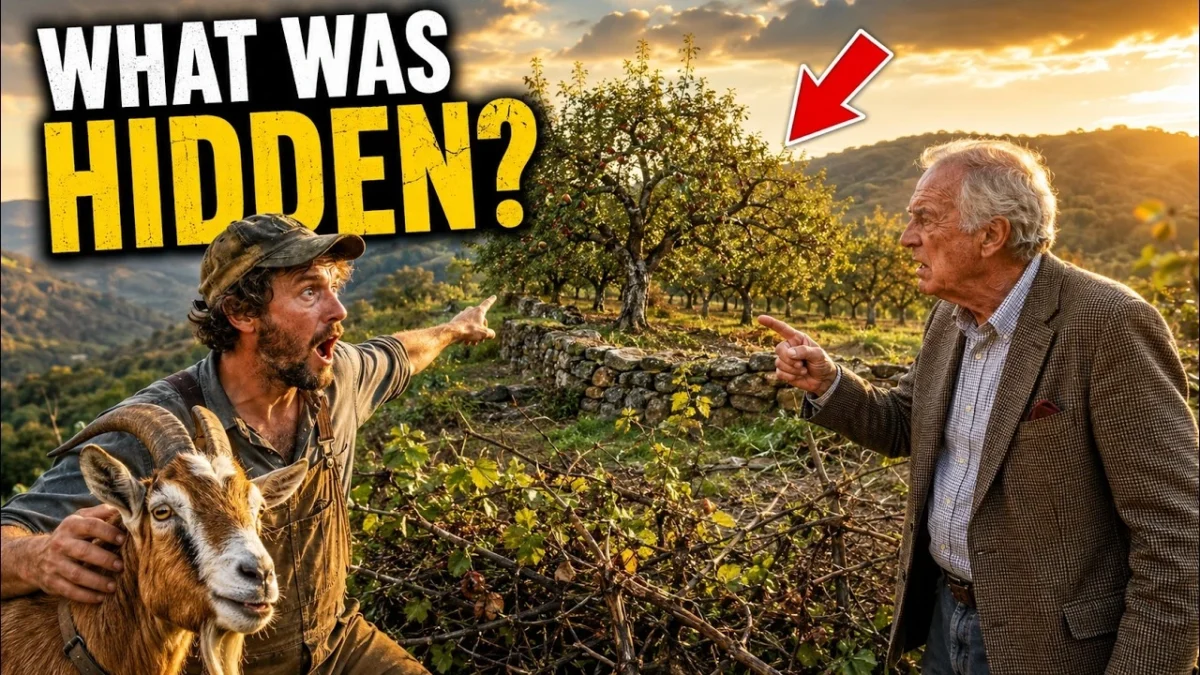
Curious, Caleb pulled away more vines and moss. It was a dry-laid stone wall, standing nearly shoulder-high in places, constructed from large, flat pieces of local sandstone fitted together without mortar. It ran horizontally across the steep hillside, perfectly level.
He followed the wall through the cleared understory for eighty feet before it disappeared into the uncleared brush of the next paddock. Moving twenty yards straight up the slope, he tripped over another stone structure. It was a second wall, running parallel to the first. Above that was a third.
The walls were not property line fences. They had been built across the contour of the hill, holding back thousands of tons of soil to create long, flat, narrow steps in the mountain.
They were terraces.
Someone had spent months—perhaps years—hand-building massive stone retaining structures to turn a steep, un-farmable West Virginia hillside into usable, stepped ground.
Caleb stood on the middle terrace, his heart thumping in his chest. As he looked closer at the ground the goats had stripped, more details began to emerge from the shadows of the woods. He found a stone-lined drainage culvert designed to catch ridge runoff and direct it safely down the slope without eroding the terraces. Further along, he found a hand-forged iron gate hinge still embedded in an ancient, rot-resistant black locust post.
And then he saw the trees.
At first glance, they looked like any other scrub hardwood in the overgrown forest. Their trunks were weathered and dark, their lower limbs dead, and thick wild grapevines wrapped tightly around their crowns.
But as Caleb stepped back and looked down the line of the terrace, he realized they were spaced at exact intervals.
Twenty feet apart. Exactly twenty feet from one trunk to the next, sitting right near the outer edge of each stone terrace where the soil was deepest and water drained freely.
He walked down the line, counting.
One. Two. Three. Four…
He counted twenty-seven trees along the first two terraces alone.
The trees had short, thick trunks that branched out wide at shoulder height, unlike the tall, straight wild maples surrounding them. Several showed massive, weathered pruning scars where large limbs had been cleanly cut decades ago.
Caleb knelt beside the base of the nearest tree and scraped away the thick moss covering the bark. Four inches above the soil line, he found a distinct, swollen ring encircling the trunk where the bark texture completely changed.
A graft union.
Caleb sat back on his heels, wiping his soil-stained hands on his jeans. He knew enough about basic horticulture to realize what he was looking at. These were not wild trees that had sprouted from windblown seeds. Someone had intentionally selected rootstock, grafted specific varieties onto them, laboriously built stone terraces to protect their roots, and trained their branches to bear weight.
He pulled his cell phone from his pocket, stepped onto a high stone outcrop to catch a single bar of signal, and called Laura.
“Laura,” he said when she answered. “You need to come out here after work.”
“Is everything okay?” she asked, hearing the edge in his voice. “Did one of the goats get hurt?”
“No. The goats are fine. Laura… there are trees under here.”
“Caleb, it’s a forest,” she said with a light laugh. “There are trees everywhere.”
“No,” Caleb said, his voice dropping. “These were planted. They’re in rows. On stone terraces.”
There was a long pause on the line. “What kind of trees?”
“I don’t know yet,” Caleb said. “But someone built this entire hill for them.”
—
Laura arrived just as the sun was beginning to dip behind the western ridge, casting long shadows across the valley. Together, they walked the cleared paths between the stone walls while the goats quietly stripped honeysuckle shoots nearby.
With the foliage thinned by the herd, the sheer scale of the historical construction became obvious. The hillside was not a chaotic wilderness; it was a carefully engineered landscape that had been smothered and forgotten under twenty years of neglect.
Laura stopped near the edge of the second terrace, squinting up into the lower canopy of a widely branched tree. “Caleb, look up there.”
High on a thin branch that had managed to push through a tangle of grapevine into the sunlight, a single piece of fruit was hanging. It was small—no larger than a plum—hard, misshapen, and covered in rough, brownish-green spots.
Caleb reached up, pulled the vine down gently, and plucked the fruit. He pulled his pocketknife from his jeans, wiped the blade on his shirt, and sliced the small fruit in half.
The flesh inside was dense, pale yellow, and embedded with tiny brown seeds. A sharp, intensely tart aroma mixed with a faint hint of sweetness drifted up from the cut fruit.
Caleb popped a small sliver into his mouth and chewed. He immediately grimaced, his tongue curling from a wave of intense bitterness and puckering acidity.
“Ugh,” he muttered, spitting it out onto the leaf mold. “Tastes like leather and vinegar.”
Laura picked up the other half, smelled it, and looked up at the row of weathered trunks stretching across the stone terrace.
“It’s an apple, Caleb,” she said softly.
Caleb looked up the steep hill, where dozens of similar trunks stood hidden in the brush, waiting to be cleared. “This isn’t just a woods,” he said. “It’s an orchard.”
—
The following morning, Caleb drove to the Monroe County Agricultural Extension office in Union. He carried a brown paper bag containing three branch cuttings, a handful of leaves, and the small, bitter apple he had sliced open the evening before.
The extension agent on duty was Nina Coleman. Nina was forty-eight, wore wire-rimmed glasses, and had worked with small farmers across southern West Virginia for nearly twenty years. She had diagnosed everything from cattle bloat to tomato blight, but her passion was historical Appalachian agriculture.
Caleb placed the bag on her desk. “I found these on some land I bought over near Sinks Grove.”
Nina opened the bag, pulled out the cutting, and examined the arrangement of the leaf buds with a hand lens. She picked up the small apple, weighed it in her palm, and cut a fresh slice to examine the seed cavity.
“How many trees did you say you found?” she asked, looking up over her glasses.
“Twenty-seven so far,” Caleb said. “That’s just on the eight acres my goats have cleared. The whole place is forty-three acres.”
“Were they planted in a grid?”
“They’re planted on hand-built stone terraces,” Caleb explained, pulling out his phone to show her the photos he had taken of the stonework. “And almost every trunk has a graft union near the base.”
Nina leaned forward, staring at the images on the screen. She zoomed in on the dry-laid sandstone wall, then on the weathered bark of the thickest tree.
“Caleb, these aren’t modern fruit trees,” she said, her voice growing cautious and precise. “The bark thickness, the graft height, the open-center training… these trees are eighty, maybe ninety years old. Some of them could be older.”
“Commercial?” Caleb asked.
“Whoever built those stone terraces wasn’t just planting a few trees for family pies,” Nina said, turning the small fruit over in her fingers. “Moving that much stone represents a massive investment of labor. But look at this fruit. This isn’t a dessert apple. It’s too small, too tannic, and far too acidic for fresh eating.”
“It tasted terrible,” Caleb offered.
Nina smiled. “In the apple world, Caleb, ‘tasting terrible’ can be a very good sign.”
“For what?”
“For traditional cider.”
She explained that before industrial refrigeration and modern transport, apples were rarely grown just for fresh eating. Across the Appalachian Mountains, farmers grew hard cider apples. They were bred for high tannin, high acid, and complex sugars—qualities that made them completely unpalatable off the branch, but produced rich, complex, naturally preserved fermented cider.
“Modern grocery store apples like Red Delicious or Gala were bred for sweetness, bright red color, and long shelf life,” Nina said. “Cider apples were bred for what happened after you ran them through a heavy wood press. Can I bring someone out to look at your place?”
“Who?”
“Dr. Samuel Price. He’s a retired pomologist from West Virginia University. He’s spent the last thirty years mapping lost heritage orchards in the Allegheny Mountains.”
—
Ten days later, Nina arrived at the property accompanied by Dr. Price.
The retired professor was in his mid-seventies, walked with a slight limp, and carried a worn leather satchel containing pruning shears, aluminum tree tags, sample bags, a brass caliper, and a waterproof notebook held together with heavy rubber bands.
By then, Caleb’s goats had cleared nearly fourteen acres, opening up three full tiers of stone terraces.
Dr. Price stepped out of the truck, walked past the electric fence, and stopped at the base of the first terrace wall. He didn’t speak for several minutes. He stood entirely still, running his hand over the mossy sandstone blocks, then looking up at the line of ancient trees above him.
He walked slowly up the terrace, stopping at a massive tree whose trunk was nearly two feet thick. He knelt, scraped away the soil near the root crown, and inspected the graft union.
“1910s,” Dr. Price said softly, touching the fissured bark. “1920s at the latest. Look at the rootstock dominance. This was planted before the introduction of modern dwarfing rootstocks.”
He spent six hours on the property, moving methodically from tree to tree. He took leaf samples, measured trunk circumferences, clipped small twigs for genetic testing, and tied bright yellow flagging tape around every living specimen.
By late afternoon, they had cataloged forty-six living apple trees across the cleared terraces.
Many carried fruit, and as Dr. Price examined them, it became clear that the orchard was not a single crop.
“Look at the variation,” Dr. Price noted, holding two different fruits side-by-side. One was pale yellow with tiny russet dots; the other was deep green with dark red streaks along the ribbing. “This isn’t a single commercial variety. It’s a specialized collection.”
While Dr. Price cataloged the physical trees, Nina spent the following week digging through property deeds, agricultural census records, and tax assessments at the Monroe County Courthouse in Union.
The story of the land slowly came into focus.
The property had been purchased in 1906 by Walter Hensley—Ruth Hensley’s father. Walter had been a miner and stone mason who bought the steep ridge land cheaply. Between 1912 and 1918, Walter and his brothers had hand-cut the sandstone from a quarry up the ridge and built the terraces to prevent the steep soil from washing away during heavy spring rains.
In an archived agricultural ledger from 1919, Nina found receipts showing Walter Hensley had ordered sixty specialized fruit trees from a long-defunct nursery in Virginia. Subsequent tax records listed a commercial cider press, wooden fermentation vats, and sales records of hard cider and vinegar delivered by horse-drawn wagon to regional coal camps along the New River Gorge.
When Prohibition arrived in 1920, the commercial cider market collapsed nationwide. Many mountain farmers chopped down their cider orchards to plant corn or pasture. But Walter Hensley had kept his trees, transitioning to small-scale local sales and livestock grazing. After Walter died, Ruth maintained the open spaces around the trees as long as her health allowed. But when she grew too old to ride her tractor, the invasive brush moved in, burying Walter’s stonework and his life’s work beneath a thick blanket of thorns.
Among the historical files, Nina found a brittle 1924 regional nursery catalog that listed the specific cider varieties sold in Monroe County during that era: *Virginia Hewes Crab*, *Harrison*, *Winesap*, *Kingston Black*, and a rare local seedling listed simply as *Hensley Bitter*.
The catalog described *Hensley Bitter* in brief detail: *Small, rough russeted skin, late-ripening, exceptionally high tannin and sharp acid. Unsurpassed for adding structure to cider blends. Native to Monroe County.*
There were no surviving photographs of the tree, no living specimens recorded in the USDA national germplasm repository, and no record of the variety anywhere in modern commercial circulation. It was presumed extinct.
—
In late October, when the late-season fruit reached full maturity, Dr. Price returned to the farm.
By now, Caleb’s sixty-seven goats had cleared twenty-eight acres of brush. They had systematically eaten away the honeysuckle, defoliated the multiflora rose, and opened up the upper terraces.
The total count of living historical trees stood at sixty-three.
Twenty-one were severely damaged—hollowed out by rot, broken by heavy ice storms, or choked by grapevine—and carried no fruit. But forty-two trees bore a modest crop of late-fall apples.
Dr. Price and Caleb spent two days harvesting sample batches from every productive tree. The professor recorded fruit shape, stem length, seed cavity geometry, brix (sugar content), and pH levels, comparing the physical data against historical texts and DNA databases.
Seven weeks later, Dr. Price called Caleb from his office at the university.
“Caleb,” the professor said, his voice quiet with excitement. “We’ve finished the preliminary DNA sequencing and fruit analysis.”
“What did you find?”
“We have confirmed eight distinct heritage cider varieties in your orchard. Five of them match known historical cultivars, including *Harrison* and *Virginia Hewes Crab*—which are extremely valuable to heritage cider makers. Two others are rare regional selections that haven’t been documented in West Virginia since the 1940s.”
“What about the eighth?” Caleb asked, holding his breath.
“The eighth sample didn’t match any profile in the national database,” Dr. Price said. “The fruit characteristics—the small size, dense russet skin, extreme tannin, and high acidity—match the 1924 description perfectly. Caleb, you have four living trees of *Hensley Bitter*.”
Caleb stood silent on his porch, looking across the road at the stepped hillside.
“Are you sure?”
“Pending final comparative markers, yes,” Dr. Price said. “You are standing on the only four known surviving *Hensley Bitter* trees on earth.”
“They’re in rough shape, Professor,” Caleb said quietly. “One of them is completely hollow. Another lost a main scaffold limb to a grapevine last winter.”
“If you had bought that land five years later,” Dr. Price replied, “those trees would have been choked to death by honeysuckle. The shade alone would have killed them.”
It was a striking paradox. The invasive brush had been slowly strangling the ancient orchard, cutting off sunlight and starving the roots. Yet that very same dense, thorny wall of multiflora rose had protected the trees from deer rubbing their bark, shielded the stone terraces from erosion, and kept wood-cutters from clearing the hill for firewood.
The ruin of the land had preserved its greatest treasure.
—
Word of the discovery spread slowly through the agricultural community. One crisp November afternoon, Everett Sloan drove his Gator across the road and parked near the lower stone wall.
The lower two terraces were now completely visible from Route 21. The elegant sandstone walls stretched across the slope in straight, clean lines. Beneath the wide canopies of the apple trees, the ground was cleared and covered in a carpet of emerging winter rye that Caleb had hand-seeded.
Everett stepped out, adjusted his cap, and stared up at the exposed stone terraces.
“So this really was Hensley’s cider place?” Everett asked.
“It was,” Caleb said, walking over to join him. “Planted over a hundred years ago.”
Everett looked up at the stone walls, shaking his head. “My dad used to talk about Walter Hensley making cider up on the ridge. I always thought he meant further west, over near the county line. I never knew it was right here.”
“The trees were here the whole time, Everett.”
“I’ve driven past this hill twice a day for forty-six years,” Everett said softly, taking off his cap and rubbing his forehead. “I just saw a nuisance. I sprayed honeysuckle on my side of the fence line for thirty years, thinking the whole ridge was worthless scrub.”
He looked over at June, who was standing balanced on her hind legs against a rose bush, calmly pulling leaves from between the thorns.
“And your goats found it?” Everett asked.
“They didn’t find it,” Caleb said gently. “They just cleared the room so we could see what was already standing.”
Everett watched the herd for a long moment. “In ’98, I took a dozer to an old fence row on my back forty. Cleared it flat in two days. There were three old apple trees in that fence line. I pushed ’em into a pile and burned ’em.”
He paused, looking down at his boots. “Never even looked to see what kind of fruit they bore.”
“Most people wouldn’t,” Caleb said.
“That’s the thing about clearing land with heavy steel,” Everett said, turning to face Caleb. “You find out real fast what’s in your way. But you don’t ever find out what was standing underneath it.”
—
Restoring the orchard was not a fast process. It took two full years of careful, labor-intensive management.
Caleb built individual wire enclosures around the trunk of every historic tree so his goats could continue grazing the understory without chewing the sensitive bark. He removed heavy grapevines by hand, cutting them at the base and allowing them to rot out of the canopy naturally so he wouldn’t tear down healthy apple branches.
He pruned the ancient trees gradually over three winters, taking only ten percent of the deadwood each year to avoid shocking the root systems.
As the goats rotated through small paddocks every few days, stripping the regrowth of multiflora rose and honeysuckle, the invasive plants began to weaken. Without leaves to feed their roots, the rose bushes died back. Sunlight poured onto the stone terraces for the first time in decades, encouraging native grasses, wild white clover, and orchard grass to sprout from the long-dormant seed bank.
In the autumn of the second year, the orchard produced its first commercial harvest.
Thirty-one of the ancient trees bore fruit. Caleb and Laura harvested seventy-four wooden crates of mixed heritage apples by hand. The fruit was ugly by modern supermarket standards—small, russeted, misshapen, and speckled—but packed with extraordinary flavor profiles.
Mark Ellison, the founder and head cidermaker at a craft cidery in nearby Lewisburg, bought the entire harvest.
When Mark pressed the *Hensley Bitter* apples separately and tested the raw juice in his lab, he called Caleb immediately.
“This juice is incredible,” Mark said over the phone. “On its own, it’s undrinkable—it’s like drinking liquid tannin and battery acid. But when I blend just ten percent of it into a tank of standard sweet apple juice, it transforms the entire batch. It gives it structure, mouthfeel, and a lingering finish that you simply cannot get with modern apples.”
That first year, Mark purchased 2,800 pounds of apples from Caleb, handing him a check for $4,620.
It was not a fortune, but it was more than enough to cover the farm’s annual property taxes, pay for his electric fencing supplies, and cover his mortgage for the entire year.
By the third year, as the pruned trees recovered their vigor under full sunlight, the harvest doubled. Mark Ellison released a limited-edition single-orchard heritage cider called *Hensley Ridge*. The press run sold out completely in three weeks.
Meanwhile, Dr. Price and the university agricultural extension took dormant scion wood from the four fragile *Hensley Bitter* trees. They grafted dozens of genetic clones onto vigorous new rootstock at two research orchards in Morgantown and Kearneysville.
Caleb grafted thirty-five young trees of his own, planting them carefully along the upper stone terraces.
The future of the *Hensley Bitter* variety no longer rested on four hollow, weathered trunks. Even if a lightning strike, a severe ice storm, or wood rot took the original trees, their genetic line was secured for generations to come.
—
The forty-three acres of thorns had transformed into a closed-loop, highly profitable agricultural ecosystem.
The goats provided low-cost vegetation management, converting invasive brush into high-value meat kids while clearing the land without fuel, heavy machinery, or soil compaction. The cleared ground allowed light to reach the historical orchard, which produced high-value cider fruit that commanded premium prices. The removal of the dense understory lowered Caleb’s winter hay costs by forty percent, as the goats grazed late into the fall on native forage.
His monthly land payment remained exactly $138.
On an October evening in their fourth year on the farm, Caleb and Laura walked up to the highest stone terrace.
Below them, the stone walls cut across the mountain in neat, solid lines. The evening sun cast a golden light through the leaves of sixty-three restored apple trees, their branches heavy with red, yellow, and russet fruit. Down on the lower bench, June and the rest of the herd moved quietly through the grass, their bells tinkling softly in the cool mountain air.
Laura rested her head against Caleb’s shoulder as they watched the herd.
“You know,” she said quietly, “the whole way we got here still sounds completely backward.”
Caleb smiled, keeping his arm around her. “How so?”
“You bought land that nobody wanted because it was buried in thorns,” she said. “You brought goats because you couldn’t afford a tractor. The goats uncovered an orchard nobody knew existed. The worst-tasting apple turned out to be the most valuable thing on the mountain. And the land that was listed as ‘unusable’ ended up feeding your animals, paying its own mortgage, and saving a piece of history.”
Caleb looked up at the four ancient *Hensley Bitter* trees standing proudly along the top wall, their branches propped up gently with wooden crutches he had crafted himself.
“I thought I was just buying cheap feed,” Caleb said softly.
Laura looked up at him. “What did you actually buy, Caleb?”
Caleb looked out over the stone terraces, thinking of Walter Hensley hauling sandstone with horses in 1912, of Ruth mowing the lanes in her youth, and of the decades of quiet resilience built into the soil beneath their feet.
“I bought a hundred years of work that nobody could see,” Caleb said.
He reached out and touched the mossy stone of the upper terrace wall.
“The walls were always here,” he said. “The orchard was always here. The grafts, the drainage, the cider apples… none of it ever disappeared. It was just covered up long enough for everyone to assume there was nothing left worth saving.”
He looked down at the goats grazing peacefully beneath the fruit-laden trees.
“Some land isn’t ruined,” Caleb said. “It’s just waiting for someone to look closely enough to remember what it was.”








