He Proposed on Air in the Summer of 1957 — Then the Radio Man Never Saw Him Again
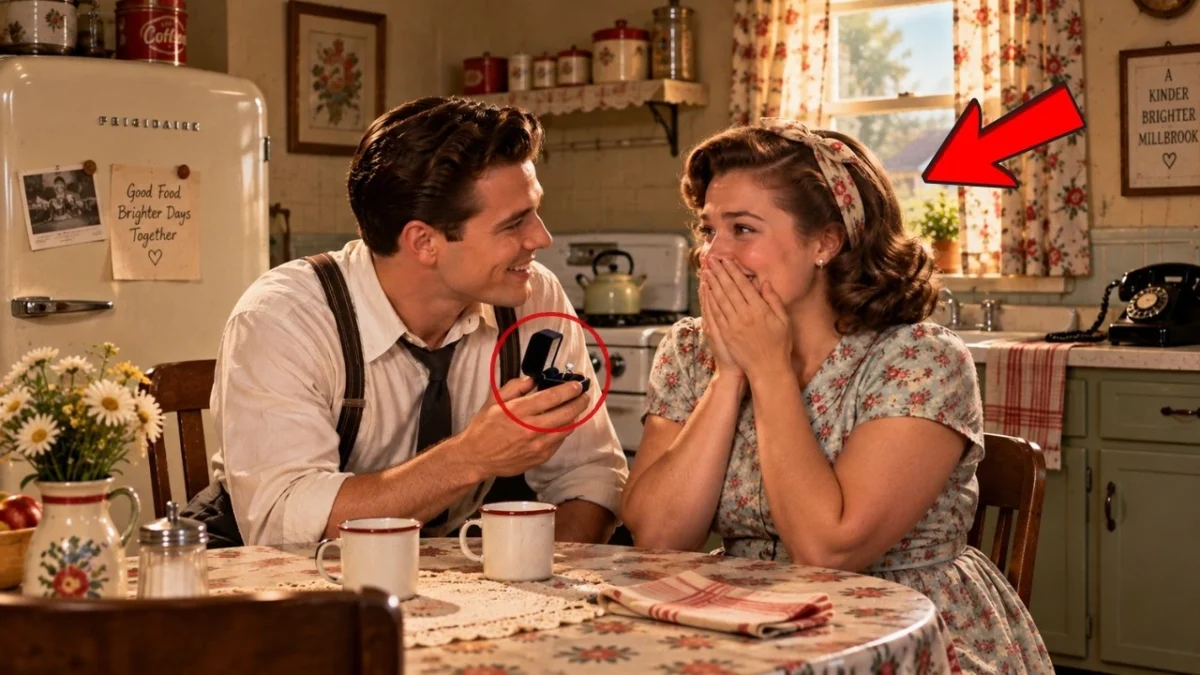
Summer of 1957.
Milbrook was a small town cradled by rolling Missouri hills, where secrets never stayed buried for long and everybody knew what kind of pie you ordered at the diner before you even sat down in your usual booth.
Rosalind Hart, known to everyone simply as Rosie, stood behind the counter of the Milbrook Diner, vigorously wiping down the laminate surface for the third time that morning.
The diner was quiet, save for the low, rhythmic hiss of the coffee machine and the heavy, deliberate ticking of the wall clock that always seemed to drag its feet on Tuesday mornings.
Rosie could not explain why her fingers refused to stay still, or why she kept darting her gaze toward the front glass door every single time the brass bell chimed with the entrance of a customer.
Something in the humid June air felt charged, pregnant with an unspoken shift, though nothing of consequence had actually happened yet.
Across town, Daniel Cole was elbow-deep in the greasy, hot engine of an old Ford Buick, but his thoughts were miles away from carburetors and oil leaks.
He had spent the last six months scraping together every single dollar he earned at the local garage, hiding a small velvet box inside a rusted coffee can tucked away on the highest, dustiest shelf of his bedroom closet.
Tonight, Daniel planned to do something entirely unprecedented in the sleepy history of Milbrook.
He was going to ask Rosie to marry him, and he was going to do it live on the radio in front of the entire county.
He had practiced the exact phrasing of the question so many times while lying awake in the dark that he could recite it backward in his sleep, yet his stomach still did a violent flip every time he pictured the look of absolute shock that would wash over her face.
In Milbrook, the radio was not merely a piece of furniture sitting quietly in the corner of a living room collecting dust.
It was the beating heart of the community.
Every single evening at precisely seven o’clock, families across the county turned their dials to the same frequency, letting the warm, crackling voice of Walter Higgins fill their kitchens and front porches.
Walter had been running the evening show for nearly twenty years, playing requested records, reading off birthdays, and stitching the town together one song at a time.
He knew half the county by their voice alone, recognizing the subtle shifts in tone before they even stated their names.
And tonight, Walter had a very special request lined up in his stack of index cards.
As the afternoon dragged on, a heavy, bruised bank of dark clouds began massing over the horizon, threatening to break the summer heat with a vengeance.
Old Mr. Puit, who ran the hardware store down the street, stood on his wooden porch with a straw broom in his hand, squinting suspiciously up at the darkening sky.
He muttered to anyone who walked past that the wind felt entirely wrong, carrying that specific, heavy scent that always preceded real trouble rather than a simple afternoon shower.
Most folks laughed it off, leaning against the storefront and claiming that Mr. Puit predicted a catastrophe every single summer without fail.
Even so, a few cautious farmers quietly climbed into their trucks and moved them under metal sheds just in case the old man was right.
Deep inside the back of Rosie’s mind, that persistent, low-grade unease from the morning still refused to dissipate.
By seven o’clock sharp, half of Milbrook was gathered around their glowing radio sets.
Rosie sat at her small kitchen table alongside her mother, half-listening while automatically folding cloth napkins for her shift the following day.
Walter’s voice crackled through the speaker, as rich and familiar as Sunday morning church bells, welcoming his listeners to another evening together.
He read off a list of local birthdays, played a requested tune for the Henderson family down the road, and then paused for a heartbeat longer than usual before speaking again.
He announced that he had a special call coming through on the line, one that everyone tuned in was going to want to hear.
Daniel’s voice filtered through the static next, trembling slightly with nerves, but steady enough to get the words out clearly.
He asked Walter to play their song, the sweet, slow melody they had danced to under the string lights at the county fair three summers ago.
Then, right there on the live airwaves for every family in Milbrook to hear, he asked Rosie to be his wife.
Rosie dropped the napkin she was folding and clamped both hands tightly over her mouth, her eyes widening in stunned disbelief.
Her mother started crying tears of joy before Rosie could even find her own voice.
Through choking tears, Rosie shouted yes into the telephone receiver sitting on their hallway table, loud enough that Walter had to pull the studio microphone back a few inches so the whole town didn’t get their ears blown out by her joyous cry.
The station switchboard lit up instantly with calls from neighbors wanting to congratulate the young couple, laughing about how the entire town had just witnessed a proposal without ever having to leave their armchairs.
Before hanging up the telephone, Daniel told Walter one final thing.
He said he was going to drive straight over to Rosie’s porch the moment the radio show ended so he could slide the ring onto her finger himself.
Walter had paused, noticing a strange catch in Daniel’s voice just then—a peculiar mixture of sheer relief and something else he couldn’t quite put his finger on.
Shrugging off the odd feeling, Walter simply told Daniel to drive safely, offered his best wishes to the future bride and groom, and smoothly transitioned into the next record on his playlist.
Rosie sat by her front parlor window for the remainder of the evening, watching every pair of headlights sweep down the dark road, entirely certain that Daniel’s truck would round the corner any second.
Her porch light stayed brightly illuminated long after the sun had completely vanished.
Ten o’clock came and went without a trace.
Then eleven rolled around, and the violent storm Mr. Puit had warned about finally broke over the town, unleashing sheets of howling rain that rattled the windowpanes and drowned out every other sound on the street.
Rosie kept vigil at the window anyway, her breath fogging the cool glass.
Daniel never arrived.
By dawn, the shocking news had already swept through Milbrook like wildfire: Daniel Cole never made it home the night before.
His mother had woken up before the sun, found his bedroom perfectly untouched, and immediately started calling around to see if anyone had the slightest idea where he might have spent the night.
Neighbors soon gathered on their front porches wrapped in heavy robes, trading fragments of gossip that ultimately added up to nothing substantial.
The storm from the night before had knocked down two massive oak trees along Route 9 and left the local creek running higher and faster than anyone could remember seeing it in years.
Swollen brown water rushed violently against the concrete banks of the bridge.
Yet that morning, something far more terrifying than the bad weather weighed heavily on the town’s collective conscience.
The entire county had heard him propose over the public radio less than twelve hours earlier.
Everyone had been bracing themselves for a joyful wedding announcement, not a chilling silence.
At the diner, Rosie forced herself to keep her hands moving, pouring coffee and wiping down sticky tables just like any other ordinary morning, desperate for a routine to anchor her spinning world.
Her mother had begged her to stay home, but Rosie knew she would suffocate if she sat alone with her own spiraling thoughts.
She told herself over and over that there had to be a logical explanation for his absence.
Maybe his old truck had suffered a flat tire along a forgotten back road in the pitch black.
Maybe he had pulled his vehicle safely onto the grass to wait out the worst of the blinding storm and simply fallen asleep.
She kept darting her worried eyes toward the front door every single time the bell jingled, fully expecting him to walk in with an easy smile and a sheepish apology for scaring her half to death.
Each time a stranger walked through the door instead of Daniel, she whispered to herself that the next person surely would be him.
She kept the small velvet ring box he had proudly shown her tucked safely inside the deep pocket of her diner apron, as if holding it close against her body could somehow pull him back to her.
By the afternoon, a solemn group of local men gathered outside the hardware store, pulling on heavy rubber boots and grabbing thick metal flashlights before heading out to retrace the winding roads Daniel would have taken home.
Old Mr. Puit handed out heavy lanterns from behind his counter without charging a single penny for them.
The storm had left the county roads in a disastrous state, with thick tree branches blocking paths and deep pools of water filling up low depressions that never usually flooded.
The searchers split into two separate pickup trucks, one heading toward the old mill road and the other toward Miller’s Bridge, shouting Daniel’s name into the dark ditches and dense tree lines as they went.
Their voices grew progressively hoarse as the afternoon wore into a gloomy evening, yet they returned with nothing to show for their exhausting efforts.
Not everyone in Milbrook joined the search, however, and by evening, ugly little rumors began slithering through the town, spreading faster than any summer storm ever could.
Some cynical folks whispered behind closed doors that Daniel had simply gotten cold feet the exact second those public words left his mouth on the radio.
They muttered that a grown man doesn’t just vanish into thin air during a thunderstorm unless he was actively running away from something he couldn’t face.
A few cruel tongues even suggested that Rosie should have known better than to trust a grand romantic proposal broadcast to the entire county.
As if a public promise meant inherently less than a quiet one spoken in private.
Walter heard these hateful whispers drifting through the town, and sitting behind the exact same microphone that had carried Daniel’s voice just two nights prior, he felt a surge of righteous indignation.
That evening on air, Walter deliberately set his scheduled index cards aside, leaned close to the metal grille of the microphone, and told his listeners in no uncertain terms that a man cannot be judged before anyone actually knows the truth of what happened to him.
If you have ever had people talk behind your back before they knew your side of the story, Walter said into the ether, go ahead and drop the words never judge in the comments below because that is exactly what was being done to Daniel and Rosie by a town that arrogantly thought it knew everything about everyone.
Two days into the grueling search, old Ellis Cobb, who spent his mornings fishing near the rushing waters of Miller’s Bridge, came forward with a piece of information he hadn’t thought much of until he heard the alarming news about the missing man.
On the night of the storm, half-blinded by sheets of torrential rain and hunched miserably under the concrete architecture of the bridge to wait out the worst of the weather, he had witnessed a set of blinding headlights swing wildly near the raging water and then vanish all at once in a sickening flash.
He hadn’t dared step out into that lethal weather to investigate, convincing himself it was probably nothing more than a local delivery truck turning around in the dark.
By the time the rain had finally eased up by morning, he had completely pushed the incident out of his mind.
Now, standing before the local authorities, he wasn’t so sure anymore, and neither was anyone else in Milbrook.
A day later, a different kind of lead drifted in from a hospital located two counties away.
A visiting nurse mentioned to her relative back in Milbrook that their facility had admitted an unidentified young man on the exact night of the violent storm, pulled half-drowned from a swollen river by a passing trucker who happened to be driving through.
The poor man carried no wallet, no identification papers, and had struck his head hard enough during the ordeal that he couldn’t even remember his own name or where he hailed from.
Because the local telephone lines between the counties had been knocked out by falling trees during the storm, nobody in Milbrook could immediately call to verify the rumor, making the agonizing wait feel almost unbearable.
By the end of the week, the local search party finally stumbled upon the grim landmark they had been dreading.
And what they discovered only served to deepen the horrifying mystery.
Daniel’s battered pickup truck sat half-submerged in the rushing brown creek near Miller’s Bridge, resting in the exact spot Ellis Cobb had described seeing the headlights disappear into the dark.
The driver’s door hung wide open, twisting back and forth in the current.
The front end of the truck was completely crushed against a massive fallen oak tree that had washed down the river.
The windshield was shattered into a spiderweb of cracks, and one of Daniel’s leather work shoes was caught tightly in the thick riverbank mud a few feet away.
Everyone braced themselves for the absolute worst as they dragged the wreck and scoured the churning water surrounding it for any sign of a body.
Yet, to everyone’s utter bewilderment, there was no sign of Daniel anywhere.
No corpse, no personal belongings, no definitive answers—just an empty, ruined truck and a terrified town left holding its collective breath.
Ten long years passed in Milbrook, and the town gradually stopped talking about that fateful, stormy summer night in 1957.
New families moved into the expanding suburbs, old ones packed up and moved away, and the local diner changed hands twice over the decades, though Rosie stubbornly stayed behind the counter through all of it.
She wore the same style of apron, wiped down the exact same corner booth every single morning without fail, and stubbornly refused to let the past fade away.
She never married.
A few genuinely kind men from neighboring towns tried courting her over the years, bringing fresh flowers to the diner and asking her to accompany them to the annual county dances, but something deep inside her soul had simply locked that door for good.
She was unfailingly polite every single time, thanking them for their kind intentions, and then walking right back to refilling coffee cups as if nothing had interrupted her thoughts at all.
Every single summer, on the exact same week that Daniel had first proposed to her on the air, Rosie faithfully called the radio station and requested their song.
She never had to explain which melody she wanted.
Walter knew the moment he heard the familiar cadence of her voice on the line, and he played the record without asking a single question, the exact same way he had done for ten summers running.
The whole town had come to expect it by now—a quiet, poignant little tradition nobody talked about out loud, though everyone understood precisely what it meant when that melancholic tune came crackling through their kitchen radios each June.
Walter himself was growing older, his knees stiffening with arthritis and his spoken voice growing a bit rougher around the edges than it used to be in his youth.
The radio station had fallen on hard financial times more than once, and two summers back, an aggressive businessman from the city had passed through town, offering to buy out the entire operation and turn it into a commercialized, modern broadcasting syndicate.
Walter had turned him down flat, looking the man dead in the eye and telling him that some things in this county simply weren’t for sale at any price.
He kept the vacuum tubes glowing and the dial permanently tuned to Milbrook, mostly because he couldn’t bear the thought of Rosie calling the station one summer and finding nobody there to answer her plea.
Two counties away, inside a quiet, unassuming care facility that primarily housed long-term patients with memory afflictions, lived a man whom nobody ever came to visit.
The overworked medical staff simply called him Mr. Do.
He had been residing there for years, shuffled between two different county hospitals before finally settling into this particular quiet ward.
And through all that time, nobody had ever managed to uncover his true legal name or figure out where he had originated from before the accident wiped his slate clean.
The catastrophe, whatever it had truly been, had taken far more than his fragile memory.
It had systematically stripped away the foundational pieces of identity he desperately needed to even formulate the right questions about his own existence.
He spent the majority of his waking days sitting quietly by a tall sunny window, calm and observant, seeming vaguely content with a hollow life that had no past attached to it.
One warm afternoon, a young, cheerful nurse named Grace was going about her daily rounds, humming softly to herself the way she often did to pass the monotonous hours.
It was an old, lilting tune, one her own grandmother used to sing while tending the garden at home.
She didn’t think anything of her idle humming until she abruptly noticed Mr. Do’s frail hands start violently shaking in his lap, his eyes fixed on nothing in particular, his breathing turning shallow and frantic.
She stopped humming immediately, deeply startled and unsure what she had inadvertently triggered, and it took nearly ten minutes of quiet reassurance before the old man settled back into his usual tranquil state.
Neither of them possessed the slightest understanding of what had just transpired in that sterile room.
A few weeks later, one of the resident aides handed Mr. Do a small sketch pad and a box of charcoal pencils, hoping it might give him a productive way to occupy his trembling hands.
Nobody expected much artistic output from the exercise, but within days, the exact same haunting face began appearing on page after page of the tablet.
It was a young woman with soft, kind eyes and dark hair pulled back neatly from her face, always drawn purely from deep-seated memory rather than any physical photograph sitting in front of him.
He couldn’t tell anyone her name, because he didn’t know it himself.
He couldn’t even definitively tell the staff if she was a real human being who had once existed or simply an elaborate figment his broken mind had invented to cope with the void.
Yet he continued sketching her likeness over and over again, day after day, as though some primitive, stubborn part of his soul stubbornly refused to let her slip away into nothingness.
When the care facility relocated to a smaller, more modern building that autumn, the staff took on the tedious task of sorting through old storage boxes belonging to long-term patients.
Most of it was discarded junk nobody had touched in decades.
Inside a cardboard box marked explicitly with Mr. Do’s permanent admission number, tucked securely away within the lining of a heavily stained, moth-eaten winter coat, someone discovered a small, tarnished silver ring.
Nobody could possibly explain how a man with no known family, no identification, and no personal belongings had managed to keep such a precious item hidden away in his possession all this time.
The curious discovery was quietly noted down in the margins of his medical file, and then just as quietly forgotten by everyone except the man who owned it.
That very night, sitting all alone in his dimly lit room with the cold metal ring resting heavily in the center of his palm, Mr. Do stared down at it for a long, unbroken stretch under the amber glow of the bedside lamp.
Something about the physical weight of the band resting against his skin felt jarringly familiar in a way nothing else in his fractured life did anymore, even though he still couldn’t articulate why.
He closed his eyes tightly, and for reasons he could not begin to rationally explain, a single word rose up from somewhere deep inside his chest, clear and ringing with absolute certainty for the first time in decades.
Rosy.
The name did not leave him after that solitary night.
Over the course of the following weeks, more fragmented pieces began surfacing in his mind, hesitant at first, then growing increasingly insistent, much like an old radio receiver slowly tuning its dial into a broadcasting signal it had lost years ago.
He vividly remembered the rich, comforting smell of diner coffee and greasy bacon.
He remembered dancing wildly under a canopy of glowing string lights at a county fair, holding a young woman who laughed with her head tipped back toward the warm summer sky.
He remembered a terrifying storm, blinding headlights cutting through sheets of rain, and freezing cold water closing over his head, though he still couldn’t piece together how he had ended up so terribly far from wherever that memory rightfully belonged.
He couldn’t fathom how many decades had quietly slipped by while he sat in the dark waiting for those memories to find their way home.
He finally confided in Nurse Grace about these sudden mental flashes during one of her routine afternoon checks, hesitant at first, terrified she would think his mind was simply playing cruel tricks on him the way it occasionally did with the elderly residents.
Instead of brushing him off, she pulled up a wooden chair and listened with total patience as he haltingly described the vivid fragments—the bustling diner, the violent storm, the recurring face of the woman he had drawn a hundred times without knowing why.
Then one evening, without any warning at all, a single geographic name flashed across his mind as clearly and brightly as Rosie’s name had weeks prior.
Milbrook.
He spoke the word out loud before he even fully comprehended what it meant or where it came from.
And Grace felt her own eyes sting with sudden tears, watching an old man desperately grab onto that one fragile, glowing piece of his true self.
Grace researched the name that very same night on a public directory and discovered, to her absolute astonishment, that a small independent radio station was still operating out of a town three counties away, bearing the exact name Milbrook.
She gently offered to help him place a telephone call to the station, but the old man hesitated for days before finally giving his consent.
He was paralyzed by a profound terror of what might be waiting for him on the other end of that telephone line—terrified that whoever he had left behind in the distant past had long since moved on, married, and built a stable life that no longer had any room for a broken man who couldn’t even explain where he had been all those years.
Even so, the irresistible gravitational pull of that half-remembered name proved far stronger than his paralyzing fear.
One quiet afternoon, he finally looked up at Grace and asked her to dial the number.
Walter answered the office telephone with his customary warmth and unhurried grace, entirely ready to take another casual listener request for his Saturday afternoon retrospective show.
The voice coming through the speaker on the other end was older, rougher around the edges, exceedingly careful with every single syllable it uttered, and it requested a specific song that Walter hadn’t played for an anonymous stranger in decades—the exact same melancholy tune Rosie requested every single summer without fail.
When Walter politely asked for a name to announce over the live airwaves, the caller fell completely silent for a long, agonizing moment before stating quietly that he would rather not give a name just yet.
Something about that heavy hesitation, the precise choice of song, and the overly careful way the older man spoke sent an electric chill straight down Walter’s spine that he couldn’t rationally explain.
He had played that specific request more times than he could possibly count over the last ten years, and never once for anyone other than Rosie.
Walter decided to keep the mysterious caller on the line a little longer, asking gentle, probing questions, and with each hesitant, uncertain answer he received, an old ghost story of a stormy summer night and an empty wrecked truck came rushing back into his mind with startling clarity.
Walter didn’t voice his wild suspicions out loud just yet.
Instead, he politely asked the caller to hold the telephone line for a brief moment, and quickly instructed his young studio assistant to dial Rosie’s house, telling her only that she needed to turn on her kitchen radio right away because something profoundly important was unfolding on air.
Rosie dropped the dish towel she was holding without asking a single question, her heart already hammering wildly against her ribs before she even reached out to adjust the wooden radio dial.
She had learned a long time ago to instinctively trust that specific brand of urgency in Walter’s voice, especially when it involved his beloved broadcasting station.
Walter let the song play live over the airwaves, letting the familiar notes fill the room the way they always had, and then gently told his caller that someone was actively listening on the other end of the county who might know precisely who he was.
When Rosie heard Walter utter the words she had never dared to seriously hope for—that a man matching every single physical detail of Daniel Cole had finally been located alive all these long years later—she sank heavily into her kitchen chair and wept uncontrollably before she could even manage to lift the phone receiver to her ear.
Within days, the two of them were standing face to face once more.
And even though the relentless passage of time and the brutal aftermath of the accident had physically changed him, the exact moment their eyes locked across the room, both of them knew with absolute certainty that there was nothing left needing explanation.
He hadn’t run away.
He had simply been lost in the dark, waiting patiently for someone to call him back home.
To this very day, old Walter still tells that miraculous story to anyone willing to listen—recounting how a single radio request brought a man back from twenty years of crushing silence, and how a tiny, stubborn radio station in Milbrook never once stopped waiting for the truth to finally find its way home.








