“He Said, ‘I’m Too Old for Marriage’… Until She Whispered, ‘I’ve Been Waiting for You.’”
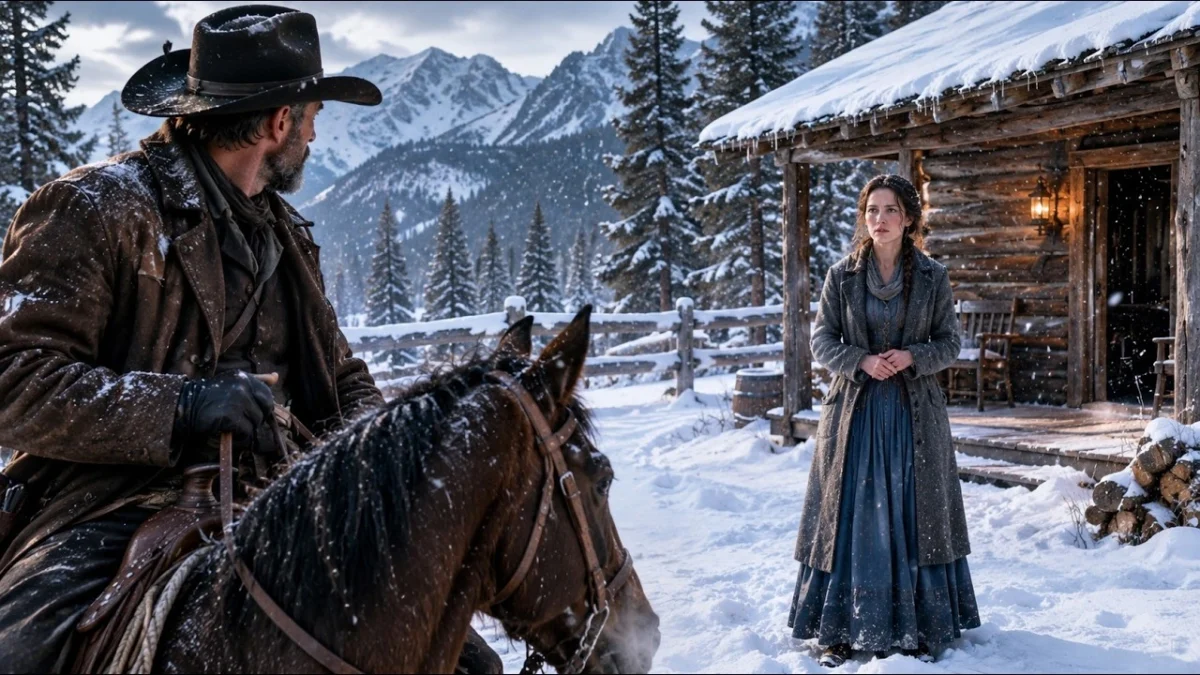
The snow fell in heavy, silent flakes over the timberline of Silver Creek, Colorado, wrapping the jagged peaks in a sheath of white.
In the late winter of 1888, fifty-eight-year-old Elias Whittaker had long since settled into the quiet cadence of a solitary life.
He lived in a rough-hewn log cabin nestled among high pines and open pasture, miles away from the nearest town.
His hands were hardened by four decades of split rails and frozen reins, his beard was shot through with silver, and his chest harbored a quiet, lingering shadow left behind by a loss he never named aloud.
That morning, Elias reined in his bay horse near the crest of the rise, his breath pluming in the crisp mountain air as he scanned the lower valley.
He was returning from checking his small herd of cattle when a dark silhouette near his cabin porch caught his eye.
A woman was standing in the snow, her dark wool coat gathered heavy with white flakes across the shoulders.
She was not pacing, nor was she waving for help; she simply stood motionless, staring down the white trail as if she had nowhere else to be.
Elias slowed his horse to a walk, his hand resting instinctively near the leather saddle horn.
In these mountains, a stranger appearing unannounced during a winter storm was rarely an accident.
He dismounted a few yards away, the snow crunching under his heavy leather boots.
The woman turned her head, her face pale beneath a dark knit bonnet, her eyes bright and clear despite the biting cold.
“Mr. Whittaker?” she asked, her voice steady though her lips were blue.
“I am,” Elias said, his voice deep and gravelly from disuse. “And you are?”
“My name is Anna Carter,” she replied, taking a small step forward before pausing. “I’ve come to ask you for a chance.”
Elias studied her face, taking in the faint lines around her eyes and the quiet determination set in her jaw.
“A chance for what, Miss Carter?” he asked.
Anna turned her glance briefly toward the dark logs of his cabin before looking back into his eyes.
“For my home.”
Elias did not answer immediately; he led his horse to the lean-to shed, unsaddled the animal, and then motioned for her to follow him inside.
The cabin was dim and smelled faintly of cedar, pine smoke, and dried wool.
He gestured to a ladder-back chair beside the cast-iron stove and began stoking the dying embers until a warm orange glow spilled across the floorboards.
Anna sat down, pulling off her damp wool gloves to expose slender fingers stiffened by the cold.
She was thirty-three years old, a former schoolteacher who had spent the last twelve months straining to manage her late father’s failing homestead down in the lower valley.
Her father had passed away five months earlier, leaving behind a mountain of debts and a farm that was rapidly slipping into default.
“The bank in town is taking the place,” Anna said softly, her voice carrying the flat weight of absolute truth.
“When?” Elias asked, setting a blackened tin kettle onto the cooktop.
“In nine days,” she said. “The notice came by courier on Tuesday.”
Elias frowned, pulling a wooden chair up opposite her. “I’m a rancher, Miss Carter. I don’t hold mortgages, and I don’t lend money. Why come up here?”
Anna reached deep into the inner pocket of her coat and produced a folded piece of heavy paper, its edges yellowed and frayed from handling.
“My father left this among his personal papers,” she said, leaning forward to lay it on the rough oak table between them. “He kept it sealed in an iron box beneath his bed.”
Elias unfolded the document carefully.
It was an old land survey dated twenty years prior, detailing a small parcel of rugged timberland bordering her father’s western fence line.
Elias recognized the boundary markers immediately, his thumb tracing a hand-drawn topographical outline near the upper gulch.
“Where did Thomas Carter get this?” Elias asked, his tone dropping an octave.
“He never told me,” Anna replied, watching his reaction closely. “He only told me that if things ever got desperate enough, I should bring it to you.”
Elias folded the paper along its old creases and pushed it back across the table.
“Your father should have burned this the day he drew it,” he said plainly.
Anna stared at him, her brows drawing together. “Why? Is it fraudulent?”
“No,” Elias said, looking toward the small paned window where the snow was beginning to fall harder. “Because some things in these mountains are worth far more than money, Miss Carter. And those are usually the things that get men killed.”
Anna waited for him to elaborate, but Elias lapsed into a stubborn, impenetrable silence.
He offered her a plate of salted beef and soda biscuits, which she ate quietly, before making up a narrow cot near the woodbin for her to sleep.
That night, while the wind howled through the high pines, Elias lay awake on his rope bed, staring up at the dark roof beams.
Memory dragged him back two decades, to an overgrown ravine high above the valley floor where he had found an old, half-collapsed silver tunnel.
He had walked away from it then, burying the entrance under rock and timber because he had already seen what silver fever did to men’s souls.
Now, Anna Carter sat in his cabin, having innocently brought him the very survey map that pinpointed its location.
When Elias woke at dawn, the smell of fresh wood smoke was already drifting through the cabin.
He pulled on his boots and stepped out onto the porch to find Anna standing by the chopping block, swinging an heavy iron axe down onto a pine log.
The axe bounced awkwardly off the frozen wood, sending a jolt up her arms.
“You don’t have to do that,” Elias said, leaning against the doorframe with his arms crossed.
Anna paused, wiping a strand of dark hair from her forehead with the back of her hand. “I know.”
“Then why are you doing it?”
“Because firewood doesn’t split itself, Mr. Whittaker,” she said, setting another log onto the block. “And I don’t intend to eat your food without paying my way.”
Elias almost smiled, a strange, unfamiliar sensation tugging at the corner of his beard.
He stepped down off the porch, walked over, and gently took the axe handle from her hands.
“You’ll split your foot wide open with that angle,” he said. “Go inside before you freeze.”
Anna folded her arms over her chest, standing her ground in the snow. “I’ve managed a farm alone for almost a year, Mr. Whittaker. I know how to work.”
“And I’ve managed a ranch alone for thirty years,” Elias countered, swinging the axe in a smooth, effortless arc that cleaved the pine block squarely down the center. “Which means I know when a tool is being misused.”
Anna watched the wood fall apart, then looked up at him with a faint spark of humor in her grey eyes. “Then perhaps you can teach me something.”
Elias paused, leaning on the axe handle as he met her gaze. “Perhaps.”
It was an unexpected turning point in the quiet house.
Over the next three days, Elias rode down with Anna to examine her father’s financial ledgers and the bank’s foreclosure papers.
As he read through the legal jargon scribbled by the town notary, Elias noticed a discrepancy that made his jaw tighten.
The foreclosure timeline was being rushed through months ahead of the standard territorial procedure.
Someone was intentionally pushing the sale before Anna could harvest her winter timber or seek private refinancing.
“Who has been coming around the property lately?” Elias asked as they sat at her father’s old pine desk.
“No one, mostly,” Anna said, pouring two cups of chicory coffee. “Except Caleb Mercer’s land agent. He offered to buy the lower pasture two weeks ago for a fraction of its worth.”
Elias set the papers down, his expression darkening.
Caleb Mercer owned the town’s general store, the timber mill, and half the mortgages in Silver Creek. He was a ruthless businessman who built his wealth on the misfortune of struggling homesteaders.
“Why would Mercer want a rocky eighty-acre farm with a failing house?” Elias mused aloud.
Anna looked at the old survey map resting on the table between them. “Do you think he knows about the paper my father left?”
“Mercer knows everything that happens in this valley,” Elias said. “If he thinks there’s mineral wealth attached to this parcel, he’ll strip this land from you before the snow melts.”
As the afternoon stretched on, the tension between them softened into a steady, working rhythm.
Together, they hauled grain to the barn, mended a broken latch on the chicken coop, and cooked a humble dinner of boiled beans and cornmeal cake.
They fell into easy conversations that lasted late into the evening, filling the drafty farmhouse with voices that had been absent for years.
“Why do you live way up on the ridge, Elias?” Anna asked softly as they sat near the stone fireplace, watching the coals die down. “It’s a lonely place for a man.”
Elias stared into the glowing embers, his weathered hands resting flat on his knees.
“Because sometimes being alone is easier than losing someone,” he said quietly.
Anna did not push him for details, but her quiet nod signaled a deep, unspoken understanding.
She knew the look of a person who carried an old, unhealed wound.
Elias had been married once, thirty years prior, to a gentle woman named Mary.
She had fallen ill with high fever during a blizzard while Elias was trapped ten miles away, clearing a blocked pass for a wagon train.
By the time he had dug his way back through the drifts, the cabin was cold, and Mary was gone.
He had blamed himself ever since, convincing himself that isolation was the only honorable punishment, and the only way to ensure he never failed anyone again.
Yet as he looked at Anna sitting across from him in the firelight, her presence felt less like an intrusion and more like a long-overdue thaw.
On the sixth morning, Elias rode into Silver Creek to gather news from the land recorder’s office.
He returned near dusk, his horse loping fast through the deep snow, carrying a folded handbill he had pulled from the courthouse door.
He walked straight into the kitchen and slapped the paper down on the wooden table.
“The auction date has been moved,” Elias said, his voice clipped.
Anna picked up the notice, her eyes scanning the black ink. “To when?”
“Tomorrow morning at ten,” Elias said. “On the courthouse steps.”
Anna’s face drained of color, and she sank into a chair. “They promised me nine days. The notice said nine days!”
“Mercer pulled strings with the county sheriff,” Elias said, pacing the length of the kitchen floor. “He wants this property sold before anyone can challenge the title.”
Anna stared down at her father’s survey map, her knuckles turning white. “It really is the silver, isn’t it?”
“Your father knew,” Elias said, stopping his stride. “He found something up there.”
“What are you saying, Elias?” Anna asked, looking up at him with desperate hope.
Elias sat down beside her, leaning his forearms on the table.
“Twenty years ago, I found a vein of silver ore in the high gulch,” he confessed. “I didn’t stake a claim because I knew the kind of scum a silver rush would bring to these mountains. But your father found the same vein years later. He kept it quiet to protect his home.”
Anna’s breath caught in her throat. “So the farm isn’t worthless at all.”
“It’s worth a fortune,” Elias said. “And Mercer knows it. But to prove the foreclosure is fraudulent, we need physical proof that your father held the prior claim.”
“Where would he keep something like that?” Anna whispered.
Elias looked out the window toward the dark outline of the upper peak. “High in the mountain. In the old mine shaft.”
An hour later, they were in the saddle, pushing their horses through the biting wind toward the high timberline.
The moon broke through the storm clouds, casting long, blue shadows across the snow as they navigated the narrow cliff trail.
When they reached the mouth of the abandoned mine, Elias dismounted and immediately knelt in the snow near the entrance.
“Hold the lantern back,” he whispered, pointing his finger toward the ground.
In the faint light, a series of fresh boot prints were visible, leading directly into the dark opening of the tunnel.
“Someone was here today,” Anna whispered, her hand instinctively gripping the leather strap of her saddlebag.
“Stay close to me,” Elias said, drawing a heavy Colt revolver from his belt.
They stepped into the damp, cold blackness of the tunnel, the smell of wet earth and ancient timber closing in around them.
Elias led her past rotting support beams to a small side chamber tucked behind a section of collapsed rock.
Anna dropped to her knees, her eyes scanning the uneven stone floor until she noticed a pair of loose pine boards wedged beneath a ledge.
She pulled the boards aside, reaching into the dirt cavity to haul out a rusted iron box.
“This is it,” she breathed, using a flat stone to pry open the lock.
Inside lay a small, leather-bound journal filled with her father’s tight, spidery handwriting.
Anna turned the pages by lantern light, her hands shaking as her eyes skimmed the entries.
Her father had mapped the silver vein in detail, but the final entries were dominated by another subject entirely.
He had written extensively about Caleb Mercer’s escalating threats, detailing how the merchant had cut off his store credit, poisoned his draft horses, and manipulated his mortgage documents to force him off the land.
On the last page, written just days before his death, her father had penned a final, heartbreaking sentence:
I fear my sweet Anna will be left alone to face the wolves when I am gone, but I pray God sends her someone strong enough to stand by her side.
Anna closed the book, tears tracking down her cold cheeks. “He knew he was dying. He knew what Mercer was going to do.”
Elias placed a heavy, warm hand on her shoulder. “He was trying to protect you the only way he knew how.”
Before she could answer, the sudden crunch of heavy boots echoed from the main tunnel entrance.
“You should have stayed down in the valley, Miss Carter,” a harsh voice called out from the darkness.
Caleb Mercer stepped into the chamber lantern light, flanked by two rugged men holding shotguns.
“Give me the journal, Anna,” Mercer said, extending a gloved hand. “You’re trespassing on county-adjudicated property.”
Anna stood up slowly, clutching the leather book tightly against her chest. “No, Mr. Mercer. This journal proves you murdered my father’s livelihood and forged the foreclosure papers.”
Mercer’s lip curled into a sneer. “A dead man’s scribblings won’t stand up against a signed bank deed. Give it to me, or my men will take it.”
Elias stepped smoothly in front of Anna, his revolver raised and level with Mercer’s chest.
“You take one step closer, Caleb, and they’ll be carrying you down this mountain in a pine box,” Elias said, his voice icy and absolute.
Mercer glanced at the barrel of Elias’s gun, then at the hard, unforgiving eyes of the old rancher. He knew Elias Whittaker was not a man given to empty threats.
“You’re making a mistake, Whittaker,” Mercer hissed, backing away slowly into the darkness of the main tunnel. “You can’t protect her forever.”
“I don’t need to protect her forever,” Elias called out over the echoing footsteps of the retreating men. “Just long enough to see you in a cell.”
They left the mountain before dawn, riding hard through the fading night to reach Silver Creek as the sun began to warm the eastern horizon.
When the county courthouse opened its doors at eight o’clock, Anna and Elias walked straight into the magistrate’s office.
The circuit judge, an honest man newly assigned to the district, spent an hour reviewing Thomas Carter’s journal alongside the rushed foreclosure documents.
By nine o’clock, the sheriff had been dispatched to arrest Caleb Mercer for fraud and extortion, and the scheduled land auction was officially canceled.
Yet as Anna sat on the wooden bench outside the courthouse, the victory felt heavy and incomplete.
The fraud was exposed, but her father’s back taxes and genuine bank debts still remained, far exceeding what she could pay.
“I saved his name,” she whispered, looking down at her worn boots. “But I still don’t know if I can save the farm.”
Elias sat down on the bench beside her, stretching his long legs out into the sunshine.
“You don’t have to save it alone, Anna,” he said quietly.
Anna turned her head to look at him. “Why are you doing all this for me, Elias? You barely know me.”
Elias was silent for a long moment, watching a supply wagon rumble down the muddy main street.
“Because for twenty years, I thought staying alone was the only way to keep from getting hurt,” he said, his voice rough with emotion. “I built a wall around my life after Mary died. But watching you fight for your home… it made me realize that a man who lives only to protect himself isn’t really living at all.”
Anna listened intently, her eyes searching his weathered face.
“Maybe you weren’t meant to stay alone forever, Elias,” she said softly.
Elias looked back at her, and for several seconds, neither of them spoke.
The cold air between them seemed to warm, a quiet understanding settling over them like a blanket.
Spring came slowly to Silver Creek that year, melting the heavy drifts and turning the mountain pastures into rich, green fields.
Anna kept her farm, merging her property line with Elias’s ranch through a joint land agreement they worked out with the county.
Elias moved his stock down to the lower pastures, helping her rebuild the decaying barn, repair the perimeter fences, and clear the upper timber.
Anna introduced new ways to make the land profitable, raising poultry, tending a massive vegetable garden, and selling fresh wool to the town weavers.
Their relationship did not bloom through dramatic declarations, but grew steadily through the quiet, ordinary rhythms of shared daily life.
It was found in a hot cup of coffee waiting on the porch at dawn.
It was in the steady hand that helped lift a heavy beam into place.
It was in the quiet dinners by the stove, and the sound of shared laughter breaking the long silence of the mountain evenings.
Months passed, and the green of summer gave way to the rich, burnt gold of late autumn.
One crisp October morning, Elias stood outside Anna’s farmhouse, holding a small, hand-carved cedar box in his calloused hands.
Anna walked out onto the porch, wiping her hands on her apron as she saw him standing there in his best wool coat.
“What’s that you’re holding, Elias?” she asked, stepping down off the wooden stairs.
Elias opened the lid of the box, exposing a simple, beautifully polished silver ring resting on a piece of dark velvet.
Anna stopped in her tracks, her breath catching in her throat. “Elias…”
He took a deep breath, looking down at the ring before meeting her eyes.
“I spent twenty years believing I was too old to start over,” he said, his voice trembling slightly.
Anna smiled, a tear glinting in her eye. “You told me that very thing the first day I came to your cabin.”
“I was a fool,” Elias said simply. “I don’t want to spend whatever years I have left pretending I don’t need anyone. I don’t know if a man my age deserves a second chance at happiness, Anna.”
Anna stepped closer, reaching out to touch his arm. “You do, Elias.”
Elias looked down at her, his dark eyes filled with a tenderness he had buried long ago.
She gently took his rough hand in hers, her thumb tracing the silver ring inside the box.
Then she looked up at him and spoke the words he had never dared to hope he would hear.
“You said you were too old for marriage, Elias Whittaker,” she whispered, a single tear slipping down her cheek. “But I’ve been waiting for you.”
Elias stood frozen, unable to speak as his chest tightened with emotion.
Anna offered him a soft, radiant smile.
“Not for a rich man,” she continued, her voice clear and strong. “And not for a perfect man. I waited for a man who would stay.”
They were married later that autumn, just as the first frost began to dusting the high pines.
There was no grand, extravagant celebration—only a quiet gathering of town friends and neighboring ranchers inside the small Silver Creek church.
Afterward, they shared a simple meal surrounded by warm lanterns, while the surrounding mountains glowed soft purple beneath the evening sky.
Elias kept his old cabin up on the ridge as a winter hunting shelter, and Anna kept her father’s house in the valley.
Together, they turned the two properties into a thriving, peaceful home where loneliness was no longer welcome.
Years later, the people of Silver Creek would still tell the story of the old mountain rancher who had spent two decades insisting he was far too old for marriage.
But Anna always knew the deeper truth of it.
Elias had never been too old to love.
He had simply been afraid to believe that life could still offer something beautiful after taking so much away.
And Anna had not walked up that frozen mountain trail merely looking for a husband to solve her problems.
She had gone looking for a chance to save her home.
Instead, she had found a man who helped her rebuild her world from the ground up.
And Elias had discovered the greatest truth the mountains had to offer.
Sometimes, a second chance does not arrive with a thunderous declaration or a grand twist of fate.
Sometimes, it arrives quietly, unannounced, in the middle of a winter storm.
It comes in the form of a brave woman standing alone in the snow.
Asking only for a chance.
And sometimes, the very future you spent years trying to avoid turns out to be the exact life you were waiting for all along.








