He Tore Down the Smokehouse for Firewood — Then a Second Door Appeared Behind the Wall
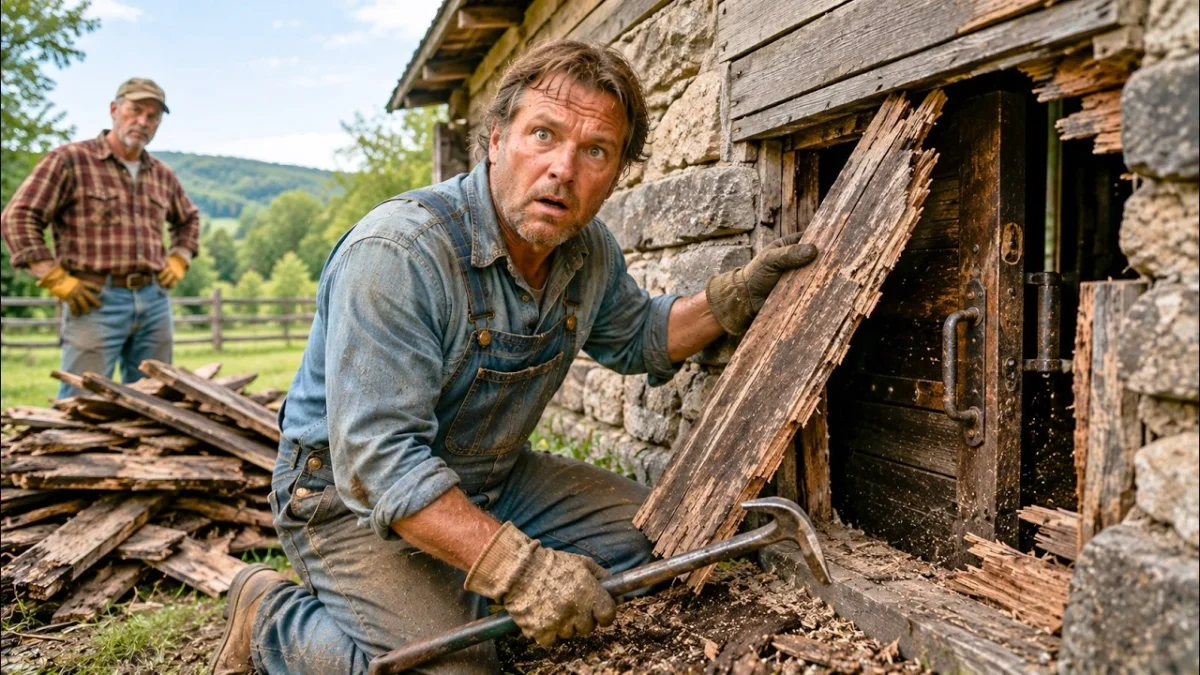
Daniel Mercer wedged the heavy iron prybar behind a weather-worn cedar board on the smokehouse wall and pulled with all his strength.
The aged wood cracked loose all at once, tearing away in a long, splintered strip that showered dry sawdust onto his work boots.
A sharp slice of bright morning sunlight cut through the newly opened gap into the deep shadow behind the exterior wall.
Daniel stopped his movement entirely.
He leaned in closer to the timber frame, resting his gloved hand against the wall to squint through the narrow opening.
It was not packed red dirt or solid limestone bedrock behind that wall, the way it should have been in a farm outbuilding constructed straight into the side of a Ozark hillside.
It was completely empty, cavernous space.
He reached into his back pocket, pulled out his heavy metal flashlight, and thumbed the switch on.
He shone the bright yellow beam directly through the gap in the broken boards.
An old iron door handle, dark with rust and shaped like a blacksmith’s latch, looked right back at him out of the pitch-black void.
Daniel took two slow steps backward away from the wall, his boots crunching on the dry fallen debris.
Behind him, a neighboring farmer named Thomas Vance, who had stopped by to see how the morning teardown was progressing, walked up to the wall and stared into the gap.
“Was that hidden opening always back there, Daniel?” Thomas asked, tilting his hat back to squint at the frame.
“I don’t know, Thomas,” Daniel replied softly, his voice barely above a whisper.
He did not say anything else for a long, heavy moment.
He just stood there in the quiet morning air looking at a farm building he had walked past his entire life, suddenly realizing he did not know it at all.
Daniel Mercer was forty-six years old in the early spring of 1987, back on the ninety-six-acre homestead in the Missouri Ozarks where he had grown up as a boy.
He was working himself to exhaustion trying to hold together a family farm that his late father had left in far worse financial shape than either of them had ever admitted out loud.
The main cattle barn sagged dangerously on its eastern corner foundation.
The barbed-wire fencing needed complete rebuilding in at least half a dozen pastures.
The galvanized grain bin leaked dirty water whenever it rained hard from the south.
The arable cropland had not been worked or fertilized properly in nearly a decade, and the outstanding note at the county bank was not getting any friendlier as interest accumulated.
Daniel was not a full-time farmer by trade, not in the seasoned, instinctive way his father and grandfather had been before him.
He knew the local storekeepers and landowners around the county were quietly watching from a distance to see how many months he would last before folding.
He had spent most of his adult working life employed as an industrial machinist in a tool-and-die shop two towns over.
He had spent years driving back home only on weekends to help his aging parents, until his father’s sudden funeral made that tiring arrangement impossible to maintain.
Selling the ancestral property outright had crossed his mind more than once during that brutal first winter alone.
Yet something about walking away from ninety-six acres that his family had held since before the Great Depression felt like a betrayal he could not live with.
The heavy financial note hung over every single decision he made from dawn until dusk.
So he stayed on the land.
He did what he could with the meager income the dilapidated place still generated month to month.
He patched one emergency leak at a time and put off the expensive structural repairs for another season.
At the far back edge of the farmyard sat an old stone-and-timber smokehouse.
It had been built sometime around 1930 by Daniel’s grandfather, Jonathan Mercer.
It had stood empty, cold, and entirely unused for longer than Daniel could accurately remember.
The wooden roof leaned visibly to the left under decades of accumulated weather.
The rough cedar siding had gone soft with dark rot along the ground line.
The main front door hung crooked on a single snapped iron hinge that squeaked in the wind.
Inside, when Daniel had finally worked up the nerve to clear out the cobwebs, he had found heavy meat hooks still hanging from the overhead rafters.
There were a few warped oak shelves coated in dust and a cracked stone smoke pit against the back wall.
Everything about the building appeared exactly as useless as it looked from the driveway.
Daniel needed usable structural lumber and building stone far more than he needed an abandoned outbuilding that nobody had entered in forty years.
Tearing the smokehouse down to salvage its raw materials seemed like the only practical, sensible thing to do.
The fieldstone foundation alone would save him an expensive trip to the commercial quarry to shore up the sinking barn corner.
The heavy timber framing, rough-sawn as it was, still possessed plenty of structural integrity for repairing fallen fence posts along the ridge.
It was a practical decision that made perfect sense on paper.
That simple decision to salvage firewood and building materials was what opened the door to everything else.
Working the outer cedar boards loose one by one over the first afternoon, Daniel noticed a physical detail that did not sit right with his machinist’s eye for measurements.
The back interior wall of the smokehouse ran significantly thicker than the exterior dimensions allowed.
A standard farm smokehouse of that modest size had no logical reason to feature more than a single course of stacked stone and timber framing.
Yet this particular rear section looked as though a secondary structure had been deliberately built up from the inside.
It had been added onto after the original building was completed, rather than raised all at once during initial construction.
Chipping away at the wood rot, he discovered a second layer of lime mortar hidden beneath the first coat.
The hidden mortar was a noticeably different color and rougher texture than the surrounding stonework.
He found fieldstones of mismatched sizes worked carefully in among the original masonry blocks.
He uncovered old square-cut iron nails that had been driven in backward, their heads buried deep in wood putty rather than left exposed.
Underneath a warped, water-stained board that he had nearly tossed onto the burn pile without a second look, he caught the glint of a hidden iron hinge rusted solid.
Somebody had gone to extraordinary trouble decades ago to make sure this specific corner of the building looked like nothing worth a second glance.
Daniel returned to his tool bench, grabbed a chisel, and worked steadily at the brittle mortar surrounding what he now realized was a concealed secondary doorway.
He chipped the grey cement away with the sharp edge of the prybar until the distinct outline of a narrow stone entryway showed clearly in the wall.
When he finally cleared enough debris to grasp the heavy iron latch, he tried to lift it, but the mechanism refused to budge.
The door was not locked with a padlock or a keyhole that Daniel could find from the outside.
Something heavy and solid was braced tightly across the inner panel from the opposite side.
That single physical detail completely altered the nature of the discovery.
A forgotten storage closet concealed behind a false wall was an unusual architectural mystery on an old farmstead.
A secret, reinforced room that had been deliberately barred shut from the inside was something far more deliberate.
Daniel dropped his tools, wiped his grimy hands on his jeans, and drove his truck over to see Earl Whitfield that same afternoon.
Earl was eighty-four years old, the oldest living resident in that corner of the county, and a man who had worked alongside Daniel’s grandfather when both were young men.
Earl walked slowly out onto his wooden porch, wiping his hands on a shop rag as Daniel explained the hidden door behind the smokehouse wall.
Earl did not look surprised by the news.
He remained completely quiet for a long moment, staring past Daniel toward the thick pine tree line along the property ridge.
“Your grandfather Jonathan never spoke a word about that back space to anyone in town,” Earl said softly.
“What was he hiding back there, Earl?” Daniel asked, stepping closer to the porch rail.
Earl did not answer the question directly.
He simply turned around, pushed his screen door open, and went back inside his dark house without another word.
He left Daniel standing alone on the wooden porch steps with far more unsettling questions than he had arrived with.
Daniel drove back to his farm with his knuckles white on the steering wheel, turning the mystery over in his mind the entire way home.
A fortified room concealed behind stone, barred shut from within, that the oldest man in the township refused to discuss.
It was the exact sort of discovery that made a man speculate about hidden Depression-era cash, illegal moonshine stills, or some dark family scandal that previous generations had buried on purpose.
Daniel was not sure which possibility made him more uneasy, only that he could not sleep until he found out what was actually inside.
He went back out to the smokehouse that evening carrying a heavy handsaw and an industrial flashlight.
Reaching through the narrow gap in the broken stone masonry, he positioned the saw blade against the thick timber bar braced across the interior of the hidden door.
He worked the blade back and forth in the dark gap, the sharp steel teeth cutting through dense, aged oak.
The heavy wooden bar finally snapped in two with a loud crack after a few dozen solid strokes.
The narrow iron door swung inward under its own massive weight, groaning loudly against its dry, rusted hinges.
Inside sat a small, windowless stone chamber measuring roughly eight feet wide by twelve feet deep.
The air inside was cool, dry, and remarkably undisturbed, smelling faintly of aged cedar, dried herbs, and old paper rather than damp earth or rot.
There were no iron chests of gold coins, no hidden cash boxes, no bootleg whiskey barrels, and no rusty firearms leaning against the wall.
Instead, carefully built oak shelves lined three sides of the stone room from floor to ceiling.
The shelves held dozens of clear glass mason jars, most of them completely empty now, their paper labels faded past the point of legibility.
Dozens of heavy burlap sacks that had once held agricultural seed sat neatly folded and stacked in the far corner.
A set of antique tin canning tools hung from iron nails driven into the mortar joints.
A small metal tin of preserved salt sat on one shelf alongside a brass balance scale.
A stack of hand-carved wooden crates rested against the back wall, completely clean of dust.
On the wooden shelf closest to the door frame sat a thick leather-bound ledger.
Daniel picked up the heavy notebook and carefully opened the stiff leather cover.
On the very first yellowed page, written in dark, faded fountain-pen ink, someone had inscribed a single line: 1936 to 1941.
He sat down on one of the sturdy wooden crates, aimed his flashlight beam at the page, and began to read through the entries.
It was not a personal diary or a record of private thoughts, the way Daniel had half-expected.
It was formatted like a meticulous merchant’s ledger, filled with page after page of hand-written names, dates, and itemized food quantities.
Entries listed dried navy beans, coarse cornmeal, smoked pork shoulders, bushels of apples, stone-ground flour, and red potatoes.
Beside every single entry, a local family name was listed.
Mrs. Carter, 12 lbs navy beans, October 14.
The Miller family, 2 jars preserved pork, November 2.
Johnson family, 1 sack seed corn, March 8.
Daniel flipped carefully through page after page of the handwriting.
He recognized nearly half the family surnames from around the township.
Some were the great-grandparents of children he had attended country school with thirty years prior.
Other names belonged to itinerant farm laborers or families who had moved away from the Ozarks decades ago.
He assumed at first glance that his grandfather had been operating a secret, unrecorded grocery business during the Great Depression, selling farm provisions to neighbors for extra income.
However, as he scanned down the columns, he realized there was not a single dollar amount written anywhere in the entire book.
There were no prices listed, no record of cash received, no bartered trades noted, and no columns tracking interest or outstanding debt.
There were only names, calendar dates, and the exact weight of food provisions that had been taken from the shelves.
He kept reading by the light of his flashlight as the night air turned cold.
The entries ran steady and organized through 1936, 1937, and 1938.
Then, starting in the harsh winter of 1940, the number of family names recorded on each page increased dramatically.
More local families appeared in a single month during that period than had been recorded across entire previous years.
Certain surnames repeated month after month through that brutal economic stretch.
The same handful of struggling families drew upon the same basic dietary staples again and again to survive.
Other names appeared only once—a single entry for flour or dried lard, and then nothing more, as though whatever sudden emergency had brought them to the smokehouse had passed.
Daniel noticed a second subtle detail as he turned the pages a second time.
The handwriting recording the provisions was not consistent throughout the ledger.
Most of the entries were written in his grandfather Jonathan’s careful, slanted script.
Yet here and there, entirely different handwritings appeared in the columns—looser, faster hands, as though different people had been trusted to write in the ledger themselves on days his grandfather was working in the high fields.
Daniel sat in the quiet room wondering how many local families had known about this hidden space during those desperate years.
He wondered how a community had kept a secret like this quiet for five straight years without a single rumor reaching the township records.
Daniel brought the old ledger with him when he drove back to Earl Whitfield’s house the following morning.
When the old man saw the leather book sitting on his kitchen table, his posture softened, and he finally sat down to talk.
“When I was twelve years old, Daniel, this entire county went through a stretch so hard people don’t like to speak of it,” Earl said softly.
“It wasn’t just one bad crop year; it was three in a row, mixed with the economic crash.”
“People were starving, weren’t they?” Daniel asked quietly.
“Farms all up and down this ridge came up completely empty,” Earl explained, looking down at his worn hands.
“There wasn’t a cup of flour or a strip of bacon left in most pantries by November, and folks were too proud to beg at the county court.”
“How did my grandfather help?” Daniel asked.
“Jonathan’s place had better timber, deep well water, and he had saved up three years of seed and cured meat in advance,” Earl replied.
“Instead of locking his barns or selling food at high prices to desperate neighbors, he built that back room into a communal supply depot.”
“Anyone who ran out of food could walk into that smokehouse at night, unbar the door, take what his family needed to survive the week, and write his own name in the book,” Earl continued.
“Nobody paid a penny, nobody was asked for money, and nobody was ever made to feel the shame of begging.”
“Why did he keep it a secret from the rest of the world?” Daniel asked.
Earl looked straight into Daniel’s eyes with a look of fierce respect.
“Because your grandfather understood that a working man who has to beg for food to feed his children carries that shame like a scar for the rest of his natural life.”
“He didn’t want any man in this valley to walk around town feeling beholden or diminished because he hit a hard patch,” Earl added.
“He made every family promise never to speak of that room to outsiders, and every man kept his word.”
That was the exact moment the discovery ceased to be about an unusual hidden room and became a revelation about the character of the man who had built it.
Returning to the secret room a few days later to clean the shelves, Daniel noticed a narrow horizontal gap in the stone wall beneath the lowest oak shelf.
He reached his hand deep into the dark recess and pulled out a sealed paper envelope.
The paper had turned dark yellow and brittle with age, but the seal remained intact.
On the front of the envelope, written in his grandfather’s distinct fountain-pen script, were the words: If this room is ever opened again.
Daniel carefully slit the top of the envelope with his pocketknife and pulled out a single sheet of heavy paper.
The letter inside was not written to boast about past charity or to seek recognition from future generations.
It was written plainly, in the direct, unvarnished style his grandfather had used in daily life.
Jonathan explained that hunger was a temporary hardship, but the loss of human dignity could crush a man’s spirit permanently if his neighbors allowed it to happen.
He wrote that he had kept no record of financial debt because food given to a hungry neighbor was not a loan to be repaid, but a fundamental duty owed between people who shared the same dirt.
At the bottom of the page, beneath his fading signature, Jonathan had left a single final instruction for whoever found the room: Take what your family needs; leave what the next family may need.
Daniel sat on the wooden crate for an hour reading those final words over and over until the sun began to set through the trees outside.
He looked around the small stone chamber with an entirely different perspective.
The faded labels on the empty glass jars carried names of families whose descendants still lived in the county today.
Grandchildren of the men who had silently unbarred that door in the dark now bought livestock feed at the same store Daniel visited every Monday.
None of them had any idea that their family line had been sustained through a brutal winter by the room concealed behind his decaying smokehouse.
The room had not been constructed to guard valuable property against thieves.
It had been built to guard human beings against the crushing weight of public humiliation.
In the corner of the room, tucked inside a wooden crate beneath a folded burlap sack, Daniel found a small galvanized tin box.
Inside the tin were dozens of original seed packets from the late 1930s—corn, pole beans, squash, and heirloom tomatoes.
The seeds looked dry and brittle, the sort of historical artifact that most people would assume had lost all viability forty years ago.
Yet across the paper face of every single seed packet, his grandfather had written the same steady instruction: Plant enough for two families.
Daniel did not throw the old seeds away.
He set a handful of the heirloom corn and bean seeds aside, took them out to his garden plot, and prepared a small test row in the rich Ozark soil that spring.
He watered the soil carefully every evening, more out of quiet respect for his grandfather’s memory than any practical expectation of a crop.
By early summer, green shoots broke through the dark earth, growing tall and strong out of soil that had sat dormant for years.
Daniel did not attempt to transform his struggling farm into an ambitious commercial operation on the back of his discovery.
He chose to do something far simpler and more meaningful instead.
He scrapped his original plan to demolish the building for salvage lumber.
He repaired the sagging timber framing, replaced the damaged roof shingles, re-mortared the exterior fieldstones, and left the smokehouse standing right where his grandfather had built it.
He scrubbed the interior shelves clean, set up a sturdy wooden table just outside the hidden stone door, and placed the leather ledger on a stand near the entry.
That autumn, without running an advertisement or making a public speech beyond quiet conversations at the local feed store, local neighbors began showing up at the farm.
Word passed quietly from household to household along the ridge, exactly as it had fifty years prior.
One local family brought three crates of fresh sweet potatoes from a garden that had yielded more than their household could eat before winter.
Another farmer dropped off several slabs of cured bacon and smoked sausage.
A young couple brought a sack of open-pollinated seed saved back from their harvest.
An elderly woman drove up his gravel driveway, walked slowly to the smokehouse, and left a box of clean mason jars on the wooden table without saying a word to anyone.
Without Daniel ever giving the operation a formal name or setting up an official organization, the smokehouse returned to its original purpose.
It became a quiet, self-sustaining space where working people in the valley exchanged what they had in excess for what their families required to get by.
It was not organized charity, nor was it a commercial business enterprise.
It was simply the continuation of the plain, dignified arrangement Jonathan Mercer had penned on the back of an envelope before World War II.
Earl Whitfield drove his truck up the gravel driveway one evening that fall, moving slower than he had earlier that spring.
He walked past the main barn and stood in the doorway of the restored stone room for a long time without speaking.
He looked at the freshly stocked shelves, at the wooden table set up outside, and at a row of preserved green beans a neighbor had left earlier that afternoon.
“Your grandfather would have been proud that you didn’t put a big commercial sign on the wall, Daniel,” Earl said softly, leaning on his cane.
“It didn’t seem like a place that ever needed a sign, Earl,” Daniel replied.
Earl nodded his head slowly, with the deep satisfaction of a man seeing an old promise properly honored after decades of silence.
He did not explain any further why he had been so reluctant to speak about the room during Daniel’s first visit to his porch, and Daniel did not press him for details.
Daniel was beginning to understand that certain things were kept quiet by country people not out of shame or secrecy, but because a sacred confidence had been established between neighbors long ago.
Daniel walked back into the stone room and set his flashlight down on the oak shelf beside the ancient leather ledger.
He did not track who took specific jars of food, nor did he log who brought extra sacks of produce, the way a bank or a government agency would have required.
He flipped the yellowed pages of the notebook past the final entries written during the winter of 1941 until he reached the very first clean, unwritten page.
In his own clear hand, using a black pen beneath the historic columns, he inscribed a new date: 1988.
Directly beneath the year, he wrote a single line: The room is open again.
The county building inspectors had assumed an old smokehouse was coming down for scrap timber.
The younger neighbors living along the ridge had never known that a secret chamber existed behind the stone wall at the back of the yard.
Daniel Mercer had set out with a prybar on a cold spring morning merely to salvage firewood and fieldstones to patch his father’s falling barn.
Instead, he had uncovered a concealed door that had been barred shut on purpose, a ledger that measured community need without ever recording a dollar sign, and a legacy that asked nothing of anyone except to leave a little more for the next family than they took for themselves.
The old stone smokehouse still stands at the back of Daniel’s farmyard today, weathered, plain, and unassuming from the county road.
Nothing about its exterior stonework gives away the history preserved behind its hidden second door.
Yet most mornings now, there is something useful left on the wooden table outside it.
And most evenings, as the sun dips below the Ozark hills, there is a little less sitting on that table than there was when the day began.
If stories about forgotten farmsteads, ancient buildings, and the quiet sacrifices people made for their neighbors hold value for you, subscribe to Old Farm Tales and let us know where you are reading from today.
Would you have torn the old smokehouse down for firewood, or would you have stopped the moment you found a door that had been barred shut from the inside?








