“He Was Hanged 10 Years Ago… So Who Is This?”
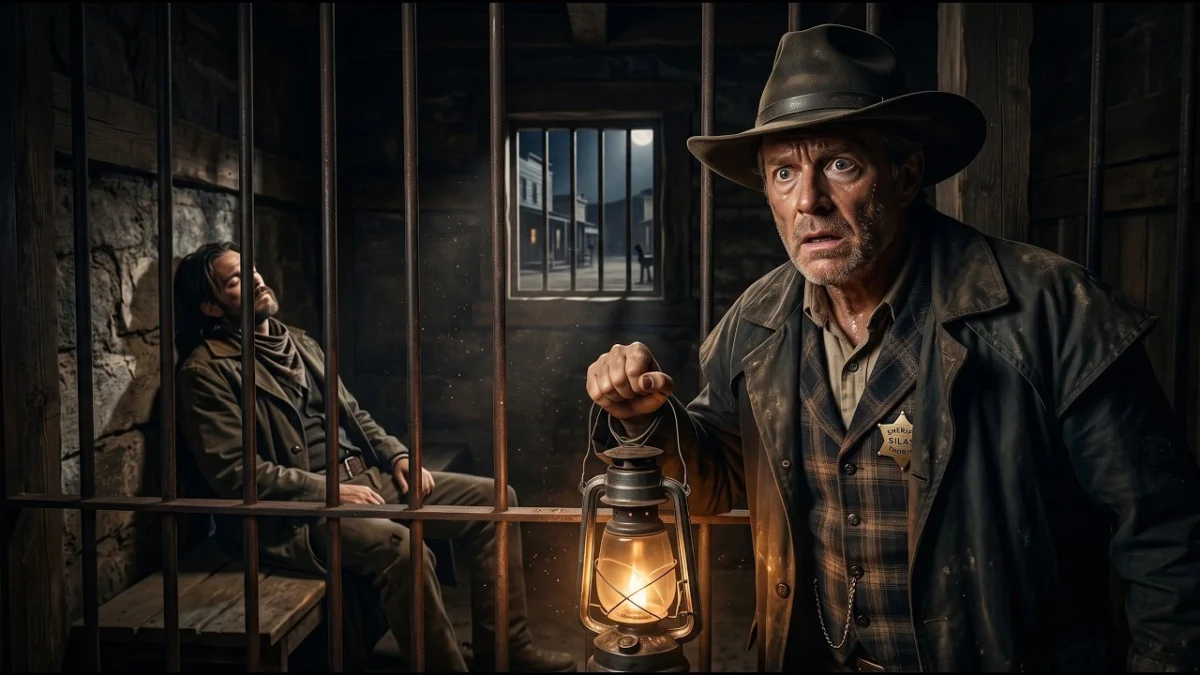
The cold autumn wind of October 1889 whistled through the narrow, rain-slicked streets of Pine Ridge, Montana.
It carried the heavy smell of damp pine, woodsmoke, and the metallic tang of an approaching mountain storm.
Inside the county jailhouse, Sheriff Elias Cole sat behind his heavy oak desk, resting his boots near the cast-iron stove.
The fire inside crackled softly, throwing faint orange light across the whitewashed wooden walls.
Elias was a man of thirty-five, with sharp blue eyes and a face lined by years of hard riding and quiet grief.
He had worn the tin star for six years, taking over the badge long after his father, former Sheriff Thomas Cole, had passed away in his sleep.
Elias rubbed his tired temples, listening to the clock on the wall tick rhythmically against the silence of the night.
It was nearly midnight, and the small town was entirely asleep.
Suddenly, a faint, metallic clicking sound echoed from the dark hallway leading to the cell block at the rear of the building.
Elias froze, his hand dropping instinctively to the leather holster resting against his hip.
He hadn’t locked anyone in the cells since last weekend, when a couple of local ranch hands had gotten too rowdy at the saloon.
The key ring hanging on the wall beside his desk was right where he had left it.
Elias stood up slowly, the leather of his gun belt creaking in the quiet room.
He lifted a heavy kerosene lantern from his desk, holding it high in front of him.
“Who’s back there?” Elias called out, his deep voice carrying firmly into the dark corridor.
There was no answer, only the steady sound of a slow, deliberate breath coming from behind the heavy iron bars.
Elias drew his Colt revolver with his right hand and stepped into the shadowy hallway.
The floorboards creaked beneath his heavy boots as he approached the final cell on the right.
He raised the lantern, casting a circle of golden light across the cold iron bars and the dark stone wall beyond.
Sitting on the wooden cot inside the locked cell was a man.
He wore a dark, dust-stained canvas duster and worn leather boots resting flat on the stone floor.
His broad-brimmed hat was pulled low over his face, hiding his features in shadow.
Elias stepped up to the bars, his fingers tightening around the grip of his revolver.
“How did you get in here, stranger?” Elias demanded, his voice hard.
“The front doors were locked, and I have the only key.”
The man in the cell did not flinch.
He slowly raised his hands, showing two open palms to prove he held no weapons.
Then, with agonizing slowness, he reached up with his right hand and pushed the brim of his hat upward.
The yellow lantern light illuminated his face, revealing a sharp jawline, deeply sunken eyes, and a prominent, jagged scar running across the left side of his throat.
Elias felt the air drain from his lungs.
The blood in his veins seemed to turn to ice as his grip on his gun loosened slightly.
He knew that face.
Every child in Pine Ridge had seen that face painted on yellowed reward posters pinned to the saloon wall.
“Impossible,” Elias whispered, his voice barely audible over the roaring wind outside.
“It can’t be.”
The man on the cot offered a faint, tired smile that did not reach his hollow eyes.
“Evening, Elias,” the man said softly, his voice raspy and rough, like stones grinding together.
“You look like you’ve seen a ghost.”
“You’re dead,” Elias said, taking an involuntary step back against the corridor wall.
“I watched you die. The whole town watched you swing from the gallows behind the courthouse.”
“You were eighteen years old back then, Elias,” the man replied quietly, looking down at his scarred hands.
“You saw what they wanted you to see. But a man doesn’t die as easily as a judge’s gavel falls.”
Elias stared at him, his mind racing through ten years of forgotten memories.
It was Caleb Rourke.
In 1879, Caleb Rourke had been convicted of murdering the town’s founding land commissioner, Marcus Vance, during a midnight robbery at the county land office.
The evidence had been overwhelming, the trial swift, and the sentence absolute.
Elias remembered standing beside his father in the rain, watching the black hood drop over Caleb’s head before the trapdoor snapped open.
He remembered the crowd cheering, believing justice had finally been served.
“If you’re alive, Caleb,” Elias said, his voice trembling slightly with anger and shock, “then a whole lot of men lied under oath.”
“They didn’t just lie, Sheriff,” Caleb said, leaning forward on the cot.
“They built this town on a foundation of blood and stolen land, and they used me to cover the smell.”
—
Elias unlocked the cell door with trembling hands, keeping his revolver trained on Caleb as the heavy iron swung open.
Caleb stepped out into the hallway slowly, making no sudden movements.
He followed Elias back into the main office, where the warmth of the cast-iron stove seemed to do nothing to cut the sudden chill in the room.
“Sit down,” Elias commanded, gesturing toward a wooden chair in front of the desk.
Caleb sat quietly, placing his boots flat on the floor.
He reached inside the breast pocket of his heavy coat with two fingers.
Elias raised his gun an inch higher.
“Easy, Sheriff,” Caleb said softly.
“I didn’t break into a jail cell to fight you. I came here because this is the only place in the territory where I might survive the night.”
Caleb slowly pulled two items from his pocket and laid them carefully onto the oak desk.
The first was a faded, sepia-toned photograph mounted on thick cardstock.
The second was a small, leather-bound pocket ledger with water-stained pages and a brass clasp.
Elias kept his gun pointed at Caleb with his right hand while using his left to reach for the photograph.
He brought it close to the kerosene lamp sitting on the desk.
The photograph showed five men standing together on the porch of the pine ridge town hall, taken during the summer of 1878.
On the far right stood Judge Arthur Pendelton, the wealthy magistrate who had presided over Caleb’s trial and still ruled the county court today.
Beside him stood Harrison Vance, the son of the murdered land commissioner, who now owned the largest bank and timber operation in the state.
Next to Harrison stood the town’s current mayor, Silas Sterling.
Standing on the far left was Elias’s own father, Sheriff Thomas Cole, wearing his tin star.
But it was the fifth man standing in the center of the photograph that made Elias’s heart stop.
It was Caleb Rourke, wearing a clean suit and holding a rolled-up land deed in his hand.
“My father never told me he knew you personally,” Elias said, looking up from the picture, his eyes narrowed with suspicion.
“Your father was an honest man forced to make a devil’s bargain, Elias,” Caleb said, his raspy voice dropping low.
“In ’78, before the timber boom, that land wasn’t worth five cents an acre. But Marcus Vance discovered a massive vein of silver running right beneath the northern valley floor.”
Caleb tapped his finger on the small leather ledger resting on the desk.
“Marcus wanted to register the strike under public land grants so the whole county could prosper. But his son Harrison, along with Judge Pendelton and Mayor Sterling, wanted it all for themselves.”
Elias picked up the ledger, unbuckling the small brass clasp.
The pages were filled with meticulous columns of figures, dates, and names written in dark ink.
“They murdered Marcus Vance in his own office,” Caleb continued, staring into the flickering flames of the stove.
“I was Marcus’s young surveyor. I was there that night. I saw Harrison Vance strike his own father over the head with an iron hearth poker while Judge Pendelton watched from the doorway.”
Elias flipped through the pages of the ledger, his eyes skimming over large sums of money transferred between Harrison Vance and Judge Pendelton.
“If you saw them do it,” Elias asked, his voice tight, “why didn’t you go to my father?”
“I did,” Caleb replied, looking directly into Elias’s eyes.
“And that’s where the story gets ugly, Elias.”
—
The storm outside flared up, heavy rain pounding against the glass windows of the jailhouse like a handful of thrown gravel.
Caleb leaned back in his chair, his hands resting on his knees.
“I ran to your father’s house that very night,” Caleb said quietly.
“Thomas Cole was a good sheriff, but he was drowning in medical debt. Your mother was dying of consumption back then, Elias. Do you remember?”
Elias swallowed hard, memories of his childhood suddenly rushing back.
He remembered his mother bedridden in their small home, the expensive medicines brought in from Chicago, and his father’s constant, silent despair.
“I remember,” Elias whispered.
“Harrison Vance offered your father a choice,” Caleb explained, his tone free of malice.
“Either Thomas helped them frame me for the murder and stayed quiet about the silver strike, or Harrison would make sure your mother was thrown out of the clinic and your father was stripped of his badge and thrown in prison on false bribery charges.”
“My father would never betray his oath,” Elias insisted, slamming his hand down on the desk.
“He loved this town!”
“He loved your mother more,” Caleb countered firmly.
“He took the money to pay for her medicine, Elias. But he couldn’t bring himself to watch an innocent man die. So your father and Judge Pendelton struck a secret deal.”
Caleb reached up and touched the dark, raised scar running across his throat.
“On the morning of the execution, your father tampered with the gallows mechanism. He adjusted the drop distance and rigged the rope with a hidden leather harness beneath my shirt so the fall wouldn’t break my neck.”
Elias listened, his breath caught in his throat.
“The black hood covered my face,” Caleb said, his eyes distant as he recalled the memory.
“When the trapdoor dropped, I choked, I passed out, but I didn’t die. That night, while the town was celebrating in the saloon, your father pulled my body from the pine coffin behind the gallows, loaded me into a supply wagon, and drove me twenty miles out into the mountain wilderness.”
“He gave me fifty dollars, this ledger he had stolen from Pendelton’s safe, and a warning,” Caleb added softly.
“He told me if I ever returned to Pine Ridge while Harrison Vance or Judge Pendelton were alive, he wouldn’t be able to save me a second time.”
Elias sat frozen in his chair, staring at the ledger in his hand.
The handwriting on the final page of the book was unmistakably his father’s bold, sloping script:
*May 14, 1879. God forgive me for what I have done. I saved the boy’s life, but I sold my soul to protect my family.*
“Why come back now, Caleb?” Elias asked softly, closing the ledger.
“My father has been dead for four years. The men who framed you own this town. You could have lived out your life anywhere else.”
“Because I’m dying, Elias,” Caleb said quietly, pulling open his thick canvas coat to reveal a deep, dark cough that shook his thin frame.
“The mountain air wasn’t kind to my lungs. I have a few months left at best. I didn’t come back for revenge. I came back to put my name right before I go into the ground.”
“And because,” Caleb added, pointing toward the street outside, “Harrison Vance is planning to sell the northern valley to an eastern syndicate next week. Once that sale goes through, the evidence of his crime will be buried forever under three hundred feet of commercial mine shafts.”
—
Before Elias could answer, the sudden sound of heavy horseshoe iron clattering against the wet cobblestones rang out from the street.
Multiple horses were stopping right in front of the jailhouse.
Elias immediately blew out the kerosene lamp on his desk, plunging the room into shadow lit only by the faint glow of the stove.
He motioned for Caleb to stay low behind the heavy wooden desk.
Elias stepped quickly to the front window, peeling back the edge of the dark canvas shade to peer outside.
Standing in the pouring rain were six heavily armed men mounted on dark horses.
At the front of the group sat Harrison Vance, wearing a tailored black wool coat and a fine felt hat.
Beside him rode Chief Deputy Frank Miller, a cruel, mercenary lawman whom Harrison had maneuvered into Elias’s department two years ago.
“Sheriff Cole!” Harrison’s sharp voice echoed through the wooden door, cutting through the sound of the rain.
“We know you have an intruder inside! Open the door!”
Elias turned to look at Caleb, who remained crouched in the shadows behind the desk, his face grim.
“They saw me cross the square,” Caleb whispered softly.
“Frank Miller has been keeping eyes on the roads for Vance.”
Elias took a deep breath, checked the cylinder of his Colt revolver, and unlocked the heavy front door.
He stepped out onto the covered wooden porch, shutting the door firmly behind him.
The rain beat down relentlessly against the porch roof.
“What’s going on out here, Harrison?” Elias asked coldly, resting his hand casually on the grip of his holstered gun.
“It’s midnight.”
Harrison Vance sneered, his silver-handled riding crop tapping rhythmically against his saddle horn.
“We received a report from a night watchman at the bank, Elias,” Harrison said, his eyes cold and calculating.
“A man fitting the description of an escaped fugitive was seen slipping into your office through the rear alley.”
“There’s no fugitive here, Harrison,” Elias replied smoothly.
“I’ve been at my desk all night.”
Chief Deputy Frank Miller rode his horse a step closer to the porch, his hand hovering near his pistol.
“Mind if we step inside and take a look for ourselves, Sheriff?” Miller asked with a nasty grin.
“Just to be thorough.”
“You know the law, Frank,” Elias said, his voice dropping into a dangerous register.
“Unless you have a warrant signed by a circuit judge, you don’t step foot inside my jail without my permission.”
Harrison Vance leaned forward in his saddle, the faint light from the streetlamp illuminating his sharp, arrogant features.
“Don’t play games with me, Elias,” Harrison hissed softly.
“You’re wearing the badge your father wore. But remember who pays for the town’s payroll. If you’re harboring a trespasser, or worse, someone carrying stolen property, you’ll find yourself stripped of that star before sunrise.”
“Is that a threat, Mr. Vance?” Elias asked, stepping down to the top stair of the porch.
“It’s a business reality,” Harrison replied coldly.
“Search the perimeter, Miller. If anyone tries to leave through the back alley, put a bullet in them.”
Harrison turned his horse around, splashing wet mud across the hitching post as he rode toward the bank.
Frank Miller gave Elias a long, lingering look before gesturing for the other four armed men to follow him toward the rear of the block.
—
Elias slipped back inside the jailhouse, locking the heavy oak door and pulling the iron deadbolt into place.
He walked over to his desk, where Caleb was already standing, holding the small leather ledger in his hand.
“They won’t wait until morning,” Caleb said quietly.
“Once Vance realizes you aren’t going to hand me over, he’ll have Miller burn this place to the ground and call it an accident.”
“Then we don’t stay here,” Elias said firmly.
He walked over to the gun rack mounted on the wall, unlocked the heavy iron chain, and pulled down a double-barreled 12-gauge shotgun and a lever-action Winchester rifle.
He tossed the rifle to Caleb, who caught it smoothly with the practiced ease of an experienced woodsman.
“Can you still shoot?” Elias asked.
Caleb levered a cartridge into the chamber with a sharp, mechanical click.
“Never forgot how,” Caleb replied quietly.
“Where are we going?”
“If we want to break Vance and Judge Pendelton, this ledger won’t be enough on its own,” Elias said, pulling a box of shotgun shells from his drawer and stuffing them into his coat pocket.
“A corrupt judge will just claim the handwriting was forged.”
“What else is there?” Caleb asked.
Elias picked up his father’s old silver pocket watch resting on the desk.
He opened the back casing, revealing a small, folded scrap of paper hidden beneath the inner gears.
“My father left me a key to a safety deposit box at the territorial court in Helena,” Elias said, his eyes dark with determination.
“He told me never to open it unless the survival of the family depended on it. I never understood what he meant until tonight.”
“He kept the original land deeds,” Caleb whispered, his eyes widening.
“The original survey maps showing the silver strike under Marcus Vance’s name.”
“Exactly,” Elias said.
“If we can reach the midnight train at the water tower three miles south of town, we can be in Helena by morning.”
“The water tower is surrounded by open pasture,” Caleb warned.
“Vance’s men will be watching the railroad tracks.”
“Then we’ll make sure they’re looking somewhere else,” Elias replied.
Elias walked over to the back corner of the office, where two large kegs of black gunpowder used for road construction were stored beneath a canvas tarp.
He grabbed an iron crowbar and pried the top off one of the barrels.
“What are you doing?” Caleb asked.
“Creating a distraction that Harrison Vance won’t be able to ignore,” Elias said with a grim smile.
—
Ten minutes later, a thick trail of black gunpowder ran from the jailhouse coal cellar down into the narrow, muddy alleyway behind the building.
Elias and Caleb stood near the rear door, wrapped in dark rain cloaks.
Outside, the rain continued to pour, masking the soft sound of their movements.
Elias struck a friction match against his boot, holding the tiny flame against the end of a long, oil-soaked cotton fuse leading to the powder trail.
The fuse hissed violently, spitting bright white sparks into the darkness.
“Run,” Elias grunted.
They burst out of the rear door, vaulting over the low wooden fence into the alley just as two of Harrison Vance’s guards turned the corner from Main Street.
“Hey! Over there!” one of the guards yelled, raising his pistol.
Before the guard could pull the trigger, a deafening explosion shattered the quiet night.
*BOOM!*
A blinding flash of orange fire erupted from the rear cellar of the jailhouse, blowing out the back windows and sending a massive cloud of black smoke billowing into the stormy night sky.
The shockwave knocked the two guards flat into the mud, their horses rearing back in terror.
Alarm bells across town immediately began to ring, their harsh bronze tones echoing off the surrounding mountains.
Shouts rang out from Main Street as townsfolk and Vance’s men rushed toward the burning building.
In the chaos and blinding smoke, Elias and Caleb slipped unnoticed through the dark alleyways, cutting behind the livery stable and heading straight for the dense pine forest at the edge of town.
They ran through the rain-soaked timber, their boots sinking deep into the wet pine needles and mud.
Caleb coughed heavily, clutching his chest, but he refused to slow down.
“Keep moving!” Elias urged, holding Caleb’s arm to steady him as they navigated the steep, dark slope.
“The water tower is just beyond the ridge!”
Behind them, the distant glow of the fire lit up the clouds over Pine Ridge, accompanied by the frantic shouts of men searching the streets.
—
They reached the elevated wooden water tower twenty minutes later.
The high structure stood beside the gleaming iron train tracks that snaked through the mountain pass.
In the distance, the low, rhythmic chug of a steam locomotive echoed through the valley, its bright headlamp cutting a long beam of yellow light through the falling rain.
The midnight freight train was approaching, slowing down as it prepared for the steep grade ahead.
“There it is!” Caleb panted, leaning against a wooden support beam of the water tower.
Suddenly, a rifle shot cracked through the night air.
*WHAM!*
A bullet struck the wooden beam an inch above Caleb’s head, sending shower of wooden splinters into his face.
“Get down!” Elias roared, firing his shotgun into the dark treeline behind them.
From the shadows of the pine trees, Chief Deputy Frank Miller and three armed men emerged, their rifles raised.
“You should have taken the money your father took, Elias!” Miller shouted over the sound of the approaching train.
“You’re just like old Thomas—too stupid to know when you’ve been beaten!”
Miller raised his rifle, aiming directly at Elias’s chest.
Before Miller could pull the trigger, Caleb lunged forward from behind the beam, swinging his Winchester rifle and firing two rapid shots into the mud at Miller’s feet.
The sudden shots forced Miller to duck for cover behind a massive granite boulder.
“Go, Elias!” Caleb yelled, his voice strained as he fired another shot at the advancing guards.
“Get on that train!”
“I’m not leaving you behind, Caleb!” Elias shouted, reloading his shotgun with two heavy brass shells.
The massive steam locomotive roared past the water tower, its iron wheels screeching against the rails as it slowed to a crawling ten miles per hour.
The open wooden door of a boxcar rumbled past them.
Elias fired both barrels of his shotgun toward Miller’s position, driving the guards back into the brush.
He grabbed Caleb by the collar of his heavy coat, forcing the older man toward the moving train.
“Jump!” Elias commanded.
Caleb grabbed the iron handrail of the open boxcar, his boots slipping on the wet wooden floorboard before Elias slammed his shoulder against Caleb’s back, shoving him safely inside.
Elias leaped onto the wooden ledge a second later, dragging himself through the door just as a volley of rifle bullets slammed uselessly into the side of the heavy oak car.
Chief Deputy Frank Miller ran along the tracks, screaming in frustration as the train picked up speed, its heavy iron wheels carrying them away into the dark, rainy night.
Elias lay on the floor of the boxcar, gasping for air as the cold wind whipped through the open door.
Beside him, Caleb sat propped against a stack of wooden crates, his face pale, but a dark, victorious smile gracing his lips.
“We made it,” Caleb rasped, clutching the small leather ledger tightly against his chest.
Elias sat up, leaning his back against the vibrating wall of the train car.
He looked out into the darkness, watching the distant fires of Pine Ridge fade into the stormy horizon.
“We made it to the train, Caleb,” Elias said softly, pulling his father’s silver pocket watch from his coat.
“Now we finish what my father started ten years ago.”
—
Three days later, the rain had finally cleared over the territory capital of Helena.
The morning sun shone brightly down on the grand granite steps of the Territorial Supreme Court building.
Inside the high-ceilinged courtroom, a special emergency session had been convened by Circuit Judge Arthur Bradley.
Sitting at the front table, dressed in his finest suit, was Harrison Vance, looking smug and confident.
Beside him sat Judge Arthur Pendelton, his hands resting comfortably on a silver-topped cane.
They had been summoned by the state marshal’s office under the guise of finalizing the northern valley land sale.
“May I ask why we are being kept waiting, Judge Bradley?” Harrison asked smoothly, adjusting his silk necktie.
“My investors from Chicago are waiting at the hotel.”
Before Judge Bradley could answer, the heavy double doors at the back of the courtroom swung open with a loud thud.
The entire room turned to look.
Walking down the center aisle was Sheriff Elias Cole, wearing a fresh shirt, his tin star polished and gleaming on his chest.
Walking right beside him was Caleb Rourke, carrying a thick leather portfolio under his arm.
A collective gasp echoed through the courtroom.
Judge Pendelton jumped to his feet, his silver cane clattering against the marble floor.
His face turned as pale as a sheet, his eyes wide with absolute horror.
“God in heaven…” Pendelton choked out, his hand clutching his chest.
“It’s… it’s impossible…”
Harrison Vance’s arrogant smile vanished instantly, replaced by a dark, murderous glare.
“What is the meaning of this outrage?” Harrison demanded, slamming his fist onto the table.
“That man is Caleb Rourke! He was executed ten years ago! He’s an outlaw!”
“He was an innocent man framed by a murderer, Mr. Vance,” Elias declared, his voice echoing with absolute authority throughout the courtroom.
Elias walked up to the bench, placing a thick stack of certified documents, the 1858 original land deeds, and the water-stained leather ledger directly in front of Judge Bradley.
“Your Honor,” Elias said firmly, “I present the original land grants for the northern valley, registered under the name of Marcus Vance, along with the personal ledger of Judge Pendelton detailing ten years of illegal land seizures, extortion, and bribery.”
Judge Bradley put on his spectacles, carefully examining the documents one by one.
As he read through the meticulous entries and viewed the original territorial seals, his face grew increasingly stern.
“These documents are authentic,” Judge Bradley said, his deep voice cutting through the silent room.
“They bear the official seal of the United States Land Office, dated four months before Marcus Vance’s death.”
Harrison Vance backed away from the table, his hand reaching toward his coat pocket.
“He’s lying! It’s a forgery!” Harrison shouted desperately.
Before Harrison could pull a weapon, two United States Marshals stepped out from the side doors, their heavy revolvers drawn and pointed directly at Harrison’s chest.
“Don’t do it, Vance,” one of the marshals warned coldly.
“It’s over.”
Judge Bradley struck his heavy wooden gavel against the bench with a decisive *CRACK!*
“Harrison Vance, Judge Arthur Pendelton, you are hereby placed under arrest for the murder of Marcus Vance, treason, grand larceny, and conspiracy,” Judge Bradley announced loudly.
“Marshals, place these men in iron.”
The marshals stepped forward, clicking heavy iron handcuffs around the wrists of Harrison Vance and Judge Pendelton.
Harrison glared at Caleb Rourke as he was led past him in chains.
“You were supposed to die ten years ago, Rourke,” Harrison hissed through clenched teeth.
Caleb looked at Harrison calmly, his raspy voice steady and clear.
“The truth doesn’t die, Harrison,” Caleb replied softly.
“It just waits for the right man to find it.”
—
One month later, a gentle autumn breeze blew through the quiet graveyard overlooking the northern valley of Pine Ridge.
The morning sun warmed the golden grass, casting long shadows across the granite headstones.
Elias stood beside a freshly dug grave located on a quiet knoll beneath a magnificent ponderosa pine.
A simple white marble headstone stood at the head of the mound, engraved with the words:
*CALEB ROURKE*
*1858 – 1889*
*An Honest Man, Finally at Rest.*
Caleb had passed away peacefully two weeks after the trial, his lungs finally giving out, but his mind at peace knowing his name had been cleared in the public record.
Elias knelt beside the grave, placing a small wooden carving of a surveyor’s compass on the soft earth.
He reached into his pocket and pulled out his father’s silver pocket watch.
He opened the back casing, looking at the small scrawled note his father had left behind ten years ago.
Elias struck a match, holding the flame against the corner of the faded paper.
He watched in quiet contemplation as the paper burned away, the black ash floating away on the mountain breeze.
“You paid your debt, Dad,” Elias whispered into the quiet wind.
“The truth is out. You can rest now, too.”
Elias stood up, adjusting his gun belt and running his hand over the polished tin star pinned to his canvas jacket.
He turned and looked down at the town of Pine Ridge bustling in the valley below.
The sun was rising high in the sky, burning away the morning mist, leaving the valley clear, bright, and free.
Elias walked down the hill toward his horse, ready to ride back into town to do the job his father had taught him to do—with honor, with courage, and with the truth by his side.








