Her Father Kept One Barn Stall Empty for 50 Years — Until the Floor Shifted Under Her Boots
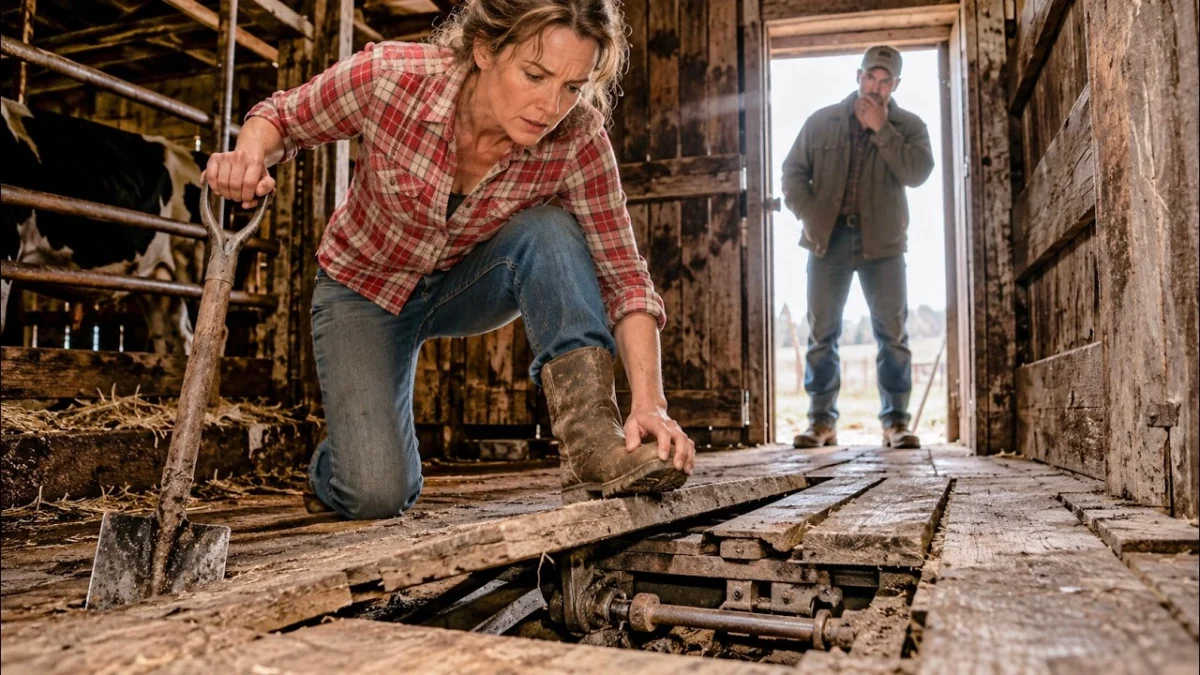
Ellen Mercer held the wooden handle of the grain shovel tightly, scraping the heavy dirt and old manure from the floorboards of the sixth stall in the livestock barn.
She had been working in the damp shade of the north wall for about twenty minutes when the heavy oak boards suddenly moved beneath her work boots.
It was not a large shift, half an inch at most.
It was the exact kind of unexpected settling that made a person’s stomach drop into a cold knot before her conscious brain could process what had occurred.
Ellen stepped back onto the main concrete alleyway without thinking.
The floorboard returned to its original level with a dull, hollow thud.
She stood at the edge of the stall for a moment, adjusted her grip on the shovel handle, and deliberately pressed her full body weight back onto the center board.
The timber platform gave way again under her boots, sinking half an inch into the ground.
When she released the pressure, the wooden surface returned to its flat position.
She stepped onto the center board a third time, watching the gap between the wood and the stone sill open and close.
Frank Dyer had been watching her from the doorway of the stall, leaning against the doorpost with a pair of fencing pliers in his hand.
“Did that floor just move under you, Ellen?” Frank asked, squinting down through the gloom at her boots.
“Floors in a hundred-year-old barn aren’t supposed to do that, Frank,” Ellen said, taking another step back.
For fifty consecutive years, Ellen’s father had kept that sixth stall completely empty.
In all her forty-one years on the farm, she had never understood the reason behind his strict rule.
Now, the moving floorboards were offering her the beginning of an answer.
Ray Mercer had managed one hundred and twenty-six acres of pasture and timber in Douglas County, Missouri, from the day he inherited the land from his father until he passed away in February at the age of seventy-six.
He had run commercial cattle across those hills for most of his life, and the livestock barn he maintained near the main house featured six identical wooden stalls along its north bay.
Five of those stalls were used daily for holding sick cows, storing square bales, or locking up calves during winter storms.
The sixth stall, sitting at the far north end of the alleyway, was never used for anything.
Ray never stored hay in it, never left machinery or fencing tools inside, and never allowed a head of cattle to stand in it overnight.
When Ellen was a small girl, she had dragged a heavy burlap feed sack into the sixth stall after running out of room in the adjacent bay.
Ray had silently carried the bag out to the aisle that same afternoon without offering a word of explanation.
Years later, when her cousin had set several rolls of barbed wire inside the stall during a fence repair project, Ray had immediately carried the spools out to the machine shed before the day’s work was finished.
Frank Dyer, who had farmed the adjacent property for over thirty years and frequently helped Ray with seasonal fence work, had asked about the empty space once.
He had received the exact same direct response Ray gave to everyone else who inquired about the unused corner.
“Leave that stall empty, Frank,” Ray had said.
Frank had pushed the matter once, the way a man pushes a neighbor he has known long enough to ask direct questions.
“What’s the stall actually for, Ray?” Frank had asked, pointing at the bare oak floorboards.
Ray had given an answer that Frank had filed away at the time as nonsensical old-farmer talk.
“That floor has a job to do,” Ray had replied flatly.
Then he had turned around and walked out of the barn toward the house.
Ray had died in the freezing cold of mid-February.
Ellen had moved back to the family farm two years prior to help her aging father through his final seasons of work.
She had stayed on the property after his funeral because there was no one else in the family to manage the land, and because the thirty-eight cow-calf pairs tying up the farm’s operating loan needed someone who understood both agricultural finance and livestock handling.
She was forty-one years old.
She had spent most of her adult life working as a head bookkeeper for a commercial feed dealership in Ava.
She understood spreadsheet numbers exceptionally well, understood cattle operations reasonably well, and knew the daily mechanical routine of this specific farm down to the smallest detail.
She was managing the daily chores on her own.
What she was not managing easily was the upcoming sale of her feeder calves.
She had fourteen spring calves that needed to be sold to a order buyer before the second week of September.
A livestock buyer named Don Kessler had driven up the gravel lane in late July, walked around the pasture fence, looked at the herd through his binoculars, and stated that the calves looked light.
Don had estimated their average live weight at around six hundred and ninety pounds per head, and he had offered his purchase price accordingly.
Ellen was not certain he was wrong.
She had no livestock scale on the farm.
The nearest certified commercial scale was forty minutes away at the auction yard in Ava.
Hauling fourteen calves back and forth across the county required a full day with a cattle trailer—a day she simply did not have to spare while the pasture rotation required constant attention.
The perimeter fence along the eastern timber line was in the middle of being replaced.
She was not certain Don Kessler was right about the weight either.
The calves had been grazing on thick clover and orchard grass all summer, and to her eye, they appeared noticeably heavier than six hundred and ninety pounds.
Without a functional scale, neither she nor the buyer had any way to prove the actual weight.
This was not an academic debate over numbers.
At current market prices for Missouri feeder calves, a difference of fifty pounds per head across fourteen calves represented a substantial sum of money.
Ellen had reviewed the farm’s accounting ledgers carefully since her father’s death, and the financial margin she was operating on left zero room for selling livestock at an undervaluation.
She needed to clear the bank’s operating note before October.
She needed to set aside hay money before the first killing frost arrived.
She needed credit room on her feed bill to carry the main herd through the upcoming calving season without filing another loan application.
The farm was not failing, but it was sitting close enough to the financial edge that she could not afford to leave hundreds of dollars sitting on the table.
The sixth stall was currently empty, and she urgently needed a temporary holding pen for the calves while the eastern fence line was torn down for repairs.
Ray was no longer there to tell her not to use the space.
So she had taken a steel shovel into the north stall to clear fifty years of accumulated dirt and chaff from the floorboards before Frank arrived to help inspect the timber walls.
And then the floor had moved beneath her boots.
She and Frank spent the next half hour removing the oak floorboards in a systematic manner.
They started at the outer edge against the wall and worked their way toward the center of the stall.
Underneath the first board, they found ordinary dry soil.
Underneath the second board, they uncovered heavy grey iron.
It was a long metal arm, pinned securely at one end by an iron bolt, and connected by a thick linkage rod that ran deeper into the darkness beneath the floor joists.
Directly below the floorboard at the exact center of the stall sat a massive iron pivot.
A solid machine shaft ran through a cast-iron mounting bracket that was bolted to a thick white-oak timber set deep below the joists.
From that central pivot, mechanical linkages extended in two distinct directions.
One rod ran toward the exterior barn wall, while the other ran toward the rear frame of the stall.
The entire mechanism was old.
The protective grease on the central pivot had dried out decades ago, turning into a fine grey powder.
One of the long connecting rods showed light surface rust, but Frank could find no structural cracks or broken welds anywhere in the assembly.
The floorboards were not nailed to the ground joists; they were attached to a heavy sub-platform frame that moved as a single balanced unit on the iron pivot below.
Frank crouched down on the concrete curb, shining his pocket light onto the linkage rods for a long, silent moment.
“Your father didn’t keep this stall empty because the floorboards were rotten, Ellen,” Frank said, resting his hand on his knee.
Ellen stood above the exposed opening, waiting for him to continue.
“He kept it empty because the floor was actually doing something,” Frank said, wiping a thumb across the rusted iron arm.
They located the vertical control rod inside the wall by removing an old pine panel near the east side of the stall.
The iron rod ran vertically between two wall studs, passing up through the framing and disappearing into the darkness of the ceiling space above the bay.
Ellen climbed the wooden ladder into the hayloft, holding her flashlight between her teeth as she crawled over old bales.
She traced the iron rod to a small wooden housing bolted directly against a support beam.
Inside the housing sat two rusted gear wheels and an arc-shaped metal indicator plate.
Most of the original numerical markings on the plate had been painted over with brown barn paint at some point in the past, but the faint outline of a graduated measuring scale was still visible beneath the surface.
The housing featured a small steel stub where an indicator pointer had once been mounted before being broken or removed.
Ellen climbed back down the ladder into the stall.
At the rear wall of the bay, Frank had located a small wooden access hatch set low to the ground, barely large enough for a person to reach a hand inside.
Below the hatch lay a dry, stone-lined pit.
Two heavy cast-iron counterweights hung from a steel chain suspended inside the dark pit.
One of the iron weights was clearly stamped with the number 500, while the second weight was stamped with 1,000.
Ellen looked at the iron weights in the pit, looked up at the wall gearing, and then looked back down at the platform floor that moved on its central pivot.
“Why on earth would anyone need a thousand-pound counterweight buried under a cow stall?” Ellen asked.
Frank looked at the metal arc plate near the ceiling with its faded markings and the broken pointer stub.
“It’s not just a floor, Ellen,” Frank said softly. “It’s a scale.”
They located the missing dial plate later that afternoon inside a hinged wooden box in the back of the hayloft.
It had been tucked behind a section of old leather machinery belting that had sat untouched for decades.
The plate was heavy porcelain enamel over cast iron, featuring a bright white background with bold black numerals: 500, 1,000, 1,500, 2,000.
The original manufacturer’s name at the top of the plate had been worn away by age, but the construction style was entirely consistent with heavy platform scales manufactured in the 1930s.
The floor of the sixth stall was the actual weighing platform.
The central pivot below transferred whatever weight stepped onto the boards through the mechanical linkage to the counterweight assembly in the pit.
The wall gears then translated that movement directly to the dial indicator on the wall.
When a cow walked into the stall, the wooden platform deflected downward, and the wall dial registered the exact weight of the animal.
Ray Mercer had not kept the stall empty out of superstition or stubborn habit.
He had kept it empty because any hay, tools, or dirt left sitting on the platform would register as dead weight and ruin the accuracy of the scale.
The mechanical pivot could not function if dirt or gravel fell into the linkages below.
The stall had to be kept completely empty for the exact same reason a commercial counter scale must be set to zero before weighing goods.
Ellen walked into her father’s home office that evening and opened the metal filing cabinet in the corner.
She pulled out his historic livestock sale receipts, going back to the earliest years of his farm ownership.
In the receipts from the 1960s and 1970s, the cattle sold were listed simply as Mercer livestock.
However, in the older record books from the late 1940s and throughout the 1950s, she found hand-written entries with other local names recorded beside the weight figures.
Names like Dyer, Collins, Reed, and Halcom—all families who owned land in the surrounding valley.
The next morning, she drove her truck down the ridge to visit Howard Bell.
Howard was eighty-two years old, had lived in Douglas County his entire life, and had raised cattle on the neighboring ridge for over six decades.
When Ellen asked about the sixth stall, Howard smiled and sat back in his porch chair.
He remembered the Mercer scale clearly.
He explained that before modern auction barns with state-inspected electronic scales became common, and before cattle trucks were readily available to haul stock long distances, regional livestock buyers traveled from farm to farm.
Those buyers made cash offers based entirely on their own visual estimates of an animal’s weight.
A small family farmer had virtually no way to challenge a buyer’s estimate.
If a traveling buyer claimed a steer weighed seven hundred pounds and the farmer believed it weighed eight hundred, the farmer almost always lost the argument because he had no physical proof.
Ray’s father, Samuel Mercer, had purchased a used industrial platform scale assembly from a closing railroad stockyard in 1937.
With the physical assistance of several neighboring farmers, Samuel had dug the pit and built the scale directly into the floor of the sixth stall.
For the next two decades, farmers from all over the township could bring their cattle to the Mercer barn on the morning of a sale.
They would walk the stock onto the wooden floorboards, check the dial, and record the exact weight before the buyer ever arrived on the property.
Howard recalled driving his own cattle up the Mercer lane as a young man on cold morning, watching the wall pointer settle on a hard number that he could then use to hold his ground during price negotiations.
It had not made any of them rich, Howard noted, but it had kept them fully informed, which was a far more useful advantage when dealing with livestock buyers.
As commercial sale barns became accessible and certified public weighing became standard practice, the need for a private neighborhood scale gradually diminished.
By the time Ray took over full management of the property, the scale was used only occasionally.
By the early 1960s, routine weighing at the farm had ceased entirely.
Yet Ray had maintained the sixth stall in a state of readiness because the iron mechanism underneath was still fully functional, and he saw no reason to let a good tool be destroyed by careless storage.
Ellen returned to the barn that afternoon.
On the main wooden support beam beside the stall door, she noticed a series of shallow carved markings in the wood that she had previously assumed were tool scratches.
She took a piece of fine sandpaper from her pocket and lightly rubbed the dirt from the surface of the timber.
Letters, numbers, and dates emerged from beneath the grime.
*JD 1120 48*
*HC 975 52*
*RM 1245 49*
There were over a dozen distinct sets of initials carved into the oak beam, half-obscured by decades of dust and a thin coat of old paint that had been brushed over the timber years ago.
She recognized her father’s youthful handwriting on two of the entries, recorded when he was helping his own father run cattle through the barn.
The initials she did not recognize belonged to the families whose names appeared in the old sales receipts in her office file.
She walked out to the lane where Frank was unloading his fencing tools and told him she wanted to restore the platform scale to full working condition.
Frank looked at the rusted gears, the linkage rods, and the central pivot with his usual calm expression.
He evaluated the machinery the way he evaluated every mechanical project—with complete patience and zero unnecessary commentary.
“We can get it working, Ellen,” Frank said, pulling a can of penetrating oil from his toolbox.
They spent the next two full days working in the north bay of the barn.
The first day was dedicated entirely to cleaning the individual mechanical parts.
They moved through the system in strict order, starting at the platform pivot beneath the floorboards and working their way up to the wall gearing.
Frank applied penetrating oil to every frozen joint, working the iron arms back and forth by hand rather than using a prybar to prevent snapping old cast iron that could never be replaced.
Frank possessed a quiet mechanical patience that Ellen deeply appreciated.
It was the specific kind of patience that came from a lifetime of fixing farm machinery—knowing that hurrying a rusted bolt usually resulted in hours of extra work.
They scraped the hardened rust from every pivot point, cleaned the linkage rods with wire brushes, and repacked the main bearing assemblies with fresh grease.
They replaced one damaged platform board that had been installed years later with a piece of seasoned white oak that matched the weight of the original timber.
Frank noted that using heavier wood would throw off the scale’s zero balance.
Frank sourced a new steel pointer for the wall dial, shaping a piece of metal rod stock in his shop to fit the original gear stub.
By late Thursday afternoon, the gears were turning smoothly inside the wooden housing.
Their very first weight test, however, failed.
Frank set a fifty-pound bag of cattle mineral on the center of the wooden platform.
The wall dial indicator moved smoothly, but it settled on seventy-one pounds.
He placed a hundred-pound bag beside the first sack.
The dial pointer moved upward and settled on one hundred and thirty-nine pounds.
The underlying mechanism was working smoothly, but the calibration reading was completely incorrect.
Ellen sat at her father’s desk for two evenings trying to solve the discrepancy.
She searched through Ray’s old notebooks, not looking for personal letters or family journals, but looking for maintenance notes.
She looked for the brief, practical entries Ray kept regarding farm equipment.
She found what she was looking for in a small black pocket notebook that she had initially overlooked because its cover matched his cattle breeding records.
A single hand-written entry dated April 1961 read: *Platform tare approx. 186 lbs after board replacement. Reset zero accordingly.*
Whoever had replaced floorboards on the weighing platform decades ago had altered the dead weight of the floor structure itself.
The counterweight system in the pit needed to be physically adjusted to compensate for the weight of the platform before the wall scale could read live weight accurately.
Frank returned to the pit beneath the access hatch the next morning.
He adjusted the iron counterweight chain by three links, changing the tension on the main balance arm.
He set the fifty-pound mineral bag back on the wooden floorboards.
The wall pointer swung upward and rested precisely on fifty-one pounds.
Frank placed a heavy iron tractor suitcase weight on the floor—a weight he knew from his shop scale to be exactly seventy-five pounds.
The dial indicator moved and stopped dead on seventy-six pounds.
Frank looked up from the floorboards at Ellen and nodded once.
Their test batch of livestock consisted of the fourteen feeder calves.
Ellen built a temporary wooden chute leading from the pasture gate directly into the sixth stall, utilizing steel livestock panels and extra lumber Frank brought over in his truck.
It was not an elaborate setup, but it was sturdy enough to control the calves.
They moved the cattle through the alleyway one animal at a time.
The first calf stepped onto the wooden floorboards of the stall.
The platform dropped its small fraction of an inch under the animal’s hooves.
The wall indicator pointer swung steadily across the white enamel dial.
Ellen stood by the wall beam with a notebook and pencil, writing down the final number: 712 pounds.
The second calf walked onto the platform: 748 pounds.
The third calf stepped up: 731 pounds.
They ran all fourteen calves through the sixth stall, recording every reading.
No animal required more time on the platform than it took for the indicator needle to settle, which took only a few seconds.
When Ellen added the numbers together and divided by fourteen, the average weight came to seven hundred and forty-one pounds per head.
Don Kessler, the order buyer, had estimated their weight at six hundred and ninety pounds.
The physical difference was fifty-one pounds per head across fourteen calves—a total of seven hundred and fourteen pounds of live beef that had been completely invisible in the buyer’s visual estimate.
At the going market price for Missouri feeder calves that season, that weight difference added between six hundred and six hundred and fifty dollars to her final sale check.
Don Kessler drove his truck back up the farm lane the following Tuesday morning.
Ellen met him near the barn alleyway and stated plainly that the calves were considerably heavier than he had calculated during his July visit.
Don asked if she had hauled the herd to the commercial scale in Ava.
Ellen told him she hadn’t needed to make the trip.
She motioned for him to follow her into the livestock barn.
Don walked into the north bay, looking down at the wooden stall floor, looking through the access gap at the iron linkages, and then looking up at the white porcelain dial mounted on the beam.
“I haven’t seen an operational farm platform scale like this in twenty years,” Don said, touching the iron framing.
They walked three of the feeder calves onto the platform together, with Don standing directly in front of the wall dial watching the pointer move.
He did not argue about the machinery.
Don was a practical businessman, not a dishonest buyer.
His original visual estimate had been based on looking at cattle grazing in an open field from fifty yards away.
The floor scale provided both of them with hard physical facts that neither could dispute.
Don adjusted his purchase offer on the spot to reflect the actual seven-hundred-and-forty-one-pound average.
The livestock sale went through that afternoon.
The resulting check fully cleared her outstanding feed bill, covered the cash deposit on her winter hay delivery, and paid the bank’s operating note payment that was due in October.
Ellen did not emerge from her first year of sole management with extra money to spend.
She emerged from the season without a financial crisis—which was the exact outcome the farm required to survive, and an outcome made possible by the scale under the floor.
She did not tear down the chute or cover the mechanism after the calves were loaded onto the truck.
A neighboring farmer named Gene Calhoun, who ran cattle two miles east on the ridge, stopped by the farm in October.
He asked whether Ellen would allow him to bring his calves over to use the scale before his own fall sale.
Ellen told him he was welcome to use the bay whenever he needed it.
Gene brought six calves over in his trailer on a Tuesday morning.
They ran the stock onto the wooden platform, Gene noted the exact weights in his pocket notebook, and he drove home possessing solid information he had not had when he arrived.
Ellen maintained the sixth stall in the exact condition she had found it.
It remained completely empty, except for the moments when someone needed to weigh livestock.
She left it in the exact state her father had maintained for fifty years.
She fully understood his reasoning now.
Ray Mercer had not been preserving an obsolete piece of farm machinery out of sentimental attachment to the past.
He had been maintaining a functional agricultural tool.
That tool required one absolute condition to perform its job correctly: nothing could be placed on the platform that would interfere with its zero balance.
The stall had to remain empty for the exact same reason a scale must be zeroed before a measurement is taken.
It was not a complicated concept.
It had simply never been explained to anyone who walked through the barn.
Ellen thought about the line Ray had spoken to Frank decades ago when Frank had asked why the stall was never used for storage.
“That floor has a job to do,” her father had said.
He had been completely accurate in his description.
For fifty years, everyone in the township had seen only the one stall Ray Mercer refused to use.
Ellen finally understood that he had been using that stall every single day.
Her father had kept the stall empty because being empty was the only way it could keep doing its job for the farm and the community.
If you have ever uncovered an old piece of farm infrastructure or forgotten equipment on your property that turned out to be something entirely different from what it appeared, leave your experience in the comments below.
These working remnants of history are far more common across our farmland than official records ever suggest.








