Her Sisters Answered a Rancher’s Ad in Her Name as a Prank — He’d Memorized Every Letter She Sent
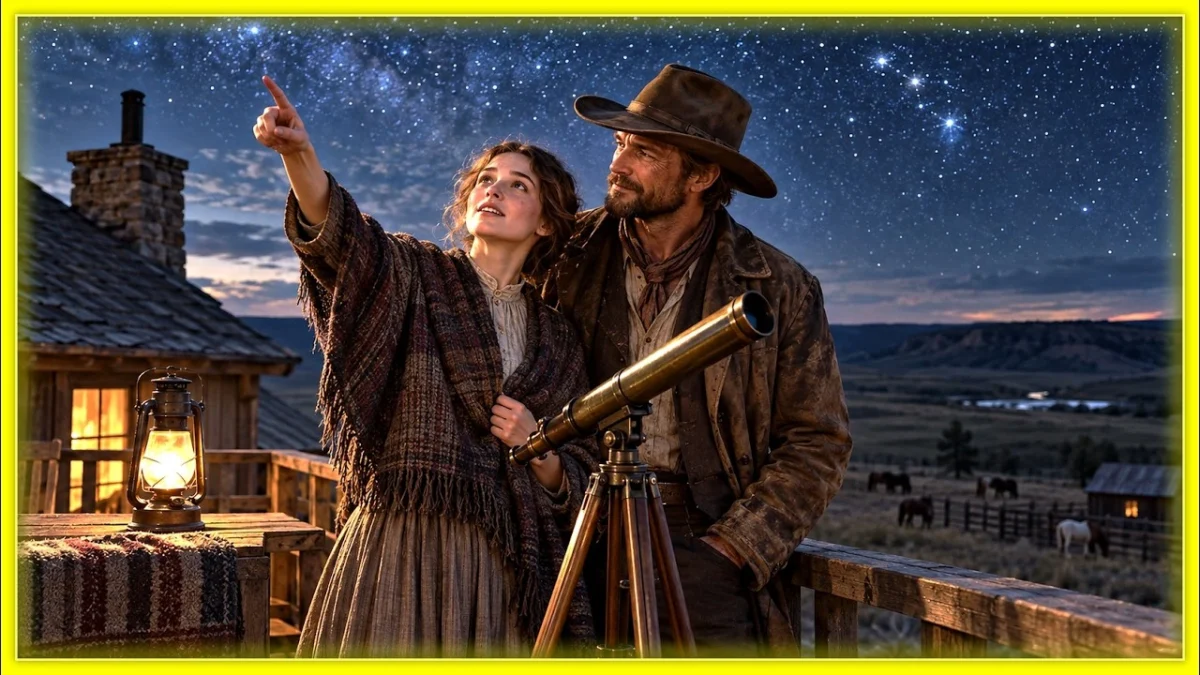
Here is the complete, expanded story based on your provided text, written in the third-person perspective, with natural dialogue, smooth logical pacing, explicit line breaks after every period, and formatted without section divisions.
—
Agnes Thorne found the thick bundle of letters buried deep in her sisters’ shared wooden trunk, tied neatly with a pale blue satin ribbon that she knew with absolute certainty was not hers.
It took her three full pages of reading by the dim lamplight to understand that what she was holding was not a forgotten keepsake or a harmless game, but a joke that had quietly stopped being funny many months ago.
She stood frozen in the doorway of the small, cramped bedroom she shared with two of her four sisters, the delicate sheets of paper trembling noticeably in her hand.
“You wrote to him,” Agnes said, her voice dropping into a flat, deadly quiet that wasn’t a question at all.
“You wrote to him using my name for an entire year.”
Louisa, the youngest of the Thorne sisters, did not even bother looking up from her vanity table where she was casually running a silver hairbrush through her long, golden curls.
“We only wrote what you would have said if you ever bothered to say anything to anyone, Agnes,” Louisa replied with a soft, dismissive shrug of her shoulders.
“We simply copied your voice. You talk about star constellations and ledgers enough at the supper table to give us plenty of material. It really wasn’t very hard to pull off.”
“And he answered every single time,” added Bate, stepping into the room with the particular, sharp relish of someone who was about to deliver very bad news very cheerfully.
“He wrote back for a year, Agnes, and three weeks ago, he proposed marriage in a very formal letter, and we accepted on your behalf because it was honestly the funniest thing any of us had ever done in our lives.”
Bate crossed her arms, looking at Agnes with a casual smirk that cut deeper than any physical blow.
“Besides, someone in this miserable house needs to leave and start actually living a life instead of doing everyone else’s household accounts until she turns forty.”
Agnes sat down hard on the edge of her narrow mattress, the scattered pages spreading across her knees like a hand of cards she had never asked to be dealt.
As her eyes scanned the elegant, masculine handwriting, she felt a sickening knot form in her chest because she recognized her own private thoughts everywhere on the page.
There was a detailed description of the Pleiades star cluster that she had only ever written down in her private, locked diary.
There was an off-hand, self-deprecating joke about her father’s terrible, chaotic bookkeeping habits.
And, worst of all, there was a whole confession about wanting desperately someday to be looked at and actually seen by someone, rather than simply being treated as useful around the house.
She had never sent a single word of those thoughts to any living soul, having barely admitted them to her own heart.
“You had no right,” Agnes said, her voice cracking painfully on the last word, a display of vulnerability she instantly despised herself for showing.
Louisa set down her hairbrush at last and turned around in her chair to meet her sister’s eyes, her expression softening for a brief, fleeting second into something that looked almost like genuine regret.
“Maybe we didn’t, Agnes,” Louisa admitted softly, stepping closer to the bed.
“But you are twenty-eight years old, and you have spent every single one of those years keeping this family running so the rest of us could go to town dances and get proposed to properly. Nobody in this town has ever once looked at you the way this man’s letters look at you. Go to Montana and see if he is real, Agnes. If he isn’t, just come back home. We will tell mother it was all a silly prank gone wrong, and she will forgive us eventually.”
Agnes looked down at the very last letter in the stack, dated three weeks prior.
It was written in a firm, unhurried, steady hand that she didn’t recognize, expressing an entirely sincere devotion that she felt herself helplessly drawn to despite her anger.
She was boarding a west-bound train two days later, less because she truly believed in the romance of the letters and more because it represented, for the first time in a decade, an exit from her life that belonged entirely to her.
The train depot at the end of the line was located sixty miles short of nowhere, consisting of nothing more than a wooden platform and a tall water tower standing against an endless sky that made Agnes’s chest ache with its sheer vastness.
The man standing alone on the dusty platform was considerably taller, broader, and dustier than she had allowed herself to imagine during the long, monotonous journey.
He did not rush wildly toward the train when it ground to a halt.
Instead, he stood firmly where he was, his wide-brimmed hat held respectfully in his hand, watching every single passenger step down the metal steps with the patient, unhurried attention of a man who had spent his entire life observing the horizon.
When Agnes stepped down onto the platform, holding her small carpetbag, he knew her at once.
She could see it happen in real-time—a quiet, private confirmation crossing his weathered face, even though she knew for a fact that her sisters had never sent him so much as a single photograph.
“Miss Thorne,” he said as he approached her, his deep voice carrying no trace of a question.
“Mr. Dunore,” Agnes replied, quickly adjusting her cotton gloves to buy herself half a second to compose her trembling nerves.
“I must confess, I am quite surprised you recognized me so instantly among the crowd.”
“You wrote in your second letter that you wear your hair plain because brass pins are a waste of a good working morning,” Caleb said, his calm eyes fixing on her face.
“And you mentioned that you have a small, faint scar just above your left eyebrow from a schoolroom slate that fell wrong when you were twelve.”
His gaze drifted directly to the faint line above her eyebrow without seeming to search for it at all.
“It wasn’t difficult to find you.”
Agnes raised her gloved hand halfway to her forehead before she managed to stop the embarrassed movement.
“You remember tiny details like that from a year of casual letters?”
“I remember all of it,” Caleb answered plainly, speaking without a single trace of the theatrical performance she would have expected from a stranger saying such an intense thing on an open train platform.
“You wrote about the Pleiades back in October, saying you had never been able to see them properly because of the city glow and the thick coal smoke where you lived. I wanted you to finally see them before the first winter snow hits out here, where there is nothing standing between you and the stars.”
Agnes looked up foolishly at the vast sky, as though the stars might somehow be visible in the pale afternoon sun.
“That is a sixty-mile wagon ride just to say hello,” she managed to say, her throat feeling strangely dry.
“I wasn’t about to let a complete stranger meet my future wife at a train depot,” Caleb Dunore said simply, reaching out his large, calloused hand to take her heavy wooden trunk.
Something in the steady timbre of his voice when he pronounced the word “wife” made it sound less like an arrogant legal claim and more like a quiet, precious hope he had been carrying very carefully through the dust for a long time.
Agnes stood still for a moment, letting him hoist the trunk onto his broad shoulder, realizing that she did not yet know what to do with the rest of her tangled emotions.
They were married two days later in a small, drafty wooden church that smelled strongly of fresh pine boards and lamp oil.
Agnes spent the entire brief ceremony endlessly rehearsing the difficult confession she knew she owed him, until finally, while sitting beside him in the wooden wagon on the bumpy road home, she simply forced the truth out into the open.
“The letters you received weren’t entirely mine, Mr. Dunore,” she blurted out, staring fixedly at her hands folded in her lap.
“My sisters wrote most of them as a cruel joke, using things I had said aloud around the house or written in my personal journals. I only discovered what they had done three weeks ago when they confessed that you had proposed and that they had accepted on my behalf. I came out here to Montana simply because it seemed far better than staying home to be laughed at, not because I actually understood what I was agreeing to.”
She braced herself, waiting for his expression to close up and turn cold, the way people’s faces always did when they realized they had been sold something vastly different from what they had paid for.
Instead, Caleb remained entirely quiet for a long moment, skillfully guiding the pair of horses around a deep rut in the dirt road.
“The letters weren’t a joke,” Caleb said at last, his voice completely level.
“The sisters were the joke.”
Agnes blinked, turning her head to stare at his side profile in confusion.
“I don’t follow your meaning.”
“Whatever hand happened to hold the ink pen, Agnes, that was you on the page,” Caleb explained, glancing over at her with a steady, unbothered gaze.
“Nobody invents a woman who worries about a hired hand’s bad knee in the exact same paragraph where she calculates the precise distance to the nearest star cluster. Nobody fakes a fierce argument with her own father’s arithmetic that runs on for three full pages and ends with an apology for rambling. That was your soul, whether your sisters licked the postage stamps or not.”
He shifted the leather reins smoothly in his hands.
“They played a foolish trick on their sister, Agnes, but they didn’t manage to lie to me. I would have known instantly if the heart inside those letters went false, because I read every single one of them at least a dozen times.”
“A dozen times?” she echoed softly.
“At least that,” Caleb said, the corner of his mouth curving into a rare, faint smile.
“My foreman, Ike, used to complain constantly that I read your letters at the supper table. I still do, some nights.”
Agnes sat silently with his words for the remainder of the long ride, watching the wide, gold-tinted country slide past the wagon wheels.
She was astonished to discover that the terrifying confession she had dreaded making had left her feeling lighter rather than smaller, which was not at all what she had expected marriage to feel like on its very first afternoon.
When they arrived at the ranch house, Agnes discovered that the financial books were in a far worse condition than Louisa’s hairbrush technique.
The ledger was a chaotic mess of tangled columns and half-finished sums that made Agnes’s fingers itch with impatience the very moment she laid eyes on the pages.
She immediately sat down at the wooden desk and spent her first week completely rebuilding, correcting, and balancing the ranch’s records until they were running completely clean.
“You have been overpaying the feed supplier in Miles City for two full seasons now,” Agnes told Caleb over supper on their seventh night together, sliding the neatly organized new ledger across the table to him.
“You are paying one percent over the standard going rate. Either the merchant does not know his own wholesale prices, or he simply assumed nobody way out here on the range would ever bother to check his math.”
“Ike handles all the feed contracts,” Caleb replied, looking over the crisp, clear rows of numbers with obvious admiration.
“Ike is a fine foreman and an exceptionally indifferent mathematician,” Agnes said briskly, taking a sip of her tea.
“And I mean that with genuine affection, considering how remarkably kind he has been to me all week. If you will permit me to sign official documents on behalf of the ranch, I will write the firm correction letter to the supplier myself.”
“You will sign for the ranch whenever you see fit, Agnes,” Caleb said without a single second of hesitation.
It was spoken with such plain, easy trust that Agnes had to quickly look down at her dinner plate for a moment to hide the sudden, overwhelming warmth that rushed to her face.
Caleb continued to surprise her in entirely different ways as the days turned into weeks.
Three days after the ledger incident, Agnes stepped out into the dusty yard at dusk to find her husband standing on the roof of the small timber barn with a heavy hammer and a spirit level in his hands.
He was carefully constructing a sturdy, flat wooden platform against the north slope of the roof, right where the night sky ran clearest above the trees.
“What are you building up there, Caleb?” she called up to him, shading her eyes against the setting sun.
“You wrote in one of your letters that you never had anywhere proper to look at the stars from,” Caleb called back down, his voice unhurried as he drove another long nail into the timber.
“You said the city roof sloped the wrong way. Well, this one won’t. I figured you would want a flat place to stand before the nights turn bitter cold and the sky gets truly clear.”
Agnes stood rooted in the dirt yard with her hand pressed tightly against her mouth.
In twenty-eight long years of running a demanding household for other people’s comfort, no one had ever built her a single thing meant solely for her own personal pleasure.
She did not entirely trust her trembling voice to thank him properly, so for a long moment she simply stood there, letting the profound gratitude on her face do the talking for her.
They quickly fell into the quiet habit of climbing onto the roof platform within a week.
Every night after the supper dishes were washed and dried, Agnes would climb the sturdy ladder carrying a thick woolen blanket and her father’s old, worn star chart.
Caleb would follow a few minutes later, moving more slowly, carrying two tin cups of black coffee that he had meticulously learned to brew exactly the way she liked it.
“That tight cluster right over there,” Agnes said one crystal-clear night, pointing her finger up toward the dark canopy.
“That is the Pleiades. People call them the Seven Sisters, though you can really only see six of them clearly with the naked eye on most nights. The ancient Greeks used to say that the seventh sister hid herself away out of deep grief.”
“Grief for what?” Caleb asked, leaning back against the wooden frame.
“It depends on who is telling the ancient story,” Agnes replied, turning her head to look at him sideways.
“In one version, she was grieving for a lost husband. But now it is your turn, Caleb. Name something out there in the dark for me.”
Caleb shifted his position, gazing out toward the shadow-draped pastures surrounding the barn.
“You see that dark shape standing right by the fence line?” he said softly.
“That is the worst-tempered cow I own. She bites any new hired hand who gets too close, but she is also the absolute best mother cow I have ever run on this range. That little shadow beside her is her calf from the early spring. He still doesn’t have an official name because Ike can’t seem to settle on one he likes.”
“Best doesn’t rhyme with anything remotely astronomical,” Agnes teased gently, a soft smile touching her lips.
“I didn’t say the night sky held a complete monopoly on interesting company,” Caleb replied lightly.
His eyes drifted away from the distant pasture and settled directly on her face, lingering there with an intense, quiet heat that Agnes felt land somewhere just beneath her ribs.
She immediately pretended to study her paper star chart with sudden, fierce concentration instead of looking at him.
Caleb pretended to go back to studying the dark pasture instead of looking at her.
Neither one of them was being remotely convincing, and both of them, she strongly suspected, knew it completely.
Neither of them said a word to break the spell, because the lingering silence carried its own deep, quiet pleasure as they lay stretched out under a sky that was rapidly filling with thousands of brilliant stars.
“Caleb?” she whispered into the dark.
“Yes, Agnes?”
“Nothing,” Agnes said softy, pulling the heavy blanket higher around her chin.
She let the peaceful silence be the whole of her answer, because she did not yet fully trust her fragile heart with the rest of what she was feeling.
The winter months rolled in, and the new town schoolteacher arrived in November.
Miss Everly was a young woman blessed with flawless manners, a pleasant, musical laugh, and an unfortunate, unconscious gift for saying extraordinarily kind things that cut straight to the bone.
“You really are remarkably fortunate, Mrs. Dunore,” Miss Everly said one afternoon over a hot cup of tea at the mercantile shop, patting Agnes’s hand with genuine, glowing warmth.
“Mr. Dunore is spoken of so very highly by everyone throughout the entire valley. He is steady, generous, and remained unmarried far longer than anyone in town could ever account for. You must feel so very lucky to have caught his eye.”
“I do,” Agnes said quietly, and she meant it from the absolute bottom of her heart.
“I must confess, when I first arrived in town, I wondered how a man like him settled down so suddenly,” Miss Everly continued, pausing to laugh lightly at her own forwardness.
“Well, none of that matters now, does it? He is officially taken, and anyone can see how utterly devoted he is by the way he speaks of you when you aren’t around.”
Agnes offered a polite smile, agreed with the teacher, and finished her tea before taking the longest possible walking route back to the ranch.
She needed the extra time to compose her face before Caleb saw her, because what Miss Everly had said—meaning nothing but pure kindness—had struck directly against the raw, painful bruise Agnes had carried her entire life.
She had always been the plain sister, the useful sister, the one that men were ultimately fortunate to end up with for her domestic labor, rather than the one they passionately chose first.
She knew she was fortunate, but it still hurt faintly to hear it voiced so carelessly by a beautiful, pleasant woman who might so easily have been the proper ending to this story if the letters had gone out under a different name.
That night, Agnes climbed onto the cold roof platform completely alone while Caleb was fast asleep.
She sat for hours under the freezing light of the Pleiades before she could trust herself to climb back down into their warm bed.
Her worst fears were realized when her youngest sister, Louisa, unexpectedly arrived on the December stagecoach.
Louisa stepped down from the carriage wearing a fine, stylish traveling coat that was far more elegant than anything the Thorne family had ever owned a real use for.
She swept into the quiet ranch house with the vibrant, unstoppable energy of a girl who had never once in her life doubted her own welcome.
“Agnes, darling! I have come all this way to rescue you!” Louisa declared, spinning in a dramatic circle in the center of the modest front room.
She took in the neatly mended curtains, the star chart pinned carefully to the wall, and the open accounting ledger lying on the table.
“Mother is practically beside herself with worry, imagining you trapped out here in the wilderness doing boring sums for a complete stranger. I told her I would come see the place for myself and bring you straight back home if it was dreadful.”
“It isn’t dreadful at all, Louisa,” Agnes said, her tone cautious and guarded.
“No, I suppose it isn’t,” Louisa said, her sharp eyes narrowing as she assessed the room before sliding past Agnes toward the dusty front yard.
Outside, Caleb was casually unloading heavy feed sacks from a wagon with Ike, his shirt sleeves rolled up to reveal sun-browned, muscular forearms as he worked with unhurried grace.
Something in Louisa’s expression shifted instantly—a quick, calculating spark that Agnes recognized with chilling clarity from a hundred town dances when a prospective partner crossed the floor toward someone else first.
“Well,” Louisa murmured, her voice dropping into a feline purr. “He is certainly far better looking than those dry letters made him out to be.”
“Louisa, please don’t,” Agnes warned, her heart sinking.
“Oh, I only mean that it was my brilliant idea in the first place, wasn’t it?” Louisa said smoothly, already taking a step toward the front door while carefully adjusting her lace collar.
“Half the clever words in those letters were mine, Agnes. It feels like I ought to at least properly meet the handsome man I helped invent.”
Agnes felt something icy cold and terribly familiar settle low in her stomach as she watched her sister walk out onto the porch.
It was the sickening, hopeless feeling of standing directly behind the pretty sister—the sister the room always looked at first.
Late that night, while the rest of the house was completely silent, Agnes packed her leather trunk by the dim light of an oil lamp.
Her hands wouldn’t stop trembling as she folded her plain cotton dresses.
She had spent the entire evening watching Louisa laugh far too easily at Caleb’s dry, quiet jokes, while Caleb remained polite, calm, and utterly unreadable.
Louisa’s eyes had burned bright with that familiar, predatory hunger for being the one chosen, and Agnes had convinced herself that it made a terrible kind of sense.
Louisa was the pretty sister, the vivid one, the one who had actually constructed half the witty sentences that had drawn a lonely rancher into writing back in the first place.
Agnes had simply been the plain name written on the front of the paper envelopes.
She was reaching for the metal clasp of her trunk when Caleb walked into the bedroom without knocking.
He was holding a faded piece of paper in his hand, and he stood quietly in the doorway, watching her fold a wool shawl that didn’t need folding.
“Are you going somewhere, Agnes?” he asked quietly.
“I am simply making things easier for everyone involved,” Agnes said, keeping her head down so he couldn’t see the tears brimming in her eyes.
“Louisa is the one who actually wrote the parts of those letters that you loved, Caleb. The wit, the charm, all of it. I am just the plain, boring version of the woman on the page.”
“Sit down, Agnes,” Caleb said, his voice firm yet entirely lacking in anger.
When she refused to move, he slowly unfolded the paper in his hand and began reading aloud in his deep, steady voice.
“‘This letter is from March—your March, Agnes, not your sister’s. I know your handwriting from theirs by now, four years of practice or not.'”
Caleb stepped closer, his eyes reading the faded ink.
“‘I do not wish to be admired from a distance for imaginary qualities I do not possess. I wish foolishly, someday, to be seen clearly and plainly as I actually am, and to be wanted anyway.'”
Caleb lowered the paper and looked directly into her eyes.
“You wrote those exact words, Agnes. Nobody else in that chaotic house of yours could ever have written a sentence like that if they tried for a hundred years. I have read that line so many times I could recite it walking in my sleep. I married the woman who wrote those words, Agnes, not the mischievous sisters who licked the envelopes.”
Agnes’s hands froze completely on the woolen shawl.
“I am not looking for artificial wit dressed up in someone else’s fancy handwriting,” Caleb said softly, taking another step toward her.
“I already found exactly what I was looking for. She is currently standing in my bedroom, frantically packing a trunk she doesn’t need to pack.”
The following morning, before the afternoon stagecoach was scheduled to arrive, Caleb met Louisa out on the front porch.
Agnes, standing inside near the open kitchen window while arranging tea cups with sudden, intense focus, could hear every single word spoken outside.
“I married the woman who wrote to me, Louisa,” Caleb said, his voice plain, unhurried, and completely absolute.
“Every single letter—whoever happened to hold the ink pen at the table—contained her heart. I would marry Agnes again tomorrow if I had to do it twice. I am glad you came all the way out here to visit, truly, but there was never a version of this story where the ending was you.”
Louisa’s airy laugh, when it finally came, sounded considerably thinner and less confident than usual.
“Well, I only wanted to see the ranch for myself, Mr. Dunore.”
“You’ve seen it,” Caleb replied simply.
Louisa left on the afternoon stagecoach with vastly less flourish than she had arrived with.
Agnes walked out to the dirt road to see her sister off, treating her with a quiet civility that cost her absolutely nothing now.
The cold, crushing weight that had sat in her chest all night was completely gone, replaced by a deep, steady warmth that felt entirely new and real.
The first heavy snow of the winter arrived the week before Christmas, falling soft and sudden, painting the entire valley in a thick sheet of pure white.
By nightfall, Agnes climbed the sturdy ladder up to the barn roof platform, carrying two thick woolen blankets instead of one.
Caleb climbed up right behind her, stepping carefully on the snow-dusted boards before settling down closely beside her.
He gently wrapped the second blanket around her shoulders before pulling her back against his chest.
“The Pleiades are going to be very hard to see through this thick cloud bank tonight,” Agnes noted softly, tilting her head back against his shoulder.
“Give it a minute,” Caleb murmured into her hair. “The wind is clearing the clouds toward the east.”
They waited together in the quiet dark, their warm breath forming pale plumes in the crisp night air, until the thick cloud cover finally broke apart.
The small, tight cluster of stars shone through, faint, silver, and brilliant, appearing in the exact spot where Agnes had always known to look for them.
“There they are,” Agnes whispered, her voice filled with awe.
“I see them,” Caleb said softly.
He wasn’t looking up at the sky at all.
He was looking down at her face, watching the delicate snowflakes catching in her plain, unpinned hair, his eyes lingering on the tiny scar above her eyebrow that he had known about long before he had ever held her hand.
“Now I am looking at you,” he added quietly.
Agnes turned toward him on the narrow wooden platform, thinking of the sixty miles of dirt road, the year of stolen letters, and the terrifying night she had almost packed her trunk to run away.
She realized then that being looked at plainly—exactly as she was—felt nothing at all like the old bruise she had carried for so many years.
It felt entirely like coming home.
Caleb kissed her tenderly beneath the Seven Sisters, where only six stars were visible in the cold night sky, and neither of them minded in the least which one was missing.








