Her Tribe Cast Her Out at Dawn… Then the Cowboy Said Three Words That Changed Everything.
Part 1
The harsh morning light cut across the jagged red cliffs of the Arizona territory, casting long, lonely shadows over the dusty trail.
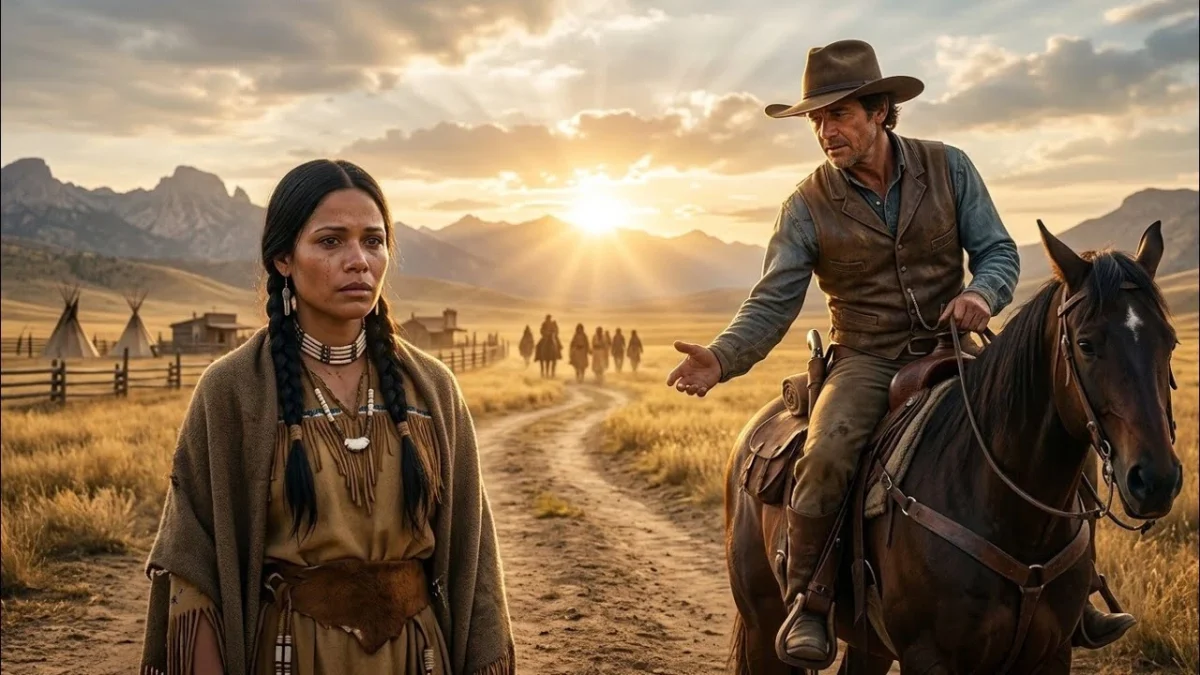
At dawn, an Apache woman named Naya stood alone at the edge of her settlement, staring back one last time at the place she had called home her entire life.
She carried nothing with her except the clothes on her back, a small canvas sack clutching her few belongings, and the heavy weight of memories from everyone who had just turned away from her.
She had been cast out after a fierce disagreement with the village council involving an old family secret that the elders insisted should remain buried forever.
With no family left to protect her and no place to call home, Naya turned her back on her past and began walking down the empty dirt road.
She had nowhere to go and no one left to trust in a harsh world that rarely showed mercy to an outcast.
A few miles down the valley, the morning sun was barely crowning the distant hills when Samuel Carter reined in his horse along the perimeter fence line.
Samuel was a quiet rancher, a man built from hard work and long winters, living on the land his late father had spent a lifetime building.
He had been checking the cedar fence posts that morning when a solitary figure walking along the dusty trail caught his eye.
At first, Samuel assumed it was simply a stranger traveling toward the nearby trading post.
However, as he watched closely, he noticed the hesitant, uncertain rhythm of her steps and the way she kept glancing fearfully behind her.
She walked with her head down, carrying her small bundle, moving as though every step forward required more strength than her exhausted body possessed.
Samuel nudged his horse forward, stopping a respectful distance away so as not to startle her.
He observed her closely, noticing the deep exhaustion etched into her face, but beneath the fatigue, he saw an overwhelming sense of loss.
She looked up, her dark eyes filled with a quiet guard, completely uncertain of where her next step would lead.
Samuel tipped his hat slightly, keeping his voice gentle and steady.
“Are you all right, ma’am?” Samuel asked, holding his horse steady.
Naya stopped dead in her tracks, her hand tightening around the strap of her small bundle.
For several long, heavy seconds, she remained completely silent, evaluating the tall cowboy sitting atop his saddle.
“I am fine,” Naya replied, her voice raspy from dust and dry air.
“You’re a long way from any settlement to be walking on foot without water,” Samuel said, looking down the empty expanse of the desert trail.
Naya took a breath, letting her guarded shoulders drop just an inch.
“I was told to leave my village this morning after a disagreement regarding an old family matter,” Naya explained quietly. “I have no destination, and I have no village to return to.”
Samuel looked at her carefully, realizing the gravity of what she had just shared.
He could have pressed her for details about the conflict.
He could have easily minded his own business, turned his horse around, and ridden back to the comfort of his home.
Instead, Samuel looked down the endless, scorching trail ahead of her, knowing she wouldn’t survive the afternoon heat on foot.
He looked back at Naya and spoke three simple words that carried the weight of pure compassion.
“Come with me,” Samuel said softly.
Naya stared up at him in complete disbelief, her eyes widening as she tried to process his offer.
She clearly had not expected a stranger—especially a white rancher—to offer aid to an abandoned Native woman.
Samuel pointed off toward the eastern ridge where the smoke from his ranch chimney gently drifted into the sky.
“My ranch is just over that ridge,” Samuel added, his tone honest and calm. “You can rest there, get some food, and drink clean water. We can figure out the rest later.”
After a tense moment of hesitation, Naya looked at his steady gaze, sensed no malice in him, and slowly nodded.
“Thank you,” Naya whispered.
Samuel dismounted, offering her the saddle while he walked alongside the horse, guiding them back toward his homestead.
When they arrived at the ranch house, Samuel pulled out a wooden chair on the shaded front porch, handing her a cold canteen and a plate of fresh bread and dried meat.
He gave her time to eat and rest through the heat of the morning, asking for nothing in return and placing no pressure on her to explain her past.
That quiet respect touched Naya deeply, melting away the sharp guard she had built up over years of hardship.
As the shadow of the porch lengthened, Naya finally set her canteen down and looked across at Samuel, who was oiling a leather bridle on the porch steps.
“You haven’t asked me why they cast me out,” Naya said, her voice cutting through the quiet afternoon air.
Samuel paused his work and looked up at her.
“A person’s trouble is their own until they choose to share it,” Samuel replied thoughtfully. “You needed a place to rest, not an interrogation.”
Naya offered a faint, grateful smile before looking down at her hands.
“I was cast out because I refused to remain silent,” Naya said softly. “I refused to abandon an old story passed down to me by my grandmother. The elders believed the story was dangerous and should remain forgotten, but I disagreed.”
“What kind of story?” Samuel asked, leaning back against the wooden porch railing.
“My grandmother always told me that one day I would meet someone connected to our family’s deeply hidden past,” Naya said, her gaze drifting off toward the mountains.
“Did she ever tell you who this person was?” Samuel inquired.
“No,” Naya answered quietly. “She only gave me something to hold onto.”
Naya reached into her canvas bag and pulled out a small piece of folded, weathered buckskin.
She carefully unwrapped the cloth, revealing a small, intricately hand-carved wooden token.
The moment Samuel’s eyes fell upon the token, his entire expression shifted from casual attention to complete shock.
Carved into the center of the dark wood was a distinct, raised emblem—a stylized mountain peak surrounded by three intertwined circles.
He had seen that exact symbol before, but not in any local market or town shop.
He had seen it locked away inside his late father’s private wooden chest, hidden deep in the back room of his house.
Naya immediately noticed the dramatic change in Samuel’s face and his sudden breathlessness.
“You recognize this symbol, don’t you?” Naya asked, her voice trembling slightly with sudden hope.
Samuel slowly nodded, his mind racing through years of distant memories.
“My father had something carved with that exact same symbol,” Samuel confessed, staring at the token in her palm.
Naya stood up from her chair, her hands shaking as she looked at him in total surprise.
“Then perhaps this was no coincidence,” Naya whispered softly. “Perhaps this is the exact reason I ended up walking down your trail today.”
Samuel looked from the wooden token up to Naya’s face, a sudden chill running down his spine.
For the very first time, he began to realize that her sudden appearance on his land wasn’t just a random act of fate.
It was connected to a secret, hidden life that his father, Thomas Carter, had taken to his grave years ago.
And suddenly, those three simple words Samuel had spoken at dawn felt far more monumental than he could have ever imagined.
Part 2
Samuel could not get the sight of the wooden token out of his mind.
After they finished their afternoon meal, Samuel led Naya inside the house and walked straight toward the small storage room located right behind the kitchen.
It was a dusty, sunlit room where his father’s personal belongings had been stored in crates ever since his passing five years ago.
Samuel reached up to the highest shelf, lifting down a heavy, dust-covered cedar box.
A thick layer of grey dust coated the lid, showing just how rarely Samuel had brought himself to touch his father’s things.
He blew the dust away, unlatched the rusty brass lock, and carefully lifted the heavy wooden lid.
Inside lay the preserved fragments of Thomas Carter’s past: old faded black-and-white photographs, a non-functioning brass pocket watch, several bundled letters tied with twine, and a worn leather notebook.
Samuel reached deep into the corner of the box, feeling for a small velvet pouch he remembered seeing as a young boy.
He pulled out the pouch, tipped it over into his palm, and gasped.
Out dropped a second wooden token.
Samuel set his father’s token down on the kitchen table right beside the one Naya had brought with her from her village.
When placed side by side, the craftsmanship was unmistakable—the geometric carvings match seamlessly, forming two halves of a single, unified emblem.
Naya stepped closer to the table, staring at the side-by-side pieces in complete awe.
“My grandmother had one just like this, kept hidden wrapped in cloth her entire life,” Naya said, her voice filled with quiet reverence.
Samuel looked at her, his brows furrowed in confusion and amazement.
“You knew about the symbol, but did you know where the second piece was hidden?” Samuel asked.
“No, I never knew who carried the other half,” Naya replied. “I only knew it existed.”
Samuel reached back into the cedar box and pulled out a faded, yellowed photograph.
The photograph showed a younger Thomas Carter standing near the edge of this very ranch, surrounded by a group of Native men and women standing beside a timber cabin.
Naya leaned over Samuel’s shoulder, her eyes widening as she pointed a finger at a young woman in the photograph wearing a traditional beaded dress.
“That is her,” Naya whispered emotional warmth filling her voice. “That is my grandmother, Ahanu.”
Samuel looked back and forth between the photograph and the table, completely stunned.
“My father never mentioned this to me,” Samuel admitted, a sense of quiet frustration in his voice. “He never spoke about your people or this connection.”
Naya gently touched the edge of the old photograph with her thumb.
“My grandmother spoke of a young cowboy who risked everything to protect her family during a bitter winter many years ago,” Naya said softly.
“What did he do for them?” Samuel asked, eager to understand his father’s unspoken history.
“She told us that when soldiers and angry ranchers came to drive them out of the valley, this cowboy gave them food, shelter, and a safe place to hide on his land,” Naya explained. “He protected them when no one else would.”
Samuel looked down at the photograph, swallowing hard as he recognized the quiet nobility of the man he had called father.
“That sounds like him,” Samuel whispered. “He was always a quiet man, never one to boast about his good deeds.”
“My grandmother always spoke about your father with immense respect,” Naya continued. “She said that before they finally parted ways, he made a sacred promise to her.”
Samuel’s curiosity flared, his heart beating faster.
“What kind of promise?” Samuel asked eagerly.
Naya shook her head regretfully.
“I was never told the exact words of the promise,” Naya confessed. “My grandmother guarded the specifics fiercely. She remembered and repeated only one final instruction to me before she passed.”
“What was the instruction?” Samuel asked.
“She told me: ‘If the symbol ever appears in your life again, follow the person who carries its half, for they hold the key to our family’s honor,'” Naya quoted softly.
Samuel stared down at the two wooden pieces resting on the table, feeling the full gravity of the revelation.
He finally understood why Naya had trusted him so quickly on the trail.
She hadn’t come to his ranch by complete accident, nor had she known his name when they met.
She had simply followed the path her grandmother’s story had laid out for her, driven by faith and the search for truth.
Yet, a lingering question still burned in Samuel’s mind.
“If your grandmother held your father’s memory in such high regard, why were you cast out from your settlement for speaking about it?” Samuel asked, looking directly into Naya’s eyes.
Naya turned her head, looking out the kitchen window toward the rugged distant mountains.
“Because over the decades, pain and mistrust grew between our people and the townspeople,” Naya explained sorrowfully. “The current elders believed that remembering a friendship with a white rancher brought dishonor and opened old wounds. They wanted the promise forgotten forever.”
“And you refused to let it die,” Samuel said quietly.
“Yes,” Naya said, turning back to face him with resolute eyes. “I believed that a true act of kindness and honor should be remembered, not erased out of fear.”
Samuel closed his father’s heavy cedar box with a firm nod.
“Then we are going to find out exactly what that promise was,” Samuel declared determinedly.
Together, Samuel and Naya sat down at the table and began carefully sifting through the stack of old, yellowed letters tied together in the box.
Neither of them realized that tucked deep inside one of those forgotten envelopes lay a final document that would explain why Thomas Carter had kept this secret hidden for nearly twenty years.
The search continued well into the late afternoon, with the sun casting warm orange rays through the barn doors as Samuel moved his search to his father’s old workshop desk.
Samuel thumbed through the worn leather notebook once more, reading past long lists of cattle counts, fence repairs, and seasonal crop yields.
Near the very back of the journal, however, the handwriting changed from quick business notes to a slow, deliberate script.
There were lists of names, dates, and short descriptions of travelers, families, and weary souls Thomas had quietly aided over the span of thirty years.
Naya leaned closer as Samuel turned a brittle page.
Tucked tightly between the final two pages was a sealed, unaddressed envelope.
On the front of the envelope, written in dark black ink, was a Native name that Samuel could not pronounce, but Naya recognized instantly.
“That was my grandmother’s tribal name,” Naya gasped, her breath catching in her throat.
Samuel carefully broke the dry wax seal and unfolded the aging parchment inside.
He began reading his father’s steady handwriting aloud to the quiet barn.
“My dear friend, I write this letter to hold my word, promising that I will keep your family’s land deed and sacred token safe in this box until the day someone from your lineage comes looking for it,” Samuel read aloud.
Samuel paused, his voice trembling slightly as he looked at Naya.
Naya’s dark eyes widened with overwhelming emotion as she listened to every word.
Samuel continued reading his father’s letter.
“I do not know when that day will come, or if I will still be breathing when it does,” the letter read. “But a sacred promise does not become less important simply because time passes and memories fade.”
Samuel lowered the paper for a moment, his throat tight as his father’s words echoed through the wooden barn.
For his entire life, Samuel had viewed his father as a stoic, emotionally distant man who cared only about the daily grind of running the cattle ranch.
Now, reading these hidden words, Samuel was discovering an entirely different man—a hero who had quietly protected others without ever asking for praise, recognition, or reward.
Samuel took a deep breath and resumed reading the final paragraph of the letter.
“This wooden symbol is not a sign of debt or ownership,” Thomas had written. “It is a eternal reminder that two families from completely different worlds once chose to trust one another in a time of hatred. If someone comes carrying the matching half, listen to their story, open this house to them, and honor the trust we built.”
Naya looked down at the wooden token resting in her palm, tears welling up in her eyes.
“My grandmother was telling the truth all along,” Naya whispered, her voice cracking with emotion. “She was not crazy, and I was not wrong to fight for her memory.”
Samuel nodded slowly, but as he moved to fold the paper, he noticed a smaller line of postscript text written at the very bottom of the page.
“To my son Samuel: Teach yourself that a man’s true worth is measured solely by what he chooses to do when nobody is watching.”
Samuel fell completely silent, those final words striking his heart with immense power.
Naya observed his emotional reaction and placed a gentle hand on his arm.
“Your father knew you would find this letter one day,” Naya said softly.
“I don’t know if he knew for certain,” Samuel replied, looking down at his father’s handwriting. “Maybe he just had faith that I would be the kind of man who would stop and help a stranger on the road.”
Samuel picked up the two halves of the wooden token from the workbench and aligned their notched edges.
With a soft click, the two pieces joined together perfectly, forming a seamless, complete wooden seal.
As Samuel turned the joined token over in his hand, he noticed a small, fine line of text carved into the back of the wood that had only become legible once the two halves were unified.
Samuel read the carved words aloud.
“A promise lives as long as someone chooses to remember.”
Samuel read the inscription a second time, letting the profound truth of the words settle into his mind.
He turned to Naya, his eyes filled with clarity.
“You were never meant to wander endlessly after leaving your village,” Samuel said firmly. “You were meant to find this place.”
Naya shook her head with a soft smile.
“And you were never meant to leave your father’s wooden chest sitting dusty on a shelf forever,” Naya replied gently.
For a long moment, neither of them spoke, wrapping themselves in the quiet magnitude of what they had uncovered.
The missing piece of Samuel’s father’s legacy was finally clear, and Naya’s grandmother’s honor had been completely restored.
Yet, as the sun began to set over the western hills, one vital question remained unanswered.
Would Naya return to her village to confront the people who had cast her out, or would she choose an entirely new path forward now that the truth was finally revealed?
Part 3
By the following morning, word had traveled fast across the valley, reaching the nearby settlement that Naya was staying at the Carter ranch.
Curious and remorseful, three representatives from her village rode out to Samuel’s homestead to speak with her directly.
They stood near the porch, offering an apology on behalf of the elders and telling Naya that she was now welcome to return home if she wished.
The decision was entirely hers to make.
Naya stood on the wooden porch, looking back and forth between her former people and the quiet cowboy who had given her shelter.
“I don’t know what to do,” Naya admitted privately to Samuel, her voice filled with lingering doubt. “A part of me wants to go back, but another part fears the past will only repeat itself.”
Samuel stood beside her, his hands resting calmly on his belt, offering wise counsel without forcing her hand.
“Do what feels right in your heart, Naya,” Samuel answered quietly. “You don’t owe anyone a decision made out of fear or obligation.”
Naya thought deeply about her grandmother’s courageous spirit, the preserved letter in Thomas’s chest, and the sacred promise hidden within the wood.
She realized that in order to truly close the painful chapter of her past, she had to stand before her people with the truth.
“I will return to speak with the elders,” Naya announced firmly. “I need to show them the truth.”
Samuel immediately stepped down off the porch.
“I’ll ride with you,” Samuel offered kindly. “Not to speak for you, but to stand beside you as a witness.”
When they arrived at the settlement, the village elders gathered in a circle to receive them.
With calm confidence and absolute dignity, Naya stepped into the center of the gathering and held out her hands.
She presented the two perfectly joined pieces of the carved wooden token alongside Thomas Carter’s written letter.
An elder of the village stepped forward, taking the wooden seal into his hands and examining the ancient emblem with profound shock.
The elder recognized the historical mark immediately, validating the long-forgotten story that Ahanu had passed down to her granddaughter.
He looked up at Naya, his eyes filled with deep regret for having doubted her.
The elder explained to the gathered crowd that the ancient agreement was never about control, land, or conflict.
It was a sacred testament to cross-cultural trust, mutual respect, and pure human kindness during a time of dark war.
The elders officially welcomed Naya back into the community with open arms and deep honor.
She had restored her family’s name and brought an incredible truth back to her people.
However, having accomplished her mission, Naya realized her journey was no longer tied solely to the village of her youth.
She had faced her past, conquered her doubts, and was now free to choose her own path into the future.
Months passed, and the harsh heat of summer gave way to the crisp, golden breezes of early autumn.
One warm afternoon, Samuel was out working near his barn when he heard the quiet beat of horse hooves approaching the driveway.
He looked up to see Naya riding toward the main house, sitting tall and confident upon her saddle.
She was no longer carrying the crushing weight of uncertainty or fear that had plagued her on that desperate morning months ago.
She had made peace with her past, found her true purpose, and walked with a vibrant, radiant strength.
As she dismounted near the porch, Samuel smiled warmly, stepping out to greet her.
“It is good to see you, Naya,” Samuel said warmly.
In her hand, Naya held a beautiful, small plaque crafted from smoothed cedar wood.
She handed it to Samuel, watching his reaction closely as he took it.
Samuel looked down and smiled deeply when he saw the three words beautifully hand-carved into the smooth wood: Come with me.
Naya looked into his eyes, her expression filled with profound gratitude.
“Those were the very first words anyone said to me when I thought I had nowhere left to go in this world,” Naya said softly.
Samuel looked at the plaque, feeling a deep warmth in his chest.
“I was only trying to help a person in need that morning,” Samuel replied humbly.
“Sometimes, simple help is more than enough to save a life,” Naya responded gently. “It gave me hope when I had none.”
Samuel brought her inside, where he had permanently displayed his father’s letter alongside the unified wooden token on the mantel above the fireplace.
He had finally come to understand the true legacy his father had left behind for him to inherit.
A man’s greatest legacy is not the acres of land he owns, the cattle he raises, or the wealth he accumulates.
It is found entirely in what he chooses to do for someone who desperately needs a helping hand.
As the afternoon sun began to set, casting a beautiful golden light across the sweeping landscape of the ranch, Naya walked out to the porch and stood beside Samuel.
They stood side by side, watching the quiet beauty of the frontier stretching out before them into the horizon.
The very same three words that had once offered a wandering outcast a temporary place to rest had now become the foundation of a lasting bond.
One single, unselfish act of kindness can ripple across generations, becoming the beautiful beginning of a brand-new story.
Sometimes, three simple words spoken from the heart can forever change the entire direction of a person’s life.








