I Asked the Apache Widow for a Ranch Job — She Said I’ve Been Praying You Here for Two Months
PART 1: THE DUST AND THE BURNING CHAPEL
The sun was a white hammer against the vast, empty expanse of the New Mexico Territory.
For thirty-one endless days, no rain had fallen across the dry benches, leaving the earth cracked, dry, and bleached to the color of old bone.
Caldwell Harrow rode his weary horse along the gravel trail, pulling a faded wild rag over his nose and mouth as the wind whipped hot dust across the flats.
He was thirty years old, dressed in a faded calico shirt washed so many times it had lost its color, canvas trousers held up by suspenders, and worn boots with run-over heels.
Behind him lay Kansas, and behind Kansas lay Texas.
Cal had learned to measure a country by what it refused to give a man, and this basin refused water above all else.
He had prayed in a lot of rough places throughout his life—under freight wagons, in stable corners, and on his knees in the churned mud of other men’s corrals.
He had prayed for work, for warmth, and for one more day of being useful to an employer who paid at the end of the night.
He had asked the Lord for a true home only once in his life; he had received it, lost it, and had never dared to ask again.
That unhealed loss was a weight he carried like a stone inside his boot that he refused to shake out, because taking the boot off meant sitting down, and sitting down meant thinking.
His directions were thin, passed along secondhand from a man at a Tularosa livery who had heard them from a freighter.
“Follow the wagon road past the burned chapel,” the man had told him.
“Turn at the cottonwoods, and look for the whitewashed adobe with the green door.”
By mid-morning of the fourth day, Cal reached the remains of the chapel.
It stopped him without his meaning to stop.
Blackened timbers stood out from the pale ground like the bare ribs of a fallen beast, roofless and hollowed by fire.
One solitary wall held a window frame without glass, framing nothing but endless desert.
Cal clucked to his horse and kept moving forward, unaware that the fire that destroyed the chapel had already set in motion the events waiting for him at the end of the trail.
A short while later, a thick stand of green cottonwoods appeared on the horizon, signaling the presence of running water.
Cal topped a low rise and held his reins tight as his eyes took in the scene below.
A clear, flowing creek cut through the basin, shaded by willows and lush wild grass.
Healthy cattle stood in the shallows, grazing on benches that showed careful rotation.
On a rise above the stream stood a solid, whitewashed adobe house with a sturdy porch, a straight barn, and a well-kept pole corral.
Four bright hollyhocks grew along the south wall, blooming alive in a country where keeping flowers required carrying water by hand every single day.
Cal sat in his saddle, realizing that whoever controlled this water in a dry land held tremendous power, and that power naturally brought dangerous enemies.
As Cal rode down the wagon road at a walk, two armed men on horseback came galloping up from the ranch house, passing him rapidly without a word.
The lead rider wore his hat pulled low, casting a sharp, assessing look at Cal—evaluating his weight, his reach, and the rifle in his saddle scabbard—before disappearing into the west.
When Cal reached the front gate, he noticed a sheet of official paper nailed securely to the gatepost with two square-driven nails.
He pulled out his pocket knife, carefully pried the nails loose, and unfolded the paper.
It was a formal purchase offer for two hundred and forty acres, including all water rights and improvements, signed by a man named Merritt Ror, with the handwritten words: Final offer, ma’am.
Cal folded the document and slipped it into his shirt pocket, knowing that a man who nails an offer to a gatepost is no longer offering; he is serving notice.
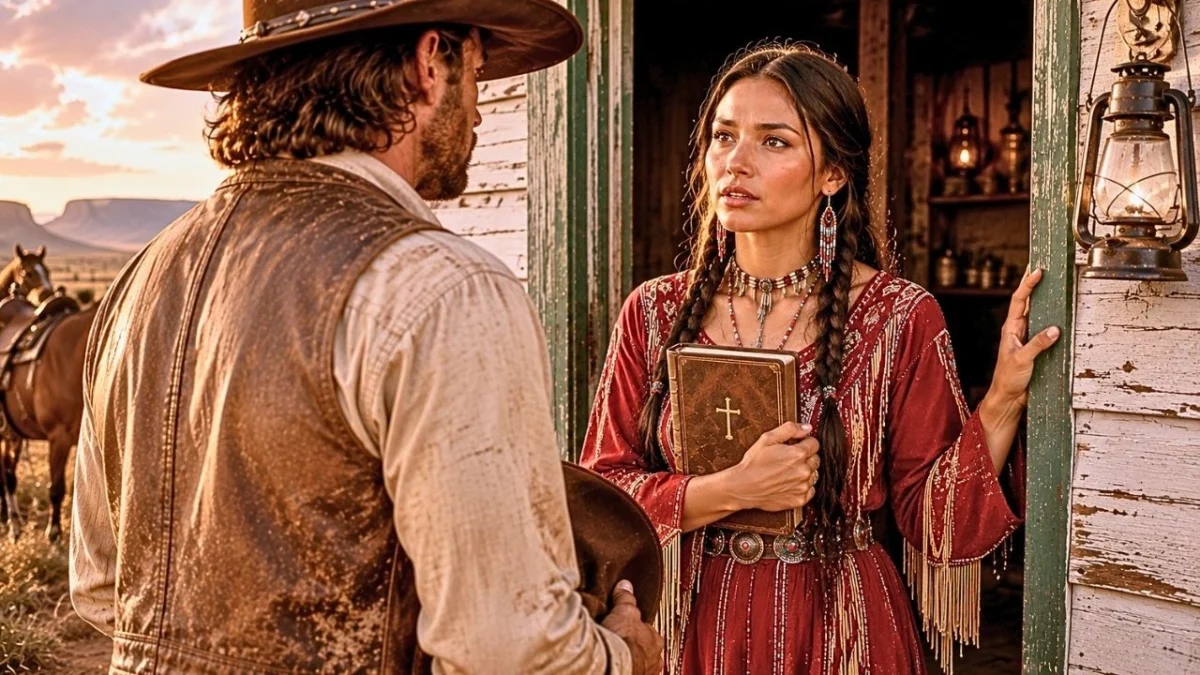
He dismounted, tied his horse, and removed his hat out of habit before walking up to the porch.
When Cal knocked, the heavy green door swung open.
The woman standing in the doorway was not the stooped, graying widow Cal had pictured during his long ride.
She was twenty-seven years old, a Mescalero Apache woman named Naomi Blackmore.
Her dark hair was pulled back with a soft leather strap, and she wore a neat calico blouse, a wide tiered skirt, a leather belt adorned with silver discs, and high moccasin boots.
In her left hand, she held a Winchester rifle loosely at her side, while her right hand held a closed Bible, her thumb keeping her place between the pages.
She looked at Cal calmly, reading his face without fear or hostility.
Cal stood under the midday sun, holding his hat in both hands, and began the pitch he had practiced for four days.
“Ma’am, I heard you might be needing a hand,” Cal said smoothly.
“I’m a hard worker, good with cattle, better with horses, and I can shoe…”
Naomi cut him off softly before he could finish.
“I’ve been praying for you for two months,” she said.
Cal froze, the remaining words evaporating instantly as he stared at her.
“Ma’am?” he managed to ask.
“Two months and four days,” Naomi clarified calmly.
Her dark eyes swept over him, settling with quiet certainty.
“You took your hat off before you reached the porch,” she observed.
“You told me you don’t drink before I had the chance to ask, and when I told you I was praying for you, you didn’t laugh.”
She stepped back into the doorway and leaned her Winchester against the interior wall, leaving the weapon completely out of her reach.
“Come inside,” Naomi said.
“I’ll explain it to you, as you look like a man who has ridden a long way to hear it.”
PART 2: THE LEDGER AND THE CONTESTED PATENT
Cal followed Naomi into a dim, cool kitchen that smelled faintly of coffee, mesquite smoke, and clean pine.
On the center table lay two items placed side by side: a closed Bible and an open accounting ledger.
Naomi poured two tin cups of dark coffee without asking, set one in front of Cal, and took a seat across from him.
“My name is Naomi Blackmore,” she said plainly.
“My grandmother gave me another name in our language when I was young—She Waits For Rain—but here I go by Naomi.”
She paused, resting her palm flat against the surface of the open ledger.
“My husband was Thomas Blackmore,” she continued.
“He was thirty-four years old when he died fourteen months ago, thrown from his horse on the west fence line during an April storm.”
Naomi outlined the ranch’s assets and debts with steady, practiced composure.
The property consisted of two hundred and forty patented acres, Blackmore Spring, seventy head of beef cattle, three horses, a milk cow, and a sturdy adobe house.
However, there was an unpaid bank note at the Concho Wells Cattleman’s Bank for eighteen hundred and forty dollars at twelve percent interest, due in just sixty-one days.
Thomas had borrowed the money to build fences, sink a second well, and purchase additional stock, expecting cattle prices to rise.
Instead, beef prices collapsed, leaving the estate heavily burdened.
Cal pulled the ledger toward himself and studied the numbers carefully.
While reading words was slow and difficult for him, numbers were clear and immediate.
He could see instantly that selling the cattle would not cover the full debt, and even if it did, it would leave Naomi without an income or livestock to survive the coming winter.
“Teague at the bank won’t extend the note,” Cal noted quietly, tapping the column.
“He won’t,” Naomi agreed without looking down.
“Mr. Teague came out here himself, sat in that very chair, drank my coffee, and explained that a woman running a ranch alone is a risk the bank cannot carry.”
“He was very polite about it, and he meant every word,” she added.
Cal reached into his pocket, retrieved the folded paper from the gate, and laid it on the table between them.
“Merritt Ror left this,” Cal said.
Naomi glanced at the paper without picking it up.
“He owns twelve sections west of here,” she explained.
“He offered to buy this place twice after Thomas died, and both times I told him no.”
“Yesterday he had his men nail that offer to my gate, and they rode back this morning to see if it was still standing.”
“I passed them on my way in,” Cal said.
He leaned forward, looking closely at Naomi.
“Ma’am, I’ll be honest with you,” Cal said plainly.
“This outfit needs a full crew, a strong market, and two good years to get square.”
“You have sixty-one days.”
“I can work harder than any two men you hire in town, but my labor alone won’t add up to eighteen hundred and forty dollars.”
“No,” Naomi agreed, pulling the ledger back and closing it.
“It won’t.”
“Then what am I here for?” Cal asked.
Naomi reached beneath the closed ledger and retrieved a second document, folded into thirds and stamped with an official Land Office seal.
She slid it across the wooden table to Cal.
“You think this is just about an unpaid bank note?” Naomi asked softly.
“The note is merely a knife someone is holding; this paper is the hand behind it.”
Cal leaned over the document, but the complex legal wording quickly began to blur before his eyes.
Noticing his struggle, Naomi did not take the paper back or comment on his reading.
Instead, she began reading the contents aloud in the same calm, steady tone she used for counting cattle.
The document was an adverse claim filed against Naomi’s land patent by Merritt Ror’s legal counsel in Santa Fe.
The claim argued that Naomi’s ownership of the land was fundamentally invalid under territorial law.
Naomi had married Thomas Blackmore in June of 1885 in the small chapel down the wagon road, in a ceremony performed by a traveling circuit preacher named Josephus Tras.
Under federal law, a Native woman who married a United States citizen automatically gained citizenship herself, allowing her to legally hold and inherit patented land.
However, Ror’s attorney alleged that the marriage had never been properly recorded in the county courthouse vault.
Preacher Tras had kept his own private record book, but he had passed away in 1886, and his record book was destroyed when the chapel burned down two years ago.
Without a formal marriage license on file, Ror claimed the marriage was legally non-existent, meaning Naomi was never a citizen and had no legal right to inherit her husband’s land.
If the patent was declared void, the ranch would revert to open public land, allowing Ror—as the first applicant in line—to claim the property and its vital water source.
Cal looked out the kitchen window, picturing the charred timbers of the chapel he had passed earlier that morning.
“They aren’t just trying to take your land, ma’am,” Cal realized grimly.
“They don’t mean to take just the ranch, Mr. Harrow,” Naomi said, her voice remaining perfectly steady.
“They mean to prove I was never anybody’s wife.”
“They want to establish that I buried a man I had no right to bury, and that for fourteen months I have been mourning a marriage that legally never happened.”
Cal looked down at his calloused hands, deeply troubled by the cruel precision of the legal trap.
“How do you fight something like that?” Cal asked quietly.
Naomi stood up, walked over to the stove, and picked up the coffee pot.
“Fighting Ror and the bank in court will leave me landless and broke,” she said.
“Taking his offer means walking away with cash, but giving up everything Thomas and I built.”
She turned back to face him, setting the pot down.
“There is only one legal door left open,” Naomi said directly.
“I need a husband more than I need a hired hand.”
Cal stared at her, completely silent.
“Before I ever let word out in town that I was looking for help, I got down on my knees on this kitchen floor,” Naomi told him.
“I asked the Lord for a husband—not a wealthy man, nor a young one, but an honest, working man who would knock before entering, take his hat off, and not mock my faith.”
“You don’t know me, ma’am,” Cal said softly.
“I know four key things about you,” Naomi replied calmly.
“I learned them before you finished your very first sentence.”
She tapped her finger on the table, listing them one by one.
“Your hat, your lack of drinking, your prayers, and the fourth thing…” She paused, looking at him with absolute sincerity.
“You couldn’t read that paper easily, and you didn’t pretend that you could.”
PART 3: THE TERMS AND THE SIX-MONTH COVENANT
Naomi reached back inside the ledger and pulled out a neatly handwritten sheet of paper, laying it directly in front of Cal.
“Here are my terms,” Naomi said.
“I wrote them out clearly so you can hold them in your hands and read them yourself.”
Cal looked down at the four lines written in clear, simple penmanship that was easy for his eyes to follow.
“First,” Naomi explained, “you receive a real home—a place where your work gives you a standing, and a roof over your head that you won’t have to leave when the seasons change.”
“Second, thirty dollars a month in wages, deferred until we refinance the bank note, paid in full with complete records kept in the ledger.”
“Third, a fair share in the increase of the cattle herd, and a real voice in how this ranch is managed.”
“Fourth,” she continued, “the term of this agreement is exactly six months, expiring on the first day of October.”
“If on that day you decide to ride away, I will pay every dollar owed, give you a good horse from my string, and wish you well without any hard feelings.”
Cal studied the paper carefully, taking in every word.
“In return,” Naomi stated, “I need your name on the bank papers and your name beside mine on a fresh marriage license.”
“We will go to the county courthouse in town, sign the license before the clerk, and file it in the official vault where no fire can ever destroy it.”
Cal looked up from the paper, processing the offer.
“You’re proposing a business arrangement,” Cal observed quietly.
“I am proposing a marriage that begins as a business arrangement,” Naomi answered directly.
“What it becomes after that is up to us and up to God.”
“On the first of October, you are completely free to leave if you choose,” she added.
“And if you choose to stay, we will write new terms together.”
Cal set the paper down on the pine table, looking deeply into her dark eyes.
“There was someone else before me, wasn’t there?” Cal asked, noticing how thoroughly prepared she was.
Naomi’s chin lifted slightly as she nodded.
“Dell Mercer,” she revealed.
“Three weeks ago he stood on that same porch with his hat in his hand.”
“What happened?” Cal asked.
“He heard the word marriage,” Naomi replied coolly.
“And before we had set a date or walked the property, he wanted to know how the creek rights would be registered.”
“He suggested it would be ‘cleaner’ if the water rights were recorded solely in his name.”
“And you sent him away,” Cal said.
“I sent him down the road,” Naomi said firmly.
“I asked the Lord for a partner, and He sent me a man who only wanted my water.”
“I have enough sense to recognize a wrong answer when it takes its hat off on my porch.”
Naomi stood up from the table and picked up her Bible.
“You have until tomorrow morning to consider it,” she told Cal calmly.
“The bunk in the barn is clean, there is hot stew on the stove, and hay in the second corral for your horse.”
“Take the night, rest, and pray on it.”
She walked toward the living room door, stopping briefly at the threshold to look back at him.
“I have found the Lord far more helpful in these decisions than my own worrying,” she added softly before stepping through the door.
Left alone in the quiet kitchen, Cal sat at the table for a long time.
He looked at the closed ledger, the official Land Office papers, and the four clear lines of Naomi’s proposal.
Outside, the evening wind blew softly across the valley, rustling through the green leaves of the cottonwood trees along the running creek.
Cal picked up the handwritten agreement, folded it carefully, and placed it inside his shirt pocket right beside the paper he had pulled off the gate.
For the first time in many years, the heavy stone in his boot felt a little lighter, and the long road behind him seemed to finally come to an end.








