“I Have Nowhere Left to Go”—The Lonely Rancher Offered His Mail-Order Bride Shelter for One Night…
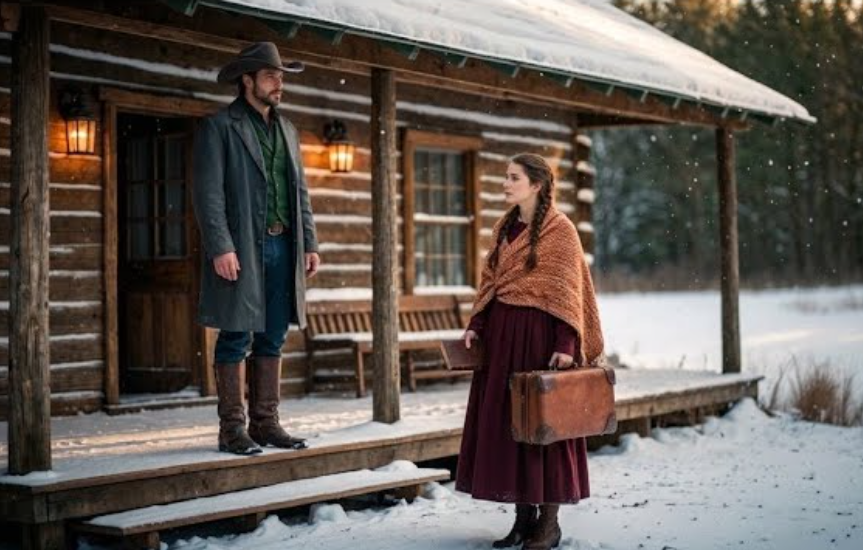
The first thing Elias Granger saw that night was not the woman standing beside his stove.
It was the trail of tiny, shallow footprints leading through his cabin door, melted slightly by the heat inside, as if someone had walked straight out of the dead of winter and into his lonely life.
Montana Territory was entirely buried beneath a white silence during the brutal winter of 1887.
Snow clung to the pine branches and drifted against the rough-hewn log walls of the ranch, sealing off the world beyond the ridge.
At thirty-two, Elias Granger was a man carved from the same hard earth as his land.
He had spent the entire day in the freezing wind, repairing frozen water pipes near the creek so his cattle wouldn’t perish in the deep freeze.
By the time he trudged back up the hill toward his cabin, pitch darkness had swallowed the surrounding hills.
His boots crunched heavily through the deep powder on the porch steps.
He pushed open the heavy wooden door, holding an oil lamp in his left hand and his repeating rifle in his right, ready for a stray wolf or a desperate thief.
Then he stopped cold on the threshold.
A chair near the hearth had been knocked onto its side.
A few tin dishes lay scattered across the floor near the rough oak table.
Beside the cast-iron stove stood a young woman, shivering so violently that her breath came in short, jagged gasps.
Her traveling dress was soaked through with melted snow, stained with dark trail mud around the hem, and her lips were painted a dangerous, pale blue by the biting frost.
She was twenty-four-year-old Annabeth Moore, a mail-order bride who had spent her last savings on a train ticket west, expecting a prospective husband to meet her at the station in Galloway.
When the train had rattled away into the blizzard, no one had been waiting on the platform.
She had wandered onto an unfamiliar, snow-covered road, following the faint glow of Elias’s cabin window through the blinding storm until her feet had lost all feeling.
“Please don’t shoot,” she whispered, her voice barely audible above the howling wind outside.
Elias lowered the muzzle of his rifle slightly, his dark eyes narrowing as the lamplight flickered across her face.
“Who are you?” he demanded, his voice thick with the gravel of disuse.
She swallowed hard, clutching her wet cloak tightly against her chest.
“My name is Annabeth. Annabeth Moore.”
“How did you get in here?”
“The latch was loose. I knocked, but no one answered. I thought this place was abandoned.”
“It isn’t.”
“I know. I am sorry about the dishes. I stumbled in the dark.”
She took a shaky breath, her eyes pleading with him in the dim yellow light.
“I have nowhere else to go.”
Those seven words hit Elias harder than any bullet could have.
He had lived in total solitude since his wife had passed away two winters earlier.
He had grown accustomed to the heavy silence of the valley, cold meals eaten in haste, empty chairs, and long, quiet evenings beside a fire that warmed only one person.
Yet now, a shivering stranger stood in his kitchen, trembling beneath a thin wool dress that offered no real protection against a Montana blizzard.
Elias set his oil lamp on the table and leaned his rifle securely against the log wall.
He walked over to his wooden chest, pulled out a heavy wool blanket, and stepped toward her.
“You won’t freeze here,” he said plainly.
He draped the thick blanket around her shoulders.
Annabeth flinched slightly at his sudden proximity, but as the dry wool settled over her cold skin, she let out a long, shaky breath.
Elias moved past her without another word, throwing two thick logs into the belly of the stove and placing a kettle of water directly over the flames.
Annabeth sank slowly onto a wooden bench near the hearth, wrapping her raw, trembling hands around a tin cup of warm water he handed her a few minutes later.
“Where were you trying to go?” Elias asked, standing near the table with his arms crossed over his chest.
“To a ranch near Bitter Hollow,” Annabeth replied, staring into the steam rising from her cup.
“A Denver placement agency arranged a marriage for me with a man named William Vance.”
Elias frowned, his brow furrowing beneath his dark hair.
“Vance left the territory three months ago. Packed his wagon and headed south toward Wyoming.”
Annabeth looked up, her blue eyes wide with shock and quiet despair.
“He left?”
“Aye. The land was poor and he was deep in debt.”
“The agency took my last fifty dollars. They assured me he was waiting for me at the Galloway depot.”
“Agencies lie to get the fee. The town marshal could have told you that much if he was at the station.”
“The station was locked when the train dropped me off. There was no one around except the wind.”
Elias looked down at her hands, which were bruised, red, and raw from gripping her carpetbag through miles of freezing snow.
“You walked all the way from the stage road in this storm?”
“I had to keep moving. I knew if I sat down in the snow, I wouldn’t get back up.”
Elias turned toward the small frost-covered windowpane.
Outside, the wind screamed through the valley, completely erasing the tiny footprints she had left across his yard.
“You can stay tonight,” Elias said, his tone flat but firm.
“When the storm breaks, I’ll hitch the team and take you into town.”
Annabeth stared at him, as though she had fully expected him to point toward the door and send her back out into the dark.
“Thank you, Mr…?”
“Granger. Elias Granger.”
“Thank you, Mr. Granger.”
Instead of retreating to his bed, Elias took off his heavy winter coat and hung it on a peg near the door.
He gathered what few provisions remained in his meager pantry—a slab of salt pork, some dried beans, and a small sack of flour.
Annabeth watched him for a moment before pushing her blanket back and standing up from the bench.
“Let me help you,” she said softly.
“You’re exhausted,” Elias noted, not looking back.
“I am, but I can still peel potatoes or stir a pot. I won’t sit here like a guest when you’ve given me your fire.”
Elias handed her a small paring knife and a wooden bowl of winter potatoes without arguing.
For the first time in two long years, the quiet cabin filled with the sounds of two people working side by side.
The rhythmic scraping of the blade, the sizzle of fat in the iron skillet, and the soft rustle of skirts created a rhythm that felt foreign yet strangely comforting to the quiet rancher.
They ate their meal in mostly silent companionship, listening to the gale howl against the timber roof.
When the meal was finished, Annabeth insisted on washing the tin plates with the remaining hot water from the kettle.
Later that night, after he had made up a simple bed for her near the warm stove using his spare blankets, Elias sat up in his ladder-back chair by the table.
He kept his eyes on the dying embers through the grate.
He told himself this was merely an act of basic human mercy, a single night’s shelter for a lost traveler.
She would leave in the morning, the road would clear, and his life would return to its predictable, silent routine.
Yet as he listened to her quiet, rhythmic breathing from across the room, Elias knew in his heart that something inside his isolated world had already shifted.
Morning arrived, but the blizzard showed no signs of mercy.
A thick wall of white snow had drifted halfway up the cabin door, sealing them in completely.
Elias was up before dawn, hauling heavy pine logs from the lean-to and tending to his horses in the drafty barn.
When he stomped his boots clean on the rug and stepped back into the kitchen, he was greeted by the rich smell of brewing coffee.
Two metal cups sat waiting on the scrubbed pine table.
Annabeth was sitting near the lamp, silently mending a wide tear in his heavy flannel work shirt with thread she had found in his sewing kit.
“I hope you don’t mind,” she said, looking up as he pulled off his leather gloves.
“I found the thread in the drawer. I thought I should earn my keep while I’m trapped here.”
Elias poured himself a cup of coffee, letting the heat sink into his calloused fingers.
“You don’t owe me anything, Miss Moore.”
She lowered her eyes, her fingers carefully tying off a knot in the gray thread.
“I’m used to owing people. Back in Saint Louis, after my mother passed, every meal felt like a debt I had to repay to my uncle.”
Elias sat down across from her, taking a slow sip from his cup.
“Well, you’re not in Saint Louis, and I’m not your uncle.”
“No,” she admitted softly, glancing at him with a brief, genuine smile.
“You certainly aren’t.”
For three days, the storm raged unabated across the Montana plains, burying fence posts and turning the wilderness into an impenetrable sea of white.
Inside the small cabin, time moved at a slow, deliberate pace.
They fell into a natural rhythm that required very few words.
Annabeth swept the timber floorboards, mended his work socks, and cooked simple, hearty meals from his stores.
Elias cleared the snow from the barn roof, checked on the cattle near the creek, and split extra firewood until his arms ached.
Neither of them spoke of their pasts right away, yet small, quiet changes began to bloom in the cold cabin.
Elias found himself automatically leaving the warmest chair near the stove vacant for her whenever he came inside.
Annabeth began saving the strongest, fresh portion of the morning coffee for his cup.
On the afternoon of the fourth day, Elias returned from the yard with a deep gash across the palm of his right hand, sustained while wrestling a stubborn log from beneath the frozen snow drift.
Blood dripped onto the floorboards before he could wrap his handkerchief around it.
Annabeth immediately set aside her sewing, brought a basin of clean warm water to the table, and motioned for him to sit down.
“Sit,” she instructed, her voice firm with quiet authority.
“It’s just a scratch,” Elias grunted, though he sat down nonetheless.
“It is a deep cut, Mr. Granger, and if it festers out here, you won’t be able to hold an axe for a month.”
She carefully washed the blood from his rough, weathered skin.
Her touch was remarkably gentle, despite the coldness of her own hands.
“You should have been more careful,” she murmured, dipping a piece of clean linen into the water.
“It’s nothing,” Elias repeated stubbornly.
Annabeth looked up, meeting his eyes from only a few inches away.
“Men always say that when something hurts.”
Elias felt a subtle tug at the corners of his mouth, a sensation he hadn’t experienced in years.
“And women always notice anyway,” he countered.
Annabeth let out a soft laugh that seemed to lighten the heavy air in the cabin.
She bandaged his hand securely, tying a neat knot near his wrist.
That evening, moved by a sudden impulse he didn’t quite understand, Elias reached into a dark cabinet above the hearth and pulled out a small, dusty metal tin.
He brought it to the table and opened the lid, revealing a handful of carefully dried wilderness mushrooms he had harvested years ago.
Annabeth stared at them in surprise.
“You saved those?”
“I gathered them along the creek bank three summers ago,” Elias explained, tossing a handful into the boiling stew pot.
“I was keeping them for a special winter.”
He paused, looking directly at her in the dim lamplight.
“I suppose this qualifies.”
As they ate their dinner by the yellow glow of the oil lamp, the silence between them felt less like a wall and more like a bridge.
“Who was he?” Elias asked quietly, breaking the silence as he set his tin plate down.
“The man who made you want to come all the way out here?”
Annabeth looked down at her lap, her fingers tracing the edge of her napkin.
“His name was James. We grew up on the same street in Saint Louis. He enlisted in the Union Army when the war broke out.”
“Did he promise to come back?”
“He did. He wrote to me every week for two years. Then the letters stopped after Gettysburg.”
She reached into her pocket and pulled out a worn, folded slip of yellowed paper, placing it gently on the table.
“I kept his last letter for twelve years, hoping there had been a mistake, that he was simply lost or unable to travel. But deep down, I knew.”
Elias stared at the faded handwriting on the paper.
“I was at Gettysburg,” Elias said softly, his voice dropping an octave.
Annabeth looked up, surprised.
“You were?”
“Second Montana infantry. I was on the ridge when the artillery started. I came back with a hip that aches when it rains and memories I try not to think about.”
He reached into his pocket, pulled out a small leather-bound tintype portrait, and set it beside her faded letter.
The image showed a sweet-faced young woman with light hair, smiling timidly at the camera.
“Her name was Sarah,” Elias murmured.
“She died of scarlet fever two winters ago. The snow was so deep I couldn’t even dig a proper grave until spring. I buried her under the big pine near the creek.”
He looked at the portrait, then at Annabeth.
“I thought I’d never sit across from another woman in this house again.”
Annabeth reached out and carefully adjusted her old letter so it lay side by side with Sarah’s portrait, neither overlapping the other.
She wasn’t trying to erase the woman who had shared his life; she was simply placing her own heartbreak beside his, recognizing the shared burden they both carried.
Elias looked at the two items sitting on the rough wood, understanding her silent gesture completely.
On the fifth morning, the dark clouds finally broke, revealing a brilliant, pale blue sky over the glistening white landscape.
The wind had died down, leaving a heavy, pristine silence over the valley.
Elias hitched his heavy gray mule to the wooden sled, cleared a path through the main drift, and helped Annabeth climb onto the bench, wrapping two thick bison robes around her knees.
They made the long, arduous trek through the deep snow into the small town of Galloway by mid-afternoon.
The town was slowly digging itself out from the storm, with shopkeepers shoveling boardwalks and smoke rising straight up from chimneys into the clear air.
Elias led her into the small timber church at the end of Main Street, seeking the counsel of Pastor Thomas, a kind, elderly man who managed the local charity registry.
Elias asked the pastor if there was any record of a William Vance or a home for Annabeth until she could secure passage back east.
Pastor Thomas searched through his dusty ledger, shaking his head slowly.
“William Vance left in November, son,” the pastor said softly.
“He left no forwarding address, and he certainly didn’t pay for any mail-order bride through the Galloway office.”
As they stood in the drafty foyer of the church, a few local townspeople gathered near the door, whispering among themselves.
A stout woman with a wool shawl glared at Annabeth, her voice carrying across the small room.
“Must be one of those rejected women from the city,” the woman muttered to her companion.
“Traveled all this way for a man who didn’t even want her. Probably got abandoned for a good reason.”
Annabeth’s face flushed bright red, a profound wave of humiliation washing over her features.
She lowered her head, bit her lower lip, and turned abruptly toward the exit, her boots clicking hurriedly against the floorboards.
Elias’s eyes hardened as he glanced at the gossiping women, but he said nothing to them.
He turned on his heel and followed Annabeth out into the crisp winter air.
He found her standing beside the sled, her shoulders shaking slightly as she tried to fight back tears.
“I’m not who they think I am,” she whispered, her voice cracking as he reached her side.
“I am not a disgraced woman, Mr. Granger. I came here honestly, believing I was going to build a proper life.”
“I know,” Elias answered, his voice steady and remarkably warm.
“I know who you are.”
She lifted her head, looking up at him through tear-filled eyes.
“Then what am I supposed to do now? My money is gone. The agency won’t refund me, and there is no train back east until the spring thaw.”
Elias looked past the town rooftops toward the dark mountain peaks, where another slate-gray storm front was already beginning to gather on the horizon.
“Come back with me,” he said.
Annabeth blinked, startled by the invitation.
“Why?” she asked softly.
Elias looked down into her eyes, his expression completely earnest.
“Because you don’t have to face another night alone in a place that doesn’t know your worth.”
Annabeth stared at him for a long moment, searching his weathered face for any sign of pity or hesitation.
Finding none, she took a slow breath, wiped her eyes with the corner of her shawl, and stepped toward the sled.
“Alright,” she whispered.
“I’ll come back.”
They climbed onto the wooden bench together and turned the mule back toward the isolated valley, neither of them fully realizing how profoundly that decision would rewrite their futures.
When Elias and Annabeth returned to the ranch that evening, the cabin looked exactly as it had when they had left it that morning, yet the coldness that had defined the timber walls for two years seemed entirely gone.
Annabeth carried her small traveling bag back inside and set it down in the corner beside the stove, no longer treating it as a temporary burden.
Elias brought in an extra armload of seasoned pine, stacking it neatly near the hearth, and cleared a set of wooden shelves near the window for her few personal belongings.
Neither of them called the cabin a home—not yet.
But both of them understood that the unspoken boundary between stranger and host had dissolved during the cold ride back from town.
Over the next few weeks, Annabeth transformed the interior of the cabin through small, quiet acts of care.
She scrubbed the floorboards until the grain showed bright and clean, mended the heavy wool blankets, and turned his sparse, basic rations into flavorful meals that filled the room with inviting aromas.
One morning, using a handful of cornmeal, a dash of sugar, salt, and lard, she baked a fresh skillet of golden cornbread over the coals.
Elias took his first bite, pausing as the warm, buttery taste registered.
“My wife used to make something like this,” he said quietly, looking down at the piece in his hand.
Annabeth offered him a gentle, reassuring smile from across the table.
“Then perhaps you needed to remember what it tasted like.”
Elias looked at her for several long seconds, feeling a strange tightness in his chest that wasn’t born of grief, before slowly nodding his head.
“Perhaps I did,” he agreed.
Their affection did not bloom through grand declarations or dramatic gestures.
It grew quietly in the rhythm of their daily survival.
It lived in the shared meals eaten beside the crackling fire, the neatly patched sleeves of his flannel shirts, the quiet smiles exchanged across the small room, and the way Elias always made sure her blankets were pulled tight against the drafts before he lay down on his narrow cot by the wall.
Then, on a bitterly cold afternoon in mid-February, a frantic knocking echoed against the cabin door.
Elias pulled open the latch to find a young, frightened orphan girl named Molly standing on the porch, wrapped in a threadbare coat and holding an empty wooden bucket.
“Mr. Granger,” the girl gasped, her teeth chattering violently.
“Our stove went out at the cabin down the ridge, and Mr. Higgins sent me to ask if you had any dry kindling to spare.”
Annabeth didn’t hesitate for a single second.
She immediately ushered the child inside, wrapped her own warm shawl around the girl’s shivering shoulders, and placed a thick piece of fresh cornbread into her cold hands.
While the girl ate eagerly near the stove, Elias went out to the lean-to and filled her bucket to the brim with seasoned pine kindling and a heavy oak log.
He walked the child safely back to the edge of the Higgins property, ensuring she made it inside safely.
When Elias returned and hung his coat on the peg, Annabeth was watching him from the hearth with a soft, thoughtful expression.
“You could have turned her away,” she noted softly.
“You barely have enough wood to last through March yourself.”
Elias shook his head, pouring himself a cup of water.
“I know what it means to have an empty place waiting for you in the cold. I won’t let a child freeze if I have a log to spare.”
Annabeth looked at him, realizing in that quiet moment that the stern, guarded rancher who had held a rifle on her five weeks ago possessed a depth of kindness he simply had never known how to voice.
That evening, as the wind rattled the windowpanes, Elias prepared her small bed near the stove as he did every night.
He smoothed the heavy wool blanket over the mattress, then paused.
He stood up, turned around, and looked down at her.
“Annabeth,” he said, his voice surprisingly thick.
She raised her eyes from her mending, sensing the sudden shift in the room.
“Yes, Elias?”
“You don’t have to leave when spring comes,” he said plainly.
Annabeth’s heart seemed to stop in her chest.
She slowly set her needle and thread down on the table, her breath catching.
“What are you asking me, Elias?”
Elias stepped closer, stopping just short of the table, keeping a respectful distance between them.
“I’m asking if you would choose to stay. Not as a guest, and not because you have nowhere else to go. I’m asking if you would stay here with me. As my wife.”
Annabeth felt tears spring to her eyes, blurring the warm yellow light of the oil lamp.
“You barely knew me when you opened that door,” she whispered, her voice trembling.
“You took in a shivering stranger off the porch.”
Elias offered a faint, tender smile, the lines around his dark eyes softening completely.
“You were freezing,” he said gently.
“That was enough reason to open the door.”
She shook her head slowly, a tear spilling over her lash and tracing a path down her cheek.
“And now?”
Elias looked around the small timber cabin—at the scrubbed table, the neatly stacked firewood, the mended clothes hanging near the stove, and finally back into her clear blue eyes.
“Now I know you,” he said softly.
“And this house isn’t empty anymore.”
The silence that settled between them was warmer than the roaring fire in the iron stove.
Annabeth reached across the small distance separating them and extended her hand toward him.
Elias looked down at her small, smooth fingers, then reached out with his rough, scarred palm and took her hand in his, closing his fingers gently around hers.
Outside the cabin walls, the icy Montana wind continued to howl across the endless, snow-covered plains, burying the wild frontier in a relentless freeze.
But inside the little log home beneath the mountain ridge, neither of them felt the cold, and neither of them was ever lonely again.
Elias Granger had opened his door on a desperate, frozen night merely to shelter a lost soul from the storm, never dreaming that the broken woman who stumbled across his threshold would be the very person to bring his buried heart back to life.
And Annabeth Moore had arrived in the West believing she was a forgotten, rejected bride with no place in the world, only to discover a quiet, honest man who recognized her true worth long before she could see it in herself.
The small cabin, which had once been filled only with grief, cold meals, and lingering memories of the past, became a sanctuary where two wounded hearts could finally leave their sorrows behind and begin their lives anew.








