I Helped an Old Stranger Lift His Trunk… Then He Smiled: “My Daughter Needs a Man Like You”
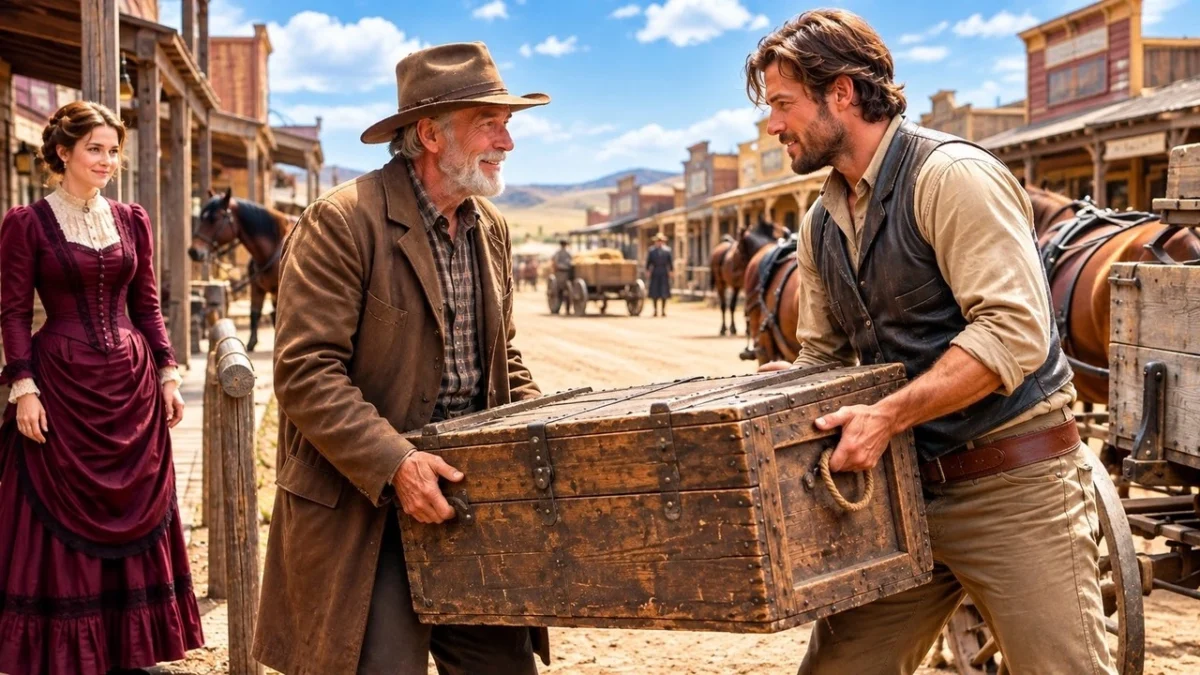
Nobody in Copperbend, Kansas was watching the morning Damon Kirby walked off the wooden sidewalk to help an old man with a heavy oak trunk.
That was the whole point, as it turned out later, though Damon himself knew nothing of it at the time.
At thirty-eight years old and exactly three days into a dusty prairie town where he didn’t know a single soul, Damon was only thinking about the sheer weight of iron-bound oak.
The trunk had slid halfway off the bed of a battered farm wagon, and the old man holding it was leaning back against the strain with the white-knuckled grip of someone who knew he had miscalculated his strength and had run out of good options.
Damon crossed the dry dirt street without pausing.
“Let me get the other end,” Damon said quietly, stepping up alongside the rear wheel.
Together, they heaved the chest back into the center of the wagon bed.
Damon looked at the rest of the load—two heavy grain sacks and a coiled spool of rusted fence wire—and, without waiting to be asked, he hoisted the first sack over his shoulder and dropped it inside.
“Didn’t ask for that,” the old man noted, wiping sweat from his forehead with the back of a calloused hand.
“I know,” Damon replied, already reaching for the second sack. “It goes easier when it’s done.”
They sorted the wagon in under eight minutes.
When the work was finished, the old man stood back, dusted off his canvas trousers, and turned his full attention to Damon.
He had steady gray eyes that held the particular, sharp quality of someone who had spent decades observing human nature and had gotten remarkably efficient at reading it.
Then he smiled—not the light, polite smile of a stranger offering customary thanks, but the slow, deliberate curve of a man who had just settled an important question in his own mind.
“Milton Reeves,” he said, extending a hand that felt like seasoned hickory. “I’ve got a farm three miles southeast of town. Barn needs a steady carpenter’s hand if you’re looking for honest work.”
Damon shook his hand firmly. “Damon Kirby. I’ll take the job.”
Milton nodded once, climbed onto the wooden wagon seat, and gathered the leather reins.
He paused just before clicking to his team, halting in the distinct way of a man who had almost forgotten to deliver his most vital piece of news.
“One more thing,” Milton said, looking down from the wagon bench. “My daughter could use a man who thinks the way you do.”
Damon looked up, caught entirely off guard. “What’s that supposed to mean?”
Milton looked back down with those quiet gray eyes, which were now holding an expression that was not quite a full smile, but contained everything that usually came right before one.
“It means what it means, son,” Milton said softly.
He clicked his tongue, the horse pulled forward, and the wooden wheels began to churn up dust along the trail.
Damon stood alone in the middle of Main Street, holding that lingering sentence like an unfamiliar tool he hadn’t yet learned how to operate.
He had been in Copperbend for three days, living out of a canvas carpetbag.
He had helped a stranger fix his wagon simply because the trunk was falling and nobody else was moving to stop it.
Now that stranger was driving out of town, having casually announced that his daughter needed a man who possessed his specific brand of quiet initiative.
Damon didn’t know the daughter.
He had no idea what Milton Reeves’s thirty-second judgment of his character was actually worth.
He only knew that the barn repair meant fair wages, and his meager traveling money was running low.
He turned and walked back toward the local boardinghouse to pack his tools, turning the old man’s cryptic words over in his mind with every step.
—
Milton Reeves had been watching for a suitable partner for his daughter, Louisa, for nearly two years.
If pressed on the matter by inquisitive neighbors, he would clarify immediately that it was not because he believed Louisa was incapable of standing on her own feet.
Louisa Reeves was twenty-seven years old, ran the telegraph office at the Copperbend post station with precise efficiency, and possessed more firm opinions per square foot than anyone else in the entire county.
She was entirely capable of managing her own life, her own finances, and her own future.
Milton was trying to intervene simply because she was lonely, with a deep and quiet solitude that only a parent could truly recognize.
He saw it not in anything she complained about, but in the specific atmosphere of Sunday evenings when she meticulously set the dining table for two, only to sit silently beside her plate without touching her food for long stretches of time.
He had known that exact brand of silence after his wife passed away fifteen years ago, and he recognized its weight from the inside out.
His previous attempts to introduce prospective suitors had ended in absolute disaster.
The first candidate, a prosperous young land clerk from the county seat, had mentioned over Sunday dinner that operating a telegraph key was “quite a charming little occupation for a woman in her delicate situation.”
Louisa had quietly set her fork down, thanked him politely for his presence, and firmly suggested he find his way to the front door before dessert was served.
The second man, a well-regarded livestock merchant, had casually informed her that she was “surprisingly clever for a girl her age.”
Louisa had studied him with cool, unblinking grey eyes for a long moment before replying, “What an exceptionally kind thing for you to say,” using a precise tone of voice that Milton knew meant all civilized communication was permanently over.
After those failures, Milton had completely abandoned the idea of looking for someone impressive, wealthy, or glib.
He began searching for something far rarer: a man who didn’t look around to see who was watching before he did the right thing.
That was the only test that mattered in his eyes.
As he guided his wagon down the dirt road toward his southeast pasture, Milton smiled to himself, thinking there was certainly no harm in placing a good man within her sphere of vision so she could make up her own mind.
The ultimate decision belonged entirely to her, but arranging the introduction was well within a father’s purview.
—
Damon arrived at the Reeves farm early the following Monday morning just as the sun was beginning to warm the horizon.
Milton had given him plain directions on the street: a start time of seven o’clock sharp, the information that the barn’s east wall was the immediate priority, and a casual note that supper was served at six.
He had offered no further comments regarding his daughter, and Damon had eventually convinced himself over the weekend that the old man’s parting remark had merely been the dry, eccentric humor of an old pioneer who liked to stir up subtle trouble.
He decided it was best not to take the comment literally at all.
However, he was forced to re-examine that decision the moment he walked up the kitchen porch steps to collect the morning coffee Milton had promised would be brewing.
The person standing by the cast-iron stove was definitely not Milton Reeves.
She had thick, copper-brown hair pinned back in an orderly twist and bore the focused expression of someone who was mid-thought and thoroughly disliked being interrupted.
She was dressed neatly for her day at the post office, holding a dark blue shawl over her arm.
“You must be the carpenter my father hired,” she said, turning her gaze directly upon him.
“Damon Kirby,” he replied, taking off his hat. “Your father said there’d be coffee ready by seven.”
“There is coffee,” she said, reaching for a porcelain mug and pouring it full with a steady hand. “He mentioned he’d brought in someone to handle the timber work.”
“He mentioned he had a daughter,” Damon said plainspokenly, taking the offered mug.
Louisa paused, her fingers resting lightly on the wooden handle of the coffee pot, and looked at him squarely.
Damon held her gaze without shifting his posture or attempting to display forced charming ease.
He chose to be entirely honest because the only alternative was pretending he hadn’t heard what her father had said on Main Street, and starting a multi-week job built on a pretense felt like an utterly foolish foundation.
“What exactly did my father say to you, Mr. Kirby?” she asked, her voice dropping into a measured, calm register.
“He said his daughter could use a man who thinks the way I do,” Damon answered directly. “He said it the way a person says something they’ve been carrying around in their head for a long time and finally decided to drop on the ground.”
Louisa set the coffee pot down on the stove with a heavy, deliberate clink.
“Mr. Kirby, let me say something to you directly so we do not waste each other’s time.”
“I would prefer that, Miss Reeves,” he said.
“My father means well, but he is not, in fact, being helpful,” she said, her grey eyes cutting straight through the morning quiet. “I am not a problem that needs to be solved, nor am I a vacant position waiting to be filled by the first passing applicant. I am a telegraph operator who earns her own living, lives in this house, and makes her own decisions. I would greatly appreciate being treated accordingly.”
Damon took a small sip of the scalding black coffee, set his hat back onto his head, and nodded once.
“Understood, Miss Reeves,” Damon said calmly. “Thank you for the coffee.”
He turned on his heel and walked straight down the porch steps toward the barn without another word.
Louisa remained standing by the kitchen counter for a long moment, staring out the glass window at his retreating back.
She had prepared herself for an argument, an awkward apology, or at least a patronizing smile—the kind of response she had received from every other man who thought they understood her better than she understood herself.
Instead, he had simply listened, accepted her boundaries without taking offense or offering defensive excuses, and gone straight to his work.
—
The barn required significantly more attention than just its deteriorating east wall.
Damon recognized the structural faults within his first hour of inspecting the post frame.
While the east side was indeed rotting from dampness, the west wall was buckling under the weight of shifting rafters, and the roof section directly over the horse stalls was dangerously compromised.
Instead of patching the obvious spot and taking his quick pay, Damon spent his afternoon taking precise measurements and drafting a complete assessment on a scrap piece of paper.
He waited by the hitching post at dusk until Milton rode in from the south pasture.
“You’ve got more than an east wall problem here, Milton,” Damon said, handing over the hand-written list. “If I only patch the rot on the right, the west side is going to cave in during the first heavy snow this coming winter.”
Milton squinted at the paper in the fading twilight, holding it near his lantern. “You could have just fixed what I asked for, taken your week’s wages, and moved along down the road.”
“I could have,” Damon said evenly. “And you’d be building a brand new barn from the ground up next year. It’s bad work to leave a job half-done.”
“How long to do all of it right?” Milton asked.
“Five weeks, assuming the weather stays dry and I can get the proper yellow pine from the lumber yard.”
Milton slowly folded the paper, slipping it into his canvas coat pocket with the deep, quiet satisfaction of a planner watching a gamble pay off perfectly.
“I’ll pay you for the five weeks,” Milton said. “And you can take your suppers at the table with us.”
Damon leaned against the fence post, looking at the old man closely. “Milton.”
“Yeah?”
“I’m taking this job because the timber needs fixing and the pay is fair,” Damon said, making his tone unmistakably clear. “I’m not staying here for any other reason you might have cooked up in your head.”
Milton looked toward the barn wall, his grey eyes reflecting the warm golden light of the setting sun.
“Understood,” Milton said, echoing the exact word his daughter had used earlier that morning.
He turned toward the house, whistling a light prairie tune as he climbed the porch steps.
Inside, Louisa was sitting at the kitchen table with her official telegraph ledger, meticulously balancing the week’s wire fees under the light of an oil lamp.
“He’s staying on for five full weeks,” Milton announced, hanging his hat on the wall peg.
Louisa did not look up from her numbers. “The barn must be in absolute ruin then.”
“Terrible shape,” Milton replied cheerfully, continuing his light whistling as he headed up the wooden stairs to his room.
—
On Tuesday morning of the second week, Louisa walked out to the barn holding a second mug of hot coffee.
She had told herself in the kitchen that she was only bringing it out because she had accidentally brewed more than enough for breakfast and hated seeing good coffee go to waste.
She set the tin cup down on the sawhorse near where Damon was working.
“There’s extra in the pot if you haven’t had your morning cup yet,” she said, wrapping her wool apron tightly against the crisp morning wind.
Damon paused his drawknife, wiping wood shavings from his leather apron. “I haven’t. I appreciate it, Miss Reeves.”
He was working on replacing the warped cedar siding of the west wall, moving with the fluid, measured efficiency of a man who had earned his living through manual labor for many years and knew how to conserve his energy for the long day ahead.
They stood together in the relative shelter of the doorway, listening to the wind rustle through the nearby corn husks.
“Is the telegraph wire busy today?” Damon asked, taking a sip from the mug.
“It picks up around ten when the train comes through from Topeka,” Louisa said, watching his hand hands work over the timber. “Most people think it’s just dots and dashes, but every operator has their own rhythm. You can tell who is on the other end of the wire just by the cadence of the key.”
“Work is work,” Damon remarked, inspecting the grain of a new board. “The tool doesn’t matter as much as the person holding it. Who does it and how they treat the job is what makes the difference.”
Louisa looked at him closely, her grey eyes searching his face with that sharp, intuitive gaze she had inherited from her father.
“The mug needs to be back in the kitchen before eight,” she said, her tone softening just a fraction. “I have to leave for the station.”
She turned and began walking toward the house, though Damon noticed her pace was noticeably slower than it had been on the first morning.
—
By the end of the second week, the small community of Copperbend had begun to take notice.
Dora Hatfield, who ran the town’s general store and handled the outgoing mail, had observed Damon purchasing supply nails on three separate occasions, which meant the news had circulated to every parlor in town before nightfall.
By Saturday evening, the barber’s wife had constructed a fully detailed narrative regarding the situation at the Reeves homestead.
The gossip suggested that Milton Reeves had deliberately imported a young handyman from out of state to court his stubborn daughter, that the handyman was fully aware of the arrangement, and that Louisa was bound to cause a public scene over it eventually.
Louisa heard a version of this story on Saturday morning from a local woman who presented it under the guise of friendly concern.
She rode her buggy back to the farm immediately, her jaw set firm, and found her father sitting on the front porch cleaning his double-barrel shotgun.
“Dora Hatfield told three separate people before noon today that you hired a carpenter specifically to marry me off,” Louisa said, dropping her gloves onto the porch railing.
Milton blew gently into the wooden stock of his gun. “Barn needed serious work, Louisa.”
“Father.”
Milton stopped wiping the steel and looked up at her. She met his gaze squarely, her hands rested on her hips.
“You have put me in a completely ridiculous position,” she said, her voice tight. “The entire town is watching this house now.”
“The town watches everything that happens on this road,” Milton noted softly. “It’s what small towns do.”
“This is entirely different,” she countered. “If nothing comes of this—which is the absolute most likely outcome—I look like a woman whose father is so desperately worried about her future that he has to hire random men off the street just to get them to talk to her.”
Milton fell silent for a long moment, laying the cleaning rag down across his knee.
“Is that really so terribly far from the truth, Louisa?” he asked softly.
She looked at him sharply, shocked by the sudden vulnerability in his voice. “That isn’t fair.”
“No,” Milton said gently, “it isn’t fair. But it is honest. I know what it is to sit in a quiet house after the day is done.”
They sat together on the porch steps as the Kansas evening slowly settled over the surrounding pasture.
The distant cattle lowed in the far field, and the last autumn sunlight turned the tall prairie grass into a sheet of warm gold.
“He knows what you’re trying to do, you know,” Louisa said finally, her voice dropping its defensive edge.
“I know he does,” Milton replied with a small smile. “And I respect him all the more for calling me out on it.”
Louisa looked out toward the horizon where the sun was dipping below the tree line. “He’s staying for three more weeks to finish the roof.”
“Terrible barn,” Milton repeated softly.
Louisa stood up and walked back inside the house.
She didn’t slam the wooden screen door behind her, an omission that Milton recognized as a sure sign that she was deep in thought rather than genuinely angry.
—
On Wednesday evening of the second week, Louisa walked out onto the back porch to draw a bucket of water from the well and found Damon sitting on the wooden bench.
He was holding a small, leather-bound book, reading by the faint orange light of the fading dusk.
He had his hat resting beside him on the planking, his heavy work boots off, and his sleeves rolled up, looking like a man who had completed a hard day’s labor and found the exact right peaceful way to wrap it up.
She hadn’t pegged him as a reading man.
“What are you reading?” she asked, leaning against the doorframe.
He tilted the cover up so she could see the gilt lettering on the spine: *Far from the Madding Crowd* by Thomas Hardy.
“Hardy,” he said simply. “It’s my second time through it.”
“Is it better the second time?” she inquired, stepping closer.
“It’s different,” Damon explained, setting his thumb between the pages to hold his place. “When you already know what’s coming at the end, you start noticing all the quiet things the characters missed the first time around.”
Louisa walked across the porch and sat down on the empty wooden chair opposite him.
“How on earth did a traveling carpenter in Missouri come across a collection of Thomas Hardy?”
“My mother kept his works on a small shelf by the window,” Damon said quietly. “When she passed away five years ago, my brothers took the farm equipment and the livestock. I asked for the books. I’m fairly certain I got the far better end of that trade.”
Louisa studied his face in the soft twilight. He turned his eyes back down toward the open page, perfectly comfortable in the silence.
She looked down at the volume of poetry she had brought out with her, though she hadn’t opened it once.
“What do you make of Bathsheba Everdene?” Louisa asked suddenly.
Damon considered the question seriously, taking a moment to form his thoughts rather than offering a quick answer.
“I think she spends a tremendous amount of time believing that being admired by people is the exact same thing as being known by them,” Damon said slowly. “And it costs her a great deal of heartache before she finally learns how to tell the difference.”
Louisa held her breath for a brief second, struck by the clarity of his words.
“Some people in town say she simply makes selfish, foolish choices,” Louisa offered.
“I think she makes the only choices she was given,” Damon responded, looking up at her, “until she finally knows herself well enough to demand a better option. I suppose both of those things can be true at the same time.”
Louisa looked out across the south field as the cool night air began to settle in.
“Mr. Kirby,” she said softly.
“Damon,” he corrected gently.
“Damon,” she repeated, tasting the name on her tongue. “What did you intend to do with your life before you ended up stopping in Copperbend?”
Damon rested the book across his knee, looking at the distant fence line.
“Find a place that actually felt like it belonged to me,” he said plainly. “I left Missouri because all that land belonged to my father’s memory, not to me. I wanted to build something with my own hands from the ground up. I just didn’t know what it was supposed to look like yet.”
Louisa looked down at her hands resting in her lap. “I know exactly what mine looks like.”
Damon turned his head toward her. “Do you?”
“It’s the telegraph key in the morning,” she said, her voice filled with a quiet, fierce passion. “The sound of the brass lever ticking as the wire comes alive. The way the early morning sunlight streams through the east window of that small office when the first message comes through from the east, and I’m the only person in this entire county who knows what’s happening in the world for a few seconds.”
She met his gaze directly, offering no apology for her independence. “I know precisely what my life looks like.”
“Yes,” Damon said softly, his dark eyes holding hers without a hint of judgment. “I can see that clearly.”
They sat together on the quiet porch as the evening deepened into night, reading their respective books in an easy, comfortable silence that felt distinctly full rather than empty.
—
On Thursday afternoon of the third week, Milton climbed halfway up the wooden ladder leaning against the barn’s east roof where Damon was hammering new shingles into place.
He rested his elbows on the wooden rung and waited until Damon finished driving a line of iron nails.
“I owe you a proper apology, Damon,” Milton said over the sound of the wind.
Damon didn’t stop his rhythm immediately, setting one last nail before placing his hammer back into his belt loop. “What for?”
“I put you and Louisa both in an unfair position,” Milton said, his gray eyes searching the younger man’s face. “I did it because I saw something in thirty seconds on a Tuesday morning that two full years of looking hadn’t shown me. But seeing what a man is made of doesn’t give an old fool the right to try and manage his daughter’s heart.”
He looked down at the barn framing below them, straight and solid against the Kansas sky. “I was wrong about my authority in this house. I wasn’t wrong about the man, but I was wrong to push.”
Damon wiped his brow with his sleeve and looked down at the older farmer. “What did you actually see, Milton? On the street that morning?”
“I saw a man who didn’t look around to see if anyone was watching him before he moved,” Milton answered plainly. “A man who just crossed the dirt because the trunk was falling and nobody else was stepping up to help. You can’t fake that kind of character, Damon.”
Damon turned his gaze toward the south pasture. “And what did you expect me to do once I got here?”
“I wanted to put a good man close enough for Louisa to make up her own mind,” Milton said honestly. “The rest was always above my pay grade. I knew that when I lied to get you out here, and I owe you both an apology for interfering.”
There was a long silence between them as the prairie wind whistled through the rafters.
“I want to stay,” Damon said quietly.
Milton looked up sharply. “I know you do.”
“She is the most remarkably plainspoken woman I’ve met in three years of traveling,” Damon continued, his voice steady. “She says exactly what she means without wrapping it in false politeness. She reads Thomas Hardy and actually understands what he’s writing about. She knows who she is and she doesn’t apologize to anyone for it.”
He paused, looking at his broad, calloused hands. “I don’t own any land here. I don’t have anything in Copperbend except a barn that’s finally standing straight and two weeks of paid work left.”
Milton reached into his pocket and pulled out a pipe, looking out toward the creek line.
“The old Greer homestead down past the south creek has been sitting empty since the spring,” Milton said casually. “Eighty acres of good bottom land. A man with your timber skills and a willing heart could have those fields producing inside of two seasons.”
Damon stared at him. “Are you offering to back me?”
“That’s all I’m offering,” Milton said, stepping down one rung of the ladder. “What you choose to do with everything else in your life is entirely your own business.”
Milton slid all the way down the ladder and walked toward the house, whistling his familiar tune long before his feet hit the barnyard dirt.
Damon watched the old man walk away, shaking his head with a quiet chuckle.
“You are an entirely impossible man,” Damon muttered to himself, “and you might just be completely right.”
He picked up his hammer and went straight back to work, determined to finish the framing before the sun went down.
—
On Friday afternoon, after the last train had cleared the Copperbend station, Damon walked into the small telegraph office near the tracks.
The room was filled with the warm scent of paper ink, dry pine, and hot metal.
Louisa was sitting behind the low wooden counter, running her brass pen down a ledger page as she balanced the day’s commercial accounts.
“We’re closed for the afternoon, Mr. Kirby,” she said without raising her eyes from the column of figures.
“I know,” Damon said, closing the heavy oak door behind him. “I came here to see you, Louisa.”
Louisa slowly laid her pen across the inkwell and looked up at him. “My father spoke to you again at the barn, didn’t he?”
“He mentioned the Greer place down by the south creek,” Damon said, stepping up to the counter. “And he told me that whatever I decide to do about everything else is entirely my own business.”
Louisa remained still, her grey eyes calm and watchful. “And what, exactly, is ‘everything else’?”
Damon crossed the small room until he was standing directly on the other side of her wooden counter, bathed in the soft afternoon light streaming through the west window.
“I’m going to ask you a question,” Damon said, his voice deep and steady. “And I want you to know before I ask it that your answer won’t change whether I take the Greer farm or not. That decision is already settled.”
“Ask then,” she said softly.
“Will you allow me to court you properly?” Damon asked directly. “Not because your father planned this whole scheme, and not because the town gossips are waiting to see what happens. But because I’ve been in this town for three weeks, and I don’t want to spend the next three years of my life thinking about Thomas Hardy and drinking excellent coffee alone.”
Louisa looked at him for a long, silent moment.
“The coffee really is excellent,” she murmured, a tiny trace of humor touching her lips.
“It is,” Damon agreed, allowing a real, unhurried smile to sweep across his face—the genuine one that reached all the way to his dark eyes. “And you are a woman who says what she means, who knows her own mind, and who built a life she is proud of.”
Louisa looked down at her hands, thinking about the past two years of awkward parlor visits with men who had talked down to her or smiled patronizingly while she spoke.
She thought about this man, who had listened to her boundaries on his very first morning, who had said “Understood,” and who had proven every day since that he respected her words completely.
“Yes,” Louisa said simply, using the same clear, unadorned tone she used for everything that truly mattered.
Damon nodded, his eyes shining with a quiet relief.
“I should warn you,” Louisa added, leaning against the counter, “that my father is going to be utterly insufferable about this.”
“I fully expect he will be,” Damon replied with a chuckle.
“He will tell everyone in the county ‘I told you so’ until he is ninety years old,” she warned.
“Let him,” Damon said softly. “He earned it.”
Louisa looked down at her brass telegraph key, resting her fingers lightly on the cold metal lever.
“Monday morning then,” she said.
“For the barn?” Damon asked.
“For all of it,” she replied.
—
When they walked up the porch steps together that evening, Milton was sitting in his rocking chair holding a cold mug of cider, executing a very poor performance of casual indifference.
Louisa stood at the top step, looking down at her father with her hands folded over her apron.
“Go ahead and say it, Father,” she said.
Milton looked at his daughter, then at Damon, then down at his mug.
“I told you so,” Milton said with a massive, triumphant grin.
“That’s one,” Damon noted dryly.
“Only three hundred and ninety-nine more to go,” Louisa added, stepping past him into the kitchen.
Milton laughed aloud, a rich, happy sound that echoed off the surrounding timber, and followed them inside to set the dinner table.
—
The courtship that followed looked almost nothing like what the residents of Copperbend had anticipated.
The town had expected grand romantic gestures, formal Sunday parlor visits, and dramatic public displays.
Instead, Damon simply finished repairing the Reeves barn during the final week of October, secured his lease on the Greer farm in November, and began appearing at the Reeves dining table every evening with the natural ease of someone who belonged there.
On Sunday afternoons, Damon and Louisa took long walks along the creek bed.
They didn’t walk to be seen by the townspeople, but because they both possessed restless minds that worked best when their feet were moving across open ground.
They talked about the harsh realities of prairie farming, the changing economic climate of Kansas, and what it meant to build a permanent home on land you owned yourself.
They discussed literature with the deep seriousness of two self-educated people who had found a rare equal in one another.
In mid-December, a bitter winter wind swept across the plains.
Damon walked down to the telegraph office on a freezing Wednesday afternoon carrying his wooden toolbox.
He spent an hour quietly repairing a heavy exterior shutter on the east window that had been rattling against its frame since early autumn.
Louisa sat at her desk, taking down an incoming train wire from the west, listening to the rhythmic tap of his chisel and hammer outside.
When the wire finished, she set her pencil down and walked over to the window just as he was testing the iron latch.
“You didn’t have to fix that, Damon,” she said softly. “The station manager should have handled it months ago.”
“It was coming off its hinges,” Damon replied, testing the swing of the wood. “It’s going to be a long, hard winter. You don’t need a cold draft hitting your back while you’re working the key.”
Louisa watched his large, steady hands handle the brass hardware with the same precise care he had given to her father’s barn timber.
“Damon,” she said quietly.
He turned to face her in the small, warm office. “Yes?”
“Why did you keep moving for three years?” she asked, voiced with genuine curiosity. “You could have kept traveling west after Missouri. Why stop here?”
Damon rested his hand against the fresh pine frame. “Every time a place started to feel like it might become home,” he admitted softly, “I got terrified and left. Not because I was unhappy, but because I was afraid of what it would feel like to stay, build something real, and then lose it all over again.”
He looked into her grey eyes. “Like my mother’s farm.”
Louisa reached out and touched his sleeve softly. “My father saw something in you in thirty seconds, Damon. What do you see when you look at yourself now?”
Damon looked at the brass key resting on her desk, at the soft winter light filling the small room, and at the woman standing before him.
“I see a man who finally found a reason to stop running,” he said clearly. “I’m not going to leave, Louisa.”
It was not a dramatic promise wrapped in grand romantic rhetoric; it was simply stated as an absolute, undeniable fact.
Louisa looked at him for a long moment, her heart swelling with a quiet certainty.
“I know,” she whispered.
—
They were married in early March at the small wooden church in Copperbend on a bright, crisp Saturday morning.
Nearly the entire town attended the service.
Dora Hatfield sat prominently in the second pew, having tracked the entire romance from its inception, and clearly considered the wedding a personal triumph of her own social instincts.
Milton sat in the front row, wearing a new woolen suit, struggling valiantly to maintain a solemn, dignified expression and failing completely to suppress his wide smile.
Louisa walked down the aisle wearing a simple dress the color of ripe prairie wheat before harvest—not stark white or overly formal, but the warm, rich gold of something that had earned its hue through time and effort.
She passed her father, giving his hand a quick squeeze, and stepped up to the altar where Damon was waiting.
He looked at her with a quiet, fierce devotion, and she met his gaze with absolute clarity.
After the simple ceremony concluded, the wedding party walked back down the dirt road toward the Reeves homestead for supper.
Milton fell into step beside Damon as they approached the front gate.
He looked at the barn—straight, square, and sturdy against the spring wind—and then at the new oak gate Damon had hung back in February, which swung shut with a solid, perfect click.
“Damon,” Milton said plainly.
“Yes, Milton?”
“Thank you for stepping off that sidewalk,” the old man said, his voice thick with emotion.
Damon paused on the path and looked at his father-in-law.
Milton held his gaze with those sharp grey eyes that had been observing the world for sixty-four years. “Thank you for being the kind of man who moves when someone needs help.”
Milton walked on ahead to open the house doors for the arriving guests, whistling his familiar tune into the clear spring air.
Damon stood near the gate for a moment, looking at the farm, the sturdy buildings, and the smoke rising warmly from the kitchen chimney.
He thought back to a dusty Tuesday morning, a heavy trunk slipping off a wagon, and thirty seconds of blind instinct that had turned into five weeks of hard labor, which had ultimately transformed into the rest of his life.
Louisa stepped out onto the porch and looked down at him, her hand resting against the doorframe.
“How many is that now?” she called out softly.
“Two,” Damon replied with a smile, walking up the steps to join her. “He said it twice on the walk back from the church.”
“Three hundred and ninety-eight to go,” she said, reaching out to take his hand.
Together, they walked inside the warm house as the sun began to set over the Kansas prairie.








