“I Offered a Slice of Pie to My Widowed Neighbor… He Smiled, ‘Only If the Baker Comes With It.'”
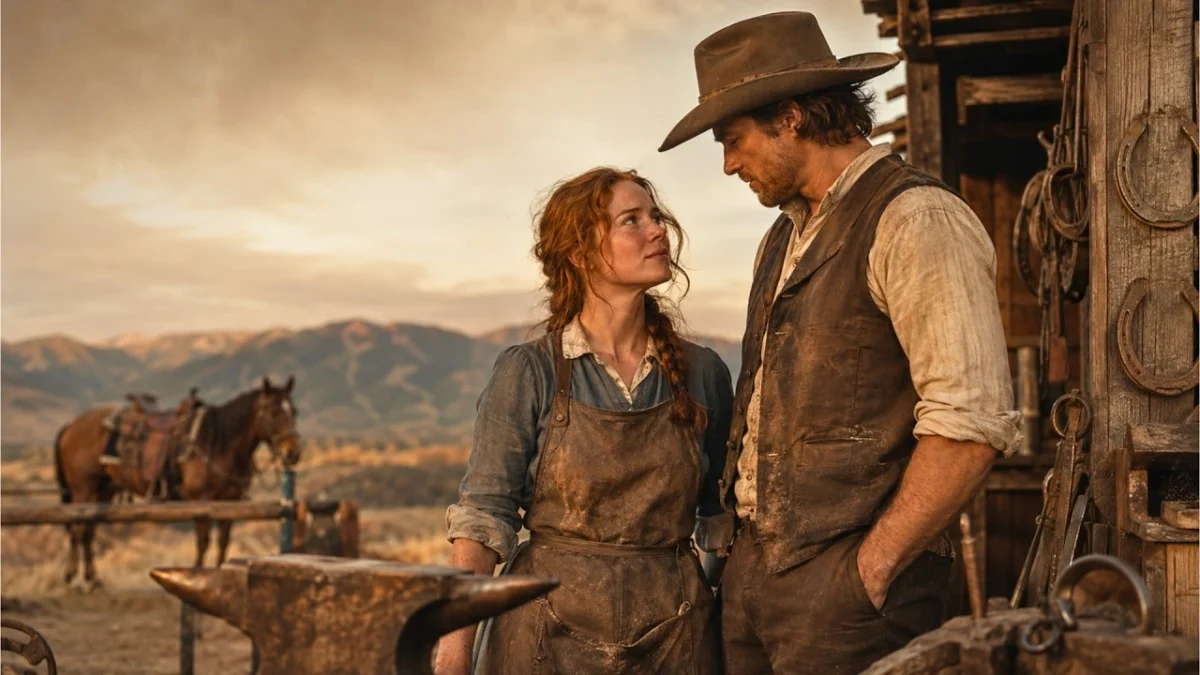
Cedar Hollow, Colorado Territory, 1884.
The forge stood at the far end of Main Street, close enough to the livery that the smell of hot iron and horse sweat had long since become one single smell in the minds of everyone who lived within a mile of it.
Margarite Doyle stood at the anvil that morning with a green-broke gelding’s hoof braced against her heavy leather apron.
A rasp worked in a steady, practiced rhythm against the newly trimmed hoof wall.
Sweat was already darkening the collar of her work shirt, though the sun had barely cleared the jagged ridge behind the feed store.
She did not look up when the county clerk’s boy rode past at a trot, an envelope tucked under his arm, bound for the addresses on his list.
She did not yet know that one of those envelopes carried her own name in handwriting she would not recognize, containing a claim that would very nearly cost her everything her husband had built and everything she had built since burying him.
The gelding shifted, his ears pinning briefly in protest.
“Easy now, boy, hold still,” Margot murmured, her voice low and even.
The gelding settled under her touch, yielding to the calm tone she used on every green horse that came through her gate.
It was a patience that had taken her the better part of three years to learn, one she now wore as easily as the apron itself.
A hawk turned slow circles in the wide sky above the ridge, indifferent to the small dramas of the valley below.
It had been equally indifferent two years earlier when they carried Henry Doyle’s body up from the forge floor after a spooked draft horse put a hoof through his chest before anyone could pull him clear.
Margot had stood in this exact spot afterward, wearing this exact apron, and made the hard decision that had shaped every day since.
She would not sell the forge.
She would not move back east to her sister’s crowded house in Springfield.
She would not let three years of learning the blacksmith trade at her husband’s side go to waste simply because the town could not imagine a woman working iron.
She had proven them wrong, customer by patient customer, though the proving had cost her considerably more than the physical labor ever had.
Standing alone at that anvil on the coldest winter mornings, she often told herself that the iron never questioned whether her hands were strong enough, only whether her aim was true.
In that simple, mechanical fairness, she found a kind of comfort the town itself was far slower to offer.
Across the dusty lane, Hattie Boon kept a bench outside her dry goods store.
Hattie had buried a husband of her own eleven years back and claimed the bench was strictly for watching the street while she mended stock.
Most of Cedar Hollow understood the bench’s true purpose was observing everyone else’s business with an attentiveness her mending never quite required.
Hattie had a clear line of sight to the forge yard and had taken to timing her Thursday morning mending sessions with a regularity she pretended was purely coincidental.
It always coincided perfectly with the hour Thomas Whitfield arrived.
“You’re burning good daylight standing there admiring a horseshoe, Margot Doyle!” Hattie called across the lane, her voice easily cutting through the quiet morning. “When there’s a considerably more interesting sight walking right up your road.”
Margot did not look up from her work as she adjusted her grip on the rasp.
“It’s a customer, Hattie,” Margot replied calmly.
“Customers don’t generally ride eleven miles for a shoe that could wait till Saturday,” Hattie countered, pulling a thread taut with the satisfied air of a woman who had made her point.
Margot felt a warm flush rise in her neck, though she maintained her flat tone.
“He has stock that needs shoeing, same as anyone else.”
“If you say so, my dear, if you say so,” Hattie chuckled, returning to her mending.
Thomas Whitfield rode into the forge yard a little after eight o’clock, leading a second horse behind his own—a young mare with a loose front shoe.
He swung down from the saddle with the easy economy of a man who had spent more hours of his life mounted than on his own two feet.
He tied both horses to the hitching rail and pulled his hat off before saying a single word.
It was a quiet mark of respect Margot had noticed months back, though she had never mentioned it aloud.
“Morning, Mrs. Doyle,” Tom said, his deep voice grounded and warm.
“Mr. Whitfield,” Margot replied, setting the rasp aside and stepping forward to run a practiced hand along the mare’s foreleg. “You could have waited till Saturday. She’s not limping badly enough to warrant a special trip.”
Tom rested a hand on the rail, his dark eyes watching her work.
“Wasn’t only about the shoe,” he admitted quietly.
Margot glanced up from the mare’s hoof, catching his eye.
“Oh?”
“Figured I’d ask if you needed anything hauled from town while I was headed that direction anyway,” Tom said smoothly. “Feed, lumber, anything heavy enough to be a bother.”
Margot straightened up, wiping her hands on a rag.
“I manage my own hauling, Mr. Whitfield.”
Tom smiled faintly, a gentle expression that softened his rugged features.
“I expect you do, Mrs. Doyle. Same as I expect a fellow’s allowed to offer regardless of whether the offer’s strictly needed.”
Margot found herself smiling despite her best efforts to remain professional.
She had come to Cedar Hollow six years earlier as Henry Doyle’s new bride, a blacksmith’s daughter from Missouri who had grown up watching her father at the bellows.
Henry had let her stand at his shoulder and learn the trade properly, treating her interest with respect rather than as a passing curiosity.
When Henry died, the skill he had taught her became the only barrier between her and complete financial dependence on distant relatives.
She had kept the forge running through that first brutal winter on sheer stubbornness, gradually winning back local ranchers who had initially doubted her capabilities.
Thomas Whitfield had been among the first to bring his stock to her without hesitation.
He ran three hundred head of cattle eleven miles west of town on land he had inherited after losing both his parents to influenza when he was nineteen.
He had raised his six-year-old sister, Eda, entirely on his own, learning to balance ranch work with braiding hair and settling fevers.
Over the past year, his regular Thursday visits to the forge had become a quiet highlight in Margot’s routine.
“Well,” Margot said softly, looking over the mare, “since she’s already here, I might as well reset this shoe before you head into town.”
“I’d appreciate that,” Tom said, stepping back to give her room.
As Margot pumped the bellows to bring the coals to a bright, golden glow, the county clerk’s boy finally trotted into the yard.
He pulled a heavy, sealed envelope from his leather pouch and held it out toward Margot.
“Delivery for Mrs. Margarite Doyle,” the boy said briskly.
Margot set her tongs down and wiped her ash-stained hands on her apron before taking the paper.
“Thank you, son.”
The boy nodded, swung his horse around, and rode off without waiting for further conversation.
Margot broke the wax seal and unfolded the letter inside.
As her eyes scanned the formal, typed lines, the warmth of the forge seemed to evaporate instantly.
A cold, heavy dread settled into her chest by the third sentence.
The letter was from a law firm in Denver, writing on behalf of a man named Silas Croft.
Croft was someone Margot had met only a few times during her early years in Cedar Hollow—an old acquaintance of Henry’s from his brief stint in the mining camps.
According to the legal notice, Silas Croft possessed a signed partnership agreement dated three years prior to Henry’s death.
The document purportedly granted Croft half-ownership of the forge and its surrounding land in exchange for initial construction capital.
The letter stated that Croft intended to press his claim in territorial court within six weeks to force a sale of the property, unless Margot agreed to buy out his alleged interest.
The sum requested was astronomically higher than anything the forge’s earnings could ever produce.
Near the bottom, the lawyer noted with sinister delicacy that ‘alternative arrangements satisfactory to Mr. Croft might be negotiated directly between the parties.’
Margot’s fingers tightened on the thick paper until the edges crumpled.
She knew precisely what ‘alternative arrangements’ implied.
Tom, standing near the hitching rail, immediately noticed the sudden shift in her posture.
“Margot?” he asked, his voice dropping its light tone. “What is it?”
Margot quickly folded the paper and slipped it into her apron pocket, forcing her expression into a mask of composure.
“Nothing to concern yourself with, Mr. Whitfield. Just a notice regarding territorial taxes.”
Tom studied her face closely, his brow furrowing slightly, but he did not press her further in that moment.
“If you say so,” he said quietly.
For the rest of the day, Margot went through the mechanical motions of her work, but her mind was in turmoil.
Henry had never once mentioned a business partner.
She had kept the forge’s ledgers herself since his passing and had found no record of capital from Silas Croft, no outstanding debts, and no signed agreements.
Croft was simply a shadow from Henry’s past who had shared a few suppers at their table years ago before vanishing entirely.
Now he had reappeared with a legal threat designed to strip her of her livelihood and home.
She knew how territorial courts worked; a widow standing alone against a man with formal legal documents faced nearly impossible odds.
By the time Thursday arrived the following week, the strain had carved dark shadows beneath Margot’s eyes.
She was working on a wagon wheel rim when Tom rode into the yard, this time accompanied by his young sister, Eda.
Eda, now twelve years old, carried a battered sketchbook under her arm and immediately went to sit on an overturned wooden crate near the forge entrance.
Tom tied his horse, walked into the shop, and stood watching Margot as she swung her hammer against the red-hot iron.
Her strikes were slightly off-center, driven by nervous exhaustion rather than her usual precise rhythm.
Tom stepped forward, caught the handle of her hammer gently, and brought her work to a stop.
“Set it down, Margot,” he said softly but firmly.
Margot blinked up at him, her chest heaving as she wiped sweat from her forehead.
“I have work to finish, Tom.”
“The iron will keep,” Tom said, his eyes searching hers. “You haven’t slept properly in a week, and you look like you’re carrying the weight of the entire ridge on your shoulders. Something is sitting wrong with you, Mrs. Doyle, and I’d prefer you tell me plainly rather than have me guess badly at it.”
Margot let out a shaky breath, stepping back from the anvil.
“It’s a private business matter. I have no right dragging a customer into my troubles.”
Tom’s expression hardened slightly, though his tone remained remarkably gentle.
“I ride eleven miles every Thursday for a woman I consider considerably more than a business acquaintance at this point,” he said, holding her gaze. “So I’d ask you to reconsider what you think you have a right to drag me into.”
The plain honesty of his words broke through the defensive wall Margot had painstakingly built since receiving the letter.
She reached into her apron, pulled out the crumpled notice from Denver, and handed it to him.
Tom unfolded the document and read it slowly, his jaw tightening by degrees as his eyes moved down the page.
Eda looked up from her sketchbook, sensing the sudden tension in the air, but remained quiet on her crate.
“Silas Croft,” Tom said, pronouncing the name like an insult. “I know of him. He operates out of the mining camps near Leadville. A opportunistic land speculator.”
“He claims Henry gave him half the forge,” Margot said, her voice trembling slightly despite her best efforts. “I’ve searched every ledger in this shop, Tom. There is no record of him ever investing a single copper. But he has a lawyer, and I have six weeks before they take this to a territorial judge.”
Tom folded the paper carefully and handed it back to her.
“You’ve kept Henry’s books yourself since he died?”
“Every single entry,” Margot confirmed. “There is no debt listed under his name.”
“Then it’s a forged paper,” Tom declared flatly. “Or a document he’s altered to make it look older than it is. Fake papers can be proven false if a person knows where to look and isn’t afraid to do the looking.”
Margot looked down at her hands, which were stained with charcoal and iron dust.
“The lawyer’s letter reads like a man entirely confident in his claim. A judge in Denver won’t take a widow’s word over a written contract.”
“Confidence and proof aren’t the same animal,” Tom said firmly. “No matter what a Denver lawyer tries to tell you.”
There was such absolute certainty in his voice that Margot felt the icy panic in her chest begin to thaw, replaced by a quiet, steadying hope.
Over the next three weeks, the quiet routine of the forge shifted dramatically.
Tom began appearing in Cedar Hollow on days that had nothing to do with his horse-shoeing schedule.
At first, he offered pretexts of hauling extra timber or picking up supplies for his ranch, but soon he dispensed with excuses altogether.
He simply showed up because there was work to be done to protect Margot’s home, and he intended to help her do it.
On a Tuesday afternoon, Tom rode to the county courthouse in the nearby town of Fairplay.
He spent hours in the dusty basement archive with the county recorder’s clerk, a man named Pertie whom Tom had assisted years ago during a harsh winter.
When Tom returned to Cedar Hollow late that evening, he rode straight to Margot’s forge.
Margot was sitting at her small kitchen table behind the shop, staring at a cold cup of tea, when Tom knocked and walked in.
“Pertie found something,” Tom said without ceremony, pulling a chair out and sitting across from her.
Margot leaned forward instantly. “What did he find?”
“The document Croft claims as an original partnership agreement was filed with the county recorder’s office only eleven months ago,” Tom explained, setting a handwritten note from the clerk on the table. “Not three years ago, as the date at the top of the page claims.”
Margot stared at the note. “Why does the filing date matter?”
“A man doesn’t wait two years to officially record a contract that grants him half a lucrative business,” Tom pointed out, his eyes bright with quiet intensity. “Not unless he had a specific reason to hold the paper back until a moment better suited to using it.”
“Like waiting until my husband was dead,” Margot whispered, the truth dawning on her. “Waiting until there was a widow alone, with no husband’s word to contradict him.”
“Exactly that,” Tom agreed. “It proves he’s acting in bad faith, but we still need physical proof that the signature or the text itself is fraudulent before a judge will throw it out entirely.”
The following Thursday, Eda accompanied Tom to the forge once again.
While the adults spoke in low, serious tones near the anvil, Eda sat nearby, carefully drawing the outline of a heavy iron vise.
She looked up, holding her pencil in the air.
“Margot?” the young girl asked abruptly.
Margot turned to look at her. “Yes, Eda?”
“Does ink fade evenly across a whole piece of paper, or does it fade differently depending on where you leave it?”
Margot paused, slightly surprised by the question.
“Well,” Margot replied thoughtfully, “ink usually fades faster if the paper is left out near a window’s light, and much slower if it’s kept tucked away in a dark drawer.”
Eda nodded slowly, seemingly satisfied, and went right back to her drawing. “I was just wondering, because my old schoolbooks have darker ink on the back pages than the front.”
Margot smiled gently at the girl’s innocent curiosity and returned to her conversation with Tom.
However, three days later, as Margot sat alone at her desk studying a legal transcript copy of Croft’s contract that the lawyer had reluctantly forwarded, Eda’s casual question echoed in her mind.
Margot brought a oil lamp closer to the desk, holding the document right under the flame.
She examined the lines closely.
The ink used for the body of the contract—detailing the transfer of land and capital—was slightly faded, displaying a brownish hue characteristic of older iron-gall ink.
But the ink of Henry’s supposed signature at the bottom was distinctly darker, crisp, and uniform.
It looked remarkably fresh compared to the text above it.
“It wasn’t written at the same time,” Margot gasped aloud to the empty room.
When Tom arrived the next morning, Margot practically dragged him to the workbench, laying the paper out flat beneath the bright morning sunlight streaming through the open barn doors.
“Look at the signature, Tom,” she said, her voice rising with excitement. “The body text is faded, but Henry’s name is dark. Someone took an old, blank paper that Henry had signed for something else years ago—maybe an old mining permit—and typed or wrote the agreement above it much later!”
Tom leaned down, studying the paper with intense scrutiny.
“You’re right,” he said softly, a slow smile breaking across his face. “The ink doesn’t match at all. But an observation from us won’t be enough for a territorial court. We need a professional to verify it.”
“Where do we find an expert on ink in Colorado territory?” Margot asked.
“The master printer in Fairplay,” Tom replied without hesitation. “He handles official territorial documents and legal printing. If anyone can give a sworn statement on ink age, it’s him.”
Two days later, Tom and Margot rode together to the county seat, carrying the document carefully wrapped in oiled cloth to protect it from dust and moisture.
The printer, a stern man with ink-stained fingers named Mr. Vance, spent nearly an hour examining the paper under magnifying lenses and testing small scrapings from the margins.
When he finally straightened up, he wiped his spectacles with a handkerchief and looked at Margot.
“Mrs. Doyle, this signature was applied to this paper years after the paper itself was written,” Vance stated authoritatively. “The chemical composition of the signature ink is modern synthetic black, which wasn’t even distributed in this territory until last year. The body text uses older oak-gall ink. It’s an obvious forgery.”
Margot sank into a wooden chair in the corner of the small, ink-scented shop.
“Will you put that in a sworn affidavit for the court?” Tom asked the printer.
“I certainly will, Mr. Whitfield,” Vance replied briskly. “I won’t stand by and watch a fraudster misuse legal instruments.”
As the printer turned to draft the affidavit, the overwhelming weight of fear, exhaustion, and uncertainty that Margot had carried for six long weeks suddenly snapped.
Tears welled in her eyes, spilling silently down her cheeks.
She squeezed her eyes shut, trying desperately to regain her composure, mortified to be crying in a stranger’s shop.
Tom immediately stepped closer.
He didn’t offer empty words or patronizing reassurances.
He simply stood beside her chair, his broad frame blocking her from the printer’s sight, offering a solid, unwavering presence.
Margot reached out instinctively, resting her forehead against his arm.
Tom lifted his hand and gently placed it on her shoulder, his touch warm and steadying.
They stood like that for several quiet minutes in the dimly lit office, surrounded by the smell of fresh ink and paper.
“I’ve been telling myself for the better part of a year,” Margot murmured, her voice thick with emotion, “that a woman who lost one husband to this trade has no business wanting anything further from life than the independence her work provides.”
Tom looked down at her, his thumb gently rubbing her shoulder.
“And what have you decided since telling yourself that?” he asked softly.
Margot wiped her eyes and looked up into his face.
“That independence and wanting a life with someone aren’t opposites,” she said quietly. “Though I’ve spent two years stubbornly insisting to myself that they were.”
Tom’s eyes softened completely, a look of profound tenderness replacing his usual stoic expression.
“I’ve been waiting a good while to hear you arrive at that particular conclusion, Mrs. Doyle,” he said softly.
Leaning down, Tom kissed her gently on the lips—a slow, unhurried kiss that carried the weight of a year’s worth of silent Thursday mornings.
Five weeks later, the territorial circuit judge arrived in Fairplay to clear the local docket.
The court proceeding lasted less than twenty minutes.
Silas Croft did not even appear in person, having fled the territory days earlier after learning that an official fraud investigation had been opened based on the printer’s affidavit.
Croft’s lawyer attempted to withdraw the claim, but the judge firmly dismissed the case with prejudice, restoring Margot’s sole, undisputed ownership of the forge and property.
The judge added an official note to the territorial records ordering Croft’s arrest should he ever return to Colorado.
When they stepped out of the wooden courthouse into the bright afternoon sunlight of an ordinary Thursday, Margot took a deep breath of the crisp mountain air.
She was a free woman. The forge was entirely hers.
Yet as she looked at the official deed in her hands, she realized her thoughts were not on the land or the iron.
She turned to look at the tall man standing beside her, holding his hat in his hands, watching her with that familiar, patient warmth.
“I believe I owe you a debt I have no particular idea how to repay, Tom Whitfield,” Margot said, her voice filled with genuine emotion.
Tom shook his head slightly, a small smile playing at the corner of his mouth.
“You don’t owe me anything, Margot. I did what any decent neighbor would have done.”
Margot stepped closer to him, her eyes locking onto his.
“You did considerably more than any neighbor’s obligation required, Tom Whitfield, and we both know it. So I’d ask you not to insult either of us by pretending otherwise.”
Tom let out a soft laugh, looking down at his boots for a moment before meeting her gaze again.
“Well,” Tom said, his voice dropping to a low, meaningful tone, “suppose there’s one repayment I wouldn’t object to.”
Margot tilted her head, her heart beating a little faster. “And what’s that?”
“Marry me,” Tom said plainly.
There was no grand grandstanding, no dramatic speech, just the simple, unwavering honesty that characterized everything he did.
“Not because you owe me a debt,” Tom continued, his eyes searching hers with complete sincerity. “But because I’ve spent the better part of a year riding eleven miles every Thursday for reasons that stopped being about horseshoes considerably before either of us admitted it. And because Eda’s asked me twice this month already when you’re coming to live at the ranch, and I’ve run clean out of good answers that don’t involve simply asking you outright.”
Margot looked at the man who had stood beside her at the anvil, who had held the heavy beam steady while she worked, who had believed in her strength when the rest of the town expected her to fail.
A bright, genuine smile broke across her face, sweeping away the last lingering shadows of her past grief.
“I think,” Margot said softly, reaching up to rest her hand against his cheek, “that Eda deserves a proper answer.”
Tom smiled, wrapping his arm around her waist as the quiet town of Fairplay carried on around them, the future finally clear and bright ahead.








