I Said, “Your Ranch Is Too Big…” The Widow Whispered, “Then Stay and Take Care of It… and Me.”
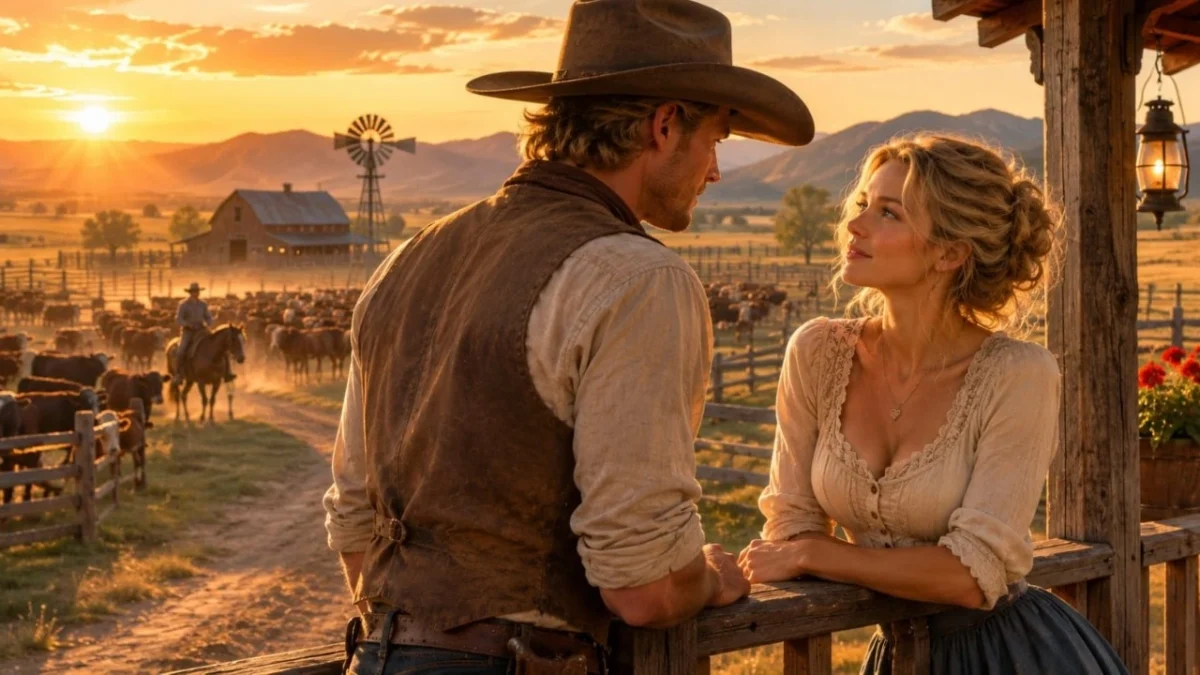
The red gold of a Montana sunset never lasted more than ten minutes before the shadows swept down from the Bridger Range to swallow the valley whole.
It was late September in the territory, 1885, and the dusk was turning the floating dust above the corrals into suspended flecks of amber.
Wyatt Callaway stood on the porch rail of the Bennett homestead, his weight leaning heavy against the pine timber.
Beside his boots rested a canvas duffel bag, packed tight, its strap tucked neatly underneath.
He stared out toward the high pastures where the last of the autumn roundup cattle were settling for the night.
“Your ranch is too big,” Wyatt said, his voice low and dry as dry-grass straw.
Clara Bennett did not move from her spot a foot away along the same railing.
She was looking at the way the lantern light hanging from the eaves cast their two shadows together, stretching them into a single dark shape across the porch floor.
A few loose strands of her blonde hair had slipped from their pins, framing a face softened by evening but set with a quiet, stubborn jaw.
“Too big for two hands and a foreman pushing sixty,” Wyatt continued, staring fixedly at the mountains.
“Too big for you to run alone come winter. And I’ve got no business pretending six weeks of wage-work makes me the answer to any of it.”
Clara turned her head slowly, looking at the trail dust still caked in the creases of his work shirt, at the hard line of his jaw, and finally down at the packed bag he hadn’t yet picked up.
“Then stay,” she said softly.
Wyatt parted his lips, drawing breath to offer the sensible arguments of a drifting hand who knew his place.
“And take care of it,” Clara added.
He opened his mouth to argue, to tell her about winter losses and Texas drives and the bad luck that followed him like a second shade.
“And me,” she whispered before he could utter a word.
Out past the heavy fir timbers of the corral, the lowing of the herd drifted in on the cooling air.
Wyatt stood frozen for a long moment, his hand hovering near his belt.
Then, slowly, his fingers uncurled, and he set the bag back down upon the porch boards.
Eight months before that quiet evening on the porch, Clara had stood in the frozen mud of the lower meadow while four men lowered a pine box into the earth.
Daniel Bennett had built the spread from a hundred and sixty acres of raw homestead claim into five thousand acres of prime grazing land, the envy of Gallatin County.
He had died the way too many cattlemen died in those years—thrown and trapped under a spooked herd during a midnight lightning storm on the spring drive, gone before the night crew could cut through the mud to reach him.
By territorial law, Montana was surprisingly generous to women left behind on the frontier.
The land passed directly into Clara’s name without requiring a male relative or trustee to sign the deed.
The territorial land records held her signature in firm, clear ink: *Clara Bennett, Sole Owner.*
Yet the territory provided no manual for managing five thousand acres of wild range, three thousand head of skittish Hereford cattle, a graying foreman, and two stubborn hands who had worked for her husband since before she ever stepped foot off the stagecoach from St. Louis.
She was twenty-eight years old.
She had allowed herself exactly three days of private grief in the quiet house, staring at Daniel’s empty boots by the stove while Hollis, the elderly foreman, managed the morning chores without asking questions.
On the fourth morning, Clara pulled on Daniel’s oversized wool coat, stepped out into the freezing wind, and rode the northern fence line herself.
By August, the summer grass was thinning early under a relentless, brassy sky.
It was the second dry year in a row, the kind that made old-timers at the stockyards lean against the pens and mutter about the great die-offs of ’72.
The fall roundup was coming, and Clara needed men.
She rode into Bozeman herself, tacking a handwritten notice onto the post at the stockyards: *Hands wanted. Bennett Ranch. Fair wages for the roundup.*
She deliberately left out any mention of her widowed status.
She had already learned that the word *widow* brought either cheap pity from neighbors or inflated prices from traders, and she had run out of patience for both.
Four men signed on off that notice.
Three of them walked off the job within two weeks, bristling at the sight of a young woman checking their tack and signing their pay vouchers.
One of them left a note pinned to the bunkhouse door with a rusty nail: *I didn’t sign on to take orders from a skirt.*
Clara read the slip of paper once, tossed it into the iron stove, and spent the rest of the morning hauling fence posts without saying a word to the rest of the crew.
Wyatt Callaway was the fourth man.
He had ridden into the yard in late August on a lean gray gelding, carrying a canvas bedroll, a Winchester rifle in a scabbard, and little else.
His hair was the color of dry river sand, pushed back under a hat that had seen too many rainstorms.
He claimed thirty-two years, though his steady gray eyes looked as if they had watched a century of hard country pass by.
Hollis had led him over to the pump house where Clara was scrubbing water troughs.
“Says he’s worked cattle from the Brazos up to the Yellowstone,” Hollis said, his arms crossed over his chest, his voice laced with skepticism. “Won’t say much past that.”
Clara wiped her hands on her canvas apron and looked the stranger over. “You have references, Mr. Callaway?”
Wyatt touched the brim of his hat politely. “No, ma’am. Just hands that know the work.”
It was a response that usually ended an interview on any reputable ranch.
Yet there was a quiet, unpretentious gravity in his posture—a stillness belonging to a man who had long since decided his past was his own business and his present was simply whatever job required doing.
Clara recognized that silence; she had been living her own version of it since the spring thaw.
She gestured toward the far corral, where a leggy, wild-eyed bay colt had been throwing dirt and snapping at halter ropes for three days, frustrating the regular hands.
“Show me,” Clara said simply.
Wyatt did not ask what she wanted him to demonstrate, nor did he boast.
He unbuckled his spurs, laid them on the top rail, and stepped into the dirt of the pen.
He didn’t rush the horse or wave his hat.
He walked slowly, keeping his shoulder turned, letting the colt circle him twice in a cloud of dust without ever reaching out a hand.
He spoke in low, rhythmic murmurs—words too soft for Clara to catch from her perch on the fence rail.
In less than twenty minutes, the bay colt was standing shoulder-to-shoulder with the stranger, its ears turned forward, blowing softly against Wyatt’s denim sleeve while he slid the leather halter over its nose.
Clara watched every move, noting details she hadn’t anticipated.
She saw the deliberate grace of his movements, the complete absence of temper, and the fact that he never once looked back over his shoulder to see if she was watching.
“You’re hired,” Clara called out over the rail. “Full wage through November.”
Hollis muttered under his breath about mysterious drifters for two full weeks.
His complaints ceased entirely on a rainy Tuesday when a frightened calf slid down a muddy ravine on the North Range, wedging itself beneath a fallen cottonwood.
While the rest of the crew stood at the ridge arguing over how to haul the beast out, Wyatt slid down the bank with a lariat, wrapped the line around his saddle horn, and guided his gray gelding to pull both calf and log clear in under four minutes.
After that, Hollis stopped muttering, though he kept his pale eyes fixed on Wyatt with the careful watchfulness of an old soldier reserving final judgment.
Clara, too, found herself watching the new hand.
She watched the way he sat by the bunkhouse lantern at dusk, oiling his leather gear in quiet concentration, never joining in the card games or the crude boasting of the seasonal riders.
Trouble arrived in early September in the person of Silas Grady.
The owner of the sprawling Circle G Ranch rode into the Bennett yard unannounced, trailing two hired riders who kept their hands comfortably close to their saddles.
Grady was a broad-shouldered man with iron-gray hair and the heavy, deliberate posture of someone accustomed to owning everything his eyes rested upon.
He didn’t bother to dismount.
“I’ll be direct with you, Mrs. Bennett,” Grady said, leaning over his saddle horn as Clara stepped off the porch to meet him. “Running a spread this size alone is going to bury you before the next hard winter does.”
“The ranch is managing, Mr. Grady,” Clara replied, keeping her distance.
“It’s scraping by,” Grady corrected smoothly. “I’ll offer you a fair price for the deed. Fairer than anyone else in Gallatin County will quote you. You can be settled comfortably in a grand house in Bozeman with a fat bank account before the first blizzard hits the passes.”
“The Bennett Ranch is not for sale,” Clara said, her voice steady.
Grady let out a short, dry chuckle that held no humor. “Everything is for sale eventually, Mrs. Bennett. It’s simple arithmetic. I’ve bought out six outfits smaller than this one in the last four years. Every single one of those owners swore they’d hold out forever. I give folks time to come around to good sense.”
Clara straightened her shoulders. “Is that a threat?”
“It’s just patience,” Grady said, casually adjusting his reins. “Though since we’re speaking directly, you ought to remember that Willow Creek runs through your north pasture before it ever hits my lower range. I’ve been buying up the timber filings and land claims upstream of you for two years now. A man in my position doesn’t need to threaten anyone. He just needs a dry summer.”
He tipped his hat with exaggerated politeness. “And this season is shaping up to be bone-dry.”
He turned his horse and trotted out of the yard, leaving a trail of white dust in the sun.
Clara stood near the water trough, her hands clenched into tight fists.
She knew instantly that the quiet war for her home had officially begun.
She also realized, with a cold knot tightening in her stomach, that Daniel had made a fatal oversight.
In all the decades his family had grazed stock along Willow Creek, they had never filed a formal water claim with the territorial land office in Bozeman.
Like most early homesteaders, Daniel had operated on the old unwritten law of the range: the family that used the water first held the right to it.
Silas Grady was not a man who respected unwritten customs.
The following week, Clara rode into town under the guise of buying flour and iron nails, asking subtle questions at the land office and the mercantile.
She learned that Grady had arrived in Montana twenty years prior with nothing but a pair of saddlebags and a ruthless understanding of territorial law.
In two decades of buying up distressed ranches, he had never once sold an acre back.
When the September roundup began, the work was brutal.
The heat held strong, drying the creeks to trickle-beds and turning the pastures into dustbowls.
It was Wyatt who kept the operation from collapsing under the strain.
On the second day of gathering cattle from the timberline, a loose boulder tumbled down a steep slope, spooking a herd of two hundred steers near the high ridge.
The cattle bolted toward the narrow canyon that led down to Willow Creek, where the bank dropped sharply off a six-foot clay ledge into deep water.
Clara was closest to the lead steers.
She spurred her mare forward, attempting to turn the stampeding lead, but her horse stumbled in the loose shale.
Before she could regain her balance, Wyatt rode hard past her flank, taking the treacherous outer edge of the trail.
He drove his horse directly into the path of the panicked lead steers, his hat off, his coiled lariat cracking like gunshot in the narrow gap.
He forced twenty of the heavy animals away from the drop-off, shouting them down with a deep, authoritative roar until Clara could bring her mare around to secure the flank.
For three terrifying seconds, Clara was certain she was going to watch Wyatt, his horse, and the cattle plunge over the clay bank into the rocks below.
The sudden, suffocating terror that seized her chest in that moment revealed far more than she was prepared to admit to herself.
They did not discuss the incident that night around the camp stove.
There were fences to patch, horses to grain, and forty stray head still missing in the dark timber.
Yet as they hauled heavy wire together under the light of a pale moon, Clara was hyper-aware of his presence—the sound of his breathing, the strength in his wrists, and the quiet efficiency with which he worked beside her.
She threw herself into the physical labor, pulling wire until her palms burned through her leather gloves, desperate to keep her mind busy.
By Tuesday morning, the threat Silas Grady had hinted at materialized.
Clara rode out to the north pasture to inspect the stock and found Willow Creek reduced to a muddy trickle barely wide enough to step across.
The cattle were bunched near the muddy banks, churning the shallow water into clay slime.
Wyatt met her at the fence line, and together they followed the dry creek bed north, crossing the property line into the timbered hills.
A quarter-mile above her boundary, they found it: a heavy timber headgate constructed directly across the stream bed, diverting two-thirds of the natural flow into an artificial ditch that snaked east toward the Circle G.
“That isn’t legal,” Wyatt said, dismounting and crouching near the fresh-cut pine beams. He ran a fingers along the wet wood. “Before I came north, I spent two years doing survey work for a land office in Colorado. The territory out here operates on prior appropriation—first in time, first in right. Whoever put the water to beneficial use first owns the right to it, paper or no paper, as long as you can prove continuous use.”
Clara stared at the structure. “He built this in broad daylight. He isn’t even trying to hide it.”
“A man that bold usually doesn’t stop with one gate,” Wyatt said, standing up and dusting off his knees. “I’d wager he’s got men coming back tonight to deepen the ditch and make it permanent.”
They returned to the spot long after midnight, riding without lanterns through the shadows of the lodgepole pines.
Neither spoke during the two-hour ride, bound by a shared understanding that whatever happened at the creek would determine the future of the Bennett Ranch.
They didn’t have to wait long in the cold night air.
Shortly past one in the morning, two riders leading a mule laden with timber and shovels approached the headgate.
They lit a single barn lantern and set to work widening the channel.
Wyatt did not draw his sidearm or reach for his rifle.
He simply rode his gray gelding out of the tree line, stopping fifteen feet from the working men.
The saddle scabbard held his Winchester in plain view under the moonlight.
“You’re standing on Bennett water,” Wyatt said, his voice quiet and perfectly steady.
The younger of the two hands dropped his shovel and reached for the revolver at his hip.
The older hand instantly grabbed the boy’s wrist, holding him fast.
For a long, tense interval, no one moved.
The only sound was the shallow murmur of the obstructed creek and the heavy breathing of the pack mule.
Clara felt her heart hammering against her ribs so loudly she feared the men would hear it.
Wyatt spoke again, his voice dropping an octave, directed entirely at the younger hand.
“Whatever Grady is paying you per month,” Wyatt said, “it isn’t going to cover the cost of a wooden box if that hand keeps moving.”
The young man slowly relaxed his fingers and let his hand fall away from his belt.
A moment later, the sound of slow, heavy hoofbeats echoed down the trail.
Silas Grady emerged from the dark timber, riding alone, appearing entirely unbothered, as though arriving at a planned meeting.
“Stand down, boys,” Grady ordered quietly.
The two hands backed away from the headgate immediately.
Grady looked at Wyatt, taking in the steady posture of the drifter, the easy resting position of his hands near the reins, and the unhurried composure in his eyes.
“I told you I was a patient man, Mrs. Bennett,” Grady said, turning toward Clara. “Patience doesn’t mean I sit on my hands while the grass dries up.”
“Stealing water from a neighbor isn’t patience, Mr. Grady,” Clara said, her voice ringing clear in the crisp night air. “It’s theft with better manners.”
Grady was silent for a time, staring down at the trickle of water reflecting the lantern light.
“I was a foreman for an old outfit south of here twenty years ago,” Grady said softly, his voice taking on a distant, hardened tone. “Owner was a man named Cyrus Whitlock. Good man. Generous to a fault. I watched three sharp partners talk him out of every acre, every steer, and every water right he owned, one polite meeting at a time, while he sat there trying to be fair about it. I helped bury him broke in a borrowed coffin.”
He looked up, his eyes cold. “I decided right then I’d rather be the man doing the taking than the man being talked out of his life. That’s no excuse. It’s just the way the world is put together.”
He swung his horse around. “Take the timber down, boys. Clear the channel.”
He looked back at Clara once before departing. “I’ll find another route.”
They did not trust his compliance.
Two nights later, while patrolling the creek to ensure the channel remained clear, Clara and Wyatt pulled their horses to a halt at the ridge overlooking the valley.
“You didn’t draw on them that night,” Clara said, breaking a long silence. “Even when the young one reached for his belt.”
Wyatt adjusted his hat against the wind. “A man draws a gun, and everybody in earshot stops thinking and starts making bad choices. Better they see it sitting in the leather and remember what happens if they push.”
“You’ve faced men like Grady before,” she stated quietly.
Wyatt looked out over the dark expanse of the valley. “I had my own homestead once. North of Denver. Three hundred acres of good bottomland. The drought of ’83 took every blade of grass and every head of stock I owned.”
He quieted for a moment, his fingers tightening on his reins. “I watched two dry years destroy eight years of hard, backbreaking work. When it was over, I didn’t have it in me to start over—to build something else that could be wiped out by a bad season or a rich neighbor.”
He glanced at her. “It’s easier to work another man’s land. If the sky doesn’t rain, you pack your bag and walk away. You don’t leave your heart in the dirt.”
“That isn’t living,” Clara said softly, looking directly into his eyes. “That’s just avoiding losing.”
Wyatt let out a long breath. “Seemed like the same thing for a long time. Now I’m not so sure.”
Clara thought of Daniel then.
She felt no pang of guilt, but rather a quiet sense of release.
Daniel had built the Bennett Ranch because he loved the land and couldn’t imagine a life without it.
Wyatt had spent two years wandering because he couldn’t bear the thought of loving something enough to risk losing it again.
She wondered which burden was heavier—the grief of a life cut short, or the solitude of a life guarded against pain.
They spoke no more that evening.
Yet the next morning, as Clara walked past the blacksmith shop, she found Wyatt replacing the hinges on a sagging barn gate that no one had asked him to repair.
It was the kind of task a man only performed when he had stopped calculating the date of his departure.
Silas Grady moved quicker than expected.
Within the week, he filed a formal claim on the Willow Creek water rights at the territorial land office in Bozeman, backdating his application to match his land purchases from two years prior.
It was a legal maneuver built entirely on the fact that no prior paper claim existed for the Bennett Ranch.
Montana was still four years away from statehood; the territorial land office was the sole legal authority governing water and land disputes.
If Grady’s claim went unchallenged through the mandatory thirty-day public notice window, the water would belong to the Circle G legally and permanently.
Hollis read the posted notice aloud at the kitchen table one evening, his voice heavy with foreboding.
“We need sworn statements,” Wyatt said instantly, standing over the table with a pencil in hand. “We need testimonies from every rancher, settler, and old-timer who remembers this creek flowing unimpeded to the Bennett land before Grady ever bought an acre upstream. And we need to present those statements to the land commissioner in Bozeman before the notice period expires.”
“That’s half the county,” Clara noted, looking at the map spread across the oilcloth. “Ranches are miles apart.”
“Then we start riding,” Wyatt said, reaching for his hat.
They spent eleven straight days in the saddle, traveling through the valleys and foothills of the Bridger Range.
They visited Old Ezra Toms, who had homesteaded alongside Daniel’s father back in the 1860s.
The old man listened to their story, nodded his gray head, and signed his name in a shaking, deliberate hand.
“Your father-in-law used to say that water didn’t belong to any man’s paper,” Ezra told Clara as he poured them black coffee on his porch. “He said it belonged to whoever needed it enough to keep showing up for it year after year. Reckon that’s you now, Mrs. Bennett.”
They rode up to the North Fork, where two Crow families were camped along the river meadows.
The elders provided testimony of the creek’s historical flow dating back long before any white settlers had brought survey chains into the territory.
Though Wyatt knew the territorial court might dismiss indigenous testimony, he insisted on writing down every word and adding it to the file, daring the court clerk to reject it.
A dozen smaller ranchers, who had been bullied or squeezed by Grady’s expanding empire, eagerly added their signatures to the petition, glad for an opportunity to challenge the cattle baron.
By the eleventh day, as they rode into Bozeman in the cold damp of dawn, Clara carried a leather saddlebag stuffed with signed affidavits, land maps, and historical accounts.
She looked at Wyatt, riding silently beside her, his coat dusted with frost, knowing that none of this defense would have been possible without a man who wasn’t even on the payroll as a manager.
The hearing inside the timbered courthouse lasted less than an hour.
Grady’s attorney argued the validity of the filed paperwork and the precise dates of the Circle G purchase claims.
Wyatt stepped forward, taking the lead, and presented twenty years of unbroken, documented water use, backed by two dozen affidavits from the surrounding community.
He cited the territorial doctrine of prior appropriation with the crisp clarity of a trained surveyor.
The land commissioner, weary of Grady’s aggressive acquisitions, reviewed the pile of evidence, signed the registry, and issued his ruling: *Prior continuous use supersedes recent paper filings. Claim denied.*
Silas Grady stood up, adjusted his coat, and walked out of the courtroom without uttering a single word.
On the stone steps outside the courthouse, the autumn sun broke through the gray clouds.
Wyatt stood turning his hat in his hands, staring down at his boots.
“Water’s yours,” he said quietly. “Roundup’s about finished. Reckon my work here is done.”
Clara watched his face closely. “Reckon it is.”
“Should probably get moving before the mountain passes freeze,” Wyatt said, though he made no move toward his horse.
“Reckon you should,” Clara replied softy.
That unfinished conversation reached its conclusion six days later on the porch of the Bennett homestead at sundown.
With the golden light fading against the mountains, his bag packed by the door, and the dust of the final cattle drive settling in the yard, Wyatt set his canvas bag back down upon the wood floorboards.
They were married in Bozeman before the first heavy snowfall of November.
Old Ezra Toms stood as Wyatt’s witness, and half the small ranchers who had signed the water affidavits turned out for the wedding supper at the town hotel.
Hollis officially retired that winter, moving into a cozy log cabin near the lower meadow, though he made it a non-negotiable condition of his retirement that he retained final approval on all matters regarding cattle breeding.
The following spring, Wyatt filed the Willow Creek water rights properly at the land office, registering the claim jointly under both their names—*Wyatt and Clara Callaway*—ensuring no future neighbor would ever find easy ground to alter the stream’s flow.
Silas Grady never rode onto the Bennett ranch again.
However, late the following spring, a hand delivered a short letter written in Grady’s firm, slanted script.
It contained no apology, only three brief lines: *I was mistaken about how the water fight would end. I hope the creek treats your family kinder than it treated Cyrus Whitlock. S.G.*
Clara read the letter twice, folded it neatly, and placed it inside the wooden desk drawer where she kept Daniel’s old land receipts and family letters.
She did not keep it out of affection, but because it belonged to the history of the land they had fought to protect.
The Bennett Ranch was still far too large for two hands and an aging foreman.
Yet it was no longer too large for two people who had chosen, with quiet determination, to build a life upon it together.
By the following September, as the sun dipped behind the Bridger Range and turned the dust of the new roundup into floating gold, Clara stood on the porch, watching her husband ride up from the corrals.
She smiled as he dismounted, knowing that some ranches were simply too big to run alone, and that the best things in life were those worth risking everything to hold.








