I Shared My Umbrella With A Stranger, And Neither Of Us Wanted To Leave
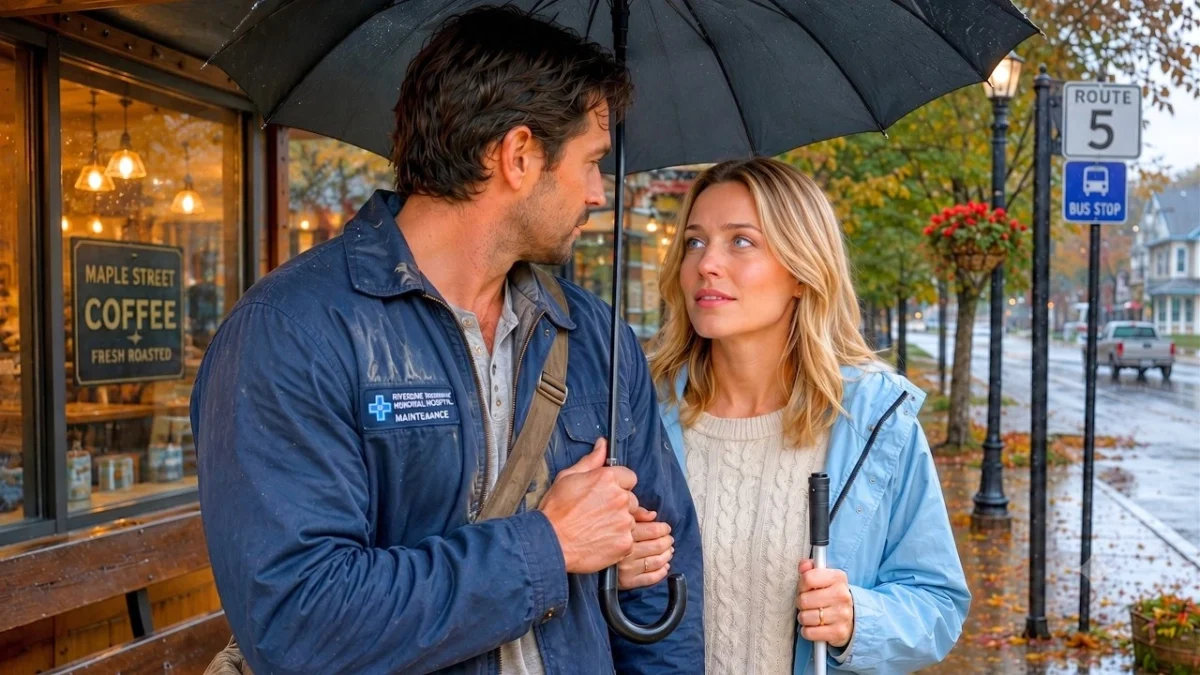
The rain came down as if the sky had a personal grudge against the earth, pounding the pavement in unrelenting, silver sheets.
Cole Hardy stood beneath the tiny glass overhang of the bus stop on Maple Street, staring down at his soaked boots.
He had forgotten his jacket, and the bitter autumn wind drove the chill deep into his bones.
Around him, the city buzzed with the dull, rhythmic hum of evening traffic, wheels spraying water against the curbs.
He reached into his pocket, his thumb absently tracing the edge of his old paramedic badge, a habit he hadn’t broken in six long years.
He didn’t wear the badge anymore.
He didn’t run toward sirens.
These days, Cole worked the night shift as a maintenance technician at St. Ambrose Hospital, mopping floors, changing air filters, and fixing leaky pipes three floors up from the emergency room he promised himself he would never enter again.
A sudden, sharp metallic pop shattered the rhythm of the storm.
Beside him, a woman flinched violently, her body locking in place at the sound.
Cole looked over, instantly noticing that she was holding no umbrella, her dark coat already heavy and drenched with rain.
Without thinking, Cole unclasped his large black umbrella and stepped closer, extending the canopy over her head.
“Room for two,” Cole said, keeping his voice quiet and low.
The woman turned toward his voice.
She didn’t turn to look at his eyes; her gaze drifted toward his chest, slightly off-center.
“Oh,” she murmured, startled by the sudden shelter.
Before he could react, her right hand shot out, her slender fingers brushing against his arm until they locked tightly around his forearm.
It wasn’t a polite, casual touch.
It was a fierce, desperate grip, her knuckles turning instantly stark white beneath the dim yellow glow of the streetlamp.
“Ma’am?” Cole asked softly.
She didn’t answer.
Her breathing was rapid, shallow, and uneven, coming in sharp, desperate hitches.
Down the street, the yellow headlights of the 5:40 bus cut through the gloom, its heavy brakes hissing as it pulled up to the curb.
The doors folded open with a sigh of compressed air.
Neither of them moved.
The driver waited three seconds, tapped the horn lightly, and then pulled back out into the rain, red taillights fading into the fog.
“Ma’am,” Cole repeated, looking down at her white-knuckled grip on his jacket. “That was the 5:40. You need that one?”
“Yes,” her voice was surprisingly steady, though her body trembled against his side. “I need you to not move for a second. Please. Just don’t move.”
Cole instinctively shifted his weight, grounding his feet into the slick concrete, creating a solid anchor for her.
“Okay,” Cole said, keeping his tone measured and calm. “I’m not going anywhere. Take your time.”
She closed her eyes and took a long, deliberate breath through her nose, holding it for three beats before releasing it slowly through her mouth.
Cole recognized the technique immediately; it was the exact breathing cadence he used to coach hyperventilating patients through during his years on the ambulance.
She repeated the pattern four or five times until the terrifying tension in her shoulders began to dissipate.
Slowly, her grip on his forearm loosened by a fraction.
“My cane’s in the gutter,” she said flatly, a heavy undertone of deep humiliation weighting her words.
Cole glided his eyes down to the curb.
Half-submerged in the rushing torrent of rainwater lay a white aluminum folding cane, snapped awkwardly at the joint, its red tip pointing toward the iron storm drain.
In an instant, every strange detail Cole had noticed rearranged itself in his mind.
The way she had faced his chest instead of his eyes.
The way her dark pupils stared into the middle distance, unblinking.
“Some guy in a hurry clipped me coming out of the coffee place,” she explained, biting off each word with suppressed fury. “Knocked it right out of my hand. The construction on the corner has the whole block torn up, so none of my sound markers are where they’re supposed to be. And the rain is so loud I couldn’t hear the crosswalk signal. I lost count of my steps.”
She paused, swallowing hard.
“I’ve been standing here for twenty minutes with no idea which way is the sidewalk and which way is live traffic,” she continued, her jaw tightening. “Too proud to yell for help like a helpless victim. And then you opened an umbrella, and you were the first solid thing I found all day. So I grabbed you. And now I can’t make my hand let go. So, congratulations. Now you know. I’m not flirting with you, mister. I’m blind, I’m lost, and I am mortified.”
Cole didn’t laugh, nor did his voice soften into pity.
He simply shifted the umbrella handle into his left hand.
“My name’s Cole,” he said casually. “And you’re not lost anymore, because I know exactly which way the street is. It’s the loud, smelly way to your left. I’m going to get your cane, which means for about four seconds, you’re going to have to hold this umbrella instead of my arm. Think you can stand my company that long?”
A beat passed in the rain.
The corner of her mouth twitched upward, just a fraction of an inch.
“Nina,” she said, reaching up to take the fiberglass handle. “And don’t take all day, Cole.”
Cole stepped out from under the canopy into the pouring rain, crouched by the curb, and fished the metal cane out of the frigid water.
He wiped the mud against the thigh of his jeans, clicked the joint securely back into place, and stepped back under the umbrella.
He gently placed the grip into her palm.
The moment her fingers wrapped around the rubber handle—her tool, her independence—Cole watched a remarkable transformation take place.
Her spine straightened instantly.
Her shoulders rolled back, and her chin lifted with sharp authority.
She was striking, but her beauty was eclipsed by her fierce presence; she was clearly someone accustomed to being in control, furious at the world for forcing her to pause.
“I missed my bus,” Nina said, testing the tip of the cane against the concrete. “There’s another one in twenty minutes. I’ll wait with you.”
Cole paused, adjusting his hold on the umbrella. “Not because I think you can’t wait alone,” he clarified carefully. “Because it’s raining, I have the umbrella, and I’m not a monster.”
A short, genuine laugh escaped her lips before she could stop it.
“You don’t have to narrate your reasons for being decent,” Nina said, tilting her head slightly. “Most people don’t bother being decent at all. A clipped cane, and twenty people walked right past me before you came along. They were probably in a hurry.”
“Everybody’s always in a hurry,” Cole replied.
Nina tilted her face toward him, her clear, pale eyes resting on his chin.
Even without her vision, Cole felt a strange, piercing sensation of being thoroughly examined.
“Except you,” Nina noted softly. “You’ve got a slow voice. Like a man who has nowhere else he’d rather be than standing at a wet bus stop.”
She waited two seconds before asking, “What kind of man has nowhere he’d rather be?”
The question struck Cole right in the center of his chest.
It was the very question he had spent the last six years actively avoiding.
“The boring kind,” Cole offered dryly.
“Mhm,” Nina murmured, her tone rich with skepticism. “We’ll see about that.”
He did not tell her the truth that night.
He did not tell her that he rode the city bus because he had sold his car six years ago, unable to bear the quiet confinement of driving alone with his thoughts.
He did not tell her that he spent his nights scrubbing tile floors in the same hospital where he used to wear a uniform and save lives.
He did not tell her about the cold winter night six years ago when his hands had frozen over the chest of a seven-year-old child in a smoke-filled hallway.
He didn’t mention the forty seconds of paralyzed terror that had cost a child his life, or how he had resigned his badge the very next morning, convincing himself that a man who freezes under pressure should never be trusted with another human being’s survival.
When the 6:00 bus finally screeched to a halt, Cole helped her up the steps.
“Have a good night, Nina,” he said from the pavement.
“You too, slow voice,” she called back as the doors folded shut.
Cole stood at the bus stop long after the red lights disappeared into the dark.
For the first time in six years, he found himself looking forward to tomorrow.
The next afternoon, Cole was at the bus stop at 5:35 PM.
He told himself it was just a coincidence, a harmless curiosity to see if the fierce blind woman would return.
She did.
For four days, they stood beneath his umbrella in comfortable silence or light banter.
On the fifth day, as soon as Cole sat down next to her on the bus, Nina turned her head toward him with an amused smirk.
“You’re not even going anywhere, are you?” she asked directly.
Cole blinked, caught off guard. “What do you mean?”
“You get on at my stop, and you get off at my stop,” Nina stated plainly. “There is nothing at my stop, Cole. I live there. So either you moved into my apartment building this week, or you are riding a bus you don’t need just to sit next to a woman who can’t see you do it. Which is it?”
Cole rubbed the back of his neck, letting out a soft chuckle. “I’ve already established that I’m not a fast man. It’s the second one.”
Nina was quiet for a brief moment, her expression unreadable, before a slow smile spread across her face.
“Good,” she declared. “I hate a coward. Buy me a coffee. The shop on the corner knows me. I’ll tell you what to order so you don’t embarrass yourself.”
That afternoon marked the beginning of a new rhythm in Cole’s life.
The daily bus rides quickly became the focal point of his existence.
Sitting beside Nina, he watched her navigate the world with an extraordinary reliance on her remaining senses.
She would sit with her cane laid horizontally across her knees, her head tilted slightly, catching sounds that Cole’s eyes completely missed.
“The couple three rows back are breaking up,” she whispered to him one evening, not even bothering to lower her voice fully.
“How do you know that?” Cole murmured back, glancing over his shoulder.
“They’ve been at it for three stops,” Nina explained smoothly. “He keeps starting every sentence with ‘I just think,’ and she hasn’t answered him once. Plus, her ring is turning against her skin—she keeps sliding it up and down her finger. And this driver is new. He brakes too hard because he’s nervous. It’s probably his first week.”
She turned her face toward Cole. “And you just took your jacket off because you ran to catch this bus because you didn’t want to wait fifteen minutes for the next one. You’re breathing hard, Cole. Give it up.”
Cole shook his head in disbelief. “You’re a witch. You know that, right?”
“I’m a chef,” Nina corrected proudly. “It’s the exact same skill set. You pay attention, or you burn the sauce.”
She leaned back against the high vinyl seat, letting the vibration of the engine rumble through her frame.
“Sighted people don’t listen,” she said softly, her voice taking on a reflective tone. “You walk around letting your eyes do all the heavy lifting, while your ears stay fast asleep. When I lost my sight, the whole world suddenly got loud and honest. I can tell when someone is lying to me now. Their voice does a specific tight thing in the throat.”
She paused, pointing a finger toward his chest. “Yours doesn’t do it, by the way. That’s rare. Most people’s voices are doing the thing constantly.”
Cole looked down at his hands. “Mine did the thing,” he admitted quietly. “On day one. When you asked me what kind of man has nowhere to be.”
Nina went still, her ears catching the subtle drop in his pitch.
“Yeah,” she acknowledged softly. “It did. I’ve been waiting to find out what that was about.”
She lightly tapped her cane against her shoe.
“But not today,” Nina added, showing a rare moment of gentleness. “Today, you can just be the slow-voiced man who runs for the bus. Tell me something that isn’t the thing. Tell me about the best meal you ever had before mine ruins food for you forever.”
Cole laughed. “That confident, huh?”
“Cole,” Nina said, leaning in closer. “I am about to cook for you this Thursday. After that, every other meal of your life is going to be a little bit sad. I’m just being honest so you can prepare yourself.”
She was not exaggerating.
Over the next two months, spent in corner coffee shops, on bus seats, and eventually inside her warm, fragrant apartment, Cole pieced together the story of Nina’s past.
Before the dark took over, Nina had been a head chef at an acclaimed downtown restaurant.
Her kitchen had featured a six-week waiting list and framed critical reviews on the wall—reviews she forbade Cole from reading out loud because she claimed that if she heard her past glory praised one more time, she would cry, and she was entirely done crying.
A progressive condition had slowly stripped away her sight over the course of a single year.
A chef who cannot see cannot run a high-intensity line, cannot plate delicate microgreens, and cannot judge the sear on a protein by sight.
She had lost her restaurant, her career, and the identity she had spent her entire youth building.
Yet, what amazed Cole most was not what she had lost, but how she had responded.
Nina had refused to surrender her passion; instead, she spent months retraining herself to cook entirely in the dark.
She learned to navigate by scent, by the precise sizzling sounds of evaporating juices, by touch, and by an internal clock that never missed a beat.
On the Thursday night she invited him over, she forced Cole to sit at the far end of her dining counter.
“Don’t help,” Nina commanded sternly, tying a black apron around her waist. “Don’t touch a single utensil, and do not try to be my eyes. I didn’t invite you over to watch me be handicapped. I invited you over because I am the best cook you will ever meet, and I want someone to eat my food and actually appreciate it.”
Cole sat completely motionless, mesmerized by the performance that followed.
Nina moved through the narrow kitchen with absolute precision, as if the darkness were an ally rather than an obstacle.
She identified every cabinet by the distinct click of its latch.
She salted a searing pan from a foot above, listening intently as the crystals hit the hot metal.
“The sizzle changes when the seasoning hits the fat,” she noted without looking back. “Listen.”
Cole leaned forward, listening intently, and to his surprise, he heard the subtle shift in pitch as the fat rendered.
She tested the doneness of a thick ribeye steak by the aroma and the rhythmic popping of the skillet, touched the skin of a tomato to gauge its ripeness, and held her hand a quarter-inch above a simmering reduction to feel the density of the rising steam.
Her white cane hung untouched on a hook near the door.
In that small, dark kitchen, she moved with greater speed and certainty than Cole ever did in full daylight.
“You’re staring,” Nina said suddenly, keeping her back turned to him as she flipped the steak.
“I can feel you staring,” she added with a smirk. “Set the table instead. The plates are in the second cabinet to the left. And don’t rearrange my cabinets. I will know.”
When the food was ready, she plated it herself, gently tracing the outer rim of each porcelain dish with her index finger to align the components perfectly.
The presentation rivaled the photography in fine-dining magazines.
She slid the plate in front of him, crossed her arms over her chest, and waited.
For the first time since he had met her, Cole saw a flicker of raw nervousness in her posture.
This was her soul on a plate, the absolute core of who she had been, handed over to him for judgment.
Cole picked up his fork, took a bite of the steak accompanied by a rich wine reduction, and stopped chewing.
He closed his eyes, swallowed, and took a second bite immediately.
“Nina,” Cole said, his voice thick with genuine awe. “That is, without a doubt, the best meal I have ever eaten in my life. I’m not being polite. That is just objective truth.”
Nina turned her face away quickly toward the window.
Cole recognized the moment for what it was and pretended to be intensely focused on his plate, giving her the space to compose herself.
“You didn’t fix it,” Nina said quietly a little later, as they sat over glasses of red wine.
“Fix what?” Cole asked softly.
“The blind thing,” Nina explained, her fingers tracing the stem of her glass. “You didn’t try to fix it, or offer to find some ground-breaking specialist, or pitch a pity party. You just ate the food. It’s good food, but most people can’t get past the cane long enough to actually taste it.”
She looked directly toward the sound of his breath.
“You want to know the loneliest part about all this?” Nina asked. “It’s not the dark. I’ve made my peace with the dark. It’s that the moment people find out, I stop being Nina. I become ‘the blind woman.’ They adopt this careful, soft, patronizing voice, and they never speak to me like a real person again.”
She leaned forward, her expression intense. “You’ve never once used that voice with me, Cole. Why?”
Cole stared into his wine glass.
He could have offered a smooth, charming answer, but he knew Nina would hear the lie instantly.
“Because I know what it’s like,” Cole said evenly, “to have one terrible mistake become the only thing anyone sees when they look at you. I have a thing like that, too. So I figured I’d do you the courtesy nobody does for me. I’d look at the rest of you.”
Nina went completely still.
“What’s your thing, Cole?” she asked, her voice dropping to a serious whisper. “The one bad thing?”
That was the night Cole almost confessed everything, but six years of silence had locked his jaw firmly shut.
The words died in his throat.
“Another time,” Cole managed to say.
Nina studied his silence for a long moment, then nodded slowly, letting him off the hook just as he had done for her earlier.
“Fair enough,” she murmured.
She finally extracted the truth from him a month later, and it was neither gentle nor comfortable.
It was a rainy Tuesday night at the end of Cole’s shift at St. Ambrose Hospital.
Nina had taken a taxi to meet him in the main lobby so they could take the bus home together.
As they walked side by side down the long, linoleum-tiled corridor toward the exit, they passed the wide double doors of the Emergency Department.
Suddenly, the overhead public address system chimed with a piercing, cold chime.
“Code Blue, ER Bay 4. Code Blue, ER Bay 4.”
The announcement echoed loudly off the hard walls.
Instantly, every hair on Cole’s arms stood on end.
His legs turned into lead, his feet coming to a dead stop on the polished floor.
Medical personnel in blue scrubs rushed past them, running toward the trauma bay where a human life was slipping away.
Cole stood paralyzed in the middle of the hallway he had spent six years desperately avoiding.
He froze—completely, utterly rigid.
Nina, who was holding his arm, felt his entire body turn to stone.
She heard his breath catch, turning into sharp, frantic gasps.
She stopped instantly, turning to face him.
“Cole!” she said sharply, her hand gripping his forearm tight. “Your heart is pounding like a trapped rabbit. What is happening? Talk to me!”
The dam inside Cole finally broke.
Standing in that sterile hospital corridor while footsteps echoed around them, six years of shame flooded out of him in a desperate, broken whisper.
“I used to be a paramedic,” Cole confessed, his voice shaking. “I was good, Nina. I was the calm one. The one they assigned to the worst calls because I didn’t lose my head. And then one night, six years ago, we got dispatched to a structure fire. A seven-year-old boy was trapped inside.”
He swallowed hard, tears welling in his eyes.
“When we pulled him out, he wasn’t breathing,” Cole continued, his voice breaking. “It was my turn to lead the resuscitation. I’d done it a hundred times before. But that night… something inside me just broke. For forty seconds, I stood over that little boy and I couldn’t move my hands. I couldn’t breathe. I just froze. My partner had to physically shove me out of the way to take over.”
He wiped his face with a trembling sleeve.
“The doctor at the hospital told us later that those forty seconds probably didn’t change the outcome—that the damage was already done before we arrived. ‘Probably.’ ‘Likely.’ I’ve spent six years living inside those words, Nina. Because I’ll never know for sure if those forty seconds I spent being a coward were the reason that child died. I turned in my badge that week. I haven’t stepped foot in an ER since. I mop the floors here because I don’t deserve to walk away entirely.”
Cole finished his confession, shaking uncontrollably, bracing himself for the soft, pitying voice he hated so much.
It never came.
“So a child died,” Nina said flatly, her voice entirely devoid of gentle comfort. “And instead of letting that tragic night make you into a man who runs even harder to save the next person, you decided the smart move was to spend the rest of your life hiding in a supply closet with a mop?”
Cole blinked, stunned by her bluntness. “Nina—”
“You want to know what I’d give, Cole?” Nina interrupted, stepping closer, her tone sharp and uncompromising. “What I would give to have your problem instead of mine? You froze for forty seconds under the most brutal pressure a human being can experience. That doesn’t mean you’re broken. That means you had one terrible night. I lost my eyes, Cole. I can’t get my sight back no matter how brave or sorry I am. But you? You could take your life back tomorrow. You’re just scared. And I don’t have an ounce of patience left for people who waste working eyes.”
Cole stood silent in the middle of the hallway, feeling as though he had been hit by a freight train.
No one had ever spoken to him like that.
No one had ever refused to let him hide behind his own grief.
“That is the meanest thing anyone has ever said to me,” Cole whispered honestly.
“You’re welcome,” Nina replied without hesitation.
He wished he could say that her words cured him on the spot, but they didn’t.
Instead, Cole panicked.
He wasn’t afraid of the hospital or his past anymore; he was terrified of her.
Over the weeks of coffee, bus rides, and shared meals, he had fallen deeply in love with a woman who saw right through his defenses, and his old, defensive logic immediately asserted itself.
‘People who count on me get hurt,’ his mind repeated like a dark mantra.
Nina was beginning to count on him, and the dark voice inside his head argued that it was only a matter of time before he froze again when she needed him most.
He convinced himself that pulling away was the kind, noble thing to do—dressing up his cowardice as protection.
Over the next two weeks, Cole made excuses.
He took a different bus route, avoided the corner coffee shop, and left his shifts early.
Nina, a woman who had spent her life fighting for independence and enduring abandonment, did not chase him.
Her intense pride prevented her from begging for anyone’s presence.
She simply went quiet, and the bus stop on Maple Street returned to being just an ordinary bus stop.
For fourteen days, Cole told himself that he was doing the right thing.
Then, on a Thursday evening, the storm returned with a vengeance.
The rain poured in relentless torrents, pounding against the asphalt just as it had the night they first met.
Cole couldn’t take the isolation any longer.
Desperate just to hear her voice, he walked down to Maple Street and stood near the back of the bus shelter, keeping his distance.
Nina was there, holding her white cane, her coat damp from the rain.
Before Cole could gather the courage to step forward and offer his apology, a sharp, wet grunt shattered the air just three feet away.
A heavily built man in his early sixties collapsed forward, his body striking the wet concrete with a heavy, sickening thud.
Panic erupted instantly among the commuters.
“Oh my God! Someone call 911!” a woman screamed.
The small crowd instinctively backed away, pulling out smartphones, their faces pale with helpless fear.
Cole rushed forward and knelt by the man, his paramedic training instantly taking over his assessment.
No pulse.
No breathing.
Full cardiac arrest.
Cole placed his hands on the man’s sternum, but as he prepared to compress, the dark memory hit him like a physical blow.
The cold hallway.
The smoke.
The forty seconds of failure.
The concrete seemed to pour into his veins, locking his elbows, freezing his muscles in place.
‘You’ll fail,’ the voice inside his head screamed. ‘You freeze when it matters!’
He couldn’t move his hands.
Suddenly, a slender hand reached out from the dark and grabbed his upper arm with fierce, white-knuckled intensity.
It was Nina’s grip—the exact same grip from the night they met.
She leaned down, placing her lips right beside his ear.
“Cole!” she commanded, her voice piercing through the haze of his panic. “There’s a man on the ground and everyone is frozen! I can hear it—nobody is moving! But you are not everyone, Cole! You are the one who knows what to do!”
She pulled him closer, her grip anchoring him to the present.
“I can’t see him,” Nina said, her tone absolute and unyielding. “You are going to be my eyes, and I am going to be your spine! You be my eyes every single day, Cole—now it’s my turn! Tell me what you see right now! Talk to me!”
Her voice—steady, certain, and completely devoid of doubt—shattered the ice in his veins.
“He’s… he’s blue,” Cole gasped out, his voice cracking with emotion. “No pulse. Not breathing.”
“Then you already know what he needs!” Nina yelled over the storm. “Go! I’m right here! I am not letting go of you! Go!”
Cole drove his hands down onto the center of the man’s chest and began deep, rhythmic compressions.
The six-year freeze was broken.
“One, two, three, four…” Cole shouted aloud, counting the cadence.
Nina kept her hand firmly on his shoulder, keeping time with her own voice. “Don’t stop! Don’t you dare stop, Cole! I’ve got you!”
Rain poured down on them as Cole pumped the man’s chest, performing resuscitation on the wet pavement.
He pushed through the fatigue, counting every compression alongside Nina’s steady voice.
On the forty-second stroke, the man suddenly gasped violently.
His chest heaved, his eyelids fluttered open, and a ragged cough tore through his throat as color flooded back into his face.
Seconds later, the familiar wail of an approaching ambulance echoed down the street.
The vehicle screeched to a halt at the curb, and two paramedics in dark blue uniforms—the same uniform Cole used to wear—leaped out with their gear.
“We’ve got it from here, man! Good job!” one of them shouted, taking over CPR. “He’s breathing! He’s got a pulse!”
Cole sat back on his heels on the wet pavement, his body shaking violently from adrenaline and exhaustion.
Nina dropped down onto her knees beside him in the rain, her hands reaching out until she found his wet face, cupping his cheeks with both palms.
Tears streamed down Cole’s face, washing away six years of hidden shame.
“There he is,” Nina whispered fiercely, her own eyes brimming with tears. “There’s the man you’ve been hiding. I knew he was in there. I could hear him.”
“You couldn’t even see it,” Cole sobbed, covering her hands with his own. “You couldn’t see any of it.”
“I didn’t have to see it,” Nina said, pressing her forehead directly against his. “I heard a man get his life back. And I felt the exact second you stopped being scared.”
She let out a soft, wet laugh into the rain.
“You want to talk about who saved who, Cole Hardy?” Nina asked softly. “Because from where I’m sitting, a blind woman just talked a broken man out of a supply closet. And I would like some credit.”
Cole laughed through his tears, pulling her close into an embrace right there on the wet sidewalk.
They didn’t waste any more time being afraid.
The very next week, Cole walked into the administrative office of the EMS department, submitted his application for recertification, and passed his practical exams without a single hesitation.
Within two months, he was back in uniform, driving an ambulance on the day shift.
He walked toward every emergency with steady hands, carrying Nina’s voice in his mind like an unbreakable shield: ‘You’re the one who knows what to do. Go.’
Nina expanded her culinary journey as well.
With Cole’s help, she began hosting private dining experiences and teaching adaptive cooking classes for both blind and sighted students, demonstrating that mastery of an art relies on passion rather than sight.
A year later, on a cool autumn evening, the rain returned to Maple Street once again.
Cole and Nina stood together under the same black umbrella at the bus stop.
Without saying a word, Cole stepped out from under the shelter, dropped down on one knee onto the wet concrete, and took her right hand in his.
“Nina,” Cole said, his voice deep and steady over the sound of the falling rain.
Nina paused, sensing the sudden change in his position. “Cole? What are you doing down there?”
“The first day I met you,” Cole said, turning her hand over so her palm rested in his, “you grabbed my arm and you couldn’t make yourself let go. You were so embarrassed about it. But I need you to know something.”
He looked up at her face, beautiful and serene in the rainy streetlamp light.
“That was the best thing that ever happened to me,” Cole whispered. “So I’m asking you to do it on purpose this time. Grab on. Don’t let go. Not for a bus, not for twenty minutes, but for good. Marry me, Nina.”
Silence stretched between them for a long, beautiful moment, filled only by the rhythmic patter of rain against the fabric of the umbrella above.
Then, Nina extended her arm, her fingers finding his forearm, locking around his muscle with the exact same fierce, white-knuckled grip from the night they first met.
“Try and make me let go,” Nina said, a radiant smile breaking across her face.








