If I Were Younger, I’d Ask You to Dance, the Duke Teased — Who Said No She Replied
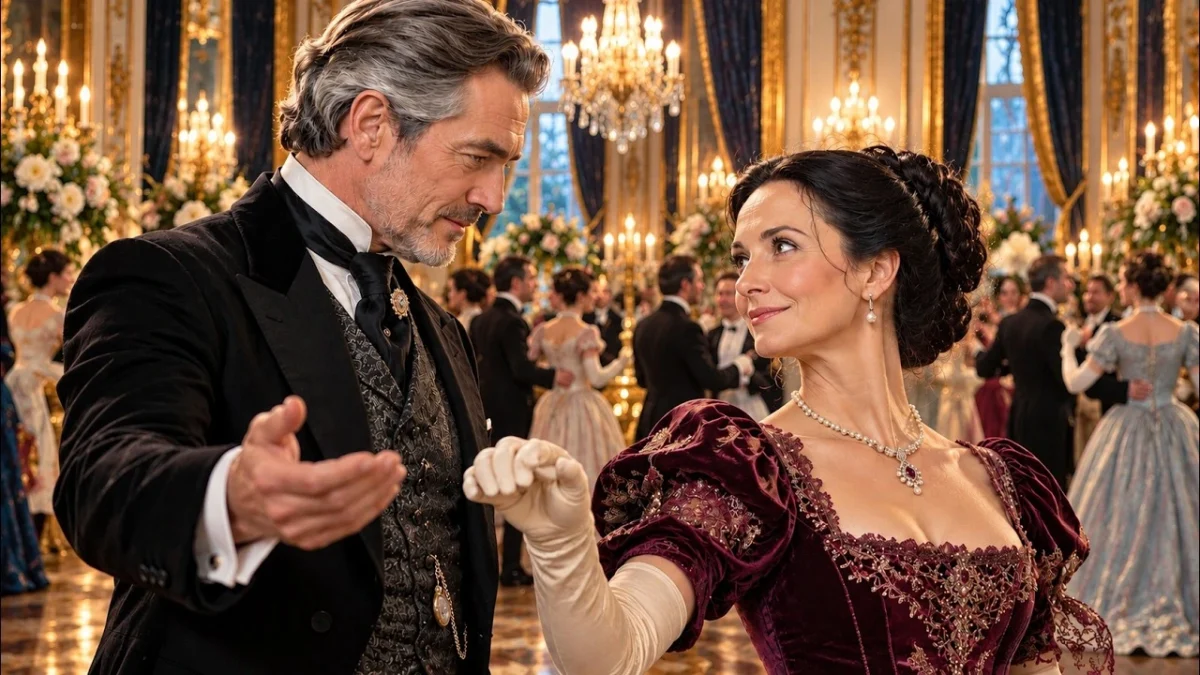
The winter of that year was remembered for decades as the harshest Britain had seen in half a century.
By the second week of December, the great turnpikes leading out of London were reduced to narrow white channels cut through impossibly deep drifts.
Hedgerows vanished entirely beneath mountains of snow, and the frost clung to the windowpanes in thick, jagged feathers that no fire could melt.
Yet inside the carriage that rattled its way up the long, winding drive of Blackwood Manor, the cold was a quiet, suffocating presence that no amount of heavy wool blankets could hold at bay.
Eleanor Hart pulled her velvet cloak tighter around her shoulders, her fingers numb inside her gray gloves.
Beside her, nineteen-year-old Clara sat with her knees pressed together, her breath coming in tight, visible puffs of vapor.
The girl’s cheeks were flushed, not from the chill, but from a terror so absolute it made her teeth chatter against one another.
“Aunt Eleanor,” Clara whispered, her voice trembling as she clutched a silk reticule to her chest as though it were a shield.
“What if my dress is creased? What if the Duke does not speak to us? What if… what if no one asks me to dance at all?”
Eleanor turned her head slowly, looking at her niece with eyes that were calm, steady, and entirely devoid of illusion.
“Your dress is fine, Clara, for it was ironed three times before we left Charles Street,” Eleanor replied softly, her tone laced with a practical warmth.
“The Duke will certainly not speak to us, as he will be occupied with three hundred other guests, and as for being asked to dance, you are young, fair, and your mother’s eldest daughter. You will not sit out a single set.”
Clara swallowed hard, her blue eyes wide as she peered out the carriage window at the looming shadow of the estate.
“I wish Mama had come,” Clara whimpered, her hands twisting the velvet fabric of her gown.
“She would know who to speak to. She would know how to make them look at me.”
“Your mother has a chest cold that would have become inflammation of the lungs had she set foot outside today,” Eleanor said firmly, adjusting the girl’s delicate lace collar with gentle, practiced fingers.
“I am here in her place. I know every face in that ballroom, Clara, and more importantly, I know how to ensure you are seen by the right ones. Now, take a deep breath. A lady of quality does not arrive at Blackwood Manor looking as though she is going to an execution.”
The carriage lurched to a halt beneath the great stone porte-cochère of the manor.
Blackwood Manor stood atop its solitary hill like a fortress from a sterner century, its heavy gray stone defiant against the howling blizzard.
Yet every one of its tall gothic windows blazed with golden light, casting long, warm rectangles onto the virgin snow below.
To those arriving from the freezing darkness, it looked like a beacon of grand hospitality, promising warmth, music, and the intoxicating hopes of the winter season.
Inside, however, the promise was only half-kept.
When the heavy oak doors opened, Eleanor stepped into a hall that smelled heavily of beeswax, roasting pine, sweet rum punch, and the oppressive heat of hundreds of bodies wrapped in expensive silks and heavy wools.
Massive crystal chandeliers hung from the high, painted ceiling, dripping with hundreds of beeswax candles that dropped tiny pinpricks of heat onto the crowd below.
Music drifted down from the balcony where a full orchestra was tuning their instruments, the sharp scrape of violins cutting through the low, thunderous roar of aristocratic conversation.
“Keep your chin up, Clara,” Eleanor murmured under her breath as they descended the marble staircase into the sea of jewels and cravats.
“Walk toward the left side of the room. The light is better there, and Lady Pembroke is standing near the punch bowl with her son.”
Clara nodded, her spine stiffening as she absorbed her aunt’s tactical directions.
Within ten minutes, through Eleanor’s quiet, unobtrusive arrangements, Clara was introduced to the baronet’s son and led out onto the polished floor for a quadrille, her cheeks glowing with sudden relief.
Eleanor watched her go, ensuring the girl was safely embedded in the dance, and then she began her own well-rehearsed retreat.
She did not head toward the fireplace where the wealthy matrons gathered to tear reputations to shreds.
She did not linger near the refreshment tables where eager younger sons sought wealthy heiresses.
Instead, Eleanor walked with smooth, deliberate steps toward the far corner of the great hall.
There, half-hidden behind the broad, drooping fronds of an enormous potted fern set in a heavy brass urn, she took her stand.
She was thirty-eight years old.
She had never married.
She possessed neither the vast fortune that made an older woman an “eccentric heiress” nor the utter poverty that made her an object of active charity.
She existed in that invisible grey space society reserved for women whose youth had faded without a ring upon their fingers.
Her gown was a deep plum silk, exquisitely tailored, impeccably clean, and undeniably two seasons out of fashion.
Her dark hair was pinned up neatly, unadorned by feathers or jewels, leaving the few silver strands at her temples clearly visible in the candlelight.
A footman passed, and Eleanor took a cup of lukewarm tea from his silver tray, holding it with both gloved hands.
She had no intention of drinking it.
The cup was merely a prop, a shield that kept her hands busy and signaled to the rest of the world that she was occupied, self-sufficient, and required no pity or conversation.
For twenty years, Eleanor had stood in corners like this one.
She had mastered the exact geometry of standing where she could see every movement in the room without forcing anyone to feel the social obligation of asking her to dance.
Over the years, she had stopped feeling like a living, breathing woman at these grand balls.
She had become like the furniture—a respectable, well-polished mahogany chair.
Useful for holding coats, entirely dependable, and thoroughly overlooked.
Across the glittering ballroom, standing near the towering marble hearth, was the master of the house.
Adrian Whitmore, the Duke of Blackwood, was fifty-one years old, broad-shouldered, and built like an iron pillar.
His hair was a dark, severe gray, cropped shorter than the current London fashion dictated, and his face seemed permanently set in lines of stoic disapproval.
He had been a widower for a decade.
His eldest son was already in Parliament, managing the family’s northern estates, while his younger son was an officer in the Guards.
He needed no heir.
He needed no bride’s dowry to clear his ledgers.
Yet every ambitious mother in the room eyed him like a prize, surrounding him with daughters in pastel dresses like wolves circling a royal stag.
The ball itself was not his idea.
His formidable sister, Lady Beatrice Crane, insisted every winter that Blackwood Manor must open its gates to society, arguing that a Duke could not entirely isolate himself from his peers.
So Adrian endured it, standing by the fire like a magnificent, brooding statue.
What the eager mothers and giddy young ladies failed to notice, because no one ever looked closely at a powerful man, was that Adrian stood with nearly all his weight resting on his right leg.
Twenty years ago, a hunting accident in the mud of Yorkshire had shattered his left knee.
It had healed, after a fashion, but whenever the damp winter cold settled into the stone walls of the manor, the knee woke up with a quiet, grinding agony.
He did not complain.
Dukes did not show weakness.
He simply endured, staring out over the sea of velvet and diamonds with a detachment so profound it bordered on absolute isolation.
He was as entirely alone in that crowded room as Eleanor was behind her fern.
Perhaps even more so, for she was at least allowed to hide.
As the quadrille drew to a close, Adrian quietly stepped away from the fireplace.
He moved with the subtle, practiced ease of a large man who knew how to slip through a crowd without attracting attention, avoiding eye contact with eager matrons and nodding to no one.
He skirted the perimeter of the room, his boots making no sound on the heavy carpets, until he reached the quiet shadow behind the potted fern.
He stopped beside Eleanor, his hands clasped firmly behind his back.
Eleanor did not turn her head.
Adrian did not offer a polite greeting.
For a long moment, both of them simply stared out at the dance floor, where a young gentleman in a glaringly bright peacock-blue waistcoat attempted a complex turn, missed his footing completely, and nearly propelled his terrified partner headfirst into the punch bowl.
“If he continues to maneuver like that,” Adrian murmured, his voice low, dry, and gravelly, “he will have killed the girl before supper is served.”
Eleanor brought the lukewarm cup of tea to her lips, taking a tiny, deliberate sip before answering.
“Then at least the evening will have served some memorable purpose,” she replied smoothly, her gaze remaining fixed on the dance floor.
Neither of them moved for a breath.
Then, very quietly, both of them let out a low laugh.
It was not the polite, hollow laughter exchanged by strangers in a ballroom.
It was the comfortable, unhurried chuckle of two old companions who knew each other’s minds without needing to look each other in the eye.
To any casual observer, their meeting was a mere coincidence—a lord pausing near a corner while a spinster rested.
It was no coincidence.
For five consecutive winters, across five grand balls, three dozen formal dinners, and more dull musical evenings than either cared to remember, the Duke of Blackwood had consistently found his way to whatever quiet corner Eleanor Hart occupied.
It had begun five years ago by pure chance, when both had fled the suffocating heat of a summer drawing room and found themselves standing side by side near an open window.
Over the years, that chance encounter had evolved into an unspoken ritual.
Neither had ever spoken of it during the months between seasons.
Neither had ever sent a letter or made a grand gesture.
They simply arrived at these agonizing social functions, took up their positions, and spoke in hushed, cynical observations, like two veteran soldiers sharing a cold wall during a long night watch.
“Lady Pembroke is setting a furious pace tonight,” Eleanor observed softly, her eyes tracking a plump woman in emerald silk.
“She has steered her eldest daughter toward three different fortunes in less than an hour.”
“The Pembroke girl looks as though she would rather be pushed out into the snowdrift,” Adrian remarked, his eyes narrowing slightly.
“She is looking at the young lieutenant near the door with absolute devotion, while her mother drags her toward a peerage.”
“A pity,” Eleanor murmured.
“And what of Mr. Fairfax over there?”
“He is courting Miss Lowell for her father’s merchant fleet,” Adrian said without hesitation.
“Miss Lowell knows it, her father knows it, and Mr. Fairfax knows that they know it. It makes it, in my humble estimation, the most remarkably honest match in the entire room.”
Eleanor’s lips twitched with a hidden smile.
“And the Countess of Ashby? She has just spent ten minutes admiring the trimming on four different gowns.”
“And she meant a word of it to none of them,” Adrian replied softly.
“Which gives her a far better record of sincerity than most members of Her Majesty’s Parliament.”
He shifted his weight slightly, a tiny wince tightening the corners of his dark eyes before his expression smoothed back to stone.
“I ought to be in my study,” Adrian added, leaning back against the wooden wainscoting.
“There is a blazing fire in there, a exceedingly comfortable leather chair, and a bottle of twenty-year-old Scotch whisky that my dear sister Beatrice has explicitly forbidden me from touching until midnight.”
Eleanor did not look away from the dancers.
“And yet, Your Grace is still standing in a drafty hall.”
“And yet I am still here,” Adrian agreed quietly.
“Beatrice insists that a host who disappears before the midnight roast is served is committing an unpardonable sin against polite society.”
“I am only here because of Clara,” Eleanor said, her voice softening slightly as she watched her niece complete a figure in the dance.
“If Margaret had not caught a feverish cold, I would be sitting at home in my own parlor with a decent book, a warm woolen shawl, and absolutely no one to observe.”
“Then it appears we are both prisoners of duty,” he said, turning his head a fraction of an inch toward her.
“A fine pair of captives.”
“We are not a pair, Your Grace,” Eleanor noted mildly.
“No,” he said after the briefest pause, his voice dropping an octave.
“Of course not.”
Yet they were a pair in every way that mattered, and in no way that the shallow world around them could comprehend.
Both were trapped inside rigid, predefined roles society had assigned to them years ago.
He was the untouchable, grieving Duke who required nothing from the world; she was the reliable, forgotten spinster who expected nothing from it.
They played their parts so flawlessly that everyone else had forgotten there were real, living people beneath the titles and the plum-colored silk.
Both had watched enough of these glittering, superficial evenings to completely abandon belief in the fairy-tale romance performed upon ballroom floors—a romance measured strictly in acres of land, title ranks, and annual yield.
And both, if they were entirely honest with themselves, vastly preferred the shadowy edge of the room.
From the edge, you could see the truth of everything.
From the edge, no one could reach out and hurt you.
Midway through the next musical piece, Eleanor subtly shifted her weight from her right foot to her left.
It was a minute movement, so small that even her own sister would have missed it.
Adrian saw it instantly.
He had seen it every winter.
Her evening slippers were brand-new, purchased three days ago at Margaret’s sharp insistence, and they were at least half a size too narrow across the toes.
By this hour of the night, Eleanor’s feet were undoubtedly aching with fierce intensity.
Adrian did not offer a word of sympathy; to speak of her feet would be an unpardonable breach of decorum that would cause her shame.
Instead, he casually stepped a foot to his left, positioning himself so that the sturdy, high wooden back of an unoccupied dining chair was brought directly into her reach.
Eleanor paused, then quietly rested one gloved hand on the solid mahogany frame, letting it absorb a portion of her weight.
She did not say thank you.
She did not need to.
A few moments later, as Adrian turned his torso to track Clara’s movements across the room, Eleanor noticed the deliberate, rigid manner in which he moved.
He turned entirely from his hips, avoiding any twist in his left leg, his jaw tightening into a hard, pale line as he settled his foot down.
The frost creeping through the glass of the tall French windows had deepened the ache in his old injury.
She knew it.
She had known it for three years, ever since the evening at the Marquess’s dinner when he had risen too quickly from a card table and gone utterly gray around the mouth.
She did not ask him about his health.
Instead, Eleanor remarked casually to the empty air, “The draft coming from this corner is truly vicious tonight. I wonder if the head footman might be persuaded to fetch a small footstool for the older ladies who might wish to rest near the walls.”
Five minutes later, a low, velvet-upholstered footstool was placed unobtrusively beside the brass urn by a swift footman.
Adrian ignored it for ten minutes out of pure, stubborn masculine pride.
Then, when Eleanor turned her head to look at a group of dancers, he quietly lifted his left foot and set it upon the cushioned stool, letting the tension drain from his throbbing knee.
Neither of them uttered a word about it.
That was the silent, secret truth of their corner behind the fern.
Eleanor had spent twenty years believing that no man in the world saw her as anything more than a chaperone or a convenience.
She had made her peace with that cold reality long ago.
Yet all that time—or at least for five long years—this powerful, guarded man had been quietly standing beside her, noticing the tight shoes, the untouched tea, the silver in her hair, and saying nothing because he did not know how, or perhaps because he was terrified of altering the only genuine comfort he possessed.
And Adrian had believed the same of himself—that behind his grandeur, his vast wealth, and his stern countenance, no one saw the tired, aching man who simply wanted an honest conversation.
He was entirely wrong as well.
The orchestra slowed, the vibrant lively music fading into a rare moment of stillness between sets.
Adrian looked at the burning candles above, watching the hot wax drip down the silver sconces.
When he spoke again, the dry, sarcastic edge had completely vanished from his voice, replaced by a quiet, raw vulnerability.
“Eleanor,” he asked softly, “do you ever miss being young?”
The question hit Eleanor somewhere deep beneath her ribs, making her breath catch in her throat.
She did not answer immediately.
She watched a young girl in white silk laugh up at her partner, radiant, breathtaking, and entirely convinced that life was a straight, sunlit path where nothing could ever break her heart.
“I miss the music,” Eleanor said finally, her voice low and reflective.
“When I was eighteen, I used to feel the rhythm of a dance in my feet before my ears even heard the notes.”
She paused, her fingers tightening slightly on the mahogany chair.
“But I do not miss the waiting. I do not miss standing near the wall with my dance card half-empty, praying that some man would take pity on me and cross the floor. I do not miss the terror of being unwanted. I do not miss that at all.”
Adrian remained silent, but he did not break his gaze.
From the raised gallery, the head violinist lifted his bow, drawing a single, long, melancholy note across the strings that resonated through the vast hall.
The rest of the musicians joined in, building a slow, sweeping waltz that rose like a tide from the polished oak floorboards.
It was a grand, dramatic piece of music, rich with longing and quiet passion.
Couples began to move out onto the floor in pairs, gloved hands touching gently, wide silk skirts billowing as they began to turn.
Outside the tall glass windows, the storm raged with sudden, frantic intensity.
The snow was no longer drifting; it fell in thick, blinding curtains, erasing the gardens, the stone statues, the drive, and the dark horizon beyond.
It felt as though the entire universe had been swallowed by white, leaving only this single, blazing room floating in an endless void.
Adrian turned his head fully and looked at Eleanor.
It should have been a brief, meaningless glance.
He had looked at her hundreds of times over the years.
Yet something in the question he had just asked, and something in the honest, unvarnished answer she had given, had fundamentally shifted the ground beneath his boots.
For the first time in five years, he did not see her as his comfortable, cynical companion of the ballroom shadow.
He saw a woman.
He saw the warm candlelight catching the silver threads in her dark hair and making them shine like spun glass.
He saw the sharp, formidable intelligence in her clear gray eyes.
He saw the stubborn, proud line of her jaw, and the delicate mouth that could disarm a pompous lord with a single, dry sentence.
And beneath all of that strength, hidden so deeply that perhaps only a man as lonely as himself could ever recognize it, he saw the profound, heavy solitude she had carried for twenty years until it had become a permanent part of her posture.
Adrian smiled.
It was a rare thing—a true Blackwood smile.
It transformed his stern, carved face, softening the harsh lines around his mouth and bringing a sudden, breathtaking warmth to his dark eyes.
Then, because he was a man who had long ago forgotten how to express the genuine feelings of his heart without a defensive barrier, he presented it as a joke.
“If I were younger,” he murmured softly, “I would ask you to dance.”
It was meant to be a harmless remark.
It was intended to take its place alongside all their other quiet, sarcastic observations—the sort of casual tease that could be laughed off, brushed aside, and forgotten by morning.
He expected her to roll her eyes.
He expected her to make a sharp, witty remark about his ruined knee or his gray hair, and then they would return to watching the room as they had always done.
Eleanor did not laugh.
She turned her body slowly, completely abandoning her view of the room, and looked him straight in the eye.
In the space of three quiet heartbeats, the entire remainder of her existence unfolded before her mind with horrifying, merciless clarity.
She saw herself chaperoning Clara through this season, and the next, and the one after that.
She saw herself twenty years from now, chaperoning Clara’s daughters in rooms identical to this one.
She saw herself standing behind potted palms, holding cold cups of tea, watching generation after generation fall in love, marry, build lives, and grow old, while she grew grayer, quieter, and smaller, until one winter she simply ceased to be invited anywhere at all.
She saw the long, bleak road of her remaining years stretching out into the dark—flat, straight, empty, with no warmth to mark the miles.
And something deep inside her chest—something that had been beaten down and forced to sleep for fifteen long years—suddenly woke up and shattered its chains.
“Who said you can’t?” Eleanor asked.
The words were spoken quietly, barely louder than the rustle of her silk gown.
Yet they landed between them like a massive stone dropped into motionless water.
Adrian stared at her, his breath catching in his throat.
For the first time in his life, the Duke of Blackwood was entirely struck dumb.
He searched her face frantically for the joke, for the sarcastic curve of her lips or the playful sparkle in her eye that would tell him she was merely playing a game of wits.
He found nothing.
Her gaze was steady, absolute, and unyielding.
The gray eyes that had spent twenty years staring safely out at the crowd were now locked entirely upon him.
“You are serious,” he said at last, his voice dropping to a rough whisper.
“I have never,” Eleanor said, her voice completely firm, “joked about your knees.”
Something broke open inside Adrian’s chest with the force of a physical blow.
It might have been a laugh; it might have been something infinitely more dangerous.
Slowly, deliberately, he lifted his left foot from the velvet stool and set it firmly on the floor.
He drew himself up to his full, imposing height, completely ignoring the sharp, white-hot protest that flared through his injured joint.
He stepped out from the deep shadow of the potted fern, leaving the safety of the corner behind, and stepped directly into the bright, uncompromising light of the chandeliers.
He turned toward her, bowed deeply from the waist, and extended his right hand to her, palm up, in the timeless, formal gesture of a gentleman requesting a set.
It was a hand he had not offered to a single woman in more than ten years.
“Then, Eleanor Hart,” he said, his voice ringing with a quiet, fierce intensity that was audible only to her, “will you walk into the fire with me?”
Eleanor looked down at his open hand.
She thought of her sister Margaret, who would suffer a fit of apoplexy when she heard of this.
She thought of the inevitable, cruel gossip that would tear through every drawing room in Mayfair by noon tomorrow.
She thought of Clara’s delicate prospects.
She thought of every rule of decorum, every boundary of age, and every social convention she had spent her life painstakingly obeying.
Then, Eleanor set her lukewarm cup of tea down on the edge of the brass pot, where it would remain forgotten for the rest of the night.
She lifted her arm and placed her gloved hand firmly into his.
Together, side by side, they took two steps out of the shadow and walked directly onto the open ballroom floor.
The effect was instantaneous and absolute.
The dancing couples nearest to them faltered in their steps, their feet tangling in their hem lines.
A high-society lady’s hand-painted fan froze mid-flutter.
Across the vast hall, heads turned one by one, like candle flames bending violently in a sudden, icy draft.
A heavy, suffocating silence began to spread outward from the center of the room, rippling across the crowd until even the musicians in the gallery hesitated, their bows hovering precariously over the strings.
The music did not stop.
The principal violinist, to his absolute professional credit, kept playing, though his eyes widened in sheer disbelief as he stared down at the floor.
And there, in the very center of the grand Blackwood Ballroom, beneath the blinding glare of three hundred candles, the Duke and the Spinster began to dance.
It was a striking, strange, and unforgettable sight.
All around them turned the young—the girls in diaphanous white silk, the young gentlemen with unlined faces and vibrant coats.
And in the absolute center of the room, moving like two dark, magnificent birds among a flock of doves, moved a tall man in severe, stark black evening dress and a woman in deep, muted plum.
Neither was young.
Neither made the slightest attempt to pretend to be.
The candle light gleamed brightly off the polished oak floor, mirroring their figures so that they appeared to dance over their own dark reflections.
Beyond the tall glass windows, the blizzard beat furiously against the panes, as though the storm itself were trying to force its way inside to witness the spectacle.
Adrian’s large hand settled firmly at Eleanor’s waist, warm, solid, and reassuring through the thick silk of her bodice.
Her hand rested upon his broad shoulder, feeling the rigid tension of his muscles beneath the fine wool of his coat as he braced himself against the pain in his leg.
On the third turn, his left knee buckled almost imperceptibly.
He recovered instantly with a stiff, unnatural half-step that threw them both slightly off the cadence of the music.
Eleanor raised a single eyebrow, looking up into his dark face.
“You are off the beat, Your Grace,” she murmured smoothly.
“My knee,” Adrian replied with solemn gravity, “has never taken the slightest interest in the wishes of an orchestra. It keeps its own time.”
Eleanor laughed.
It erupted from her suddenly—a clear, bright, joyful sound that was entirely unguarded.
It startled her so profoundly that she almost missed her next step, and it startled Adrian even more.
She could not remember the last time she had laughed like that—out loud, in the middle of a public room, without first stopping to consider who might hear her.
It was a sound she had forgotten her body knew how to make.
The ballroom heard it too.
Near the orchestra, Lady Beatrice Crane stood completely paralyzed, her champagne glass frozen halfway to her lips, staring at her brother as though he had suddenly lost his mind.
A gentleman near the refreshment table allowed his expensive red wine to pour over the rim of his crystal glass and directly onto his silk slippers, entirely unaware of the spill.
The young ladies lined up along the wall—the ones who had spent the entire evening trying to capture a single glance from the elusive Duke—watched with open mouths as he swept a woman nearly twice their age across the floor.
And their mothers, those ruthless generals of the London marriage market, had already put their heads together behind their fans, their eyes darting like daggers.
The whispers began to surge across the hall faster than the cadence of the waltz.
“Who is she?”
“The Hart woman.”
“The old spinster?”
“Surely not! He is only being charitable…”
“He must be!”
Near a marble pillar, Clara stood with her dance card slipping from her paralyzed fingers, staring at her aunt with an expression that oscillated between utter horror and profound wonder.
The baronet’s son was speaking to her, but Clara heard not a single word.
Her Aunt Eleanor—her quiet, sensible, invisible Aunt Eleanor, who spent her life reminding Clara to keep her collar neat and her voice low—was waltzing in the center of Blackwood Manor with the most powerful Duke in England, and she was laughing aloud.
Clara had no idea what to do with her face.
Eleanor felt every single pair of eyes in the room burning into her skin.
She had spent twenty years learning to detect the judgment of others, and she felt it now, sharp as needles pressing into the back of her neck.
Her footing faltered just a fraction.
Adrian felt the subtle shift in her posture instantly.
He inclined his head, bringing his mouth close to the shell of her ear.
“Let them look,” he commanded softly, his voice a steady anchor in the storm.
Eleanor’s lips curved into a faint, defiant smile.
“I have let them look for twenty years, Adrian,” she murmured back.
“Believe me, I know how to endure it.”
His hand tightened gently at her waist, drawing her half an inch closer to his chest—a scandalous, unforgivable half-inch that would be debated at every breakfast table in London by tomorrow morning.
“Then it is high time,” he said, his eyes burning into hers, “that they finally looked at the right woman.”
Eleanor could not answer.
A tight knot formed in her throat, choking off her speech, so she allowed the sweeping music to carry them instead.
Around and around they turned, the candlelight wheeling overhead in a blur of gold, the white snow a violent chaos beyond the windows.
His leg was throbbing with excruciating pain.
Her slippers were pinching her toes like a iron vice.
Neither of them cared in the slightest.
For the brief duration of that single waltz, they were no longer a grieving widower and a discarded spinster.
They were simply two human beings moving together in time—or very nearly in time—which was far more than most people in that room would ever achieve in a lifetime.
Then, the final, resonant chord of the waltz sounded from the gallery and faded slowly into the high rafters.
The movement ceased.
By long-established social custom, the room should have filled with polite, gentle applause.
No one clapped.
No one spoke.
The entire glittering assembly simply stood in dead silence, staring at the couple in the center of the floor.
The quiet in that hot, crowded room was as absolute as the snow drifting outside.
Adrian took a deliberate step back, drew his feet together, and bowed low to Eleanor with flawless, formal grace, as though nothing extraordinary had occurred.
Then, he extended his arm to her.
Eleanor rested her hand upon his forearm.
Together, with their heads held high, they walked the entire length of the grand ballroom, cutting directly through the parting crowd.
They walked past Lady Beatrice’s horrified face, past the narrowed, furious eyes of the matchmaking mothers, past the potted fern and the forgotten cup of tea, straight toward the heavy French doors at the far end of the hall.
Neither of them turned back.
A footman, far too well-trained to display the slightest emotion, pulled the heavy doors open for them, and the freezing night air struck them like a physical blow.
After the suffocating, perfumed heat of the ballroom, the air of the winter terrace was so sharp, clean, and icy that it seemed to cut straight into their lungs.
The moment the thick glass doors swung shut behind them, the muffled sound of the music and the sudden outburst of frantic chatter instantly died away.
Out here, there was only the silent, relentless falling of the snow through the golden light spilling from the windows.
It settled upon the dark stone balustrade, upon the bare, frozen branches of the lime trees, upon the broad shoulders of Adrian’s black coat, and upon the bare, pale skin of Eleanor’s neck.
The vast winter gardens below lay entirely buried, their manicured hedges and stone fountains turned into soft, ghostly mounds.
Eleanor walked to the stone balustrade and gripped the freezing masonry with both gloved hands.
The bitter cold bit straight through the fabric, but she did not pull away.
Her heart was hammering against her ribs like a trapped bird, and she desperately needed something solid to anchor herself to the earth.
For a long moment, she simply stood there, watching her breath form white plumes that vanished into the darkness.
Then, without turning around, she asked, “Why did you do that?”
Behind her, the snow crunched softly under his heavy boots as Adrian walked up to stand beside her.
“Why?” Eleanor asked again, turning her head to look up at him.
“You could have turned it into a joke. I gave you every opportunity to laugh it off and save yourself. Why didn’t you?”
Adrian looked at her, his dark eyes solemn.
He could have lied to her.
He had spent a decade lying smoothly to society, using his grand title as a shield and his cold demeanor as a weapon.
But the snow was falling, the artificial world of the ballroom was gone, and she was looking at him with those fierce, honest gray eyes.
He had no lies left to give her.
“Because I have been watching you for five years, Eleanor,” he said softly.
Eleanor went completely motionless.
“I know that you despise the smell of lavender,” Adrian continued, his voice barely louder than the falling snow, “because you quietly step away from any woman who wears it, and Lady Ashby wears nothing else. I know that you shift your weight when your slippers hurt, and that they always hurt because your sister buys them half a size too small. I know you hold a cup of tea at every party so your hands have a purpose, and I know you never drink a single drop of it.”
He stepped closer, his shadow falling over her.
“And I know that you deliberately seek out the one corner in any room where no man will ever ask you to dance. I have watched you choose that shadow a hundred times, Eleanor, and every single time, I have wanted nothing more than to walk across the room and pull you out of it.”
The blizzard continued to fall around them in a silent, white deluge.
When Eleanor finally found her voice, it was barely a whisper against the wind.
“What do you want from me, Adrian?”
Adrian looked out over the vast, white void of his buried gardens, and then turned his gaze back to her face.
“I want to remember what it feels like to be alive,” he said simply.
“Tonight, on that floor, for the first time in ten years, I remembered. And I am not ready to forget again.”
Slowly, deliberately, he lifted his right hand and gently touched her cold cheek with his gloved fingertips.
It was a tiny, simple gesture.
Yet it unraveled her entirely.
A single, hot tear escaped the corner of Eleanor’s eye, tracing a warm path down her freezing cheek until it met the fabric of his glove.
She did not turn away.
Snowflakes caught in her dark hair and settled on her long eyelashes, but she remained there, trembling from a feeling that had nothing to do with the winter cold.
“I did not want this,” she whispered, though her cracking voice betrayed the lie.
“I made my peace with my life years ago, Adrian. I built a quiet, safe existence, and it was enough for me. All I wanted was peace.”
“No,” Adrian said softly, his thumb gently wiping the tear from her skin.
“You did not want peace. You were simply terrified to admit that you wanted more than that.”
Eleanor could not deny it.
The profound, undeniable truth of his words hung between them in the frozen air, too clear and raw to be argued with.
Adrian lowered his head and kissed her.
It was not the gentle, polite kiss of a courtship in a parlor.
It was something far older, deeper, and infinitely more urgent.
It was the desperate release of two human beings who had been stranded in cold isolation for so long that they had forgotten they were allowed to reach out and claim happiness.
For a brief second, Eleanor went rigid with pure shock.
Then, her hands released their grip on the freezing stone balustrade, reached up, and clutched the lapels of his heavy wool coat.
She kissed him back fiercely, like a starving woman who had suddenly been brought to a feast.
When they finally drew apart, both of them were breathless, their faces flushed, and a thick layer of white snow had settled upon their hair and shoulders.
Adrian’s chest heaved as he breathed in the freezing air, his eyes dark with an intensity she had never seen before.
Eleanor’s gloved hands remained tightly clenched in his coat, anchoring him to her.
They stared at each other in the dim light cast by the ballroom windows, and neither uttered a word, for words had become entirely redundant.
Behind them, inside the warm, bright, suffocating hall, the initial shock was already hardening into fierce scandal and unstoppable gossip.
Ahead of them lay a ruined garden buried in snow, where every previous path had been wiped clean.
There was no returning to the quiet shadow behind the potted fern.
There was no returning to the safety of their old, lonely lives.
London awoke the following morning beneath a heavy, muffled blanket of fresh snow.
It lay thick upon the grand rooftops of Mayfair, piled high against the black iron railings, and deadened the sound of the few carriages that dared to navigate the icy streets.
It turned the modest brick townhouse that the Hart sisters shared on Charles Street into a scene of picturesque winter peace.
Inside the townhouse, however, there was no peace to be found.
Margaret Hart had resurrected herself from her sickbed like a woman rising from the grave to deliver judgment.
Wrapped in three heavy woolen shawls, her nose bright red from her cold, she was pacing the narrow length of the small front parlor with frantic energy, her voice rising steadily toward the ceiling.
Three urgent letters had already arrived before ten o’clock in the morning.
The first was from Lady Pembroke—dripping with false sympathy, intense curiosity, and barely concealed malice.
The second was from a distant cousin in Kensington, demanding to know if the unthinkable rumors were true.
The third was from the mother of Clara’s most promising suitor—it was the briefest of the three, formal and icy, and it was the one that had caused Margaret to collapse onto the velvet settee in utter despair.
“She has heard!” Margaret cried, waving the paper in the air with a trembling hand.
“They have all heard! Mrs. Lyle writes that she is certain the entire affair is merely a ‘regrettable misunderstanding’! Do you have any concept of what those words mean, Eleanor? It means she believes the absolute worst, and Clara’s suitor will never call again!”
Across the room, Clara sat curled up in the wide window seat, her eyes swollen and red from a night of weeping, twisting a damp lace handkerchief in her lap.
She had not slept a single wink.
Her very first season in London—her one real opportunity to secure a respectable match and a future—was now completely overshadowed by a scandal that would be discussed in every drawing room in the city.
“Mama, please,” Clara whimpered softly, her voice thick with tears.
“Aunt Eleanor did not mean to cause harm…”
“She danced with the Duke of Blackwood!” Margaret shrieked, turning her furious gaze toward Eleanor, who sat quietly near the cold fireplace, sipping a fresh cup of tea.
“She walked out of the shadows, threw twenty years of respectable behavior into the gutter, and waltzed with a widower in front of half the peerage! And then—as if that were not sufficient ruin—she walked out onto the terrace with him alone!”
Margaret pressed a hand to her forehead, groaning dramatically.
“We are ruined, Eleanor! Utterly ruined! No respectable man will look at Clara now! They will think our entire family is mad, forward, and unmanageable! What do you have to say for yourself?”
Eleanor set her teacup down onto the saucer with a small, clear click.
She did not look ashamed.
She did not look repentant.
She sat straight-backed in her chair, her face serene, a soft, quiet light burning in her gray eyes that had never been there before.
“I have to say, Margaret,” Eleanor replied, her voice entirely calm and steady, “that for twenty years I played the quiet aunt who stood in the corner so that everyone else might be comfortable.”
She stood up slowly, her plum-colored skirt falling gracefully around her, and looked at her sister and niece.
“I spent my youth making sure no one was offended by my presence. But last night, I decided that I am a living woman, not a piece of furniture to be left against the wall.”
“And what has your sudden realization brought us?” Margaret demanded, tears of frustration spilling down her cheeks.
“Disgrace! Gossip! The door of polite society shut in our faces!”
Before Eleanor could answer, the heavy brass knocker on the front door echoed through the townhouse, sharp and commanding.
Margaret froze, her breath catching in her throat.
Clara sat up straight in the window seat, her eyes wide with terror.
“Who could that be at this hour?” Margaret whispered in horror.
“It is barely eleven o’clock! If it is a journalist or a gossip-monger, Eleanor, I swear I shall…”
Footsteps sounded in the hall, followed by the quiet, panicked voice of their elderly butler.
The parlor door opened, and the butler stood in the doorway, his face pale, holding a silver tray upon which rested a heavy, folded parchment card bearing a deep black wax seal depicting a crest of a lion and a oak tree.
“His Grace,” the butler announced, his voice trembling violently, “the Duke of Blackwood.”
The parlor went dead silent.
Margaret dropped her shawls.
Clara gasped, pressing her hands to her mouth.
Adrian Whitmore stepped past the butler and walked directly into the small room.
He was dressed impeccably in a dark, tailored overcoat, carrying a polished silver-headed cane in his right hand.
He leaned slightly on the cane, but his posture was regal, commanding, and absolute.
He did not look like a man who had come to apologize.
He looked like a sovereign who had entered a foreign court.
His dark eyes swept over the frozen room, ignoring Margaret’s open mouth and Clara’s terrified gaze, until they locked onto Eleanor.
The stern, harsh lines of his face softened instantly.
Adrian walked across the small parlor, completely ignoring social formality, stopped directly in front of Eleanor, and bowed deeply.
“Good morning, Eleanor,” he said, his gravelly voice filling the room with an undeniable authority.
“I trust you slept well, despite the storm?”
“I slept better than I have in twenty years, Your Grace,” Eleanor replied, a small, genuine smile gracing her lips.
Margaret suddenly found her voice, stepping forward with her hands clasped tightly against her chest.
“Your… Your Grace!” Margaret stammered, her face pale.
“We… we did not expect… That is to say, after the events of last night…”
Adrian turned his head slowly, looking at Margaret with a cold, aristocratic detachment that instantly silenced her.
“Mrs. Hart,” Adrian said smoothly, his tone icy and precise.
“I am aware that my actions last night may have caused a certain degree of chatter among those who have nothing better to do with their minds than observe their neighbors.”
He paused, shifting his cane slightly.
“I have come this morning to ensure that no misunderstanding persists.”
He reached inside his heavy coat, produced a thick, official letter bearing the grand seal of the Blackwood estate, and stepped toward Clara.
The girl shrank back slightly, but Adrian’s expression turned remarkably gentle as he looked down at her.
“Miss Clara,” he said, holding out the letter.
“This is a formal invitation to the Blackwood Private Musical Gala next fortnight. It is an exclusive gathering, limited to thirty of the most prominent families in the Kingdom.”
Clara took the letter with trembling hands, her eyes wide.
“Furthermore,” Adrian added, turning back to Margaret, “I have already instructed my solicitors to inform young Mr. Lyle’s father that if his son does not immediately renew his courtships with Miss Clara with the utmost respect, the Blackwood shipping contracts with his firm will be permanently terminated by sunset today.”
Margaret choked back a sob, her hands flying to her mouth in utter astonishment.
“Your Grace… you… you would do that?” Margaret whispered.
“I would do far more than that to protect those associated with my family,” Adrian replied calmly.
Then, he turned back to Eleanor.
The stern Duke vanished, leaving only the man who had stood beside her behind the potted fern.
He reached out, taking her gloved hand in his, completely unbothered by the presence of her family.
“Eleanor,” he said softly, his dark eyes searching hers with profound earnestness.
“The snow has cleared the roads to the north estate. The carriage is waiting outside.”
He raised her hand to his lips, pressing a slow, deliberate kiss to her knuckles.
“I am going to my country house in Yorkshire, far away from the ballrooms, the fans, and the empty chatter of London.”
He looked at her, his voice dropping to a low, intense whisper.
“Will you come with me? Not as a chaperone, not as a guest, but as the Duchess of Blackwood?”
In the small parlor on Charles Street, the silence returned, complete and absolute.
Margaret looked as though she might faint directly onto the rug.
Clara stared at her aunt with tears of pure joy springing to her eyes.
Eleanor looked at the man standing before her—the man with the silver hair, the aching knee, and the heart that had chosen her out of all the women in the world.
She thought of the cold, safe corner behind the fern.
She thought of the long, empty road she had feared.
And then she let go of the past entirely.
“Adrian,” Eleanor said, her voice clear, radiant, and filled with an absolute certainty that rang through the quiet house.
“I thought you would never ask.”








