“If I Were Younger, I’d Ask You to Dance,” the Duke Teased — “Who Said No?” She Replied
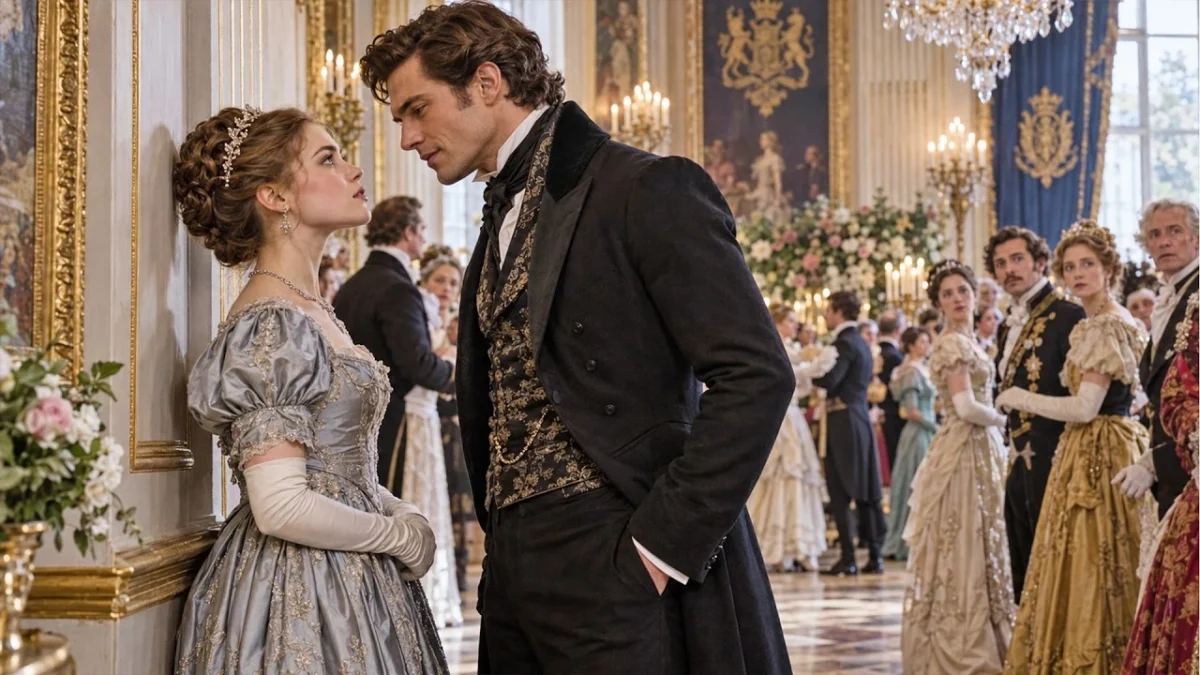
The ballrooms of Mayfair were built on a foundation of well-dressed lies.
You smiled at men you despised, drank champagne that tasted like brass, and pretended you did not notice when your youth quietly slipped out the back door.
Every so often, amidst the suffocating silk and forced laughter, a moment of reckless, terrifying honesty broke through.
A careless tease, a daring reply, and suddenly the rigid rules of polite society burned to the ground.
This was one of those moments.
The heat in the Earl of Rockford’s ballroom was a physical weight.
It pressed against the guests, heavy with the scent of wilting gardenias, hot floor wax, and the undeniable tang of anxious perspiration masked by expensive French perfumes.
Hundreds of wax candles burned furiously in the chandeliers overhead, dripping occasional beads of hot wax onto the polished oak floor, or in one unfortunate instance earlier in the evening, onto the bare shoulder of a shrieking debutante.
Cybil Trent stood in the shadows of a massive, aggressively green potted fern, pressing her shoulders against the cool plaster of the wall.
She was thirty-eight.
In the brutal mathematics of London society, this made her a ghost.
She was not wealthy enough to be an eccentric, nor poor enough to be an object of pity.
She was simply there, the unmarried aunt, the reliable chaperone, a piece of gray furniture in a room desperate for bright colors.
Tonight she was tasked with guarding the interests of her niece, Jane.
Currently, Jane was being steered through the steps of a country dance by a young baron who possessed a terrifyingly loud laugh and the chin of a wet trout.
Cybil watched them with a detached, cynical affection.
Jane would marry him, probably.
He was harmless, and his estate in Kent was entirely free of debt.
It was a transaction, much like everything else in the room.
Cybil shifted her weight, wincing as the stiff leather of her right slipper dug painfully into her heel.
Her corset was laced just a fraction too tight, restricting her breath to shallow sips of the stale air.
She reached up, adjusting a tortoiseshell comb in her dark hair, finding the quiet misery of the corner far preferable to the exhausting theater of the dance floor.
“If Lord Hembury continues to laugh with his mouth open, he is going to swallow a moth.”
The voice was low, rough around the edges, and spoken right next to her left ear.
Cybil did not jump.
She merely turned her head.
Arthur Pendleton, the Duke of Westford, stood beside her.
He was fifty-one years old, though the deep lines carving brackets around his mouth made him look a hardened fifty-five.
He was a man who looked like he had been left out in the weather too long.
His dark hair was heavily salted with gray, receding slightly at the temples, and he wore his evening clothes with the begrudging air of a man who would rather be in hunting leathers.
“I believe it is a fly, Your Grace,” Cybil replied, her tone perfectly flat, her eyes returning to the dance floor. “Moths have the good sense to seek out the light. He is strictly surrounded by dimness.”
Arthur let out a sound that was half snort, half cough.
It was the closest he ever came to a laugh.
He leaned back against the wall beside her, mirroring her posture.
They were not friends, exactly.
They were fellow prisoners.
Over the past five seasons, they had found themselves occupying the same drafty corridors, the same secluded libraries, and the same terrace corners at dozens of these excruciating events.
He was a widower of ten years who had no need for a new wife, having secured two healthy heirs in his youth, and he possessed an active disdain for the matchmaking mothers who still occasionally tried to throw their eighteen-year-old daughters in his path.
“Why do we do this, Miss Trent?” Arthur asked.
He pulled a silver pocket watch from his waistcoat, checked the time with a scowl, and shoved it back.
“I could be in my study. I have a fire. I have a very expensive bottle of scotch. Instead, I am standing in a room that smells like a wet dog rolled in lavender, watching the youth of England step on each other’s toes.”
“You do it because your sister threatened to withhold her presence at your Christmas hunt if you did not show your face tonight,” Cybil said calmly, stating the gossip she had overheard in the cloakroom. “I do it because if I do not watch Jane, she will allow that baron to talk her into a stroll in the gardens, and the night air ruins her curls. We are both slaves to duty, Your Grace.”
Arthur rubbed a hand over his jaw.
The friction of his calluses against the closely shaved stubble made a quiet scratching sound.
“Duty is a terrible taskmaster,” Arthur grumbled. “It has robbed me of my evening and given me a headache.”
“Perhaps you should try smiling,” Cybil suggested dryly. “I am told it completely changes one’s disposition.”
“I smiled in 1814,” Arthur said, completely deadpan. “I found it entirely overrated.”
Cybil allowed a small, genuine smile to curve her lips.
It felt strange on her face, a muscle she rarely used in this company.
She turned to look at him fully.
Up close, he looked exhausted.
There was a dullness in his dark eyes, a heavy resignation that she recognized because she saw it in the mirror every morning.
They were two people entirely stripped of the illusions that propelled the dancers spinning before them.
They knew the romance was a lie, the marriages were contracts, and the glittering jewels were just rocks dug out of the dirt.
“You look tired, Westford,” she said.
It was a breach of etiquette to speak so directly, to drop his title so casually, but the potted fern offered a temporary amnesty from the rules.
“I am tired, Cybil,” he answered softly, the use of her Christian name a quiet reciprocation.
He shifted his weight, and she noticed the slight, suppressed flinch in his left knee.
He had taken a musk ball to the leg in Spain decades ago, a fact she only knew because he had once cursed violently and rubbed it during a particularly vicious rainstorm at a garden party three years prior.
“The chairs in the card room are padded,” she offered softly.
“If I go to the card room, Lady Jersey will corner me and demand a subscription for some orphanage,” Arthur groaned, crossing his broad arms over his chest. “I am perfectly content to stand here and rot with you.”
“A charming proposition,” Cybil murmured. “I accept.”
They lapsed into a comfortable silence.
Around them, the music ground to a halt.
The red-faced dancers applauded weakly, fanning themselves, desperate for lemonade and cold air.
The floor cleared, leaving a massive, empty expanse of polished wood in the center of the room.
It looked like a stage waiting for a tragedy.
The orchestra in the gallery began to tune their instruments for the next set.
The discordant pluck of violin strings and the low, mournful groan of the cello cut through the rising chatter of the room.
Arthur reached up and tugged at his cravat, loosening the crisp white linen by a fraction of an inch.
“Do you ever miss it?” he asked suddenly.
Cybil kept her eyes on the musicians.
“Miss what? Sweating in public? Being young?”
He did not look at her.
He watched a young couple, no older than twenty, laughing near the punch bowl.
The boy touched the girl’s wrist in a fleeting, electric contact.
Arthur’s jaw tightened.
“Believing that the next dance might actually change the course of your life,” he said quietly. “Believing in the sheer, unadulterated nonsense of it all.”
Cybil swallowed.
The cynicism she wore like armor suddenly felt very heavy and entirely useless.
“I do not miss the anxiety of it,” she said truthfully. “I don’t miss the terror of waiting to be asked or the humiliation of being overlooked.”
She hesitated, for she rarely gave away pieces of herself.
“But I do miss the music. I used to love the music. When you are young, you hear the music and your body simply wants to answer it. Now I hear the music and all I can think about is how badly my feet hurt.”
Arthur gave a low hum of agreement.
“My knee protests if I so much as look at a polished floor. Last time I attempted a waltz, I spent the following two days walking like a crippled crab.”
The orchestra leader tapped his baton against his music stand.
A hush fell over the room.
The first notes bled into the air, carrying the opening movement of a waltz.
It was a sweeping, melancholic melody, far slower and more intimate than the lively country dances that had preceded it.
It was a dance designed for lovers, or at least for people who desperately wanted to be.
The couples began to file onto the floor, men bowing, women curtsying, a sea of colored silk and black broadcloth forming neat, rotating circles.
Arthur watched them for a long moment.
He shifted his stance, turning slightly so he was facing Cybil directly.
The proximity between them was a violation of at least three societal rules, but the shadows of the alcove kept them hidden.
He was tall enough that she had to tilt her head back to look at him.
He smelled of starch, sandalwood, and something distinctly male, a clean, sharp scent that cut through the cloying perfume of the room.
He looked down at her, really looked at her.
He took in the severe line of her dark hair, noticing the few silver threads catching the candlelight.
He looked at the stark intelligence in her gray eyes, and the stubborn set of her jaw.
He looked at her not as a fixture of the ballroom, but as a woman breathing the same stifling air he was.
A self-deprecating, lopsided smile touched the corner of his mouth.
It was not his usual mocking smirk, but something remarkably soft, tinged with a regret that felt entirely too intimate.
“If I were younger, I’d ask you to dance,” he teased, his voice dropping in volume so that the words were meant for her and her alone.
It was a throwaway line, a compliment dressed up as a joke designed to be brushed off with a polite laugh and a witty deflection.
It was the kind of safe, protective banter they had traded for half a decade.
Cybil looked at his mouth.
She looked at the faint scar cutting through his left eyebrow.
She felt the heavy, suffocating weight of the room, and the years stretching out ahead of her, a long gray hallway of chaperoning nieces and sitting in shadows until she simply faded away entirely.
She was tired of the shadows.
She was tired of being safe.
She met his gaze squarely.
Her heart gave a sudden, violent kick against her ribs, but her voice remained perfectly, terrifyingly steady.
“Who said no?” she replied.
Arthur froze.
The teasing smile vanished from his face, replaced by a look of sheer, unadulterated shock.
He stared at her, searching her eyes for the punchline, for the smirk that would tell him she was mocking him.
But Cybil did not blink.
She stood her ground, her chin raised, holding his gaze with a quiet, fierce defiance.
The silence between them stretched thick and heavy, drowning out the swelling music of the waltz.
Arthur’s throat worked as he swallowed hard.
He looked at the dance floor, a swirling vortex of youth and gossip, and then he looked back at Cybil.
She saw the exact moment the Duke of Westford—pragmatic, cynical, and deeply tired—decided to throw caution into the fireplace.
“You are serious,” he murmured.
“I rarely joke about my feet, Your Grace,” Cybil said.
Arthur took a slow, deliberate breath.
The stiffness in his shoulders vanished.
The heavy resignation that usually clung to him evaporated, replaced by a sudden, sharp intensity.
He stepped backward out of the shadows of the fern and into the harsh, bright light of the ballroom.
He did not offer a polite, perfunctory bow.
He simply extended his large, gloved hand toward her.
“Then, Miss Trent,” he said, his voice stripped of all its usual armor, “would you do me the immense honor of walking into the fire with me?”
Cybil’s pulse was roaring in her ears.
She lifted her hand and placed it in his.
His fingers closed around hers, warm, solid, and surprisingly strong.
There was no hesitation as Arthur led her out onto the polished wood.
The reaction was immediate.
A ripple of whispers tore through the crowd, radiating outward from them like a stone dropped in a still pond.
Heads turned, and fans paused mid-flutter.
The sight of the reclusive, formidable Duke of Westford leading the spinster aunt of the Colgate family onto the floor for a waltz was a scandal of microscopic yet seismic proportions.
Arthur ignored them entirely.
He stepped into her space, placing his right hand firmly on her waist.
The heat of his palm bled through the thin silk of her gown, grounding her completely.
Cybil placed her hand on his broad shoulder, feeling the solid muscle beneath the wool coat.
“Ignore them,” he whispered, stepping into the rhythm of the music.
“I already am,” she whispered back.
And as he pulled her into the turn, his bad knee holding steady, the cynical walls they had built around themselves shattered into a thousand glittering pieces on the ballroom floor.
A waltz was an aggressive piece of machinery.
It demanded a synchronicity that could not be faked, forcing two bodies to share a single center of gravity.
For Cybil, dancing had always been a mathematical exercise—counting beats, calculating distance, and anticipating the heavy-footed blunders of nervous young men.
Arthur did not count.
He simply moved.
He was not a graceful dancer, for there was a rigid military precision to his steps, an economy of movement dictated by the lingering ache in his left knee.
However, what he lacked in fluidity, he compensated for with absolute, unyielding authority.
He steered her through the crowded floor with the sheer physical presence of a warship cutting through a fleet of dinghies.
“You are stepping on the beat,” Cybil noted, her voice breathless.
The heat of his hand on her waist was entirely distracting, acting as a massive warm pressure anchoring her to the polished floor.
“I am stepping where my leg allows me to step, Miss Trent,” Arthur replied, his focus fixed entirely on her face. “If the orchestra cannot keep up with my limp, that is their failing.”
A short, sharp laugh escaped her.
She snapped her mouth shut immediately, horrified at herself, because spinsters did not laugh during a waltz.
Spinsters did not waltz at all.
Around them, the ballroom was a blur of horrified fascination.
Cybil caught glimpses of it as Arthur spun her.
Lady Agatha, a woman whose face usually resembled a bulldog chewing a wasp, had gone completely pale, her feathered fan frozen against her chin.
Lord Croft, a man who had famously ignored Cybil for a decade, spilled a generous measure of claret down the front of his yellow waistcoat as they swept past.
They were a spectacle: a middle-aged, unremarkable chaperone and the most notoriously reclusive duke in England, holding each other in the center of Mayfair.
“They are staring,” Cybil said.
She tried to maintain the flat, detached tone she had spent twenty years perfecting, but she failed.
A slight tremor betrayed her.
“Let them stare,” Arthur said, his grip on her waist tightening just a fraction in physical reinforcement. “They have spent thirty years staring at children fumbling in the dark. It is about time they saw two adults who actually know how to stand on their own feet.”
“I am fairly certain my right heel is bleeding,” Cybil confessed, “and my corset is currently screaming in Spanish.”
Arthur’s mouth twitched.
The harsh lines around his eyes softened, crinkling in a way that made him look remarkably, startlingly human.
“But I find I do not care,” Arthur murmured softly. “Do you?”
Cybil looked at him.
She looked past the title, past the wealth, past the gray hair and the intimidating scowl.
She saw a man who was just as exhausted by the charade as she was.
She felt the tight, suffocating corset of her social standing begin to loosen, breath by breath.
“No,” she said softly. “I do not care at all.”
The music swelled, the cellos digging deep into the minor chords.
Arthur pulled her slightly closer, and the distance between them shrank to a scandalous margin.
She could feel the heat radiating through his broadcloth coat.
She could smell the sharp tang of peppermint on his breath and the underlying scent of clean linen.
“You are a remarkably stubborn woman, Cybil,” he murmured.
“It is my only defense mechanism,” she replied smoothly. “I cannot rely on a vast fortune or a title to terrify people into leaving me alone.”
“You terrify them because you see right through them,” Arthur said. “You sit in that corner and you mentally dissect every lie they tell themselves. It makes them profoundly uncomfortable.”
He steered them smoothly around a colliding couple, his left leg taking the brunt of the turn with a barely perceptible hitch.
“It makes me entirely fascinated,” he added.
Cybil’s breath caught in her throat.
Compliments in this world were currency traded for favors or used to grease the wheels of a transaction.
But Arthur wanted nothing from her.
He had nothing to gain by dragging her onto the floor.
“You are speaking nonsense, Westford,” she whispered.
“I have never been more articulate,” he countered, looking down at her as his dark eyes stripped away the last of her practiced indifference. “I spent the last five years watching you watch the room. I thought we were the same—two ghosts haunting a house that belongs to the living.”
“We are ghosts,” she insisted weak-jointedly.
“Speak for yourself,” Arthur’s voice dropped, vibrating in the narrow space between them. “I feel entirely alive right now.”
The final chords of the waltz struck.
The music did not fade; it ended with a sharp, decisive crescendo.
They stopped moving for a single, suspended second.
Neither of them pulled away.
Arthur’s hand remained flat against the small of her back, and Cybil’s fingers stayed curled into the wool of his shoulder.
The heat between them felt entirely untethered from the cold, calculating world around them.
Then the reality of the room crashed back in.
The silence was deafening.
It was not the polite, expectant hush of a dance ending, but a dense, suffocating quiet born of absolute shock.
No one applauded.
No one moved toward the refreshment tables.
Hundreds of eyes were pinned to the center of the floor.
Arthur slowly dropped his hand.
He stepped back, putting the socially acceptable distance between them.
He did not bow, but instead offered her his arm, his expression instantly hardening back into the granite mask of the Duke of Westford.
Cybil looked at his offered arm, her fingers trembling.
She had walked into the fire just as he had asked, and now she had to figure out how to survive the burn.
She placed her hand on his sleeve.
They did not walk toward the edges of the room where Jane and the chinless baron were standing in slack-jawed horror.
They did not retreat to the shadowy corners reserved for chaperones.
Arthur led her straight through the center of the crowd.
The sea of silk and broadcloth parted for them, not as a gesture of respect, but out of sheer self-preservation.
Arthur’s expression promised violence to anyone who dared speak a word, and Cybil kept her chin elevated at a rigid, defensive angle.
Her heart hammered against her ribs like a trapped bird.
He steered her out of the ballroom, down a long, dimly lit corridor adorned with heavy tapestries, and finally pushed open a set of French doors.
The night air hit them like a bucket of cold water.
It was a small stone terrace overlooking the earl’s manicured gardens.
The scent of damp earth and crushed gravel replaced the stifling odor of hot wax and perfume.
Cybil immediately dropped her hand from his arm and walked to the stone balustrade.
She gripped the cold masonry with both hands, dragging oxygen into her lungs.
“Well,” Arthur said, his voice rough.
He leaned against the stone wall beside the doors, pulling a silver flask from his inner pocket.
“We have undoubtedly ruined your niece’s marital prospects. I apologize.”
“Jane’s dowry is twelve thousand pounds,” Cybil panted softly. “She could dance naked on the supper tables, and Lord Hembury would still marry her.”
Cybil squeezed her eyes shut, fighting the sudden sharp sting of tears.
It was adrenaline, she told herself, just the violent crash following an unexpected thrill.
She heard the unscrewing of a metal cap.
“Drink,” he offered.
She opened her eyes and turned.
He was holding the silver flask out to her.
Cybil stared at it.
Spinsters did not drink from men’s flasks on dark terraces.
Then again, spinsters did not waltz with dukes.
The rules had already been shattered, so she might as well sweep up the glass.
She took the flask, wiped the rim carefully with her thumb, and took a long sip.
The whiskey burned a fiery path down her throat, hitting her stomach with a heavy, spreading warmth.
She coughed, handing it back.
“Good God, do you clean your boots with that?”
“Only on Sundays,” Arthur replied.
He took a pull from the flask himself, leaning his head back against the stone wall.
He looked exhausted again, but the dullness in his eyes was completely gone.
He looked like a man who had just survived a bar brawl and found he enjoyed the bloody knuckles.
“Why did you do that?” Cybil asked, the whiskey having stripped away her remaining politeness. “Why did you ask me to dance? I told you I was tired of standing by the fern. Do not lie to me, Arthur.”
The use of his Christian name spoken with such sharp authority made him pause.
He lowered the flask.
The mockery vanished from his face, leaving behind something raw and deeply uncomfortable.
“Because I looked at you,” he said, his voice dropping to a quiet rasp, “and I realized that if I spent one more night watching you pretend you are dead, I was going to lose my mind.”
Cybil flinched as the words hit her with physical force.
“I am not pretending,” she protested. “I am merely accepting my reality. I am thirty-eight years old, unmarried, and entirely unremarkable.”
“You are the most remarkable woman in that miserable room, and you know it,” Arthur said fiercely.
He pushed off the wall and closed the distance between them in two long strides.
He did not touch her, but his proximity was a heavy, inescapable weight.
“You hide behind your sarcasm and your terrible gray gowns because it is easier than admitting you still want something from this life.”
“I want peace,” she snapped, her voice breaking slightly. “I want to be left alone to read my books and ignore the fact that the world decided I was useless fifteen years ago!”
“Liar,” he said softly.
It was not an insult, but a devastating observation.
Arthur reached out.
He did not grab her arm or her waist.
He reached up and gently touched the side of her face.
His thumb, rough with calluses from the reins of a horse, brushed against her cheekbone.
Cybil froze completely.
The touch was so painfully gentle, so entirely at odds with the harshness of the man, that it shattered her remaining defenses.
A single tear betrayed her, slipping down her cheek to wet his thumb.
“You don’t want peace, Cybil,” Arthur whispered, staring down into her eyes. “You want a fire. You want someone to look at you and see the woman, not the furniture. You want to be terrified and thrilled and ruined.”
She could not breathe, nor could she look away from him.
“And what do you want?” she asked, her voice a fragile thread in the dark.
Arthur’s jaw tightened, the shadows of the terrace carving deep, lonely lines into his face.
“I want to remember what it feels like to burn,” he said.
He did not wait for permission.
He did not ask.
He leaned down and pressed his mouth to hers.
It was not a polite, tentative kiss.
It was desperate.
It was years of forced isolation, cynical observation, and quiet fury boiling over into a single point of contact.
His mouth was hard and tasted of expensive whiskey and bitter reality.
Cybil gasped against his lips, her hands flying up to grip the broad lapels of his coat.
She did not push him away.
She pulled him closer.
She kissed him back with a fierce, answering anger.
It was a kiss of defiance, a violent rejection of every rule that had told them they were too old, too tired, and too late to feel anything at all.
The kiss ended not with a soft romantic sigh, but with a harsh intake of breath.
Cybil pulled back first, her chest heaving, the cold night air suddenly rushing in to fill the space between them.
She stumbled a half step backward, her right heel striking the unforgiving stone of the terrace.
She did not fall, for Arthur’s hand shot out, gripping her elbow with bruising force to steady her.
They stood there in the dark, two people who had just thrown a lit match into a powder keg, watching the embers burn.
Cybil pressed the back of her gloved hand to her mouth.
Her lips felt swollen, bruised by the sudden violence of the encounter.
She tasted a tiny metallic tang where her teeth had caught her lower lip.
She looked up at Arthur.
He did not look smug, nor did he look triumphant.
He looked like a man who had just stepped off a ledge and realized he did not know how to fly.
“We need to go inside,” Arthur said, his voice a low, gravelly rasp.
He dropped his hand from her elbow and stepped back, his chest rising and falling heavily.
“We need to collect your niece and leave before the Earl’s wife decides to send a footman out here to investigate the delay.”
“Yes,” Cybil managed to say, her voice sounding thin and stripped of its usual cynical armor. “Yes, of course.”
She turned toward the French doors.
Her legs felt hollow, as if the marrow had been scooped out and replaced with cold lead.
She paused, her hand hovering over the brass handle.
If she opened this door, she was stepping back into the firing line.
The kiss on the terrace was a private madness, but the waltz was a public execution.
Arthur stepped up directly behind her.
He did not touch her, but his presence was a solid wall at her back.
“Keep your chin up, Miss Trent,” he ordered softly. “Do not give them the satisfaction of a retreat. You are a conqueror returning to camp. Act like it.”
Cybil took a sharp breath, squared her shoulders, and pushed the door open.
The heat of the corridor slammed into them, dragging the oppressive noise of the ballroom with it.
They did not speak as they navigated the labyrinth of heavy tapestries and gilt-framed mirrors.
As they approached the main archway of the ballroom, the music was playing again.
It was a lively country reel, but the atmosphere in the room was distinctly sour.
Eyes darted toward them instantly.
Fans snapped open in unison.
Whispers hissed through the room like steam escaping a cracked pipe.
Cybil scanned the crowd, her gray eyes narrowing as she slipped seamlessly back into the familiar role of the chaperone.
She spotted Jane near the refreshment tables.
The girl looked utterly terrified, clutching a half-empty glass of warm lemonade as if it were a shield.
Beside her, Lord Hembury was shifting his weight from foot to foot, looking entirely out of his depth.
Cybil marched straight toward them, with Arthur trailing a half pace behind her like a heavily armed shadow.
“Jane,” Cybil said briskly upon reaching the girl, “get your wrap. We are leaving.”
Jane’s wide blue eyes darted from Cybil to the towering figure of the Duke, and then back to Cybil.
“Aunt Cybil!” Jane squeaked softly. “What… what has happened? Everyone is saying…”
“Everyone is entirely correct, and it is none of their business,” Cybil interrupted firmly.
She turned her sharp gaze to the chinless baron, who immediately straightened his posture in sheer alarm.
“Lord Hembury,” Cybil addressed him, her voice cool and crisp, “you will escort my niece to the cloakroom at once, and then to our carriage. If you allow so much as a single gust of damp air to touch her hair, I shall ensure your name is struck from every respectable guest list in London.”
“Y-yes, Miss Trent! Immediately!” the baron stuttered, offering his arm to a bewildered Jane and practically marching her away.
Arthur stood beside Cybil, watching the retreating couple with a faint curve of his lip.
“You are formidable when you are threatening small nobility,” he observed quietly.
“I am merely efficient,” Cybil replied, refusing to look at him directly lest the heat in her cheeks betray the storm inside her chest.
“I shall see you tomorrow afternoon, Cybil,” Arthur said, his tone shifting into a command that left no room for debate.
Cybil turned her head slowly, meeting his dark, unyielding gaze.
“Tomorrow? Whatever for, Your Grace? Society will be picking our reputations apart by breakfast.”
“Let them feast,” Arthur murmured, stepping closer so that only she could hear his final words over the swelling music of the reel. “I am coming to call at three o’clock. We have spent five years standing in the shadows, Miss Trent. It is time we built a fire.”
Without waiting for her reply, the Duke of Westford bowed—a deep, immaculate, formal gesture—turned on his heel, and walked away through the parted crowd, leaving Cybil Trent standing in the bright lights of Mayfair, her heart burning brighter than a thousand candles.








