She hadn’t asked a single person for help in eight months. So why did she open the gate for a wounded stranger — and why couldn’t she stop thinking about him long after he rode away?
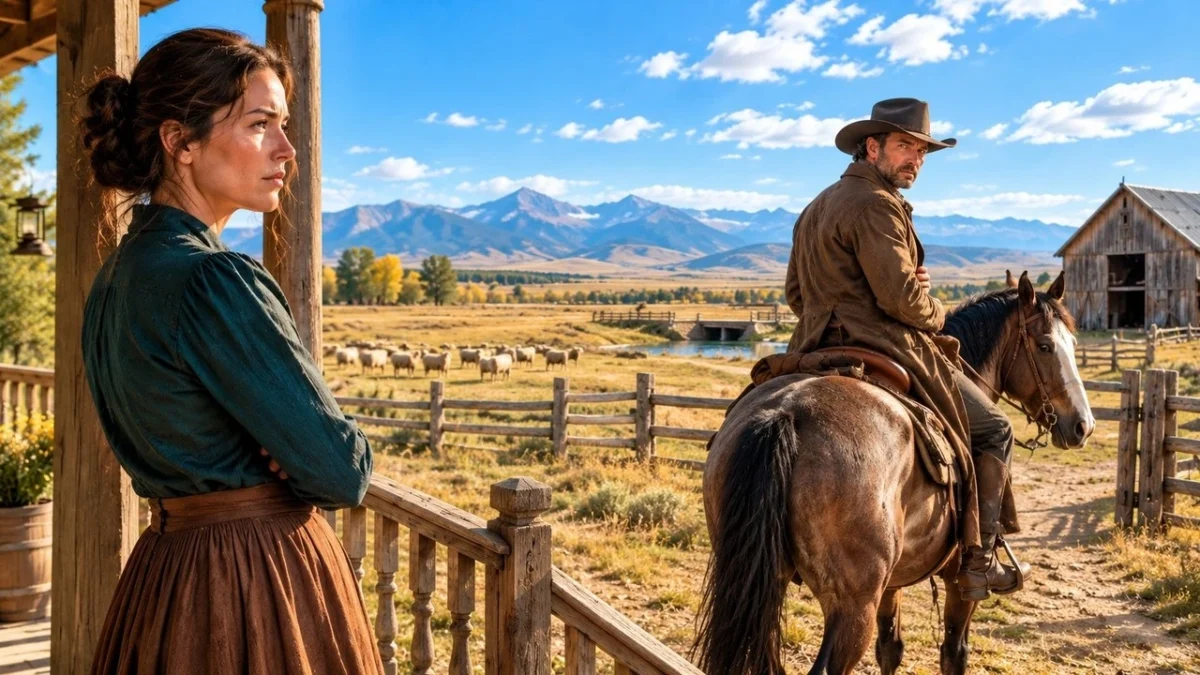
She had not asked a single person for help in eight long months, not once.
Joanna Hess was twenty-seven years old, and she had learned early in life that asking cost far more than it was ever worth.
There was always a price hidden behind an offer, a favor owed, an unwanted opinion given, or a reaching hand that expected something in return.
So, she had stopped asking long before Lauren died, and after he died, she had simply continued practicing the quiet self-reliance she had perfected over the years.
She ran three hundred and forty acres in the harsh Powder River country of Montana Territory in the year 1889.
She raised sheep, not cattle, which already made her deeply unpopular with half the ranchers in the surrounding valley.
She had one hundred and eighty head going into the coming winter, a good deep well, a stock dam that desperately needed work before the ground froze solid, and a lambing shed that had developed a concerning lean she was still trying to decide whether to brace with heavy timber or tear down completely to rebuild.
Her husband, Lauren, had been dead since January, swept away in four short days by a sudden lung fever that moved faster than any doctor could ride from town.
She had been completely alone on the vast land since the crisp morning she wrapped him in his thick wool coat and arranged for the circuit preacher to travel out from Miles City.
She had not shed a single tear at his quiet burial.
She had cried twice in the hard weeks that followed, tucked away alone in the dark corner of the barn where no living soul could see her weakness.
Then she had gone straight back to figuring out how to keep the land alive, which was the only way she knew to deal with the heavy weight of grief.
The northern autumn had been bitter, dry, and relentless.
The stock dam desperately needed its wooden spillway rebuilt before the heavy freeze locked the soil, and Joanna had spent three frustrating days trying to solve the proper angle on her own, shifting heavy river stones only to lose them to the steady current, laboring until her lower back ached and her arms felt entirely detached from her body.
She was still down in the mud working on it when a solitary rider came descending the ridge road on a cold, gray October afternoon.
She spotted him from across the broad north pasture.
He was moving wrong.
It was not the careful, easy pace of a seasoned range man reading the horizon, but the braced, rigid lean of a man straining to hold himself together when everything inside wanted to collapse.
His horse, a sturdy dark roan with a distinctive white blaze, moved steadily enough, but the man in the leather saddle had his right arm pressed firmly against his side in a posture that told Joanna everything before he even got close enough to speak.
He pulled his horse up at the heavy wooden fence gate and sat motionless.
He did not call out or hail the ranch.
He stared at the gate, then up at the modest log cabin, then back down at the latch as though calculating whether he possessed enough strength left to dismount and open it himself.
Joanna walked steadily across the dry pasture with her Winchester rifle cradled over her arm, the barrel pointed safely down toward the dirt.
He was significantly older than she had anticipated.
She estimated his age at fifty, perhaps a year or two more.
His face was weathered and deeply lined in the distinct manner of men who spent their entire lives under the open sky, with crow’s feet carved around his sharp eyes and a jaw that had not seen the edge of a razor in five or six days.
He held himself upright in the saddle with a deliberate, agonizing discipline, the posture of a man in deep pain who had decided that his dignity cost him nothing extra to maintain.
She halted ten feet short of the timber gate and looked him over.
He returned her gaze with clear gray eyes that were remarkably alert, missing no detail of her posture or the rifle across her arm.
Slowly, he reached up with his left hand and lifted his wide-brimmed hat.
“Ma’am,” he said, his voice quiet, low, and entirely controlled.
“I have a wound that requires attention and a horse that needs rest. I can pay for the use of your tack room. I will be gone by tomorrow morning.”
Joanna looked at his hand, then at the blood dark shirt beneath his jacket.
“Where are you hit?” she asked plainly.
“Right side, below the ribs,” he replied without hesitation. “It is a through and through.”
“A through and through can still bleed you to death or rot your guts,” she said.
“Yes, ma’am,” he said quietly. “I am well aware.”
She studied his face, the tight pressure of his arm against his ribs, and the broad dark stain soaking through the canvas of his heavy coat.
His gray eyes watched her without pleading, offering no excuses, displaying no hidden motives, simply waiting for her to make her choice.
“There is a full water trough beside the barn,” Joanna said finally. “Get your horse unsaddled and settled. Then come to the back kitchen door.”
She turned on her heel and walked back toward the house without waiting to see if he followed.
His name was Cordell Maze.
He was fifty-two years old, and he gave her these facts himself while sitting stiffly at her scrubbed pine kitchen table while she cleaned the ugly wound in his side.
She had asked his name first and his age second, and he had answered both directly without asking why she needed to know.
He sat motionless as stone while she worked on him.
She had stitched a man once before, a clumsy ranch hand who had driven a rusted fence nail through his boot, but she had never tended a gunshot wound.
She made use of the carbolic wash, the heavy curved suture thread, and the rigid medical instructions printed in a household manual Lauren had ordered years ago from a catalog in Bozeman.
The wound was deep and treacherous.
It had missed his vitals by an inch, but it was severe enough to lay a lesser man flat on his back for a month.
She worked in complete silence, and he allowed her to work without complaint, a quality she deeply appreciated.
Most men felt compelled to fill uncomfortable silences with nervous talk to manage their physical pain.
Cordell Maze sat with the quiet room as if silence were his natural element.
“Who shot you?” she asked cleanly as she tied off the final black stitch against his pale skin.
“Men working for a land operator named Pickett Dyer,” he answered, his breathing shallow.
Joanna paused slightly before reaching for the clean cotton bandages.
Everyone in the Powder River country knew the name Pickett Dyer.
He was a ruthless cattle baron who viewed small homesteaders and sheep ranchers as pests to be scrubbed off the open range.
“And who are you?” she asked, setting the shears down. “Besides a man with a fresh hole through his ribs?”
Cordell reached carefully into the dry inner pocket of his coat with his uninjured arm and withdrew a folded square of heavy paper, laying it flat on the tabletop.
Joanna picked it up and opened the fold.
It was an official commission letter signed by the Montana Stockgrowers Association.
The name typed neatly across the top was Cordell Maze, Range Detective.
“Dyer has spent the last two years running small operators off their legal grazing allotments,” Cordell explained in his steady tone.
“He burns haystacks, cuts wire, and shoots stock. Two homesteaders were killed over near the creek last spring. I have been gathering sworn statements and land records for six months. I got close enough to something concrete last week that Dyer decided to hire men to stop me.”
Joanna refolded the document and placed it back on the table between them.
She walked over to the dry sink to wash the dark blood from her red hands.
Her back was turned toward him, and she was grateful for it, because her face was doing something she did not want a stranger to witness.
It was not fear that tightened her throat.
It was a far more complicated sensation.
It was the sudden, terrifying feeling of a person who had been entirely alone for a long time suddenly finding the four walls of her quiet kitchen closing in.
“The tack room is dry and warm,” she said without turning around. “There is a clean canvas cot inside. Breakfast is served at six sharp.”
She heard the heavy scrape of the wooden chair as he stood up.
She heard him pick up his commission paper, heard his slow steps move toward the threshold, and then heard him pause.
“Mrs. Hess,” he said, pronouncing her name with the same quiet, careful weight he gave to everything else. “Thank you.”
She gave a single nod toward the stove.
She listened to the back door latch shut.
Then she stood alone in the dim kitchen, listening to the vast silence return to the house.
It was a different kind of silence now—the distinct, lingering silence of a room where another living soul had recently stood, which felt entirely different from pure emptiness.
That night, Joanna lay awake in her cold bed staring at the dark wooden ceiling.
She was not staying awake out of fear of the man sleeping in her barn.
She had formed a sharp judgment about Cordell Maze within the first thirty seconds of meeting him at the fence gate, and her instincts about people had proven right far more often than they had proven wrong.
It was something far more elusive that kept her eyes open into the late hours.
It was the subtle awareness that the air inside the house felt fundamentally altered from how it had felt the night before.
She was down at the stock dam by the first gray light of the morning.
The dam did not care that a stranger was resting in the barn, and it still required work before the winter ice locked the valley.
She was down on her knees in the freezing mud, straining with a iron bar to lever a heavy flat stone into the timber spillway frame, when she heard firm, measured footsteps on the dirt bank above her.
Cordell stood at the edge of the pit, looking down at the damaged dam with the analytical eyes of a man evaluating a complex structural problem.
“You are supposed to be resting that side,” she said without looking up from the mud.
“I spent twenty minutes looking at this structure from the barn ridge yesterday evening,” he said.
He possessed a habitual way of ignoring direct commands without being rude, simply redirecting the conversation toward whatever was practical and useful.
“Your spillway angle is off by three degrees. You are fighting the weight of the water instead of redirecting its natural flow.”
Joanna rested her hands on her knees and looked up at him.
“I know the angle is wrong,” she said coldly. “I have spent three days trying to calculate the right one.”
“May I show you?” he asked.
He stepped down the muddy embankment slowly, favoring his right side with deliberate care, and crouched beside her in the dirt with the smooth movements of a man who had long accepted that his body would remind him of its physical limits every day.
He picked up a straight willow stick from the bank and began drawing a series of clean lines in the soft mud beside the timber frame.
“Water always wants to go where it is already going,” Cordell said, his voice even. “You cannot stop it by force. You can only offer it a better path.”
He traced a sharp angled channel in the mud.
“If you shift the primary upstream stone to this mark, it forces the main current to turn before it ever hits your spillway frame. The spillway stops absorbing the impact and begins steering the flow.”
Joanna looked at the diagram in the mud, then at the rushing water, then back at the drawing.
It was glaringly obvious.
She had spent three exhausting days failing to see it, and now that he had pointed it out, she could not unsee the logic of it.
“I have been doing it wrong for three days,” she said quietly.
“You were doing what made sense from where you were standing,” Cordell said gently. “Sometimes a person has to see a problem from a slightly different position.”
They worked together on the dam for four straight hours.
Joanna moved the heavy stones according to his directions.
Cordell guided the placement and supplied leverage whenever a rock required two sets of hands, managing the heavy strain using his uninjured arm and his body leverage in the practiced manner of a man who had worked around physical injuries before and knew his exact limits.
By mid-morning, the cold mountain stream was flowing through the new spillway exactly as he had sketched it in the dirt.
The water moved through cleanly, without the violent, churning sound it had made against the bank the day before.
They sat down side by side on the dry bank in the crisp October sun, their hands caked in dry river mud and their arms trembling with exhaustion.
Joanna looked down at the functioning spillway and felt, for the first time in eight grueling months, that a problem had actually been solved rather than merely patched over.
“How long have you been doing this work?” she asked, leaning her elbows on her knees. “The detective work?”
“Three years,” Cordell answered, turning a smooth pebble over in his calloused palm. “Before that, I served as a deputy marshal out of Cheyenne for eleven years.”
“Why did you leave the marshal’s office?”
He remained silent for a long moment.
It was the deliberate silence of a man deciding not what to invent, but precisely how much of the truth to share.
“The marshal I served under was an honorable man,” Cordell said softly. “He died of pneumonia. The man the territory appointed to replace him was not honorable. I am not built for that kind of accommodation.”
“And the range detective work?” she pressed.
“It is the same law, just a different employer,” he said, setting the stone down. “Pickett Dyer has operated for two years without facing consequences because he has deep pockets, and money buys the sort of local silence that makes the legal process move very slowly. The Stockgrowers Association hired me because they required someone willing to step outside that silence.”
Joanna looked out across the yellow pasture grass.
“My husband wanted to sell this place,” she said suddenly.
The words escaped her mouth before she could stop them, rising up on their own the way long-buried thoughts do when a person has kept silent for too long.
“After our third hard winter, Lauren said the land was costing us far more than it was worth. I told him this land was the only thing I knew how to hold onto. We were still arguing about whether to pack up when he caught the fever.”
Cordell turned his head and looked at her, saying nothing, simply listening.
“I do not know if I was right,” she added, her voice dropping. “I just know I could not bring myself to leave it.”
“That is not the same thing as being wrong,” Cordell said firmly.
They walked back to the homestead together under the bright midday light.
Joanna was acutely aware of how natural it felt to walk across her own soil with another human being beside her.
Then she became aware that she had noticed it, and finally aware that noticing it was a profound piece of information about her own heart.
He was gone before she woke on the third morning.
She walked out onto the wooden porch in the freezing gray pre-dawn and discovered the tack room door standing slightly open.
The canvas cot inside was neatly made, and a folded sheet of paper rested on the small wooden table near the door.
She picked it up.
It was not a personal letter.
It was a page torn from a surveyor’s map of the Powder River valley, marked in precise pencil with three specific locations where Dyer’s armed hands had been illegally driving cattle onto small homesteaders’ land, complete with the routes they traveled and the times he had observed them.
In the clean margin, written in a clear, disciplined hand, he had left a brief message:
*”If any men ride up asking after a range detective, you know nothing of me. I am sorry for any trouble I may have left at your door. C. Maze.”*
Joanna stood alone in the quiet tack room with the map in her hands for a long time.
Finally, she folded the paper carefully, slid it into her apron pocket, and went into the kitchen to brew coffee.
She brewed only a single cup.
She did not realistically expect to hear from him again.
She had no logical reason to.
He was a man constantly on the move doing dangerous work, and she was simply a widow rooted to a lonely piece of Montana ground where he had rested for three days.
The letter arrived in late November, three full weeks after his departure.
She was sorting wool in the barn when the mail rider called out from the gate.
Cordell Maze, as she had already learned, was a man who used words with great economy.
The letter was a single page of heavy paper.
He wrote that he had successfully delivered his evidence to the federal land office in Miles City, that a deputy United States Marshal had been dispatched to investigate Dyer’s operations, and that while he could not predict the legal outcome, the matter was finally in capable hands.
He asked whether her stock dam had held up against the first severe autumn freeze.
In the final paragraph, written in noticeably darker ink—as though he had set the pen down and forced himself to return to the paper after much deliberation—he had added:
*”I find that I think about the Powder River country far more than a man working in another county ought to. I am not entirely sure what to make of that truth just yet.”*
Joanna read that single sentence three times in the dim light of the barn.
Then she walked inside, placed the letter in the drawer of Lauren’s old desk, and sat down to write her reply that very evening.
She wrote about the stock dam, which had held perfectly through two hard freezes.
She wrote about the lambing shed, which she had officially decided to rebuild plank by plank during the quiet afternoons.
She wrote about the sheep, about how the vast valley looked under its first dusting of snow, and about a remark Cordell had made regarding water finding its lowest point—a thought she admitted she kept turning over in her mind because it seemed to apply to far more than river currents.
Then, after sealing the envelope, she tore it open again, deciding she was not going to be the kind of woman who said less than she truly felt.
She added a final line:
*”I have set out two coffee cups on three separate mornings since you rode away. I have decided this habit means something, though I am not yet certain what.”*
She sealed it quickly before she could talk herself out of sending it.
His reply came in middle of December.
It was shorter than the first.
He was staying in a boarding house in Billings.
The case against Pickett Dyer was progressing rapidly; two of Dyer’s hired men had signed confession statements, and Dyer himself had been arrested during the first week of December and was being held without bail pending federal trial.
Then, toward the bottom of the page, he wrote:
*”I told myself I was not going to write what follows, because three days spent on a ranch is only three days, and I am old enough to know better. But I find I am writing it anyway. I would like to return to the Powder River country in the spring if you would be willing to receive me—not merely passing through, but coming with clear intention.”*
Joanna sat with the letter in her lap at the kitchen table as the lamplight flickered against the dark windowpanes.
Outside, the valley was buried under deep snow, the Powder River ran dark and slow beneath a thick layer of ice, and her sheep were sheltered in the winter pasture.
She sat in the silence for a long time.
Then she stood up, set the kettle on the hot stove, and pulled out a sheet of paper.
She wrote back:
*”Come in the spring. The stock dam will need looking at after the snow melts, and I could use a second opinion.”*
She stared at that final sentence for a moment, considered revising it, and then left it exactly as it was.
It expressed precisely what she meant, written in the careful language of two guarded people who were not yet ready to speak of love plainly, but were steadily making their way toward it.
Cordell Maze arrived on a clear morning in late April, just as the valley was beginning to show green shoots along the riverbanks.
He looked strikingly different than she remembered.
There was less weariness in his shoulders, his seat in the saddle was effortless, and he moved with the ease of a man who had stayed somewhere long enough to put down the heavy burdens he had carried for years.
He pulled his roan up at the timber gate and removed his hat.
Joanna walked out onto the wooden porch to meet him.
“You are a week early,” she called out across the yard.
“I know,” Cordell said, looking down at her with his clear gray eyes, completely unguarded. “I kept finding reasons to leave town sooner.”
She walked over and pulled back the wooden latch.
“The stock dam held through the spring runoff,” she said.
“I know,” he replied with a faint smile. “You wrote and told me.”
“I know you know,” she said, stepping back to swing the heavy gate wide. “I am telling you again anyway. There is fresh coffee on the stove. Come inside.”
He tied his horse to the hitching post and stepped through the gate she held open.
She let the gate swing shut behind them.
“I have something I want to ask you,” Cordell said, stopping in the yard.
“Ask it inside,” Joanna replied, turning toward the door. “Over coffee. We have plenty of time.”
Cordell looked at her, an uncharacteristic warmth passing over his weathered face that he made no attempt to conceal.
Then he nodded and followed her up the wooden steps into the house.
The vast valley stretched out behind them in the bright April light, the river catching the morning sun, new grass rising along the fence lines, and the sheep moving across the far pasture.
The stock dam sat firm at the bend of the north channel, exactly where they had built it together, steering the current smoothly through its timber spillway—the way water always wants to go when you stop fighting it and learn to work with it instead.
They were married the following October, when the valley turned gold and the light struck the hills at that sharp angle that makes Montana look larger than the rest of the world.
The circuit preacher read the service on the porch.
Three neighboring homestead families traveled miles to attend, because news travels fast in open country, and when something genuinely worth witnessing occurs, people always find their way to it.
Joanna kept the name Hess on the ranch deed, because that was the name the land was registered under.
Lauren had earned his resting place beneath the great cottonwood tree by the north fence, and nothing was ever going to change that.
Cordell understood her decision without ever needing it explained to him, which was one of the primary reasons she had agreed to marry him.
He never wore his detective’s badge again.
One morning during their second summer together, Joanna walked into the tack room and noticed his official commission papers rolled tight, tied with a leather thong, and placed neatly on the high shelf above the saddle rack.
She did not ask him about it.
He offered no explanation.
Some choices speak clearly enough for themselves when two people truly understand one another.
During their second year together, the legal proceedings against Pickett Dyer finally concluded in federal court, and three small ranching families in the valley had their stolen grazing allotments legally restored.
Cordell had traveled to Miles City to give key testimony.
He returned home on the evening the final verdict was handed down, stepping into the warm kitchen and looking at Joanna as she stood by the stove.
She looked back at him, and there was no need for speech, because the silence between them spoke far better than any words ever could.








