It’s Damn Cold and We’re Out of Beans
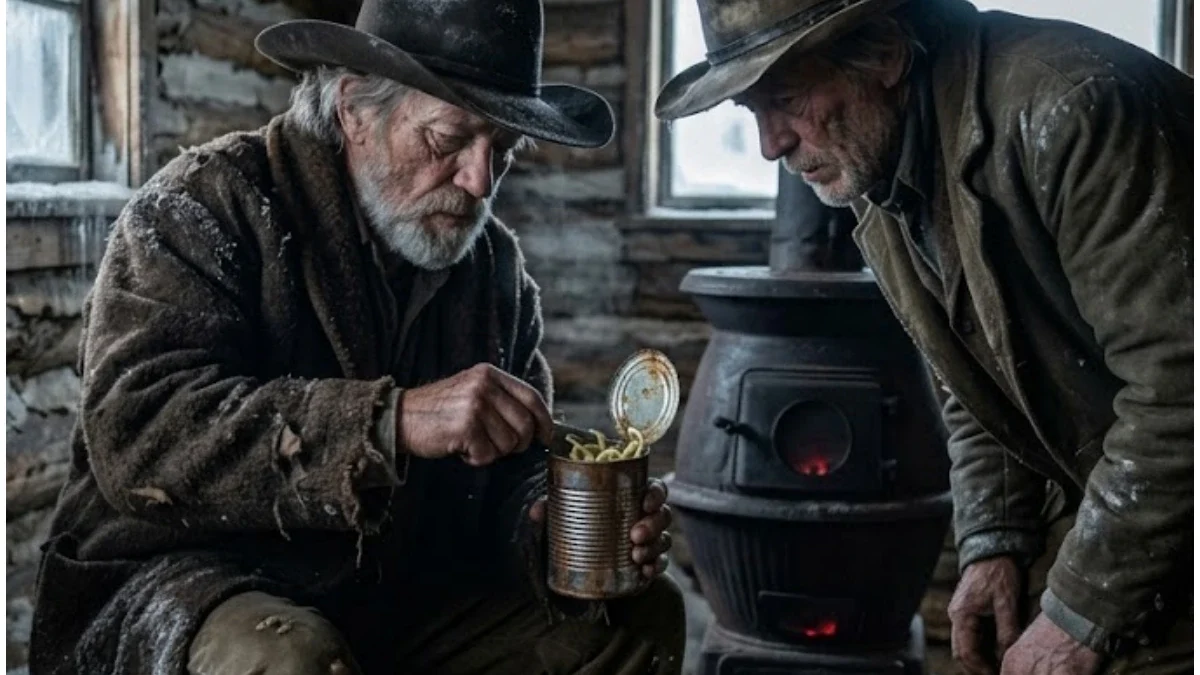
The wind had been screaming since noon, and by the time the sun dropped behind the ridge it sounded less like weather and more like something alive trying to get inside.
It scoured the valley floor, whipping fine, needle-like ice across the dry cedar shingles and slamming hard against the mud-chinked walls of the old line shack.
Old Tobias Reyes sat with his boots propped against the stone hearth, watching the fire gnaw at the last good log in the woodpile.
His knees were pulled slightly toward his chest, wrapped in an old, grease-stained wool coat that smelled strongly of wet horse and tobacco smoke.
Across from him, in the only other chair the cabin had left standing, Whit Calloway was picking at a loose seam on his worn leather glove with the patience of a man who had nowhere else to put his hands.
“You hear that?” Whit said, not looking up from his fingers.
“I hear a lot of things,” Tobias said, his voice low and gravelly.
“Most of them are the roof.”
“No, listen real close.”
Tobias listened.
The wind dropped for a second, the way it sometimes did, like it was catching its breath before another desperate go at the shutters, and in that brief gap came a long, low groan of stressed timber somewhere directly above them.
“That’s the roof,” Tobias said again, shifting his weight in the creaking chair.
“That’s the roof dying,” Whit said, finally raising his chin to look at the ceiling beams.
“There’s a difference.”
“Same outcome for us either way if it collapses.”
Whit grunted and went right back to picking at the thread on his glove.
They had ridden into the line shack two days ago meaning to stay just one night, wait out what looked like an ordinary early spring squall, and then push on toward Alma’s Crossing where there was a cast-iron stove that actually worked and a woman who made coffee strong enough to argue with.
Instead, the squall had turned into something the old-timers back at the main ranch would have called a freak storm, the kind of blizzard the high desert threw maybe once every couple of decades, snow coming in sideways over frozen sand that had no memory of ever holding it for long.
Now the main trail was completely gone under two feet of drift, the horses were spooked into the tiny attached lean-to and refusing to be led anywhere, and the only supplies left in the cabin were a half-empty bag of coffee grounds stretched thin with roasted acorns, half a sack of coarse cornmeal, and one dented tin can of beans that had been sitting on the upper shelf so long it had started sprouting right through a split seam in the tin.
Tobias had found the can that morning, turned it over in his rough hands, and set it right back down like it was something that might bite him if he pressed too hard.
“We could still eat it,” Whit said, following Tobias’s gaze toward the shadowy corner of the room.
“It’s growing something out the side, Whit.”
“That’s just moisture from the wall.”
“Moisture doesn’t have leaves.”
Whit leaned forward, squinting the way a man squints at a troublesome horse he already knows the answer to but doesn’t want to admit.
There, poking through a rust seam no thicker than a blade’s edge, was a single pale green shoot, curled over on itself like a small comma.
“Well I’ll be damned,” Whit whispered, rubbing his jaw.
“You will be, if this keeps up much longer.”
They sat with that for a while, the fire popping softly, the bitter wind working at the wooden shutters like it had a personal grudge against the both of them.
“Bean plant in a can,” Whit said eventually, shaking his head.
“In the middle of a blizzard.”
“In the desert.”
“World’s got a sense of humor, I reckon.”
“World’s got no sense at all is what it’s got.”
Tobias almost smiled at that, the corner of his weathered mouth twitching before he caught himself and put it away, the way he put away most feelings these days.
He was sixty-one years old and had been riding fence lines and pushing stubborn cattle since he was nine years old.
If there was one thing four decades of that hard life had taught him, it was that comfort was just a debt you paid for later with interest, so it was best not to get too used to it.
Whit was younger by six years, but he looked older in the lamplight, the fierce sun and relentless wind having done far more damage to his face than mere time would have managed on its own.
He also had a peculiar way of talking that filled up long silences Tobias would rather have left empty.
They had ridden together, on and off, for going on twenty-five years now.
First as wild young men breaking green horses on the Bar K outfit, then as not-so-young men doing whatever heavy ranch work was still needed around these parts.
These days, that mostly meant checking remote line shacks, clearing washouts, and mending barbed wire in country too poor and too far out for anybody younger to want the job.
“You remember the winter we spent up at Cutter’s Notch?” Whit asked, leaning back until his chair legs squeaked against the pine floorboards.
“Which one.”
“The bad one.”
“Before you married Alma’s cousin.”
“Before that whole business went the way it went.”
“They’ve all been bad ones, Whit.”
“Pick a year.”
“The one where Sanderson lost half his winter herd and blamed it all on wolves that weren’t even there.”
Tobias thought back, his eyes fixed on the flickering embers.
“Ninety-one,” he said after a pause.
“Or maybe ninety-two.”
“Ninety-one,” Whit said firmly.
“I remember because that was the last year I still had both my knees working right without a ache.”
“You still don’t have both your knees working right.”
“Worse now than then, is what I’m saying.”
Tobias reached over to the small woodpile, picked up the last split log of pine, and fed it carefully onto the hearth, watching the bright flame catch along one dry edge and spread, slow and orange, into the tight grain.
“We were what, twenty-five, twenty-six years old,” Tobias said quietly.
“Thought we knew everything there was to know about the cold.”
“We did know something about cold.”
“We knew nothing.”
“We just hadn’t lived long enough yet to be scared of it properly.”
Whit laughed at that, a short, dry sound that turned into a sudden coughing fit halfway through.
“That’s about the truest thing you’ve said all week,” Whit said, spitting into the hearth once he’d got his breath back.
“I say true things all week.”
“You’re just usually too busy talking yourself to notice.”
“There he is.”
“There’s the old bear.”
Outside, something loose on the tin roof tore free with a sudden metallic shriek and went scraping and clattering off into the pitch dark, disappearing into the white void.
Both men flinched at the sharp noise before settling back into their seats as if nothing had happened.
“That was the top sheet,” Whit said, eyes darting upward.
“I know what that was.”
“We’re gonna have a full hole up there by morning.”
“We already have a hole up there.”
“Now it’ll just let more of the storm sit in here with us.”
Whit reached down for the battered coffee pot sitting at the edge of the red coals, gave it a gentle shake, and set it back down with a dark frown.
“Two cups left in there,” he said.
“Maybe.”
“Split it then.”
“You take the extra half, Tobias.”
“I don’t want the extra half.”
“Take it anyway.”
“You’re older.”
“That’s not a valid reason.”
“It’s the only reason I’ve got, so it’ll just have to do.”
Tobias let him win that small point, the way he let him win most of the small arguments they had nowadays.
Arguing over half a cup of bad, acorn-bitter coffee in a dying cabin in the middle of a desert blizzard struck him, suddenly, as the kind of ridiculous thing a man might laugh about someday—if he lived long enough to get to someday.
Whit poured out what little black liquid remained into two rusted tin cups, handed the fuller one across the gap, and settled back down with his own.
He blew gently across the dark surface, though it had long since gone lukewarm in the chilling room.
“You scared?” Whit asked softly, after a long silence.
Tobias considered the heavy question the way he considered most things Whit asked him, turning it over in his mind like an old coin before speaking.
“Some,” Tobias said.
“Yeah.”
“You?”
“Some,” Whit admitted, staring into his cup.
“Not of dying, particular.”
“More of dying in a drafty shack that smells like wet horse with a can of beans sprouting on the shelf.”
“Doesn’t seem like much of a proper way to go, after everything we’ve done.”
“Nobody picks the way, Whit.”
“That’s the whole trouble with the world.”
“Still.”
“Still,” Tobias agreed.
The wild wind found a new gap somewhere in the cedar siding and began to whistle through it, high and thin, like an old tin kettle that had forgotten how to stop boiling.
Whit pulled his heavy coat tighter around his throat and looked toward the shuttered window.
There was nothing to see through it except pitch black and the occasional white flash of driven snow lit orange by the firelight whenever a heavy gust drove it hard against the glass panes.
“You ever think about Rosalind?” Whit asked quietly.
Tobias’s jaw tightened, just slightly, the single visible sign that the old name had hit anything inside him.
“Sometimes,” he said.
“You never talk about her anymore.”
“Nothing much to say.”
“She left.”
“I let her go.”
“That’s the whole story right there.”
“That’s not the whole story and you know it as well as I do.”
“It’s the part of the story I’m willing to tell tonight.”
Whit accepted the boundary, the way old friends learn to accept the sharp edges of each other’s silence over time.
He let the heavy topic sit between them for a moment before trying a somewhat gentler road in.
“I think about Del sometimes,” Whit said, his thumb running along the rim of his cup.
“My younger brother.”
“Not near as often as I used to.”
“But out here, on nights like this, seems like there’s nothing else left to do but think about the people who aren’t in the room with you.”
“He still up in Cheyenne?” Tobias asked.
“Far as I know.”
“We don’t write.”
“Why not?”
“Ran out of things worth saying to each other a long time back.”
“Easier to let it lie than to keep picking at an old scab.”
Tobias nodded slowly in the dim light, understanding that sentiment far better than he would have liked to admit out loud.
“Everybody’s got somebody they don’t write,” Tobias said softly.
“Suppose so.”
They finished what was left of the lukewarm coffee in a thick silence that was not uncomfortable, but rather familiar.
It was the kind of deep silence two men build up over a quarter century of sharing campfires that were too small and nights that ran far too long.
The fire had burned down to a glow of deep orange coals by the time Whit spoke again, his voice dropping an octave, roughened by the creeping cold and the late hour.
“You figure we make it out to Alma’s Crossing tomorrow?” Whit asked.
“If the wind lays down some by dawn, and the horses settle, maybe.”
“And if it doesn’t lay down?”
“Then we sit right here another night and argue about sprouted beans.”
“There’s worse company to be stuck with in a ditch.”
“There’s better, too, but you’ll do for now.”
Whit huffed out a breath that might have been a small laugh, tipped his hat brim low down over his eyes, and slid lower in the wooden chair like a man settling in for whatever the dark night decided to hand him.
Tobias sat a while longer in the fading light.
He watched the coals dim from bright orange to dull ash, listened to the roof rafters groan under the weight of the snow, and heard the wind pick viciously at every loose shingle it could find.
He thought about how strange it was that a man could spend his whole long life chasing wide open, empty country, only to end up right here, in a drafty room barely big enough for two wooden chairs, feeling glad of nothing more than a small fire and somebody worth talking to.
He glanced over toward the dusty wooden shelf where the dented can of beans sat.
Its tiny green shoot was curled patient and stubborn toward whatever thin sliver of light managed to come through the cracks in the wooden shutters.
Tobias found himself oddly comforted by the sight of it.
It was the same way a man is comforted by any small, quiet proof that life keeps trying to push forward, regardless of the harsh conditions it has been handed.
“Whit,” Tobias called out quietly.
“Mm.”
“We’re not eating that can.”
“Wasn’t gonna suggest it again anyway.”
“Good.”
“Might plant it, though,” Whit mumbled from beneath his hat.
“Come spring.”
“See if beans grow any different after having survived a mess like this.”
Tobias almost laughed, surprised by how much the strange idea actually appealed to him.
“You’re a strange man, Whit Calloway.”
“Been told that before.”
“By who?”
“By just about everybody who’s ever met me, near enough.”
The fire popped one last time, sending up a thin, brief spiral of orange sparks that died out long before they reached the chimney stack.
Outside, the great winter storm kept working tirelessly at the old cabin with the relentless patience of something that had the whole season to spend and nowhere better to be.
Tobias reached up, pulled his own felt hat down over his eyes, folded his arms tightly across his chest, and let his eyelids close.
He was not sure if he would actually sleep so much as simply wait out the dark.
It was the same way he had waited out a hundred other bad nights before this one, with nothing to his name but a dying fire, a bitter taste of coffee, and a man sitting across from him who talked too much, yet somehow made the brutal cold just a little easier to sit through.
“Tobias,” Whit called out, his voice barely a whisper above the howl of the wind.
“What is it now.”
“Glad it’s you stuck out here with me, and not some stranger.”
Tobias did not open his eyes or move his head, but the corner of his mouth twitched upward again, and this time he didn’t bother to hide it in the dark.
“Go to sleep, Whit.”
“Working on it right now.”
The wind screamed on across the high desert, the heavy roof held its ground against the snow, and somewhere on the dark shelf, a small green shoot kept reaching, slow and stubborn, toward whatever morning was still owed to it.








