“I’ve Never Had a Home,” the Mail-Order Bride Said — Until The Cowboy Whispered, “This Is Your Home”
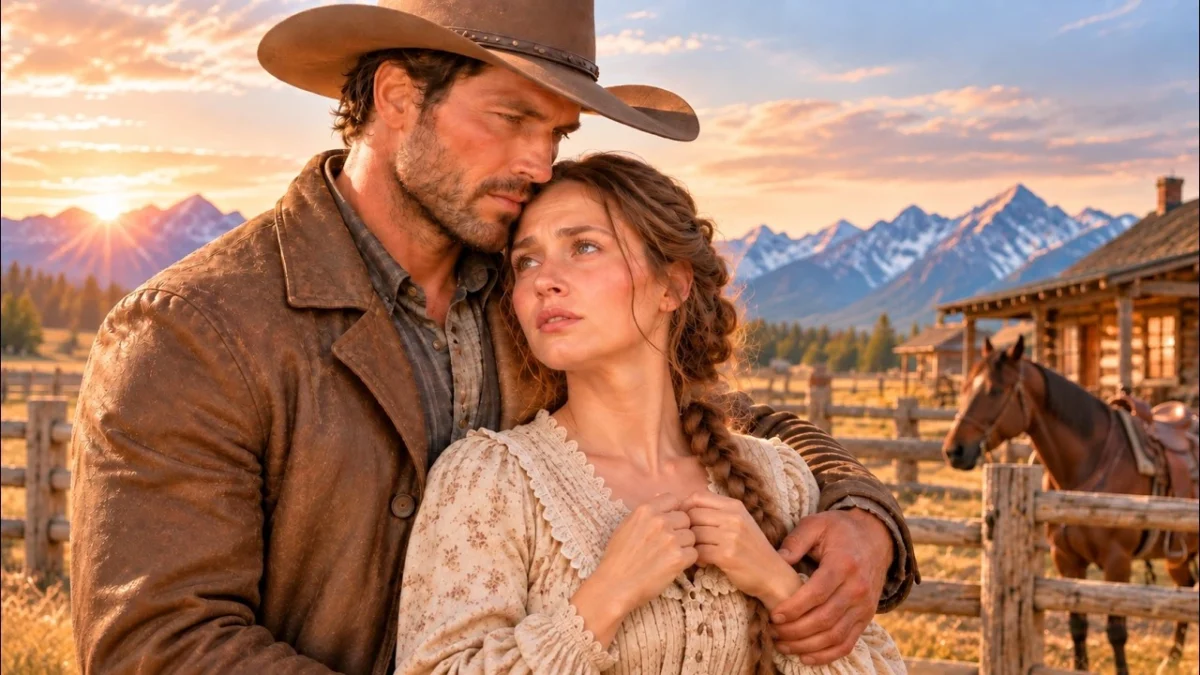
The deed was already in her hand when Gideon Ror rode up and told her he wasn’t moving his fence.
He said it the way men say things they’ve been saying for twenty years without anyone pushing back.
Flat, patient, like he was explaining weather to someone who hadn’t learned to read it yet.
His fence had been where it was since her uncle was alive.
His cattle had grazed that strip since before she was born.
He didn’t raise his voice.
He didn’t need to.
Half the basin knew what happened to small landowners who argued with Gideon Ror.
They got tired.
They got cold.
They sold before spring.
Mara Vance stood in the dirt outside a cabin she had owned for four hours and looked at him.
“The survey line doesn’t agree with you,” she said.
Gideon looked down at her from his saddle with calibrated patience, the expression of a man expecting a temporary nuisance to resolve itself.
“The fence stays where it is, Miss Vance,” Gideon said calmly.
“It’s been there twenty years, and it’ll be there twenty more.”
“That doesn’t make it right,” Mara replied, her voice steady and unyielding.
“It makes it established,” he said.
Then he turned his horse around and rode back toward his property without another word, as if the conversation were already finished.
Mara watched him go, the dust settling slowly in the dry mountain air.
Then she walked inside, put her leather bag down beside the door, and left it there unpacked.
She pulled out her notebook, sat at the wooden table, and started making her list.
—
The letter from the attorney’s office in Billings had arrived at her boarding house in late September, addressed in careful legal language to a woman currently employed as a ledger keeper for a dry goods merchant.
It stated that her great-uncle, Wallace Vance, had died on the fourteenth.
It stated that she had inherited three hundred and forty acres in Blackthorn Basin, Montana Territory, including a cabin, a failing stable, several horses of unspecified condition, and a ranch Wallace had named Iron Will Crossing.
When Mara asked her employer for two weeks off without pay to inspect the property, he had cleared his throat and shook his head.
“If you leave for two weeks, Mara, I’ll need someone else sitting at that desk by Monday,” he had told her.
“I understand,” she had said without hesitation.
She packed the carpetbag she always kept half-ready under her iron bed frame.
Mara had spent twenty-one years moving between rented rooms, drafty boarding houses, and temporary arrangements.
She had learned specific protective habits over those hard years.
She memorized every room she entered because she fully expected to lose it.
She kept her bags light so she could leave on short notice.
She never planted anything she couldn’t abandon.
The driver of the supply wagon had agreed to carry her and her bag out to the basin for two dollars.
As they pulled up to the weather-worn cabin, the driver pointed toward a far corral where a dark shape stood perfectly still.
“That black stallion’s been in that enclosure since your uncle bought him three years ago,” the driver said, leaning over the wheel.
“A man named Crow sold him when the horse got too difficult to handle. Nobody’s been able to do much with him since.”
Mara looked across the dry dirt toward the stallion.
The horse looked back at her across the distance.
She had the passing thought that his expression was not aggressive.
It was careful.
Those were very different things.
The cabin itself had a sagging front porch, a roof with soft spots she could identify without even climbing up, and a heavy wood stove whose flue clearly needed relining.
Before touching her bag, Mara walked the western fence line, following the deed description she had memorized on the long coach ride out from town.
She found the discrepancy within twenty minutes.
The western fence sat well inside her legal property line.
The strip of land between the physical fence and the true boundary held vital access to Widow Creek, and whoever had placed that fence decades ago had known exactly what they were doing.
She walked back toward the stables and found Corg, the only remaining ranch hand, greasing a rusted gate hinge.
“How long has that western fence been where it is, Corg?” she asked, leaning against the timber.
Corg paused his work, wiping his grease-stained hands on his canvas trousers.
“Longer than I can remember, Miss Vance,” he said.
“What about the grazing lease with Gideon Ror?” she asked.
“Is there a written contract in the house?”
“No written contract,” Corg said flatly.
“Just a handshake arrangement your uncle made. Forty dollars for the season to let Ror’s cattle cross a portion of the eastern pasture.”
Corg offered this without commentary, but with the particular silence of a man who had already formed a firm opinion on how Mara’s tenure would end.
Mara spent her very first night at the kitchen table with the deed laid open next to her ledger, making neat notes in parallel columns.
*Fence: correct boundary.*
*Lease: formalize and re-price.*
*Water access: clarify before ground freezes.*
She worked until the oil lantern burned low and dim, then slept in her heavy wool coat because the damaged stove couldn’t hold heat through the night.
—
In the crisp morning light, Mara walked the mile and a half down the dirt trail to Gideon Ror’s homestead.
His ranch was everything hers was not: established, well-staffed, and operating at a scale that told a clear story of accumulated advantage.
Gideon met her on his broad front porch.
He was in his mid-forties, broad through the shoulders, with the quiet stillness of someone who had been the largest presence in every room he had entered for a very long time.
Mara unrolled the deed and stepped up to the porch railing.
“I have reviewed the property lines and the existing arrangements,” Mara said clearly.
“The current grazing rate is inadequate. I have drafted a revised rate, and I will require a formal written contract before the next grazing season begins.”
Gideon stood silently, listening to every word without interrupting.
When she finished, he leaned against the porch post and gave her that same flat, patient look.
“The fence has been where it is since Wallace was alive,” Gideon said softly.
“I’m not moving it, and I’m not changing an arrangement that has worked for twenty years.”
“The survey line doesn’t agree with you, Mr. Ror,” she said.
Gideon looked at her with calibrated patience, stepped back, and opened his front door.
“Good day, Miss Vance,” he said, and went inside.
Mara walked back to Iron Will Crossing with a tight, familiar feeling settling deep in her chest.
It was the feeling of being told that the ground she was standing on wasn’t truly hers to stand on.
She had accumulated that feeling since childhood.
It always came from the same direction: someone larger, more established, and more comfortable with the status quo, explaining patiently that things were already fine as they were.
*I am not going to disappear before winter,* she thought to herself.
That evening, she walked out to the sturdy timber enclosure where the black stallion was kept.
She stood at the perimeter fence for thirty minutes, not approaching any closer, not speaking, just remaining quiet and present.
The stallion, whom her uncle had named Onyx, stayed at the far end of the pen, thirty feet away, but he did not turn or run.
She noted his posture in her mind and went back inside.
The next morning, Corg came into the cabin kitchen while she was boiling water.
He looked at the packed carpetbag still sitting right beside the front door.
“You’ve been to see Ror,” Corg said, statement rather than question.
“I have,” Mara replied, putting the kettle on the stove.
“He’s a hard man to move, Miss Vance,” Corg said quietly.
“Most folks give up before the snow flies.”
“I am not most folks, Corg,” she said, opening her ledger.
“We have work to do.”
The roof leaked in two places during the first heavy autumn rain.
When Mara checked the financial records left by her uncle, she found that one of the two remaining accounts at the town supplier was sixty days overdue, and the second was in even worse standing.
Corg casually mentioned that a second hand named Pete had quit three weeks before Mara’s arrival, doubting the long-term viability of the operation.
Despite the mounting problems, Mara sat at her table that night and drafted a formal grazing contract.
She set the price at ninety dollars for the season, specified the exact legal boundary line, and deliberately omitted any provision giving Gideon Ror first right of refusal to purchase the ranch if she ever decided to sell.
She sent the document to Gideon’s ranch via Corg.
Ten days later, the contract was returned to her kitchen table.
Gideon had signed it, but he had hand-written a new clause into the margin granting him first rights to purchase Iron Will Crossing.
Mara took her pen, drew a heavy black line straight through his added clause, initialed the deletion, and sent it right back to him.
The following Saturday morning, boots heavy on the porch boards announced Gideon’s arrival.
He stood in the doorway, not with the easy authority of his previous visit, but with the quieter manner of a man realizing he was dealing with an unexpected kind of opponent.
“That clause protects your investment, Miss Vance,” Gideon said from the porch steps.
“A known buyer is better than scrambling in a hard season if things go wrong.”
“I’m not planning to sell,” Mara said, standing on her threshold.
“People change their plans when winter sets in,” he replied.
“If my plans change, I’ll find my own buyer,” she said flatly.
“I’m not signing away my options before I’ve even gotten through my first winter.”
Gideon looked at her for a long moment, then accepted the contract without the clause.
—
Two weeks later, the results of an independent survey Mara had quietly commissioned arrived from county officials.
The certified paper confirmed what her uncle’s deed had indicated: the physical western fence sat thirty-two feet inside her legal boundary line.
More importantly, that thirty-two-foot strip contained direct, uninterrupted access to Widow Creek.
In dry seasons and deep winters, that water access made the difference between a functional ranch and a failed one.
At dawn the next day, Mara rode her mare over to Gideon’s corral, finding him checking a leather bridle.
She handed him the official survey paper over the wooden rail.
“Did you know that boundary marker was placed in the wrong spot, Mr. Ror?” she asked directly, her tone completely free of accusation.
Gideon took the paper, read it slowly, and remained silent for four long seconds.
“I suspected it might be,” he admitted quietly.
It was the confession of a man who had looked at an uncomfortable question, decided the answer was inconvenient, and deliberately stopped looking.
Mara felt something settle firmly in her chest—not rage, but absolute clarity.
This was the true nature of what she was facing: not blind malice or stupidity, but the comfortable arithmetic of a powerful man who kept what came easily and never checked the math too closely.
“I want the fence moved to the true survey line,” Mara said.
“I want our water access fully restored. And if there are any other boundary discrepancies you are aware of, I expect them addressed voluntarily.”
Gideon looked up from the paper, his eyes locking onto hers.
“I will give you fourteen days,” Mara added.
“Fair enough,” Gideon said before she could even finish her sentence.
“I’ll have my men move the posts this week.”
Mara turned her horse and rode back to Iron Will Crossing.
That afternoon, she hired a second ranch hand who had stopped by looking for work—a twenty-two-year-old woman named Tessa Rowan, who carried a single glowing letter of reference from an operation in Wyoming that had folded after its owner died.
Corg watched Tessa’s arrival with visible skepticism, but on her very first morning, Tessa walked up to Onyx’s pen, studied the stallion for two minutes, and turned to Mara.
“He’s not crazy, Miss Vance,” Tessa said without preamble.
“He’s just got a very good memory.”
Mara looked at the younger woman and smiled slightly.
“That’s exactly what I thought,” Mara said.
Within the fourteen-day window, Gideon’s men rebuilt the western fence line along the true survey boundary.
The access to Widow Creek was restored, and Gideon paid the full revised grazing rate without another word of protest.
The rest of Blackthorn Basin watched the development in quiet shock.
The locals had seen newcomers try to push back against Gideon Ror before.
Usually, it ended in one of two ways: either the newcomer backed down immediately, or Gideon made life so thoroughly inconvenient that backing down became inevitable by February.
A twenty-nine-year-old woman with no family connections, no history in the territory, and thin accounts had been expected to be the easiest problem Gideon ever solved.
Instead, the fence had actually moved.
With the grazing money in hand, Mara rode into town and sat down with the local supplier.
“I can pay half of the overdue balances today,” Mara told the storekeeper, laying the cash on the glass counter.
“In exchange, I want seventy-five days of extended credit on future supplies.”
The storekeeper looked at the cash, then at Mara’s steady eyes, and nodded.
“Agreed, Miss Vance,” he said.
It was not a complete victory, but it bought crucial time.
That same evening, when Mara went out to stand by Onyx’s pen, the stallion did something new.
Instead of remaining thirty feet away at the back fence, he walked forward until he was only twenty feet from where she stood.
She did not reach out or try to lure him with food.
She simply stood her ground, letting him measure the space between them.
He was no longer calculating the distance to an exit; he was calculating her.
—
By mid-November, the first heavy gray clouds rolled over the northern peaks.
On a cold Tuesday morning, a light buggy pulled into the yard carrying Silas Crow.
Crow was a mild-eyed, unhurried man who drove with the relaxed posture of someone accustomed to transactions always resolving in his favor.
He stepped down, tipped his hat to Mara, and got straight to the point.
“I have a buyer for your black stallion, Miss Vance,” Crow said smoothly.
“A wealthy gentleman from the eastern states who is building a selective breeding operation. He wants that specific bloodline and conformation.”
Crow named a price—a sum large enough to instantly clear both store accounts, repair the stable roof, reline the stove flue, and leave a comfortable cash reserve in her ledger.
“He’s not for sale, Mr. Crow,” Mara said calmly.
Crow smiled politely and raised the figure by fifty dollars.
“Still no,” Mara replied.
Crow’s smile faded, his eyes going flat and cold.
“You’re going to lose this ranch, young woman,” Crow said, his voice completely devoid of emotion.
“Sentiment is a luxury you cannot afford. Every desperate landowner eventually has a price.”
“Onyx isn’t sentiment, Mr. Crow,” Mara said, stepping closer to the buggy.
“He’s the foundation of my breeding program. Your buyer’s interest simply proves his true market value.”
Crow narrowed his eyes in frustration.
“If an eastern buyer wants him that badly,” Mara continued, “he’ll tell other wealthy buyers where he found such stock. That creates a high-end market. I intend to be in that market, not sell my entry ticket out of it.”
Silas Crow stared at her for a long moment, realized he was wasting his breath, climbed back into his buggy, and drove away without another word.
Corg, who had been listening from the stable doorway, walked over after the buggy vanished down the road.
“You just turned down enough money to fix every broken thing on this property, Miss Vance,” Corg said, shaking his head.
“I turned down Silas Crow’s money, Corg,” she said firmly.
“I didn’t turn down fixing this ranch.”
Corg stood silent for a moment, looking at her with a new kind of respect.
“Do you want me to stay on through the spring?” he asked quietly.
“Only if you want to stay,” Mara replied, looking him in the eye.
“I don’t feel sorry for you anymore,” Corg said, surprised by his own realization.
“Then yes,” Mara said with a soft smile.
“Stay.”
—
The major blizzard hit six days later.
The morning sky had carried a strange, heavy yellow-gray hue since sunrise.
By noon, the temperature dropped precipitously, and by three in the afternoon, the wind roared through the basin so loudly that human voices were swallowed whole.
Mara and Tessa worked quickly to finish the evening feeding while Corg rode out to check the eastern fence line.
Suddenly, a loud, sharp crack echoed over the howling wind—the percussive sound of wooden fence posts snapping under intense pressure.
Through the swirling wall of snow, Mara saw three horses break through the northern perimeter line and bolt toward the treacherous north ridge.
Tessa reacted instantly, driving the remaining herd into the main barn and latching the doors.
“The northern section gave way!” Tessa shouted over the storm.
“Corg is trying to patch the break!”
Mara ran into the small barn to count her stock and realized with a sickening drop in her stomach that Onyx’s pen latch had failed in the gale.
The black stallion was gone, trailing the panicked horses out into the blinding white dark toward terrain laced with hidden ravines and sheer drops.
“You can’t go out there, Mara!” Tessa yelled, grabbing her arm as Mara pulled a heavy saddle off the rack.
“You’ll freeze before you reach the ridge!”
“I’m not leaving them!” Mara shouted back, buttoning her heavy canvas coat to her chin.
Before she could lead her mount outside, a tall figure emerged from the whiteout into the barn entry.
It was Gideon Ror, his face dusted with ice, holding the reins of his sturdy bay mare.
“I saw your northern fence go from my upper pasture,” Gideon said, his voice booming over the wind.
“Take my mare, Mara. She knows every foot of this basin in the dark.”
“I’m taking Onyx’s saddle,” Mara replied, slinging it over her shoulder.
Gideon grabbed her arm, his grip firm.
“You’ve been working with that stallion for eight weeks, Mara! He’s barely handled! You cannot ride an unbroken horse in a total whiteout!”
“I’m not riding him in a whiteout, Gideon,” she said, looking him dead in the eye.
“I’m going to follow him through it.”
She pushed past him into the freezing gale, fighting her way to the break in the northern fence.
The stallion’s deep tracks were already filling fast with drifting snow.
Mara walked steadily into the roaring dark, calling out into the freezing wind—not shouting orders, but using the specific, low call she had used at his fence every single evening for two months.
Present.
Low.
Steady.
Ten minutes into the blinding snow, a huge dark shape loomed out of the white roughly fifteen feet ahead of her.
Onyx stood trembling in the drift, the three missing horses crowded tightly behind him, all of them blowing hard with terror.
Mara walked forward slowly, keeping her hands low and visible.
She reached up and placed her palm gently against the stallion’s muscular neck.
He shivered violently under her touch—not flinching away, but shaking from extreme cold and surging adrenaline.
She stood close beside him in the freezing gale, holding her hand firmly on his skin until his hard shaking began to slow.
“Good boy,” she whispered into his flattened ear.
“I’ve got you.”
Slowly, methodically, she threw the blanket and heavy leather saddle over his back.
Onyx stood completely still for it, accepting the girth strap without a single buck or protest.
Gideon, who had followed her tracking line at a safe distance through the storm, stepped out of the dark just as Mara buckled the cinch.
He stopped in his tracks, watching in utter disbelief as Mara swung herself cleanly up into the saddle.
Sitting atop the magnificent black stallion in the middle of a raging Montana blizzard, Mara gathered the leather reins.
She attempted to turn Onyx toward the south trail, knowing the path back toward the cabin.
Onyx resisted firmly, leaning his weight to the east with absolute, unyielding certainty.
Mara paused, sitting high in the saddle with the wind ripping at her coat.
She remembered what Tessa had said on her first day: *He’s not crazy. He’s got a very good memory.*
She realized that Onyx had roamed these northern hills for three full years before she ever set foot in Montana.
He knew where every ravine was buried beneath the soft snow.
She had been studying this land for two months; he had memorized every rock and drop.
Mara dropped the reins, letting them fall completely loose across his neck.
“Take us home,” she whispered.
Onyx immediately turned left, taking a route that felt completely wrong to Mara—skirting far to the east, navigating around the high ridge at a wide distance that only made sense if one knew the hidden drop-off waiting above.
The three other horses followed closely in his wake.
Within minutes, the brutal wind suddenly dropped.
Onyx had led them into a sheltered cut between two rock ridges where the snow was shallow and the gale couldn’t reach.
Ahead, a warm yellow glow flickered through the falling snow—the stable lantern at Iron Will Crossing.
Corg and Tessa were standing in the open barn door, holding lanterns against the dark.
They went completely silent as Mara rode Onyx out of the storm, leading the missing stock in a neat line behind her, with Gideon Ror trailing close behind on his mare.
Nobody spoke a word for a long, heavy moment.
Mara dismounted smoothly, her boots hitting the snow-covered dirt.
She stood under the lantern light with her hand rested against Onyx’s neck, feeling his deep chest expand as his breathing slowed.
The stallion turned his heavy head and gently rested his wet muzzle against her shoulder—the exact same gesture he had made weeks ago through the wooden fence.
Only this time, it did not feel like a cautious beginning.
It felt like a settled truth.
—
The structural damage from the blizzard took two full weeks to assess and repair.
The northern fence line required total replacement because three main support posts had been rotting below the soil line for at least two seasons.
The stable roof had suffered severe water damage where old patching had given way under the weight of heavy ice, and a lean-to had partially collapsed.
Yet, what was strikingly different from every previous crisis at Iron Will Crossing was that Mara was no longer facing it alone.
The morning after the storm, Corg walked into the kitchen with an itemized breakdown of materials and costs he had drafted at daybreak.
Tessa had already ridden out to negotiate salvage lumber prices with a neighboring mill.
A local hand named Amos, who had worked briefly for Wallace Vance years ago, showed up to inspect the collapsed lean-to and offered to fix it for fair wages.
Mara hired him immediately.
Money remained tight, but because of her meticulous accounting, the slim margin required to pay them existed.
On a quiet Monday afternoon, Gideon Ror rode up to the yard, ostensibly to check on the restored western boundary line.
He stayed far longer than the topic required.
As Mara was working a young horse on a lead line in the main corral, Gideon stood by the fence posts, watching her silently for twenty minutes.
“I knew about your north ridge drainage issue,” Gideon said suddenly, without preamble.
Mara kept the horse moving in a steady circle.
“What drainage issue, Gideon?” she asked over her shoulder.
“Seasonal snow melt off the west face cuts directly across your north pasture every spring,” he said, his voice low.
“If you don’t route it properly, it’ll take that fence section down again next year and eventually ruin your stable foundation.”
Gideon paused, looking toward the mountains.
“Your uncle Wallace knew about it, but he never had the money or energy to address it. I watched it get worse for six years and never said a word.”
Mara stopped the horse, turned around, and looked at him directly.
“Why didn’t you?” she asked.
“Because it wasn’t my property,” Gideon admitted quietly, looking at the ridge rather than at her face.
“And there’s more,” he added after a moment.
For the next ten minutes, Gideon listed every hidden flaw he had quietly cataloged over years of watching her uncle’s ranch from across the property line.
He told her about the eastern boundary spring that ran strong in March but dried completely by July.
He told her about the soft clay section of the access road that became impassable mud for three weeks during the spring thaw.
He warned her about standing water in the lower pasture that caused foot rot in cattle, and the specific gap in the northwest treeline that funneled high winds straight into the stable roof.
He handed over every small private advantage he had accumulated over a decade.
When he finally finished speaking, he looked down at his leather gloves.
“I should have told you all of that the day you arrived,” Gideon said softly.
“Yes,” Mara said plainly.
“You should have.”
Gideon nodded slowly.
“I thought you’d give up and sell by October,” he said.
“I was wrong.”
It was not a theatrical apology, but a simple statement of fact delivered with his full weight behind it.
Mara looked at him for a long moment, then nodded toward the ridge.
“Show me how to route the drainage,” she said.
Gideon stepped over the fence rail and spent the next two hours walking the ground with her, detailing precise, practical solutions he had pondered for years.
—
By January, the high-end breeding program took its first concrete shape.
Tessa was the true architect of the operation, viewing Onyx not with sentimental attachment, but with sharp professional assessment.
“Onyx represents something rare around here,” Tessa told Mara while grooming the stallion.
“It’s not just his conformation or his bloodline. It’s the fact that he was trained through patience and trust rather than being broken by force. Stockmen in this territory ruin good horses every day because they only know one way to handle them. That patience is our selling point.”
“Write the letters,” Mara instructed.
Tessa drafted inquiries to established ranchers across the eastern basin.
Within a week, a prominent breeder responded with serious interest, and by late February, the first official breeding contract was signed.
The payment shifted Iron Will Crossing’s ledger balance firmly into positive territory for the first time in years.
Around that time, Corg stopped referring to the property as “the Vance place.”
When speaking to folks in town, he simply called it “Iron Will,” saying the name with the quiet pride of someone referring to a permanent fixture on the map.
Gideon Ror began stopping by so frequently that the formal pretexts ran out entirely, so he stopped making them up.
He would roll up his sleeves and work alongside Corg for a few hours, watch Tessa handle the horses with respectful distance, and then find Mara in the late afternoon to talk.
They spoke of basin politics, upcoming county surveyor meetings, and cattle prices.
One cold evening while sitting on the porch as dusk settled, Gideon spoke of his late wife.
He kept it brief and factual—the account of a man who had carried a quiet grief alone for six years and had finally decided that keeping it private no longer served any purpose.
“She passed in the winter of eighty-one,” Gideon said quietly, watching the shadows lengthen over the snow.
“We had no children. I buried myself in expanding my acreage afterward because I needed to stop thinking.”
Mara listened quietly, then told him about her twenty-one years of moving between rented boarding houses, the temporary jobs, and the protective habit of memorizing rooms she fully expected to lose.
She spoke without drama, describing her past simply as what it had been.
Gideon didn’t offer empty pity or try to fix her past; he simply listened with deep, respectful attention.
That quiet listening meant more to Mara than any grand gesture could have.
Still, Mara moved with deliberate caution.
Twenty-one years of uncertainty had taught her that desperate urgency was its own kind of trap, pushing people into arrangements that looked like stability but were only illusions.
She let Gideon visit, answered his questions with absolute honesty, and watched as he gradually came to understand the true nature of the woman he was dealing with.
Late one afternoon in late February, as Mara was checking a hoof on a young filly in the corral, Gideon stood nearby.
“I underestimated you, Mara,” he said out of nowhere.
Mara didn’t look up from the hoof.
“I know,” she replied.
“I wanted to say it plainly,” he added.
“You just did,” Mara said, setting the filly’s foot down gently and standing up.
Gideon’s expression was the most unguarded she had ever seen on him—free of the careful management he usually maintained, standing before her simply as a man who found himself somewhere he had never expected to be.
“Don’t rush this, Gideon,” she said gently.
Gideon nodded silently, accepting her words, and walked back toward his ranch.
Mara stood alone in the cold yard for a moment, looking toward the cabin.
Inside her bedroom, the carpetbag still sat packed beside the door, exactly where she had left it on her first day.
The ledger margin was narrow, but it was unquestionably positive.
Out in his enclosure, Onyx watched her across the dirt with the settled, calm attention of an animal that had long since stopped measuring the distance to an exit.
—
Spring arrived in Blackthorn Basin as a fierce argument with winter.
Snow retreated slowly from the southern slopes while holding firm on the northern ridges.
The creeks ran high and fast with ice melt, turning the ranch yard into thick mud that pulled at boot heels and doubled every morning’s labor.
In the first week of March, Mara addressed the northern drainage problem using Gideon’s plan and Corg’s labor.
Amos and Corg spent four relentless days digging a deep routing channel above the pastures.
When the work was finished, the ground surrounding the stable foundation remained bone-dry, and the new fence posts stood seated in solid rock and clay rather than frost-heaved soil.
Mara stood at the crest of the slope, surveying the dry ground below.
She realized then that running a successful ranch was rarely about grand, dramatic triumphs; it was about the patient, systematic closing of vulnerabilities.
It was fixing a fence line before the blizzard hit, routing drainage before the foundation rotted, and balancing a ledger before debt became an inescapable trap.
In mid-March, a second, larger breeding contract arrived from a buyer recommended by their first client.
Tessa managed the stock with effortless expertise, while Mara handled the contracts, legal documentation, and accounts with mathematical precision.
Their partnership flourished because neither woman sought dominance over the other; they possessed different talents and divided the work along natural lines.
By April, neighboring ranchers began stopping by Iron Will Crossing.
They came individually and quietly—younger landowners with boundary disputes, ranchers seeking advice on handling difficult stock, and local wives offering baked goods.
A woman from the eastern valley arrived asking how to formalize a grazing lease her neighbor was trying to ignore.
Two young brothers came seeking guidance on navigating the county surveyor’s office.
Mara reminded everyone that she was not an attorney, but she willingly read their documents and explained the legal jargon in clear, simple terms.
Plain, honest language was a rare commodity in Blackthorn Basin, and people valued it deeply.
One evening in early May, Corg sat on the porch step after oiling a harness.
“Folks in town don’t call this place the Vance place anymore, Miss Vance,” Corg said with a quiet smile.
“They call it Iron Will. Like it’s a permanent town on the map.”
Mara nodded silently, holding the thought close to her heart.
On a warm Thursday afternoon in mid-May, Gideon rode over to the ranch.
After checking the stock, he and Mara walked slowly along the banks of Widow Creek, following the corrected boundary line.
The water ran crystal-clear and powerful with the final snowmelt.
Gideon stopped near a cluster of mountain willows, turned to face her, and said her name.
There was something profoundly different in his tone—a complete absence of reserve, his full weight behind his words.
“I’ve spent six months deciding whether I had the right to say what I’m about to say to you, Mara,” Gideon said softly.
“I am fifty years old, and I’ve been living a diminished, half-full life since 1881. I waited until I was absolute in my certainty.”
He stepped closer, looking down into her face with complete honesty.
“I am not asking out of loneliness, or because our lands join together neatly on a map,” he continued steady and clear.
“I am asking because you are the most capable, true person I have ever known. Being near you makes me realize that the isolated version of myself I’ve been running for six years doesn’t have to be the only version available to me. I don’t want your land, Mara. I want a life beside the woman who fought to keep it.”
Mara stood on the green bank of Widow Creek, listening to the rushing water.
She thought about the legal letter arriving at her tiny boarding house room in Billings.
She thought about the packed carpetbag that had sat by her bedroom door for nearly a year.
She thought about Gideon’s face on her first week when she had asked if he knew the boundary marker was wrong, and he had honestly admitted he suspected it was.
She thought about him standing in her yard during a howling blizzard, watching her saddle an unbroken stallion without trying to stop her or take the reins from her hands.
She thought about him cataloging every flaw on her land and handing those secrets over to her unprompted.
He had shown her who he was—not merely in dramatic moments that were easy to show up for, but in all the quiet, ordinary days that followed.
She looked up into his waiting eyes.
“Yes, Gideon,” Mara said simply.
She said it the way she made every meaningful decision in her life—having thought it through entirely, understanding exactly what she was agreeing to, and knowing beyond a doubt that what was being offered was real.
Gideon took her hand in his broad, calloused palm, holding it firmly.
They stood together beside the flowing water of Widow Creek in comfortable, peaceful silence.
They were married in late June under a clear Montana sky.
It was a small, quiet gathering held in the yard of Iron Will Crossing, attended by Tessa, Corg, Amos, a few neighboring families, and the county magistrate.
That evening, after the guests had departed and the sun began to sink behind the western peaks, Mara walked into her bedroom.
She walked over to the corner beside the door, picked up the packed carpetbag that had sat there untouched since the morning she arrived, and unbuckled the leather straps.
She unpacked her clothes, putting them away into the wooden chest of drawers.
Gideon walked quietly into the room, leaning against the doorframe, watching her.
Mara set the empty bag inside the closet, turned around, and looked out the window at the sweeping pastures of Iron Will, where Onyx stood calmly by the stream in the evening light.
“I spent twenty-one years thinking I didn’t have a home,” Mara whispered softly, feeling Gideon’s warm hands rest gently on her shoulders from behind.
Gideon pulled her close against his chest, leaning down until his lips brushed her ear.
“This is your home, Mara,” Gideon whispered back, his voice thick with emotion.
“This is your home.”








