Mail Order Bride Found an Abandoned Wagon in the Mountains—Inside Was a Secret Worth More Than Gold
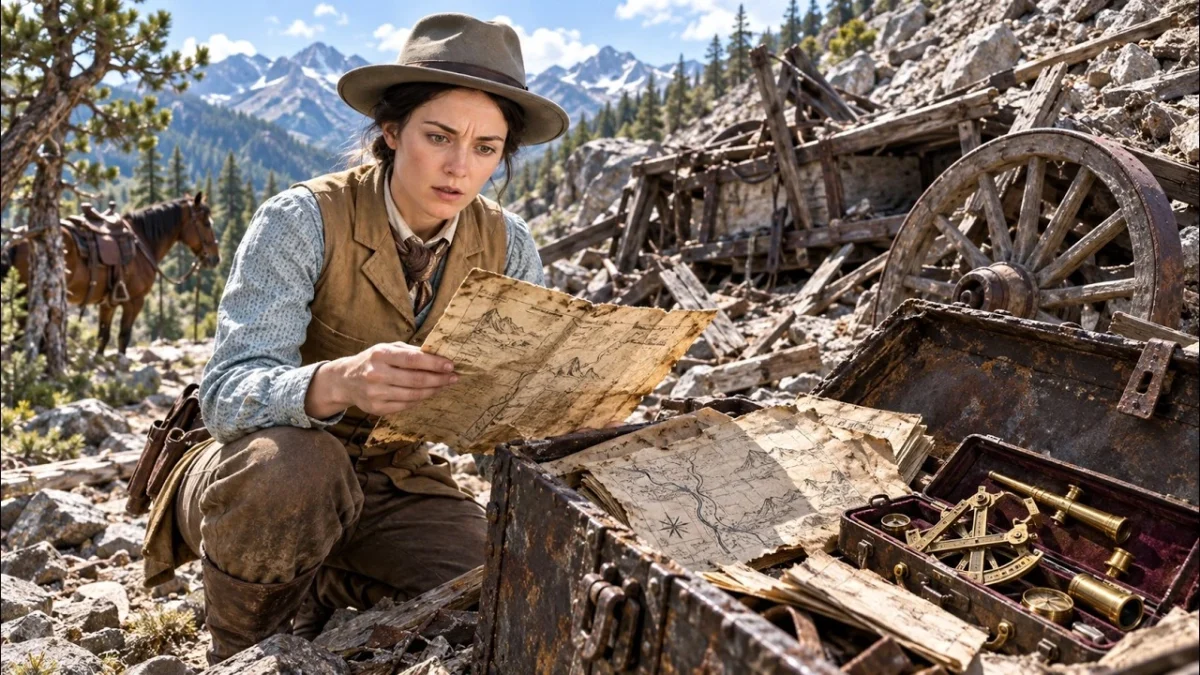
The mountain was not gentle to those who tried to take its secrets, and Genevieve Sorenson knew the look of a dangerous slope better than most men in the territory.
She had been riding the high country above Wolf Creek for nearly three hours when the rockslide scar on the north face caught her eye.
It was a raw, brown gash cut deep into the pine-covered slope, fresh enough that the scent of crushed cedar still hung faint in the crisp autumn air.
Beneath the loose scree and shattered timber, something gleamed in the hard sunlight—the unmistakable iron rim of a wagon wheel jutting directly out of the rubble.
She pulled her mare to a halt, resting both hands on the saddle horn as she studied the ruin.
She had ridden out that morning against Barnaby’s mild objections, insisting that she could scout the disputed boundary line herself rather than wait for him to find time between cattle chores.
She had promised him she would only observe the terrain, but as she looked at that exposed wheel, the quiet habit of a lifetime made the decision for her.
She dismounted, tied the reins to a sturdy scrub pine, and began her descent down the shifting gravel with careful, deliberate steps.
Growing up on her father’s survey sites had taught her how quickly a mountain could give way beneath a careless foot.
The wagon was ancient, its canvas long since rotted into threads, its wooden frame half-crushed under a massive boulder that had pinned it to the rock face decades ago.
Genevieve knelt in the dirt beside the driver’s bench, using a flat piece of slate to pry open a rusted metal strongbox wedged into the floorboards.
The hinges groaned and snapped, revealing no shiny coins or forgotten jewelry, but something far more valuable to a trained eye.
Inside sat a bound leather ledger swollen from old moisture, a hand-drawn map browned at the margins, and a polished brass transit resting securely in a velvet-lined wooden case.
She lifted the brass instrument with practiced reverence, checking its scales and sight tubes with the instinct of someone who had calibrated her father’s gear a hundred times.
When she opened the swollen ledger, her fingers hesitated on the stiff, yellowed pages.
Neat columns of bearings, distances, and landmarks filled the paper, written in the steady, confident hand of a professional surveyor.
She sat back on her heels in the loose shale, resting the heavy book on her knees as she read the same entry three times to be entirely certain.
“It can’t be,” she whispered to the empty canyon.
This was an original survey record from the late 1860s—the missing record that the whole valley believed had vanished twenty years ago along with the man who made it.
It was the very survey that Emmett Dracott was currently attempting to overturn with his new territorial claims.
Carefully, Genevieve wrapped the ledger, map, and brass transit inside her thick wool saddle blanket to protect them from the damp air.
Her heart pounded against her ribs as she climbed back up the crumbling slope toward her horse, fully aware that she was holding the one thing that could save Barnaby’s ranch.
Barnaby Holloway had built his eleven hundred acres through fifteen years of relentless, unglamorous labor, starting with money earned freighting goods between Deadwood and the railhead.
At forty-two, he was a quiet, broad-shouldered man respected by his neighbors for his honesty, but the territorial land dispute had worn him down to the bone.
Emmett Dracott had arrived eight months prior with a shiny new survey from the land office that shaved nearly two hundred prime grazing acres off Barnaby’s western boundary.
Without the original 1860s records to prove where the lines were first set, Barnaby had been fighting a losing battle in a game played with legal papers he barely understood.
When Genevieve arrived in July as a mail-order bride, Barnaby had expected a quiet companion to share his home, not a skilled partner capable of unraveling a legal conspiracy.
Her letters to the agency had been plain and practical, mentioning her late father’s work with quiet pride, though she had omitted just how much of the actual surveying she had done herself.
She knew all too well that men in the territory grew uncomfortable when a woman knew more about measurements and land lines than they did.
The evening light was fading to a dull slate gray when Genevieve finally rode into the ranch yard, her horse lathered and her clothes caked in dry mud.
Barnaby stepped out of the barn, wiping his grease-stained hands on a rag as he watched her dismount with an unusual bundle cradled against her chest.
“You stayed out longer than you said, Genevieve,” Barnaby remarked, his deep voice laced with mild worry.
“I found something up on the north ridge,” she said, her breath coming in quick white clouds in the cooling air.
“Did you find where Dracott’s men were setting those new timber posts?” he asked, walking over to take her mare’s reins.
“No,” she replied, looking him squarely in the eye. “I found the man who set the first posts twenty years ago.”
Barnaby paused, looking at her with a mix of confusion and quiet tiredness.
“Come inside, Barnaby,” she urged gently. “Set the lamp on the kitchen table.”
Inside the small wood-framed house, the oil lamp cast a warm, golden circle over the scrubbed pine table.
Genevieve unrolled the saddle blanket with slow precision, revealing the damp leather ledger and the brass case.
Barnaby stood over the table, his heavy hands resting on the edge as he stared down at the water-stained pages.
“What am I looking at here?” he asked softly, hesitant to touch the brittle paper.
“This is the lost field book from the 1868 territorial survey,” Genevieve explained, her index finger tracing a neat line of figures. “Look right here. These are the original bearings for your western border.”
“How can you be sure?” Barnaby asked, leaning closer as his brows furrowed. “That handwriting is half-faded, and the water got to the edges.”
“Because I spent ten years reading field notes just like this for my father,” she answered directly. “Look at the baseline coordinates. He anchored the western corner at a triple-stemmed ponderosa pine and a set iron rod on the rock shelf.”
“Dracott claims the line runs fifty yards east of that shelf,” Barnaby noted, his eyes narrowing as he followed her finger.
“Dracott is lying, or his surveyor was lazy,” Genevieve declared flatly. “This ledger proves where the true boundary was established. If the physical markers are still up on that ridge, his new claim is completely worthless.”
Barnaby looked up from the table, his dark eyes searching her face with a sudden, sharp intensity.
“You really know how to read these instruments and charts?” he asked, a hint of wonder breaking through his usual caution.
“My father lost the use of his hands to the shake when I was fifteen,” she said calmly. “I ran his chain, set his sights, and wrote his reports until the day he died. I know this work as well as any man licensed by the territory.”
Barnaby took a slow, deep breath, pulling out a wooden chair and sitting down hard.
“He’s got a hearing set in Wolf Creek for the first week of October,” Barnaby muttered, rubbing his jaw. “Dracott has the land office behind him.”
“He has paper,” Genevieve corrected him. “We have the original ground truth. But a ledger isn’t enough on its own. We need to go up there and find those iron rods before the snow covers the ridge.”
“You want to go back up into that rough ground?” Barnaby asked, looking at her muddy skirt and tired shoulders.
“I intend to locate every single marker mentioned in this book,” she said firmly. “Are you coming with me, Barnaby?”
Barnaby stared at the old book for a long moment, then looked at his wife, seeing a determination that made his own doubts feel small.
“We leave at first light,” he said softly. “I’ll pack the canvas and extra rations.”
Word traveled fast in small mountain towns, and by the time three days had passed, rumors of Genevieve’s discovery had already reached the local saloon.
Emmett Dracott rode out to the Holloway ranch on a chilly afternoon, his shiny leather saddle and groomed bay horse standing out starkly against the rugged barnyard.
He was a smooth-faced man with sharp, calculating eyes and a quiet manner that had managed to dispossess three other local ranchers without ever raising his voice.
Barnaby met him at the gate, while Genevieve stood on the porch, her arms crossed against the cold wind.
“Good afternoon, Holloway,” Dracott said, tipping his hat with practiced elegance. “I heard a curious rumor in town about your wife finding some old junk up in the slide.”
“It wasn’t junk, Dracott,” Barnaby said coldly, keeping his feet planted firmly in the dirt. “It was the 1868 survey log.”
Dracott let out a short, polite laugh, swinging himself down from his saddle with easy grace.
“Barnaby, my good man,” Dracott said, walking closer with a patronizing smile. “Old papers found in a ditch don’t overturn an official, certified plat from the territorial land office.”
“They do if they match the iron markers on the ground,” Genevieve spoke up from the porch, her voice cutting clearly through the autumn breeze.
Dracott turned his gaze toward her, his smile tightening just enough to betray his annoyance.
“Mrs. Holloway, isn’t it?” Dracott said smoothly. “I admire your loyalty to your husband’s cause, but land surveying is a precise science handled by court-appointed officials. A woman’s interpretation of a dead man’s scribbles won’t carry much weight with Judge Miller.”
Genevieve stepped down from the porch, walking slowly toward the fence line until she was standing directly across from him.
“A set of bearings means nothing without physical evidence to back it up, Mr. Dracott,” she said without a tremor in her voice. “Your surveyor drew his lines from a desk in the land office. The man who wrote this ledger drove iron into the rock face.”
“And you think you can find twenty-year-old iron in fifty square miles of timber?” Dracott scoffed softly.
“I don’t think,” Genevieve replied, meeting his gaze steadily. “I know. And when I bring those measurements into the courtroom, we’ll see whose paper holds up.”
Dracott stared at her for a long, silent moment, his easy demeanor vanishing completely to reveal a cold, hard glare.
“The territorial court values credentials, madam, not sentiment,” Dracott said curtly. He turned back to his horse, swinging into the saddle with sharp movements. “I advise you not to waste your time freezing on that ridge.”
“We’ll see you on Tuesday, Dracott,” Barnaby called out as the land speculator turned his horse around and galloped down the dirt trail.
Once the dust settled, Barnaby looked at Genevieve, noticing for the first time that her knuckles were clenched tight around the wooden porch railing.
“Are you all right?” he asked gently, walking over to stand beside her.
“I am angry,” she admitted quietly, her eyes fixed on the retreating horseman. “I have spent my whole life dealing with men who think a uniform or a title makes them smarter than the ground under their feet.”
“He’s scared, Genevieve,” Barnaby said, a slow, rare smile touching his lips. “I’ve seen Dracott talk ten men out of their property, but he didn’t have an answer for you.”
“He won’t have an answer for the court either,” she insisted. “Pack the horses. We leave now.”
The high country was unforgiving as the autumn weather began to turn sour, channeling a freezing wind directly down the mountain gaps.
For two days, Genevieve and Barnaby picked their way through loose shale, dense pine thickets, and steep granite shelves above the slide area.
Genevieve worked with a sharp, methodical focus, setting up the old brass transit, taking sightings off distant peaks, and instructing Barnaby where to pull the heavy measuring chain.
“Hold it taut right there, Barnaby!” she called out over the howling wind, squinting through the glass sighting tube of the instrument. “Don’t let the link sag on the bush!”
Barnaby stood waist-deep in a brush thicket, holding the metal chain tight despite his freezing fingers, watching her work with growing wonder.
He had expected her to tire out, to complain about the bitter cold or the rough terrain, but she moved across the mountain with the absolute authority of a master craftsman.
“Seventy-four chains and twelve links!” she shouted, marking the location in a fresh notebook she carried in her coat pocket. “The first marker should be right near that rock ledge!”
Barnaby dropped the chain and moved toward the base of the granite cliff, using his iron pry bar to clear away years of accumulated fallen leaves and pine needles.
Metal struck metal with a sharp, ringing clink.
“Genevieve!” he shouted, dropping to his knees. “Over here!”
She hurried across the rock, dropping beside him in the dirt.
Driven deep into a fissure in the solid granite was a square-headed iron pin, heavily rusted but firm as the mountain itself.
“That’s it,” she breathed, her cheeks red from the wind as a brilliant smile broke across her face. “That’s the northwest corner.”
They worked through the afternoon until the gray sky turned dark and heavy with the promise of rain.
By the time the last light faded, Genevieve had located all three original boundary pins, completing a tight geometric triangle that clearly placed the two hundred acres squarely inside Barnaby’s land.
A cold, driven rain began to fall as they scrambled down into a protected hollow beneath a rock overhang to pitch their small canvas shelter.
Huddled close under the heavy canvas, wrapped in wool blankets with the smell of wet pine around them, Barnaby watched the firelight flicker across her determined face.
“I’ve never seen anyone work like you did today,” Barnaby said quietly, his voice low against the steady drum of rain on the canvas.
“It’s just math and patience, Barnaby,” she replied, rubbing her cold hands together near the small blaze.
“No, it isn’t,” he said, shaking his head. “It’s knowing who you are and not letting the mountain or anyone else tell you different. I spent eight months feeling helpless against Dracott’s papers. Watching you today… it was like watching someone born for the job.”
Genevieve looked at him, surprised by the raw sincerity in his eyes.
“My father never gave me his name on the survey records,” she confessed softly, looking down at the fire. “Every line I ever ran, every map I ever drew, had his signature at the bottom. People thought I was just carrying his bags.”
“They were fools,” Barnaby said firmly, reaching out to cover her cold hand with his large, warm palm. “I don’t care whose name was on those old maps. You saved this ranch, Genevieve.”
She didn’t pull her hand away, letting the warmth of his grip settle the long fatigue in her bones.
When they returned to the ranch house, Genevieve spent four continuous days at the kitchen table, producing a pristine, formal report based on her field notes.
She drafted clean diagrams, mapped the exact coordinates of the recovered iron pins, and wrote plain, precise explanations comparing the 1868 data with Dracott’s fraudulent filing.
Cyrus, the ranch’s senior hand, walked into the kitchen on the fourth evening holding a supply order for Barnaby to sign.
He stood near the door for a moment, watching Barnaby leaning over Genevieve’s shoulder as she demonstrated how the angles offset Dracott’s line.
“Is that the map for the court, Mrs. Holloway?” Cyrus asked respectfully, pulling off his hat.
“It is, Cyrus,” she said, looking up with a brief smile. “It shows exactly where the line sits.”
Cyrus looked at Barnaby, who nodded with quiet confidence, then tucked his supply order into his pocket.
“I reckon that order can wait until after we win on Tuesday,” Cyrus muttered with a dry chuckle, slipping back out into the yard.
Desperate to protect his scheme as news of their discovery spread, Dracott made one final, underhanded attempt to disrupt the case.
Two nights before the hearing, a lone rider crept onto the Holloway property under the cover of dark, cutting the fence wire where Genevieve had stored the physical iron stakes she had carefully extracted to present as evidence.
Barnaby discovered the cut wire at dawn, finding the heavy iron pins still sitting safely inside the lockable wooden crate inside the barn where Genevieve had insisted on putting them.
“He sent someone to steal the physical evidence,” Barnaby noted grimly, looking at the fresh wire cuts. “He’s terrified of what you put on paper.”
“Then let him be terrified,” Genevieve said coldly. “We leave for town in an hour.”
The Wolf Creek meeting hall was packed to the doors on the first Tuesday of October, humid with the smell of wet wool coats, woodsmoke, and crowded townspeople.
Judge Miller, a stern-faced man with thick gray eyebrows, sat behind a improvised oak table at the front of the room, reviewing the legal filings.
Emmett Dracott sat at the defense table beside a polished territorial attorney named Harrison, both looking entirely composure and confident.
When the case was called, Harrison stood up first, resting his hands smoothly on his lapels.
“Your Honor,” Harrison began, his voice echoing in the hall. “We request an immediate dismissal of the defense’s claims. The opposition relies entirely on the amateur observations of an uncertified individual—a woman who has no official standing or license within this territory.”
A hush fell over the room as the townspeople leaned forward on the wooden benches.
Genevieve did not wait for Barnaby’s attorney to defend her; she stood up directly from her chair, holding her leather-bound portfolio in her hands.
“If it pleases the court, Your Honor,” Genevieve said, stepping out into the aisle with a clear, steady voice. “I am prepared to present the mathematical evidence myself.”
Judge Miller raised his heavy eyebrows, peering over his spectacles at her.
“Mrs. Holloway, this is an official territorial proceeding,” Miller warned neutrally. “Do you possess formal qualifications?”
“I served as chief assistant to Edward Sorenson, civil engineer for the Northern Pacific land surveys, for twelve years,” she answered, stepping forward to hand her documents to the court clerk. “I have included two certified court precedents from the 1877 territorial records where land grants were validated based directly on field measurements performed under my supervision.”
Harrison shifted uncomfortably on his feet, glancing down at his legal notes.
“Furthermore,” Genevieve continued calmly, addressing the judge directly, “surveying is not a matter of opinion or legal rhetoric, Your Honor. It is a matter of physical ground measurements. In this portfolio, you will find the recorded bearings from the recovered 1868 field log, cross-referenced with the three physical iron boundary markers currently sitting in the wooden crate beside the clerk’s desk.”
Dracott leaned over to whisper urgently into his lawyer’s ear, his composure beginning to crack under the quiet focus of the room.
For the next forty minutes, Genevieve walked the court through the technical details with methodical perfection.
She cited chain lengths, baseline elevations, and magnetic deviations without checking her notes a single time, speaking with an authority so absolute that even Dracott’s attorney stopped interrupting her.
When Dracott took the stand to defend his filing, the contrast was immediate and devastating.
“Mr. Dracott,” Judge Miller questioned, leaning forward over his desk. “Can you explain why your 1883 survey shifted the boundary line exactly one hundred and ninety-eight acres west of the original 1868 iron pins?”
“Your Honor,” Dracott stammered, adjusting his collar. “Modern equipment offers a higher degree of precision than primitive territorial methods. We simply recalculated the variance…”
“Did your team locate the original 1868 ground markers before recalculating?” Miller cut him off sharply.
“Well… no,” Dracott admitted, his face flushing dark red. “The records were presumed lost…”
“They were not lost,” Miller said, looking down at the wet leather ledger sitting on his table. “They were merely waiting for someone who knew how to look for them.”
The judge took two long days to issue his written verdict—two days during which Barnaby barely slept, walking the perimeter of his home each evening in nervous anticipation.
On Thursday morning, the written decree was posted on the doors of the Wolf Creek town hall.
The court accepted the original 1868 survey as the sole controlling record for the property.
Dracott’s 1883 filing was formally voided as fraudulent, and the full eleven hundred acres were permanently reconfirmed as belonging to the Holloway Ranch.
Within a month, the Dracott Syndicate quietly packed up its local office and withdrew from the county entirely, its reputation destroyed by the plain facts recorded in a dead surveyor’s book.
The victory changed more than just the legal boundaries of the ranch.
Over the following weeks, a steady stream of local neighbors began stopping by the Holloway house, asking if Mrs. Holloway might have time to examine their own boundary lines and deed disputes.
Barnaby stood on the front porch one crisp late-November afternoon, watching Genevieve log a neighbor’s request into a new leather ledger she had bought in town.
“You know,” Barnaby said with a quiet smile, leaning against the doorframe. “I wrote to the agency asking for a partner to keep house and help run the ranch. I didn’t realize I was marrying the finest surveyor in the territory.”
Genevieve looked up from her book, a faint, genuine smile touching her lips.
“Are you disappointed, Barnaby?” she asked softly.
“I’m more grateful than I know how to say,” he answered honestly.
Later that evening, as the sun dipped low behind the snow-capped peaks, they walked out together to the western edge of the property.
They stopped at the rock shelf where the third iron marker had been found, the mountain air cool and clear around them.
Barnaby looked out over the sweeping, golden grass of his pasture, then turned to face her directly.
“I fell in love with you up on that mountain, Genevieve,” Barnaby said, taking both of her hands in his. “Not just because you saved this land, but because I saw who you really are when you’re doing the work you were made for.”
Genevieve felt a warmth blossom in her chest that had nothing to do with the fading light.
“I spent my whole life standing behind another man’s name, Barnaby,” she said quietly, looking into his steady, honest eyes. “You’re the first person who ever let me stand in the light.”
“I want a real marriage, Genevieve,” Barnaby said gently, bringing her hands to his chest. “A true partnership, where your mind and your skills belong to this ranch just as much as my hands do.”
“It’s already ours, Barnaby,” she replied softly, leaning into him as he wrapped his arms around her.
When he kissed her under the vast, open sky of the high country, Genevieve knew that the secret wagon hidden in the rocks had given her far more than land or legal papers.
It had given her a life where she was finally seen, valued, and home on ground that was truly their own.








