“Mama Said You’d Know What to Do,” the Little Boy Said… The Rancher Froze When He Saw the Letter
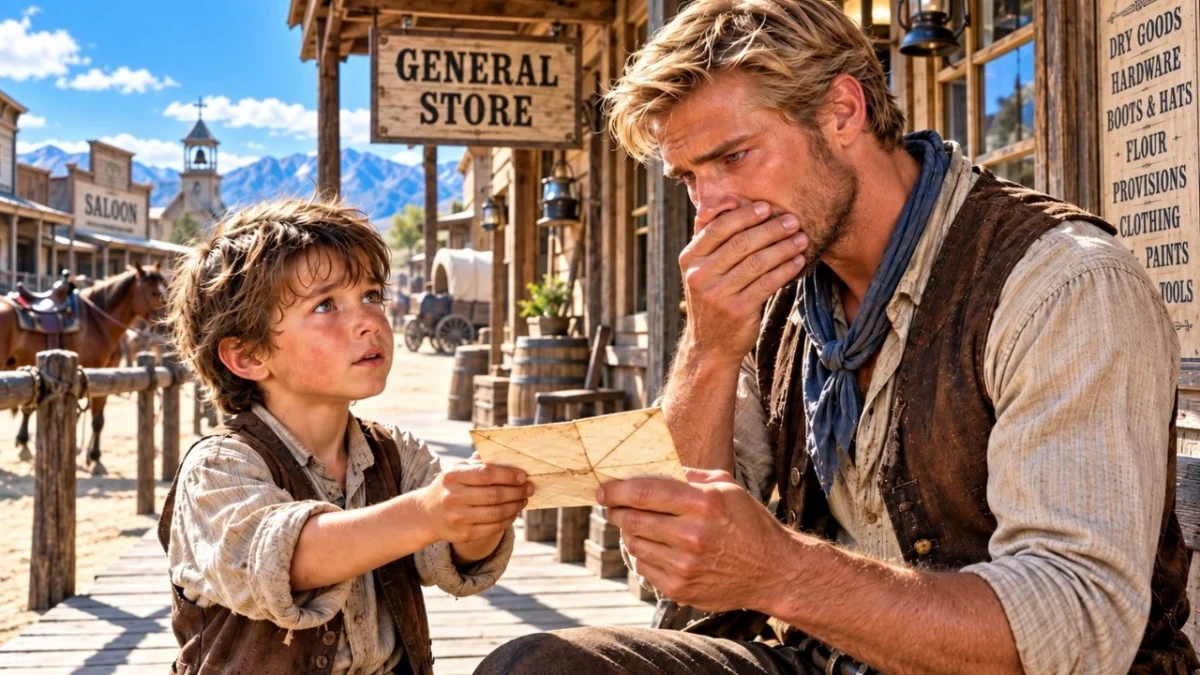
Cold Water, Montana Territory, 1883.
The boy appeared on a Tuesday morning when the sun was still low and the mountains behind the town were doing what they always did at that hour, catching the first gold of the day on their peaks while everything below them was still in the cool blue shadow of early morning.
It was the kind of light that made the whole world look like it was holding its breath before deciding what kind of day to be.
Jake Alderman was sitting on the wooden steps of the general store with a tin cup of coffee he had not asked for.
Mrs. Pruit had handed it through the door without comment, which was her quiet way of saying she had noticed he had been sitting there since before she unlocked the front door and that she thought he needed something warm in his hands.
Jake stared down at the dark liquid, watching the steam rise into the crisp autumn air, feeling the familiar dull ache in his lower back that came from years of hard ranch labor.
He was a man who spoke only when speech was necessary, built like the timber in the surrounding hills, shaped by wind, winter, and the steady weight of daily work.
The sound of footsteps on the dusty main street made him look up.
The boy came down the main street of Cold Water at a pace that was not quite running, but was the urgent, determined walk of someone who had been walking a long time and had finally seen where they were going.
He was perhaps nine years old, small for his age, or maybe just thin in the way children got when they had not been eating enough of the right things over a long journey.
He had dark hair, badly cut, falling across his forehead in a jagged fringe that he kept pushing back with his free hand.
His clothes were worn and patched at the knees, but they were remarkably clean.
Someone had cared very much about keeping those clothes clean, even when other things in life had gotten difficult and unforgiving.
He carried a brown leather satchel over one shoulder, its strap digging into his thin shirt, and he was holding something in both hands, pressed tightly against his chest.
He held it like the way a person held something they had been told was extraordinarily important, careful not to drop it or let the wind catch it.
The boy stopped at the bottom of the general store steps and looked straight up at Jake.
He looked at Jake Alderman with the direct, undeflecting gaze that certain children possessed—the ones who had learned early in life that adults were not always reliable, and who had decided that the best approach was to look at them steadily and see what they were made of before trusting them with anything that mattered.
“Are you Jake Alderman?” the boy asked.
His voice was small, slightly raspy from the road dust, but remarkably clear.
Jake set down his coffee cup on the step beside his boot.
“Yes,” he said.
The boy held out what he had been carrying pressed against his chest.
It was a letter, or had been a letter once.
The paper was worn soft at the folds from being handled and unfolded many times, the edges beginning to fray at the corners, the outside stained with pale ringlets from what looked like a long journey in a satchel through uncertain weather.
But the name written on the front was still legible, penned in a graceful, fluid script that Jake recognized before he had consciously registered recognizing it.
It was his name, written in her handwriting.
Jake reached out and took the letter.
His hand, he noticed distantly with a strange jolt in his pulse, was not entirely steady.
“Ma said, ‘You’d know what to do,'” the boy said.
Then, with the formal precision of a child delivering a message exactly as it had been rehearsed and instructed, he added another sentence.
“She said to tell you that she was sorry she waited this long, and that she would have come herself, but she couldn’t.”
Jake looked down at the letter in his hands, at his name written in that familiar handwriting, and then back at the boy standing at the bottom of the steps looking up at him with those steady dark eyes.
“What’s your name?” Jake asked, his voice rough.
“Henry,” the boy said.
“Henry,” Jake repeated, testing the sound of it against the morning air. “How old are you, Henry?”
“Nine,” Henry said. “In three months.”
“Where’s your mother now, Henry?”
Henry looked at him for a long moment, that measuring look returning to his dark eyes as if he were deciding how much to say and how much to hold back until he was sure.
“She’s sick,” Henry said quietly. “She sent me ahead on the stage to the junction, and I walked the rest. She said you’d know what to do.”
Jake Alderman looked down at the letter in his hand, then at the mountains behind the town going from soft gold to the hard, bright white of full morning, and then back at the boy who had walked into Cold Water on a Tuesday carrying something important against his chest, looking for a man he had never met because his mother had told him to.
“Stay here,” Jake said softly.
He broke the wax seal on the letter.
The letter was four pages written close, filling every margin in the handwriting he had not seen in eight long years.
It was the same handwriting he had read in a different letter once—a much shorter one that had arrived two years after he had left for the northern cattle drives.
That old letter had said she was married and well, and that she hoped he was too.
Jake had read that first letter three times before folding it, putting it in the bottom of his saddlebag, and carrying it for a full year before finally burning it one evening at a lone campfire because carrying it had become a weight he decided he could no longer afford, and burning it had been the only way to make his mind stop returning to it.
He should have known, probably, that seeing her handwriting again would do what it did to his heart.
Eight years was a long time, long enough to forget a great many things about a person’s face or the sound of their voice.
It was not, apparently, long enough to forget that.
He read the letter standing on the steps of the general store with the morning coming up around him, while Henry watched from the bottom of the steps with those steady dark eyes.
By the second page, Jake understood why his hand had not been entirely steady when he took the paper.
By the third page, he had sat back down on the wooden steps because standing no longer felt like the right relationship to have with gravity.
By the fourth page, he had his hand over his mouth, staring blankly at the ink lines, and then looking up at Henry with an expression that he was quite certain Henry had never seen on an adult’s face before.
It was a mixture of absolute shock, ancient grief, and a sudden, overwhelming surge of clarity that altered the horizon of his entire life.
“Henry,” Jake said when he had finally finished reading.
“Yes, sir,” Henry said, resting his hand on the leather strap of his satchel.
Jake carefully folded the four pages back along their soft, worn creases.
He placed the letter inside his vest pocket, pressing it flat against his ribs.
He looked at the boy for a long, silent moment, taking in the small shoulders, the dusty boots, and the intense composure of a child who had been forced to grow up far too fast.
“Are you hungry?” Jake asked.
Henry said nothing at first, but something in the set of his shoulders shifted.
It was not a dramatic movement, just the small, controlled adjustment of a child who had learned not to show physical need too plainly, but who was doing it anyway because the question had been asked in the right way.
“Yes, sir,” Henry said.
“Come on,” Jake said.
He picked up his tin coffee cup, stood up from the steps, and walked over to the heavy wooden door of the general store, holding it open.
Henry came up the steps without hesitation and went inside.
Outside, the mountains behind Cold Water kept doing what they had always done—watching, patient, holding their gold in the morning light, entirely indifferent to the human drama unfolding below them, and yet entirely responsible for the quiet beauty that made it possible for people to keep going in spite of it.
Inside the store, the smell of roasted coffee, dried tobacco, smoked hams, and fresh pine boards filled the air.
Mrs. Pruit behind the counter had been listening to the conversation outside through the open window with the focused discretion of a woman who had run the general store in Cold Water for fifteen years.
She had learned long ago that the most useful thing a person could do in most complex human situations was to keep the hot coffee coming and keep her opinions to herself until she was explicitly asked for them.
She came out from behind the counter carrying a plate piled high with warm buttermilk biscuits and a small crock of plum jam.
She placed it on the small wooden table in the corner where travelers sometimes sat.
She refilled Jake’s cup with steaming dark coffee.
She did not look at Jake directly while she worked, which was a true mercy.
Jake sat down across from the boy and watched Henry eat a plate of Mrs. Pruit’s biscuits with the focused, methodical attention of someone who had not had enough of anything good in a very long time.
As Henry ate, Jake did the arithmetic in his head.
He did it twice because the first time he finished the numbers, he thought he must have made an error in subtraction.
The second time he calculated the months and the years, it merely confirmed the first.
He put his coffee cup down on the table very carefully so it wouldn’t rattle.
“Henry,” he said softly.
Henry looked up from the half-eaten biscuit in his hand, his dark eyes clear and questioning.
“Did your mother tell you why she sent you to me specifically?” Jake asked. “Not to a neighbor, not to the town authorities in Billings, not to anyone else… but to me?”
Henry chewed thoughtfully before answering.
The rhythm of his considering was careful, in the specific way that children’s considering was careful when they were deciding whether an adult could truly be trusted with an honest answer.
“She said you were the one person she was certain of,” Henry said.
He wiped a bit of jam from his thumb.
“She said some people were certain for a little while, and some people were certain even when you didn’t see them for years. She said you were the second kind.”
Jake looked at the boy across the narrow wooden table.
He looked at the dark hair falling over his brow, at the steady dark eyes, and at the erect, straight-backed way he held himself even when he was exhausted.
He was careful even when hungry, precise even when delivering heavy information to a stranger.
He looked like Clara around the eyes—that same clear, unflinching gaze that saw straight through pretenses.
And around the line of the jaw, Jake realized with a sudden tightening in his throat, he looked remarkably like Jake’s own father.
“Okay,” Jake said, his voice doing a reasonable impression of being steady. “Finish your biscuits, Henry.”
Jake took another sip of his coffee and let his mind travel back over the missing years, piecing together the narrative Clara had laid out in her letter.
Her name had been Clara Moss recently, though she had been born Clara Vance.
Jake had known her long before any of the titles or marriages, back when they were young and the world seemed vast and manageable.
They had known each other in the deep, unhurried way that young people knew each other in small frontier towns where everyone knew everyone’s history.
Their knowing had possessed a particular quality—two people who had decided, without making grand speeches or promises to the wind, that the other one was the anchor they wanted.
They had been twenty and twenty-two.
They had been, for one bright year, the kind of certain about each other that young people were certain before life demonstrated that certainty was a choice you had to keep making every day rather than a destination you arrived at and stayed in forever.
Then Jake’s father had died suddenly in his sleep, leaving the ranch heavily burdened with debt, and the local bank had demanded payment on the mortgage.
Jake had done the only thing a young man with cattle experience could do—he had gone far north to work the long cattle drives that paid high wages, aiming to earn enough to save his family’s land.
He had told Clara he would be back in two seasons.
He had kept his word and returned in two seasons, but two seasons in cattle country was an eternity, long enough for the structure of lives to shatter and rebuild themselves in different shapes.
When he had come back to the valley, she was already married to a man named Arthur Moss.
Moss was an older man who owned a hardware store, had a steady income, and possessed the immediate ability to provide a permanent home in one place—which was what Clara had desperately needed at that moment, and what Jake, at twenty-two with an insolvent ranch, had not yet known how to offer her.
Jake had not blamed her then.
He had understood the brutal economics of survival on the frontier.
He had spent the following six years pouring his sweat into the soil, building his ranch into something solid that could sustain a life without ever needing another cattle drive.
He had never looked for anyone else to share it with.
He had told himself that it was because he was too busy with the stock and the fences, and he had told himself it was not because of Clara, though deep down he knew it was entirely because of Clara.
The letter resting in his vest pocket had revealed truths he had never imagined during those lonely years on the range.
Clara had written that the child she was carrying when she married Arthur Moss—a pregnancy she had not known about when Jake rode out on the trail, and only discovered two months after his departure—was not Moss’s child.
Arthur Moss had known the truth from the beginning and had married her anyway.
It was an act that was either pure generosity or cold calculation, and perhaps a bit of both.
By Clara’s account, Moss had been a decent enough husband until hardship hit his business, at which point he grew bitter and distant.
Eventually, in the harsh winter of 1880, he had simply packed his bags and left for the western territories, abandoning Clara and the young boy.
Clara had spent the last three years surviving on her own, taking in laundry and sewing, doing whatever was necessary to feed her son.
The child she had been carrying when Jake rode north—the boy sitting across the table eating biscuits—was Henry.
He was nine years and three months old.
Jake looked out the small glass window of the general store toward the main street.
The mountain town of Cold Water sat in a high valley that was, by any honest accounting, one of the most beautiful places in the Montana Territory.
It was not the dramatic, terrifying beauty of the jagged high peaks further north, but the quieter, more enduring beauty of a valley that had been settled long enough to have grown into itself.
The mountains surrounding it served as natural walls that kept the chaotic noise of the rest of the world at a respectful distance.
The main street ran east to west and caught the morning light from end to end during the summer months.
The wooden buildings on both sides cast long, dark shadows that shortened as the day went on, until at noon everything was lit flat and equally, leaving no secrets that the sun couldn’t reach.
Jake had come to this valley eight years ago after the drives, determined to build something that would endure.
He had built it with his own hands.
The ranch outside of town was three hundred acres of prime grass and reliable creek water, featuring a barn built of thick pine logs that would outlast him, and a house that was sound, dry, and warm in the depth of winter.
He had built all of it thinking, in the vague way that men built things without fully admitting why to themselves, that someday it would be for more than just himself.
He had not been specific about when that someday would arrive, or who the others would be.
He had simply kept building because stopping felt like a failure, and because the mountains in the morning were reason enough to remain in a place even when other reasons were unclear.
“Finished?” Jake asked gently.
Henry pushed the empty plate away and wiped his mouth with the back of his hand. “Yes, sir. Thank you.”
“Let’s go,” Jake said.
He paid Mrs. Pruit for the biscuits, acknowledging her silent nod with a tilt of his hat, and led Henry outside to where his wooden supply wagon was hitched to a pair of sturdy bay horses.
Jake helped the boy up onto the high bench seat, then climbed up beside him, taking the leather reins in his hands.
He took Henry out to the ranch that afternoon, not because he had fully processed everything or made a long-term plan, but because the boy had been traveling for days and needed a real place to rest.
Henry had mentioned walking the last stretch from the junction without any dramatic flourish, stating it as a simple fact—the same way a person might state that the sky was blue or that winter was cold.
Jake’s house had a spare bedroom that had remained empty for eight years, never finding a proper purpose.
Now, it finally had one.
As they drove out of town, Henry sat beside Jake on the wagon seat, his small hands resting on his knees as he surveyed the expansive valley.
The afternoon light was turning to rich gold on the western slopes of the mountains.
The grass in the wide pastures was still vibrant green from the late summer rains, and the winding creek visible through the thickets of willows along the road caught the sunlight, turning the water into a ribbon of moving brightness.
“The mountains are bigger here,” Henry observed, breaking the long silence.
“They are,” Jake agreed, keeping the horses at an even walk.
“We had mountains where we lived before,” Henry said. “But they weren’t like these. These look like they go all the way up.”
“Where did you live?” Jake asked.
“Billings, mostly,” Henry answered. “And before that, Bozeman. And before that, somewhere I don’t remember the name of because I was too small.”
Jake glanced sideways at the boy.
Henry was looking at the passing landscape with a serious, absorptive attention, as if he were filing away every tree, rock, and fence line for future reference.
“Your mother,” Jake said slowly, choosing his words with care. “The letter said she was sick. Did she tell you what kind of sick she is?”
Henry was quiet for a moment.
When he spoke, his tone was entirely devoid of theatrical grief, possessing instead the heavy, tragic steadiness of a child who had already done the hardest part of his crying in secret.
“The kind that doesn’t get better,” Henry said softly.
Jake felt a cold knot form in his stomach.
He carefully placed his right hand on the wooden bench seat between them.
He did not place it on Henry’s shoulder, because he did not know yet if the boy would shrink away from an unfamiliar touch, and he believed that certain offers needed to be made visible before they were imposed.
He simply laid his rough, calloused hand on the seat where Henry could see it if he chose to look.
Henry looked down at Jake’s hand, then raised his eyes back to the distant peaks.
“She said you had a good ranch,” Henry said.
“She did?” Jake asked.
“She said you were the kind of man who built things that lasted,” Henry said. “She told me she always knew you would be.”
Jake kept his eyes fixed on the dirt road ahead, the reins loose in his fingers.
“She was right,” Jake said, his voice thick. “About most things.”
“She usually was,” Henry said.
For the first time since he had appeared at the general store steps, something in the boy’s face shifted.
It did not break into tears or a display of sorrow, but softened into the smaller, quieter expression of a child who loved someone deeply and was carrying that love the only way he knew how—carefully, and mostly in silence.
Jake Alderman, who had built a life out of timber, stone, and hard labor, felt something yield inside his chest.
It was not precise, and it was not practical, but somewhere on that dirt road between Cold Water and his ranch, flanked by mountains in the golden afternoon light, he decided to stop fighting the past.
Three days later, after leaving Henry under the watchful eye of his reliable old ranch hand, Pete Coulton, Jake rode out to Billings.
He found Clara in a small, quiet boarding house run by a widow named Mrs. Carver.
It was clear from the clean linens, the fresh water pitcher, and the gentle atmosphere of the room that Mrs. Carver had been attending to Clara with the seasoned competence of someone who had ushered many souls through their final earthly days.
Clara was thin—far thinner than her written words had prepared Jake for.
Her frame seemed almost weightless beneath the heavy blankets, but when she turned her head and looked at Jake standing in the doorway, her eyes were unmistakably Clara’s eyes.
They were bright, clear, and filled with the expression of someone who had been holding onto hope against long odds and was startled to find it actually answered.
She looked past Jake’s shoulder toward the hallway.
“You found him,” she whispered, her voice frail as dry leaves.
“He found me,” Jake said.
A faint, bittersweet smile touched the corners of Clara’s lips.
“He’s very good at finding things,” she said softly. “He always has been.”
Jake pulled a heavy wooden chair close to the side of the bed and sat down.
Clara watched him with the anxious uncertainty of a person who had sent four long pages into the world and was now waiting to see the final verdict of those words.
“I read the letter,” Jake said.
“I know,” she replied. “You’re here.”
“You should have told me, Clara,” Jake said, the pain finally surfacing in his voice. “Eight years…”
“I know,” she murmured, closing her eyes for a brief second. “I was afraid you’d feel obligated. And I didn’t want that from you, Jake. I didn’t want to be a burden you took on just because you felt you had to.”
Jake looked down at his own hands resting on his knees—at the thick calluses, the faded scars, and the weathered skin earned from eight years of solitary ranch work.
They were the physical record of everything he had constructed while she had been struggling somewhere else in silence.
A small sound made them both look toward the doorway.
Henry was standing there, his small frame framed by the pine casing.
“He did the arithmetic,” Henry said plainly, looking at his mother.
Clara looked from her son to Jake.
“On the steps outside the store,” Henry explained to her. “He did the arithmetic. I could tell.”
Clara managed a small, genuine laugh that turned into a quiet cough.
“He’s very observant,” she said to Jake.
“I can see that,” Jake said.
He turned to the boy.
“Henry, go down to the kitchen and find Mrs. Carver. Ask her if there’s anything to eat in the house, and come back after.”
Henry considered the instruction for a moment, measuring Jake’s tone.
Then he gave a single, firm nod and turned down the hallway, his footsteps precise and unhurried on the floorboards.
In the quiet room that remained, Jake and Clara looked at each other.
The eight years of separation and unspoken truths sat between them, no longer an insurmountable wall, but simply a distance that had finally been measured and named.
“Tell me what you need,” Jake said quietly.
Clara reached out a trembling, thin hand, and Jake immediately took it in his own large, warm palm.
“I need him to be all right,” she said, her voice trembling with the full weight of a mother’s final desire. “After I’m gone. That’s all I need. That’s why I sent him to you.”
“He’ll be all right,” Jake said without hesitation.
“You don’t know that for sure,” she whispered.
“No,” Jake acknowledged. “But I know how to build things that last. That’s what you told him, wasn’t it? And you were usually right.”
Clara stared at him, her dark eyes searching his face, seeing past the rugged exterior to the man she had always known he was.
“You’re going to be furious at me later,” she said softly. “When this part is over, and the practical work starts, and you’ve had time to think about all the years we lost.”
“Probably,” Jake admitted honestly. “That’s fair.”
“Yes,” she said. “It is.”
Henry returned a few minutes later, carrying two buttermilk biscuits on a small tin plate.
He announced that Mrs. Carver said supper would be served at six o’clock sharp and that there was plenty of room at the table for all of them.
He delivered the news with the efficient clarity of a child who took his responsibilities seriously.
Clara passed away on a cold Thursday morning six weeks later in that quiet room in Billings.
Outside her window, the distant mountains stood tall against the pale sky, blue, permanent, and silent—doing what mountains always did, which was simply being there.
Jake was at her bedside. Henry was there, holding her other hand.
Mrs. Carver stood by the door, present because she was the kind of woman who understood that no one should cross that final boundary alone.
No one in the room said anything inadequate to the moment, because everyone present had learned through hard experience that certain moments in life were too heavy for ordinary words.
After the simple burial on the hill outside Billings, Jake and Henry began the long drive back to Cold Water in the wagon.
The autumn air was sharp, and the mountains flanked both sides of the valley road.
The morning light turned to gold on the western slopes, and the creek flashed brightly through the bare willow branches.
Neither of them said much during the journey, because there was little that needed saying.
Both of them understood that what lay ahead in the coming months would not be simple, neat, or easy.
Grief was not a straight line, and building a family out of loss was complicated work.
In the weeks that followed, Henry was angry sometimes—expressing it in the specific, unpredictable way that children expressed anger when they had been carrying the heavy burden of dignity for too long and finally found a place safe enough to drop it.
Jake remained patient in the steady way that men remained patient when they recognized that patience was the only tool that could repair what was broken.
They argued over small, practical matters around the ranch.
They argued about the proper way to mend a broken wire fence, whether Henry ought to finish his reading assignments before or after the evening chores, and whether a nine-year-old boy was old enough to have valid opinions on cattle management.
Those small arguments were necessary practice for the larger, unspoken understandings taking root between them.
Pete Coulton, the old ranch hand, watched the process unfold from a respectful distance.
Pete was fifty-five, had lived a hard life, and had seen most human situations at least twice.
He offered no unsolicited advice, choosing instead to contribute by quietly producing extra biscuits at mealtimes.
Once, in late November, as a cold wind blew off the peaks, Pete casually mentioned to Henry that the north pasture fence had a gap in the high rocks that needed fixing.
“I’m getting too thick in the middle to squeeze through those rocks,” Pete said, scratching his chin as he looked at the boy. “Need someone smaller. You look like just about the right size, if you’re interested.”
Henry had looked up, his dark eyes instantly sharpening. “I’m interested.”
Henry squeezed through the rocky gap that afternoon, holding the wire tight while Pete nailed the staples into the pine posts.
He went through a second time to check the tension, and by the third time, Pete formally declared the north fence adequately maintained.
When they walked back to the barn, Henry carried the proud, square-shouldered expression of someone who had been entrusted with real, necessary work and had completed it correctly.
It was precisely the expression Pete had been aiming to produce.
By the time the deep winter arrived and the mountains turned pure white above the timberline, Henry had mastered the routine of the ranch.
He knew the repair schedule for the north fence, the order of the morning barn chores, and the names of all six working horses.
He had even learned Pete’s complex system for organizing the tool shed—a system that followed no recognizable human logic, but belonged to Pete, and was therefore absolute law.
Most importantly, Henry learned Jake’s morning habit.
Every day at sunrise, Jake would walk out to the edge of the yard, stand by the fence line looking north toward the peaks, and drink his coffee slowly.
Henry discovered that if he went out and stood right beside Jake, remaining completely silent for the first five minutes, Jake would eventually start talking.
Jake didn’t talk about grand or dramatic things.
He talked about the ordinary things that people shared when they were becoming accustomed to each other’s presence.
He talked about the shifts in the weather, the behavior of the herd, and how the light hit the high peaks at different times of the year.
He taught Henry how to read the clouds over the mountains to predict whether the day would bring rain, snow, or clear skies.
So, every morning as the sky turned pale, Henry put on his coat and walked out to the fence line.
He stood beside Jake, kept quiet for five minutes, and listened as the man taught him how to read the world.
When spring arrived, melting the high snows and sending the creek rushing full and fast through the valley, the meadow grass returned in vivid green.
The whole valley seemed to fill with the quiet energy of things that had been dormant deciding to come alive again.
On a clear morning in April, Jake rode into town to the county courthouse in Cold Water.
He filled out the formal legal documents, signing his name in firm, dark ink to make official what had already been true for months in every way that mattered.
The name recorded on the legal paper was Henry Alderman.
When Jake returned to the ranch that afternoon, he found Henry out near the barn with Pete, getting an advanced lesson in wire tensioning.
Jake walked over to the fence, resting his arms on the top rail.
“The paperwork is done,” Jake said.
Pete nodded once in approval without looking up from his fence pliers.
Henry paused, wiping his brow with his sleeve. “What kind of paperwork?”
“The kind that means this ranch belongs to you, too,” Jake said softly. “Officially.”
Henry looked at Jake, then at Pete, and finally at the great mountains behind the house, gleaming blue and white in the bright spring sunshine.
They were the same mountains that had been there every morning since he arrived, and that would remain there for far longer than any of them could measure.
“I already knew that,” Henry said.
Jake looked at him, surprised. “You did?”
“I knew it the first day,” Henry said, his voice quiet and sure. “When you put your hand on the seat in the wagon. You didn’t put it on my shoulder because you didn’t know yet if I’d want that. But you put it on the seat right where I could see it.”
Jake stood silent for a moment, swallowed hard, and looked down at his boots.
“You’re very observant,” Jake said, his voice thick with emotion.
“Mama said,” Henry replied simply.
Over by the post, Pete was examining a wire staple with intense, unwavering concentration, wearing the exaggerated expression of a man who was completely deaf and would swear to it under oath in any court in the territory.
“She was usually right,” Jake said.
“Usually,” Henry agreed.
He picked up his wire tool, turned back to the fence post, and went right back to work.
The mountains watched over them that evening, as they did every evening.
They were the same mountains that had witnessed a nervous boy walk down the street on a Tuesday morning, a quiet wagon ride through a golden valley, a tearful promise in a boarding house room in Billings, and two figures sharing a single cup of coffee at a fence line in the cold of November.
They were still there months later on a bright Saturday morning when Henry turned ten years old.
Pete marked the occasion by mysteriously producing a fresh apple cake from the kitchen—a cake nobody had seen him bake.
Jake marked it by bringing out a custom leather bridle he had been secretly crafting in the barn during the evenings for six weeks.
It was sized specifically for the smallest bay horse in the barn—a gentle horse Henry had been admiring since his very first week on the ranch.
“This is yours now,” Jake said, handing the soft leather bridle to the boy. “The horse, too.”
Henry looked down at the hand-carved leather of the bridle for a long, breathless moment, feeling the smooth oil finish beneath his fingers.
Then he looked up at Jake, his dark eyes clear, steady, and filled with a profound, unspoken understanding.
Finally, he turned his gaze toward the mountains rising proud against the Montana sky, knowing he was finally, truly home.








