My Blind Date Never Showed Up… Then The Waitress Sat Down And Said, “Can I Tell You Something?”
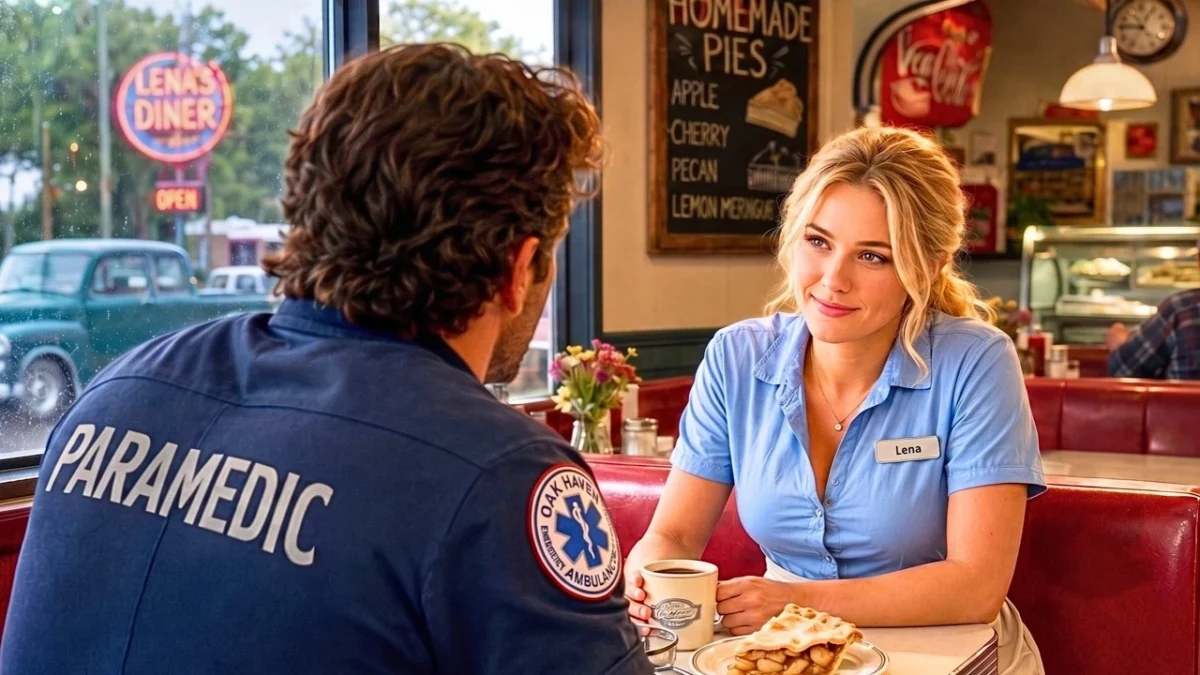
Owen Walsh was thirty-nine years old, and for fourteen of those years, he had been a paramedic. His entire working life was spent stepping into the worst moments of other people’s existence. He was the man who showed up when a chest gave out on a linoleum kitchen floor, when a teenager crumpled a sedan around a telephone pole, or when an elderly woman lay helpless at the bottom of her stairs for a full day. In those dark, frantic spaces, Owen was the steady anchor. He kept his voice flat and calm, did what needed to be done with practiced hands, delivered his patients through the sliding doors of the hospital, and then turned around to drive toward the next emergency.
He drove an eleven-year-old sedan that he kept alive with his own mechanical tinkering, much like he kept strangers alive on the asphalt. His apartment was small, perpetually dark, and empty. The pay was modest, barely stretching to cover a rent that rose every spring, forcing him to pick up overtime shifts that left his shoulders tight and his eyes bloodshot. People often assumed that a man who saved lives must carry a sense of grand fulfillment, but Owen mostly carried exhaustion. The physical labor was heavy, but the true burden was the quiet. Fourteen years of walking through his own front door to an empty hallway had taught him to expect nothing else.
His younger sister, Beth, had spent years lecturing him about his isolation. She would watch him pour coffee during brief family visits and sigh, telling him that he gave everything he owned to complete strangers and kept nothing for his own life. Eventually, tired of his gentle brush-offs, Beth had taken matters into its own hands. She traded phone numbers with a woman at her office, arranged a dinner time, and threatened to stop speaking to him if he failed to show up.
That was how Owen found himself sitting in a vinyl booth at Marlene’s Diner off Route 9 on a crisp Thursday evening. He had ironed his button-down shirt twice, a detail he felt slightly embarrassed by. He sat alone with a sweating glass of water in front of him, feeling a knot in his stomach that was far tighter than any nerves he experienced on an ambulance run.
Twenty minutes passed. Owen stared at the condensation trickling down the glass, telling himself that traffic on the highway was simply backed up.
Thirty minutes passed. He checked his phone screen, which remained completely dark, and convinced himself that she was merely looking for a parking spot in the overcrowded lot.
By the forty-minute mark, he stopped looking toward the glass front door entirely. Watching the door swing open only to reveal strangers was a small, sharp disappointment he chose not to repeat.
The waitress had dropped by his table twice already. The first time, Owen had offered a polite smile and mentioned he was waiting for a date. The second time, he had barely murmured the same line, his voice dropping an octave.
At forty-five minutes, the truth settled over him with a familiar, heavy certainty. The blind date was not coming. Perhaps she had driven by, glanced through the window at a tired paramedic in a stiff shirt, and decided to keep driving. Or perhaps she had simply forgotten. The reason did not alter the reality. He was a middle-aged man sitting alone in a diner, wrapped in the long-standing belief that he was simply not the sort of person anyone chose to stay for.
Owen reached into his back pocket, pulling out his wallet to leave a few dollars for the water before slipped out to his car.
Before he could slide off the vinyl seat, a plate bearing a thick slice of marionberry pie and a steaming mug of black coffee landed on the Formica table.
Owen blinked, holding his wallet halfway out of his pocket. He looked up, expecting to apologize for taking up space, but the waitress did not stand back with her order pad. Instead, she slid into the booth opposite him, taking the seat that was meant for his missing date.
She was roughly his age, with dark hair pulled back into a simple clip and dark circles under her eyes that spoke of long shifts on hard floors. She folded her hands tightly on the tabletop, her fingers trembling slightly.
“I’m sorry,” she said, her voice barely carrying over the hum of the diner’s neon lights. “I know this is completely out of line. I’ve been trying to work up the courage to walk over here for almost an hour.”
“It’s alright,” Owen replied quickly, assuming she was offering a pity gesture to a man who had clearly been stood up. “You don’t have to do this. I was just about to head out.”
“No, please,” she said, leaning forward. She studied his face intently, her eyes searching his features as if double-checking a long-remembered photograph. “It is you. I’ve been standing behind that counter for forty-five minutes telling myself I was losing my mind, but it’s really you.”
Owen frowned slightly, his brows knitting together. “I’m sorry, miss. I think you might have me confused with someone else.”
“I don’t,” she said firmly, though her hands remained tightly clasped. “You don’t recognize me, and there’s no reason you should. But I have spent six years hoping I would run into you again just to say one thing. And I am not going to let tonight pass just because some woman didn’t have the sense to show up.”
She took a slow, steadying breath.
“Six years ago, you saved my son’s life,” she said softly. “And you saved mine right along with him.”
Owen sat back, the leather of his jacket creaking against the booth. As a paramedic, he encountered thousands of faces every year. They blurred into a continuous tapestry of crisis, and he had learned long ago to let those memories go at the end of every shift. Carrying every patient’s face was a path to burnout.
“I really do see a lot of people,” Owen said gently, not wanting to disappoint her. “Are you sure?”
“My name is Lena,” she said, ignoring his hesitation. “Six years ago, I was living in a third-floor walk-up on Elm Street. I was single, raising my five-year-old boy, Max, all by myself after his father walked out. It was just a regular Tuesday evening. Max was playing on the rug, and then he suddenly went rigid. He had a massive seizure.”
As she spoke the address and the details, a faint spark of memory stirred in the back of Owen’s mind.
“He stopped breathing,” Lena continued, her voice beginning to crack. “He started turning blue right in front of me. I was alone in that tiny apartment, holding my child, so terrified I could barely press the numbers on the phone. When the crew arrived, the apartment was filled with people shouting and rushing around, and it made me feel like the world was ending. But then you came through the door.”
Owen stared at her as the obscure memory began to take sharp focus. He remembered the narrow, creaking staircase. He remembered the smell of old wood, a bicycle chained to the radiator in the lobby, and a young woman standing frozen against a living room wall, rendered completely silent by sheer terror.
“You didn’t shout,” Lena whispered, a tear escaping her eye. “You got right down on the floor next to Max. You cleared his airway and got oxygen into him. And then, while everyone else was moving equipment around, you turned your head and looked straight at me.”
Owen kept his eyes fixed on her face, listening intently.
“You looked at me,” Lena repeated, “and you said, ‘I need your help, Mom. He needs to hear your voice right now.’ You gave me a task. You told me to kneel down on the floor opposite you, take his hand, and breathe with you so he had a rhythm to follow.”
She swallowed hard, taking a ragged breath.
“‘In for four,’ you told me,” Lena said, her voice shaking with the memory. “‘Hold for four. Out for four.’ You made me do it with you over and over while you worked on him. You took a mother who was watching her child die and made her part of his survival. Do you have any idea what that did for me? You took away my helplessness.”
Owen looked down at his coffee mug. He remembered the count now. It was an old psychological technique he had picked up early in his career to ground panicking family members, keeping them calm and preventing them from hyperventilating during critical interventions. To him, it had been a standard procedure on an ordinary shift. To him, it had been a Tuesday.
“I remember,” Owen said quietly.
“You rode in the back of the rig with us all the way to the county hospital,” Lena said, wiping her cheek with the back of her hand. “And later, when Max was stabilized in the ICU, I asked the nurse where you went so I could thank you. That was when she told me your shift had actually ended an hour before my call even came in. You had stayed late, off the clock, just to make sure my boy made it.”
Owen offered a small, awkward shrug. “That was just the job.”
“When I tried to find you that night, you were already gone,” Lena said, a soft smile breaking through her tears. “For six years, I carried that moment. And then tonight, you walk into my diner, sit down in my section, and wait for a woman who doesn’t show up. I couldn’t believe it.”
Owen felt an unfamiliar sensation tightening in his chest. In his line of work, the casualties stayed in a paramedic’s mind, while the lives saved simply walked out the hospital doors and dissolved back into the world. He had spent fourteen years wondering if any of his quiet efforts actually mattered after the ambulance doors closed, or if he was merely a nameless set of hands that appeared in the dark and vanished just as quickly.
“How is he?” Owen asked, his voice rough. “Max.”
Lena’s entire expression brightened instantly. “He’s eleven now. He’s a total handful. He plays goalie for his middle school soccer team, reads books about ocean predators, and eats everything in the kitchen. He hasn’t had a single seizure in four years.”
She pulled a smartphone from her apron pocket, tapped the screen, and slid it across the table toward him.
Owen picked up the phone. On the screen was a photograph of a lean, dark-haired boy with a wide, gap-toothed grin, wearing a brightly colored goalie jersey and holding a soccer ball under his arm. He looked vibrant, healthy, and entirely alive.
“Every year on his birthday,” Lena said softly, “we sit down at the dinner table and say a thank you to the paramedic who stayed past his shift. Only until tonight, we never had a name to go with the memory.”
“My name is Owen,” he said.
“I know,” Lena smiled. “I saw it on the reservation slip Beth left when she called in.”
They remained in the booth as the minutes turned into hours. The dinner rush died down completely, and by ten o’clock, the rest of the dining room was entirely empty. The line cook closed up the kitchen and said his goodbyes, and the other server locked the front doors before leaving. Lena flipped the hanging sign on the door to ‘Closed,’ turned off the primary overhead lights, and returned to sit across from Owen in the quiet, dim diner.
They talked about the six years that had passed. Lena spoke about the relentless struggle of raising a child alone on a waitress’s wages, the constant background anxiety that every minor fever might trigger another seizure, and the gradual relief as the years built up without incident. Owen found himself opening up in ways he rarely did, describing the quiet weight of driving home to an empty apartment after a terrible call, and the soul-crushing assumption he had held earlier that evening—that he was simply a man meant to be forgotten in diner booths.
“The woman who stood you up tonight,” Lena said softly, leaning her chin on her hand, “did me the greatest favor anyone has done me in a very long time.”
Owen looked down at his untouched slice of pie, feeling an overwhelming warmth that made him instinctively pull back out of habit.
When midnight approached, Lena unlocked the front door to let him out into the cool night air. Owen stood under the buzzing fluorescent light of the parking lot next to his old car, feeling a sensation he hadn’t experienced in over a decade. For the first time in fourteen years, he felt as though his existence had left a meaningful mark on the world.
He drove back to his apartment, parked on the street, and walked up the dark staircase. But as he unlocked his front door and stepped into the cold silence of his living room, the familiar wall of self-doubt immediately reasserted itself.
The inner voice he had lived with for decades began its work. *That was gratitude,* the voice told him cold-bloodedly. *That was a relieved mother thanking a man who did his job six years ago. Don’t ruin a good memory by mistaking a mother’s appreciation for actual affection. If you go back there trying to pursue her, you’ll make things uncomfortable and ruin the one nice thing that happened to you.*
The logic felt safe, protective, and familiar. Owen convinced himself that the noble choice was to leave the memory pristine. He would be the hero who stepped back into the shadows.
So he did what he had always done when things felt risky: he withdrew. Over the next week and a half, Owen threw himself back into his long shifts at the station. Whenever an emergency route required him to drive past the Route 9 exit, he kept his eyes on the road ahead and did not take the off-ramp toward Marlene’s Diner. He told himself he was being respectful, but in reality, he was simply running away before anyone had the chance to reject him.
Ten days after the night at the diner, Owen was sitting in the station’s apparatus bay during an afternoon lull, checking the oxygen levels in the back of his rig.
His partner, Dave, stuck his head into the back of the ambulance. “Hey, Owen. There’s a woman and a kid out in the driveway asking for you by name.”
Owen paused, dropping his clipboard onto the gurney. He stepped down from the rear bumper of the vehicle and walked out into the sunlight.
Standing on the concrete apron in front of the open bay doors was Lena, dressed in a simple sweater and jeans. Beside her stood the eleven-year-old boy from the photograph, wearing his green goalie jersey and athletic shorts.
The boy stepped forward, looking up at Owen with wide, intensely curious eyes.
“You’re the guy,” the boy declared plainly, skipping any formal introduction. “You’re the guy who saved me when I was little. Mom’s been looking for you for six years.”
Owen felt his breath catch in his throat. He slowly dropped down onto one knee on the hard concrete, placing himself at eye level with the child, just as he had done on the rug of an Elm Street apartment six years prior.
“I’m the guy,” Owen said, his voice coming out far rougher than he intended. “You’ve grown a lot, Max.”
“I’m a goalie now,” Max informed him proudly, squaring his shoulders. “I don’t let anything past me.”
The boy extended his right hand with serious, adult dignity. “Thank you for not letting me die.”
In his fourteen years as an emergency responder, Owen had held the hands of dying patients and delivered tragic news to weeping families without breaking down. But kneeling on the station driveway with the small, warm hand of an eleven-year-old boy wrapped around his fingers, his composure cracked entirely. A lump formed in his throat so severe he couldn’t force a single word past his lips. He sat there on one knee, struggling to draw air into his lungs as his eyes filled with tears.
Lena crouched down beside him on the pavement. She reached out and placed a firm, warm hand on his trembling shoulder.
“In for four, Owen,” she said softly, her voice steady and gentle right beside his ear. “Come on. In for four. Hold for four. Out for four.”
Owen closed his eyes and followed her command, inhaling deeply as she recited his own rhythm back to him. The simple exercise he had handed to a frantic mother in her darkest hour was returned to him precisely when his own walls were collapsing.
“In for four,” Owen repeated under his breath, leaning into the rhythm until his breathing stabilized.
When he finally opened his eyes and wiped his face with the back of his sleeve, Lena was looking at him with a gentle, searching gaze.
“You didn’t come back,” she said softly, without a trace of anger. “I waited at the diner every night for a week, and you never showed up. I figured you’d sat alone in your apartment and talked yourself into a dozen reasons why you shouldn’t come back.”
Owen looked down, feeling a wave of embarrassment. “I thought… I thought I shouldn’t bother you.”
“You strike me as a man who is very good at talking himself out of the things he wants,” Lena said directly. “So Max and I came here. Because I spent six years searching for the man who helped me save my son, and now that I’ve found him, I am not going to let him run away because he’s afraid to let someone care about him.”
She leaned closer, her voice dropping so only he could hear.
“You don’t get to go around saving everybody else and then run off before anybody gets the chance to save you back,” she said softly. “Not this time, Owen.”
Max looked between the two of them, tilting his head. “Is he gonna cry again, Mom?”
The tension broke instantly. Owen let out a wet, breathless laugh, wiping his eyes again as Lena smiled warmly.
“No,” Owen said, pulling himself up from the pavement. “No more crying.”
That afternoon marked the true beginning of their connection. They moved forward slowly and intentionally, recognizing that both of them had carried years of self-reliance that took time to unpack.
Their interactions began with quiet dinners at Marlene’s Diner after Lena’s shifts concluded. Soon, Owen was spending his days off standing along the sidelines of chilly soccer fields, yelling himself hoarse alongside Lena as Max made diving saves in goal.
Integrating into the life of an eleven-year-old boy brought its own set of challenges. Max tested Owen repeatedly, pushing boundaries to see if this new figure would pack up and disappear like his biological father had done years before. But Owen possessed one supreme quality forged over fourteen years on the road: he knew how to show up, remain calm, and stay put.
Whenever Owen felt the old instinct to retreat into his shell—whenever closeness began to trigger his fear of vulnerability—Lena recognized the signs immediately. She wouldn’t press him or force confrontation. Instead, she would simply send him a brief text message containing three words: *In for four.*
Receiving those messages in his old car, Owen would stop, take a slow breath, and force himself to turn the wheel toward the diner instead of driving back to his empty apartment. He learned to voice his fears aloud, telling her directly how terrifying it was to trust that someone truly wanted him around.
“You’ve been choosing other people your whole life, Owen,” Lena told him one evening as they sat on her porch steps. “It’s time to stand still long enough to let someone choose you back.”
Five years passed.
Max grew into a towering sixteen-year-old teenager who still played goalie with fierce determination and possessed a sharp, affectionate wit. Though he stubbornly claimed that the word “Dad” was strictly for commercial greeting cards, he began using the title naturally when speaking to his friends and family, a shift that had forced Owen to pull his car over to the shoulder the first time he overheard it.
Owen and Lena were married in a small, late-night ceremony inside Marlene’s Diner after operating hours. Marlene herself prepared the food, and Max stood beside Owen as his best man, dressed in a suit jacket he had already nearly outgrown.
Owen remained on the ambulance crew, continuing the demanding work he had done for nearly two decades. But the nature of his life shifted entirely at the end of every shift. The long, solitary drives back to a dark apartment were replaced by a home with lights burning in the windows, a stepson needing assistance with chemistry homework, and a wife whose steady presence had reshaped his understanding of his own worth.
The four-second breathing rhythm remained a staple in their household. They utilized it constantly—to soothe Max’s pre-game anxiety, to unwind after Lena’s grueling double shifts, and to navigate the ordinary stresses of everyday life. The simple technique Owen had passed to a stranger in a narrow stairwell had returned to become the foundational cadence of his family.
When colleagues at the station occasionally asked Owen how his life had transformed so dramatically, he always offered a simple, grounded truth. He had not set out with a grand plan; he had simply performed his duties with care on an ordinary Tuesday years prior, completely unaware of the seed he was planting.
His only real credit, he maintained, was that when life finally offered him the chance to be seen, he had managed to stop running long enough to let himself be chosen.








