“My Father Said You Wanted to Have Children,” Whispered the Apache… And I Said, “Maybe I Do.”
The desert does not lie, nor does it yield easily to those who carry broken hearts across its red clay. In the bitter heat of New Mexico, where the sun burns away every fragile hope until only stone and bone remain, a man could easily lose himself in the silence.
Ethan Carter stood by the sagging pine fence of his small ranch, watching the last of his skinny cattle graze along the dusty ridge.
He did not chase after them. He had stopped chasing anything a long time ago.
At forty-one years of age, Ethan was a tall, lean man with sun-beaten skin and eyes the color of dry riverbeds. He owned a sturdy log cabin, a reliable pack mule, enough dried beans to survive another winter, and a silence so heavy it wrapped around his chest like a wet wool blanket.
Once, there had been a woman named Margaret who filled his house with warmth and the sound of humming.
Once, there had been a dream of raising sons and daughters who would laugh under the wide desert sky.
Then the fever swept through the valley like a sudden, merciless wind, taking Margaret before the wild cottonwoods could even bloom.
The children they had dreamed of were buried with her in the cold earth east of the old oak tree, seven long years ago.
Since that dark spring, Ethan had grown harder, quieter, and entirely detached from the world of living men.
The folks in the nearby town of Rio Blanco County had long since decided that Ethan Carter was simply waiting out his days, waiting for his own heart to finally catch up with the dead.
On a warm morning in late autumn, Ethan was slowly cranking the wooden handle of his water well when the sound of approaching hooves drifted across the dirt road.
He did not look up immediately. Strangers rarely rode out to his isolated homestead, and unexpected visitors seldom brought good news.
Yet the gentle clip-clop of iron shoes came to a halt right at his front wooden gate.
Ethan wiped his damp hands on his canvas trousers and turned around.
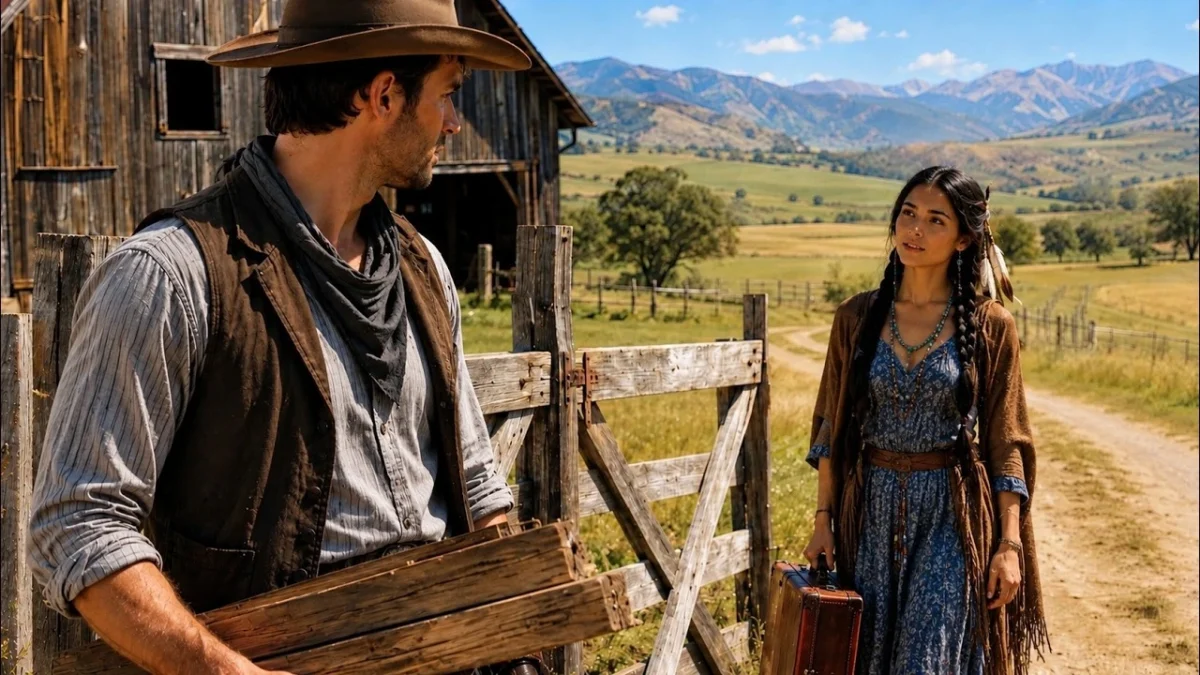
Standing on the opposite side of the fence was a young woman mounted on a dusty bay horse.
She appeared to be no older than nineteen or twenty, possessing a watchful, immovable stillness that spoke of long hardship and deep caution.
She was Apache, her thick black hair tied back with a leather thong, wearing a faded cotton blouse under a soft deerskin vest.
Across her shoulder hung a battered canvas satchel, and a rolled woolen blanket was strapped neatly behind her wooden saddle.
Her leather boots were cracked and coated in white dust from miles of hard travel.
She looked at Ethan not with fear, but with the quiet scrutiny of someone measuring a potential hazard.
Ethan walked slowly toward the perimeter, stopping a few paces short of the latch.
“Can I help you, miss?” Ethan asked, his voice rough and unpracticed.
The girl did not dismount. She fixed her dark eyes on his face and spoke six words that seemed to shatter the thick quiet of the valley.
“My father said you wanted children,” she said quietly.
Ethan stood perfectly still, his eyes narrowing slightly as he tried to process her words.
“Who was your father?” Ethan asked, his tone cautious and heavy.
“He was Cale,” she answered, her voice steady despite the dry dust coating her throat. “He died three months ago.”
She paused for a second, watching his expression carefully.
“You knew him as Charlie,” she added.
The name hit Ethan like a sudden blast of mountain air.
Charlie Running Horse.
Twelve years ago, long before the fever had stolen Margaret, Ethan had spent two long seasons riding trail with Charlie, driving herds through the treacherous canyons of Arizona.
They had shared bread, guarded cattle through stormy nights, and pulled each other out of more than one deadly jam.
Ethan had not heard a word from him in over a decade.
“Charlie is dead?” Ethan asked, though he already knew the answer.
“Yes,” the girl replied softly. “He caught a chill in his lungs when the rains came.”
Ethan looked at her cracked boots, her tired horse, and the heavy satchel slung over her shoulder.
“He sent you all the way out here?” Ethan inquired.
“He told me to come to you before he passed,” she said, adjusting her reins. “He said you always wanted a family, but that you gave up after your house went cold. He said you were a good man, but a stubborn one.”
She tilted her head slightly, studying his hardened jawline.
“He also said you would probably tell me to turn around and leave,” she added.
“He wasn’t wrong about that,” Ethan muttered, taking a deep breath.
“He told me that if you tried to send me away,” she continued without flinching, “I should tell you that a man who stops wanting things is a man who has stopped living. And he said you owed him a debt.”
“What kind of debt?” Ethan asked slowly.
The girl reached into her leather satchel and pulled out a folded piece of thick paper, yellowed at the margins and tied with a simple cord.
“The kind of debt you can only pay back with time,” she said, holding the paper across the top rail of the wooden gate.
Ethan hesitated for a moment before stepping forward to take the letter.
He gestured toward the wooden hitching post near the barn.
“Dismount,” Ethan said briefly. “Water your horse at the trough.”
He walked inside the dim, cool kitchen of his cabin, pulling out a wooden chair at the rough-hewn table.
The girl followed him inside, stepping through the doorway with careful, silent steps.
She did not sit down, nor did she explore the room with her eyes. She simply stood near the doorframe, keeping her back close to the exit.
Ethan untied the cord and unfolded the letter.
Charlie’s handwriting was jagged and clumsy, written by a man who had only learned to hold a pen late in his life, but the words were clear enough to read.
*Ethan,*
*If you are reading this paper, it means my daughter made it to your gate.*
*Her name is Ayanna. It means eternal bloom. Her mother gave her that name before she passed.*
*Ayanna is strong, honest, and far too smart for her own good. But she has nowhere left to go.*
*Our people will not take her in because she has lived too much among the white towns with me.*
*The towns will not give her peace because she is Apache, unless she surrenders to a life in some saloon or a bad marriage.*
*I thought of you because I know you are an honest man who does not lie to himself or others, and because I know you are sitting alone on that ridge.*
*I am not asking you to take her as a daughter or a wife.*
*I am asking you to give her one season of honest work, shelter, and meals so she can figure out her own path.*
*If she wants to leave when the winter breaks, let her go.*
*If she chooses to stay, let her make that choice.*
*You told me once, while we were sitting by the river east of the Brazos, that your greatest regret was not raising children to inherit your land.*
*I told you then it was not too late.*
*You swore to me that it was.*
*I am asking you one last time, my old friend, prove me wrong.*
*Charlie Running Horse.*
Ethan sat in silence for several minutes, staring down at the ink until his eyes began to ache.
He slowly folded the paper along its original creases and rested his hands flat on the wooden tabletop.
“He had no right to write this,” Ethan said quietly, his eyes fixed on the letter.
“I know,” Ayanna replied from the doorway, her tone calm and completely devoid of self-pity. “He was a desperate man at the end.”
Ethan looked up at her face. “I am not looking for company, Miss Running Horse. And I am certainly not looking for a family.”
“I am not looking for a father, a husband, or your charity, Mr. Carter,” Ayanna said, meeting his gaze directly. “I am looking for one season of fair work for fair pay. I can mend fences, break horses, and keep a homestead running. That is all.”
Ethan stared at her for a long moment, listening to the soft howl of the mountain wind sweeping through the dry pasture outside.
He rubbed his weathered hand over his face, feeling the fatigue deep in his bones.
“There is a small room in the back with a cot,” Ethan said, standing up from his chair. “You can put your bedroll there. Supper is at sundown.”
He took a step toward the front door, then paused near the threshold without turning his head.
“One more thing,” Ethan added, his voice dropping to a low growl. “I do not talk about my wife, Margaret. Not to anyone. Not ever. I need you to understand that from the start.”
“I understand,” Ayanna said quietly.
Ethan stepped out onto the porch, letting the heavy screen door snap shut behind him.
Ayanna looked down at the folded paper resting on the oak table, noticing that her father’s letter had made no mention of a woman named Margaret at all.
In that quiet moment, she realized just how heavy a burden this solitary rancher had been carrying across the empty years.
The first two weeks of Ayanna’s arrival were defined by a strict, unbroken silence and a careful rhythm of hard labor.
Ayanna woke every morning an hour before the dawn, quietly stepping out to the barn without waking Ethan.
She did not merely patch the decaying cattle fences along the south boundary; she rebuilt them post by post, pulling the wire taut until the line ran straight and firm across the brush.
She learned the quick quirks of the old water well, figuring out how to grease the rusted iron pulley so it wouldn’t bind when the morning air turned cold.
In the evenings, she prepared simple meals of fried cornmeal, salt pork, and dried beans.
Sometimes she gathered wild roots and prairie herbs from the high hills, adding them to the stew pot to create rich, dark broths that Ethan ate without complaint.
Ethan watched her from a distance, the way a cautious trail driver watches unpredictable dark clouds on the horizon, waiting to see what kind of storm she would bring into his quiet life.
Yet Ayanna brought no turmoil. She was the absolute quiet that arrives after a long, damaging gale.
They spoke only when necessary, exchanging bare facts about the chores, the cattle, and the weather.
“The south gate needs a new leather hinge,” Ayanna said one evening as she set a metal plate on the table.
“I have spare hide in the shed,” Ethan replied, keeping his eyes on his food. “I will cut it tomorrow.”
“I already cut it,” she said simply. “The gate is hung.”
Ethan looked up from his plate, opening his mouth to say something, but ultimately closed it and continued eating.
On the fifteenth afternoon, Ethan was working high on the timber roof of the horse barn, replacing a row of rotten pine shingles.
A dry wooden rung on his ladder snapped under his weight without warning.
Ethan made a wild grab for the main support beam, managing to break his momentum slightly, but he still crashed heavily onto the hard dirt floor below.
He landed hard on his left side, knocked breathless, lying flat on his back while staring up at the dusty rafters as his body registered the impact.
Within seconds, a shadow blocked the bright sunlight spilling through the barn door.
Ayanna crouched beside him in the dirt, her hands moving quickly to check his arms and legs with firm, practiced touch.
“Can you wiggle your fingers?” Ayanna asked, her voice calm and urgent.
Ethan flexed his hand, grunting as a sharp pain shot through his ribcage. “Yes.”
“Can you move your toes?”
“Yes,” Ethan spat out, trying to catch his breath.
“Then your back is not broken,” she said, letting out a small breath of relief. “Though you are far less careful than an old rancher ought to be.”
Ethan almost chuckled, though the sudden movement caused a sharp ache in his side.
“I have managed to keep this place standing alone for seven years,” Ethan said, pushing himself up onto one elbow.
“I know,” Ayanna replied softly, offering her hand to help him up. “That is precisely why you fall off ladders.”
Ethan looked at her slender, dirt-stained hand, hesitating for a second before gripping it to pull himself up to his feet.
As soon as he was standing, he quickly pulled his hand away, brushing the dust from his canvas shirt.
Ayanna did not comment on his sharp recoil, nor did she offer any further assistance.
She simply picked up the dropped hammer from the dirt, set it neatly on the workbench, and walked back toward the house.
That night at the kitchen table, neither of them mentioned the accident at the barn.
Yet the heavy, cold distance that had lingered between them since her arrival had subtly shifted into something altogether different.
A few nights later, Ethan built a small campfire in the stone pit east of his cabin, sitting on an overturned pine crate to watch the orange embers glow against the twilight.
He had been sitting alone for over an hour when he heard the light rustle of dry grass behind him.
He did not look back, nor did he ask her to return to her room.
Ayanna walked over silently, wrapping her heavy wool shawl around her shoulders as she sat down on a large flat rock across the fire pit.
She tilted her head back, gazing up at the vast expanse of the night sky the way her father had taught her to look at the open country.
After a long interval of quiet crackling from the pine wood, Ayanna spoke into the dark.
“My father used to tell me that the brightest stars are the campfires of the old people who walked these trails before us,” she murmured.
“Charlie always had a way with stories,” Ethan said, his deep voice blending with the night wind.
“Yes,” she replied gently.
Ethan raised his eyes to the heavens.
The Milky Way stretched across the black void like a river of crushed white glass, permanent and indifferent to the small lives below.
He had sat under that same sky thousands of times since Margaret’s death without feeling anything other than a cold, endless emptiness.
Tonight, for the first time in seven years, the vast silence did not feel quite so hostile.
“He spoke of you often when we lived near the mountains,” Ayanna said, her gaze returning to the small fire. “He said you were the only white man he ever met who didn’t feel the need to fill the air with useless lies.”
“Charlie was always too generous with his praise,” Ethan remarked.
“He was accurate,” Ayanna countered, her tone matter-of-fact.
The way she said it—not as a shallow compliment, but as a plain statement of observed truth—made Ethan look directly across the fire at her face.
She was watching him with complete open honesty, free of pretense or hidden motives.
“What are you looking for, Ayanna?” Ethan asked quietly. “When this season ends and the spring comes, where will you go?”
Ayanna stared into the glowing heart of the embers for a long time before answering.
“I do not know,” she admitted. “Before my father died, I thought I knew what my life would look like. But when he passed, all the certainty went away.”
She pulled her shawl a little tighter around her neck.
“I think I am just looking for a place where I do not have to apologize for existing,” she whispered.
Ethan looked back down at the fire, his hands resting heavily on his knees.
Something deep within his chest, something that had been locked away in darkness for years, gave a small, painful stir.
He offered no comforting words, but when he finally stood up to return to the cabin, he left the fire burning a little brighter than usual.
At the start of the following month, Ethan and Ayanna rode their horses into the small town of Rio Blanco to purchase winter salt, flour, and iron nails.
Ethan had been dreading the trip for days.
Rio Blanco was a narrow, sun-baked town built around a muddy main street, inhabited by folks who viewed outsiders and solitary recluses with equal suspicion.
As they tied their horses to the hitching rail outside the general store, Ethan could feel the watchful eyes of the townsfolk weighing on his back.
Standing near the timber porch of the county land office was a tall, heavy-set man named Silas Doyle, accompanied by a lean stranger in a city coat.
Doyle was a prosperous local cattleman who had spent years trying to buy up the smaller ranches in the valley for next to nothing.
Ethan ignored them, guiding Ayanna through the front door of the mercantile.
Inside, the storekeeper’s wife, Mrs. Galvin, stood behind the polished wooden counter, her eyes widening slightly as she took in Ayanna’s deerskin vest and dark features.
The air in the store turned stiff and cool as Ethan laid out his list of supplies.
“Morning, Ethan,” Mrs. Galvin said, her voice laced with sharp curiosity. “Haven’t seen you in town since the late summer.”
“Busy with the fences, Mrs. Galvin,” Ethan replied evenly. “We need two sacks of flour, ten pounds of salt, and a box of rifle cartridges.”
Mrs. Galvin glanced past Ethan’s shoulder at Ayanna, who was quietly inspecting a display of iron horseshoes near the back wall.
“I see you hired yourself some help,” Mrs. Galvin remarked, her tone carefully neutral. “Didn’t know Charlie’s girl was working out your way.”
“She is the best hand in the county,” Ethan said, his voice loud enough to carry across the room. “And her work is her own business.”
Mrs. Galvin blinked at his blunt sharp tone, quickly turning to fetch the flour sacks without another word.
When they carried their wooden crates back out to the sunlit street, Silas Doyle was standing near their horses, leaning against the hitching post with a toothpick hanging from his mouth.
“Well now, Ethan Carter,” Doyle drawled, spitting into the dust. “Word around town was that you were living like a hermit up on that ridge. Didn’t realize you took in an Apache girl to keep your bed warm.”
The insult hung in the hot afternoon air, thick and filthy.
Ethan set his wooden crate onto the back of the wagon with a slow, deliberate movement.
He felt Ayanna stiffen beside him, her hand instinctively moving toward the small skinning knife tucked into her belt.
Ethan stepped past her, walking up to Doyle until there were less than two feet of red dust separating them.
Ethan’s face was entirely calm, but his eyes carried a lethal, unyielding dark focus that made the smile fade from Doyle’s face.
“You will apologize to the lady, Silas,” Ethan said, his voice dropping to a terrifyingly soft register. “And then you will step away from my horse before I break your arm in three places.”
Doyle looked into Ethan’s face, measuring the height and broad shoulders of the man standing before him.
He realized in an instant that the quiet rancher who had spent seven years grieving in silence was more than willing to kill him right there on the boardwalk.
Doyle slowly raised his hands, taking two steps backward into the shade of the land office.
“Just making conversation, Carter,” Doyle muttered, turning his back and walking quickly down the street.
Ethan stood in the dust until Doyle disappeared around the corner, then turned back to help Ayanna finish loading the wagon.
They rode back out toward the ranch in absolute silence, the long shadows of the mesa stretching across the road ahead of them.
“You did not need to step between us,” Ayanna said softly as they turned onto the ranch trail. “I can handle men like Doyle.”
“I know you can,” Ethan replied, staring straight ahead at the golden grass of his pasture. “That doesn’t mean you should have to.”
Ayanna looked at his profile, noticing the tight clenching of his jaw line.
“Why did you do it, Ethan?” she asked quietly.
“Because it was the right thing to do,” Ethan said. “And because I am tired of letting bad men say whatever they please on my watch.”
A small, quiet warmth settled between them, replacing the cold air of the town with a shared sense of safety.
On a quiet Sunday afternoon during their sixth week together, Ethan walked into the kitchen to fetch a clean lantern chimney.
He stopped dead in his tracks when he saw Ayanna’s canvas satchel lying open on the wooden table.
Spread across the rough oak surface were dozens of detailed charcoal sketches drawn on heavy parchment paper.
Ethan walked closer, mesmerized by the delicate, powerful lines drawn on each sheet.
There was a drawing of a wild mustang rising on its hind legs, captured with astonishing speed and grace.
There was a sketch of a red-tailed hawk circling over the high canyon walls, its feathers rendered with incredible precision.
Near the center of the table was a portrait of an elderly man with weathered skin and deep, knowing eyes—Charlie Running Horse.
And right beside it was a detailed drawing of Ethan’s own ranch.
The sketch showed the wooden cabin, the newly mended fence line, the old stone well, and the leaning branches of the massive oak tree east of the house.
Every board, every shadow, and every curve of the ground was rendered with deep care and devotion.
“Charlie taught me how to hold the charcoal,” Ayanna said softly, stepping into the kitchen from the back porch.
Ethan did not look up immediately. He gently picked up the sketch of his ranch, holding it by the corners so his dusty fingers wouldn’t smudge the black lines.
“He told me that if you can draw a place truly, you understand its spirit,” Ayanna added, standing a few feet behind him.
“This is…” Ethan started, his voice trailing off as he stared at the image.
“Like what?” she asked gently.
Ethan looked at the drawing of his house—a place he had viewed as a tomb for seven dark years—and realized that in her picture, it looked like a home.
“It looks alive,” Ethan whispered, setting the paper down as if it were made of thin glass. “You are wasting your time dragging fence posts through the dirt, Ayanna. This is what you ought to be doing.”
“A person needs practical work for her body and beautiful things for her spirit,” Ayanna replied simply. “The fence holds the cattle. The drawings hold me.”
Ethan turned to face her, seeing her in a completely new light.
“Could you draw something for me?” Ethan asked, his voice rough with sudden emotion. “Anything you see fit.”
Ayanna looked into his eyes, her dark pupils reflecting the afternoon sun streaming through the window.
“I have already drawn it,” she said quiet. “I will finish it tonight.”
Three days later, while Ethan was sitting on the wooden porch grease-cleaning his saddle leather, Ayanna handed him a fresh piece of parchment.
Ethan took the paper and looked down.
It was a drawing of the old stone water well in the front yard.
The morning light was captured in sharp, diagonal strokes across the wet timber bucket.
Gripping the thick hemp rope were two large, calloused hands—Ethan’s hands, drawn with such exquisite accuracy that he could recognize every scar across his knuckles.
And reflected in the shallow water inside the wooden bucket, barely visible unless one looked with extreme care, were the tiny reflections of two people standing side by side.
Ethan stared at the small reflections for a long time, his pulse hammering against his ribs.
That evening, Ayanna was missing from the dinner table.
Ethan walked outside into the cool night air, finding her sitting on the stone ledge of the well, her knees pulled tight against her chest as she stared out toward the dark hills.
“Ayanna?” Ethan called out softly.
She looked up, the faint light of the moon catching the wet trails on her cheeks.
She wiped her eyes quickly with the sleeve of her blouse, standing up to face him.
“I need to tell you something, Ethan,” she said, her voice shaking slightly. “Something my father left out of his letter because he knew you would turn me away if you knew.”
Ethan sat down on the flat stone ledge across from her. “Tell me.”
“I am not just passing through this valley looking for temporary work,” she admitted, her chin trembling with quiet defiance. “A land agent named Aldous Rowe, who works for the district court, told me that an Apache woman cannot hold land or stay in this territory unless she is attached to a registered property as a contracted laborer.”
“He gave me until the end of this season to prove I have a permanent position, or he will have the deputy marshal transport me to the agency reservation two hundred miles north.”
Ethan felt a sudden, icy shock wash through his veins. “Two hundred miles north? To the agency camp?”
“Yes,” Ayanna whispered. “It is a barren place. People die of cold there every winter.”
“Why didn’t Charlie put that in the letter?” Ethan asked, his fists clenching tightly in his lap.
“Because my father wanted you to take me in out of respect for him, not out of pity for me,” Ayanna said, her eyes shining with fierce pride. “He did not want me to be a burden on your conscience.”
Ethan looked down at the parchment drawing still tucked into his coat pocket, thinking of those two tiny reflections standing side by side in the bucket water.
He stood up without saying a word, walking into the dark house and closing the door.
Ethan did not sleep a single minute that night.
He lay awake on his narrow rope bed, staring up at the dark roof beams while the ghosts of his past paraded through his mind.
He thought of Margaret, whose memory he had used as a shield to keep the world at bay for seven long, lonely years.
He thought of the empty crib he had chopped up for firewood the winter after she died.
He thought of the dark, silent rooms of his cabin, and how Ayanna’s presence had quietly filled those empty spaces with life, purpose, and art.
At three o me in the morning, Ethan admitted to himself a truth he had been fleeing from for weeks.
He was terrified of the spring.
He was terrified of the day when the snow would melt, the season would end, and Ayanna would pack her satchel and ride out of his life forever.
It was not mere gratitude, nor was it simple obligation to his old friend Charlie.
It was a quiet, deep, and overwhelming love that had grown silently between them through hard work, shared meals, and starlit nights.
The next morning, Ethan saddled his bay horse before the sun rose and rode straight into Rio Blanco.
He walked into the county courthouse, demanding to speak with the clerk about the territory’s residence laws regarding Native women.
The clerk, a small man with thick spectacles, flipped through a ledger of territorial statutes.
“The agent, Mr. Rowe, is technically within his legal rights, Ethan,” the clerk explained quietly. “Without a formal labor contract filed here, or a legal marriage certificate registered with the county, she has no standing to remain in the district.”
“A marriage certificate?” Ethan repeated, the word sounding heavy and strange in his throat.
“Yes,” the clerk nodded. “That is the only absolute protection under territorial law.”
Ethan walked out of the courthouse and mounted his horse, riding back toward his ranch at a slow, measured pace.
He watched the sun rise high over the red mesas, feeling the old, heavy crust around his heart finally crack and fall away.
He had spent seven years acting like a man whose life was already over.
He was done with dying.
When he reached his front gate, he saw Ayanna standing near the fence, holding a bundle of dry pine kindling in her arms.
Ethan dismounted, throwing his reins over the fence post, and walked directly up to her.
“Ayanna,” Ethan said, his voice ringing loud and clear in the morning air.
She turned to face him, setting the wood down on a pine stump.
“I do not want you to leave when the spring comes,” Ethan said, taking a deep breath.
Ayanna did not reply immediately. She stood motionless, watching his face with her characteristic stillness.
The wind rustled through the dry grass around their boots, carrying the clean scent of cedar and rain from the distant peaks.
“What does that mean, Ethan?” she asked quietly.
“It means this ranch is better with you here,” Ethan said, stepping closer to her. “It means I sleep better knowing you are in the next room. It means your drawings are the first thing in seven years that made me want to look at tomorrow.”
He looked down at his calloused hands, then met her dark eyes with complete, unreserved honesty.
“It means I have been dead inside for seven years, Ayanna,” Ethan confessed, his voice thick with emotion. “And you brought me back to life. I do not want to go back to the cold.”
Ayanna looked at him, her eyes searching every line and shadow of his face.
“I came here to work for a season, Ethan,” she whispered, her voice trembling slightly. “I did not know what we would become. I am not your daughter, and I am not a replacement for your lost wife.”
“I know you aren’t,” Ethan said firmly. “I don’t want a daughter, and I don’t want a memory. I want you, Ayanna. If you will have me.”
Ayanna stared at him, a sudden, bright tear escaping her eye and trailing down her sun-browned cheek.
“My father said you were a good man,” she whispered, a small, radiant smile breaking across her face.
“He was lying,” Ethan said with a faint grin.
“No,” she said softly, reaching out to place her hand over his heart. “He was right.”
Before they could say another word, the sound of heavy hooves echoed from the main road.
Riding up to the gate was Aldous Rowe, the district land agent, accompanied by two armed deputy marshals wearing tin stars on their coats.
One of the deputies was the lean man who had been watching them outside the land office weeks ago.
Ethan stepped smoothly in front of Ayanna, his body shielding her from the riders as they pulled their horses to a halt at the fence.
“Ethan Carter,” Rowe called out, holding a roll of official paper in his gloved hand. “The seasonal labor exemption for this woman expires at the end of the week. Under territorial order, she must be remanded to the agency representative in the north.”
“She isn’t going anywhere, Rowe,” Ethan said, his voice flat, calm, and terrifyingly absolute.
Rowe frowned, settling his hat lower over his eyes. “This is official county business, Carter. You have no legal standing to hold an unregistered Indian woman on your property.”
“She is not an unregistered laborer,” Ethan declared, stepping forward to rest his hand on the top rail of the wooden gate. “She is my intended wife. We are registering our marriage at the courthouse in Rio Blanco tomorrow morning.”
The word hung in the crisp desert air like an iron anchor.
Rowe looked from Ethan’s stone-hard face to Ayanna, who was standing tall and proud behind the rancher.
Rowe was a bureaucrat who understood when a fight had slipped beyond his control. He could see that Ethan Carter was ready to tear down the world before letting anyone touch the woman behind him.
“If the paper is signed by the magistrate tomorrow,” Rowe said grudgingly, “the order is voided. But if you are lying to me, Carter, I will return with a full posse.”
“You be sure to bring them,” Ethan replied coldly. “Because you’re going to need them.”
Rowe pulled his horse around with a sharp jerk of the reins, galloping back down the dirt road with his deputies close behind.
When the dust settled, Ethan turned back to face Ayanna.
She was watching him with a mix of surprise, affection, and quiet amusement.
“Your intended wife?” she asked, raising an eyebrow.
“I know I should have asked you properly before shouting it at a land agent,” Ethan said, looking slightly sheepish.
“Yes,” Ayanna agreed, stepping closer to him. “You certainly should have.”
She looked up into his eyes, her expression softening into deep tenderness.
“Ask me now, Ethan Carter,” she whispered.
Ethan took her small, strong hands into his own calloused palms, looking deep into her eyes.
“I am forty-one years old,” Ethan said quietly. “I am quiet, set in my ways, and I spent seven years believing I was done with happiness. I cannot offer you a grand life, Ayanna, but I can promise that I will spend every single day of my life making sure you are safe, respected, and loved. Will you stay with me?”
Ayanna looked at his face, at the small lines around his eyes, at the strength and kindness that defined every inch of his character.
“My father knew,” she whispered, her voice filled with warmth. “He knew you were the only man who could hold my heart.”
“He was a stubborn old fool,” Ethan said, a genuine smile breaking across his weathered face.
“Yes, he was,” Ayanna agreed, tears of joy sparkling in her eyes. “And so am I. My answer is yes, Ethan. I will stay.”
Six weeks later, on a clear winter morning, Ethan Carter and Ayanna Running Horse were married in the small wooden courthouse in Rio Blanco.
Mrs. Galvin from the general store stood as their official witness, having arrived early with a bouquet of dried prairie flowers for the bride. It turned out the storekeeper’s wife had been quietly rooting for them ever since Ethan had stood up to Silas Doyle in the street.
The town, as it always did, adapted to the new reality, leaving the couple to live their lives in peace.
When spring finally arrived in the valley, melting the high mountain snows and bringing wild cottonwood blooms to the creek beds, the Carter ranch was transformed.
The south fence ran straight and true across the ridge, the barn roof was fully restored, and a lush vegetable garden bloomed in neat rows east of the cabin.
The dark, heavy silence that had haunted every room for seven years was gone, replaced by the warm, sweet sounds of daily life, shared laughter, and soft conversation.
One morning, as the sun began to climb over the eastern mesas, Ethan stood near the old stone well, pulling up a fresh bucket of cold water.
Ayanna walked out from the porch, wearing a simple blue dress, holding her leather sketchbook beneath her arm.
She walked over to the well, resting her hand gently on Ethan’s forearm.
“The morning light is perfect today,” she said softly.
Ethan set down the wooden bucket, turning around to gather her into his arms.
He held her tight against his chest, listening to the steady beat of her heart, feeling the warm morning sun warming his back.
Standing on that small, stubborn ranch at the edge of the New Mexico desert, Ethan Carter realized that he was no longer waiting for his life to end.
He had finally come home.
And far out across the golden distance, beneath the wide, endless sky where the old campfires burn bright, Charlie Running Horse was smiling down on them both.








